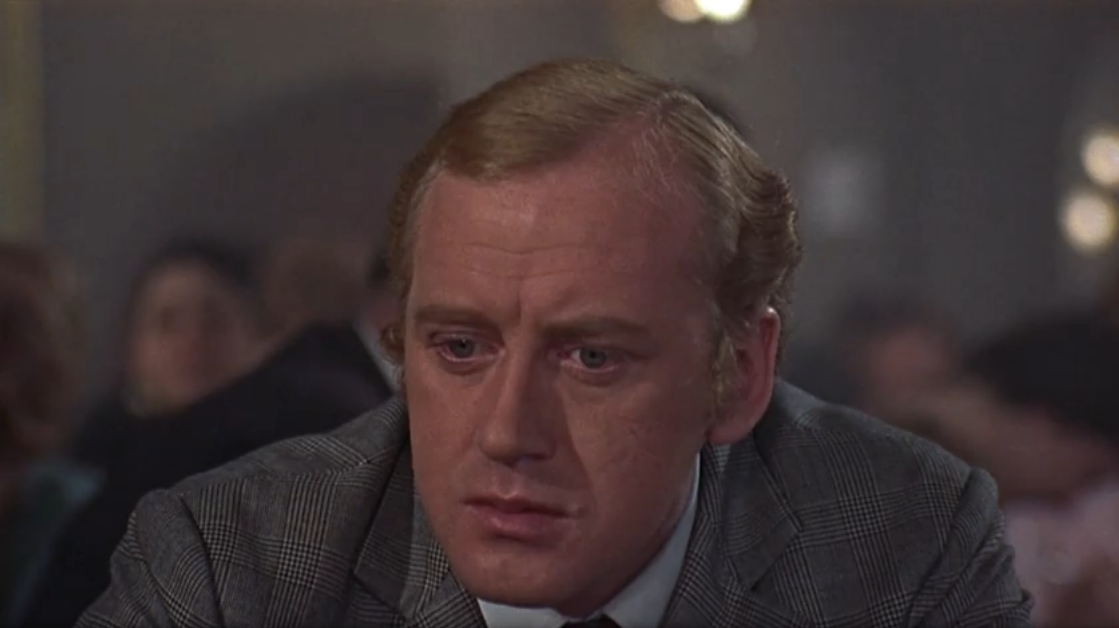
Nicol Williamson did not receive Oscar nomination, despite being nominated for a BAFTA, for portraying Gunner Daniel O'Rourke in The Bofors Gun.
The Bofors Gun follows a long night of watching a defunct gun and the power struggle that develops between a NCO and an insubordinate soldier.
Nicol Williamson is a fascinating actor to explore into his specific career which was one of perhaps a slow downfall. This as he fell towards a certain obscurity, even within his passing, despite the acclaim during his early career. This was not example of an actor wasting his talent, but one torn down by his own ego and vices. Looking into his life suggests two things, one that there ought to be a film about Williamson (even if in a perhaps everything except name fashion), and the strange similarities between himself and his character of Gunner O'Rourke within this film. One being rather superficial as Williamson himself took the rank of Gunner in his time in the armed forces, but more so in this figure that is O'Rourke, who may share a similar, albeit far more extreme, case of self-destructive tendencies. Now Williamson here is actually secondary lead to David Warner as the milquetoast Lance Bombardier Terry "Lance Bar" Evans, whose been recently promoted, and is given the strange duty of leading the men to "protect" the defunct gun. The problem is Terry is more interested in getting home to England by trying to avoid any trouble in the night, but for that there is one major thorn in his side. The thorn in his side being Williamson's O'Rourke who comes into the film, marching towards the duty, with a mocking walk, along with an outrageous cry as he takes his place along the line, Williamson setting up instantly that O'Rourke is likely to be a problem.
Williamson is brilliant from his first disagreement as he asks the purpose of their duty to guard the useless gun, from the non-existent enemy. Williamson asking the question with an intensity illustrating a false sincerity in questioning the need. There is in that already a sense of something else in Williamson's performance, something unnerving that goes beyond simply being cynical about his strange duties as a soldier. The following scene though is that of the greatness of Williamson, and in that perhaps something so unfortunate about his own career as an actor. This is in the following scene where he bullies another soldier into changing beds, without permission from Terry, nor protest. Williamson is this force of personality with such ease. He captures the moment with such a powerful force of space, of a man who in this reveals so effectively O'Rourke. This as a man of this fierce personality, however he uses it in a way only seemingly to tear down his environment for the sake of the action. Williamson, mind you, controls that environment with such effortless power, however with such limited purpose. Williamson showing a man who much succeeds in being larger than life, a quality potentially useful in a soldier, however with little purpose in this. As the men begin to mock Terry, to which he says little, Williamson brings the most pronounced insults as he mocks the bombardier. This with the most natural venom, and Williamson using those eyes of his to make even a mockery some severe act of a violent in a way, through how piercing they are alone.
It is rather fascinating just how striking Williamson can be in a scene even when laying on his back, just adding a few words of derision, as the men discuss Terry's position. Williamson's voice used to such potent purpose, as he makes O'Rourke's verbal attacks brutal, even in seemingly the most casual asides. Of course O'Rourke does go beyond even deriding Terry, as he attacks another of his disobedient soldiers for his sexual fixations, where Williamson brings this callous dominance seemingly of the proper soldier, however used without any sense of one. When it seems in this moment of mutual insult, Terry himself throws one casually O'Rourke's way. What follows is a truly astonishing bit of acting from Williamson, in his eyes shift from a casual disregard to a vile hate, as his eyes become that of killer all just within Williamson's work. Williamson is genuinely terrifying as this shift is so naturally realized as he appears to aim himself towards Terry. What follows though is an act of violence, not towards Terry, but rather towards himself as he grabs a hot coal for several seconds before declaring his disdain for all. Williamson is amazing in as he captures the violence of one man for another, externalized in the sharpness of his delivery, but internalized in his eyes that seem to indicate towards some deeper chaos within the man. O'Rourke retiring in the moment, in a way that Williamson suggestst as his only option, that seemingly would've otherwise resulted in his own breakdown or the violent end for Terry.
O'Rourke I'd say honestly is a role most actors would struggle with, not only because the part requires as striking of a presence as Williamson, but it would be so easy to make the actions of the man just random moments for the sake of performance. That is never even remotely the case for Williamson's work which crafts a logic in this seeming illogical man. This is as Williamson's performance captures this specific nature of the man vividly. This as any action comes from the same core that is the man.This is as even early on when he sings a jovial song, or seemingly jokes, there is even that this intensity Williamson brings to it. The attempt at something jovial seems real enough however Williamson's portrayal of it is this though still as some anguished act all the same. Williamson making O'Rourke's unwieldy state as a natural state of nature for where the man is. There is a moment where O'Rourke questions Terry's authority directly while also telling him he should essentially preemptively have him locked up. Williamson delivers the derision with the incisiveness in his words and his disregard in his eyes, however when speaking of the suggestion, there is nothing mocking in it. There is almost a cry for help in Williamson's portrayal that has this derangement within it, yet a sense of clarity as he makes the suggestion for Terry to not let him go be free into the night. Williamson in these two acts is able to reveal the man who is a particular dangerous combination as he most willing wishes to disobey, yet is as keenly aware of the problem of this.
The reason for this is briefly reflected in a moment where O'Rourke notes that the night will mark his birthday, as well as his time of turning to the age of 30. Williamson is simply incredible in the moment as his eyes capture a man truly looking into a nihilistic void as the man remarks how he'd never wish to turn 30. Williamson delivering this as a fundamental philosophy of a man, who as hostile as he is, Williamson alludes to within this a horrible depression.The rest of the night essentially becomes this prolonged suicide, that Williamson realizes with a terrible vividness. This as he does not portray it as exact, anything but as the man is both quite assured in his "mission" while not at all assured in the exact method. O'Rourke delivers this potent id within the man, that portrays a destructive style that means to destroy all in his path, himself included. Williamson delivers this emotional wretchedness of the man as he speaks of killing within the army, yet seems to be looking towards only an emptiness. His random destructive actions become of near animalistic violence. Not quite though as Williamson quite simply is outstanding in these scenes as it is not a singular emotion of violence, that is there, along with these moments of temporary joy, those that only delay a profound decay that Williamson returns to as O'Rourke basic expression. All other actions being these temporary delays towards his inevitable fate he has declared for himself. That depression that is brutally, yet powerfully depicted within Williamson's performance. This as he does not make this momentary lapse, but this seething quality of a man who has long determined himself, or at least his existence, to be useless. Williamson is amazing as the way he manages to show even a descent within this idea as the man becomes messier and drunker throughout the night. Williamson delivering the only respites towards O'Rourke's own depression, being his hate towards others.
Williamson creating this searing since of self-destruction as this crutch of anger towards others that he holds onto, as that intense emotion is the only relief from his own self-hatred. What oddly becomes the most off-putting moments are when O'Rourke attempts to return to joke, that become these unnerving asides in Williamson's portrayal, as the man willing almost to say anything given he intends to leave the world quite shortly. When Terry threatens to turn him in, Williamson delivers O'Rourke's lack of concern towards the consequences, as wholly earnest, as a man content to waste away. The final minutes of the film are this extreme that Williamson makes so vivid as he creates the mania of O'Rourke. This as he threatens Terry himself it is with a maniacal loathing in his eyes towards Terry, but just as much towards himself. Williamson brings a hostility to every one of O'Rourke's words to Terry, who attempts to talk sanity into him. Williamson speaks each word with a painful combination of treating the world as an abomination but doing himself with the same treatment. Williamson delivering this sincere outrage towards Terry's selfishness for his fixation on his promotion however he does not make it as this arbiter of justice, but rather a man clawing at anything he can find as he intends to lose it all. As he pushes Terry to name why he is suicidal as a game, I love how Williamson, as much as he is so despairing towards Terry's opinion, there is this as powerful desperation as though there is a glint of need that Terry would really be able to give O'Rourke a semblance of an answer for his own self-destruction. The final few seconds of Williamson work shows the sheer brilliance of his performance. This as he does not turn O'Rourke into a device to challenge Terry, but rather shows that this is very much O'Rourke own personal journey to the end. This as hateful as the man is, the humanity in his own suicide is kept ever prevalent in Williamson's performance. This as we see as he is about to stab himself, there is that vile hate again in his voice, yet in his eyes we see the profound sorrow in the man accepting destruction, not with ease, but with the suffering one would expect. This is a brilliant performance by Williamson as he manages to give one of the most captivating portraits of self-destruction committed to film, as he never makes this simple act, but a complex irrational feast of decay within the man's mind.