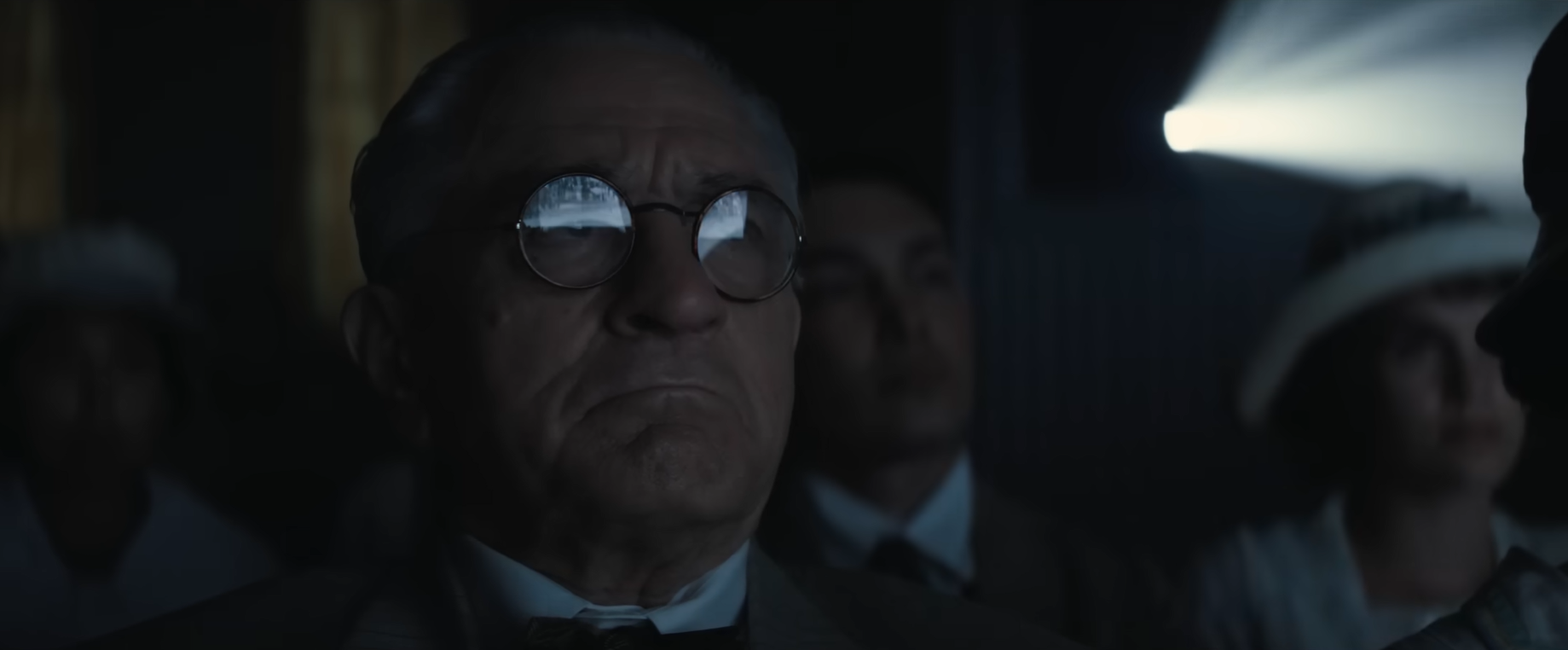
Robert De Niro received his eighth acting Oscar nomination for portraying William King Hale in Killers of the Flower Moon.
Killers of the Flower Moon follows the story of the murder that transpired around the indigenous Osage nation after they had become unexpectedly wealthy from having discovered oil.
I will admit coming into the film I pretty much thought I was going to know how Robert De Niro was going to approach the role of William Hale, one of the most evil men of history, and to the credit of the great actor he instantly surprised me the moment his nephew Ernest Burkhart (Leonardo DiCaprio) stepped on his estate after having returned from being a soldier in World War I. The first being De Niro's accent, which in the tricky mid-west to southern regions it is easy to become overwrought very quickly, perhaps even a co-star of his is, and maybe even De Niro fell to this trap in his last Oscar-nominated Scorsese turn, but here De Niro's work is on point. De Niro's accent not only makes him simply fit the setting of Oklahoma it also oddly disarms you within the character. As De Niro's accent isn't just of the period, of the area, it is also surprisingly welcoming innately. There's an ease in his voice that seems to want to invite everyone into his good company, not just his kin even, he appears to be the man of the people everyone says he is within the story early on, not the monster that you'll learn he is throughout the film. Take the first scene, where yes Hale is welcoming his nephew back, but De Niro's whole demeanor is just exuding a generous warmth towards him, but just also seemingly to the world as he tries to accentuate every positive in Ernest's story of war, which mostly involved feeding other troops and almost dying of a burst gut. And on rewatch De Niro is simply brilliant here in what he is doing, in actually immediately creating the full intention of Hale even as he seems like just a man being happy to see his nephew again. But when going through specific motions about Ernest's prospects, De Niro eyes shift towards a more incisive stare at times, and you can almost see the calculation in his head processing what value the nephew may have for him.
The surprise of De Niro's work resonates even more towards the scenes where we see Hale in public. And in public De Niro exudes a charisma that is so specific to period and kind of the time of this man about the community. And part of this creates the suspect in plain sight because his performance is so much as seemingly a good man, but the thing is, which is the choice I find the most fascinating, is this isn't entirely a facade as played by De Niro. Not just because he's convincing either, which De Niro is, as take this as a different film, remove some scenes obviously, and you'd think that Hale was merely the wise old man who everyone can trust. In the sequence where Ernest marries the Osage woman Mollie (Lily Gladstone), who is heir to a substantial fortune, De Niro is, for the lack of a better word, lovely. First in his advising Ernest as he'll be married with frankly a sweet sense of encouragement, then at the wedding where Hale reminisces of seeing Mollie as a little girl, his eyes are filled with nostalgia, his manner as a man just encouraging love, because De Niro's delivery is with this earnest quiet conviction and more than that the surprising warmth about the man. De Niro from the outside perspective doesn't leave you any room to even suspect the man would be anyone but a good man. When the man is stating his own claim to support the Osage when they offer a reward money to discover the perpetrators of the local murders, De Niro appears to be absolutely sincere though with this specific accentuation of "come see me", where De Niro couldn't be more inviting. His big speech to the support of the whole nation in the moment, De Niro's eyes glisten with optimism, hope and affection. He seems like a man who genuinely, absolutely wants to help. And historical spoiler alert, I guess, Hale is the mastermind behind all the murders.
De Niro's choice in respect to the outward Hale and the inward Hale though is I think the genius of this performance. Because here's the thing, within the way De Niro expresses this it isn't entirely a facade, even though Hale is actively advocating for the murder of multiple people. Therefore part of him is most definitely lying in terms of the wanting the killers found, however De Niro doesn't entirely portray the hospitality of Hale as completely false. Partly this is because the man is truly disarming as he speaks and you wouldn't immediately suspect him so there is the completely successful ruse as such, but De Niro I think gets to something more insidious within Hale through this approach. De Niro does not portray sadism in Hale towards the people he's killing, in fact he only shows them warmth, and for me the twisted brilliance of his performance is that Hale isn't lying entirely. Rather De Niro presents a man who loses nothing in his warmth, but the warmth isn't something that keeps him from orchestrating the murders. De Niro though presents Hale as treating them as merely obstacles to him, and as such their deaths are meaningless, while also not having the meaning of even hate to them. He can say he "loves" them even, even as he says it's time for them to die, because De Niro accentuates that it is all just merely something that needs to be done for his benefit, which is merely the profit from the murders. There isn't a single scene where De Niro voices a hint of venom to the natives, he saves that for Ernest, but rather leaves it to Hale's actions. And as odd as this seems, Hale is truly vile by showing a man who is entirely detached from it. De Niro expresses in his performance that killing the natives is something to happen, Hale has no ill-feeling towards them, but he also has no ill-feeling towards their deaths either. It is just merely a step in his horrible plan.
De Niro's choice to create a charismatic villain for the piece not only is dynamic, it is particularly essential because so much of the film he needs to carry the scenes featuring Leonardo DiCaprio. DiCaprio's very mannered performance falls into the category of many of his Scorsese directed performances, which is going off on the wrong end. I actually find that DiCaprio's performance, while in itself not ideal, is made worse by his influence overall on the film which is centering on Ernest Burkhart as the main character. And while I had reservations the first time in this regard, it was only exacerbated the second time around for two main reasons. One, there isn't anything interesting about Ernest. You can have a fool as a main character, but you either need a fool with more going on or just briefer runtime. Ernest is a big nothing, whose motivation is simple and his conflict feels frankly false. What does make this even less ideal is DiCaprio's performance, and I'll say this is a constant for me with lesser DiCaprio performances, where his more obnoxious choices grate on me the more times I watch the film. As I can kind of ignore it the first time but it is hard to keep ignoring his needlessly attempted showboating the second time, similar was my response to Gangs of New York and Shutter Island. And DiCaprio's choices though just stick out for the worse, in just his over the top choices to make Ernest as a cretin, with a ridiculous grumpy cat face of conflict for no reason, and an overdone accent to make sure you know he's playing this low class man of the west and not Leonardo DiCaprio. But in a film where just about everyone else feels just so authentic, he sticks out like the sorest of thumbs, until I guess he gets to share a scene with Brendan Fraser. And just spending time with Ernest became even more of an arduous time, because he's just not interesting on any level, and even the attempt to show the pull between loyal nephew and husband, just feels forced. I didn't mind getting through it thanks to nearly every other element, which I still love, but having to go through his pointless tomfoolery the first time was when I did think, "this could be trimmed down" but over again, made me really think "most of this could be cut". And as a film that is just as an overall tapestry of the murders with different characters of equal importance, that could've been the complete masterpiece, as opposed to this film which has qualities of a masterpiece but is not one.
Anyway back to De Niro, and the reason I gave that brief review is in part to praise De Niro more, because his performance kept me engaged in his scenes with DiCaprio, almost in part as it was very easy to enjoy his scenes of being semi-comical in his berating. And I will say I do quite enjoy his "now don't swear on your children, it makes you sound foolish", which is a well realized bit of pitch black comedy on his part. And it is in his scenes with DiCaprio where De Niro does implement the true evil of Hale, though still not again not quite in the way you might expect. As we return to the calculating stare in his scene of greeting Ernest, and it is in his eyes where De Niro expresses the truth of Hale. As part of his eyes isn't again looking with hate, towards Osage, but rather this chilling sense of eager opportunity. The true full classic De Niro intensity, is largely towards Ernest's idiocy, where we see the vile evil of Hale. Although De Niro carries this, most strikingly often in just a slight switch of his look to a glare that speaks of the true killer nature of the man. De Niro implements this intensity only in the moments where something may threaten his eventual profit. De Niro there reveals the truth to Hale's want which is purely for the greed of it, and it is only when something gets in the way do we see the real menace of De Niro. A menace that he presents with the expected ease, though specifically weaponized and you do see the hate in the man, though the hate for any idiocy that will get in his way. And what De Niro essentially crafts is a businessman who is treating this whole affair as a business agreement, and much like a businessman, everything is smiles and joyful good feeling until something gets in the way of profits. As even when dealing with the FBI investigating him, De Niro brings that graceful charisma who eagerly greets the agent, though still with the angle of working the man as he ponders if there's anyone he might be able to influence behind the investigation. De Niro though showing a man working a deal, and working a deal with outsiders, the man must always put on the good face of business. I love the sequence of him going to his own arrest, and frankly I think De Niro kind of purposefully evokes his 70's cohort Robert Duvall in the specific way he carries himself in the scene, with this generous spirit as he essentially laughs off the murder charge as an impossibility. As do I his final conversation with Ernest, where Ernest says he's going to testify against him, and I'll credit it as one of the few scenes that DiCaprio doesn't detract from by easing back a little bit. De Niro is outstanding in the moment because it is a true blend within his performance. As De Niro shows the greatest struggle in Hale to maintain his face in semi-public of the investigator, where his face is hardened with that intensity but he's just barely maintaining cordiality, though explaining with chilling disregard that people will just forget about his crimes. And ending with his final words being back to the pure jovial face of the man in his delivery of "I love you son" as one final "sell" to change Ernest's mind. And this is yet another great performance by Robert De Niro, though one that again truly took me by surprises with some of his choices, and wholly won me over with each of them them, in his disturbing portrait of a man whose business is genocide.