Showing posts with label 1962 Best Supporting Actor. Show all posts

Tuesday, 25 October 2011

Best Supporting Actor 1962: Results

5. Telly Savalas in Birdman of Alcatraz- This performance is nothing because his character is nothing.
4. Victor Buono in What Ever Happened to Baby Jane?- Buono gives an effectively humorous performance that is not a whole lot but creates some nice little moments when on screen.
3. Ed Begley in Sweet Bird of Youth- Although the Southern Political Boss is an old role, and Begley does not reinvent anything about it he everything the boss should be from the charisma to the cruelty. 
2. Terence Stamp in Billy Budd- Stamp gives an effective performance that is filled with charm and an incredible ease that fully realizes the purity of his character.
1. Omar Sharif in Lawrence of Arabia- Good Prediction Dinasztie and Moviefilm. Sharif gives a strong supporting performance that works in great harmony with Peter O'Toole amazing work as the lead. Sharif perfectly contrast his characters transition to sanity and understanding, as O'Toole shows Lawrence's transition into insanity and sadism.
Deserving Performances:
Peter Sellers in Lolita
Jose Ferrer in Lawrence of Arabia
Claude Rains in Lawrence of Arabia

Best Supporting Actor 1962: Terence Stamp in Billy Budd

Terence Stamp received his only Oscar nomination so far for portraying the titular character in Billy Budd.

Billy Budd tells of the life aboard a British warship.

The character of Billy Budd really is the main character and Terence Stamp's performance is a leading one not a supporting one. This is the standard supporting placement for a first time film performance. This is not that egregious of a performance placement as say Richard Burton in My Cousin Rachel because there are scenes without Billy, and it can be argued that Peter Ustinov as the ship Captain is also the lead. Billy Budd is the newest addition to the ship impressed by the British navy while he was working on a Merchant vessel. Billy Budd is an interesting character who is purely a good character who has a purely good view of life and of people. He never purposefully gives offense, and his only really problem is has a stammer that comes from being unable to express himself. Billy Budd is really a difficult character to get right actually because although he is simple in a way his goodness is pure in just the right fashion that it could have been very easy to make Billy a boring character or an unrealistic one, but Stamp succeeds in avoiding both of these potential issues. Stamp is never boring as Billy showing a clear strong screen presence in his first film performance. 

He makes Billy a charming character with a natural charisma in his performance. Stamp finds the charm in just the simplicity of Billy as a character. In every scene where Billy eases through a potentially problematic situation, or when he inadvertently causes himself problems through his simple belief in doing what is right Stamp is always able bring to life a genuine innocence in Billy. There is almost an otherworldly quality about Billy's kindness as the Ship Captain says is almost as inhuman as the cruelty of the ship's Man of Arms (Robert Ryan). Stamp realizes this otherworldly quality brilliantly there is something special about Billy's kindness because Stamp is able to show how it comes completely naturally with Billy because there is never a forced moment in Stamp's performance. Stamp gives a good performance because of this that makes what happens to Billy truly heartbreaking because Stamp realizes the purity of Billy's optimism just that honestly.

Monday, 24 October 2011

Best Supporting Actor 1962: Ed Begley in Sweet Bird of Youth

Ed Begley won his Oscar from his only nomination for portraying Boss Tom Finley in Sweet Bird of Youth.

Sweet Bird of Youth tells of a young man (Paul Newman) Chance who wishes to regain some of his youth with his old girlfriend.

Ed Begley portrays a southern political boss apparently a liked Oscar type character since it also brought Broderick Crawford a win for best actor in 1949. Now I was not the biggest fan of Broderick Crawford's lead performance in All the King's Men and I think Ed Begley's performance as Boss Finley actually succeeds in a few ways with the same type of character where Crawford failed.

Begley just as Crawford did succeeds quite well in showing the brutal as well as pompous nature of the political boss, but I think Begley does it better. Begley always shows that Finley is the boss of any room, even when he is not talking always having an strong presence in any scene forcing one to notice him. Begley always has the right attitude in the part he is the political boss and he knows it, he knows it so well that he does not mind flaunting it as much as he feels like.

My major problem with Crawford was although properly cruel as the political boss he was always too obviously evil, Begley outs on the facade quite well. Begley even with thinking of various acts of cruelty usually likes to come off as a nice old man while doing it. There are moments where he is not an exacts his cruelty directly, but since Begley combines both types of moments with ease which are essential in showing how Boss Finley is able to be a political boss not just a crime boss.

Begley is effective in both types of moments of cruelty. He is appropriately gentle but with always that little evil glint in his eye, and that deliciously fake smile that goes with it. Begley knows how to make the facade of of Finely that allows him to keep power as well as mistress. There is a little charm, a perfect politician's charm, there in the boss that makes this believable.

In his scenes of more direct evil Begley is rather chilling, and properly brutal. Begley shows that when Finley facade goes away it is only when he means absolute business, when it something that angers him off in the just the right way it makes him go over the edge and the full force of who he is comes out. Begley shows him a pathetic bully, whose cruelty who shows no empathy for his worst actions.

I think most important to his performance though are his out in public scenes that establish his nature as political boss. Begley is very friendly in these scenes almost fatherly in his few moments with Chance that are set in the past when they were on good terms. Begley apparent warmness, and charisma in these scenes act perfectly to show exactly how Finley became the boss, and stayed as one. The role of the boss is not an original one by any means and Begley does not try to take some whole new entirely style to it, but he certainly meets all the challenges of the character.

Best Supporting Actor 1962: Omar Sharif in Lawrence of Arabia

Omar Sharif received his only Oscar nomination so far for portraying Sherif Ali ibn el Kharish in Lawrence of Arabia.
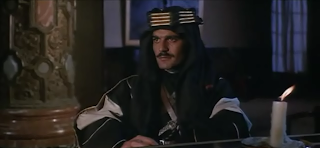
What is so great about Lawrence of Arabia is its entire scope and that it never only settles on the central character study of Lawrence (Peter O'Toole), but it always manages to give an appropriate amount of time to the various supporting players who are well realized by the large cast. Although the film is filled with such actors well liked by the academy as Anthony Quinn, Claude Rains, Alec Guinness, Arthur Kennedy, and Jose Ferrer the only one of the supporting players nominated was Omar Sharif whose first English language film was this film. This certainly makes sense as Sherif Ali has an interesting transformation that is the opposite of Lawrence's central one of the film. Although it is not given an enormous amount of time through the film's strong script, and especially Sharif's performance it is fully realized. In his first scene Omar Sharif appears as Sherif Ali mercilessly kills a fellow Arab, Lawrence's guide, simply because the man was from the wrong tribe and drinking from his well.

Sharif is interesting in Ali first scene and shows absolutely no remorse over his killing. This important because Sharif shows with his lack of empathy that Ali's behavior is simply commonplace, he really sees no reason for an alternative. Also in this first scene Ali acts with certain interest as well as a very much unimpressed quality toward Lawrence. Sharif again establishes well Ali's whole past suggesting an intelligent man as well as one who is very skeptical of both the British's help and their longtime goals. 

In their move to take Aqaba Sharif makes Ali act as an interesting contrast to Lawrence. Sharif shows that Ali is very much doubtful of Lawrence's plan, and his whole overly optimistic and passionate attitude. Sharif always plays down all of these scenes. He never acts as if this is some wonderful plan instead Sharif shows Ali overall cynicism involving the plan and Lawrence as well. He also stays consistently realistic in showing how although doubtful of the plan Ali still wants the plan to work therefore acts as a teacher to Lawrence showing his knowledge of the land.

In the whole of the Aqaba sequence Sharif undergoes a transition of both accepting of the idea, as well as excepting Lawrence as a man who honestly wants to help them. It is a subtle and effectively portrayed transition by Sharif where he never overplays it. He instead shows actually a slow removal of a sort of defense against outsiders he had from before, and Sharif naturally shows that Ali begins to accept Lawrence as one of their own. Sharif never pushes this change instead carefully showing it, which is essential since his defense against Lawrence briefly returns when Lawrence must leave to report on their success, it returns not in an overriding fashion but rather as Sharif showing Ali realistically was not completely sure of Lawrence just yet.

Later in the film it is interesting because Sharif shows that Ali no longer is a cynical almost adversary to Lawrence but his greatest confidant. It is interesting because Ali concerns change over from Lawrence's ability to Lawrence's mental state since Lawrence becomes increasingly involved with his own idea that he is some sort of savior. Sharif does not play it as finding Lawrence insane and treating him as such, but instead Sharif shows that from his time with Lawrence he does have an honest care for the man. Sharif is terrific in playing opposite of O'Toole being able to stay with O'Toole incredible performance as well as showing how Ali attempts to act as both a friend and reality to Lawrence.

The most interesting aspect of Sharif's performance though comes near the end of the film where Lawrence as become overwhelmed with sadism and revenge against the Turks. Sharif shows a very much changed man from the man who had originally killed without caring from the film, which is the opposite transition of Lawrence's. Sharif conveys this change superbly owing to his own horror at Lawrence's blood lust as well as his increased understanding of the fault of tribal politics. Sharif effectively portrays this change making Ali the moral center of the film at the end. He is particularly great in the massacre scene where Ali cannot even believe the degree of Lawrence's change and hatred. Sharif though ends on a high note as he shows Ali honest struggle, and heartbreaking realization in seeing the change in his friend. This is a great performance by Omar Sharif that effectively realizes Sherif Ali as a character, as well manages to keep his presence known despite the overwhelming strength of the lead performance.

Saturday, 22 October 2011

Best Supporting Actor 1962: Victor Buono in What Ever Happened to Baby Jane?

Victor Buono received his only Oscar nomination for portraying Edwin Flagg in What Ever Happened to Baby Jane?.

What Ever Happened to Baby Jane? tells the story of two aged sisters the demented and has been Baby Jane (Bette Davis) who terrorizes the crippled buy still fondly remembered Blanche (Joan Crawford).

Victor Buono plays a fairly small role of a pianist and composer who takes on the add put in by Baby Jane to help her with the songs in the act she believes she can make. Edwin is fairly oblivious to the insanity of Baby Jane, and believes her to be a serious opportunity for work as a composer. Buono actually a nice addition to the film, and his jovial performance helps keep the film from becoming a depressing affair.

Edwin is a fairly simple role he lives with his mother, and than spends time with Jane. In his scenes with Edwin's mother Buono is rather humorous even though it is rather funny looking just the size difference between Edwin and his mother to begin with. Buono though appropriately shows the frustrations he has with his mother clearly showing the Edwin does want to get out of her house, and even shows some anger over his past with his mother and father. The relationship is small and simple but Buono tries to get the most out of it.

Buono is as well humorous in his scenes with Jane. Buono shows that Edwin attempts to come off far more proper and pompous composer than he really is. He also appropriately is believable in his relationship with Jane. They have an interesting dynamic with Edwin not noticing she is off her rocker always very much interested in the prospects of money. It is a simple dynamic but one that is properly amusing as portrayed by David and Buono.

Buono really though only amounts to just a small humorous role with a few dramatic moments such as his later scenes where he finally realizes that Jane is insane after all. Buono is just fine in his dramatic moments as his humorous always doing his best. The simple truth though is Edwin Flagg never is that much of character to begin with. What there is though Buono does manage to bring anything he can out of it. It is not much but it is an amusing and likable performance.

Best Supporting Actor 1962: Telly Savalas in Birdman of Alcatraz

Telly Savalas received his only Oscar nomination for portraying Feto Gomez in Birdman of Alcatraz.

Telly Savalas plays fellow prisoner to the Birdman Robert Stroud (Burt Lancaster). He gets some birds of his own gives them to Stroud when they are laying eggs, than we see him one more time in Alcatraz as he hands Stroud a book. That's it this character should never have been considered for a nomination, Savalas brings nothing to the part than one would expect from this nothing of a character. He is tough guy prisoner that's it. Savalas has absolutely nothing to do here that is all there is to it. This is a truly wasted nomination.

Friday, 21 October 2011

Best Supporting Actor 1962

And the Nominees Were:

Terence Stamp in Billy Budd

Telly Savalas in Birdman of Alcatraz

Ed Begley in Sweet Bird of Youth

Omar Sharif in Lawrence of Arabia

Victor Buono in What Ever Happened to Baby Jane?