Showing posts with label 1971 Alternate Supporting. Show all posts

Thursday, 26 May 2016

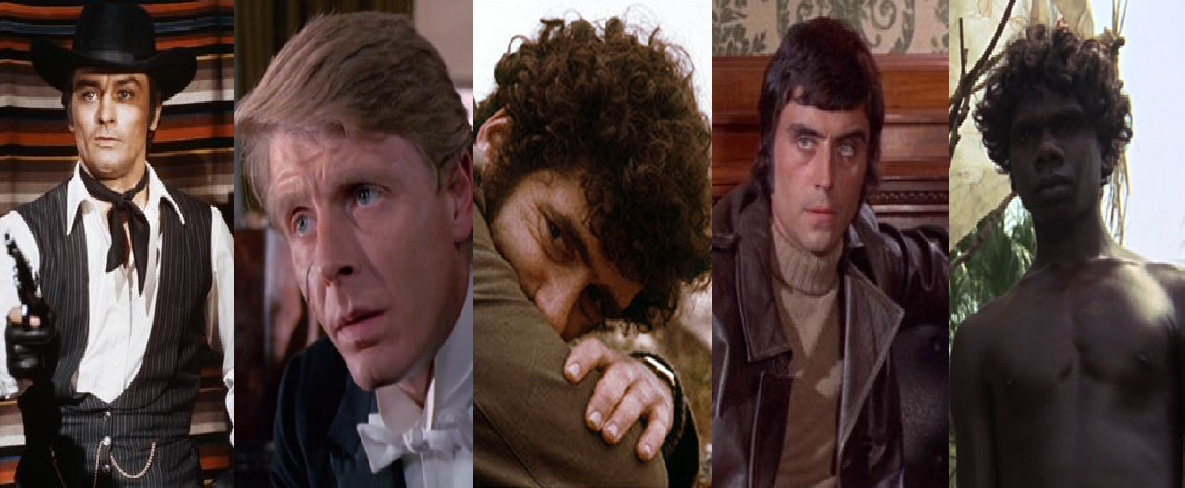
Alternate Best Supporting Actor 1971: Results

5. Elliot Gould in The Touch - A downright atrocious performance that fails on every level, and is quite bizarre to witness in a Ingmar Bergman film.

Best Scene: When he's off-screen. 
4. David Gulpilil in Walkabout - Gulpilil does not have a great deal to work with, but gives an honest portrayal of his character.

Best Scene: The failed mating ritual. 
3. Edward Fox in The Go-Between - Fox manages to be more than background largely in a single scene where he brilliantly realizes exactly what his character is going through.

Best Scene: Leo asks Hugh about Ted.
2. Ian McShane in Villain - McShane, despite dealing with a terrible co-star, gives an engaging and complex portrait of a gangster's closest associate. 

Best Scene: Vic goes to Wolfe after his mother dies.
1. Alain Delon in Red Sun  - Delon creates a memorable and appropriately smooth villain who acts as worthy foe for the all-star pairing at the center of the film, which is quite an achievement.

Best Scene: Catching Kuroda and Link off guard.
Updated Overall Rank

Next Year: 1985 Lead

Alternate Best Supporting Actor 1971: Edward Fox in The Go-Between

Edward Fox did not receive an Oscar nomination, despite winning a BAFTA, for portraying Hugh Trimingham in The Go-Between.

The Go-Between tells a story about star-crossed lovers separated by social classes whose relationship is facilitated for some time by a young boy visiting the estate the two live on for the summer. The material itself runs thin with the film's length, though director Joseph Losey's execution of it is often intriguing.

Now the standard version of such a story would be shown from the lovers in this case the richman's daughter Marian Maudsley (Julie Christie), and the tenant farmer Ted Burgess (Alan Bates). The emphasis here is based on the go-between, the boy Leo (Dominic Guard) who delivers messages between the two in which they set up their rendezvous. This firmly maintains the perspective of the child, and we only see the events unfold through his view of them. This technically limits every other character in a way since we only see them in the way they interact with the boy, which is obviously not exactly as they are. This includes Edward Fox, despite his scarred physical appearance, which is only explained briefly by someone else as a wound he received in the Boer War. That's all there is left to it, and as with every one else the perspective of Hugh is kept very tight. However Fox still does well within this frame in the majority of scenes as just an unassuming yet charming gentleman who is more than kind and courteous to his betrothed Marian, despite that she continues her efforts to meet Ted as frequently as she can.

Fox has two strikes against from the start then due to the film's perspective, but also being the other man which is traditionally a thankless role. Fox though thrives more effectively than any other member of the cast within this confinement. Most scenes with Fox are just Hugh being a pleasant enough fellow, which he does well. There is one scene though where he gets a chance for more when Leo alludes to the relationship between Marian and Ted directly to Hugh. Fox is downright brilliant in this scene as again what he says to the boy keeps everything properly respectable in his description of Ted as a lady killer. What's outstanding about Fox's work is that he says everything else silently in the scene. In his face as he hears the name mentioned Fox reveals the pain and discomfort of a man realizing he is not truly loved by his soon to be wife, but also portraying a definite acceptance of the situation all the same. It's a fantastic scene for Fox as he wholly establishes Hugh's own view of the affair without a word being said. After that remarkable moment Hugh returns to the background for the rest of the film, but Fox with that moment makes Hugh more than just a part of the background. This is a good performance as Fox makes the most out of a thin part.

Wednesday, 25 May 2016

Alternate Best Supporting Actor 1971: Donald Pleasence in Wake in Fright

Donald Pleasence did not receive an Oscar nomination for portraying Doc Tydon in Wake in Fright.

Wake in Fright is rather unique and effective horror film of sorts about a middle-class teacher John Grant (Gary Bond) who finds himself in a mining town known as The Yabba.

Now the film is often described as a thriller though I don't feel that's quite accurate since those usually need more of an exact plot than this film has, although describing the film as a horror film might give the wrong impression as well. It is a horror film just you won't find your usual supernatural monsters, or even serial killers here. You'll just find people. It's all about the people though. Our main character John first enters the mining town, and is shown around by the local sheriff. The place seems like it could be harmless enough, though he finds two of the main sources of entertainment are constant drinking and gambling over a game that involves flipping two coins. As his little tour ends he comes across a man who immediately changes the tone set by the sheriff. That being Donald Pleasence who breaks any possibly positive sentiments with the incisive cynicism in his flawless delivery of his introductory line "All the little devils are proud of hell". Pleasence, as he would later prove with his performance in a Halloween as well, is a master of infusing a sense of dread in words and sets the tone for the rest of the film, which is not a horror of a single event but rather the horror of the very existence of the people in the Yabba, which again is not what you'd expect it to be.

Now with that introduction one might think Doc is somehow separate from the rest of the Yabba, but that's not quite the case, and with that is the brilliance of Pleasence's performance. Pleasence opens with that harsh truth of a man who has no delusions about where he lives, but in just a few moments afterwards we see Doc playing the coin toss game as though he's enjoying it just as much as anyone else. Pleasence plays this as the truth as well, which is very important to the way he develops Doc's character throughout the film. After these initial moments with Doc, where John loses all his money on the coin toss game and becomes stranded in the Yabba. This is where the horror starts which is found in the lifestyle of the men which involves brutal kangaroo hunts, gambling, and almost non-stop drinking. Despite being often in the open air there is a distinct sense of claustrophobia that amounts from the crudity of this life, which slowly seems to penetrate John's sanity. Most of the other denizens are of the place, and every moment is unexplained yet natural, as this is their existence. Pleasence though offers a different view through his portrayal of Doc, who does not quite fit with everyone else, but not in the way John fails to do so.

Again when Doc turns up again it is a card game, where there once again is plenty of drinking, and Pleasence only reveals Doc as a man completely at harmony with the other men as they go about downing yet another beer while making one crude remark after another. However the next morning when John finds himself in Doc's house, his association with the town becomes understood. Pleasence is terrific as Doc explains his enjoyment of what the town of Yabba has. There is devilish quality in Pleasence's grin as he states his ability to have all his sexual desires fulfilled and only looks down upon those who question his lifestyle. The sheer pleasure is shown by Pleasence as something more to the Doc than any of the other people who only know that way of life. Pleasence reveals instead this certain understanding and intelligence in the Doc's words actually, as he basically uses the nature of Yabba to live the life he wishes live, which would not be possible in a more savory place. the thrill Pleasence reveals of a man who has found his place, though again Pleasence does not allow this to be a simplification. Pleasence in that same smile still finds a definite self-loathing within, as he knowledge to perceive the sort of man he has to be to thrive in such a place.

Pleasence sort of takes over the film in its last act in an interesting way, in the way Doc seems to control John. Pleasence again does not do this as one would expect, in that he does not become commanding in the traditional sense. Instead Pleasence exudes an influence in an interesting, organic fashion as though the pleasure oozes from him in a way that spreads into John's mind. Pleasence is excellent as he goes full force to the point that this behavior is made grotesque, as the film intend, though he never makes it inhuman. The base qualities within it are always found deep rooted in Pleasence chilling yet always honest portrayal of this hedonist. This is pivotal to Pleasence's approach which succeeds in being more than just a personification of the Yabba. Pleasence is outstanding in his final scenes that he again subverts. This includes an implied homosexual encounter with John, which Pleasence carefully makes less exploitative than it might have been if the film had been completely left to its own devices. This is found in the surprising tenderness found in Pleasence's interactions with towards John, that again is comfortable with what he's doing, though it places John in a place he's most decidedly not comfortable in. I love Pleasence's final scene as once again presents a warmth as Doc comforts John with an apologetic tone acknowledging he went too far with him. This never feels like an inconsistency as Pleasence makes every aspect of the Doc only part of a cohesive whole. This is exceptional work for Pleasence as he helps craft the horrific atmosphere, though never simplifies his character, creating a fascinating portrait of a man who, for better or worse, has found his place in the world.

Sunday, 22 May 2016

Alternate Best Supporting Actor 1971: Alain Delon in Red Sun

Alain Delon did not receive an Oscar nomination for portraying Gauche in Red Sun.

Yojimbo, Le Samourai, and Harmonica walk into a film and you get a pretty entertaining western about a Samurai, Kuroda, and a bandit, Link, teaming up to track down the bandit's treacherous partner.

The film is notable already through its pairing of Charles Bronson and Toshiro Mifune. The film ups the ante all the more by throwing in Alain Delon as the main antagonist for the film. Delon plays Gauche who begins as Link's partner in crime, and thankfully it is not long for us to see these three onscreen definitions of cool interact with one another. The three are perfectly in tune in that each take a different approach in portraying their characters so there's no override. Mifune takes an intense stoic determination, Bronson takes a sardonic approach, while Delon goes for being a personification of one word, smooth. Now all three are very physical actors, in that they can say a whole lot without speaking. This was already for Delon when he played a modern gunslinger of sorts in his most famous role. What's fascinating in potentially a similair role, Delon manages a unique approach even in this quality. Where Delon portrayed his movements in that role as very exact, almost ritualistic, Delon here instead does something that seems far more relaxed. Delon finds this innate confidence in the character of Gauche from the first scene we see him, because of how at ease Delon is in the frame. There is never a question that Gauche is in danger in the opening robbery, as Delon shows a man in his element. The most remarkable part of this is that, even as the villain, Delon earn this overconfidence.

In the robbery Gauche sets himself up as the chief villain by taking two actions. The first by killing Kuroda's friend in order to steal a gold encrusted samurai sword the second by trying to literally blow up his partner in crime Link in order to steal the bounty from the robbery for himself. What I love about Delon's approach here is in the moment where he kills Kuroda friend is that he does not play it as pleasurable for Gauche, nor is it an exact psychotic detachment. Delon instead keeps with the calm cool of the character as Delon shows that Gauche kills since they happen to be in his way in some way. Delon though creates the right sense of danger in this by portraying not even a second thought in the character, creating an effective sense of a selfish view that best defines the man. Delon is excellent by being just so despicable, yet doing it in such cool way somehow, that he leaves the right impression. This impression being pivotal to the film since Gauche only infrequently appears after this point, but remains as the objective for our two leads for the rest of the film. Delon is often missing but never forgotten as he does not waste an instance of his screen time in the first act.

The film proceeds with a very enjoyable road trip between Bronson and Mifune to try to find Gauche. Delon occasionally appears though only in brief cutaways in order for the film to remind us of what a badass he is, which Delon delivers with every time, it must be said. Eventually though Kuroda and Link come across him,  Delon's entrance in the final act is pretty amazing thanks to again that ridiculous confidence that Delon projects so well, which only is multiplied by Gauche's casual twirling of his pocket watch. Another party though interrupts the three's showdown, leaving the three to team up against a common foe. Delon's performance makes this action particularly convincing since the self-absorption was always at the center of the character, which would of course include self-preservation. Delon's little asides to his two opponents throughout the scene are great since there is such a lack of concern in his expression. Once again this should not work, yet Delon realizes Gauche's personality so well that this in the end should be his only reaction. This is terrific villainous turn from Delon as he earns his place as a worthy opponent for Bronson and Mifune, which is already quite an achievement, and crafts a memorable villain out of a role that in the wrong hands, considering the character is rather thin as written, would have been forgettable.

Wednesday, 18 May 2016

Alternate Best Supporting Actor 1971: Ian McShane in Villain

Ian McShane did not receive an Oscar nomination for portraying Wolfe Lissner in Villain.

Villain tells the story of a violent cockney gangster Vic Dakin (Richard Burton), it probably would be a decent enough crime film if it were not for its rather atrocious central performance.

Well even though the film stands as yet another example of the cinematic law of the more performances you see from Richard Burton the worse actor he becomes. This is one horrible example of this as any scene with Burton is tainted despite there being a saving grace often around him in the form of one Ian McShane. McShane is one of those actors whose been around for a long time while only having a pseudo breakout later in his career via the television series Deadwood (which I've yet to see). McShane's abilities as an actor though were evident early on such as here where he plays Wolfe Lissner one of the members of Vic's criminal organization. Wolfe's unique within the organization though not only in terms of his actual activities, which involves handling a prostitution ring which he also uses to garner blackmail material against powerful officials, but also in terms of his relationship with Vic, since he just happens to be his lover as well.

McShane owns the role in a way that is very much needed for the film. McShane carries himself with a certain style, which while realistic gives Wolfe's the right flair as a character. McShane is rather smooth in the role in that he so well realizes the distinct sort of charm that Wolfe's possesses. McShane utilizes this to portray Wolfe's methods particularly well at every front. This includes convincing women to do "favors" for him, which McShane carries this quiet elegant warmth in his statement that makes his way of swaying them to sell themselves believable. The same is true for Wolfe as he paints the men of power into a corner as well. McShane so delicately plays these scenes as he always makes Wolfe seem so earnest as he tells the women, or the men that the arrangement that he has made is mutually beneficial for all. McShane's approach is to project this innocence of sorts that understandably puts all at ease, despite the fact that Wolfe is anything but.

Now the main crux of the film probably should be the relationship between Vic and Wolfe. The film always comes back to them, and it is quite possible that this is properly set up on the directing and writing fronts. The problem is found in Burton's performance which is so hammy in the worst possible way that Vic never is more than a one dimensional caricature. Again though McShane comes in to pick up the slack left by Burton. McShane is brilliant in his depiction of the various scenes where Wolfe interacts with Vic, since he never leaves it as simple as it could have been. McShane instead finds a definite complexity in this relationship. On the surface McShane expresses the certain manipulative side of Wolfe in his interactions towards Vic, as he does not shy away of showing the blunt pleasure he seems to get from colluding in Vic's schemes. He still conveys certain limits to this as Vic becomes more possessive. McShane's excellent as he presents Wolfe as not having the same singular obsession, especially in one moment where the bi-sexual Wolfe is interrupted with his girlfriend by a desperate Vic. However McShane does not leave it a wholly shallow relationship despite some questionable elements within it. McShane subtly alludes in pivotal moments a genuine side to Wolfe, that is particularly striking against his false earnest side, when Wolfe shows actual concern for Vic's mental state. McShane finds this never to be a contradiction, instead even allowing a real complexity in the relationship between Wolfe and Vic. This is wasted in terms of the film due to Burton, but on McShane's end it's there. McShane's performance is rather wonderful here as any scene in which he appears has at the very least a spark of energy to them. In the scenes without Burton, McShane only excels all the more, and there was quite possibly a great film if it had been all from Wolfe's perspective or at the very least Vic had been played well.

Wednesday, 11 May 2016

Alternate Best Supporting Actor 1971: David Gulpilil in Walkabout

David Gulpilil did not receive an Oscar nomination for portraying the boy in Walkabout.

Walkabout is at the very least an interesting film about a sister (Jenny Agutter) and her younger brother (Luc Roeg) who become stranded in the outback after their father commits suicide.

David Gulpilil plays an Aboriginal boy the two come across, who is roaming the outback on his Walkabout in which he fends for himself. The boy though takes the two along with him, or at least he allows them to follow him. Gulpili speaks his own native language throughout the film, and the film purposefully eliminates the possibility of understanding him. No subtitles are ever granted to him, and there are very few moments in which the siblings manage to create a direct understanding with him. We are placed in the view of the siblings in this respect as even when the boy does speak it rarely focuses upon in a way in which would even allow one to decipher the words. Of course the film itself does not focus on any of the actors in really the traditional sense. The film seems to care more about the atmosphere of the location and the behavior of those within it more than precisely who they are as people, to the point that it feels like the siblings are supporting as well even though they technically are not in terms of traditional definitions.

Gulpilil therefore has an unusual challenge in that he's not silent, but he's also left without much in terms of verbal communication with the other characters or even the audience. The challenge only becomes more severe due to the nature of the director Nicolas Roeg's approach throughout the film. Gulpilil's performance works well within this structure though as he act natural to be as blunt about it as possible. He never seems to be pantomiming the role of the native, nor does his performance ever seem to be that clichéd restricted view of the native despite the fact there is only a rare occasion that we are given the chance to even know what it is that he is saying. Gulpilil succeeds in being what he should be in that the boy very much becomes sort of the natural expression of the nature around him. This is helped by Gulpilil having a natural charisma of sorts as he manages to have a certain magnetism about him even though this is never a forced intention by his performance. Gulpilil is able to produce this quality without ever seeming to try, which is essential for the role and the film.

Once again the nature of the film and the role does place upon a few severe restrictions on all the performers, since again we mostly witness their behavior with only some emphasis placed on the actual growth of the trio as characters. The major transition is given to Gulpili though in the final interactions between the boy and the siblings, well in this case more of just the sister. This is when the boy decides upon the sister as being more than a travel companion. Gulpilil is quite effective in this scene as he portrays the gradual change in the boy from a mere curiosity in the sister to something far more intense. This leads to the eventual point in which the boy tries to take her as his mate by performing a ritualistic dance after he stumbles upon her half naked. Gulpili is terrific in this scene in that he portrays the moment as more than a primal dance, but also a breakdown of sorts for the boy as the sister outright rejects his advances. Now even this breakdown is still muted in a way by Roeg's choices, despite being well played by Gulpilil. This is a good performance by Gulpili that stands well within the film, even if it does not exactly standout all that much beyond it.

Wednesday, 4 May 2016

Alternate Best Supporting Actor 1971

And the Nominees Were Not:

Alain Delon in Red Sun

Edward Fox in The Go-Between

Elliott Gould in The Touch

Ian McShane in Villain

David Gulpilil in Walkabout

Tuesday, 29 October 2013

Alternate Best Supporting Actor 1971: Results

5. Bruce Dern in Drive, He Said- Dern does not have much of a part but he does make himself the best part of his film through his energetic performance.

Best Scene: The Coach reorganizes his team at half time.
4. Jack Albertson in Willy Wonka and the Chocolate Factory- Albertson gives a nice warm supportive turn even if he is overshadowed by Gene Wilder for a large chunk of the film.

Best Scene: Grandpa Joe surprises Charlie with a Wonka bar.
3. Fernando Rey in The French Connection- Rey's is a minimalistic performance that realizes his French crime lord as an effective villain.

Best Scene: Frog one waves Popeye goodbye.
2. Andy Robinson in Dirty Harry- Robinson is a great villain by being both incredibly pathetic and exceptionally threatening.

Best Scene: Harry tortures Scorpio.
1. John Hurt in 10 Rillington Place- Good Predictions Mark, Moviefilm, and Michael McCarthy. This was a landslide victory for John Hurt as I did not have to think twice to give the win to him for his absolutely devastating performance as man who faces one tragedy after another that perfectly complements the terrifying lead performance by Richard Attenborough. I can sort of understand the academy's oversight of Attenborough because of their timidness for completely despicable characters, but there was no excuse for ignoring Hurt especially with the filler nominations given to Leonard Frey and Richard Jaeckel.

Best Scene: Timothy finds his wife after the murder.
Overall Rank:
  1. John Hurt in 10 Rillington Place 
  2. Donald Pleasence in Wake in Fright
  3. Andy Robinson in Dirty Harry
  4. Ben Johnson in The Last Picture Show
  5. Alain Delon in Red Sun
  6. Eddie Axberg in The Emigrants 
  7. Ian McShane in Villain
  8. Fernando Rey in The French Connection
  9. Jack Albertson in Willy Wonka and the Chocolate Factory 
  10. Jeff Bridges in The Last Picture Show
  11. Roy Scheider in The French Connection
  12. Tom Baker in Nicholas and Alexandra
  13. John Huston in Man in the Wilderness
  14. Max von Sydow in The Touch
  15. Bruce Dern in Drive, He Said
  16. Donald Pleasence in THX 1138
  17. Roy Kinnear in Willy Wonka and the Chocolate Factory 
  18. Jack MacGowran in King Lear
  19. Ian Hendry in Get Carter 
  20. Edward Fox in The Go-Between
  21. Hugh Millais in McCabe & Mrs. Miller
  22. Laurence Olivier in Nicholas and Alexandra
  23. Cyril Cusack in King Lear
  24. Patrick McGoohan in Mary, Queen of Scots
  25. Patrick Magee in A Clockwork Orange
  26. John Osborne in Get Carter
  27. Patrick Magee in King Lear 
  28. Percy Herbert in Man in the Wilderness
  29. Trevor Howard in Mary, Queen of Scots
  30. Michael Gothard in The Devils
  31. David Battley in Willy Wonka and the Chocolate Factory 
  32. Marcel Bozzuffi in The French Connection
  33. David Warner in Straw Dogs   
  34. David Gulpilil in Walkabout
  35. Ian Holm in Nicholas and Alexandra
  36. Nigel Davenport in Mary, Queen of Scots
  37. Murray Melvin in The Devils 
  38. Nigel Davenport in Villain 
  39. Michael Redgrave in The Go-Between
  40. David Warbeck in Duck, You Sucker!
  41. Reni Santoni in Dirty Harry 
  42. Alan Bates in The Go-Between
  43. Paul Mann in Fiddler on the Roof 
  44. Eddie Egan in The French Connection
  45. Chips Rafferty in Wake in Fright
  46. Bryan Mosley in Get Carter 
  47. Graham Armitage in The Devils
  48. Godfrey Quigley in A Clockwork Orange 
  49. Pierre Lindstedt in The Emigrants
  50. Bill Hickman in The French Connection
  51. John Vernon in Dirty Harry
  52. Aubrey Woods in Willy Wonka and the Chocolate Factory 
  53. John Stride in Macbeth
  54. Tony Lo Bianco in The French Connection
  55. Jack Thompson in Wake in Fright
  56. Charles Cioffi in Shaft
  57. Roy Scheider in Klute
  58. Peter Vaughan in Straw Dogs 
  59. Per Oscarsson in The Last Valley
  60. Raul Julia in The Panic in Needle Park
  61. John McEnery in Nicholas and Alexandra 
  62. Timothy Dalton in Mary, Queen of Scots
  63. Frederic de Pasquale in The French Connection 
  64. Art Garfunkel in Carnal Knowledge
  65. Nigel Davenport in The Last Valley
  66. Anthony Sharp in A Clockwork Orange  
  67. Jack Hawkins in Nicholas and Alexandra
  68. Richard Bright in The Panic in Needle Park 
  69. Charles Gray in Diamonds Are Forever
  70. John Larch in Dirty Harry 
  71. Michael Bates in A Clockwork Orange
  72. Charles Cioffi in Klute 
  73. Leonard Frey in Fiddler on the Roof
  74. Martin Shaw in Macbeth
  75. John Mitchum in Play Misty For Me 
  76. John Meillon in Wake in Fright
  77. Philip Stone in A Clockwork Orange
  78. John Mitchum in Dirty Harry
  79. Arthur O'Connell in The Last Valley
  80. Gunter Meisner in Willy Wonka and the Chocolate Factory
  81. T.P. McKenna in Straw Dogs
  82. Robert Towne in Drive, He Said  
  83. Harry Guardino in Dirty Harry
  84. Rene Auberjonois in McCabe & Mrs. Miller 
  85. Moses Gunn in Shaft
  86. Romolo Valli in Duck, You Sucker!
  87. Paul Glaser in Fiddler on the Roof
  88. Clu Gulager in The Last Picture Show 
  89. Dudley Sutton in The Devils 
  90. Alan Vint in The Panic in Needle Park 
  91. David Prowse in A Clockwork Orange
  92. Paris Themmen in Willy Wonka and the Chocolate Factory
  93. Warren Clarke in A Clockwork Orange
  94. Leonard Stone in Willy Wonka and the Chocolate Factory
  95. Randy Quaid in The Last Picture Show
  96. Michael Bollner in Willy Wonka and the Chocolate Factory
  97. Timothy West in Nicholas and Alexandra
  98. Charles Tyner in Harold and Maude
  99. Harry Andrews in Nicholas and Alexandra
  100. Barnard Hughes in The Hospital 
  101. Terence Bayler in Macbeth 
  102. Roderic Noble in Nicholas and Alexandra
  103. Murray Head in Sunday Bloody Sunday
  104. Charles Aidman in Kotch
  105. Josef Summer in Dirty Harry
  106. Michael Margotta in Drive, He Said
  107. Elliot Gould in The Touch
Next Year: 1999 lead

Alternate Best Supporting Actor 1971: Bruce Dern in Drive, He Said

Bruce Dern did not receive an Oscar nomination, despite winning NSFC, for portraying Coach Bullion in Drive, He Said.

Drive, He Said is about a star basketball player Hector who deals with problems with an affair he is having and his protestor friend who is in fear of the draft. The film was Jack Nicholson's directorial debut and it is obvious in the film, much like Sean Penn directing for the Indian Runner although he had a better script to fall on, that he was trying far too hard to show himself to be director with a distinct style and vision. It is no surprise that Clint Eastwood continued his directing career and Nicholson rarely returned as Eastwood's debut film from the same year, Play Misty For Me, is a far more assured work.

Drive, He Said is a film with many ineffectual performances that often come off as obnoxious, dull or just simply not very cinematic. The great exception to this is Bruce Dern in the role as the Coach of the Basketball team Hector plays with. Bullion is not to much of a character he is just always trying to push Hector to fly straight and push his team to win the game. Dern's performance just has a presence no one else has in the film. When he is on screen the film does come alive in a certain way because he brings a certain energy to the part sorely missing from most other places in the film. Although the point of his character is simple Dern does bring this point alive effectively.

Dern does well in showing the differences in the Coach's approach. When in practice or on a game Dern reflects the intensity of the situation as he portrays the Coach as being particularly direct to get his points across as quickly and firmly as possible. Dern makes Coach Bullion like a military strategist positioning his troops and motivating him his way so they get the job done. When they are not on the court Dern tones down Bullion to make him a believable character. Dern still makes him forceful in his attempts to shape up Hector but shows him to be much quieter yet still persistent figure. Dern instead of having the piercing criticisms of the court, he makes Bullion criticisms in the form of a restrained disappointment.

Unfortunately for Dern as well as the film itself Coach Bullion is not featured all that often and really the character is almost entirely made by Dern's performance. Dern tends to be a reliable character actor and certainly is reliable here. There is just only so much he can do with his underused and underwritten character, but hey he did make me wish the film had been about his character's story to bring his team to the championship. This is not a great performance by Bruce Dern but it certainly is a solid one which does manage to steal the film even though there really is not all that much of a film to steal.

Monday, 28 October 2013

Alternate Best Supporting Actor 1971: Andy Robinson in Dirty Harry

Andy Robinson did not receive an Oscar nomination for portraying the Scorpio killer in Dirty Harry.

Dirty Harry went on to have four sequels none which came close to the strength of the original film. Although all of the films, besides The Dead Pool, had a devoted Clint Eastwood they always lacked a personal arc for Harry and something even more important which was a good villain. The only film that even came close to a good villain was the first sequel Magnum Force although that was not in the main villains who were rather silly looking traffic patrol death squad but rather the last minute reveal villain played by Hal Holbrook. The only film which has a great main villain is the very first film and a great deal of the credit for this needs to go to Andy Robinson's performance as the serial killer who calls himself Scorpio.

For the first third of the film or so we mostly see the actions of Scorpio as he murders people and leaves ransom notes demanding money to be paid or else he will commit more murders. The first murder we barely see him but the second attempted murder we see Scorpio make his preparations. Robinson is exceptional in the scene as we see Scorpio mark his target. Robinson is quite chilling in the scene as he loses his mark then he finds his potential victim again. Robinson is great as he brings the most eerie smile over his face as Scorpio sees his chance to murder has returned, in his expression he shows the sick sadism of Scorpio very effectively. We don't learn why he does this, but from here we can see he certainly enjoys it.

Once we see more of Scorpio Robinson makes a most unusual but remarkable dynamic for his character. Robinson makes Scorpio a very pathetic and very threatening character all at the same time. Through his meek posture and his squeal Robinson makes Scorpio clearly a weak and very lowly individual. In this though Robinson brings an unpredictability of the man through the viciousness of his psychotic behavior. He mixes in the violence with his overall lowly state to make this a very visceral performance. Due to his more pathetic qualities when Robinson brings out the violence it is all the more jarring and Robinson makes every scene with Scorpio have an underlying intensity as you don't know what he is going to do.

Scorpio is a most interesting adversary for Dirty Harry as the only quality they share is their ability they share is their ability to kill fairly efficiently. Where Eastwood stands tall, Robinson well stands short, Eastwood's voice is firm and forceful, Robinson is fluttery and whiny, where Eastwood makes Harry emotions rather self contained that although can be intense are always in control, Robinson shows Scorpio become an emotional mess very easily. This juxtaposition absolutely works as Eastwood and Robinson complement each other's performance marvelously. Their scenes together have a raw power as both go all their way in their differing characters making for some very memorable moments particularly the torture scenes with Eastwood being so controlled and Robinson being such a wreck.

Robinson's turn as Scorpio is a bit underrated as villain turn goes and his influence is rarely mentioned as I think you can see some of Scorpio in Heath Ledger's performance as the Joker. The crazed psychopath is easily a part that an actor can go too far with, but Robinson handles it incredibly well by showing the way the extreme craziness comes out at certain times. Robinson builds to it as it becomes time for violence that is when Scorpio begins to well lose his composure a bit. Robinson handles the progression in natural fashion even though this is not a case of the evil coming out, and even when Scorpio seems come Robinson plays him in a particularly slimy way. This might not seem like a large leap but Robinson makes an art of going from slime to psycho.

Robinson makes Scorpio a most despicable and completely unsympathetic villain, and that is completely the right approach. He never takes a step back showing Scorpio revel in everyone of heinous acts, Harry says Scorpio likes to kill and Robinson supports this point. This is the best approach in the film as we want Harry to torture Scorpio, and we want him to kill him at the end with that build up to the 6 shots or only 5 scene at the end of the film. Robinson is great in making Scorpio the lowest of the low. He is creepy, one scene where he walks through a park is especially off putting as he looks so happy around children, he is threatening, he is  just all together deplorable. Robinson makes a great villain you hate, and takes an interesting approach that absolutely works where he is not the equal to Harry but rather a brilliant subversion.

Sunday, 27 October 2013

Alternate Best Supporting Actor 1971: Jack Albertson in Willy Wonka and the Chocolate Factory

Jack Albertson did not receive an Oscar nomination for portraying Grandpa Joe in Willy Wonka and the Chocolate Factory.

Jack Albertson plays Grandpa Joe a man bedridden for twenty years and one of the four grandparents of the poor Charlie Bucket (Peter Ostrum) who hopes to be one of the lucky children to find a golden ticket that will give him a tour of Willy Wonka's Chocolate Factory. Albertson is the very traditional sort of supporting performance here in that Grandpa Joe is always supporting Charlie with moral support any way he can. Albertson is very charming the role just having a genuine warmth needed for the part. He has just the right sweetness without becoming saccharine, and serves the film well with his bright personality in the early scenes of the film where Charlie faces some big disappointments.

Albertson handles his scenes very well being the kindly encouraging grandfather to Charlie, and does well because they are not all happy moments. Albertson's best scene is when he surprises Charlie with a bar and they open it together to find nothing. Albertson brings such genuine emotion to the moment as Grandpa Joe first shares Charlie's excitement but then sadly has to tenderly comfort his grandson after their disappointment. Another scene that causes some complaints is when Grandpa Joe gets out of bed because he sings a song to do it. I really don't mind because Albertson really does deliver with the song, not necessarily with how good or bad his singing voice is, but rather with an energy and brightness to bring the joy of the situation out quite splendidly.

Once the film steps in the Chocolate Factory Albertson takes a back seat, in fact everyone does, to Gene Wilder's performance as Willy Wonka. Gene Wilder owns the film without question and for most the tour the most everyone can get out is a surprised reaction or two. No one for a moment steals Wilder's thunder during these scenes and as the reactionary cast goes I would probably say Roy Kinnear as Mr. Salt probably does the best. Albertson is not bad in these scenes, he handles all the little moments he has well enough, but they don't leave too much of an impression with Gene Wilder around. This is not a criticism against Albertson though, but rather just praise for Wilder.

Albertson does get one scene at the end of the film when Grandpa Joe confronts Wonka after Wonka has said that Charlie will not receive the lifetime supply of chocolate due to a violation of contract. Albertson is very good in the scene as Grandpa Joe angrily denounces Wonka's actions and even suggests they go to Wonka's competitor with information. The moment does not pain Grandpa Joe in a bad light at all though because Albertson shows that where the anger comes from is his disbelief that Wonka would honestly treat a child that way opposed to having any actual malice. It's a good moment for Albertson as it lets him fulfill the important role Grandpa Joe had in the film's opening act. Albertson does not steal that scene or the film, but he adds very nicely to the film as a whole by being the tender support Grandpa Joe should be.

Friday, 25 October 2013

Alternate Best Supporting Actor 1971: Fernando Rey in The French Connection

Fernando Rey did not receive an Oscar nomination for portraying Alain Charnier in The French Connection.

The French Connection did receive a supporting actor nomination for Roy Scheider's fine work as the partner of Popeye Doyle (Gene Hackman). Fernando Rey though was not nominated for his performance as the film's villain the Frenchman Alain Charnier who intends to smuggle a large amount of heroine and sell to a New York criminal. Fernando Rey though is given a small story of his own as the film depicts Charnier set up his plan to exchange the heroine. These scenes are relatively short but uses them well to allude to Charnier's nature. Rey carries himself well and in doing so creates Charnier as an astute, seasoned, and above all high class sort of criminal who wears his profession below the surface unlike his New York counterpart.

Aside from the scenes of him setting up the deal this is mostly a silent performance by Alan Charnier in all of the scenes where Popeye is trying to follow him and keep him in sight. In this part of his performance Fernando Rey is excellent in being the adversary to Hackman's Doyle. In Hackman's performance all the frustrations and the effort of a hard boiled cop, Rey acts as the perfect foil to Hackman's performance as he shows Charnier doing everything to escape Doyle's pursuit while he stays completely calm cool and collected. When the two play the game on the cat and mouse is a great scene but it is made even more memorable by Rey and Hackman's performance. The scene's end is unforgettable as we see the angry Doyle lose Charnier, and Rey's brilliantly smug face as Charnier waves goodbye to Popeye.

Rey is pretty consistent in his performance until the very end of the film when Charnier himself has to deliver the drugs rather then use his patsy friend. Rey is again silent in these scenes and is very good in showing the manner in Charnier change to reflect his grievousness and indicate that handling the deal is clearly the last thing that he ever wanted to do. The best moment comes when the tables have turned with Popeye and Charnier changing places from the subway scene with now Popeye being the one giving the wave. Rey makes the moment extremely satisfying because he shows all the confidence drain right out Charnier face. This is a relatively simple role but one that Fernando Rey handles well with his very assured performance. Rey without much screen time hints at who this man is but more importantly to the film as whole makes Frog one the elusive mystery that you do want to see Popeye catch.

Thursday, 24 October 2013

Alternate Best Supporting Actor 1971: John Hurt in 10 Rillington Place

John Hurt did not receive an Oscar nomination, despite being nominated for a BAFTA, for portraying Timothy John Evans in 10 Rillington Place.

10 Rillington Place is an extremely effective film about the serial killer John Reginald Christie (Richard Attenborough in a scary as (four letter expletive) performance).

John Hurt plays Timothy Evans who with his wife and infant daughter move into the top room of a house which they rent unfortunately from John Christie. One of the great strengths of the film is its strive for a realism throughout the film including depiction of Timothy Evans's relationship with his wife Beryl. Their marriage is made out to be far from ideal as both find themselves rather troubled by their poor financial state and the fact that Beryl finds herself once again pregnant. John Hurt plays Timothy as a fairly average man, with somewhat below average education and intelligence perhaps, and give one of the most authentic performances ever given in playing just a rather undistinguished sort.

Hurt is great in making the relationship between Timothy and Beryl very real and making Timothy a man who is clearly far from perfect. Hurt, in the some relatively brief moments gives a very vivid look into the married life of Timothy Evans. Hurt brings us the lovely moments of when they are just starting out in their new place or when he is on a romantic date with his wife. These scenes are key to Hurt's portrayal as Hurt does show that Timothy does love his wife and does have some good times with her. In the scenes of their fighting though Hurt lets us look into any key hole of a man fighting with his wife with all the anger, screaming and bitterness played so naturally by him. Hurt importantly makes Tim's frustrations just as ordinary as they come.

One of the qualities of Timothy is simply that he is not all that bright. As I've said before playing a not overly intelligent character is challenge as they simply can seem to give a stupid performance that does not realize the character, or base the character solely on the mannerisms to prove the character's lack of intelligence. John Hurt of course does neither of things and he makes Timothy's level of intelligence a subtle but important facet in his character. He is not dumb in that he acts stupid as played by Hurt, he acts like a normal person most of the time, but what Hurt shows so well is that Timothy has to take time to really understand things in an entirely concrete fashion. Hurt's exceptional portrayal of this quality becomes especially important late in the film.

Timothy's nature though comes earlier into plays as well in a few very important moments all of which Hurt knocks out of the part. In one scene we see Timothy telling a tall tale at a pub although he is acting like it is an authentic one. Timothy is lying but Hurt plays it well by making the story as a simple joy for Timothy nothing more than that. He might even believe it in a way, but it is all just a bit of an escape for him. Timothy's nature comes into play again when his wife wants an abortion which Christie says he will be able to do. Hurt does well in showing the mixed frustrations in Timothy as he can't support it as he sees as wrong at a very base level. When Timothy agrees to it though, Hurt makes it believable as again his change is a simple agreement with Hurt showing, once again, that Timothy has not thought it threw completely.

After Timothy agrees, things take a turn for a worse as Christie murders Beryl although he lies to Timothy telling him it was due to the one in ten chance that the abortion could cause his wife to die. John Hurt is so good in these scenes it becomes rather hard to watch the film. The moment in which Timothy examines his wife is especially heartbreaking due to Hurt as he only suddenly notices that she is in fact dead rather then merely being injured. Hurt so naturally portrays the progression of grief and confusion as Timothy can barely understand what is happened. This is such emotionally draining performance to watch because Hurt is so honest in these scenes because the grief he portrays in Timothy stays there right with him as something he obviously could never forget.

Timothy has no time to grieve, so to speak, as Christie tries to instruct him that something must be done to cover their tracks. Hurt continues to be outstanding in his portrayal of the complexities that come to Timothy. Timothy is not to bright and Hurt shows Timothy is simply overwhelmed by the events to the point that he cannot even comprehend the situation. Hurt brings to life the complete scatter of emotions that Timothy is. There is confusion, extreme sadness, guilt, and disbelief all there in Hurt's performance. The way Christie is able to convince Timothy not to call the police, and to even to leave his daughter in the hands of Christie is made entirely believable by Hurt. Hurt shows that Timothy s not able to see anything clearly in his state and that is what leads him to follow Christie's orders.

Timothy, after following Christie's suggestions briefly, does give himself to police although attempts to lie to keep Christie out of it at first. Again Hurt makes Timothy's actions wholly believable as a result of both his simple nature and his troubled mental state. They are also made so powerful because of again how genuine he is as Timothy deals with his own shame and condition and tries to confess to the police what has happened. These scenes are truly disheartening by John Hurt's performance because he does convincingly destroy Timothy's credibility to the police, all the while though he is exceedingly moving in the investigation scenes because we know he is telling the truth. The moment Timothy hears of his daughters fate is absolutely heart wrenching with Hurt's perfect reaction that realizes the horrible sorrow in Timothy but also his final understanding that it was Christie who did it.

Timothy John Evans must be one of the most unfortunate men ever depicted onscreen as not only is his family murdered he is put on trial for their murder with the sentence being death by hanging. All of the final scenes with Hurt are terrific in creating the tragedy of Timothy Evans. Hurt still leaves Timothy a simple man he is even as he is pleading in his life. Hurt is incredibly powerful as he keeps Timothy of his nature as tries just to tell everyone that it was Christie who did it not him in his very plan way, as he is man who does not know how to plead his innocence. 10 Rillington Place is brutal in its keeping with the facts of the real life story and because of that the end of Timothy is quick and vicious, and only made more more painful by Hurt still showing the disbelief and sadness still in Timothy. This is an outstanding achievement by John Hurt as he gives a flawless portrait of a real man who was the victim of evil.

Wednesday, 23 October 2013

Alternate Best Supporting Actor 1971

And the Nominees Were Not:

John Hurt in 10 Rillington Place

Andy Robinson in Dirty Harry

Fernando Rey in The French Connection

Jack Albertson in Willy Wonka and the Chocolate Factory

Bruce Dern in Drive, He Said