Showing posts with label 2017 Alternate Supporting. Show all posts

Monday, 30 June 2025

Alternate Best Supporting Actor 2017: Kōji Yakusho in The Third Murder & Results

Kōji Yakusho did not receive an Oscar nomination for portraying Misumi Takashi in The Third Murder. 

The Third Murder follows a defense attorney Tomoaki Shigemori (Masaharu Fukuyama) for a man who murdered his boss. Sounds like a straightforward mystery or courtroom drama but given it is Kore-eda, if only it twere so simple. 

Kōji Yakusho this time around is decidedly not playing the kindly bathroom cleaner in Perfect Days, the last film I reviewed him for, something that is abundantly obvious in the opening of this film that is perhaps the clearest picture of the intention of Yakusho’s character Misumi, but then again maybe not. What we do see is a double act of brutality as Misumi not only bludgeons the man, his boss, to death he then sets the corpse on fire. This seemingly is the undisputed act of the piece and perhaps our best method to understanding the enigma of this character…maybe. Yakusho’s performance in the scene, which we assume is real at the very least and the facts as presented. There is a hostile extreme in the act and Yakusho presents us with a violent man. Something that seems to fit when Misumi was formerly imprisoned for murder avoiding the death penalty only by the act of Shigemori’s father who was Misumi’s judge. Leaving Shigemori to essentially try to figure out why this man was deserving of such mercy, something that will not be easy for him or the viewer in uncovering the enigma that is Misumi. Yakusho’s performance here is brilliant right off the bat because of how much he frustrates you in a way by his ability to answer questions while not saying a damn thing about anything. When his defense team first meets him, inquiring about the crime and essentially trying to reduce the sentence by making it more of a side effect of a robbery, Yakusho’s performance seems almost disinterested by the questions. Yakusho has the vibe of a career criminal in a way looking for the “cheapest” way out of a situation he’s been in before. He’s captivating though because he’s not precisely that, he’s sort of that, as that sort of disinterest is only can be a criminal to treat his obviously severe crime as just something for him to throw away. He makes you sorta believe this but the problem is there’s the edge of every word where Yakusho is presenting at least a slight or severe lie in his eyes in each delivery. 

You can’t believe the man so clearly particularly when it becomes clear the robbery came after the murder therefore requiring a new defense if there is any chance at avoiding the death penalty. So the next try is to suggest he was motivated by the murdered man’s wife to kill her husband as some sort of illicit lover’s pact. Something that when Misumi’s asked about it he doesn’t deny, but doesn’t confirm either. Again Yakusho’s performance is key to all of this because he too doesn’t confirm or deny it either. Which could be an excuse just to be nothing but it is the something that Yakusho plays around with that makes him so transfixing in his vexing qualities. When asked point blank about an affair, Yakusho’s shrug is a masterclass of alluding to something but not quite alluding to enough. There’s some kind of embarrassment, and suddenly you can perceive him as a different kind of crook. There’s something he sort of cares about, but at the same time there is a callousness about him that makes it seem like it is a standard issue sleazy murderer…maybe. The only truth you can truly accept is that Yakusho captivates in his peculiar way of dodging the questions, without saying no or saying yes. But kind of saying both at the same time. Shigemori, still struggling to find some way to prevent the death penalty, seems to find some other motive where the murdered man may have been molesting his daughter and Misumi acted in judgement of that heinous act. Naturally when Shigemori asks him about it, Yakusho doesn’t make things easy for us. Rather Yakusho shifts again this time most powerfully to portray a different kind of killer, and here is curiously just as he’s given the potentially most sympathetic motivation that Yakusho actually doesn’t make it the simple way of showing the man burdened by performing this kind of vengeance. Rather Yakusho goes to a darker place, particularly as he speaks of tragedies of his family where Yakusho doesn’t give motivation still, but what he shows is suddenly this more chilling intensity in the man. Suddenly he speaks with the type of viciousness of a killer, even a serial killer which Misumi technically is, but you can take it as hate towards the world, due to injustice or just hate towards the world. Yakusho makes it a most striking declaration by keeping the ambiguity alive as the man is speaking an emotional truth but he still is not speaking the truth. Even when he demands that Shigemori answer with his own belief, where Yakusho is genuinely scary in the intensity of the moment, how can one be sure with this man?

Shigemori’s path isn’t easy as Misumi seems ostracized by his own family, however the daughter’s story gives credence to this motivation though no one speaks an exact command or choice at any point. But as the best possible approach Shigemori attempts to get Misumi to pursue this course, until in court he does the exact opposite and insists that he’s innocent saying that he was pressured to make a deal. Suddenly as he is pleading his innocence Yakusho’s performance manages to be his most obviously false and guilty, where everything else he says you can’t be sure of, Yakusho brilliantly overplays this moment of creating a man playing the part now of just the criminal making up stories for the sake of it. Yakusho brings a different kind of blithe quality now where there’s more of an act than in his early scenes where you just can’t be sure of it, here you know this is the one place that Misumi is unquestionably lying. Leading to his death sentence, Shigemori visits Misumi with that sentence placed to try to figure out the mystery one more time. Of course Yakusho/Misumi still remain extremely cagey in his exact intentions, but captivating in his enigmatic state. Yakusho delivery of Misumi stating it would’ve been better if he had not been born seems real and creates the penetrating nature of a deep pathos…but this doesn’t exactly tell you why either which is the brilliance again. Something that Shigemori attempts to challenge by stating that Misumi’s actions must’ve been to protect the young woman, even his plea change protecting her from testifying makes it so he does have a good deed out of his existence. Yakusho is outstanding in his reaction to this because in the first moment you do believe this along with Shigemori as his face brightens a bit and the man seems to accept his good deed within what appears to be a rotten life. BUT when Misumi shrugs off that this may all be the lies of an old murderer, Yakusho doesn’t make it easy once again, as even his grin in this shrugging suggests you can’t believe any exact intention of the man at any point. And that’s the greatness of this performance, because while you can choose to take an interpretation as Shigemori does, Yakusho doesn’t enforce it, nor does he prevent it. He manages to instead brilliantly tiptoe around the lines to create a cohesive whole yet remain an enigma, which we know he’s a murderer, but why, well Yakusho gives you riddles but he never gives you answers in the best possible way. 

Next: 1967 Lead

Wednesday, 18 June 2025

Alternate Best Supporting Actor 2017: Nawazuddin Siddiqui in Mom

Nawazuddin Siddiqui did not receive an Oscar nomination for portraying Detective Dayashankar Kapoor in Mom. 

Mom follows a college professor Devki (Sridevi) who seeks revenge for her step daughter after she is brutally sexually assaulted by a group of men. 

I will say Nawazuddin Siddiqui is an actor I reviewed three times before this and in each instance has been a disparate performance and character. Siddiqui physically in each instance looks very different, no more so than in this film as he appears as a mostly bald private detective with a style all his own, who happens to hear about the plight of Devki’s stepdaughter, being missing initially, who is eventually found near death. Unfortunately for Devki, due to the stepdaughter having been drinking her testimony is put into question and the four men are exonerated by the courts despite their obvious guilt leading Devki to take the law into her own hands. In order to do this more effectively she calls upon Siddiqui detective Kapoor to help her. Siddiqui’s initial appearance is well performed in establishing the idiosyncratic nature of his character. Siddiqui is once again very much doing his own thing and successfully in the way he holds himself as a purposeful peculiarity. Something that works as presents himself as a peculiarity, where Siddiqui specific eagerness to help he paints with the right ambiguity between someone who is genuine in his keen eyed interest as he almost looks like a dog waiting for a treat with his specifically curious eyes and particularly accentuated grin, that may denote almost an ambulance chaser version of a detective, or just a man who presents his genuine interest in helping in his own unusual way. Well it becomes the latter clearly when Devki utilizes his skills as a detective to track down and find different ways to seek revenge against each of the guilty men. Siddiqui continues his ambiguous but entertaining note, where basically what he does is offer some levity within the rather dark situation. He does so in a way that works just through his off-beat delivery that fits and works for this off-beat oddball character. So every time he comes in for some exposition or moment of maneuvering the revenge plan, Siddiqui comes at it with his own unique angle that fits this eccentric character. What Siddiqui does effectively is show sort of the growth and investment of Kapoor into the revenge that is beyond monetary benefits. Something we see when he keeps mentioning his mother, something that Siddiqui plays initially seemingly within the eccentricity of Kapoor, but as he continues to mention it his eyes effectively denote a real care and outright empathy where his mother represents what Devki is doing for her stepdaughter. Siddiqui utilizes just that much more investment, he doesn’t lose the eccentricity by revealing sincerity as the ambiguity leaves to show that his investment goes beyond monetary compensation. An element that is featured even more strongly in his final scene where he comes face to face with the most dangerous of the men. Siddiqui’s wonderful in this scene by playing the shades of a sense of dread, but with a bravery of a man who has no desire to suffer fools of this hideous man. His delivery of correcting the man about a correct pronunciation is pitch perfect because he manages to make it a joke to Kapoor but also with it this real belief in Devki as he spells out the man’s own doom. Siddiqui hitting his height in this moment that exemplifies his overall effectiveness in the role, that makes the comedic elements of the character speak to more than just the comedy, though it works straightforwardly as well, by funneling within a highly specific character that he makes believable, while also using it to allude to a greater depths to the real motivation of the man. It’s a strong performance that really other than Sridevi, manages the very tricky tone of the film to deliver another wholly engaging performance, that for Siddiqui is yet another performance that didn’t for a moment make me think of the other performances of his I’ve reviewed here. 

Monday, 9 June 2025

Alternate Best Supporting Actor 2017: Mark Rylance in Dunkirk

Mark Rylance did not receive an Oscar nomination for portraying Mr. Dawson in Dunkirk.

Dunkirk follows three stories related to the Dunkirk evacuation by the British army. 

The nature of Dunkirk is one of the most pure example of a cinematic approach where I do think it is one film where it was absolutely meant for its original format to the most pronounced extreme, having said that, still works for me even in the lesser format of a home viewing, even on a larger television screen. Relevant though is Christopher Nolan’s emphasis on the visual approach for the material where the amount of backstory per character is very limited. The character probably with the most backstory is Mark Rylance as the “lead” of the boat story, where an older English gentleman goes with his son, and ill-fated friend George (Barry Keoghan, who I was taken by being reminded of just how not creepy he is here) to rescue men from Dunkirk using his own boat. Rylance's performance very much from the outset is about stature and developing that specific comforting presence of an old fashioned unfussy English gentlemen intent on doing the right thing. Initially what Rylance does is to not really put too much on anything, showing a very internalized determination fitting for the quiet man he is as he prepares the boat, before the navy can commandeer it themselves and set sail. Even his warning to George that they are going into war Rylance’s delivery of the line is with a subdued yet potent urgency of someone who speaks in fundamental truths and with an innate earnestness about himself. Rylance sets up the character effectively as empathetic respectability with the presence of a quiet established dignity for the good natured patriarch of the time.  

The journey is naturally not the easiest though on the more hopeful outset of the trip Rylance’s moment of beaming with pride at the spitfire planes, even giving a bit of history on their engines Rylance exemplifies the specific belief in the planes. Something that one could take as just belief in his country, but it extends to something beyond that. Rylance lays the groundwork for what are the essential truths of his character. The first important moment of the trip comes in as the boat picks up the only survivor of a sunken ship, the shivering soldier (Cillian Murphy). A man clearly suffering PTSD from the attack and refuses to stay on the boat that is headed back to the danger in Dunkirk. Rylance is fantastic in the way he presents the measured approach Dawson takes to dealing with the man at a breaking point. Rylance brings first just this considerable calm where his eyes bring so much empathy for the man’s brokenness, yet there is the perfect type of conviction in his voice as he notes that they can’t run away from the way. Rylance brings such a simple certainty to the moment that is absolutely wonderful. As is his moment of realization of just how of an extreme the man is, and falsely says they’ll turn around. Rylance brings such a gentle disarming quality to his performance, where his eyes note the real danger the man is posing before doing his best to alleviate the situation. Rylance offers such calm as he lies to the man by saying that they’ll chart a course. Even when shortly afterwards the man attacks Mr. Dawson, in order to get control of the wheel, Rylance’s reaction is still not of anger or fear but rather surprise at the extreme desperation of the man in the moment. Even after that though Rylance believably stays largely as this rock of dignified determination. And what makes Rylance stand out though is the quiet internal life in every decision, with an innate empathy, and the suggestion of key moments of pride. Rylance consistently offers some greater sense of the story of Mr. Dawson even though we are eventually only given one clear piece of motivation for Mr. Dawson. Something that Rylance establishes before we are told the moment when the boat has the chance to save a downed fighter pilot. Suddenly Rylance loses all his composure, and it is especially striking because of how quietly reserved he is the rest of the time. The urgency Rylance brings is emotional and honestly very moving as the panic is real and there is more going on with Mr. Dawson then just trying to save this one pilot. Rylance’s delivery suddenly hurried and in his own way desperate in his insistence that they try to save the man. A moment that is later explained when Dawson’s son tells the saved pilot that Dawson's older son had been a pilot who had been killed. An element that doesn’t change Rylance’s performance but rather one can see that Rylance already made it clear. The quiet determination, the moments of specific pride in the RAF, and that key moment of losing his own grip, all reveal a grieving father who wants to live by his son’s example and do everything in his power to honor his memory. Rylance manages to fully embody the type of the volunteering older gentlemen but naturally goes further both in the bigger moments but also the nuance in every small detail he has. 

Saturday, 24 February 2018

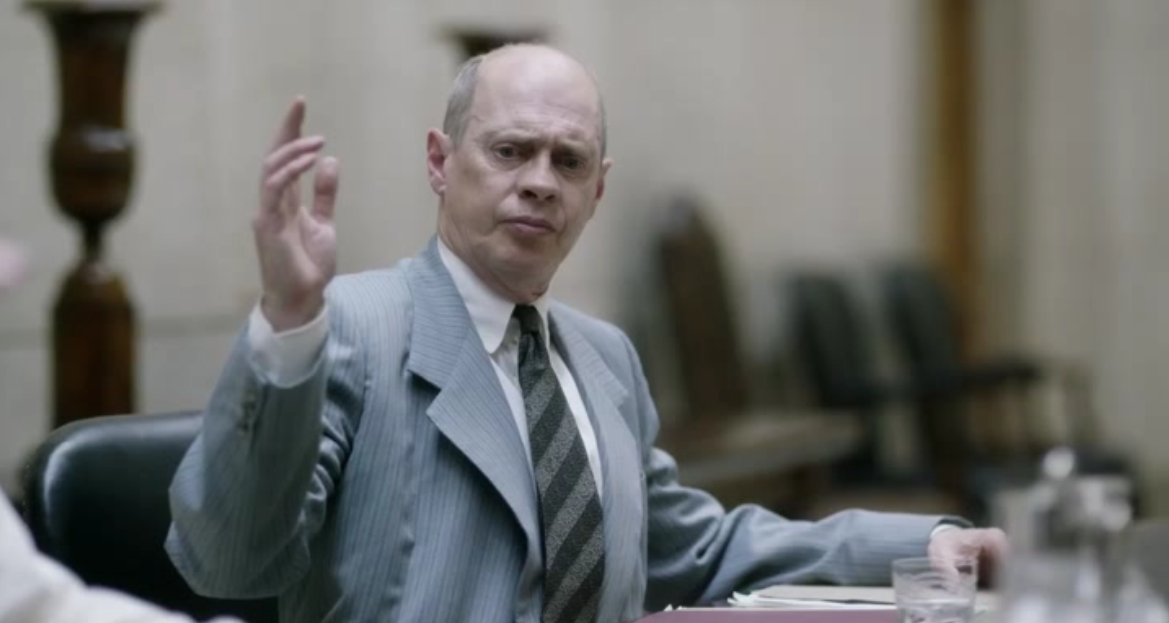
Alternate Best Supporting Actor 2017: Steve Buscemi, Simon Russell Beale, Jason Isaacs and Michael Palin in The Death of Stalin

Steve Buscemi, Simon Russell Beale, Jason Isaacs and Michael Palin did not receive Oscar nominations for portraying Nikita Khrushchev, Lavrentiy Beria, Georgy Zhukov, and Vyacheslav Molotov respectively in The Death of Stalin.

The Death of Stalin is a hilarious and biting dark satire focusing on the immediate political fallout in the U.S.S.R from the titular "loss".

An essential ingredient to making this very exact tone of the satire to work is found within the cast. This includes just strong performances all around in the best ensemble from 2017, but it goes further than that in terms of the very nature of the casting and the performances. It's best to begin then with Steve Buscemi as he would unlikely be anyone's first casting choice for Nikita Khrushchev in a film about the history of the Soviet Union, or even in a prestige British representation of such a story. The Death of Stalin is neither of those things of course in its approach and Steve Buscemi's casting is a perfect representation of this approach. The idea isn't to represent a strict historical truth in the least, though there is historical truth to be found in the film, but rather it purposefully sets itself outside of this to create a unique satirized version of Russian. This makes Brooklyn born Buscemi as just a natural part of the film. He is not only a natural part though but Buscemi's style as an actor ends up being this rather natural fit to who Khrushchev will be in the film, which is as our "hero" the use of quotations very much needed there. Buscemi's unassuming performance style though is the right one for that of Khrushchev who is just as much of a political operator as his chief rival, but Buscemi's approach just makes him seem all the more approachable.

This is in stark contrast to Simon Russell Beale as Lavrentiy Beria the man in charge of NKVD who essentially were the police in the Soviet Union who performed the most dirty of the dirty work of Stalin's regime. Beria is the film's "villain" however again that is as much of in need of quotations as the use of hero for Khrushchev. Beale's performance though is this fascinating little juxtaposition as he makes Beria essentially the most honest dishonest man around. This is as Beale so embraces the very nature of the man in his portrayal as someone who genuinely thrives in the system. Beale conducts himself with this most definite ease in itself in almost every moment as the smoothest of political operators mainly because he so understands the situation he is in. When early on he casually mentions one of their colleagues will soon be gone, to be taken away by the police, Beale delivers it with such a glib attitude that establishes Beria so effectively before the plot even begins. Beale reveals this man as oh so comfortable with his existence within this system who unlike the other men does not put on any other personal delusional fronts. In that what Beale does is stand out among the pack as the man most comfortable with being a completely despicable human being. That devilish grin of his and wily eyes are of the man who has long fashioned himself within this life of backstabbing without a single hesitation in any facet of it.

The titular event, while at first Stalin just becomes incapacitated, springs all the men of the inner circle into action in order to attempt to find their own ways to take advantage or deal with the situation. Naturally enough Beria is the swiftest to take action, and Beale properly shows a man glorying in the acts as he for a very brief period is unencumbered by any authority above himself. There is such a horrible glee that Beale brings in every little bit of use of power in these scenes particular his exact joy when giving out a new list of people to be taken away or possibly killed. Beale delivers the needed incisiveness in every word as he goes about in his act of seizing power through his alternate source of power by quickly making a puppet out of Jeffrey Tambor's Georgy Malenkov who technically is next in line by virtue of procedure. Beale's great in his interactions with Tambor in these moments by speaking to every word with him either with the man as though he's offering specific and leading stage direction to a bad actor though occasionally with a more terrifying glance to suggest his capability to destroy the man if he doesn't properly stay in line. Beale brings the right type of physical presence in the role in a very unique way as in the way he holds sway by carrying himself with this calm command, and those eyes of his which almost always carry that unmistakable intensity of a true political, well really any kind of, cutthroat.

This is against Buscemi's portrayal of Khrushchev which he brings a bit of natural manic energy to as he first comes on the scene of Stalin fitting to a man just quickly trying to come up with a way to deal with the situation that will determine his fate. Buscemi's great here in figuring out this exact way Khrushchev puts forth his way of dealing with his office, which is much more as a proper politician, though that is not necessarily a good thing. Buscemi's very enjoyable in bringing out this sort of the need to act as the politician kicks in at seeing Stalin's soon to be corpse, as he so overly expresses his sorrow as a proper man of the people giving his respects to their leader. Buscemi oversells this in the right way as the man just really enforcing the act showing Khrushchev playing this as a man trying to make sure onlookers note that "Khrushchev almost wept at seeing Stalin's corpse". Buscemi though is careful to show that Khrushchev is not a true fool, but even that act is a maneuver that he quickly drops at the sight of Stalin's urine soaked pants. Buscemi properly switches gears in that moment to show Khrushchev basically switching to the political operative mode though, after fulfilling the politician's duty, as he begins to deliver his own incisive ways though in a different way than Beale which is a strangely key thing in this film.

This key element is in the difference between Buscemi's approach to Khrushchev against Beale's portrayal of Beria which is a fascinating interplay particularly in terms of audience perception of each. This is one of the, many, brilliant parts of the film as really Khrushchev isn't a good guy either, yet I found myself siding to him by how well these performances realize these two characters. Buscemi again brings the right unassuming quality, which is in part the politician act, however he goes further to show it with a bit of honesty in that he cannot embrace really evil in the same way Beria does. Beale on the other hand does show the more honest dishonest man by in no way hiding the gruesome grotesque nature of the man. Beale particularly puts so much hideous elation when finding a new rape victim, or delivering the mentions of his own ill deeds so brazenly. In a way this is more honest than Buscemi's portrayal who shows Khrushchev as someone, who to be fair isn't as evil anyways, but also manages to delude himself to a certain degree. Buscemi however makes Khrushchev more likable also though by bringing this emphasis on the idea of the man as having any reluctance in being a cutthroat. Buscemi again is careful in the way he reveals this in these moments as once again more for show in the reluctance, however it is much appreciated for decency's sake.

Of course these two it needs to be also said are hilarious here in just kind of a traditional comedic way in every single scene. This is in part due to the two's flawless delivery of the rich dialogue given to them. Beale delivering Beria's one liners though as more exact daggers into anyone who dare trespass him, Buscemi, again somehow being likable in this by bringing more of a sardonic energy in cutting down his opponents such his "two clowns, one joke between you" to deflect an insult by two of the less powerful members of the inner circle. Their performances also are hilarious in terms of their physical energy that is classically comedic. I have particular affection in Beale's work for his way of portraying Beria's mad dashes while disposing of and replacing files while Stalin lies dying on the floor. Buscemi also excels in this regard particularly in the scene of Stalin's funeral wake where Khrushchev tries to get a better spot to hear a conversation between members of the inner circle by attempting to make it look like it is part of the ceremony. The conviction that Buscemi brings in each step, and again a bit of that false properness of a politician, as this very refined act that is in fact just trying to be in a better place to eavesdrop. Beale and Buscemi make for a great pair though as the two true leaders of the two sides matching each other well as Beale the oh so assured monster, against Buscemi the proper harried underdog.

Of course in this power struggle there are many players with two of them perhaps being the most important as the wild cards in this game at a very grand scale. The first being Jason Isaacs's Georgy Zhukov the leader of the armed forces. Isaacs is essentially Peter Capaldi's Malcolm Tucker for this political satire as a man who doesn't give two "excrements" about making himself heard and heard well. Isaacs comes in fast and hard as a man almost with more medals than will fit on his uniform and Isaacs properly is as proud as that amount of medals would suggest. Although Beale and Buscemi do have their own form of command here, Isaacs delivers a different sort of a man who has fought hard and long with his particularly, and so deliciously blunt delivery of "What's a war hero got to do to get some lubrication around here" before being introduced in text by the film. Isaacs conducts himself as a man who kind of is aware of power in a more direct and obvious way as a proper soldier.  Isaacs's gruff accent is perfect for the role as a man ready to growl and pounce at any point. Isaacs delivers every one of his take down with particularly pinpoint accuracy fitting to a man who doesn't mind risking death with words given his more hands on experience with death. Isaacs is a treat every single minute he is onscreen by in every moment conducting himself with such a comedic, yet real, intensity that is absolutely perfect. He's just a joy to watch while also wholly fulfilling his particular role which is as man who makes his points clearly and directly to make sure they are heard. Isaacs has so much fun here as the man who has no delusions in a different way in that he plays the game with a different sort of perspective on the whole thing, since again power is different to him. My favorite scene of his though has to be when Khrushchev goes to seek help from him to dispose Beria, to which Isaacs delivers a magnificent false concern about Khrushchev's idea before revealing this to be only a joke, and that he is more than eager to destroy Beria. It just a moment of pure comic gold sold to perfection by Isaacs's performance, which there is not a lot of here, but every second of it is something quite special.

The other wildcard is in Michael Palin's Vyacheslav Molotov. I have to say first off I couldn't be happier at Palin's return in this film after having not appeared in a mainstream live action film in almost 20 years. They couldn't have asked for a better actor though to pull off the tricky part of Vyacheslav Molotov, Stalin's most loyal man but also the one who was to be taken away in the opening of the film. Now this requires a certain balance of things in this role, that thankfully Palin is a master of. Molotov is of course partially defined by the fact that Stalin had his wife imprisoned, used by Beria as a sex slave, though Molotov remained working with Stalin. Palin, as always, brings an innate charm to the part here just in this way as an affable old statesman that from the moment you hear he's going to be taken away, it is very easy to feel sorry for him. Palin in addition though finds a real pathos as he remarks on the loss of his wife though, and convincingly finds this strange state of the man. He offers a genuine earnestness in portraying the feelings of a loving husband, but where the comedy comes in is how this fashions through the type of man that is Molotov. Molotov being absolutely loyal to Stalin to the point that when he hears he was originally going to be taken away by the police, Palin only offers the most honest, and in turn hilarious, concern as he ponders how he could've wronged Stalin. Palin is exceptional in the way he is able to make this sort of ridiculous state of the man actually believable by just how well he can be absurd yet believable at the same time. This becomes particularly important once Khrushchev and Beria try to fight for his support, where Beria brings Molotov's wife to bribe the man, while Khrushchev tries to play towards the man's strict loyalties. Palin plays again finds a certain quality of the loving husband when he sees his wife and reveals a most genuine jubilation at the initial sight of her. Palin though makes the love of the husband real, however he still reveals that what is more important to him is his loyalty to Stalin, which requires that he see his wife as a traitor. Palin again is equally funny when revealing Molotov's support for Khrushchev's power play, because he brings such a fervent devotion to the denouncement of his wife, since according him Stalin was right, which he feels Beria wrongly absolved her of. What's so fantastic here in his performance is that Palin is able to be extremely humorous yet he makes this absurd nature of the man seem logical in his own peculiar sense of being caused by his undying loyalty to Stalin.

Khrushchev's plan to destroy Beria comes from technically both of them causing a massacre after Beria's men going about killing or at least causing the deaths of many of the Russian citizens Khrushchev allowed in to attend Stalin's funeral. Khrushchev though makes the first step which again I love how Buscemi brings such a dogged determination that again somehow makes him seem the righteous one even though he is just about as guilty in causing the deaths as Beria is. This is against Beale's depiction of Beria who is effectively just so smug you can't help but hate the guy who seems so assured of his grotesque abuse of power. Beale naturally keeps this quality when he is initially taken prisoner and he believes he might be able to get his way out of this still. Beale carries himself with such a firm disregard for everyone around him, carrying such venom in every delivery of his as he denounces everyone around him while also lashing out at everyone around him. Beale still carries that personality of command as though he keeps such a viciousness in his hatred, though with enough of a creeping up undercurrent of unease, but mostly something Beale portrays as being overwhelmed by Beria trying to stand firm in his position of power. Of course his insults get him nowhere and the inner circle decide to blame him for the massacre, and quickly make a trial and convict him in no time at all. Now this final sequence I think is a testament to the genius of the film, and to the strength of the performances of all particularly Buscemi and Beale's. This is the one scene that strictly and mostly strongly moves closest to the purely dramatic. There have been talk of deaths, and even the sight of them, however with a purposeful distance within the satire. This one scene that makes it more tangible because the violence finally happens to a named character who we know, which is Beria. What's so brilliant about this is he's the worst of the worst, however with that in mind he still is a person we've gotten to know. In turn Beale is actually kind of heartbreaking as he loses all pretense and just brings such a palatable desperation as he begs for his life. In that moment the bluntly hits you with the reality by showing a more concrete loss of life, even though it is through the man most deserving of death in the whole film. The other touch that's so great though is Buscemi though who also changes as he loses that underdog status and reveals Khrushchev as much of a cutthroat as Beria in his ice cold deliver of his insults while the man is shot then burned in front of him. The execution of this is incredible as it is uncompromising as it reveals this story was always about a group of terrible people, though Beria might have flaunted his vile nature more openly all of the characters are very bad men. The entire ensemble here is magnificent though in realizing this duplicitous world so well in creating each and everyone of this vile sorts creating this tapestry of amorality, oh yes and being quite hilarious while doing so.
(For Isaacs and Palin)
(For Beale and Buscemi )

Friday, 9 February 2018

Alternate Best Supporting Actor 2017: Results

10. Daniel Craig in Logan Lucky - Craig goes wildly against his established James Bond type here to give a very entertaining portrayal of a southern crook that manages to get laughs even when the film undersells his moments.

Best Scene: "We're dealing with science here"
9. Hugh Grant in Paddington 2 - Grant gives a very enjoyable performance here bringing the needed charm but also the explosive ego to his villainous actor. 

Best Scene: A character conference.
8. Paul Dano in Okja - Dano gives yet another strong performance here bringing such warmth and delivering an uncompromising empathetic figure within a film that is very much in need of one.

Best Scene: Taking the stage.
7. Jack Dylan Grazer in It - Grazer gives the best performance of the loser boys as he not only adds so much  to the overall chemistry of the group, but also has some stand out individual moments through his arc that he realizes so well.

Best Scene: Gazebos.
6. Mark Hamill in Star Wars: The Last Jedi - Although I think his performance is slightly weakened by the forced humor given to his character, Hamill delivers a powerful reprise here in his depiction of a broken man.

Best Scene: Final scene with Leia.
5. Jerome Flynn in Loving Vincent - Flynn in one major scene makes a tremendous impact that sums up the nature of van Gogh's death through his moving portrayal of the man who blames himself for it. 
4. David Lynch in Lucky - Lynch delivers some Lynchian greatness here as he manages to be both hilarious yet heartbreaking in his portrayal of a man who has lost his tortoise.

Best Scene: Coming to terms with tortoise loss.
3. Romain Duris in All the Money in the World - Duris quietly steals this film in his dynamic and moving depiction of the crisis of conscience of his kidnapper who struggles with his innate goodness as he tries to be a bad man.

Best Scene: The amputation.
2. Will Poulter in Detroit - Poulter's work is truly disturbing here as rather than portraying an overt drooling racist he depicts a calm and confident one who doesn't need to announce his prejudice as obvious hate rather he puts it within his horrible actions.

Best Scene: Interrogation tactics gone wrong. 
1. Patrick Stewart in Logan - Good Prediction Michael McCarthy. Patrick Stewart gives a heartbreaking reprise of his most famous cinematic role. He realizes the real tragedy of the Professor's demise through how far he has fallen through his failing mind, but also finds a real poignancy just in those minor hints of the man he once was.

Best Scene: The most perfect night. 
Overall Ranking:
  1. Sam Rockwell in Three Billboards Outside Ebbing, Missouri
  2. Kōji Yakusho in The Third Murder
  3. Sebastian Stan in I, Tonya
  4. Woody Harrelson in Three Billboards Outside Ebbing, Missouri 
  5. Patrick Stewart in Logan
  6. Willem Dafoe in The Florida Project
  7. Will Poulter in Detroit
  8. Romain Duris in All the Money in the World
  9. David Lynch in Lucky
  10. Jason Isaacs in The Death of Stalin
  11. Jerome Flynn in Loving Vincent
  12. Mark Hamill in Star Wars: The Last Jedi
  13. Tom Skerritt in Lucky
  14. Christopher Plummer in All the Money in the World
  15. Jack Dylan Grazer in It
  16. Michael Palin in The Death of Stalin
  17. Paul Dano in Okja
  18. Eric Tsang in Mad World 
  19. Mark Rylance in Dunkirk
  20. Algee Smith in Detroit
  21. Richard Jenkins in The Shape of Water
  22. Michael Keaton in Spider-man: Homecoming
  23. Hugh Grant in Paddington 2
  24. Daniel Craig in Logan Lucky
  25. Nawazuddin Siddiqui in Mom
  26. Bruce Greenwood in Gerald's Game
  27. Jason Mitchell in Mudbound
  28. John C. Reilly in Kong: Skull Island 
  29. John Boyega in Detroit
  30. Brendan Gleeson in Paddington 2
  31. Rory Cochran in Hostiles 
  32. Jean-Louis Trintignant in Happy End
  33. Ray Romano in The Big Sick
  34. Paul Walter Hauser in I, Tonya
  35. Paddy Considine in The Death of Stalin
  36. Caleb Landry Jones in Three Billboards Outside Ebbing, Missouri
  37. Cillian Murphy in Dunkirk
  38. Bradley Whitford in Get Out
  39. Robert Carlyle in T2 
  40. Rupert Friend in The Death of Stalin
  41. Ben Foster in Hostiles
  42. Shia LaBeouf in Borg McEnroe
  43. Armie Hammer in Free Fire
  44. Jeff Goldblum in Thor: Ragnarok
  45. Stephen Merchant in Logan
  46. Terry Notary in The Square
  47. Bill Nighy in Their Finest
  48. Thomas Kretschmann in A Taxi Driver
  49. Sharlto Copley in Free Fire 
  50. Michael Rooker in Guardians of the Galaxy vol. 2
  51. Dave Bautista in Blade Runner 2049
  52. Michael Stuhlbarg in Call Me By Your Name 
  53. Harrison Ford in Blade Runner 2049
  54. Clarke Peters in Three Billboards Outside Ebbing, Missouri
  55. Bruce Greenwood in The Post
  56. Carlos Sanz in Stronger
  57. Michael Shannon in The Shape of Water 
  58. Idris Elba in Molly's Game
  59. Jaeden Lieberher in It 
  60. Stellan Skarsgard in Borg McEnroe
  61. Anthony Mackie in Detroit  
  62. Kenneth Branagh in Dunkirk 
  63. Bob Odenkirk in The Post
  64. Ewen Bremner in T2
  65. Gil Birmingham in Wind River
  66. Dave Bautista in Guardians of the Galaxy vol. 2
  67. Michael Stuhlbarg in The Shape of Water
  68. Jon Hamm in Baby Driver 
  69. Luke Evans in Beauty and the Beast
  70. Ian McShane in John Wick Chapter 2
  71. Ben Mendelsohn in Darkest Hour 
  72. Buddy Duress in Good Time
  73. Lakeith Stanfield in Get Out 
  74. Traci Letts in Lady Bird
  75. Peter Dinklage in Three Billboards Outside Ebbing, Missouri
  76. Bill Skarsgård in It 
  77. Austin Stowell in Battle of the Sexes
  78. Jack Reynor in Free Fire 
  79. O'Shea Jackson Jr. in Ingrid Goes West
  80. Kurt Russell in Guardians of the Galaxy vol. 2 
  81. Jared Leto in Blade Runner 2049
  82. Jack Lowden in Dunkirk
  83. Danny McBride in Alien: Covenant
  84. J. Quinton Johnson in Last Flag Flying
  85. Ben Safdie in Good Time
  86. James Darren in Lucky
  87. Woody Harrelson in War for the Planet of the Apes 
  88. Ryu Jun-yeol in A Taxi Driver
  89. Tom Hiddleston in Thor: Ragnarok
  90. Jamie Foxx in Baby Driver
  91. Jeremy Ray Taylor in It 
  92. Owen Wilson in Lost in London
  93. Graham Greene in Wind River
  94. Josh Gad in Beauty and the Beast
  95. Tom Hardy in Dunkirk
  96. Hugh Bonneville Paddington 2
  97. Camille Salameh in The Insult
  98. Mark Hamill in Brigsby Bear
  99. Gary Basaraba in Suburbicon
  100. Fionn Whitehead in Dunkirk 
  101. Udo Kier in Brawl in Cell Block 99
  102. Jeffrey Tambor in The Death of Stalin
  103. John Hawkes in Three Billboards Outside Ebbing, Missouri
  104. Ronald Pickup in Darkest Hour
  105. Taika Waititi in Thor: Ragnarok 
  106. Jonathan Majors in Hostiles
  107. Oscar Issac in Suburbicon
  108. Ron Livingston in Lucky
  109. Pedro Pascal in Kingsman: The Golden Circle
  110. Cillian Murphy in Free Fire
  111. Mark Ruffalo in Thor: Ragnarok 
  112. Barry Keoghan in Dunkirk
  113. Matt Walsh in Brigsby Bear
  114. Too Hae-jin in A Taxi Driver
  115. CJ Jones in Baby Driver
  116. Johnny Lee Miller in T2
  117. Timothy Spall in The Party
  118. Gael Garcia Bernal in Coco 
  119. Akshaye Khanna in Mom
  120. Ian Hart in God's Own Country
  121. Wes Studi in Hostiles 
  122. Ed Oxenbould in Better Watch Out
  123. Dwight Yoakam in Logan Lucky 
  124. Jacob Latimore in Detroit 
  125. Bill Pullman in Battles of the Sexes 
  126. Domhnall Gleeson in American Made
  127. Jesse Plemons in Hostiles 
  128. Cillian Murphy in The Party
  129. Tom Holland in The Lost City of Z
  130. Tommy Flanagan in The Ballad of Lefty Brown
  131. Joe Cole in Thank You For Your Service
  132. Chosen Jacobs in It 
  133. Steven Yeun in Okja 
  134. Kenneth Cranham in Film Stars Don't Die in Liverpool
  135. Kevin Costner in Molly's Game
  136. Aneurin Barnard in Dunkirk
  137. Eddie Marsan in Atomice Blonde
  138. Robert Pattinson in The Lost City of Z
  139. Kit Harington in Brimstone
  140. Chris O'Dowd in Loving Vincent
  141. Josh Gad in Murder on the Orient Express
  142. Paul Scheer in The Disaster Artist
  143. Barry Shabaka Henley in Lucky 
  144. Wyatt Russell in Ingrid Goes West
  145. Adnan Siddiqui in Mom
  146. Dallas Roberts in My Friend Dahmer
  147. John Goodman in Atomic Blonde
  148. Greg Kinnear in Brigsby Bear
  149. Oscar Isaac in Star Wars: The Last Jedi
  150. Boyd Holbrook in Logan
  151. Michael Smiley in Free Fire
  152. Stephen Henderson in Lady Bird
  153. Bruno Ganz in The Party
  154. Lior Ashkenazi in Norman
  155. Giancarlo Esposito in Okja
  156. Stephen Root in Get Out 
  157. Stephen Dillane in Darkest Hour
  158. John Boyega in Star Wars: The Last Jedi 
  159. Seth Rogen in The Disaster Artist
  160. Marcus Henderson in Get Out
  161. Harry Styles in Dunkirk
  162. Martin McCann in Lost in London
  163. Laurence Fishburne in John Wick Chapter 2
  164. Finn Wolfhard in It 
  165. Steve Buscemi in Norman
  166. Toby Jones in Atomic Blonde 
  167. Michael Sheen in Brad's Status
  168. Don Johnson in Brawl in Cell Block 99 
  169. Barry Keoghan in The Killing of a Sacred Deer 
  170. Sterling K. Brown in Marshall 
  171. Willem Dafoe in Death Note
  172. Armie Hammer in Call Me By Your Name
  173. Tom Glynn Carney in Dunkirk  
  174. Dwayne Johnson in Fast 8
  175. Jason Statham in Fast 8
  176. Ralph Fiennes in The Lego Batman Movie
  177. Kurt Russell in Fast 8
  178. Robert Downey Jr. in Spider-man: Homecoming
  179. Alex Lawther in Goodbye Christopher Robin
  180. Karl Urban in Thor: Ragnarok  
  181. Glenn Fleshler in Suburbicon
  182. Carel Struycken in Gerald's Game
  183. Alan Cumming in Battle of the Sexes
  184. Rob Morgan in Mudbound
  185. Ben O'Toole in Detroit
  186. Brian Gleeson in Phantom Thread 
  187. John Lithgow in Beatriz At Dinner
  188. John Magaro in War Machine
  189. Alec Secareanu in God's Own Country
  190. Benjamin Bratt in Coco 
  191. Jon Favreau in Spider-man: Homecoming
  192. Barkhad Abdi in Good Time
  193. Noah Taylor in Paddington 2
  194. James D'Arcy - Dunkirk
  195. Choi Woo-shik in Okja 
  196. Mathieu Kassovitz in Happy End
  197. Eddie Izzard in Victoria and Abdul
  198. Bokeem Woodbine in Spider-man: Homecoming
  199. Morgan Spector in Chuck
  200. Anthony Hopkins in Thor: Ragnarok
  201. Peter Capaldi in Paddington 2 
  202. Bobby Cannavale in I, Tonya
  203. Wyatt Oleff in It 
  204. Derek Jacobi in Murder on the Orient Express
  205. Matvey Novikov in Loveless
  206. Franz Rogowski in Happy End
  207. Adeel Akhtar in The Big Sick
  208. Jason Mitchell in Detroit
  209. Lakeith Stanfield in War Machine
  210. Colin Firth in Kingsman: The Golden Circle 
  211. Donald Glover in Spider-man: Homecoming 
  212. Brian Gleeson in Logan Lucky
  213. Jack Quaid in Logan Lucky
  214. David Thewlis in Wonder Woman
  215. Kwon Hae-hyo in On the Beach at Night Alone
  216. Sam Riley in Free Fire
  217. Ron Perlman in Chuck
  218. Richard E. Grant in Logan
  219. Jonathan Pryce in The Man Who Invented Christmas 
  220. Alex Wolff in My Friend Dahmer
  221. Samuel L. Jackson in Kong: Skull Island
  222. Nicholas Hamilton in It  
  223. Sam Claflin in Their Finest
  224. Marton Csokas in Mark Felt
  225. Jung Jae-young in On the Beach at Night Alone
  226. Michael Rapaport in Chuck
  227. Traci Letts in The Post 
  228. Johannes Krisch in In The Fade
  229. John Goodman in Kong: Skull Island
  230. Colin Farrell in Roman J. Israel, Esq. 
  231. Michael Cera in Molly's Game
  232. Beulah Koale in Thank You For Your Service
  233. Mark Strong in Kingsman: The Golden Circle
  234. Lance Reddick in John Wick Chapter 2
  235. Christopher Plummer in The Man Who Invented Christmas
  236. Jim Gaffigan in Chuck 
  237. Denis Moschitto in In The Fade
  238. Said Taghmaoui in Wonder Woman
  239. Matthias Schoenaerts in Our Souls At Night
  240. Jacob Batalon in Spider-man: Homecoming 
  241. Bradley Cooper in Guardians of the Galaxy vol. 2
  242. Willem Dafoe in Murder on the Orient Express
  243. Lucas Hedges in Lady Bird
  244. Bill Camp in Molly's Game
  245. Billy Crudup in Alien Covenant
  246. Timothee Chalamet in Lady Bird
  247. Ewan Bremner in Wonder Woman 
  248. Michael Cera in The Lego Batman Movie 
  249. Christopher Fairbank in Lady Macbeth
  250. David Cross in The Post 
  251. Anupam Kher in The Big Sick
  252. Jon Bernthal in Wind River 
  253. Paul Hilton in Lady Macbeth
  254. Tom Hanks in The Circle
  255. Domhnall Gleeson in Mother!
  256. Ezra Miller in Justice League 
  257. Nick Offerman in The Hero 
  258. Shea Whigham in Death Note
  259. Paul Anderson in Brimstone
  260. Jacob Tremblay in The Book of  Henry
  261. Michael McElhatton in The Foreigner
  262. Emory Cohen in War Machine
  263. Christopher Lloyd in Going in Style
  264. Ian McKellen in Beauty and the Beast 
  265. Udo Kier in Downsizing
  266. Peter Fonda in The Ballad of Lefty Brown
  267. Leslie Odom Jr. in Murder on the Orient Express
  268. Tim Blake Nelson in Colossal
  269. Lee Pace in The Book of Henry
  270. Michael Sheen in Norman
  271. Dominic West in The Square  
  272. Christopher Abbot in It Comes At Night
  273. Caleb Landry Jones in The Florida Project
  274. Noah Taylor in Free Fire 
  275. Michael Stuhlbarg in The Post 
  276. Christoph Waltz in Downsizing
  277. Stephen Graham in Films Stars Don't Die Liverpool
  278. David Yow in I Don't Feel at Home in This World Anymore
  279. Jesse Plemons in The Discovery
  280. Sunny Suljic in The Killing of a Sacred Deer
  281. Arnaud Valois in BPM
  282. Jim Caviezel in The Ballad of Lefty Brown
  283. Caleb Landry Jones in Get Out
  284. Steve Zahn in War For the Planet of the Apes
  285. Owen Wilson in Wonder
  286. Ed Harris in Mother!
  287. Bradley Whitford in The Post
  288. Benicio del Toro in Star Wars: The Last Jedi
  289. Dustin Hoffman in The Meyerowitz Stories
  290. Garrett Hedlund in Mudbound
  291. Aleks Mikic in Better Watch Out 
  292. Israel Broussard in Happy Death Day
  293. Jack Reynor in Detroit
  294. Aidan Gillen in The Lovers 
  295. Brian Gleeson in Mother!
  296. Lucas Hedges in Three Billboards Outside Ebbing, Missouri
  297. Jason Momoa in Justice League
  298. Riz Ahmed in Una
  299. Jordan Rodrigues in Lady Bird
  300. Andy Serkis in Star Wars: The Last Jedi 
  301. Lil Rel Howery in Get Out 
  302. Ian Glen in My Cousin Rachel
  303. Matthew Rhys in The Post 
  304. Jon Hamm in Marjorie Prime 
  305. Tom Hollander in Breathe
  306. Robert Redford in The Discovery
  307. Ray Fisher in Justice League
  308. Adeel Akhtar in Victoria & Abdul 
  309. Emory Cohen in Shot Collar
  310. Tim Robbins in Marjorie Prime 
  311. Dan Stevens in Colossal
  312. Jim Belushi in Wonder Wheel 
  313. Zach Efron in The Greatest Showman
  314. Austin Abrams in Brad's Status
  315. Jason Clarke in Mudbound
  316. Henrik Rafaelsen in Thelma
  317. Eugene Brave Rock in Wonder Woman 
  318. Seth MacFarlane in Logan Lucky 
  319. Ewan Mcgregor in Beauty and the Beast
  320. Jay Hernandez in Bright 
  321. Johnny Depp in Murder on the Orient Express
  322. Oliver Platt in Professor Marston and the Wonder Woman
  323. Jeffrey Donovan in Shot Collar
  324. Dacre Montgomery in Better Watch Out 
  325. Scott Eastwood in Fast 8
  326. J.K. Simmons in The Snowman
  327. Common in John Wick Chapter 2
  328. Edgar Ramirez in Bright 
  329. John Ortiz in Going in Style
  330. Domhnall Gleeson in Star Wars: The Last Jedi
  331. John Slattery in Churchill
  332. Jeremy Strong in Molly's Game
  333. Tyler Ross in The Lovers
  334. Toby Kebbell in Kong: Skull Island
  335. David Dencik in The Snowman 
  336. Bo Burnam in The Big Sick
  337. Chris O'Dowd in Molly's Game
  338. Clancy Brown in Stronger
  339. Danny Huston in Wonder Woman
  340. Zack Galifianakis in The Lego Batman Movie
  341. Billy Magnussen in Ingrid Goes West
  342. Dean Norris in The Book of Henry 
  343. Devon Graye in I Don't Feel at Home in This World Anymore
  344. John Krasinski in Detroit
  345. Ike Barinholtz in Bright
  346. Kurt Braunohler in The Big Sick 
  347. Mike Colter in Girls Trip
  348. Jonathan Banks in Mudbound 
  349. Jonas Karlsson in The Snowman
  350. Michael Mando in Spider-man: Homecoming
  351. Caleb Landry Jones in American Made
  352. Jake Gyllenhaal in Okja 
  353. Riccardo Scamarcio in John Wick Chapter 2
  354. Thomas Mann in Kong: Skull Island 
  355. James Jordan in Wind River
  356. Elton John in Kingsman: The Golden Circle
  357. Ellar Coltrane in The Circle
Next Year: 2017 Lead

Alternate Best Supporting Actor 2017: Mark Hamill in Star Wars: The Last Jedi

Mark Hamill did not receive an Oscar nomination for portraying Luke Skywalker in Star Wars: The Last Jedi.

The Last Jedi is a bit of the Dark Knight Rises of Star Wars movies as it becomes bloated by its expansive narrative and rare is there satisfactory execution within its exploration of some admittedly interesting ideas at times.

Although I do not care for The Last Jedi, I will say that some of the negativity towards the film is a bit overblown. In that those who say it is the worst Star Wars film of all time, even saying it is worse than the best prequel is going too far. The reason being in terms of just more basic film making techniques this film is clearly superior as well as in the acting. This brings me to Mark Hamill's long awaited return to his iconic role after his brief non-speaking role at the tail end of The Force Awakens. Unfortunately as we pick up from that I must return to more negativity by addressing the use of the film's humor, don't worry this will be the darkness before I get to the dawn. The aforementioned film did have a bit more humor overall than a typical Star Wars film however it was placed correctly for the most part. There is humor in the original trilogy as well however it is placed in the lulls of the action, The Force Awakens mostly followed this idea it just had a little more of it. There is one mistake in the opening of that film where Oscar Isaac's Poe is perhaps a little too casual with the film's chief villain Kylo Renn. That was only a minor offense though amplified to outrageous proportions in this film where Poe goes about the same behavior though now in almost pop culture referencing levels where he makes "your momma" and call waiting jokes to Domhnall Gleeson's General Hux.

This humor is consistently used at the wrong time and wrong place throughout this film. This includes making the villains goofballs, making Yoda behave as he does before he reveals himself to be Yoda to Luke in The Empire Strikes Back for some reason, but no example of this is more egregious than its use in the character of Luke Skywalker. Now Luke Skywalker was never an overly comical character in the original series, he was usually the earnest one that Harrison Ford's Han and Carrie Fisher's Leia bounced off of. For Luke to develop a more overt sense of humor in his old age is perfectly fine, that's not the humor of the character in this film that feels forced upon Hamill's performance. These are moments that are breaks in whatever else Hamill is doing in a given scene to make the audience laugh no matter how detrimental they may be to the dramatic potential of a scene. This is within the opening scene of the film where we come off of Rey (Daisy Ridley) returning his father's old lightsaber on the top of his island hideaway. In the previous film, the one piece of acting we get from Hamill in that film, we see a man haunted by the sight of the item, clearly taking it in and facing something from his past. In this film we get that moment then he tosses it. He tosses in a way to get a chuckle, a wah wahhhhh wouldn't have been out of place, from the audience yet it is a scar within this performance. I have no doubt this was a directorial, if not studio, mandate. It undercuts what Hamill did in the previous film, and makes no sense for the character. The idea that the man would toss it, as though it had not a single meaning to him whatsoever is the problem.

If he tossed it as though he wanted to avoid it, that would be fine, if tossed as though it caused him pain, that would be fine, but no, his father's lightsaber, the lightsaber given to him by his old mentor, he just whips it back as though he had absolutely no connection to it whatsoever. This isn't the act of a guy with a sense of humor, this isn't the act of the character we knew or we come to know even in this film, it's a goofy moment to get a cheap laugh. This sadly is not the only moment, and again just want to get through these negatives since there will be positives soon...I promise. Another moment is when is speaking to Rey and asks where she's from, to which she says nowhere, and then he says "Nobody is from nowhere" and she says "Jakku", and to which Hamill is forced to stop whatever else he is doing and go " Yeah, that's pretty much nowhere" as though he's in a sitcom. It stops whatever else he's doing in the scene to break, do something out of a character just for a good old hyuk hyuk hyuk because here in Disneyland we can't stomach a dramatic scene for more than four minutes at a time. There is one more time of this when he's training Rey to reach into the force where he messes with her with a leaf, however while I still don't think it's funny and is problematic as the force was always treated with gravity in every other film, Hamill at least makes this moment work in that it seems natural in the context of the overall scene. Hamill makes it feel like a bit fooling around rather than becoming automatized into ill-fitting joke mode that we saw previously.

Now putting that aside for a moment let's take a look at what Hamill does for the majority of his performance. Hamill actually does overall continue from that one haunted expression in the last film to portray Luke as this bitter man. His eyes are world weary, there is not a hint of any joy in him as he goes about his day, which I won't get into too much detail since I'll get annoyed again, but Hamill delivers in creating this sense of just a man burdened by his experience. We don't know exactly what he's been through yet Hamill expresses in every part of him this sense of exhaustion that has changed Luke to this man we meet here. When Rey asks him to go back to help, Hamill delivers his lines as a man who has been through one too many fights in his life within his exasperated and cynical responses to these requests. Hamill really plays into the age of the character as he says every line of a man scarred by his experience far from the hero of long ago at the end of The Return of the Jedi. We are not given a glimpse of anything else until when he reunites with Chewbacca who lets Rey into Luke's hut by literally breaking down the door. In this moment, and later he sees R2D2, are great moments by Hamill. As his delivery seems to de-age about thirty years as he says their names. He's back for just a second to the hopeful boy moisture farmer, and in these moments you really get a sense of the friendship that still is strong in the mind of his Luke towards the people he cares about.

Those moments though are only momentary respites towards his friends while towards Rey he continues as this irritable old man. Hamill does not make this one note either though as Luke begins the training through three lessons, we only see two for whatever reason, on why he believes the Jedi need to end. Hamill brings this great begrudging quality to every spoken word as he explains to Rey how the force works, the words once spoken with far more appreciation by his old masters, but now Hamill shows Luke spouting them out with almost certain hatred towards the word. When Rey reveals her level of power to the point she even reaches into the dark side Hamill is incredible in his reaction. He seizes up in fear showing Luke essentially with ptsd as the reaction isn't a general fear, it is this fear of the past. There is a sadness in it as he says he saw it once before, but it didn't scare him enough before. In this scene Hamill reveals some of the memories that cause his suffering and correctly he attaches these to basically the character's grumpiness. He's not just some angry old man, Hamill offers the proper context within where this comes from. He furthers this in every scene with Rey as he explains the Jedi's past failures in his second lesson. There is no care or affection that Hamill grants just a disgruntled man examining the faults of the past. When Rey though suspects he's closed himself fully from the force though Hamill is great in that he portrays a direct shame. A shame not of a bad man, but of a former hero who has run from his problems and the beliefs he once held so strongly.

The revelation of the full extent of Luke's past with his former student, and now near ultimate evil Kylo Ren aka Ben Solo (Adam Driver) is where of the great controversies of the film lies. This is actually one decision I don't have a problem with since you do need to take the character somewhere, however I do understand why others hated it including Hamill himself. After all it does perhaps seem strange that the man who refused to kill his own father, who was obviously very evil, would preemptively try to kill his nephew, but hey time can change people. Now Hamill to his credit, despite his own personal reservations, puts his all into his portrayal of the confession scene. When Rey initially confronts him Hamill reveals just the full anger again now revealing itself naturally to be the anger of a man hiding from something he did than just at the world in general, part of that is the shame that is so overwhelming in his work. When he finally is forced to explain Hamill is outstanding in revealing in his eyes such an overwhelming sadness of the failures of the man, with this palatable sense of despair when he notes his hand in creating Kylo Ren even if from a momentary weakness. In the scene Hamill makes sense of who Luke is in this situation now, which is someone trying to lose himself within his suffering by essentially lashing out at anyone or anything that expects more of him. When Rey though states her belief that she can save Kylo, Hamill delivers now a more passionate anger towards the idea creates this sense that he's understood this to be a lost cause for some time.

Luke eventually returns to the force due to these confrontations by Rey which leads again to some strong acting by Hamill. This is particularly in the moment where he initially reconnects speaking to Leia through the force, and Hamill expresses the intensity of that emotion, the man allowing himself to touch his past once again something rather powerful. It also leads to the reappearance by wacky Yoda, who never existed, and has since changed his philosophy from "Do or do not. There is no try" to failure is the best teacher. Kind of a complete 180 there which is also the theme of the movie being you gotta fail to succeed sometimes, while not if you're in a fight to the death then you're just dead! Anyway Yoda goes off to tell him that Rey knows more than him and she's surpassed him, despite almost no training from him because that's great writing, or lazy writing...I forget. Now I know I'm getting off topic a bit however that moment suggests really more time should have been spent on the island between Rey and Luke. Unfortunately this film suffers from the horrible condition of seeming to rush its good elements while dragging out its bad ones. That leaves only one sequence left for Hamill to return to the Luke we once knew and loved. I will say, despite the limited screen time, Hamill makes this transition convincing and effective by having those moments with his old friends by showing the younger man still there, making it so he did not really need to go too far to return to his old self. Also Hamill doesn't completely just become young Luke, rather he still shows the wear in the man, but now with the determination to fight. Hamill is excellent in this final sequence bringing now that sort of hero's bravado as he steps out to face Kylo, with even a cool of a true hero in his particularly efficient delivery of his one liners.

There is though still just enough of a shame there in Hamill's portrayal when Luke apologizes to Kylo for his past mistakes, but now more hidden by his conviction to confront the man. Hamill in presence delivers the Luke of legend, the man who faced down the emperor and defeated Darth Vadar once again. The man who said "I'm a Jedi like my father before me" as he once again commands that same confidence and power. Of course this confrontation, through force projection, leaves him to fade away into the force for some reason, even though Obi-Wan did right before he was going to be killed, and Yoda was dying from extremely old age there is no real reason why this should have killed Luke especially as it takes some of the oomph from his epic delivery of "see you around kid" to Kylo since I guess he won't see him around. Again just another problem I have with the film, but not Hamill's performance. My favorite moment in his work though is probably just before that scene when he "physically" meets up with Leia. It's a wonderful scene with Hamill bringing such a tenderness in this moment of recognizing loss, and it is a beautifully rendered both as a moment within the film recognizing Han's death, but also outside of it as this final onscreen time shared by Mark Hamill and Carrie Fisher. He creates such a tremendous since of warmth in that moment that is particularly cathartic when compared against the colder man we knew throughout. This is a legitimately fantastic performance by Mark Hamill however I cannot ignore the scenes I mentioned at the beginning of this review. They are there, and they're a blight on this performance. I'm sure they were not Hamill's choices but unfortunately they're realized through his work, to the detriment of it. They not only take me out of the performance, out of the scene, but also the film when they happen. It's a real shame because if it were not for those moments this would be the best performance in a Star Wars film, instead it's merely one of the best.

Thursday, 8 February 2018

Alternate Best Supporting Actor 2017: Patrick Stewart in Logan

Patrick Stewart did not receive an Oscar nomination, despite being nominated for BFCA, for portraying Professor Charles Xavier aka Prof. X in Logan.

Long before the first X-Men film was ever made Patrick Stewart was seen as the one man to bring the comic book telepath and leader of the X-Men to the screen. As expected Stewart did not disappoint in the role however the films rarely seemed to fully serve him as a character, leaving most of the actual exploration of the role to his successor James McAvoy. In the original films they went out of their way to put him out of commission for long periods whether it was due to some green stuff in Cerebro, a lobotomized telepath, or being glittered away by the dark phoenix Stewart was rarely granted the appropriate time to shine. It is notable that before this film it was only his side story portion of Days of Future Past, where it seemed like he was allowed to properly sink his teeth into the part. Finally though Stewart managed to find himself in a more character driven X-Men film through this film as the aged Professor hiding out near the U.S./Mexican border with Hugh Jackman's Wolverine/Logan taking care of him in his decrepit state. This role is not only a departure for Charles Xavier but Stewart in general who is best known for his refined roles usually as a mentor figure.

What Stewart does here is fascinating in that this performance essentially must make sense of a mess of a mind. Stewart's performance has a great challenge in that as written Charles is all over the place because he has dementia and his mind, which used to be the source of his power, is fading away. Stewart needs to not only make these inconsistencies make sense, he must also connect them to the Prof. X we once knew. Stewart must make these dramatic shifts natural by realizing them each as a part of the broken man and in one phase or another of his mind while it is falling apart. The earliest scenes Stewart reveals Charles at his very worst, but not in the same way depending on the situation. In his first scene Stewart is quite great in portraying the man completely caught up on drugs and raving like a complete maniac. Stewart finds even a real tragedy in these ravings by showing this man that Logan, really even the audience, greatly revered into this complete mess of a man. Stewart makes this drugged up state particularly unusual though for a man once capable of reading every person in the world's mind now echoing just random thoughts of a man now lost in them. Charles does have a worst state than that when he undergoes seizures, which Stewart shows as the man just completely breaking down within himself that unfortunately unleashes a shock wave that becomes potentially fatal to everyone within the vicinity, that is only satiated through a direct injection which brings forth a more coherent Charles.

Stewart still does not show this to be the man Logan or we once knew by any margin. He's far more sorrowful and it downright heartbreaking to believably see the professor in this state. A state now where he reveals an actual cynicism when lashing out at Logan which Stewart plays as part mental decay, but also part of failures over the years to genuinely help the man away from his own personal demons. As rough as some of these interactions are though Stewart and Jackman both make use of the chemistry they've built over the long running franchise. The years are inherent within them and their interactions have that vibrancy as there is a glint of tenderness even if it buried over years of suffering. It is within that mess of the mind that Stewart makes such an essential and authentic part of his portrayal though where at times there is that moment of clarity, but others just rambling anger of a jumbled mind. Every switch Stewart makes just part of that jumble and that is what makes him so effective in truly revealing this decaying mind that rarely has a consistent state. The one more concrete change comes with the introduction of Laura aka X-23 (Dafne Keen) a young mutant seeking helping from Logan in order to escape her captors/creators. Stewart is outstanding the way he brings a bit of optimism back to the old professor as he treats Laura with such an absolute uncompromising affection of the man who use to believe in the best of anyone.

That spark that created the notion of the X-Men returns in Stewart's performance, but what makes this even more poignant is how faint he depicts it. He does not suddenly become the old professor, not by a long shot. Stewart still shows the man dealing with his decaying mind in this state but now with the ability to hone in any way towards this young person he sees hope in. Stewart again fluctuates so effectively from times where he brings a grandfather's concern yet still with just a touch of daffiness that had been more overt before. When he speaks to Logan now there is less of an overt cynicism towards him, though it still lies within Stewart's delivery as he urges Logan to do the right thing with a diminished yet still palatable passion towards righteousness. As the two go on the road to help her, Stewart is excellent in the way he shows the professor trying to essentially return to himself once more, these moments are absolutely heartbreaking. He carries himself again attempting to be the man he was and now when he correct Logan Patrick delivers with this level of care to try to encourage rather than discourage. One moment I love in his performance is when he helps ranchers get their horses back into a trailer by for once using his powers effectively again. Stewart is magnificent in this moment as when he looks at Logan he does smile, or act pompous yet for that moment shows the confident and concerned mentor he met in their very first encounter in the first X-Men film. This is only glimpse of clarity for the man as even when he has regained some of his optimism in his final scenes in the film, Stewart still presents this fading mental state overall. The difference though now is with that optimism as he reveals his tenderness not only to Laura but also to Logan more directly. Stewart still shows a man ravaged by his state but now content with it. He is incredibly moving in just the smallest of smiles, and gentle words that now reveal a man looking towards his inevitable demise, but no longer with anger or fear. Stewart finds this moment of clarity of introspection beautifully in his work as finally examines his own mistakes. There is a sadness in the realization of what he's done, but within that Stewart conveys this sense of understanding towards Logan, and his own demons from the past. He reflects this overt sympathy of the professor reducing himself down from his original role for a moment, though in a positive way to place himself inside the same mindset as his most difficult "student". Patrick Stewart delivers an amazing performance here. He takes what was given before and uses it to offer an even more powerful portrait of decay. A vivid depiction of a most unusual mental deterioration made convincing through his exceptional performance. Stewart does not waste this chance to take the character beyond the limits that had been placed by the previous films. He realizes the real tragedy of the Professor's demise both through how far he has fallen, but also just in those minor hints of the man he once was as well as eventually tries to be again.

Alternate Best Supporting Actor 2017: David Lynch in Lucky

David Lynch did not receive an Oscar nomination for portraying Howard in Lucky.

David Lynch, better known as one of the greatest directors of all time, takes on a rare acting role here. Lynch isn't someone who typically implants himself into his films, he's only ever appeared as an actor in his series Twin Peaks, out of his own projects. This got me thinking of his unique method of casting his films which that he doesn't audition his actors by having them read the script, he just speaks to the actor to decide if they're right for the role. This is notable as Lynch's films have some of the greatest cinematic performances ever given, and even the performances with little screentime can be unforgettable. I'd say it is fair to say his method is quite successful. This takes me to Lynch himself. Now a director casting themselves even small part can sometimes be problematic, Quentin Tarantino for example has consistently burden himself with his own shoddy performances, but other times it can work Martin Scorsese is very memorable in Taxi Driver on the other end of the spectrum. These typically are smaller roles, even when cast outside their own films. When he did cast himself as FBI director Gordon Cole in Twin Peaks, which was a fairly substantial role in the original series and one most important roles in the return of the series also from 2017. That role obviously though Lynch knew he was perfect for as his Gordon Cole is one of the many highlights of that series.

Lucky, which is directed by veteran character actor John Carroll Lynch, no relation as far as I know, was obviously not something David Lynch had control of yet it seems once again he took the part knowing he would be perfect for it. Lynch, as with his films, is a rather idiosyncratic man, and in turn the same as a performer. When Lynch acts it is something you've never quite seen before, but something you never knew you wanted so much. This is true once again as Howard in this film who is one of the regulars at a bar the titular man played by Harry Dean Stanton, a David Lynch regular, frequents. Lynch's Howard only features in three scenes of the film, and all relate to his most peculiar problem. That being that his old tortoise, not turtle, has escaped. This is where we get Lynch with his brilliant performance, that is all Lynch, and it is fascinating as you can see part of what makes him such a memorable director facilitated through a performance. Lynch is unassumingly hilarious in his delivery that much like his films can only be described as Lynchian. Lynch kind of should speak too loudly too broadly, yet never comes off that way for Lynch, it just seems right. In addition it seems just a hilarious when he speaks of his tortoise, named President Roosevelt, having escaped. When he mentions that he saw him "eyeing the gate" it is incredibly funny yet Lynch's delivery never as though he's trying clown around. In his own way he shows that Howard is deadly serious about this predicament someone having this certain somberness and a genuine in his expression that some how only contributes all the more to the comedic value as he ponders the escape. In his second scene we see as Howard is meeting with a lawyer (Ron Livingston) to make sure his estate is settled, which leads to a confrontation as Lucky doesn't take too kindly to the lawyer. Lynch throughout the scene still remains fascinating in his unique Lynch way he plays the scene distraught in the only way he could as he goes on about his loss of the tortoise, and how it made him think about his own mortality. Lynch does what he does in his films in that he can make something so amusing, and he's still funny here as he corrects everyone for wrongly calling President Roosevelt a tortoise, yet is also honestly moving as Lynch portrays so earnestly Howard's introspection and concern over his lost friend. Lynch's final scene is one more moment at the bar where Howard comes to state that he's come to terms with the loss of his tortoise. Lynch now though in his own strange Lynch way inspires hope, while of course still humor, as he so seriously states that the tortoise had something "he thought was important" and if it was meant to be "I'll see him again". There is a sadness in there still yet with this calm and acceptance of fate that is something remarkable. The fact that he says these words directly to Harry Dean Stanton with a certain smile and understanding creates an even greater poignancy to the moment no matter the intention. In the end the lost turtle man, sorry lost tortoise man, should be an utterly ridiculous concept. It should be clownery and silliness. In Lynch's hands it is something very entertaining to be sure, but also somehow beautiful in a way only David Lynch could provide. The truth is no other performer could give this performance, this is David Lynch delivering that Lynchian quality within his own self, and it is something truly special to behold.

Wednesday, 7 February 2018

Alternate Best Supporting Actor 2017: Algee Smith, John Boyega and Will Poulter in Detroit

Algee Smith, John Boyega and Will Poulter did not receive an Oscar nominations for portraying Larry Reed, Melvin Dismukes, and Trooper Philip Krauss respectively in Detroit.

Detroit follows a few different individuals once it hones in on one night during the Detroit riots of 1967. The first of the three most notable of these individuals is Larry Reed an inspiring Motown singer who we are first introduced to as his group is about to debut on stage. Smith plays Larry without a care in mind towards the riots but rather a directness towards the fulfillment of the dream. This is not a selfish thought as portrayed by Smith but rather the most fervent optimism about living his dream. This is infused into the entirety of his work as he so earnestly speaks of going on stage offering one of the most potentially naive yet pure attitudes within the gritty film. Smith doesn't make this corny though making this desire pure in the right way particularly in his rather remarkable singing that captures the Motown style, but with this real heart that so effectively exudes the optimism within the act. When the riots cancel the show the disappointment that Smith shows is genuine to this guy caught up in his dream to the point he does ignore what's around him. When he is with his other band mates trying to avoid the riots, Smith's performance keeps this devotion towards this thought as a man with a sight on his goal, and his main frustration being the denial of that. What's important though is that Smith finds that optimism in the goal that doesn't make Larry seem indifferent but just almost on a different wavelength even while fires rage around him.

This is rather different from the introduction to John Boyega's Melvin Dismukes who works as a security guard for a store in the riot zone. Boyega portrays his part with a world weariness but not a true cynicism. When we first meet him he portrays the focus of a man just doing his job in the way he knows how. When he goes about helping a rioter from the brutal treatment of a policeman. Melvin stands between two aggressors. Boyega depicts this exact calm in Mevlin as he attempts to cool the situation between the cop and the young man delivers every line with this exact patience. He speaks just trying assuage any problems not in a subservient way but rather as someone who desires peace and order above else. Boyega in this moment shows this as man who probably has been doing this awhile particularly when he has a word with the young rioter just a second later who calls him an "Uncle Tom". Boyega's great as he still keeps that same calm that defines his portrayal, but after the man leaves has the perfect near eye roll reaction that shows that Melvin's probably been called something similair many times while working his job as a security guard. Boyega lays the right stake as Melvin as one of the few people who intends to reduce rather than exacerbate any given situation during the riots.

The last player of this trio is played by Will Poulter as one of Detroit's officers Philip Krauss. We initially meet Krauss on patrol during the day when there is a level of calm for the moment, yet he takes it upon himself to mortally wound a man who has taken groceries from a store. Poulter in this scene establishes Krauss as the film's most despicable character but not in the way one might expect. He does not portray Krauss as the drooling racist, in fact his fellow officers are far more open in that regard. Poulter doesn't play it as Krauss is hiding this either, instead he plays it in a way that is possibly far more disturbing. Poulter makes Krauss's racism implicit within his portrayal of the man's attitude towards the riots. When he speaks that the rioting shouldn't be allowed to go on like this, that "they" deserves a lesson, or even when he shoots the man there is no sadism displayed. He instead delivers these lines as though they are of this firm philosophy in the man, a man who believes himself to be so above the people he is policing that it isn't something he struggles with. His racism is something that Poulter depicts as Krauss is so comfortable with it doesn't require any of the typical outrage, as he just so firmly believes in his superiority to the point that he feels he is justified in any actions he takes in order to maintain the "peace". When a detective says he's going to be charged for the man he shot, Poulter shows only mild frustration, and only a bit of confusion fitting to a man who is absolutely convinced of his unnerving belief. Poulter shows that he's not a man who need to speak with unneeded zealousness because he knows he's in the "right".

The three sadly all converge on the Algiers hotel. Smith's Larry gets there first with his friend Fred (Jacob Latimore) who are just trying to wait out the riots within the hotel. Smith is good in these scenes establishing the style of Larry just directly outside of the sphere of performance. In one part just his easy friendship between the two one based on encouragement for that dream though, where Smith just depicts a mild somberness due to that denial caused earlier in the night. The two have just enough a warmth between the two suggesting their friendship as when Fred encourages him to keep working for his singing career Larry attempts to help Fred find a woman within the vicinity of the hotel. Smith's also very good in these scenes in portraying Larry as guy who is properly smooth, he has a definite charm, but perhaps not quite smooth as he thinks he is. This happens when arrives in the annex whereas the other men there are non too impressed by his personal style, and Smith reactions are very effective here in portraying kind of losing that overt confidence he projected so well when he initially approached the women who led him and Fred to the annex. A practical joke, involving a starter pistol, soon gets out of hand when the noise of the fake gunshots cause the law enforcement outside to believe there is a sniper in the building.

The law enforcement group eventually includes Boyega's Melvin, but is more or less lead by Poulter's Krauss who is the first to enter the building. His first act in there is to once again shoot a fleeing man which Poulter portrays without hesitation. Instead he depicts again this mindset of an extremist's justification as he is not at all phased by this as he quickly plants a knife to make the escapee seem as though the shot into the back was somehow warranted. Poulter brings this unsettling assurance in the moment though as though this is merely Krauss going about his business as he firmly believes is fit, which if he suspects you for a moment you're target practice for him. Krauss takes over as he has all the denizens lined up on a wall for interrogation. Poulter is terrifying here in the intensity he brings in this scene. What is particularly unnerving is how Poulter plays the scene with such an effortless command, as though this brutality is what Krauss has been waiting for. He specifically doesn't seem at all messy and in a way is scarier in the more subdued hatred that he expresses because of how refined it is within the man. There is a detached precision in Poulter's performance who goes from one verbal or physical attack to another with such ease without a moments hesitation, as though this is his "duty" of his to perform. Poulter conveys absolute control of  the situation that makes it all the more horrifying for the complete lack of empathy in any facet of his work.

This leaves Smith's Larry at sometimes the literal blunt end of a gun, and his performance adds to the visceral quality of the scene. Smith portrays Larry as barely able stand amidst all the shouting and violence as he depicts a man wholly gripped in fear. Although he is part of the group being attacked he does stand out within this once Poulter's Krauss demands that the group starts praying for their lives. Smith is absolutely haunting in his depiction of this by bringing the same passion into his performance here than on stage, but now as this terrified cry for help when doing so rather than with the optimistic cheer of before. Boyega's Melvin appears as though potentially one of the few sources of help as he also arrives on the scene. Boyega plays this quite well because he does not play Melvin as this hero at the annex. Boyega instead properly shows, largely with very few speaking lines, depicts the right sense that Melvin is trying to figure out what is going on himself. Unlike Poulter, he does bring an underlying sense of empathy as he watches the brutality, but within that conveys the sense of confusion. Boyega properly plays it as Melvin has no idea whether or not the members of the annex are guilty or not, since there was no way for him to know. When he takes one of the men away into another room in the annex Boyega bluntly delivers the questions on where the gun is, offering still a sense of understanding in this interactions, but still with the hesitation of a guy who doesn't know exactly what's going on.

Krauss's reign of terror continues even as he goes about interrogating everyone, multiple ways including fake "shooting" them in order to find the gun that doesn't exist. Poulter's work does overpower these scenes in how effectively he realizes the sheer extent of the man's vicious behavior without a hint of shame. Again though Poulter keeps to the idea of the man's conviction towards his deranged worldview that makes him act without impunity, and this hollowness as the violence comes so easily to him. Poulter's performance though goes further in that he's not one note, but the variations that appear in Krauss Poulter uses them only to make the man all the more disquieting. This includes the scene where he interrogates the two women in the hotel. At first doesn't hold back but when it appears he's gotten any information from them, Poulter shows Krauss's effort to offer a bit of comfort through this little smile he gives that is downright bone chilling by how Poulter realizes as this brief almost alien false face for the man while attempting to do something completely against his nature. The other moment that shows any other side is when one of his fellow officers shoots one of the hotel guests after failing to understand Krauss's fake shooting interrogation tactic. Poulter doesn't humanize Krauss in this rather he just merely shows that he is human in his reaction. A reaction of genuine fear and concern. A concern not at all for the dead man, but rather Poulter plays it as this realization that things might have finally gotten out of hand for him and the other officers.

The incident ends with Smith portraying Larry as petrified in fear and both physically and emotionally exhausted by the end. His performance completely brings about the wear of the man as this man who is an absolute wreck as he stumbles away looking for any help. Boyega, while I do think Melvin is somewhat under served as a character throughout the film, effectively conveys the growing unease in the realization that something has gone very wrong here. Poulter though shows that Krauss with still his personal determination to somehow get himself off of the night as he lets most of the men go except demands that they will lie about what happened. Poulter delivers this threat in a truly alarming way by again being so direct and blunt in this. In his eyes there is only this certainty that he will have no hesitation to kill if he does not hear as he wants to hear with his questions. When Larry's friend Fred fails to lie, Poulter portrays the reaction to this with just a slight shrug as one more atrocity that Krauss can live with. This leads to the final act of the film, which is the weakest portion of the film. Boyega again feels somewhat short shrift by the narrative as Mevlin is arrested and charged along with the racist officers. This isn't really explored all that much beyond a few brief scenes including one where Melvin is interrogated by detectives, then a later scene where he vomits upon realizing the men will get off. This seems like a complicated idea that just isn't given the time to develop. That leaves Boyega with only a few brief scenes. They are are well portrayed as in the interrogation where Boyega begins with this earnest explanation and slowly drifts this unease into his face as the men's questions become more intense. The same is true for his later scene where he conveys that inward disgust at the result incident. Boyega gives a terrific performance and really makes the most he can out of the part, a part that seemed to have more potential though then we see within this film. Poulter only has a few moments after the incident ends. He uses them well though to show a man who has not all been changed by the events still showing that same confident streak even when taken into questioning where he portrays this just general confusion as though he couldn't possibly know why he's being arrested. His very final moment is one last great one for his performance where he tells Boyega's Melvin that "You're a good guy". Poulter's delivery couldn't be more patronizing as though he's recognized one person from what he sees as the lower class worthy of his minor approval. Poulter delivers a great performance in a truly frightening depiction of unrepentant monster defined by his grotesque philosophy. The film ends with the story of Larry as he tries to move on after his brutal treatment and the death of his friend. Smith is incredibly powerful in portraying the complete loss of any of that optimism or drive in the man as he refuses to follow his singing career. Smith, even in the final scenes, where Larry is now singing with a church choir, his singing, though as potent in terms of technical skill, now is defined by sorrow and pain rather than the joy of his expression. Algee Smith is heartbreaking in showing in his performance the transformation of the sanguine young man reduced to a living victim of the event who continues on in this solitude forever scarred by his experience.
(Smith & Boyega)
(Poulter)