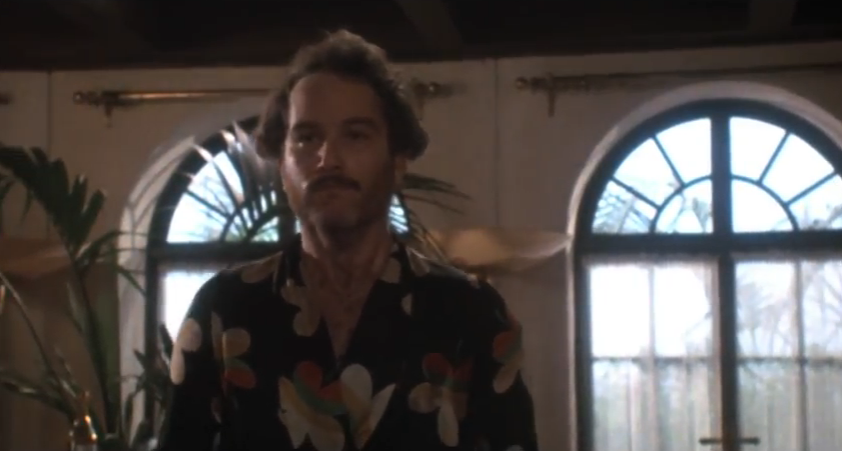
4. Charles Bronson in Hard Times - Bronson fulfills the tough guy needs of the role, yet once again reveals his greater talent to exhibit a more powerful emotional side subtly within his portrayal of a man in desperate circumstances.
Best Scene: Before the first fight.
3. Robert Mitchum in Farewell, My Lovely - Mitchum elevates his entire film, despite being too old for the part, he captures the style of the genre so effectively through his earnest yet intelligent approach towards the material.
Best Scene: Waking up next to a corpse.
2. Maxim Munzuk in Dersu Uzala - Munzuk gives a wonderfully idiosyncratic turn that captures both the history of hardship as a man of the wilderness, but also an optimistic spirit that defines the man's success within it.
Best Scene: Death of a tiger.
1. Richard Dreyfuss in Inserts - Richard Dreyfuss gives one of his best performances that uses his unique presence well to create a very particular state of a man completely spent by life at such a young age.
Best Scene: Boy wonder directs the first time.
Updated Overall
Next Year: 1975 Supporting, Note: I decided to move Ugo Tognazzi's review over to supporting. I have also seen In Celebration and Smile, and consider both to be ensemble films.
Showing posts with label 1975 Alternate Best Actor. Show all posts
Sunday, 23 September 2018
Wednesday, 19 September 2018
Alternate Best Actor 1975: Richard Dreyfuss in Inserts
Richard Dreyfuss did not receive an Oscar nomination for portraying The Boy Wonder in Inserts.
Inserts comes off a bit like a play that wasn't adapted all that well, even though it isn't based on a play, but it does hold some interest at the very least as one of those 70's films that would only ever have been made in that decade.
One of the most intriguing facets of the film is the central performance by Richard Dreyfuss during his heyday as a rather young leading man. He fittingly plays a boy wonder here as well though in a different profession in the film industry. Here we find him as a director already left behind by the film industry, due to the transition to sound, leaving him to resort to making pornographic films in his large isolating mansion. Immediately to his credit is Dreyfuss's ability to be convincing in creating the very idea of the character. This being this young man who is already spent and more or less done with life. This weariness is wholly captured in his worn eyes, and whole physical demeanor that feels like that of a man who has stayed up all night for the past 10 years. One can feel tired just looking at Dreyfuss here as he makes this man who has wholly burned out that exudes from his very being at every moments he is onscreen. Although we don't know the exact journey that lead him down this place, though we do get a few details, Dreyfuss immediately creates a vivid sense of a long painful history that brought this boy wonder to a rather dark place.
Dreyfuss is an interesting performer with a natural energetic talent, even if it isn't always used perfectly, but this is just right for the boy wonder here. Dreyfuss is fascinating in that he manages to create both a man at the end of his rope, but still realize this idea of the wunderkind of Hollywood who has wasted away. This is through his very specific sort of exasperation that Dreyfuss realizes in his work that manages to wield that energetic style of his in a rather unique fashion. There is this inherent intensity that Dreyfuss finds in the souse director that are this embers of the brilliant talent. A certain unpleasant frigidity quality he brings even in that exhaustion. There is a burden in this that Dreyfuss is able to play into the part that makes the man seem especially uncomfortable in his state. Dreyfuss doesn't make it wholly natural, but instead rather directly atypical. He is not a man who has settled into his state of life. He is writhing within it that allows Dreyfuss to deliver this viciousness of a personality deep within his eyes that are never only glazed rather still piercing in their own way. He creates the sense of the man who is almost in this state of a madness created by his descent towards nothingness.
There is more to the boy wonder than a husk, though not too much, which we see particularly through the other supporting characters of the film. Now on one end we have his relationships with the other men including his male "star" Rex (Stephen Davies) or his producer Big Mac (Bob Hoskins). In his relationships with the men there is a more overt derision that Dreyfuss portrays in every venomous delivery towards them. In these moments he accentuates a most powerful callousness that shows so well the boy's disregard for fellow "users" of the same industry where he's now applying his trade. Dreyfuss differs this subtly within his two "starlets" one former in the heroin addict Harlene (Veronica Cartwright) and later the potential newcomer Cathy Cake (Jessica Harper). With the former Dreyfuss and Cartwright are simply excellent together. In just a few minutes we quickly see their rotting relationship through their performances. There is a certain tenderness even sweetness the two brings in their interaction, even as one drinks towards death, and the other shoots up her arm towards the same fate. They create a warmth though even in this that suggests an older friendship even within this certain grotesque state of their current mutual rot as people.
Dreyfuss has one great moment early on with Cartwright where the boy wonder warns her about the drugs she's taking. Dreyfuss's tired delivery on the surface still shows the man beaten down by life, but deep within it is still an earnestness that reflects an honest concern still somewhere in the man. When she rather suddenly exits the picture Dreyfuss is again remarkable in creating the state of the man. Dreyfuss finds a callousness in his delivery as the boy wonder makes an obscene suggestion in regards to the news, yet again he underlays it with a quiet yet still palatable sadness deep within that reveals itself as this piercing anguish internalized in Dreyfuss's beaten down face. Now this a little bit different from his relationship with Cathy who is initially introduced to him as the girlfriend of Mac, and seems to have a strange interest in the concept of inserts. Dreyfuss initially brings the same disdain towards her initially until she begins to challenge him beyond what he expects. When her interest in him grows, and she begins to encourage his inspiration, in more ways than one, Dreyfuss slowly moves to this genuine interest along with almost a hint of hope at times. Of course this is a little separate, though effectively so, from when we see the boy wonder direct his "films". Dreyfuss is brilliant in these scenes where he does show a spark in the man, though specifically related to the act of directing. This is as he essentially embodies that ambition of a great director as Dreyfuss switches it on suggesting the man the boy once was. This too is unpleasant in its own, mostly due to the end result, though he is amazing as he one moment becomes the tender lover and another the vile sadist. In each though Dreyfuss is absolutely convincing in the success of the man, and in revealing the man in his purest state as a director. Dreyfuss though depicts these as only minor relapses though never wholly bringing the man out of his decay, powerfully showing the man is perhaps beyond recovery. Dreyfuss's work is consistently captivating as he makes use of his best qualities as a performer to craft quite the unique character as this man both bursting at the seams and dying inside.
Inserts comes off a bit like a play that wasn't adapted all that well, even though it isn't based on a play, but it does hold some interest at the very least as one of those 70's films that would only ever have been made in that decade.
One of the most intriguing facets of the film is the central performance by Richard Dreyfuss during his heyday as a rather young leading man. He fittingly plays a boy wonder here as well though in a different profession in the film industry. Here we find him as a director already left behind by the film industry, due to the transition to sound, leaving him to resort to making pornographic films in his large isolating mansion. Immediately to his credit is Dreyfuss's ability to be convincing in creating the very idea of the character. This being this young man who is already spent and more or less done with life. This weariness is wholly captured in his worn eyes, and whole physical demeanor that feels like that of a man who has stayed up all night for the past 10 years. One can feel tired just looking at Dreyfuss here as he makes this man who has wholly burned out that exudes from his very being at every moments he is onscreen. Although we don't know the exact journey that lead him down this place, though we do get a few details, Dreyfuss immediately creates a vivid sense of a long painful history that brought this boy wonder to a rather dark place.
Dreyfuss is an interesting performer with a natural energetic talent, even if it isn't always used perfectly, but this is just right for the boy wonder here. Dreyfuss is fascinating in that he manages to create both a man at the end of his rope, but still realize this idea of the wunderkind of Hollywood who has wasted away. This is through his very specific sort of exasperation that Dreyfuss realizes in his work that manages to wield that energetic style of his in a rather unique fashion. There is this inherent intensity that Dreyfuss finds in the souse director that are this embers of the brilliant talent. A certain unpleasant frigidity quality he brings even in that exhaustion. There is a burden in this that Dreyfuss is able to play into the part that makes the man seem especially uncomfortable in his state. Dreyfuss doesn't make it wholly natural, but instead rather directly atypical. He is not a man who has settled into his state of life. He is writhing within it that allows Dreyfuss to deliver this viciousness of a personality deep within his eyes that are never only glazed rather still piercing in their own way. He creates the sense of the man who is almost in this state of a madness created by his descent towards nothingness.
There is more to the boy wonder than a husk, though not too much, which we see particularly through the other supporting characters of the film. Now on one end we have his relationships with the other men including his male "star" Rex (Stephen Davies) or his producer Big Mac (Bob Hoskins). In his relationships with the men there is a more overt derision that Dreyfuss portrays in every venomous delivery towards them. In these moments he accentuates a most powerful callousness that shows so well the boy's disregard for fellow "users" of the same industry where he's now applying his trade. Dreyfuss differs this subtly within his two "starlets" one former in the heroin addict Harlene (Veronica Cartwright) and later the potential newcomer Cathy Cake (Jessica Harper). With the former Dreyfuss and Cartwright are simply excellent together. In just a few minutes we quickly see their rotting relationship through their performances. There is a certain tenderness even sweetness the two brings in their interaction, even as one drinks towards death, and the other shoots up her arm towards the same fate. They create a warmth though even in this that suggests an older friendship even within this certain grotesque state of their current mutual rot as people.
Dreyfuss has one great moment early on with Cartwright where the boy wonder warns her about the drugs she's taking. Dreyfuss's tired delivery on the surface still shows the man beaten down by life, but deep within it is still an earnestness that reflects an honest concern still somewhere in the man. When she rather suddenly exits the picture Dreyfuss is again remarkable in creating the state of the man. Dreyfuss finds a callousness in his delivery as the boy wonder makes an obscene suggestion in regards to the news, yet again he underlays it with a quiet yet still palatable sadness deep within that reveals itself as this piercing anguish internalized in Dreyfuss's beaten down face. Now this a little bit different from his relationship with Cathy who is initially introduced to him as the girlfriend of Mac, and seems to have a strange interest in the concept of inserts. Dreyfuss initially brings the same disdain towards her initially until she begins to challenge him beyond what he expects. When her interest in him grows, and she begins to encourage his inspiration, in more ways than one, Dreyfuss slowly moves to this genuine interest along with almost a hint of hope at times. Of course this is a little separate, though effectively so, from when we see the boy wonder direct his "films". Dreyfuss is brilliant in these scenes where he does show a spark in the man, though specifically related to the act of directing. This is as he essentially embodies that ambition of a great director as Dreyfuss switches it on suggesting the man the boy once was. This too is unpleasant in its own, mostly due to the end result, though he is amazing as he one moment becomes the tender lover and another the vile sadist. In each though Dreyfuss is absolutely convincing in the success of the man, and in revealing the man in his purest state as a director. Dreyfuss though depicts these as only minor relapses though never wholly bringing the man out of his decay, powerfully showing the man is perhaps beyond recovery. Dreyfuss's work is consistently captivating as he makes use of his best qualities as a performer to craft quite the unique character as this man both bursting at the seams and dying inside.
Thursday, 13 September 2018
Alternate Best Actor 1975: Maxim Munzuk in Dersu Uzala
Maxim Munzuk did not receive an Oscar nomination for portraying the titular character of Dersu Uzala.
Dersu Uzala follows the leader of a Russian army expedition, Arsenev, into the wilderness where he befriends a local hunter.
Dersu Uzala marks a little bit of a strange period for Akira Kurosawa. It is certainly was a period of rejuvenation after his unfortunate suicide attempt after the commercial failure of his previous post-Mifune endeavor. A strange circumstance though as Kurosawa collaborated with the Soviet government to develop this film which would eventually go on to win best foreign language film at the Oscars. A film not in Kurosawa's native Japanese but rather Russian. The film is rarely spoken of perhaps as it pre-dates his return to the epic of the masterworks of his 80's period, though perhaps better known than his quietly contemplative "retirement" films of the 90's. The film though is almost a mix of the two periods in a certain sense. In that the scale is very much of a grand filmmaker with gorgeous outdoor cinematography and remarkable sequences within that. The story, despite that scale, though is particularly intimate and rather relaxed, despite some tragic underpinnings. This is realized through the central characters of the expedition leader Arseney, and the man he meets in the expedition, of course the titular man played by Maxim Munzuk.
The role Dersu Uzala was intended for Toshiro Mifune by the Soviet film company, however it is said they were deterred from that pursuit as Mifune would likely have refused due to the nature of the shoot. I have a feeling though it may have run deeper due to the rift between the two former collaborators. Although it is easy to imagine Mifune in the role, we are given a very atypical lead then in Maxim Munzuk instead. He's a very curious man just in stature and appearance. The type of man you might find just randomly in Siberia, which is what happens in the film. Munzuk's performance very much embraces the idea by in no way trying to project some other style with his work. He instead works very much with the atypical nature of Dersu with his whole manner as a performer. There is a certain scurrying way he walks, his excessively energetic, though wholly earnest, delivery that creates this funny little man. A funny little man that is wholly endearing and honestly Munzuk makes us take to Dersu just as Arseney takes to him. Munzuk just creates such a wonderfully genuine quality within this manner, and just feels the truth of the man in every moment of this behavior. A behavior that evokes a varied, and perhaps harsh life though this is punctuated by an inherit optimism which makes Dersu so likable.
This is an example of a performance that is very much defined by its consistency. Munzuk does not veer off much from his general demeanor however this approach works in terms of creating a sense of who this man is. Munzuk shows that even in the most arduous of times, such as bearing a life-threatening blizzard, carries that endearing attitude. Munzuk holds the consistency as the manner of a man who has come to experience life his certain way. This is taking hardship in stride, and portraying only the utmost sincerity of appreciation towards friendship as an alleviation of that. We see this in his consistent relationship with Arseney as Munzuk only portrays this overarching gratitude and respect to the man. Munzuk delivers a warmth in every interaction making the friendship this purity that in part stems from the nature of the man. Munzuk brings enough of a vividness within this consistency that he makes Dersu not only likable but compelling in this state. He creates this sense of understanding of his surroundings as a man who has come to terms with his life very much through experience. This leads him to greatly help the expedition, but just thrive in the wilderness in general. The only element within the film that changes Dersu, which when this life experience is challenged in some way.
The first instance comes from this when Arseney scares away a Siberian tiger by shooting at it, unknowingly killing it as Dersu explains the tiger runs to its death once it is scared off. It is a fantastic moment in Munzuk's performance as he portrays his reaction as less of a direct anger towards Arseney but rather this palatable anguish withdrawn towards himself. An anguish he depicts as deeply emphatic as Munzuk says the words there is this almost fear in his eyes representing the man essentially seeing himself within the tiger and its strict attachment to nature, something he shares. This becomes all the more evident when the expedition ends and Arseney invites Dersu to stay with his family in the city. Where Munzuk portrayed that consistency of a man in his element, though certainly in his own unique way, in the wilderness, in the confines of a house he presents this inherent discomfort. I love though the warmth in interactions with Arseney and his family. He shows in his weary eyes a clear affection for the people around him, but as a man made ill by the city that forces him to live against his very nature. Munzuk effectively keeps this from seeming a negative by having so well established the particular nature of the man that is of, well...nature. The story in the end is tragic though the tragedy is founded by the accidental destruction of nature by a man with good intentions, as seen in the tiger and eventually Dersu. Again though this is no direct fault, and in turn Dersu's final scenes are bittersweet. They reflect a man just again being true to his self, that self that it is so wonderfully realized by this performance by Maxim Munzuk. Although I wouldn't place within the upper echelon of Kurosawa directed performances, it still stands as a memorable part of this charming curiosity.
Dersu Uzala follows the leader of a Russian army expedition, Arsenev, into the wilderness where he befriends a local hunter.
Dersu Uzala marks a little bit of a strange period for Akira Kurosawa. It is certainly was a period of rejuvenation after his unfortunate suicide attempt after the commercial failure of his previous post-Mifune endeavor. A strange circumstance though as Kurosawa collaborated with the Soviet government to develop this film which would eventually go on to win best foreign language film at the Oscars. A film not in Kurosawa's native Japanese but rather Russian. The film is rarely spoken of perhaps as it pre-dates his return to the epic of the masterworks of his 80's period, though perhaps better known than his quietly contemplative "retirement" films of the 90's. The film though is almost a mix of the two periods in a certain sense. In that the scale is very much of a grand filmmaker with gorgeous outdoor cinematography and remarkable sequences within that. The story, despite that scale, though is particularly intimate and rather relaxed, despite some tragic underpinnings. This is realized through the central characters of the expedition leader Arseney, and the man he meets in the expedition, of course the titular man played by Maxim Munzuk.
The role Dersu Uzala was intended for Toshiro Mifune by the Soviet film company, however it is said they were deterred from that pursuit as Mifune would likely have refused due to the nature of the shoot. I have a feeling though it may have run deeper due to the rift between the two former collaborators. Although it is easy to imagine Mifune in the role, we are given a very atypical lead then in Maxim Munzuk instead. He's a very curious man just in stature and appearance. The type of man you might find just randomly in Siberia, which is what happens in the film. Munzuk's performance very much embraces the idea by in no way trying to project some other style with his work. He instead works very much with the atypical nature of Dersu with his whole manner as a performer. There is a certain scurrying way he walks, his excessively energetic, though wholly earnest, delivery that creates this funny little man. A funny little man that is wholly endearing and honestly Munzuk makes us take to Dersu just as Arseney takes to him. Munzuk just creates such a wonderfully genuine quality within this manner, and just feels the truth of the man in every moment of this behavior. A behavior that evokes a varied, and perhaps harsh life though this is punctuated by an inherit optimism which makes Dersu so likable.
This is an example of a performance that is very much defined by its consistency. Munzuk does not veer off much from his general demeanor however this approach works in terms of creating a sense of who this man is. Munzuk shows that even in the most arduous of times, such as bearing a life-threatening blizzard, carries that endearing attitude. Munzuk holds the consistency as the manner of a man who has come to experience life his certain way. This is taking hardship in stride, and portraying only the utmost sincerity of appreciation towards friendship as an alleviation of that. We see this in his consistent relationship with Arseney as Munzuk only portrays this overarching gratitude and respect to the man. Munzuk delivers a warmth in every interaction making the friendship this purity that in part stems from the nature of the man. Munzuk brings enough of a vividness within this consistency that he makes Dersu not only likable but compelling in this state. He creates this sense of understanding of his surroundings as a man who has come to terms with his life very much through experience. This leads him to greatly help the expedition, but just thrive in the wilderness in general. The only element within the film that changes Dersu, which when this life experience is challenged in some way.
The first instance comes from this when Arseney scares away a Siberian tiger by shooting at it, unknowingly killing it as Dersu explains the tiger runs to its death once it is scared off. It is a fantastic moment in Munzuk's performance as he portrays his reaction as less of a direct anger towards Arseney but rather this palatable anguish withdrawn towards himself. An anguish he depicts as deeply emphatic as Munzuk says the words there is this almost fear in his eyes representing the man essentially seeing himself within the tiger and its strict attachment to nature, something he shares. This becomes all the more evident when the expedition ends and Arseney invites Dersu to stay with his family in the city. Where Munzuk portrayed that consistency of a man in his element, though certainly in his own unique way, in the wilderness, in the confines of a house he presents this inherent discomfort. I love though the warmth in interactions with Arseney and his family. He shows in his weary eyes a clear affection for the people around him, but as a man made ill by the city that forces him to live against his very nature. Munzuk effectively keeps this from seeming a negative by having so well established the particular nature of the man that is of, well...nature. The story in the end is tragic though the tragedy is founded by the accidental destruction of nature by a man with good intentions, as seen in the tiger and eventually Dersu. Again though this is no direct fault, and in turn Dersu's final scenes are bittersweet. They reflect a man just again being true to his self, that self that it is so wonderfully realized by this performance by Maxim Munzuk. Although I wouldn't place within the upper echelon of Kurosawa directed performances, it still stands as a memorable part of this charming curiosity.
Saturday, 8 September 2018
Alternate Best Actor 1975: Robert Mitchum in Farewell, My Lovely
Robert Mitchum did not receive an Oscar nomination for portraying Philip Marlowe in Farewell, My Lovely.
Farewell, My Lovely is a somewhat tepid, though not terrible, take on the Philip Marlowe mystery.
This film is a little strange within its period. It is a noir, but during the time of neo noirs. Unlike the other earlier Marlowe adaptation in the 70's, The Long Goodbye, which featured a subversion of the character and the whole idea of noir, this film plays it straight. Perhaps too straight in attempting to make the film as it probably would've been in the 40's or 50's, only with colored cinematography and the allowance of a bit more graphic content. The overall style though is that of a classic noir, which is a little strange for a 70's film. I would say this approach could have even lead to abject failure if not for one man. Well that brings me to my continued exploration into the career of the great Robert Mitchum. Now I specifically noted in my previous reviews of his memorable turns in the decade, Mitchum embraced his age and found success within that. This turn would seem contradiction in that path given the role is typically played by a much younger man, and probably would have made more sense if he had played the part in the 40's or 50's, when Mitchum was often the lead of a noir. Although the film might not quite know this, Mitchum actually does. His performance is particularly astute as he again wears his age into the role, that is just one of the most obvious intelligent choices he makes in his approach as the film opens.
Mitchum's performance is something of a wonder in how he seeks to make the film work despite its shortcomings at every turn. The film itself really is lacking in terms of capturing a proper noir style to grant the vibrancy one would want out of such a mystery. Mitchum though seeks to provide this style within his performance as Marlowe that beautifully embodies the genre. Mitchum physically plays the part with that smooth yet still haggard stature. A man very much bearing through long nights, and just has that iconic look about him to truly be Marlowe, even if a few years above the actual age of the character. This is further amplified by the obligatory narration that leads us through the various twists and turns of the plot, and a bit of insight into Marlowe's mindset throughout. A old trope, but so well realized not really by again how the film uses it rather by Mitchum's delivery of it. Frankly one could just listen to the film wholly as radio play by how much character Mitchum brings to every word. He creates the intrigue of the mystery, and captures the exasperation of the man so well. Again he does it with style, but also a real emotion within every twist and turn. Such narrations can quickly become ridiculous, particularly in a noir out of time and place, Mitchum nearly sets things right through his wonderfully nuanced take.
Of course Marlowe has to work the case and get into every little cliche in the noir book, well since the source material helped to define them, but again the film does it so earnestly it could become comical. Mitchum though again salvages it all through his approach that just so embodies the part that it doesn't matter that the film has absolutely nothing new to say within the genre. Mitchum takes us along in almost every part. This is whether he making his close calls with gunfire, a tense physical confrontation, the occasional drugging, being harassed by the police, or of course occasionally dealing with a few lustful women. Mitchum never lost or forgot the ways of the noir, in fact he sort of refines it here to an art form all of his own. The way Mitchum goes about any scene he brings you into his orbit that makes this point of the film that is compelling even if other things around him are a little clunky. Mitchum just commands these moments with this purity of the noir lead. That is in bringing just that certain sarcasm in his police interrogations, that daze in his eyes as he witnesses one double cross after enough though with just enough of glint to represent his own determination, and of course with all that overarching gritty suave manner behind it all needed to be such a hero. He even can lose that all in the drugging scene where Mitchum realizes the effects of the drugs, and the desperation of that moment brilliantly as well.
The one place that there is a bit of struggle though is in the lusty women. Well specifically Charlotte Rampling's femme fatale Helen Grayle, now don't get wrong Mitchum's easy going charm is as prevalent as ever when Helen tries to work her wiles on him, but his age does find one problem here. The problem being Mitchum, again, uses it to his advantage except for in these scenes where it makes the older man seem far too naive as the duplicitous woman seduces him, especially given the life one would assume he had lived. Mitchum is a better fit for the scenes he shares with the more age appropriate Sylvia Miles as the desperate Jessie Halstead Florian. Here Mitchum truly thrives in his knowing reactions where he brings a certain distance but also playfulness as interacts with her. He finds the right balance as sort of presenting his professional needs for the interaction, but with the right understanding of her not so hidden ulterior motives. Those are just examples of Mitchum's whole approach which is to be the first rate noir lead, for sort of a second rate noir film. What works about the film is Mitchum, but he actually sort of makes the film work. As I found it is easy to stay invested just by how pitch perfect Mitchum is as Marlowe. Although all the circumstances of the casting might not be ideal, Mitchum still proves himself to be a ideal as Philip Marlowe. It is a terrific performance as Robert Mitchum frankly elevates the film entirely to be worthy of the genre it is exists in.
Farewell, My Lovely is a somewhat tepid, though not terrible, take on the Philip Marlowe mystery.
This film is a little strange within its period. It is a noir, but during the time of neo noirs. Unlike the other earlier Marlowe adaptation in the 70's, The Long Goodbye, which featured a subversion of the character and the whole idea of noir, this film plays it straight. Perhaps too straight in attempting to make the film as it probably would've been in the 40's or 50's, only with colored cinematography and the allowance of a bit more graphic content. The overall style though is that of a classic noir, which is a little strange for a 70's film. I would say this approach could have even lead to abject failure if not for one man. Well that brings me to my continued exploration into the career of the great Robert Mitchum. Now I specifically noted in my previous reviews of his memorable turns in the decade, Mitchum embraced his age and found success within that. This turn would seem contradiction in that path given the role is typically played by a much younger man, and probably would have made more sense if he had played the part in the 40's or 50's, when Mitchum was often the lead of a noir. Although the film might not quite know this, Mitchum actually does. His performance is particularly astute as he again wears his age into the role, that is just one of the most obvious intelligent choices he makes in his approach as the film opens.
Mitchum's performance is something of a wonder in how he seeks to make the film work despite its shortcomings at every turn. The film itself really is lacking in terms of capturing a proper noir style to grant the vibrancy one would want out of such a mystery. Mitchum though seeks to provide this style within his performance as Marlowe that beautifully embodies the genre. Mitchum physically plays the part with that smooth yet still haggard stature. A man very much bearing through long nights, and just has that iconic look about him to truly be Marlowe, even if a few years above the actual age of the character. This is further amplified by the obligatory narration that leads us through the various twists and turns of the plot, and a bit of insight into Marlowe's mindset throughout. A old trope, but so well realized not really by again how the film uses it rather by Mitchum's delivery of it. Frankly one could just listen to the film wholly as radio play by how much character Mitchum brings to every word. He creates the intrigue of the mystery, and captures the exasperation of the man so well. Again he does it with style, but also a real emotion within every twist and turn. Such narrations can quickly become ridiculous, particularly in a noir out of time and place, Mitchum nearly sets things right through his wonderfully nuanced take.
Of course Marlowe has to work the case and get into every little cliche in the noir book, well since the source material helped to define them, but again the film does it so earnestly it could become comical. Mitchum though again salvages it all through his approach that just so embodies the part that it doesn't matter that the film has absolutely nothing new to say within the genre. Mitchum takes us along in almost every part. This is whether he making his close calls with gunfire, a tense physical confrontation, the occasional drugging, being harassed by the police, or of course occasionally dealing with a few lustful women. Mitchum never lost or forgot the ways of the noir, in fact he sort of refines it here to an art form all of his own. The way Mitchum goes about any scene he brings you into his orbit that makes this point of the film that is compelling even if other things around him are a little clunky. Mitchum just commands these moments with this purity of the noir lead. That is in bringing just that certain sarcasm in his police interrogations, that daze in his eyes as he witnesses one double cross after enough though with just enough of glint to represent his own determination, and of course with all that overarching gritty suave manner behind it all needed to be such a hero. He even can lose that all in the drugging scene where Mitchum realizes the effects of the drugs, and the desperation of that moment brilliantly as well.
The one place that there is a bit of struggle though is in the lusty women. Well specifically Charlotte Rampling's femme fatale Helen Grayle, now don't get wrong Mitchum's easy going charm is as prevalent as ever when Helen tries to work her wiles on him, but his age does find one problem here. The problem being Mitchum, again, uses it to his advantage except for in these scenes where it makes the older man seem far too naive as the duplicitous woman seduces him, especially given the life one would assume he had lived. Mitchum is a better fit for the scenes he shares with the more age appropriate Sylvia Miles as the desperate Jessie Halstead Florian. Here Mitchum truly thrives in his knowing reactions where he brings a certain distance but also playfulness as interacts with her. He finds the right balance as sort of presenting his professional needs for the interaction, but with the right understanding of her not so hidden ulterior motives. Those are just examples of Mitchum's whole approach which is to be the first rate noir lead, for sort of a second rate noir film. What works about the film is Mitchum, but he actually sort of makes the film work. As I found it is easy to stay invested just by how pitch perfect Mitchum is as Marlowe. Although all the circumstances of the casting might not be ideal, Mitchum still proves himself to be a ideal as Philip Marlowe. It is a terrific performance as Robert Mitchum frankly elevates the film entirely to be worthy of the genre it is exists in.
Tuesday, 4 September 2018
Alternate Best Actor 1975: Charles Bronson in Hard Times
Charles Bronson did not receive an Oscar nomination for portraying Chaney in Hard Times.
Hard Times is an entertaining enough film about a street brawler and gambler during the great depression.
In the primary lead role you have Charles Bronson in a role that was written with a younger man in mind, as this drifter who goes around just scraping by through fights. This is an interesting casting choice, but really an essential element in granting the film a bit more of an emotional impact than it might have had otherwise. On the surface Bronson certainly proves worthy of the role as he is wholly convincing as a fighter even at his age at the time of filming. In addition to that he is quite simply one of the great stoic badasses from the period. This is to the point that he makes a fellow stoic badass James Coburn look properly weak as the gambler, Speed, who bankrolls Bronson's Chaney. Bronson simply commands the screen as to be expected both in terms of offering that sort of physical intimidation needed for the character, but also just the power of the spirits embodied within that. Bronson is this force of a man that the film needs, of a man driven within the fight, which Bronson realizes so effectively without even raising his voice. He rather creates that calm cool that makes Chaney both appealing and intimidating.
Of course the film as written by Walter Hill is pretty bare bones, however that isn't not explicitly a negative value in film, or this film. It is rather an approach and what matters is what is within this approach. The script is already elevated to be sure by Hill's own direction which creates a vibrancy in the period through the aesthetic he realizes. According to Hill's own design for the film though there is not suppose to be a moral to this story. It is rather just a story that is engaging. Now if one inflicts just that much style one can overcome the lack of a thematic weight, however it is still a bit of a challenge. Bronson helps to alleviate this problem through his performance that creates within itself a certain substance that likely would've been completely absent with a bland performer in the role. Bronson can be stoic, however he is not bland as there is more than a shallow fighter within his eyes. It is in those eyes that define his best work, this performance included. It is interesting in that the tough Bronson, when relying on this quality becomes a deeply emotional performer.
We see this in his first scene where he approaches Speed and the fighting den. In Bronson's eyes we see the weight of a life of hardship in his eyes, and in this conveys that with his age has come much experience. An experience that is never illustrated in dialogue however is sensed through Bronson's performance which carries this weight. A weight that makes the fight as much of a life line for the man, well beyond the monetary compensation within it. Although Chaney is never a vulnerable character, Bronson creates a certain vulnerability surrounded by the defense of his might as fighter. A vulnerability that alludes to a desperation again within his eyes that create such a potency in terms of a life he seems to try to avoid. This is also shown in his scenes with local woman, that don't wholly work only because Jill Ireland in the role, despite being Bronson's real life wife, is a bit stiff in the part. Bronson does not falter in his side though by bringing out a definite charm but with this certain emotional distance. A distance he portrays as a reluctance though, as again he shows the honest fear at what the relationship would brings out of him in the most expressive part of his face, yet still overall maintain a near facade of a man who simply toughens everything out. Although Chaney in the end does not change, Bronson's performance does take the character and the film further by hinting at the potential to do so, while also creating a stronger sense of the man's motivation throughout the film.
Hard Times is an entertaining enough film about a street brawler and gambler during the great depression.
In the primary lead role you have Charles Bronson in a role that was written with a younger man in mind, as this drifter who goes around just scraping by through fights. This is an interesting casting choice, but really an essential element in granting the film a bit more of an emotional impact than it might have had otherwise. On the surface Bronson certainly proves worthy of the role as he is wholly convincing as a fighter even at his age at the time of filming. In addition to that he is quite simply one of the great stoic badasses from the period. This is to the point that he makes a fellow stoic badass James Coburn look properly weak as the gambler, Speed, who bankrolls Bronson's Chaney. Bronson simply commands the screen as to be expected both in terms of offering that sort of physical intimidation needed for the character, but also just the power of the spirits embodied within that. Bronson is this force of a man that the film needs, of a man driven within the fight, which Bronson realizes so effectively without even raising his voice. He rather creates that calm cool that makes Chaney both appealing and intimidating.
Of course the film as written by Walter Hill is pretty bare bones, however that isn't not explicitly a negative value in film, or this film. It is rather an approach and what matters is what is within this approach. The script is already elevated to be sure by Hill's own direction which creates a vibrancy in the period through the aesthetic he realizes. According to Hill's own design for the film though there is not suppose to be a moral to this story. It is rather just a story that is engaging. Now if one inflicts just that much style one can overcome the lack of a thematic weight, however it is still a bit of a challenge. Bronson helps to alleviate this problem through his performance that creates within itself a certain substance that likely would've been completely absent with a bland performer in the role. Bronson can be stoic, however he is not bland as there is more than a shallow fighter within his eyes. It is in those eyes that define his best work, this performance included. It is interesting in that the tough Bronson, when relying on this quality becomes a deeply emotional performer.
We see this in his first scene where he approaches Speed and the fighting den. In Bronson's eyes we see the weight of a life of hardship in his eyes, and in this conveys that with his age has come much experience. An experience that is never illustrated in dialogue however is sensed through Bronson's performance which carries this weight. A weight that makes the fight as much of a life line for the man, well beyond the monetary compensation within it. Although Chaney is never a vulnerable character, Bronson creates a certain vulnerability surrounded by the defense of his might as fighter. A vulnerability that alludes to a desperation again within his eyes that create such a potency in terms of a life he seems to try to avoid. This is also shown in his scenes with local woman, that don't wholly work only because Jill Ireland in the role, despite being Bronson's real life wife, is a bit stiff in the part. Bronson does not falter in his side though by bringing out a definite charm but with this certain emotional distance. A distance he portrays as a reluctance though, as again he shows the honest fear at what the relationship would brings out of him in the most expressive part of his face, yet still overall maintain a near facade of a man who simply toughens everything out. Although Chaney in the end does not change, Bronson's performance does take the character and the film further by hinting at the potential to do so, while also creating a stronger sense of the man's motivation throughout the film.
Thursday, 30 August 2018
Alternate Best Actor 1975
And the Nominees Were Not:
Maxim Munzuk in Dersu Uzala
Richard Dreyfuss in Inserts
Charles Bronson in Hard Times
Robert Mitchum in Farewell, My Lovely
Ugo Tognazzi in My Friends
Maxim Munzuk in Dersu Uzala
Richard Dreyfuss in Inserts
Charles Bronson in Hard Times
Robert Mitchum in Farewell, My Lovely
Ugo Tognazzi in My Friends
Tuesday, 14 May 2013
Alternate Best Actor 1975: Results
5. Gene Hackman in Night Moves- Gene Hackman as usual gives a solid performance as a footballer turned private detective who is out of his element, but his best work this year was his heartbreaking reprise of Popeye Doyle in French Connection II.
Best Scene for the French Connection II: Doyle suffers withdrawal.
4. Tim Curry in The Rocky Horror Picture Show- Curry gives a delightful entertaining strange performance that is by far the highlight of his film.
Best Scene: "Sweet Transvestite"
3. Roy Scheider in Jaws- Scheider gives a great reactive performance that amplifies the intensity of his film by being a very human guide and who we can relate to.
Best Scene: Chief Brody sees the Shark attack.
1. Michael Caine and Sean Connery in The Man Who Would Be King- I find it almost impossible to separate these performances as they both amplify each other through their impeccable chemistry and together they create two marvelous characters that end up both being very entertaining as well as rather heartbreaking as well. As for the year itself I feel like kicking myself for my placement for any one of the top seven performances because I love all of them. I hate putting Hackman as low as he is because I love that performance. This is just a tremendous year and all seven of my top seven would be a worthy winners.
Best Scene: Danny apologizes to Peachy.
Overall Rank:
Best Scene for the French Connection II: Doyle suffers withdrawal.
4. Tim Curry in The Rocky Horror Picture Show- Curry gives a delightful entertaining strange performance that is by far the highlight of his film.
Best Scene: "Sweet Transvestite"
3. Roy Scheider in Jaws- Scheider gives a great reactive performance that amplifies the intensity of his film by being a very human guide and who we can relate to.
Best Scene: Chief Brody sees the Shark attack.
1. Michael Caine and Sean Connery in The Man Who Would Be King- I find it almost impossible to separate these performances as they both amplify each other through their impeccable chemistry and together they create two marvelous characters that end up both being very entertaining as well as rather heartbreaking as well. As for the year itself I feel like kicking myself for my placement for any one of the top seven performances because I love all of them. I hate putting Hackman as low as he is because I love that performance. This is just a tremendous year and all seven of my top seven would be a worthy winners.
Best Scene: Danny apologizes to Peachy.
Overall Rank:
- Jack Nicholson in One Flew Over the Cuckoos Nest
- Al Pacino in Dog Day Afternoon
- Gene Hackman in French Connection II
- Michael Caine and Sean Connery in The Man Who Would Be King
- Roy Scheider in Jaws
- Giancarlo Giannini in Seven Beauties
- Maximilian Schell in The Man in The Glass Booth
- Robert Redford in Three Days of the Condor
- Richard Dreyfuss in Inserts
- Gene Hackman in Bite the Bullet
- Tim Curry in The Rocky Horror Picture Show
- Maxim Munzuk in Dersu Uzala
- Gene Hackman in Night Moves
- Robert Mitchum in Farewell, My Lovely
- Charles Bronson in Hard Times
- Jack Nicholson in The Passenger
- Sean Connery in The Wind and the Lion
- Jack Lemmon in The Prisoner of Second Avenue
- Glynn Turman in Cooley High
- Fabio Testi in That Most Important Thing: Love
- Rafael Roco in Manila in The Claws of Light
- Woody Allen in Love and Death
- William Atherton in The Day of the Locust
- Don Johnson in A Boy and His Dog
- Warren Beatty in Shampoo
- David Hemmings in Deep Red
- George C. Scott in The Hindenburg
- Steven Keats in Hester Street
- Daniel Olbrychski in The Promised Land
- Tim McIntire in A Boy and His Dog
- James Caan in Rollerball
- James Coburn in Hard Times
- John Wayne in Brannigan
- Dharmendra in Sholay
- Amitabh Bachchan in Sholay
- Lawrence Hilton-Jacobs in Cooley High
- Clint Eastwood in The Eiger Sanction
- Michael Caine in The Wilby Conspiracy
- Yury Solomin in Dersu Uzala
- Walter Matthau in The Sunshine Boys
- Victor Lanoux in Cousin Cousine
- Sidney Poitier in The Wilby Conspiracy
- Ryan O'Neal in Barry Lyndon
- John Wayne in Rooster Cogburn
- Barry Bostwick in The Rocky Horror Picture Show
- Kirk Douglas in Once is Not Enough
- Paul Hampton in Shivers
- Roger Daltry in Tommy
- David Carradine in Death Race 2000
- James Caan in The Killer Elite
Alternate Best Actor 1975: Tim Curry in The Rocky Horror Picture Show
Tim Curry did not receive an Oscar nomination for portraying Dr. Frank N. Furter in The Rocky Horror Picture Show.
The Rocky Horror Picture is a musical about an unassuming couple who find themselves in a strange castle with even stranger residents. Despite its cult following I found the film to be a mostly hollow exercise that I did not find particularly compelling or entertaining, even its "edgy" elements I did not find all that memorable, and the songs felt redundant rather quickly.
It is pretty easy to say that Tim Curry is the best part of the film in his feature film debut as Dr. Frank N. Furter a mad scientist transvestite who hails from the planet of transsexual in the galaxy Transylvania. There is not a great deal to Frank N. Furter other than his overt strangeness and the way he things interested in all things sexual, although is also capable of a great deal of violence when brought to it usually in fits of jealousy. Frank N. Furter is the bizarre sexuailzed version of both doctor Frankenstein as well as the monster itself. I suppose there was probably only one way to play the part, and that is the approach Curry takes which is to go head first with his character and to be completely unabashed with his character's style.
This performance is rather in the same vein as Joel Grey's performance as the Master of Ceremonies in Cabaret where it is more about how the performance is performed than what is being performed. Yes there is various strands to this character the lustful transvestite, the evil scientist, the alien with some plan, or just the homicidal maniac, but they don't exactly make a cohesive whole. I am not saying against Curry nor am I really saying anything against the part as this really is the intention of the part. Frank N. Furter is simply there to freak you out well entertain you at the same time, he is not there to create an in depth look at the nature of an evil alien scientist. Frank N. Furter is simply suppose to be strange and entertaining so it is good that Curry's performance is strange and entertaining.
Curry doesn't hold back, that is for sure, playing the part with a devilish glee almost like Frank N. Furter is filled with orgasmic ecstasy simply from talking. This certainly works in creating the sexual creature that is Frank N Furter, and he only adds to that through his delivery of the songs which are done in such a forceful as well as rather slithery fashion. Curry not only fascinates with his style but as well threatens as well. Curry has such strange menace even well he is singing. It is most unusual but Curry pulls it off quite marvelously as being a pure evil but also quite magical in the musical sense. It is an interesting trick and one that Curry pulls off without any visible effort in his outrageous delivery.
Curry jumps around in the styles from a seductive force with his sly smile and piercing eyes, to the mad scientist with a maniacal glee, and to the jealous psychopath with his a ferocious stare. Curry does this all well and is something fascinating to watch every moment he is given something to do. He is just filled with energy and the fact that he is clearly having so much fun does rub off. The only problem with his part really is the fact that sometimes Frank N Furter is forced to just kind of stand there, and that is part of the problem with the film as a whole when it seems to be trying something but takes too long to do anything and ends up going nowhere. To his credit though Curry would be the reason to see the film since whenever he does get the chance to do something he gives it his all and then some.
The Rocky Horror Picture is a musical about an unassuming couple who find themselves in a strange castle with even stranger residents. Despite its cult following I found the film to be a mostly hollow exercise that I did not find particularly compelling or entertaining, even its "edgy" elements I did not find all that memorable, and the songs felt redundant rather quickly.
It is pretty easy to say that Tim Curry is the best part of the film in his feature film debut as Dr. Frank N. Furter a mad scientist transvestite who hails from the planet of transsexual in the galaxy Transylvania. There is not a great deal to Frank N. Furter other than his overt strangeness and the way he things interested in all things sexual, although is also capable of a great deal of violence when brought to it usually in fits of jealousy. Frank N. Furter is the bizarre sexuailzed version of both doctor Frankenstein as well as the monster itself. I suppose there was probably only one way to play the part, and that is the approach Curry takes which is to go head first with his character and to be completely unabashed with his character's style.
This performance is rather in the same vein as Joel Grey's performance as the Master of Ceremonies in Cabaret where it is more about how the performance is performed than what is being performed. Yes there is various strands to this character the lustful transvestite, the evil scientist, the alien with some plan, or just the homicidal maniac, but they don't exactly make a cohesive whole. I am not saying against Curry nor am I really saying anything against the part as this really is the intention of the part. Frank N. Furter is simply there to freak you out well entertain you at the same time, he is not there to create an in depth look at the nature of an evil alien scientist. Frank N. Furter is simply suppose to be strange and entertaining so it is good that Curry's performance is strange and entertaining.
Curry doesn't hold back, that is for sure, playing the part with a devilish glee almost like Frank N. Furter is filled with orgasmic ecstasy simply from talking. This certainly works in creating the sexual creature that is Frank N Furter, and he only adds to that through his delivery of the songs which are done in such a forceful as well as rather slithery fashion. Curry not only fascinates with his style but as well threatens as well. Curry has such strange menace even well he is singing. It is most unusual but Curry pulls it off quite marvelously as being a pure evil but also quite magical in the musical sense. It is an interesting trick and one that Curry pulls off without any visible effort in his outrageous delivery.
Curry jumps around in the styles from a seductive force with his sly smile and piercing eyes, to the mad scientist with a maniacal glee, and to the jealous psychopath with his a ferocious stare. Curry does this all well and is something fascinating to watch every moment he is given something to do. He is just filled with energy and the fact that he is clearly having so much fun does rub off. The only problem with his part really is the fact that sometimes Frank N Furter is forced to just kind of stand there, and that is part of the problem with the film as a whole when it seems to be trying something but takes too long to do anything and ends up going nowhere. To his credit though Curry would be the reason to see the film since whenever he does get the chance to do something he gives it his all and then some.
Monday, 13 May 2013
Alternate Best Actor 1975: Sean Connery and Michael Caine in The Man Who Would Be King
Sean Connery and Michael Caine did not receive Oscar nominations for portraying Daniel "Danny" Dravot and Peachy Carnehan respectively in The Man Who Would Be King.
The Man Who Would Be King is an extremely enjoyable adventure film about two former British soldiers in India who wish to set on a journey that would make them Kings in an even more secluded land.
It is interesting to note that its director John Huston intended to make it for some time originally planning for Humphrey Bogart and Clark Gable to play the lead roles. Although that probably also would have made a pretty good film the performances probably would not have been nearly as fitting for the parts of Danny and Peachy. The reason I am reviewing both of them together is that it is hard to separate them, there are a few differences in their performances which I will get to, but a great deal of the success comes from their work together as one. One aspect that the two share that makes both Danny and Peachy great characters is the past of the two men that we learn from both Caine and Connery's performances.
Danny and Peachy are adventurers and con men to say the least who intend to find some fortune by out scheming one of the natives out of a fortune of some sort. These two are a mischievous sort and the duo play this marvelously. The both have wink and sly grin to go along with their scheme. They handle this just right bringing us into the scheme right along with them through their mutual charms, and never seeming self indulgent as they could have easily been. Caine and Connery are both of the time and are always within in their story with their scheming. They have a certain knowing in their style but this always feels natural to the pair while still naturally bringing out the humor of the situations they get into quite effectively.
One of the ways they do this is although they are mischievous con men they are mischievous con men who are former proper British soldiers as well. Both of their styles are a brilliant combination of both of the rather low with the oh so proper. Connery and Caine both play them with a great firmness in style and step. They were soldiers their is no doubt about that and they absolutely sell the idea that the two men would write up a proper contract about their insane expedition before starting it. They play this type of style both with the utmost conviction, but as well with the utmost wit about it too. They are able to make their march not only the march of soldiers but as well easily finds the humor in making it part of the dynamic between their actions and method.
The two act as the best type of guides as they take us through their adventure through this strange mix of proper British conviction along with their more technically low brow scheming. Connery and Caine take such an unique approach for the leads of an adventure film and it absolutely pays off. It is interesting in the way that Caine and Connery bring out the pride of individualism as men in the manner in which they go about their task even teaching the natives how to fight and die like "real" soldiers, while they have this sharp edge still as they still show a sarcasm in their delivery. Connery and Caine find such an enjoyably dichotomy that makes this such a particularly fun ride.
Caine and Connery as a duo are perfect for one another. Caine and Connery are two of the most charming and charismatic actors around, and the fact that neither out charms the other it only makes the charm of the two only amplified with the two. Caine and Connery play off each other with expert timing never seeming to lose their place as one never does for a moment overwhelm the other performance together they are just an extremely entertaining pair. What is so special though is they are able to each stand out on their own when necessary as well. When they do stand out it does not seem like they are trying to one up the other instead they each allow one another great individual moments while never losing the terrific chemistry they have together.
There is a splitting point for each though as Danny is accidentally declared a god by the natives taking a role as a King. Connery changes his style a little bit when he starts portraying Danny who is swept up into the whole idea of being a god and begins to believe it himself. Connery nicely changes from the slightly sarcastic soldier to a man of lordly dignity who wants to rule his dignity as a king and a god should. Connery is excellent as he eases into this delusion and shows that the con man starts to leave him and the over confidence of his delusions begins to rise in him. Connery makes Danny become exactly what he believes him to be, and effective shows how the former con man could so easily forget his purpose and be enveloped by the delusion.
Caine's performance moves in the other direction as Peachy's cynical edge only becomes stronger as Danny becomes more and more earnest. Caine is equally good as he moves Peachy in the opposite direction of Danny in his portrayal of Peachy's reactions to Danny. He shows Peachy almost in complete disbelief to the point that he just finds it all very amusing. Caine is very good as he moves Peachy's reaction from a cynical bemusement to the situation to a much sadder disappointment in his comrade. Caine is a very to the point as Peachy bluntly expresses this disappointment and does well to stand as basically the call for reality to Danny which is made particularly incisive because Caine expresses that the humor in Peachy is now gone from this matter.
Thanks to the schism between Danny and Peachy is believably portrayed it really makes the finale of the film all the more powerful. After Danny's godhood is shown to be nothing more than a falsehood. This revelation leads them both two a bitter end and a quick reconciliation as they find themselves surrounded by angry natives. When Danny apologizes to Peachy it is a great moment because it not only is it very funny in the way they still do things in their proper British fashion, but it is also very sweet in that it shows how genuine the friendship between the two has been all along. This also contributes incredible final scene between the two of them as Danny goes to meet his maker. It is a beautiful scene as they both sing "The Son Of God Goes Forth to War" and we see just how much Danny and Peachy really meant to each other as well as how much we as the audience have grown to love the rascals.
These are great performances all on their own and truly something special when considered together. Sometimes with two leads there is a duel to see who conquers the picture, but in this case Caine and Connery rule the picture as Kings together. Neither shines brighter than the other they together instead are almost symbiotic in their characterizations of these peculiar yet very endearing pair of adventurers. The two together are both in top form throughout the picture, they are brilliant as a team and stay brilliant even when they slide apart. These are wonderful turns from both actors and rank as some of the very best work from each of the actor's cannon, and they just might create two of the very best characters you have ever been able to go on an adventure like this with.
The Man Who Would Be King is an extremely enjoyable adventure film about two former British soldiers in India who wish to set on a journey that would make them Kings in an even more secluded land.
It is interesting to note that its director John Huston intended to make it for some time originally planning for Humphrey Bogart and Clark Gable to play the lead roles. Although that probably also would have made a pretty good film the performances probably would not have been nearly as fitting for the parts of Danny and Peachy. The reason I am reviewing both of them together is that it is hard to separate them, there are a few differences in their performances which I will get to, but a great deal of the success comes from their work together as one. One aspect that the two share that makes both Danny and Peachy great characters is the past of the two men that we learn from both Caine and Connery's performances.
Danny and Peachy are adventurers and con men to say the least who intend to find some fortune by out scheming one of the natives out of a fortune of some sort. These two are a mischievous sort and the duo play this marvelously. The both have wink and sly grin to go along with their scheme. They handle this just right bringing us into the scheme right along with them through their mutual charms, and never seeming self indulgent as they could have easily been. Caine and Connery are both of the time and are always within in their story with their scheming. They have a certain knowing in their style but this always feels natural to the pair while still naturally bringing out the humor of the situations they get into quite effectively.
One of the ways they do this is although they are mischievous con men they are mischievous con men who are former proper British soldiers as well. Both of their styles are a brilliant combination of both of the rather low with the oh so proper. Connery and Caine both play them with a great firmness in style and step. They were soldiers their is no doubt about that and they absolutely sell the idea that the two men would write up a proper contract about their insane expedition before starting it. They play this type of style both with the utmost conviction, but as well with the utmost wit about it too. They are able to make their march not only the march of soldiers but as well easily finds the humor in making it part of the dynamic between their actions and method.
The two act as the best type of guides as they take us through their adventure through this strange mix of proper British conviction along with their more technically low brow scheming. Connery and Caine take such an unique approach for the leads of an adventure film and it absolutely pays off. It is interesting in the way that Caine and Connery bring out the pride of individualism as men in the manner in which they go about their task even teaching the natives how to fight and die like "real" soldiers, while they have this sharp edge still as they still show a sarcasm in their delivery. Connery and Caine find such an enjoyably dichotomy that makes this such a particularly fun ride.
Caine and Connery as a duo are perfect for one another. Caine and Connery are two of the most charming and charismatic actors around, and the fact that neither out charms the other it only makes the charm of the two only amplified with the two. Caine and Connery play off each other with expert timing never seeming to lose their place as one never does for a moment overwhelm the other performance together they are just an extremely entertaining pair. What is so special though is they are able to each stand out on their own when necessary as well. When they do stand out it does not seem like they are trying to one up the other instead they each allow one another great individual moments while never losing the terrific chemistry they have together.
There is a splitting point for each though as Danny is accidentally declared a god by the natives taking a role as a King. Connery changes his style a little bit when he starts portraying Danny who is swept up into the whole idea of being a god and begins to believe it himself. Connery nicely changes from the slightly sarcastic soldier to a man of lordly dignity who wants to rule his dignity as a king and a god should. Connery is excellent as he eases into this delusion and shows that the con man starts to leave him and the over confidence of his delusions begins to rise in him. Connery makes Danny become exactly what he believes him to be, and effective shows how the former con man could so easily forget his purpose and be enveloped by the delusion.
Caine's performance moves in the other direction as Peachy's cynical edge only becomes stronger as Danny becomes more and more earnest. Caine is equally good as he moves Peachy in the opposite direction of Danny in his portrayal of Peachy's reactions to Danny. He shows Peachy almost in complete disbelief to the point that he just finds it all very amusing. Caine is very good as he moves Peachy's reaction from a cynical bemusement to the situation to a much sadder disappointment in his comrade. Caine is a very to the point as Peachy bluntly expresses this disappointment and does well to stand as basically the call for reality to Danny which is made particularly incisive because Caine expresses that the humor in Peachy is now gone from this matter.
Thanks to the schism between Danny and Peachy is believably portrayed it really makes the finale of the film all the more powerful. After Danny's godhood is shown to be nothing more than a falsehood. This revelation leads them both two a bitter end and a quick reconciliation as they find themselves surrounded by angry natives. When Danny apologizes to Peachy it is a great moment because it not only is it very funny in the way they still do things in their proper British fashion, but it is also very sweet in that it shows how genuine the friendship between the two has been all along. This also contributes incredible final scene between the two of them as Danny goes to meet his maker. It is a beautiful scene as they both sing "The Son Of God Goes Forth to War" and we see just how much Danny and Peachy really meant to each other as well as how much we as the audience have grown to love the rascals.
These are great performances all on their own and truly something special when considered together. Sometimes with two leads there is a duel to see who conquers the picture, but in this case Caine and Connery rule the picture as Kings together. Neither shines brighter than the other they together instead are almost symbiotic in their characterizations of these peculiar yet very endearing pair of adventurers. The two together are both in top form throughout the picture, they are brilliant as a team and stay brilliant even when they slide apart. These are wonderful turns from both actors and rank as some of the very best work from each of the actor's cannon, and they just might create two of the very best characters you have ever been able to go on an adventure like this with.
Sunday, 12 May 2013
Alternate Best Actor 1975: Gene Hackman in French Connection II
Gene Hackman did not receive an Oscar nomination, despite being nominated for a Golden Globe and a Bafta, for portraying Jimmy "Popeye" Doyle in French Connection II.
French Connection II as a follow up to the first one does has to be taken as a bit of a disappointment, it's just not on the same level, Fernando Rey's reprise of the villainous Charnier is rather wasted, and Roy Scheider is missed. Having said that though it does have good scenes and it is an excellent showcase for Hackman as an actor as it continues the story with Popeye going to France to try to find "Frog One" who alluded him in the first film.
I know I planned to review Hackman in Night Moves which he was also Bafta nominated for, but after watching that film I decided it would be best if I went back to and finally finish French Connection II as well which for whatever reason I stopped watching about thirty minutes in many years ago. Finally finishing I clearly saw what was Hackman's best output from 1975 was. Now that is nothing against Night Moves which itself is a strong character study with a not nearly as strong film noir plot. Hackman, as usual, commits himself admirably there as well as an ex footballer who tries his hand at being a private detective even if his enthusiasm for the job outweighs his competence.
In both of his performances actually Hackman plays characters who are much more out of their element than they would like to believe. He does this quite well in Night Moves, but in the French Connection II Hackman takes it to another level. What aids in this surely is the memory of his performance in the first film where he was the streetwise New York City detective who knew the city like his own home, the man who could handle a room of criminals like a lion tamer, and had that unshakable drive to get his man. Although if you did not remember this for whatever reason Hackman does it with Doyle's manner as he first arrives to France trying to take that same approach even though Marseille is not New York.
Hackman though does well to show that this is not exactly the same Popeye that we saw last and clearly shows in his face that what happened at the end of the last film has not be completely forgotten by him. Yes Hackman plays the forceful quality of Popeye still there but in his eyes there is some pain to be seen both clearly from the accidental killing in the previous film as well as the fact that he failed to capture the main drug smuggler Charnier. Hackman handles perfectly by coming on so strong at first, showing Popeye trying to be that same street smart cop he was in the city, even though he soon finds out that things do not go for him the same way they did in New York.
Hackman is terrific in portraying what's lost in translation as Popeye does his forceful interrogation and tries his best to get something from the suspect but fails since the suspect can't even understand what he is saying. The same even goes for when Popeye is trying to be a man about town, Hackman again turns on a certain charm like he had in the original, but is perfect in playing up the disappointment as Popeye just is unable to really fit into the place that he knows very little about. Hackman's plays this disappointment perfectly because he has Popeye still putting on a proud face as he keeps making the wrong moves but still suggests at the same time the way it is slowly making him much more vulnerable.
Popeye lumbering around soon finds him in a bad spot where he is captured by Charnier who forcefully uses heroine on him to try to derive information. Hackman is great as he portrays Popeye being forced into the addiction starting with the utmost anger and resistance but slowly fading as they continue to give it to him. Hackman physical performance is outstanding as he plays the phases as he shows that Popeye still will not give up anything he knows but as well cannot avoid the physical and psychological problems that build up do to this treatment. Hackman emphasizes just how much this degrades Popeye leaving him truly a wreck when the police find him.
This leads to when Popeye is forced by the police to go cold turkey to get rid of the addiction. All I can say is these set of scenes is absolutely amazing and some of the greatest work in all of Hackman's career, and that is really saying something. Hackman physically portrays the sheer brutality of the situation and the slow horrible process he undergoes. Hackman is unflinching in playing just how low it takes Popeye and how hard it is for him. There is one particularly outstanding moment as Popeye talks about some random things to try to keep his mind off the pain. Hackman has him speak at first with such a beautiful nostalgia and just a certain pleasantness as Popeye tries his best to ignore the torture.
Hackman's performance is awe inspiring as he speaks so gently and we really see the better times comes out in his expression and delivery as he tries to think of anything other than the present. Hackman though is absolutely heartbreaking though as he shows that the pain just is too much and he feels it once again. Hackman is incredible in his intensity as the pain just overwhelms Popeye and every thought before is slowly compromised until he leaves him to his most vulnerable state making Popeye nothing but a sad shell of his former self. It is just a tremendous scene made so powerful by Gene Hackman as he entirely earns this transformation of Popeye making as heart wrenching as it should be.
Hackman is perfect in his full portrayal of Popeye's recovery because he does not skip a single step leaving all of it to be seen including the way that even after the worse is done he still shows that Popeye still has to take his time to find his old strength. Due to this when Hackman finally builds him back up again it is earned fully, and it has the impact it should. It of course is not the exact same man from the beginning, any pompousness in his Popeye is gone and Hackman shows him to be a man who has learned from his experience and now knows what he needs to do. When he finally goes about taking down the criminals Hackman brings that old drive back, but now with a purpose and an exact mission in his eyes.
This is what all role reprisals should be like. Hackman doesn't just meet his first performance he surpasses it. Where many reprisals seem like their treading water sometimes just seeming like their doing the same old thing, or losing what made the character special to begin with Hackman finds all new ground for his character while still doing justice to his original characterization. This is a great performance from start to finish as he takes Popeye through his very personal journey. Nothing feels like the same old routine while still feeling like this is the same man from the first film. Hackman continues with Popeye brilliantly giving such a powerful turn in his portrayal of both Popeye's psyche as well as his physical condition.
French Connection II as a follow up to the first one does has to be taken as a bit of a disappointment, it's just not on the same level, Fernando Rey's reprise of the villainous Charnier is rather wasted, and Roy Scheider is missed. Having said that though it does have good scenes and it is an excellent showcase for Hackman as an actor as it continues the story with Popeye going to France to try to find "Frog One" who alluded him in the first film.
I know I planned to review Hackman in Night Moves which he was also Bafta nominated for, but after watching that film I decided it would be best if I went back to and finally finish French Connection II as well which for whatever reason I stopped watching about thirty minutes in many years ago. Finally finishing I clearly saw what was Hackman's best output from 1975 was. Now that is nothing against Night Moves which itself is a strong character study with a not nearly as strong film noir plot. Hackman, as usual, commits himself admirably there as well as an ex footballer who tries his hand at being a private detective even if his enthusiasm for the job outweighs his competence.
In both of his performances actually Hackman plays characters who are much more out of their element than they would like to believe. He does this quite well in Night Moves, but in the French Connection II Hackman takes it to another level. What aids in this surely is the memory of his performance in the first film where he was the streetwise New York City detective who knew the city like his own home, the man who could handle a room of criminals like a lion tamer, and had that unshakable drive to get his man. Although if you did not remember this for whatever reason Hackman does it with Doyle's manner as he first arrives to France trying to take that same approach even though Marseille is not New York.
Hackman though does well to show that this is not exactly the same Popeye that we saw last and clearly shows in his face that what happened at the end of the last film has not be completely forgotten by him. Yes Hackman plays the forceful quality of Popeye still there but in his eyes there is some pain to be seen both clearly from the accidental killing in the previous film as well as the fact that he failed to capture the main drug smuggler Charnier. Hackman handles perfectly by coming on so strong at first, showing Popeye trying to be that same street smart cop he was in the city, even though he soon finds out that things do not go for him the same way they did in New York.
Hackman is terrific in portraying what's lost in translation as Popeye does his forceful interrogation and tries his best to get something from the suspect but fails since the suspect can't even understand what he is saying. The same even goes for when Popeye is trying to be a man about town, Hackman again turns on a certain charm like he had in the original, but is perfect in playing up the disappointment as Popeye just is unable to really fit into the place that he knows very little about. Hackman's plays this disappointment perfectly because he has Popeye still putting on a proud face as he keeps making the wrong moves but still suggests at the same time the way it is slowly making him much more vulnerable.
Popeye lumbering around soon finds him in a bad spot where he is captured by Charnier who forcefully uses heroine on him to try to derive information. Hackman is great as he portrays Popeye being forced into the addiction starting with the utmost anger and resistance but slowly fading as they continue to give it to him. Hackman physical performance is outstanding as he plays the phases as he shows that Popeye still will not give up anything he knows but as well cannot avoid the physical and psychological problems that build up do to this treatment. Hackman emphasizes just how much this degrades Popeye leaving him truly a wreck when the police find him.
This leads to when Popeye is forced by the police to go cold turkey to get rid of the addiction. All I can say is these set of scenes is absolutely amazing and some of the greatest work in all of Hackman's career, and that is really saying something. Hackman physically portrays the sheer brutality of the situation and the slow horrible process he undergoes. Hackman is unflinching in playing just how low it takes Popeye and how hard it is for him. There is one particularly outstanding moment as Popeye talks about some random things to try to keep his mind off the pain. Hackman has him speak at first with such a beautiful nostalgia and just a certain pleasantness as Popeye tries his best to ignore the torture.
Hackman's performance is awe inspiring as he speaks so gently and we really see the better times comes out in his expression and delivery as he tries to think of anything other than the present. Hackman though is absolutely heartbreaking though as he shows that the pain just is too much and he feels it once again. Hackman is incredible in his intensity as the pain just overwhelms Popeye and every thought before is slowly compromised until he leaves him to his most vulnerable state making Popeye nothing but a sad shell of his former self. It is just a tremendous scene made so powerful by Gene Hackman as he entirely earns this transformation of Popeye making as heart wrenching as it should be.
Hackman is perfect in his full portrayal of Popeye's recovery because he does not skip a single step leaving all of it to be seen including the way that even after the worse is done he still shows that Popeye still has to take his time to find his old strength. Due to this when Hackman finally builds him back up again it is earned fully, and it has the impact it should. It of course is not the exact same man from the beginning, any pompousness in his Popeye is gone and Hackman shows him to be a man who has learned from his experience and now knows what he needs to do. When he finally goes about taking down the criminals Hackman brings that old drive back, but now with a purpose and an exact mission in his eyes.
This is what all role reprisals should be like. Hackman doesn't just meet his first performance he surpasses it. Where many reprisals seem like their treading water sometimes just seeming like their doing the same old thing, or losing what made the character special to begin with Hackman finds all new ground for his character while still doing justice to his original characterization. This is a great performance from start to finish as he takes Popeye through his very personal journey. Nothing feels like the same old routine while still feeling like this is the same man from the first film. Hackman continues with Popeye brilliantly giving such a powerful turn in his portrayal of both Popeye's psyche as well as his physical condition.
Friday, 10 May 2013
Alternate Best Actor 1975: Roy Scheider in Jaws
Roy Scheider did not receive an Oscar nomination for portraying Chief Martin Brody in Jaws.
The performance usually given the most credit in Jaws is that of Robert Shaw as Quint the shark hunter, as it should be, but Roy Scheider should not be forgotten in his important lead role as the Chief of police who deals with the shark attacks. Scheider as an actor has a certain ease in being just a normal guy with his performances. Scheider knows how exactly to play roles without flamboyance yet still make the role still interesting in his own way. That is certainly the case here as Chief Brody who more than anything would like things just to be calm and normal on the island of Amity.
Scheider acts as the embodiment of our feelings toward the events of the film. He plays him very well by just handling the part in a purely down to earth fashion. There is not style or flamboyance to Brody he is just a guy who is terrified of the idea of the shark as anyone would be. Sheider rightfully leaves these types of performances to Richard Dreyfuss and Robert Shaw whose characters fit that type of portrayal. He does very well to make it so we can easily empathize with Brody throughout the film and he carries us through both the terror and adventure found in the film.
This is a very reactive performance as Brody has to deal with not only the shark attacks but as well as the public reactions whether it be hysteria or denial. Scheider finds the right pitch in the way he handles each and every moment in which Brody deals with the problems presented with them. He in fact through his very grounded reactions amplifies the effectiveness of every scene. For example when the Shark kills the boy on the beach, the thing I remember most from that scene actually is Scheider absolutely perfect in that single shot of his reaction bringing the full weight of the moment through that terror in his eyes.
Scheider also does manage to create Brody into a likable character particularly through the adventure scenes late in the film. His chemistry with both Shaw and Dreyfuss is great bringing so much more to the film. Scheider makes Brody almost the straight man of the three and makes the dynamic between all three of them work. And again it must be stressed how Scheider way of just being there contributes so much like during Shaw's magnificent delivery of the Indianapolis Speech Scheider succeeds by taking the right place within it. The scene of course belongs to Shaw that is unquestionable, but Scheider does contribute through the dread he brings to Brody's face.
As Brody Scheider mixes in both the right strength and hesitations in Brody throughout and he quite excellent in really internalizes the guilt and fears of Brody. He is really great because he makes Brody a man who does have the strength to keep it together, but at the same time still definitely feels the pains from the situation particularly when he is accused of allowing more of the Shark deaths to occur. He adds the layer with subtly and it really is quite powerful because he keeps it contained without seeming a repressed man either, rather the way an honest man would deal with it.
Jaws is a one of the greatest thrillers ever made and Scheider is the perfect hero for the film. His reactionary performance is just brings so much to the film, and Scheider deserves a great deal of credit for the strength of the film as well. The best example being when we first see the shark where Spielberg is (rightfully) credited in making the scene so effective being doing the joke than cutting it off with scare. Scheider though also enjoyably delivers that joke, than is amazing as he instantly switches to just about frozen in terror, then tops it all off with his absolutely brilliant ad lib "We're Gonna Need a Bigger Boat".
This might not be your traditional "great" performance in that he does not really have a really any individual scenes just to express his character, he has to move right along with the whole story and has to express his character quickly as the film moves along. Scheider does it incredibly well though never letting us forget Brody's own personal stake while we are taken in by all that surrounds him as well. Scheider's work he adds that extra emphasis to every scene Scheider brings to us even more fear in the early attacks, and perhaps even more importantly makes feel the joy right along with him when Brody finally gets the shark.
The performance usually given the most credit in Jaws is that of Robert Shaw as Quint the shark hunter, as it should be, but Roy Scheider should not be forgotten in his important lead role as the Chief of police who deals with the shark attacks. Scheider as an actor has a certain ease in being just a normal guy with his performances. Scheider knows how exactly to play roles without flamboyance yet still make the role still interesting in his own way. That is certainly the case here as Chief Brody who more than anything would like things just to be calm and normal on the island of Amity.
Scheider acts as the embodiment of our feelings toward the events of the film. He plays him very well by just handling the part in a purely down to earth fashion. There is not style or flamboyance to Brody he is just a guy who is terrified of the idea of the shark as anyone would be. Sheider rightfully leaves these types of performances to Richard Dreyfuss and Robert Shaw whose characters fit that type of portrayal. He does very well to make it so we can easily empathize with Brody throughout the film and he carries us through both the terror and adventure found in the film.
This is a very reactive performance as Brody has to deal with not only the shark attacks but as well as the public reactions whether it be hysteria or denial. Scheider finds the right pitch in the way he handles each and every moment in which Brody deals with the problems presented with them. He in fact through his very grounded reactions amplifies the effectiveness of every scene. For example when the Shark kills the boy on the beach, the thing I remember most from that scene actually is Scheider absolutely perfect in that single shot of his reaction bringing the full weight of the moment through that terror in his eyes.
Scheider also does manage to create Brody into a likable character particularly through the adventure scenes late in the film. His chemistry with both Shaw and Dreyfuss is great bringing so much more to the film. Scheider makes Brody almost the straight man of the three and makes the dynamic between all three of them work. And again it must be stressed how Scheider way of just being there contributes so much like during Shaw's magnificent delivery of the Indianapolis Speech Scheider succeeds by taking the right place within it. The scene of course belongs to Shaw that is unquestionable, but Scheider does contribute through the dread he brings to Brody's face.
As Brody Scheider mixes in both the right strength and hesitations in Brody throughout and he quite excellent in really internalizes the guilt and fears of Brody. He is really great because he makes Brody a man who does have the strength to keep it together, but at the same time still definitely feels the pains from the situation particularly when he is accused of allowing more of the Shark deaths to occur. He adds the layer with subtly and it really is quite powerful because he keeps it contained without seeming a repressed man either, rather the way an honest man would deal with it.
Jaws is a one of the greatest thrillers ever made and Scheider is the perfect hero for the film. His reactionary performance is just brings so much to the film, and Scheider deserves a great deal of credit for the strength of the film as well. The best example being when we first see the shark where Spielberg is (rightfully) credited in making the scene so effective being doing the joke than cutting it off with scare. Scheider though also enjoyably delivers that joke, than is amazing as he instantly switches to just about frozen in terror, then tops it all off with his absolutely brilliant ad lib "We're Gonna Need a Bigger Boat".
This might not be your traditional "great" performance in that he does not really have a really any individual scenes just to express his character, he has to move right along with the whole story and has to express his character quickly as the film moves along. Scheider does it incredibly well though never letting us forget Brody's own personal stake while we are taken in by all that surrounds him as well. Scheider's work he adds that extra emphasis to every scene Scheider brings to us even more fear in the early attacks, and perhaps even more importantly makes feel the joy right along with him when Brody finally gets the shark.
Thursday, 9 May 2013
Alternate Best Actor 1975
And the Nominees Were Not:
Sean Connery in The Man Who Would Be King
Michael Caine in The Man Who Would Be King
Roy Scheider in Jaws
Gene Hackman in Night Moves
Tim Curry in The Rocky Horror Picture Show
Sean Connery in The Man Who Would Be King
Michael Caine in The Man Who Would Be King
Roy Scheider in Jaws
Gene Hackman in Night Moves
Tim Curry in The Rocky Horror Picture Show
Subscribe to:
Posts (Atom)