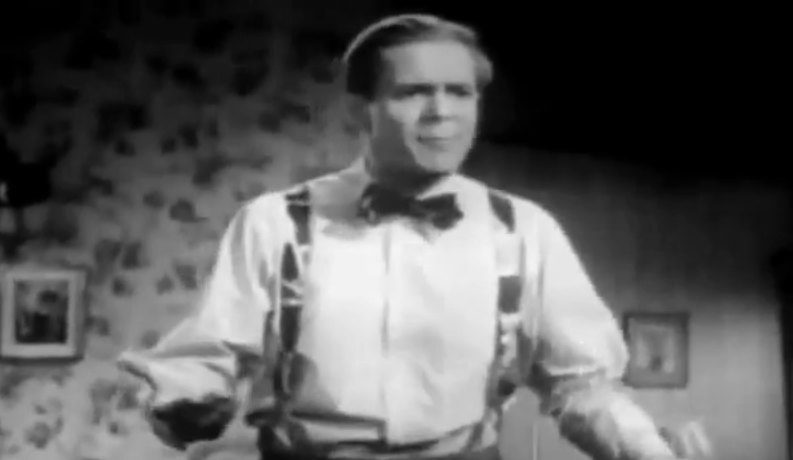
Michael Redgrave did not receive an Oscar nomination for portraying Maxwell Frere in Dead of Night.
 Dead of Night tells a series of supernatural tales.
One such supernatural tale is a doctor recounting a most unusual criminal case featuring a ventriloquist performer Maxwell Frere and his dummy Hugo. This is indeed the original horror dummy story that would influence others, yes Erich von Stroheim also was a bit dummy obsessed in The Great Gabbo, but the dummy's nature was more generalized craziness than horrifying madness. Although this film is a series of spooky tales, that one could say has a campfire style, none of the performers treat the material as anything less than something worthwhile, particularly not Michael Redgrave. Redgrave brings as much devotion as we'd later see from Anthony Hopkins in Magic in terms of portraying this very specific role, though Redgrave doesn't do the voice. Although even without that touch, Redgrave's performance is fascinating to watch in his first performance in tandem with the dummy Hugo, as Hugo entertains the crowd and Redgrave's Maxwell goes along with it. Redgrave portrays a few things at once. One being his performance as ventriloquist where he just so slightly is mouthing to be believed that this may be just the act of the man, as Hugo goes around entertaining, but watch everything Redgrave does as Hugo speaks to the audience. Redgrave is creating this sense of a piercing anxiety in the man in every conversation, and this very specific awkwardness as though Maxwell is behind the joke every time. Redgrave leaves the ambiguity if this is a clever act as he plays the "dummy" or if it is a man that genuinely doesn't know. This seems to come to light when they speak to another ventriloquist where Hugo acts as though Maxwell may be worthless, where Redgrave brings all the intensity of the sense of an immediate betrayal of an underlying being mistreated by his boss as he lashes out and slaps Hugo. Maybe the act still, but Redgrave depicts a man very much distraught at the notion. When the man comes to see both in their dressing room, where Hugo invites the man to take over. Where Redgrave then is seething in emotional distress, and a pure mania in his eyes. A man with a terrible fixation as he speaks about Hugo with this sense of dread and despair almost at the idea of Hugo moving on from him. Redgrave makes all of this eerily tangible, which could be ridiculous, but here Redgrave makes it terribly real in its strange way. There's a physical brilliance in the moments where Redgrave is in the sphere of Hugo, where there's a subtle stiffness to Redgrave almost as though he moves a bit as the dummy himself, in the way he hangs himself at a bar matching Hugo, much more than just as a man would and Maxwell is the dummy. Although a short within anthology, Redgrave doesn't waste a moment in creating this increasing insanity and descent, as he acts, perhaps as Hugo's arm, as he shoots the other ventriloquist, calling him a "dirty thieving swine", with a completely deranged performance which is altogether amazing. As Redgrave devotes fully to the idea, as particularly when now in jail they bring Hugo back to him, and Redgrave is outstanding in the way he first acts in this sudden fear, then discovery, and a near jubilant happiness of his old partner finding him worthy. Before Redgrave acts as almost a beaten partner, as he reacts as a dejected and such potent fear as Hugo says he'll rid himself of Maxwell, and Redgrave is such a brilliant festering mess of a man as he lashes out against his abuser. Even his final moment, where Maxwell is fully the dummy, Redgrave, physically sells it more so than the voice, in the chilling artificial mask of a smile as he "performs" as Hugo fully. Redgrave delivers the horror of this segment by somehow both giving into the absurd insanity of this notion while at the same time convincing one of its reality by presenting as the portrait of the breaking point of a degraded and abused partner.
 Dead of Night tells a series of supernatural tales.
 One such supernatural tale is a doctor recounting a most unusual criminal case featuring a ventriloquist performer Maxwell Frere and his dummy Hugo. This is indeed the original horror dummy story that would influence others, yes Erich von Stroheim also was a bit dummy obsessed in The Great Gabbo, but the dummy's nature was more generalized craziness than horrifying madness. Although this film is a series of spooky tales, that one could say has a campfire style, none of the performers treat the material as anything less than something worthwhile, particularly not Michael Redgrave. Redgrave brings as much devotion as we'd later see from Anthony Hopkins in Magic in terms of portraying this very specific role, though Redgrave doesn't do the voice. Although even without that touch, Redgrave's performance is fascinating to watch in his first performance in tandem with the dummy Hugo, as Hugo entertains the crowd and Redgrave's Maxwell goes along with it. Redgrave portrays a few things at once. One being his performance as ventriloquist where he just so slightly is mouthing to be believed that this may be just the act of the man, as Hugo goes around entertaining, but watch everything Redgrave does as Hugo speaks to the audience. Redgrave is creating this sense of a piercing anxiety in the man in every conversation, and this very specific awkwardness as though Maxwell is behind the joke every time. Redgrave leaves the ambiguity if this is a clever act as he plays the "dummy" or if it is a man that genuinely doesn't know. This seems to come to light when they speak to another ventriloquist where Hugo acts as though Maxwell may be worthless, where Redgrave brings all the intensity of the sense of an immediate betrayal of an underlying being mistreated by his boss as he lashes out and slaps Hugo. Maybe the act still, but Redgrave depicts a man very much distraught at the notion. When the man comes to see both in their dressing room, where Hugo invites the man to take over. Where Redgrave then is seething in emotional distress, and a pure mania in his eyes. A man with a terrible fixation as he speaks about Hugo with this sense of dread and despair almost at the idea of Hugo moving on from him. Redgrave makes all of this eerily tangible, which could be ridiculous, but here Redgrave makes it terribly real in its strange way. There's a physical brilliance in the moments where Redgrave is in the sphere of Hugo, where there's a subtle stiffness to Redgrave almost as though he moves a bit as the dummy himself, in the way he hangs himself at a bar matching Hugo, much more than just as a man would and Maxwell is the dummy. Although a short within anthology, Redgrave doesn't waste a moment in creating this increasing insanity and descent, as he acts, perhaps as Hugo's arm, as he shoots the other ventriloquist, calling him a "dirty thieving swine", with a completely deranged performance which is altogether amazing. As Redgrave devotes fully to the idea, as particularly when now in jail they bring Hugo back to him, and Redgrave is outstanding in the way he first acts in this sudden fear, then discovery, and a near jubilant happiness of his old partner finding him worthy. Before Redgrave acts as almost a beaten partner, as he reacts as a dejected and such potent fear as Hugo says he'll rid himself of Maxwell, and Redgrave is such a brilliant festering mess of a man as he lashes out against his abuser. Even his final moment, where Maxwell is fully the dummy, Redgrave, physically sells it more so than the voice, in the chilling artificial mask of a smile as he "performs" as Hugo fully. Redgrave delivers the horror of this segment by somehow both giving into the absurd insanity of this notion while at the same time convincing one of its reality by presenting as the portrait of the breaking point of a degraded and abused partner.

Boris Karloff did not receive an Oscar nomination for portraying cab-man John Gray in The Body Snatcher.

Theoretically in the long line of creepy Boris Karloff performances as a titular character of one sort or another, and to be fair to Karloff he's often good regardless of the quality of the film. This one is a little different in that Karloff is just *that* good here. Playing a non-supernatural role, and one where his makeup is relatively limited, more striking really is his costume which is just a great look for a character regardless as this cab driver from a certain time, who we actually meet in somewhat humble circumstances as he gives a ride and helps out a little girl to visit the respected surgical professor, Dr. Wolfe MacFarlane (Henry Danielle). Karloff doesn't change his voice to any monstrous thing here, rather he seems to almost try to emphasize even more this certain English delicacy within, to the point I'd say he sounds most similar to his narration from The Grinch Stole Christmas, and as narrator not as the Grinch. And it is with a masterstroke of this decision because Karloff has never been creepier than he is here in portraying John Gray. Karloff is so gentle with the little girl with his bright smile as he helps her in that you just know there can't be anything good that is going to come from all this. And the truth of this becomes quite clear when the next time we see Gray he's dropping off someone else at the doctor's office, with reception by our bland hero (required for all horror films of this time it would seem) Donald Fettes, although this time Gray is dropping off a corpse. Karloff though has just as much of a bright smile, and just as much of this light way of speaking that instantly is bone chilling in the ease about it. We soon find out that Gray has become the corpse provider for Dr. Wolfe, as we see him talk to the doctor at the inn, and the genius of Karloff's performance becomes all the more evident.
The scene between Gray and Wolfe, whom Gray calls Toddy as a nickname is just amazing because of Karloff. Karloff's manner is incredible here because technically everything he says, except the use of Toddy, even his physical way of almost bending down to the man, it is all of this servile manner, as though he is the most grateful servant to be able to speak to a "great" man like the doctor. Yet as courteous and modest as Karloff makes Gray, it is all this genius subversion where just *how* gentle he is in his voice, and his gracious eyes always have this glint that you know this is all a lie, even as he speaks to with a truth. It is absolutely an outstanding portrayal of this sort of hectoring as nothing he is saying, other than again the overly familiar use of Toddy, isn't being respectful, yet the way Karloff fashions it, he is respectful while being terrifyingly threatening and penetrating with just how "respectful" he is. And it has to be said this is one of those performances that is just magnetic in such an unusual way, that the moment Karloff appears, you can't take your eyes off of him, because he's so fascinating here in presenting John Gray's particular evil. And that's before we even know the real evil of Gray, as perhaps he's just a grave robber at this point, and our boring younger surgical student thinks so when he asks Gray to find a corpse to help heal a crippled little girl. To which Gray listens out to hear a homeless alms singer in the distance. Karloff's expression as we see Gray perhaps fully as himself as it grows this sudden ideal as an immediate prey to be found and there is a horrifying clarity upon his face. Something that is all the more disturbing when he comes over with the dead corpse of the poor woman, and Karloff comes with that genial quality as though he were delivering milk to the surgical student. We are granted a little more insight when the doctor's other assistant Joseph (Bela Lugosi, which you know a doctor is quite suspicious when he has Karloff and Lugosi working for him), comes to Gray with knowledge of his murder. To which Gray initially seems to invite him into the whole idea, telling him with the story of Burke and Hare who were real life serial killers who provided cadavers via their victims, which Karloff delivers every word of this tale as though this is a wonderful fairy tale with his whole sprite manner. Karloff is devilishly sinister as he slowly twists the notion and then turns to Joseph with clearly a different intention than a partner as he stares at him. Karloff provides the utmost vile menace but with the most "pleasant of smiles" before going in for the more literal kill. We only technically get the truth of Gray's motivation when the doctor tries to basically beg him, where Karloff changes his tone so slightly and with such potent intensity as he now speaks so calmly yet directly of the satisfaction he gets from being able to mentally torture the "superior" doctor. Karloff relishing in every word he articulates and dominates the scene by portraying so calmly yet viciously the man's motivation, which is less blood lust and more of the most diabolical of class warfare. Karloff IS this film in a way few performances are, in that the film really wouldn't be much, but Karloff is such a powerful presence that he makes the whole film worth watching because he's worth watching. He is captivating every moment he's onscreen, to the point the film is captivating every moment he's onscreen, because he makes his fiendish cab-man a most charismatic villain, though in his own uniquely fiendish way.

Next: 1998 Lead