Showing posts with label 1979 Alternate Best Actor. Show all posts

Wednesday, 14 January 2026

Alternate Best Actor 1979: John Heard in Chilly Scenes of Winter

John Heard did not receive an Oscar nomination for portraying Charles Richardson in Chilly Scenes of Winter. 

Chilly Scenes of Winter is essentially an anti-70’s romantic comedy.

John Heard is probably one of the most recognizable actors to the general public where the general public, and even some of the more knowledgeable cinematic public doesn’t have a hint of an idea of his actual talent level. I will freely admit being one myself until I saw his utterly brilliant transformative turn in Cutter’s Way, which while I knew him more than Kevin’s dad in Home Alone, that performance showed an entirely different avenue Heard might’ve taken, but that’s not where the story ends. As we have his performance in this film, which unlike Cutter’s Way he looks exactly like John Heard as we know him as we follow a workaday guy in the 70’s as he deals with his family and the relationship with a married woman. The latter being an important note because the sort of “freewheeling” relationship was a trend within 70’s films whether it be Touch of Class, Same Time Next Year or Shampoo, where honestly the relationships were celebrated and the protagonists treated as “cool”. Well this film and Heard’s performance seem weaponized to eviscerate those notions and turn that subgenre on its head ...despite the marketing team behind the film later trying to re-release it as exactly the type of film it is subverting. 

Heard’s performance is a unique lead for any film because he’s a terrible person in such an uncommon way, which this is not a man with any pageantry to his behavior, he’s not any grandiose villain, he’s not someone where we see motivation of the man, alcoholism, drug addiction, even while his family is a little strange, hardly enough to create the horrible man that we find here. Heard’s Charles Richardson is a moderately successful man and a terrible person regardless of all else and notable in Heard’s performance is the fact that he manages to pull off a compelling performance by uncovering the nature of the man, without ever excusing the behaviors. Heard is fascinating in the specific guide he offers as his character who in many ways is commenting on his existence not unlike Woody Allen in his films. Yet what Heard does here isn’t about comic asides rather uncovering the nature of this man with an unnerving honesty of someone just telling you exactly who they are without exception. 

We follow Charles as he goes about spending time with his more than a little off-beat unemployed brother, his mentally unwell mother, his overly jovial step-father and his seemingly well to do sister. Heard’s performance is one of constant judgment with a callous dismissiveness frequently even in his narration that speaks to his sister having it together there is a degree of resentment. Heard reeks naturally of a lived in bitterness of the man within his family with almost a rejection of familial connection, despite technically interacting with his family a lot. Heard looks upon all of them as a burden to Charles on one level or another, there may be a smile but even the smile while not wholly forced is weighted with a lack of natural warmth within it. Heard presents it as another aspect of Charles where we see nothing to make the man likable, although again a curious effectiveness in Heard’s part in that he manages to be captivating despite being so horrendous and horrendous in such an average day to day manner. There’s nothing special about Charles, and within that Heard perhaps realizes within this normalcy a different type of creep, because he is a tangible one. 

The central element to the film is Charles’s relationship with a married woman Laura (Mary Beth Hurt), a relationship that even at its start there’s an unpleasantness even within the initial connection. As Heard's delivery of his flirtation is with what can be described I think as a privileged matter of fact entitlement to the notion of connecting with her even though she’s married. When she states her interest in him, Heard’s performance accentuates a certain immediacy to exploit the notion and no hesitation in terms of her obviously vulnerable state. As we see the relationship progress, Heard has a natural manner to himself but also a certain extra push about every little segment of the relationship. Heard creates this particularly unnerving obsession by the way he develops it so naturally in such a disturbing way. Heard’s performance is so incisive because of how subdued yet penetrating he is in his methods of creating Charles’s particular form of toxicity which grows throughout the film. 

Even in the initial stages Heard brings no innate joy, more of this twisted kind of enjoyment of his “steal” in a way, but even that particular joy is brief. From there Heard’s performance becomes increasingly paranoid, controlling and despicable. What is so remarkable about his work though is the ease he brings to it, that isn’t of psychopathy but rather of an unpleasant expectation in his mind. Heard’s eyes don’t share love, just concern and critique. Something that becomes more penetrating as we go on in the relationship where he becomes less and less accommodating to her having any kind of actual freedom within their relationship, even though their starting point was knowing she was married. Heard lets us see the spite building in his mind that is not of love but of obsession and control. As when he builds a fantasy in his mind of Laura cheating on her, explaining first with this playfulness, that Heard makes shaky to start but seemingly like he can find any levity in the situation. Heard so naturally swings though as this “fantasy” turns into a disturbing violent threat that is especially disturbing because Heard’s portrayal of it feels so honest in depicting a particular sort of controlling man. Heard commanding the putridness in a uniquely disturbing way, particularly as becomes more aggressive with her there is the calm determination that makes every word feel beyond threat, given the emotional desperation mixed in with this precise viciousness. Within this horrible man though in the off-beat nature of the film, Heard’s depiction even becomes within a classic romcom silly situation where he pretends with his brother to insert himself between Laura and her husband at the latter’s home. There’s no fun to be had however as we do get the playacting, Heard’s performance isn’t performing rather just another form of obsession as he stares down both members of the couple before stating his “love” less as a grand romantic gesture and more so emphatic need to set his “claim” to her in a point of despondency. Although much of that fails the film isn’t even exactly about him getting his comeuppance though he finds no happiness, which I suppose is a form of it though a twisted version of the expected protagonist. Such as even a theoretically comedic scene of him unloading his life on someone randomly, which is a brilliant scene for Heard but again not comic in the way you’d expect. Rather Heard even in the more comic sendup is this unleashing of every bit of insecurity as an onslaught of the man’s essential hatred of everything and its treatment of him as just another inconvenience. Notably a true seventies protagonist, where the lessons are not learned, although comical realization of the difference in the values of the decades as the 80’s re-release attempting to put a square socket in a round hole, in trying to make the film more so a traditional romcom with a lesson. But it’s not that, it is rather an uncompromising portrait of a casually horrible person, realized in a masterclass by Heard, because he doesn’t soften an edge, nor do he heightened an element, he rather just shows you this man’s heart in vivid detail, a rotten one at that. 

Sunday, 24 July 2022

Alternate Best Actor 1979: Results


10. James Mason in Murder By Decree - Mason gives one of the best turns as Watson, emphasizing the character's low key manner compared to Christopher Plummer's Sherlock. 

Best Scene: Dealing with the prostitute. 
9. Steve Martin in The Jerk - Martin gives an entertaining turn of just emphasizing the blunt dumbness of his character. 

Best Scene: Unearned excitement. 
8. Frank Langella in Dracula - Langella successfully reworks the role of Dracula to that of a cunning and alluring romantic figure, though still vicious in his own right.  

Best Scene: Introduction. 
7. George C. Scott in Hardcore - Although I wouldn't say the film around him is the strongest, Scott gives a compelling portrayal of a man descent into both violence and the world of pornography.  

Best Scene: Attempted apology.
6. Klaus Kinski in Woyzeck - Kinski gives one of his most subdued performances, powerfully showing a man pushed around until  he's pushed too far.  

Best Scene: The murder. 
5. Malcolm McDowell in Time After Time - McDowell delivers a surprisingly charming and endearing turn that makes for a proper hero, a proper romantic and a proper man out of his time. 

Best Scene: Negotiations with Ripper.
4. Ben Gazzara in Saint Jack -  Gazzara gives a vivid characterization that so well realizes this man who seems to not care, but probably cares more than anyone would ever believe. 

Best Scene: CPR
3. Alexander Kaidanovsky in Stalker - Kaidanovsky gives a brilliant portrayal of a guide who treats his particular expertise with a religious like reverence, conviction and even anxiety. 

Best Scene: Ending. 
2. Patrick Dewaere in Série Noire - Dewaere delivers a brilliant completely off the wall performance, that just has so many weird choices yet they all pay off so wonderfully well. 

Best Scene: Final conversation with his wife.
1. Ken Ogata in Vengeance is Mine - Good prediction Bryan. Ogata gives a great uncompromising depiction of a serial killer, showing the callousness of the man through ever step of his merciless journey. I'll admit in this list, and the overall, my winner isn't decided by unanimous thought, nor is this even an example of having to choose between two performances, I could make a case in my mind for any of my top five. Ogata's cold brilliance, Burns's heartbreaking earnestness, Dourif's pure id, Dewaere's off the wall insanity, or Scheider going against type and achieving sheer greatness. I could swing to any five on the right day, I'll admit that but for now #1 is the #1. 

Best Scene: Final conversation with his father. 

Next: 1979 Supporting

Saturday, 23 July 2022

Alternate Best Actor 1979: Patrick Dewaere in Série Noire

Patrick Dewaere did not receive an Oscar nomination for portraying Franck Poupart in Série Noire. 

Série Noire is a compelling character study of a strange door to door salesman. 

The film in many ways seemingly takes some kind of crime and punishment style narrative though not at all in an expected way, and what stands out about this is that we follow a most unusual character for such a story, with a most unusual performance to lead such a tale. Patrick Dewaere's performance is very much the lifeblood of the film, not just because he's the main character whom we follow, but just everything about his performance is what breathes life into the material. We enter right into it as Dewaere is already just something all himself as he approaches his house with a physical manner that just isn't your typical leading man physical manner. There is urgency without direction kind of an innate neurosis in his lack of calm as he approaches the house of an elderly woman to try to make a sale while looking for a man who owes him money. Dewaere's delivery in this scene is brilliant because it is just on the edge of too much without ever going over it as he tries to basically flim-flam his way through to making a deal. Dewaere's terrific in that his manic delivery manages to have a sense of charm while also being clearly a man just haphazardly trying to make something work without any actual sense of any skill involved. Dewaere is convincing in his off-beat way of making it work, of course, his payment ends up being in a strange way via the prostitution of the old woman's niece Mona (Marie Trintignant). 

This scene is where I think you first get the strange sense of this performance, which I actually wholly love, that being that Dewaere kind of gives what is a comedic performance in what is a dramatic story by all other traits. Take when Mona disrobes where Dewaere is brilliant in his wholly hilarious delivery of telling the teenage girl that her dress has fallen off. Dewaere's reaction is pitch perfect in his eyes being both absolutely fascinated while also being strangely frightened by the scenario, before making his way out of the situation before he could do anything wrong. We follow him in his equally curious relationship with his wife Jeanne (Myriam Boyer), in scenes that would be nearly described as slapstick, though not quite that in their strange domestic squabbles. There again though is something that so oddly works about them largely because of Dewaere's completely oddball energy he brings to every moment. This rush of intensity as he is interacting with her and getting annoyed by her. He actually pulls it off as he gives this particular exasperation that successfully grants a sense of a long and for him, arduous, relationship as the two bicker, while Dewaere though still filters it through a madcap craziness of a man just barely holding it together mentally. What is fascinating though is again this madness is more comic in Dewaere's hands though the dramatic sense isn't lost, there's something just very broadly entertaining about the craziness of the approach. 

The navigation of this film with this performance is honestly what makes the film stand out and work as it does. As you take a scene where the man, Tikides, who owes Franck money shows up outside a phone booth with a hostile reaction. That could be a pretty straightforward moment of the con man talking his way out of a situation while being physically menaced. The way Dewaere performs it though is honestly more akin to a silent comedian in the way he closes the phone booth and defends himself from the man. Or take the scene where he meets up with his boss, who rather cheerfully calls on Franck for having stolen funds from the man. Dewaere's reactions in these scenes are just a sheer kind of strange perfection as with a genuine sense of anxiety and guilt, there is something very comical in the peculiar way that Franck barely can build even the ability to deny. Dewaere is wonderful though as you see all the thoughts going through his head at the time and the eccentric Franck frustrated but not really able to come up with a way to talk himself out of the situation before the boss reveals he's called the police with the impression that he just wants the young man to learn a lesson more than anything. Dewaere again is great as he exhaustively protests his imprisonment with a constant barrage of complaints, which again is just so beautifully composed by Dewaere's delivery which somehow manages to meet the expectation of obnoxiousness to his captors, while not making his own performance obnoxious. A brilliant trick, which speaks really to the entirety of this performance.  

Franck is released from jail early, not due to his complaining but rather to the financial intercession of Mona, not his wife. Here is where we get to an essential facet of his performance where we see Franck become obsessed with Mona after his strange obsession with him. Dewaere's portrayal of this again is what makes this whole idea work because he doesn't exactly realize this typical naturalistic chemistry with Trintignant, it is rather specifically this lustful obsession, however, even that isn't so straightforward. Dewaere presents it with this sense of surprise and disbelief, as though this scenario seems impossible and even acting upon the scenario isn't something he seems to completely buy as told by his manic eyes that pierce into Mona as though he must be missing something. Of course, this is where the film takes an extremely dark turn as prompted by Mona, he decides on a future of them built on robbing Mona's aunt with the help of Tikides, leading to the death of both Tikides and the old woman by the hands of Franck. Here's where I have to mention Ken Ogata from Vengeance is Mine who also portrayed a series of blithe murders, but he and Dewaere couldn't be more different in their performances despite both showing men who seem to murder without a second concern. With Ogata, it is pure psychopathy, with Dewaere he manages to make these moments a strange extension of the character's innate eccentricity and neurosis, and even when he commits the acts his portrayal is that of personal surprise more than anything almost an accident, though not that more hapless tomfoolery. Dewaere doesn't depict guilt though, just a man being himself, the problem is Franck has no idea what that is. 

Dewaere's performance is what makes this character work because the character is a total mess and does horrible things, yet you still like him to some strange degree. Again there's just something about Dewaere's work that just goes for it that is strangely endearing, and perhaps it is even the hapless lack of ego at every point that Dewaere conveys so well. Maybe it is his ability just to be so convincing despite being so strange and so disparate in every scene. Take for example two different examples of the character. One where Mona seems to temporarily reject him and Dewaere's physically falling into self-destruction should be a purely violent act, but Dewaere's performance of it somehow grants a bizarre levity to each and every self-inflicted head butt as Dewaere releases the anguish against himself. This is in stark contrast to the scene where his wife attempt to legitimately connects with him again. Dewaere is equally outstanding in this scene if so very different in how tempered he is and in his eyes showing some degree of reflection albeit only momentarily. The moment seems a bit of strict humanity in his work and even moving for a moment, before of course, he falls back into mania again by dealing with his wife by simply murdering her as well, if again in the act of true fool rather than a hardened criminal as presented by Dewaere unusual approach. Dewaere though presents just a minor bit of self-awareness in the moment, followed by when his boss confronts him, though his boss leaving with his life and all of Franck's loot. Dewaere in the scene though shows the man essentially having a moment of pronounced realization of his misdeeds, again though Dewaere's reactions don't denote guilt, just an understanding that he's obviously screwed up in some way. The greatness of this performance is making this character work and make this film work, by Dewaere going off on a limb constantly and just somehow not falling off despite going all over the place in terms of playing around with tone in theoretically very dramatic material. The ending moment of Franck having committed several heinous crimes and with almost nothing left embracing Mona in a full-on romantic swing works, because of Dewaere and the sheer brilliant chaos of his work here. That moment, which I'd probably hate or at least reject in most films featuring multiple murders, I kind of loved because it just seemed right for the journey of the eccentric of this character as brought to life by Patrick Dewaere. An amazing performance that is just a series of nearly baffling big swings that somehow all work in tandem to craft a one of a kind character in Franck Poupart.

Monday, 18 July 2022

Alternate Best Actor 1979: Alexander Kaidanovsky & Anatoly Solonitsyn in Stalker

Alexander Kaidanovsky and Anatoly Solonitsyn did not receive Oscar nominations for portraying the titular character and the writer in Stalker. 

Stalker is a great film about a guide taking two men into a forbidden zone towards a room that is said to grant the wish of those who enter it. 


The film follows three men the stalker, the writer, and the professor, who each offer a different perspective within this journey that is indeed more philosophical than practical, though within the film there are moments of tangible threat and supernatural. The idea though appears to be to put very human characters within this strange journey. We enter the film through Kaidanovsky's stalker who we see as he dismisses the concerns of his wife (Alisa Freindlich) in order to proceed by taking two new people to the zone for some unstated bounty. Kaidanovsky's performance, which his whole work will be defined with to some degree, is this innate sense of urgency as he dismisses his wife's concerns and leaves her alone with their daughter supposedly mutated by the zone's appearance. Kaidanovsky's physical manner has this almost rat-like manner, that though as a survivor of sorts in his physical manner that is introverted within the way he rarely faces others and so often seems contained within himself, yet within that there is this dogged determination about it. With that, we meet the two men, one being the professor who seems straightforward yet is mainly an enigma for much of the film, and the writer whose whole point seems to be that he's far less of a mystery. The writer is played by Anatoly Solonitsyn, once again playing an artist technically after his turn as the titular Andrei Rublev, however, Solonitsyn's writer character is a far cry from the quietly devoted artist of that previous film of Tarkovsky's. Contrasting Kaidanovsky, Solonitsyn has initially this ease of presence as he seems relaxing with an adoring girlfriend before going to join the other two for their unexpected adventure. Solonitsyn's performance has an innate ego in his manner, this confidence as he speaks towards a scientific view of everything, and just ease of man very much projecting an artistic genius. 

Of Andrei Tarkovsky's films that I've seen, this is the film where he gives the most breathing room for his actors to realize a scene, though his vision certainly is most prevalent and striking throughout the film. Part of this is through the focus on the interaction between the men, though the professor rarely participates too much at first, we instantly come to understand the dynamic between the writer and the stalker rather quickly. Kaidanovsky carrying this lowkey disdain in the stalker towards Solonitsyn's writer, as he seems dismissive of the man, and for his own measure, Solonitsyn presents a certain cynicism towards the stalker's claims of expertise, initially always peering at the seemingly more lowly man with his own kind of disdain. Both men do not really trust the other, and both actors give a strong sense of the gap that separates the two of them. Following that is essentially an action sequence of the three men alluding guards to enter the outskirts of the zone. Although the work is very "in the moment" so to speak, both Kaidanovsky and Solonitsyn are terrific in portraying different states. Kaidanovsky presents a degree of confidence here in exchange as clearly someone who has done this trick before, though there is clearly still an undercurrent of fear that alludes to the sense of danger. This is in stark contrast to Solonitsyn presenting the man gripped quite bluntly with fear and just barely holding it together. A great scene for both actors, even as functional as it may seem, in that it immediately shifts the state of the two characters, and the two performances from their first scene together, and does it in such a dynamic yet still wholly natural fashion. 

Entering the zone is when we begin to adjust the men into their positions, with the professor and the writer often talking about the stalker's teacher, called porcupine by them, who was said to have been a stalker before suddenly becoming rich after visiting the room, then committing suicide shortly afterward. The professor is this strange sort of centerpiece within discussions, with the contrast still being the writer and the stalker. Kaidanovsky's performance within the zone is quite fascinating in that he manages to portray this combination between extreme confidence and a kind of zealous desperation. Whenever he speaks to the men about his knowledge of the zone, about its various traps, and how it can be so difficult to navigate, Kaidanovsky doesn't speak these words with a kind of natural ease but rather it is with this sort of zealot's passion. He is speaking to the men about the state of the zone almost as maybe a preacher would warn the men about sin and hell with the way he speaks with a very particular kind of assurance and passion. An assurance and passion though that has intertwined within it a low-key sense of that desperation of the man, even as we see him move about with such seeming confidence as he gives the men times to go ahead, and where to start and stop. Once again contrasting that is Solonitsyn finds this fantastic combination between this sense of anxiety and fear, with this almost a pompous kind of cynicism towards every claim by the stalker. His performance finds this right balance of in between as he grants the sense of a man who probably doesn't want to believe in the prospect of the zone, yet also is quite fearing that its dangers might exist after all. 

The two craft a striking dynamic as they are at this particular odds about the whole thing. Solonitsyn often presents the skeptical view of each point, even if the fear of the situation is always very present in his performance, against Kaidanovsky who presents the true believer who at every point, every discussion, he is always emphatic on his belief of the zone, but also that of his teacher's teachings, despite the bitter end. Kaidanovsky even speaking towards that only unhappy people can make a wish is with the blunt reality even as when questioned he doesn't exactly give straight answers of proof. Kaidanovsky rather speaks as a man of faith within that conviction no matter what. In turn, though there is this quietly pestering manner he brings whenever he requests that the writer take the risk of walking one path or another, each that Solonitsyn presents with near petrification as he goes along while still always bringing this sort of doubtful anger towards the stalker. The two of them have this conflict that is developed brilliantly within the performances as both men seem to speak with such a contrasting state even as the two technically move along together. Each man though is challenged as elements of their journey question the stalker's knowledge, but in turn, the writer's disbelief also is often challenged by the strange occurrences that do happen. Each actor shows this particular and powerful sense of externalized and internalized conflict with each men, which is partially in verbalization but most often in reaction towards wherever they are. Each man fighting with different elements of themselves, and a different sense of conviction or lack thereof. The uncertainty is especially well performed by both actors because neither is vague, rather they show the real potent nature that exists in uncertainty, even as this exists from very different perspectives. 

The truths of some sort seem to come about as the two approaches just outside the room, and we see a very different writer from the one we saw at the beginning of the film, where Solonitsyn exuded a pompous man planning on wishing for another grand work. This is in contrast to the man, fearing that he might've almost died, now speaks truly to the nature of the writer and the demand of the state of people always expecting more of him. Solonitsyn is truly powerful in his delivery in this scene speaking bluntly now without any facade of the cynic. He shows rather the man speaking truly as himself now allowing his fears to surface, and loses the certain smugness of his manner at other times. Just a man offering what is a real truth he knows which is a bit of a curse that comes even within his perceived success. From there on the writer's manner has changed, and less bluster, a deeper honesty within the man in Solonitsyn's performance, as a man seemingly accepting his flaws to an extent, particularly his personal fears. The challenge of Kaidanovsky's performance comes as the professor reveals his own quest was also false, as he originally claimed to be there for scientific study, but in fact wanted to blow up the room to prevent evil men from using it. Kaidanovsky's portrayal of the stalker's defense of the room again is with a certain kind of passion. An explosive passion of someone whose belief in the room is beyond a tool, but something fundamental within himself. The intensity he brings is tremendous of the man trying to make them understand it to be something respected beyond any of them, needing physical punishment from the writer to subdue him from stopping the professor. In the end, all men return from the zone having not taken a wish, and Kaidanovsky's stalker is perhaps the most changed, though not in terms of being a different man. This as we see him this despondent state fully that Kaidanovsky powerfully illustrates as a man essentially fighting against having his faith shattered due to the faithlessness of others. Kaidanovsky's amazing in his final moment shows such trauma in the man's eyes, and this anxiety is wrapped with the passion that shows a man who so painfully needs to hold onto his faith that any question of it, therefore making him question it, is more than he can bear. Both actors deliver great performances, and more than any Tarkovsky film I've seen, performances that are essential in realizing the potency of his vision. 

Thursday, 14 July 2022

Alternate Best Actor 1979: George Burns in Going in Style

George Burns did not receive an Oscar nomination for portraying Joe in Going in Style. 

Going Style is the original film about a trio of old-timers deciding to go on a heist. After seeing the original film, the remakers should hold their heads in shame in ridding all the power from this surprisingly potent story.

George Burns had one of the most unorthodox film careers not only returning successfully into films after 30 years, but doing so by winning an Oscar, and becoming almost a leading man at times, quite an accomplishment for a man late into his seventies. From what I've seen, Going in Style might be the most challenging of the roles presented to Burns in this later period. Of course, we get what made Burns that unlikely film star. You can actually put Burns down as one of the great singular presences of an actor, just in that there was only one Burns, and his style was very much all his own. His particular kind of deadpan, which he won his Oscar for, is so very specific in that it seems completely his own and does make Burns one of a kind as a performer. Coming into this film that is more so what I expected from him, and we certainly do get that side of Burns, and in prime form. Burns is fantastic in his comic timing as to be expected with his deliveries that are so specific yet like in the Sunshine Boys, they are so perfect in that strange specificity. Here we get that here in the earliest scenes really as Burns inquires about a young child standing way too close to him in a park, that is a classic Burns reaction, and we get a few of these throughout this film. Each is splendid on its own, and just in that regard, this could've been said to be another great deadpan turn by George Burns. 

An obvious difference in the setup for the situation though is that here instead of an antagonistic relationship like his with Walter Matthau in The Sunshine Boys, this film is built upon the relationship between three friends sharing the life of three old-timers seemingly with little more to do than go to the part, as Burns's Joe is joined by Al (Art Carney) and Willie (Lee Strasberg). The chemistry between the two is fantastic as they just have this natural ease in their presence together. They just have this innate sense of the connection between the three men, and the friendship between the three is a given within their performances. Indeed it seems like they could've been sitting in that park together for years. The comedic angle comes in when Joe comes up with the idea for them to run a bank heist together. This is creating the dynamic of Joe being the ringleader, Willie being somewhat hesitant to join in, and Al being a consummate sidekick in the endeavor. Their comedic dynamic is wonderful in creating this natural energy between the two, with again Burns being the key here in his exceptionally blunt delivery in explaining to the others guys not only the idea but the various steps in the planning. Burns being so direct in his way creates a particularly funny element of Joe seeming just going by the steps in his George Burns way, but now in terms of setting up a bank robbery. Making things like explaining that one needs to make sure the crowd fears them comic just because it is Burns's method is so matter of fact.

Of course, if this was merely an entertaining performance by George Burns, I probably wouldn't be reviewing it as I already covered him for his Oscar-winning turn in that vein. This performance though suggests maybe the Oscar should've looked back to Burns one more time with this performance because it truly challenges him beyond that presence of his, even if that presents itself as something quite worthwhile. Burns gives his most dramatic performance here and we actually get that even in the earliest scenes as he just seems the likable old man just somewhat confused by the young children playing sometimes. Burns is doing more with his silent work by creating in his eyes this certain sense of unease that doesn't have anything to do with this confusion, a certain sense of discontent in the man as though somewhat stuck in something he needs to get out of. Burns in his silent performance creates the motivation for the actual robbery as we see a man who needs some kind of change before he suggests it to his friends. His suggestion of course is based upon a more eager manner, and Burns's delivery is very enjoyable in just laying out the plan as being a good thing for them whether they successfully steal the money or get caught. But there is something more in Burns's performance that wasn't in the previous scene, a lack of that discontent is suddenly in him, and more importantly suddenly in his eyes, there is optimism, a sense of purpose. 

And what Burns does is show the sense of fun in planning robbery, where there is continued comedy through Burns's matter-of-fact delivery, but there is a lot more in the planning within his performance. The joy that Burns expresses feels very new to the man, at least new again to Joe, and you sense someone essentially living out a dream, and breaking out of his shell. The joyful nature of it is very pure, even as the act that they are committing is grand larceny. Burns's performance articulates this growth of life in Joe as they take each step toward completing the crime. Burns brings just the right combination here of emotions really in that while it is very entertaining just, there is this combination of confidence and really haplessness in the preparations, along with the sense of a man fully alive at the moment as they go about it. We see this as Joe does this it seems to give Al and Willie also more life and what Burns is great at is portraying this sense of friendship through his reactions towards his friends. Burns shows this beautiful sense of appreciation for the life his friends are showing, while occasionally undercutting, in the right way, in his moments of side-eyeing them just a bit when either they're a little too casual in their preparations, or eventually they might be getting into it a bit too much. Leading up to the robbery itself, which actually really is the end of the first act of the film surprisingly, where Burns is wonderful by brandishing this criminal swagger, even while he quite clearly still looks like an elderly man doing it all. 

Spoilers from here on. This is where the film truly surprised me as I genuinely expected the robbery to be the climax or at least the end of the second act, but that's the case, as well as that's where we really get to the truth of this piece which more seriously examines the pains of aging than you might expect. Then the film drops the hammer on you right after the seemingly successful robbery Willie dies, and instantly the film reminds you how much you've enjoyed these guys' banter that the missing spot is felt. Burns is terrific in showing with others the sense of Joe remaining stoic and firm in just trying to be more comforting than needing comfort. When alone though we see Joe as he looks at old photographs of a better time and Burns is heartbreaking as just in his face you see all the emotions that Joe is going through, from the love of looking upon his wife to the sadness of losing her and the sense true anguish as it all reflects the loss of Willie. The scene doesn't end even on a simple note though as Joe urinates accidentally, and Burns is amazing in so bluntly showing the quiet shame within himself, and really discomfort of dealing with the side effects of growing old. The film then shifts where Joe and Al decide to give most of the money to Al's friendly nephew and his family, and leave only some for them to attempt to live it up. This leads the two to go to Las Vegas to do some betting. In a sequence that actually reminscent of Ikiru, though not quite that brilliant, Burns is exceptional in portraying a similar sense of this troubled attempt at "living it up". Burns shows the man trying to have fun, in exploring this style of "living life" yet in his eyes there's always this quiet anxiety that denotes a certain hollowness of the act.

The hollowness of trying to keep the "thrill" going isn't the only issue as it seems like the police may be closing in, but worse Al suddenly dies too.  Burns's performance in this scene is absolutely devastating because it isn't only heartbreak he shows, but this kind of pressure and frustration as he rushes away almost as a man who really can't take any more pain from the deaths of his friends. Burns finds such a painful but poignant nuance in this moment of the man really seeing everything fade around him. There is such a tremendous power in Burns's performance that gives the real sense of the weight of each loss, not only in reflecting on the friendship gone but also in where it leaves Joe. One of the most moving moments actually is Joe on his first day really being alone, with no friends to see or sit with at a park, and Burns's usual deadpan state is erased with this quiet state of despair replacing it. A strange solace comes though when Joe gets arrested for the robbery and received a lot of attention as the authorities don't know what to make of him nor can they intimidate him. Burns's performance shifts here from great tragedy and again towards comedy, but it totally works in showing the man finding purpose again basically as this criminal, and attention from everyone around him. Burns is wonderful though in changing his demeanor to this comical cool of a man with nothing to lose and a wiseguy delivery towards the cops trying to find the money. Burns is fantastic in his final scene where Joe is now in jail in comfort, visited by Al's nephew, who in fact got all the remaining money. Burns is amazing in this scene as he brings this combination of the heartbreaking truth of Joe while also showing where Joe has found a lease on life via being a criminal. Burns describes his life before the crime with this blunt somberness and a real sense of a man trapped in the state of his age. When leaving the room though Burns is all swagger of someone who's found a path for his life as unusual as it is, now a man truly going in style. I love this performance. I always liked Burns, but this is a performance that shows he had an even greater talent than I knew. The entry point is his typical endearing presence but that is only a starting point in crafting this rather tragic and oh so powerful portrait of a man fighting against having grown old.  

Saturday, 9 July 2022

Alternate Best Actor 1979: Ken Ogata in Vengeance is Mine

Ken Ogata did not receive an Oscar nomination for portraying Iwao Enokizu in Vengeance is Mine. 

Vengeance is a grisly though captivating film, though I'm not sure we needed so many scenes of Iwao's father's relationship with Iwao's ex-wife,  about the exploits of a serial killer. 

I previously covered Ken Ogata with his later Shōhei Imamura collaboration with The Ballad of Narayama. In that film, Ogata created real a very human, and humane portrait of a man dealing with a difficult life and an even more difficult fate of his elderly path destined to die by a village rite of passage. This performance is a far cry from that later work, though both films I think share a degree of kind of a randomness in their occasional shift of perspective, in the main focus of Ogata as the serial killer Enokizu. The film has a strange though effective structure in laying out his life as the film opens with Enokizu having been caught by the police already and being taken in for questioning. Ogata is striking within the moment he appears on screen through just how much he pierces through with his unrepentant portrayal of Enokizu. As the detectives question him initially, Ogata has this particularly unnerving callous delivery of a man who truly does not care about anything he's done. There is only one hint of annoyance in his performance, not even regret, as Enokizu reflects on his very likely upcoming death by hanging, Ogata's performance shows the real fixation is not getting to get laid again, and just really exasperated at the notion at what is being lost in his life. Not lost as any regret at the time being misspent rather Ogata conveys the idea of a man who truly just was interested in more vice and that's about it. 

Ogata's dominating feature of his performance is in a way in which the immorality of Enokizu strangely empowers the character and does make him darkly fascinating. We see this when the detectives are attempting to trace his crimes, given that he will be condemned no matter what, but Enokizu refuses to offer them any help in their task. Ogata's performance has essentially a trolling energy where he presents this refusal as the state of the insistence of a man without care or concern. Ogata has this natural state of hate in his eyes towards these men. What is so compelling about his performance though is the ease of the hate in his work, the hatred that he exudes is just what is within the man's blood, and it is just something in Ogata's eyes. An amazing bit of acting given that he could be filled with such humanity like in his aforementioned later turn, yet here he defines a man whose existence is defined by his vile nature. We see this more bluntly even as the film flashes back to his first two murders where he kills two unsuspecting delivery drivers. Ogata's performance in this sequence is absolutely chilling because his depiction of Enokizu's violence is with this incredible ease, and even a particularly disturbing naturalism. Even when he toys with the second victim, promising some kind of mercy for a moment, Ogata's performance shows this to be the state the man exists with ease. He has no hesitation no regret, he just has a vicious enjoyment as he brutally murders both men, where his only hesitation is to torture one of them a bit more.

We are then given minor glances of his childhood as a violent boy bothered by his father's weak will against the brutality of Imperial Japan until we again meet the adult man and see him in his somewhat briefly lived relationship with his wife Kazuko. This is probably where Enokizu is at his most human, per se, it's a sliding scale for him. Ogata's performance I think is key in creating that while Enokizu might've gotten worse, there was something wrong with the cloth he was cut from. When we see him maneuvering this human relationship with his wife as he presents her to his parents and even technically proposes the idea of being with her, in both instances Ogata delivers this fascinating kind of hostility about it. His performance in both, even when theoretically giving loving words to his wife, or standing up for her to his parents, is with a hectoring tone of voice and a strange kind of sinister intent in his eyes. As even in this instance it is as though Enokizu is committing some moral transgression by not being clear with his future wife or his parents, and surprising both by revealing Kazuko's pregnancy is a brilliant moment for Ogata. Again the typical idea of humanity seems ripped from his performance, rather a man whose basic heart is that of hate, as where Ogata portrays the joy is not emphasizing that he will be marrying his wife but rather the joy comes from the unpleasantness he seems to cause in both parties in his methods. 

Enokizu goes to jail initially for fraud and encourages Kazuko to basically move on from him. Ogata's portrayal of this is not with this deep love of a man hoping to see the woman he loves move on, rather there is this dismissive dispassion in his voice, of a man hoping to disregard anything really that is attached to him. When he finally gets out he basically finds his wife obsessed with his own father, who in turn rather haplessly attempted to satiate her by getting a friend to sleep with her, though rape her would be more accurate. I believe the purpose of these scenes is to suggest the twisted nature of Enokizu's home even separate from his own existence, however, what we see in his arrival home is not the remaining of Enokizu's humanity leaving him with Ogata's performance, not we see something a little more disturbing. Ogata is excellent in the scene of uncovering the news in basically putting the state of the need be jealous husband angry with the situation, and the violent nature is startling with Ogata's work. There is a certain façade about it almost though, and almost at times, his eyes glance with a kind of disregard nearly a disinterest with the idea. Ogata showing not a man losing his humanity from this situation but rather someone who finally decided to stop even putting on the slight airs that he has any humanity at all. Ogata's face goes so far as to convey a certain near-bemusement in the setup and is incredibly discomforting in showing the man seemingly embracing his worst self in the exchange.  

The physicality is something in Ogata's performance that deserves particular mention and must be mentioned in the scene afterward where he terrorizes his father's rapist friend, seemingly more for the money he can pilfer from him than truly any deep affection for his wife. Ogata's work is amazing though as he stalks the man, who is desperately just making promises of money while trying to avoid the man. The casual walk that Ogata brings but with this truly menacing confidence in his eyes that seem in true control of the situation. Ogata as he pesters the man both verbally, then also physically, there is a terrible command in every act. His physical manner suggests no second thoughts about it only this calm of mind of a man who doesn't mind relishing in a bit of violence. Soon afterward Enokizu goes off and we see him on the run technically rather than hide Enokizu continues to ply his trade of immorality. When Enokizu is murdering people he's lying to them, stealing from them, or misusing them in any way he can imagine.  As the confidence man Ogata is again outstanding in instantly shifting his manner when he is a lawyer suddenly or a professor. Ogata shifted his physical manner to a tighter more professional demeanor, speaking with even gentle understanding towards people with a quick smile, and an even swifter disappearing act once he takes the victim's money, or worse their lives. In each again Ogata shows a man who thrives within the amorality of the acts, in the moments of stealing he changes to suit the need of a truly unscrupulous human if you can call him that. 

Ogata's work is remarkable in showing the shifting nature of the man, though that shifting is only ever different facades he plays in front of the state of a man with morality. The trick is always that Enokizu makes himself seem an interesting person when he is pure evil. We see this when he befriends even a prostitute and her mother, a murderer herself, Ogata projects a man of any interest in them as he supports both of their confidence with these simple assurances. Although what is exceptional in Ogata's work is that he manages to be both convincing that he would persuade both to trust him as even still his manner is that of a man just barely putting the effort in with them. Ogata though has the power of charisma here that even when seeming slightly dismissive there is something still captivating within his state. Of course always in contrast to this is when we see Enokizu in his most private moments where he is also at his most disturbing. In multiple scenes, we see Enokizu as he interacts with his victims after they're already dead and in these moments Ogata's performance is that of a chilling disregard for any kind of life. Enokizu will manipulate the bodies or move around them really as though they are meaningless objects to them, stealing from them or moving them away from him just as an annoyance, certainly not any source of guilt of any kind. Ogata shows in these moments that even the people he interacts with, seemingly making some kind of connection, are just things for him to do with as he wishes in the end. 

The performance Ken Ogata's performance most reminds me of in a way is Richard Attenborough's portrayal of John Reginald Christie in 10 Rillington Place, in the especially disturbing detachment in terms of the reflection of the crimes. Ogata's work, like Attenborough, creates the portrait of this sort of evil that is innate to their very being and requires no effort. Ogata doesn't portray any of the killings as special to Enokizu, they are almost merely something to do, just as his thievery and con man plays are for him. Ogata shows this as evil as a way of life that is especially disturbing. There is no pull towards the act, no psychopathic shift or need, just a spirit defined by a complete callous disregard for humanity. Ogata's final scene is one final extraordinary moment for him when he is visited by his father. Again perhaps the closest attachment that should force humanity to be shown from him. Instead, when his father reveals his own feelings of guilt over the situation, Ogata in contrast is beaming with this most unnerving pride at the idea of being excommunicated by the Catholic church and being seen as this dreadful man. Ogata's delivery is that it is almost all meaningless to him. The only smallest chink in his state within Ogata's work is reflected by his relationship with both parents. First, his father tells him about the death of his mother, where Ogata's performance doesn't quite reflect true care, but almost as though Enokizu is attempting to show care as he did care for his mother on some level yet still can't quite bring himself to even care as a son. The most genuine humanity we get is when his son denounces him and spits in his face, where Ogata shows the only human he can muster which is just terribly vile hate he feels for his father. Ogata shows the truth of the man's heart at the moment which is a hateful distaste for the idea of care or affection, as he wishes death upon his father voicing his only regret sincerely. That regret is that he did not murder his own father. Ogata crafting a truly chilling portrait of a man's evil that is defined by an absence of any good in his soul, an evil that could only cease with his own demise. 

Friday, 1 July 2022

Alternate Best Actor 1979: Malcolm McDowell in Time After Time

Malcolm McDowell did not receive an Oscar nomination for portraying H.G. Wells in Time After Time. 

Time After Time follows H.G. Wells attempting to stop Jack the Ripper through time. A true breath of fresh of air of film as enjoyable entertainment even with its final scene that has a bit of dud element regarding Jack's final fate. Although this was unquestionably helped by a dire triple feature I suffered of Caligula, more on that in a bit, Natural Enemies, one of the most miserable, repetitive and just mean spirited films that is best avoided by all, and 1941, which is almost fascinating in its particular failure however not enough to make it any less of a slog. 

Anyway back to Time After Time which is a low key entertainment, that opens basically the same as Murder by Decree as we see Jack the Ripper stalking victims though this time making his escape via going to a dinner party held by H.G. Wells who in this universe just finished inventing a time machine. McDowell playing a unique role for both playing not only a decent man but in fact a hero as the central protagonist here, but also playing a rather modest fellow. This is a far cry from his other noted work as the infamous Caligula in the infamous film Caligula. A film that would be best used by abstinence training facilities to ward individuals off from ever having sex again, as never has sex, nudity and eroticism in general come off as less appealing as in Caligula. If you want to ensure no one is turned on in a given situation, just watch Caligula, of course that is essentially the opposite of seemingly its intention. The film has little else to note except its attempts a debauchery as it barely has what one would describe as a story, and characters are almost all one note sex fiends of one kind or another. McDowell is the best part of the film, as opposed to Peter O'Toole who just may be the highest actor ever recorded on film and I'm not referring to his distance as positioned from the earth, or John Gielgud who almost is comical in that he is bringing a more traditional attempt at gravitas. McDowell understands the film he's in, and is trying to bring something to it. He has a nice deranged smile throughout it all, and probably that's the best way to go, as one would have to be deranged to have agreed to be in that production it seems. So that energy McDowell brings does work, and again also works for the nature of Caligula in the film as the most depraved man in existence essentially. Again though the writing is atrocious so basically McDowell just needs to float from scene to scene being either sexually deranged, violently deranged or violently deranged while being sexual. McDowell does this as well as to be expected however he can't quite pave away beyond the garbage dump that is around him. He's good to the extent the film allows him to be, but the film isn't interested in Caligula as a character, it's just interested in whatever grotesqueries they decided he got up to. 

Anyway back to his absolutely wonderful work in Time After Time that is far cry from his work in Caligula in basically every way imaginable. McDowell's work here is remarkable because it is so anti-McDowell, in a performance that not only asks him to be subdued, but also demands specific charm from him rather than say the charisma we typically get here. McDowell from his first appearance presents us with a most affable Wells, with this quiet earnestness he brings as he speaks of his new invention. It is with a slight smile but even a bit of shyness that McDowell shows someone who hesitates to even speak of his accomplishments too openly. There is a sincerity in his eyes though as he presents them and even speaks towards his lack of bravery in regards to testing the machine out. He makes one instantly like his Wells though as this intelligent but very unlikely hero for us to follow. He takes from the respected author to making him an underdog to root for with incredible ease. The task of hero is then thrust upon him when his dinner guest turns out to be none other than Jack the Ripper who escapes via Wells's time machine, leaving Wells needing to do the same, leading him to find himself within San Francisco in 1979. Here in a way is where we get the secret weapon of the film, and really of McDowell's performance, as we follow Wells as he attempts to navigate the future. This as we have a whole secondary film really as we follow Wells as he discovers this new world of phones, televisions, automobiles and McDonalds. McDowell is terrific by bringing this sense of discovery in his performance as even reacting to french fries or a McDonald's bench, there is this honest sense of curiosity that he brings. McDowell touches upon it with the right comedic sense, he doesn't overplay it to the point of caveman, but brings the right touches of humor in the moments of Wells's lack of certainty with the various new inventions. I have particular affection for the way McDowell speaks towards every phone as though it were a distant loudspeaker. McDowell awkwardness manages to be funny while also making Wells most endearing. In this whole setup McDowell creates so much of the entertainment of the film by realizing this fun naturally as Wells is truly a man out of time trying to figure things out. He makes that right sense of discovery both in disbelief and just a little bit of proper humorousness in just showing the man being out of his depth. 

The situation gets complicated when Wells comes across a bank teller Amy Robbins (Mary Steenburgen), who takes a liking to him. Again this is such a different side to McDowell who typically on screen has less savory relationships with women more often than not. This is a great change of pace for him as McDowell is winning in providing just the sweetest of charm in his chemistry with Steenburgen. McDowell has a great naturalism in projecting the modest in his show of love with her that is most appealing, even if Steenburgen's performance makes me very confused as I go from randomly from thinking she's just a unique presence to terrible from moment to moment. Nonetheless the two create the proper investment in their chemistry that is off-beat in the right way with McDowell showing Wells always to be very much the man of his time navigating the modern woman with these terrific expressions of amusement, confusion and positive fascination. This in turn raises the stakes as Wells attempts to stop Jack who has no trouble jumping head first back into his murdering ways in the 70's. McDowell is fantastic in every moment of these scenes because his avenue is so idiosyncratic. In that he is never a simple hero, and take any moment there's much to be taken from it from sort of the left field choices in his work that are always absolutely winning. Take his light comic timing when Wells attempts to convince the local police to help him by giving Sherlock Holmes as his pseudonym. Even in the way he runs, or operates a telephone booth, McDowell brings the right uncertainty and less than capable power to a man just trying his best in a theater that is far from his expertise. He's equally good though in showing his reactions of horror towards Jack, where the power within McDowell's emotional breakdowns is that of a wholly decent man suffering greatly from witnessing the worst of humanity. McDowell gives a very moving performance in these moments and adds an extra bit of gravitas to the proceedings. Of course that is the truth of the entirety of McDowell's work here, which is always adding a bit extra to the point I think his performance is really what makes the film work. It could've been easy to make Wells too much of a cartoon, or too much of a stiff, but McDowell finds the right tonal balance to make a hero you want to see succeed in love, against the ripper, and also have just some fun watching as he struggles to operate a telephone. 

Sunday, 26 June 2022

Alternate Best Actor 1979: George C. Scott in Hardcore

George C. Scott did not receive an Oscar nomination for portraying Jake Van Dorn in Hardcore. 

Hardcore follows a devout Midwesterner who goes in search of his daughter in California after she appears in a pornographic film. 
 
This film marks the second film written and directed by Paul Schrader after his excellent debut in Blue Collar. It is once again working within the same starting point, as Schrader starts in almost every one of his films written or directed, that is a man on some kind of edge, usually inhabiting a world in some kind of fringe. Although this film isn't nearly as effective as that film, a bit of a mixed bag overall, particularly with some of the "action" scenes but certainly with some intensely effective emotional moments. The film opens though with a snowy Michigan with a quiet seemingly peaceful religious life. Scott is barely even particularly present in these moments as basically just a quiet father figure, not even exactly stern as the man keeps his distance from his daughter who soon disappears on a religious school trip. The most we get with Scott is the man handling his business with a certain cordiality but a hard line in terms of what it is that he wants and doesn't want with his company. A lot of what makes the character have a presence in these scenes is just Scott himself being such a strong presence innately within himself. We get him though as this kind of hard rock of a man who then the film is going to challenge, the first challenge being when a sleazy Private detective (Peter Boyle) hired by him brings Jake some evidence of his daughter, that being a low rent pornographic film staring her. A great scene for Scott in his reaction to the film as you see the striking different emotions of initial disbelief, then heartbreak then intense anger that all flash against his face. 

We then follow him as he goes about infiltrating the world of the sex trade Scott's performance is basically these different mixtures of this outsider experiencing this. Scott is quite effective in managing to modulate between the states of the character. There are moments of intense anger of course that are these pent-up snaps well performed as the innate reaction of the man towards the world. This amidst moments of trying to infiltrate it as some wannabe producer which Scott brings the right awkwardness to in each scene never quite hiding his true nature all that well as he either is just barely hiding his disgust or anger towards the various people he comes across in his intense search. Eventually, this changes slightly when he meets a prostitute Nikki, who offers some kind of help to him, while also offering a more human expression within this world that feels so alien. This is an aspect that I don't think quite hits the sweet spot in terms of its realization of it though the general idea is a good one. Scott is effective though for his part in portraying many steadfast aspects of Jake as he states all his beliefs regarding his religion and against sex with this certain strict certainty in his delivery. This is against his moments of interacting with Nikki on a slightly more human level where Scott brings these excellent glints of a momentary empathy though he never seems to fully embrace Nikki as a person in her own right
 
The last act of the film is Jake getting closer to his daughter as he explores the even more extreme fringes of a fringe world. This has some truly pointed moments in there where Scott shows the intensity of the unnerving qualities as he seems to find a snuff film, and more expectedly I think brings the powerful sense of bluntness in the character's conviction to find his daughter. What is unique though is that Scott never feels the avenging angel for a moment, and there is always a greater kind of messiness with it, even a sense of coldness about it that suggests what maybe made her leave to begin with. Scott shows this measured man in conflict with himself in every scene of letting the emotions of a given moment only out carefully most of the time either because Jake is hiding essentially undercover, but just as often because that is the nature of Jake as a man. Scott earns the final moment of meeting his daughter again, who blames him for being loveless. This is an uneven scene because the actress as his daughter is pretty terrible. Scott though is excellent in the way he shows the struggle for Jake to show his genuine emotions to this daughter, the strain of it is wearing on him, but also the force within himself to show it all in attempt to connect with her. Scott is powerful in the scene because he shows that every tear is being forced out, not as an unnatural act, but rather the man fighting against his nature to bluntly show his love finally.

Sunday, 19 June 2022

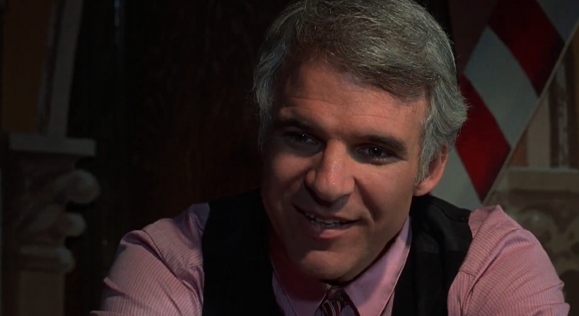
Alternate Best Actor 1979: Steve Martin in The Jerk

Steve Martin did not receive an Oscar nomination for portraying Navin R. Johnson in The Jerk.
 
The Jerk is an enjoyably dumb comedy about a jerk going through life. 
 
The Jerk marked Steve Martin's successful breakout from stand-up comedian, who occasionally cameod in films, to a full-on movie star. This is an interesting film to look at in terms of Steve Martin's later more expected presence which was a more white-collarish jerk, where he played a distinctly blue-collar jerk. Although more importantly than that, Martin later would play an intelligent man where the comedy of his work came from that in some context, particularly the idea as the smartest man in the room one way or another. This is the opposite as his Navin R. Johnson is always the dumbest man in the room right when we seem to see him in his sharecropper roots. Martin's accent he uses here I think is perhaps the greatest risk of this performance, which is really on a certain tight rope of goofiness, to begin with, and is rather wonderful in just how dumb his voice is. It isn't quite a southern accent, instead, it is best described as a stupid accent, a very stupid accent that manages to be hilarious in its odd dumbness. His way of not quite being anything that makes sense just makes for perfect sense in creating a strangely endearing kind of dumb for his Navin as we see him move from his rural life to find his fortune. 

What this performance then becomes is this series of Martin being funny as a complete idiot and getting into ridiculous situations often due to Navin's idiocy or by mere happenstance. Martin's work here is pure in the sense of him just trying to be as funny as possible with his overly earnest delivery which might be the key to his portrayal of Navin as the jerk. This as Martin is kind of everything you'd want in this performance, as there is the right lack of awareness that Martin brings as the fool. A kind of essential ingredient that is interesting to see upon reflection given Martin would be known for smarter seeming characters. Martin's approach wholly works in his foolishness because there's just something pure about his smile that suggests little to few thoughts of Navin as he first finds work at a car garage. A place where we get great comedic timing from Martin whether it be his hapless reactions to his boss (Jackie Mason)'s strange advice, or his physical comedy goes around with a sort of incompetence. That run of his alone is needed for a bit of analysis for comedy. It is just the right kind of dumb, natural unnatural dumbness. It is too much, but also not too much. A highlight of Martin's approach perhaps finding his closet apartment where the excitement in his voice and wonder in his eyes as he looks at the dingy place is hilarious because Martin is too much, but there is something strangely authentic about it as well. He makes it that Navin is a ridiculous fool, but in that foolishness, his delight at his crappy apartment is 100% true. 

I think a great example of just this is when we see him find two very different lovers one a rough-around-the-edges stunt woman and the other a sweet woman, Marie (Bernadette Peters). With the latter, there is a scene of the two talking that is hilarious as Martin shows Navin's particular ineptness that Marie for whatever reason finds absolutely endearing. The thing is it is endearing because of the pitch-perfect nature of Martin's performance. Martin says completely stupid lines like asking Marie to think of her boyfriend when making love to him, but he says them with this sort of boyish honesty that makes it so funny. The film's romance itself is really dumb, right to an initial kiss of Navin's being licking Marie, which Martin does in such stride, which is also what is so funny. Martin shows the key of trying not to be funny is often the key to hilariousness and here we get kind of a great mix of trying to be funny, while also being funny, and trying not to be funny and being funny. Martin knows how to fluctuate his performance from going all in, such as the silly way he evokes Bruce Lee in a sudden battle with racists, or his quiet "seriousness" when a lost soul is forgotten by society. Both are Martin throwing all of himself in from the strict conviction of a battle stance as a fighter to a dumb saunter of the loathsome creature attempting redemption. Martin's work here has no higher purpose here, but he does not need it. This is just Martin being funny, by so purely being this idiot, and doing so in a way that is truly delightful in its idiotic ways.

Monday, 13 June 2022

Alternate Best Actor 1979: Klaus Kinski in Woyzeck

Klaus Kinski did not receive an Oscar nomination for portraying  Friedrich Johann Franz Woyzeck in Woyzeck. 

Woyzeck is perhaps an overly brief, though still intriguing, film about a soldier in a rural town. 

This film was made by the team that made Nosferatu, with production starting immediately after that larger-scale production, compared to this shorter, smaller-scale film. What you have though is said to be an exhausted crew and an exhausted star in Klaus Kinski. The quiet and solemn, though still animalistic turn, from Kinksi, offered a bit of a swerve from his innate presence, though it certainly used elements from it. That is the case here again in the role of Woyzeck, who to say is put upon is an understatement. Kinski's trademark intensity is of course present, however, utilized quite differently here as seen from the opening scene of the film. We see Woyzeck as he is put through the soldiers' paces but alone, making it almost look like a comical affair. Kinski has a kind of intensity as he physically straightens up and moves around with all the required soldiering you'd expect. His face though is of exhaustion and desperation within the paces. He's not having fun, nor is he determined in his task, he's rather moving around as a fearful schoolboy just doing what he has to because he's too scared not to do so. 

Kinski's performance here is fascinating because he really is not at all the fearsome warrior, despite playing a soldier, rather he's this rather weak-willed man and while Kinski is many things, that is probably on the bottom of the list when it comes to potential descriptors. Yet here it wholly works in Kinski's performance, where he presents this timid and exhaustive state in his performance. Kinski shows Woyzeck both as a soldier, and often the jack of no trades around town, with a glint of terror in his eyes at all times. He's a man just discomforted in his life and discomforted in his place, yet really too weak to do anything about it. There is that trademark madness in Kinski here yet where we see it is not in outward rage, but rather this kind of internalized petrified quality. He's a man stuck within himself and within anxieties. His whole performance is stiff and overly modest in the right way as someone just defined by his constant fear of the world along with everyone else. Woyzeck basically being this town fool, which Kinski delivers in a uniquely potent way. 

The one area where Woyzeck doesn't seem completely lost is a relatively brief scene of the man with his wife and son as they watch clever Hans the mathematician horse. A notable scene in a way in that for once in his career it seems that Kinski might be just a normal man, however, if that wasn't enough of a stretch, Kinski goes further by bringing this kindly meekness of the moment. He portrays this quiet joy of the man at the moment who does seem to enjoy his family, even as there is still the constant undercurrent of fear still present upon his brow in this moment of comfort. This is quickly subverted as we see his wife entertains another local soldier, who gifts her earrings. This leaving Woyzeck just to ask about them, and even in this Kinski's delivery is remarkable because he manages to be so painfully timid. There is a shyness in this confrontation even and continues to show a man who is basically beaten down by every aspect of the world. 

Naturally being a film that stars Kinski there is going to be a point of no return and this comes as he confronts his wife again, dragging her to a river to murder her for her infidelities. Kinski is downright amazing in this scene. First, as the actual motion of the stabbing is different from usual Kinski's rage, there is such a sense of desperation and kind of confusion about it. Even in this unquestionably permanent act, there is still such a sense of uncertainty in his eyes. The expression on his face is truly what is so incredible about his acting in this scene as it immediately and so naturally segues towards the moment of realization and sadness for his act. His face falls into the man coming into his sense to look even more lost than he already was. Kinski's final scene of him raving as he tries and fails to halfheartedly move on from the crime is still with this weakness even in this state. Kinski shows the man even more cowering than he was before, wholly defeated as he tries to explain to himself the truth of the matter. Kinski portrays just a terrified creature with nothing but his fear to hold on to. Although a relatively brief performance due to the brevity of the film, Kinski delivers a memorable turn here. A performance that contains the intensity he's known for, however, mutilated in a different direction to create such a striking portrait of a man breaking from his confines to become only more pathetic and desperate than he already was.