Showing posts with label David Gulpilil. Show all posts

Monday, 17 August 2020

Alternate Best Actor 2002: Results

9. Sol Kyung-gu in Oasis - Sol delivers a convincing portrayal of a man with disability, if only it was in a film I had more patience for. 

Best Scene: Bus.
8. Greg Kinnear in Auto Focus - Kinnear gives a fascinating depiction of a man living as a contradiction and the degradation that occurs as he tries to maintain this strange illusion.

Best Scene: Seeing his agent the last time.
7. Leslie Cheung in Inner Senses - Cheung gives a performance that leaves all the greater impact due to its real life connections, however even standing on its own it is a moving portrayal of dealing with guilt.

Best Scene: Ending.
6. David Gulpilil in The Tracker - Gulpilil excels in his off-beat portrayal of a man quietly taking control of a situation.

Best Scene: Making the turn.
5. Bill Paxton in Frailty - Paxton plays off his presence well in helping to create his southern Gothic horror story, in being both the seeming a genuine father and a deranged fanatic.

Best Scene: After the death of the sheriff.
4. Philip Seymour Hoffman in Love Liza - Although I found the film repetitive I found Hoffman as usual gives a convincing portrayal, here offering a moving portrait of a man suffering through his specific despair.

Best Scene: Reading the letter.
3. Olivier Gourmet in The Son - Gourmet gives a compelling portrayal of a normal man essentially dealing with a revenge scenario.

Best Scene: Confrontation. 
2. Chiwetel Ejiofor in Dirty Pretty Things - Ejiofor delivers a compelling leading turn portraying effectively a decent man trying to navigate a troublesome situation.

Best Scene: Airport goodbye. 
1. Hiroyuki Sanada in The Twilight Samurai - Sanada delivers a brilliant low key turn as a samurai who more than anything just wants to be able to live his life.

Best Scene: Talk before the final duel.
Updated Overall

Next: 2002 Supporting

Monday, 10 August 2020

Alternate Best Actor 2002: David Gulpilil in The Tracker

David Gulpilil did not receive an Oscar nomination for portraying the titular character in The Tracker.

The Tracker is an intriguing off-beat film about a posse tracking an indigenous man accused of murdering a white woman.

The posse features a tyrannical and violent leader known as the Fanatic (Gary Sweet) with two other white men whom he also berates, and their tracker played by David Gulpilil. As mentioned some reviews ago, Gulpilil has a unique presence as a performer which once again comes to play here. This as he can stand out really without doing much of anything. This being essential in the early scenes of the film which almost play like a musical in a strange way where there is very little dialogue as we see the men walking through the desert, title cards telling us their purpose, and really the music filling most of the blanks past that. In these scenes we see the tracker technically as part of the group but not as part of the group. This as Gulpilil delivers this certain distance in his manner as a man doing a job he doesn't particularly like. This in his eyes a gaze of lack of investment as they follow the brutal Fanatic. One of the earliest acts of the Fanatic being to slaughter a group of aborigines. The initial cut to Gulpilil's immediately after this act is depicted through a painting is incredible. This as his reaction is a specific heartbreak. He's clearly devastated but more internalized as a man who knows how he must behave in order to survive the circumstances he is in. This as even with that monstrous act he must continue going on with the group and the Fanatic's whims.

Gulpilil is great though in almost bringing a comic quality to his performance as it continues on. This as he finds the right tone in his manner that is both uncaring to Fanatic's cause, but also as disarming as possible. Gulpilil finds this effortless combination as he portrays the Tracker showing his ways to try to basically avoid the Fanatic's wrath while also in a way mocking him in his sort of quiet way of delivering every mention of his expertise in trying to find the supposed murderer. This of course doesn't satiate the mad man who instead chain up the tracker to bring him along the trip.Gulpilil still makes remarkable use of his presence in he has this certain command in presence in the sense of assured intelligence within the man even when shackled the way he is. He keeps both a reality and dignity intact with the character that simply is wonderful. There is a particularly great moment for Gulpilil takes a moment even to eulogies one of the fallen men of  the posse. Gulpilil brings such an understated yet palatable warmth in the moment, showing the tracker caring for another even within this divide with such a honest humanity. Again Gulpilil is captivating in his work by being so genuine in every moment here even in the film's rather atypical and at times overtly stylistic approach, Gulpilil is able to stand out in this essential reality within his own work.

After the tide turns though, where the tracker and the other surviving posse member team up against the fanatic, Gulpilil's performance changes. Naturally he shows the tracker more overt in his defiance, after all he is in charge. This is so powerfully shown though in the intensity he brings in a moment when he shows the fanatic directly his cruelty by looking upon a dead aborigine. There is such a notable strength in Gulpilil's glare no longer diluted by the need to seem harmless. This eventually leading to the tracker condemning the fanatic, where I love how straight forward Gulpilil is in the moment. This as his sentencing is even delivered with almost this casual quality, however in this creates such an honesty if even humor in the moment by showing that same manner of how he used to survive now inform him in his way of punishing the Fanatic. In this though still Gulpilil's casual quality has a real power to it as it feels so pure to the man and the character. It is again part of the man's presence so wonderfully. The film continues past this point as the tracker decides to still go to figure if the man is guilty or not. Gulpilil's sort overt confidence in terms of how much he expresses grows all the more. This again reinforcing the idea of the hidden intelligence of the tracker basically no longer being hidden, and the confident man that was there all along just being completely open in the moment. In the end we see the man wholly within his power and it is great just to see Gulpilil own the screen in these moments, no longer on the edge of moments but just dominating them. Now that is a relatively brief part of his work, however it is the natural end to his work. This being a fantastic realization of this arc of the tracker in a way revealing himself, but Gulpilil's artful gradual increase of his basically his charisma as a performer.

Monday, 27 July 2020

Alternate Best Actor 2002

And the Nominees Were Not:

Leslie Cheung in Inner Senses

Chiwetel Ejiofor in Dirty Pretty Things


Bill Paxton in Frailty


Hiroyuki Sanada in The Twilight Samurai


Sol Kyung-gu in Oasis


Predict Those Five, These Five Or Both:

Greg Kinnear in Auto Focus

Olivier Gourmet in The Son

Philip Seymour Hoffman in Love Liza

David Gulpilil in The Tracker

Timothy Spall in All or Nothing

Friday, 19 June 2020

Alternate Best Actor 2014: Results

10. Ethan Hawke in Predestination - Although Hawke ends up being crushed by the machine of his film, he still gives a largely compelling portrayal of grounding mind bending time travel.

Best Scene: Outlining the truth. 
9. Jesse Eisenberg in The Double - Eisenberg is less effective as the "confident man", though not bad, but is engaging in presenting his nebbish protagonist dealing with particularly odd circumstances.

Best Scene: Cyrano date
8. Shahid Kapoor in Haider - Although almost static, though sensibly so, in the first half of his performance, Kapoor in the second half unleashes a brilliant atypical take on Hamlet. 

Best Scene: Song number
7. Dan Stevens in The Guest - Although his film is lesser than, Stevens is a delight and absolutely captivating as a killer who seems strangely invested in a family.

Best Scene: Bully takedown. 

6. Jeremy Renner in Kill the Messenger - Renner gives a powerful portrayal of a man whose convictions slowly destroy him.

Best Scene: Final speech. 

5. Tom Cruise in Edge of Tomorrow - Cruise plays with his star persona by brilliantly subverting it in a multitude of ways, but also by living up to it as a natural progression of his character.

Best Scene: You don't make it any further
4. Oscar Isaac in A Most Violent Year - Isaac gives a brilliant portrayal of an atypical character in presenting a man quietly attempting to maintain his morality while also attempting to maintain power as a boss in a cutthroat business.

Best Scene: Confronting the thief. 

3. Channing Tatum in Foxcatcher - Tatum shatters any expectations on him through his powerful and intense portrayal of a man who has great potential but only can follow.

Best Scene: Breakdown.

2. Tom Hardy in The Drop - Tom Hardy gives one of his best performances in a brilliant high wire act that pays off as you're watching, but even more so with the revelation that gives you a greater sense for the overall accomplishment of his performance.

Best Scene: "You embarrass me"

1. David Gulpilil in Charlie's Country - Good predictions Luke, RatedRStar, Michael McCarthy, Anonymous, Aidan Pittman, Omar, and Mitchell. Gulpilil gives a portrait of just sheer honesty that reflects such a purely genuine person yet endearing in the unique qualities and life within this naturalism.

Best Scene: Seeing his dead friend.
Updated Overall

Next: 2014 Supporting

Tuesday, 16 June 2020

Alternate Best Actor 2014: David Gulpilil in Charlie's Country

David Gulpilil did not receive an Oscar nomination for portraying the titular character in Charlie's Country.

Charlie's Country is an effective character study following an aborigine man trying live life his way in Australia.

This is perhaps one of the more interesting progression of reviews as the last time I covered Gulpilil was for his work when he was a teenager in Walkabout. Here though we make a great leap forward to a much older Gulpilil as Charlie. Gulpilil's performance here is one of those performances that could only be given by the man performing it, not only due to his obvious heritage, but far more in what he brings to the role. This being this strictest honesty in finding his character, in a way that bars you from even second guessing a suggestion of it. From the first frame Gulpilil simply is Charlie and anything he does or acts is a given. There is neither a false or performed note in his performance. Of course this isn't to say that this is just a naturalistic turn, even if it is that, but the character of Charlie is actually quite idiosyncratic, and part of what makes it so wonderful is how Gulpilil finds this so truthfully. This in his weathered face is a man who has lived a life of a different kind of hardship and just is trying to plug along as he can initially. Gulpilil's work though doesn't fall upon easy martyrdom, in fact what I love is how much life and spirit he brings to the part rather than being a potential one note of somberness. This as even as we see the often dismal state of his existence Gulpilil does not portray it as this simple state of being downtrodden.

There's a real charm that Gulpilil brings to this performance that is just delightful. This in the manner of the man as he interacts with his fellow people, and even initially in his interactions with local badgering police force. The eccentricity that Gulpilil is something quite unique in that he manages to craft it in that same honesty as the rest of his work. This in this slight bit of kookiness, for the lack of a better word, as sort of the man attempting to maintain a bit of wildness within a world that demands a particular kind civilization from him. The sort of wily manner Gulpilil has this glint of mischievousness but also something almost inspirational within it. This as we see the man going about hunting with one of his friends, it is with an eagerness and daring. This in the moment Gulpilil showing in such an endearing manner a man living his best life at least for a moment. This even as the police initially crush these endeavors Gulpilil creates such an earned sense of frustration given how joyous the act he shows, and how natural it is to his very person. In this work I love the way Gulpilil embodies this state of empathy though within the character as we see Charlie interact with the other downtrodden. Although he doesn't speak on it a lot at first, there is such a powerful sense in his eyes and his reactions how he truly takes in this plight. Again it is with this piousness but rather this genuine sense of man being so connected within, fittingly, his country.

Gulpilil's performance is one here that manages to achieve that particular sort of success of being compelling within himself. In that just to watch him here becomes rather fascinating by so inherently authentic his work is. This is as we just see him creating a spear for himself to hunt, after the police take away his gun, the act of it being made is something special through Gulpilil;s nuanced performance that shows the certain dedication in the act, along with the curious yet always endearing eccentricity within it. This can be seen in every act of Gulpilil throughout the film. Gulpilil's work emphasizing very much how Charlie very much lives through attempting to just be as really would've his traditional calling at one time with always this sense of pride within these activities. Again though this even I think could box in the work here as that is not the case with Gulpilil as he doesn't become just a symbol of this type of man. This is as he in equal measure brings such natural humor to his performance as well. Whether this be in his interactions with a couple of local drug dealers, or acting as a "tracker" for the police to get those dealers, Gulpilil has these delightful blithe moments, most often in his English, delivery where we grants this sense of intelligence within his brief, seemingly, simple responses to men. Gulpilil's work always emphasizing all the more the thorough amount of life in his performance. This being essential in that he shows within the world that is often downtrodden there is the sense of the natural urge just to be allowed to live in the bush, in a way that wouldn't cause anyone harm. 

The police become insistent as they even confiscate his spear and kick him out of the wilderness. I love initially how Gulpilil doesn't play it as bitter right way rather this sense of disappointment and befuddlement that they would get in the way of his harmless way of life. Gulpilil's work showing the way the actions essentially are getting in the way of the natural existence of the man. When placed within the city Gulpilil with the same naturalism slowly shows a change in manner though with that same striking empathy. This first being when he discovers one of his friends dead in the hospital. Gulpilil's reaction is downright heartbreaking as he handles the most so subtle, it isn't a big cry, but rather this so intensely somber of sense of near confusion at the seeming unfeeling around the death. Gulpilil's performance then is one of this painful degradation as it seems there's something to get in the way of him living his life at every point. The point of finally lashing out has such an impact as Gulpilil is this instinctual pent up reaction. It isn't exacted with an obvious hate but rather within the moment it is filled with a potent exasperation at the treatment. This leading Charlie though to be sent to prison, where the transformation of the man is wholly within Gulpilil's performance. This in that just in his eyes he grants the needed sense of examination of the existence, before he is allowed to leave again. This with a brilliant scene Gulpilil as he meets with a parole officer. Gulpilil bringing so much charm in his honest yet also cutting responses regarding the difficulty of not associating with known drinkers particularly among cops. Gulpilil managing to be so genuinely funny while doing it in this way that just is again who Charlie is. After getting out of prison rather than trying to push the strange limits against him we instead see Charlie teaching aboriginal about his past as a dancer on a world stage in front of Queen Elizabeth. Gulpilil is amazing in this scene as he delivers that undercurrent that was always there of that pride of the man, but now here in full view. This in his work capturing such poignancy by portraying so earnestly the man's sense of love for the accomplishment but even more so the sense of that care to deliver this pride to the children. The scene being essentially Charlie fully being himself without being stopped by anyone and in that act there is something magical within Gulpilil's work. The scene exemplifying his work so beautifully. This as Gulpilil's work achieves greatness through a quiet but oh so powerful portrayal of just a portrait of an idiosyncratic man in which there is not a single false moment. This being a work were you feel as though you've just spent time with him on his journey, and were happy to do so.

Wednesday, 13 May 2020

Alternate Best Actor 2014

And the Nominees Were Not:

Channing Tatum in Foxcatcher

Tom Hardy in The Drop

Shahid Kapoor in Haider

Ethan Hawke in Predestination

Dan Stevens in The Guest

Predict Those Five, These five or both:

Jesse Eisenberg in The Double

Jeremy Renner in Kill the Messenger

Tom Cruise in Edge of Tomorrow

David Gulpilil in Charlie's Country

Oscar Isaac in A Most Violent Year

Thursday, 26 May 2016

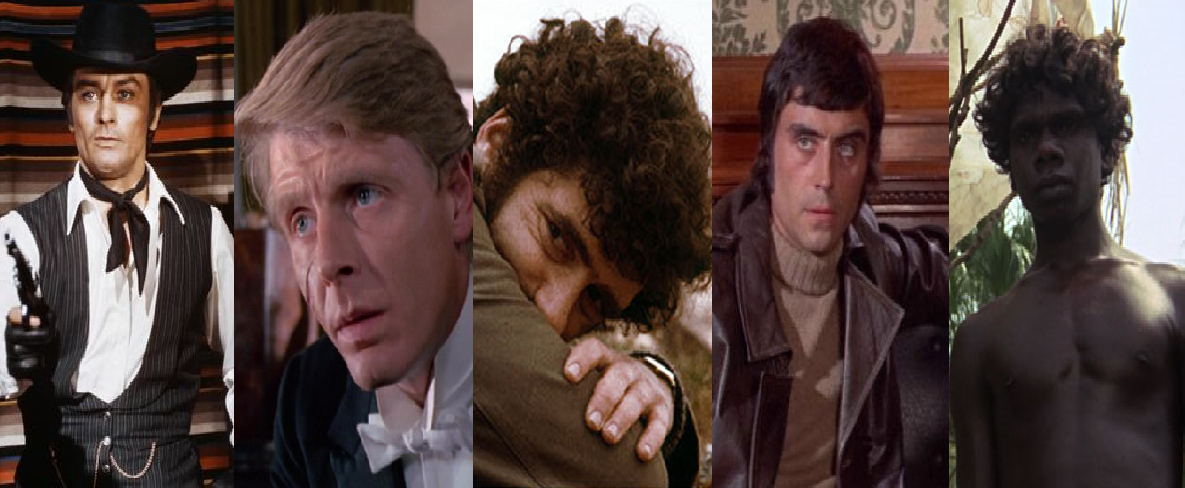
Alternate Best Supporting Actor 1971: Results

5. Elliot Gould in The Touch - A downright atrocious performance that fails on every level, and is quite bizarre to witness in a Ingmar Bergman film.

Best Scene: When he's off-screen. 
4. David Gulpilil in Walkabout - Gulpilil does not have a great deal to work with, but gives an honest portrayal of his character.

Best Scene: The failed mating ritual. 
3. Edward Fox in The Go-Between - Fox manages to be more than background largely in a single scene where he brilliantly realizes exactly what his character is going through.

Best Scene: Leo asks Hugh about Ted.
2. Ian McShane in Villain - McShane, despite dealing with a terrible co-star, gives an engaging and complex portrait of a gangster's closest associate. 

Best Scene: Vic goes to Wolfe after his mother dies.
1. Alain Delon in Red Sun  - Delon creates a memorable and appropriately smooth villain who acts as worthy foe for the all-star pairing at the center of the film, which is quite an achievement.

Best Scene: Catching Kuroda and Link off guard.
Updated Overall Rank

Next Year: 1985 Lead

Wednesday, 11 May 2016

Alternate Best Supporting Actor 1971: David Gulpilil in Walkabout

David Gulpilil did not receive an Oscar nomination for portraying the boy in Walkabout.

Walkabout is at the very least an interesting film about a sister (Jenny Agutter) and her younger brother (Luc Roeg) who become stranded in the outback after their father commits suicide.

David Gulpilil plays an Aboriginal boy the two come across, who is roaming the outback on his Walkabout in which he fends for himself. The boy though takes the two along with him, or at least he allows them to follow him. Gulpili speaks his own native language throughout the film, and the film purposefully eliminates the possibility of understanding him. No subtitles are ever granted to him, and there are very few moments in which the siblings manage to create a direct understanding with him. We are placed in the view of the siblings in this respect as even when the boy does speak it rarely focuses upon in a way in which would even allow one to decipher the words. Of course the film itself does not focus on any of the actors in really the traditional sense. The film seems to care more about the atmosphere of the location and the behavior of those within it more than precisely who they are as people, to the point that it feels like the siblings are supporting as well even though they technically are not in terms of traditional definitions.

Gulpilil therefore has an unusual challenge in that he's not silent, but he's also left without much in terms of verbal communication with the other characters or even the audience. The challenge only becomes more severe due to the nature of the director Nicolas Roeg's approach throughout the film. Gulpilil's performance works well within this structure though as he act natural to be as blunt about it as possible. He never seems to be pantomiming the role of the native, nor does his performance ever seem to be that clichéd restricted view of the native despite the fact there is only a rare occasion that we are given the chance to even know what it is that he is saying. Gulpilil succeeds in being what he should be in that the boy very much becomes sort of the natural expression of the nature around him. This is helped by Gulpilil having a natural charisma of sorts as he manages to have a certain magnetism about him even though this is never a forced intention by his performance. Gulpilil is able to produce this quality without ever seeming to try, which is essential for the role and the film.

Once again the nature of the film and the role does place upon a few severe restrictions on all the performers, since again we mostly witness their behavior with only some emphasis placed on the actual growth of the trio as characters. The major transition is given to Gulpili though in the final interactions between the boy and the siblings, well in this case more of just the sister. This is when the boy decides upon the sister as being more than a travel companion. Gulpilil is quite effective in this scene as he portrays the gradual change in the boy from a mere curiosity in the sister to something far more intense. This leads to the eventual point in which the boy tries to take her as his mate by performing a ritualistic dance after he stumbles upon her half naked. Gulpili is terrific in this scene in that he portrays the moment as more than a primal dance, but also a breakdown of sorts for the boy as the sister outright rejects his advances. Now even this breakdown is still muted in a way by Roeg's choices, despite being well played by Gulpilil. This is a good performance by Gulpili that stands well within the film, even if it does not exactly standout all that much beyond it.

Wednesday, 4 May 2016

Alternate Best Supporting Actor 1971

And the Nominees Were Not:

Alain Delon in Red Sun

Edward Fox in The Go-Between

Elliott Gould in The Touch

Ian McShane in Villain

David Gulpilil in Walkabout