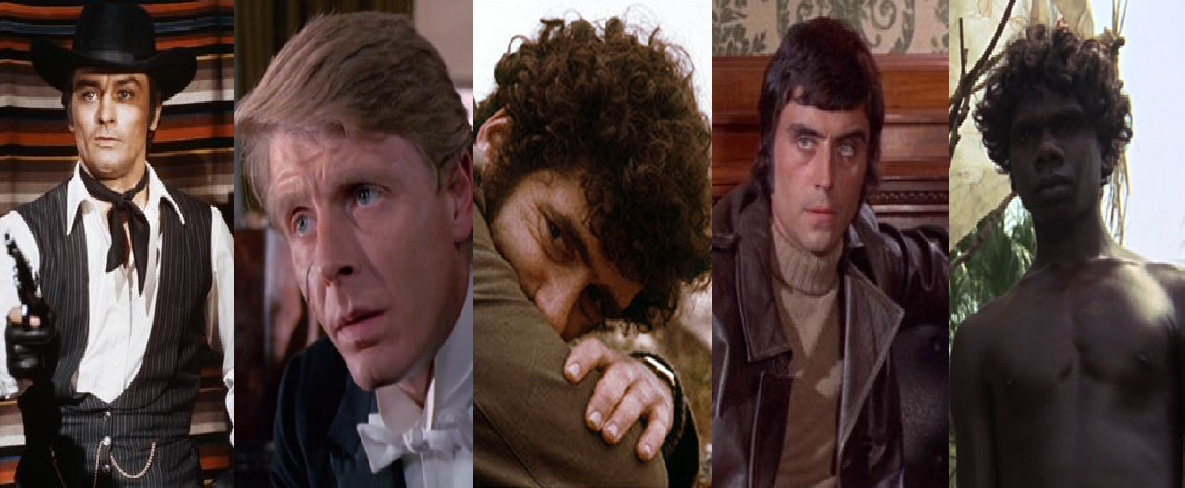
5. Elliot Gould in The Touch - A downright atrocious performance that fails on every level, and is quite bizarre to witness in a Ingmar Bergman film.
Best Scene: When he's off-screen.
4. David Gulpilil in Walkabout - Gulpilil does not have a great deal to work with, but gives an honest portrayal of his character.
Best Scene: The failed mating ritual.
3. Edward Fox in The Go-Between - Fox manages to be more than background largely in a single scene where he brilliantly realizes exactly what his character is going through.
Best Scene: Leo asks Hugh about Ted.
2. Ian McShane in Villain - McShane, despite dealing with a terrible co-star, gives an engaging and complex portrait of a gangster's closest associate.
Best Scene: Vic goes to Wolfe after his mother dies.
1. Alain Delon in Red Sun - Delon creates a memorable and appropriately smooth villain who acts as worthy foe for the all-star pairing at the center of the film, which is quite an achievement.
Best Scene: Catching Kuroda and Link off guard.
Updated Overall Rank
Next Year: 1985 Lead
Showing posts with label Ian McShane. Show all posts
Thursday, 26 May 2016
Wednesday, 18 May 2016
Alternate Best Supporting Actor 1971: Ian McShane in Villain
Ian McShane did not receive an Oscar nomination for portraying Wolfe Lissner in Villain.
Villain tells the story of a violent cockney gangster Vic Dakin (Richard Burton), it probably would be a decent enough crime film if it were not for its rather atrocious central performance.
Well even though the film stands as yet another example of the cinematic law of the more performances you see from Richard Burton the worse actor he becomes. This is one horrible example of this as any scene with Burton is tainted despite there being a saving grace often around him in the form of one Ian McShane. McShane is one of those actors whose been around for a long time while only having a pseudo breakout later in his career via the television series Deadwood (which I've yet to see). McShane's abilities as an actor though were evident early on such as here where he plays Wolfe Lissner one of the members of Vic's criminal organization. Wolfe's unique within the organization though not only in terms of his actual activities, which involves handling a prostitution ring which he also uses to garner blackmail material against powerful officials, but also in terms of his relationship with Vic, since he just happens to be his lover as well.
McShane owns the role in a way that is very much needed for the film. McShane carries himself with a certain style, which while realistic gives Wolfe's the right flair as a character. McShane is rather smooth in the role in that he so well realizes the distinct sort of charm that Wolfe's possesses. McShane utilizes this to portray Wolfe's methods particularly well at every front. This includes convincing women to do "favors" for him, which McShane carries this quiet elegant warmth in his statement that makes his way of swaying them to sell themselves believable. The same is true for Wolfe as he paints the men of power into a corner as well. McShane so delicately plays these scenes as he always makes Wolfe seem so earnest as he tells the women, or the men that the arrangement that he has made is mutually beneficial for all. McShane's approach is to project this innocence of sorts that understandably puts all at ease, despite the fact that Wolfe is anything but.
Now the main crux of the film probably should be the relationship between Vic and Wolfe. The film always comes back to them, and it is quite possible that this is properly set up on the directing and writing fronts. The problem is found in Burton's performance which is so hammy in the worst possible way that Vic never is more than a one dimensional caricature. Again though McShane comes in to pick up the slack left by Burton. McShane is brilliant in his depiction of the various scenes where Wolfe interacts with Vic, since he never leaves it as simple as it could have been. McShane instead finds a definite complexity in this relationship. On the surface McShane expresses the certain manipulative side of Wolfe in his interactions towards Vic, as he does not shy away of showing the blunt pleasure he seems to get from colluding in Vic's schemes. He still conveys certain limits to this as Vic becomes more possessive. McShane's excellent as he presents Wolfe as not having the same singular obsession, especially in one moment where the bi-sexual Wolfe is interrupted with his girlfriend by a desperate Vic. However McShane does not leave it a wholly shallow relationship despite some questionable elements within it. McShane subtly alludes in pivotal moments a genuine side to Wolfe, that is particularly striking against his false earnest side, when Wolfe shows actual concern for Vic's mental state. McShane finds this never to be a contradiction, instead even allowing a real complexity in the relationship between Wolfe and Vic. This is wasted in terms of the film due to Burton, but on McShane's end it's there. McShane's performance is rather wonderful here as any scene in which he appears has at the very least a spark of energy to them. In the scenes without Burton, McShane only excels all the more, and there was quite possibly a great film if it had been all from Wolfe's perspective or at the very least Vic had been played well.
Wednesday, 4 May 2016
Alternate Best Supporting Actor 1971
And the Nominees Were Not:
Alain Delon in Red Sun
Edward Fox in The Go-Between
Elliott Gould in The Touch
Ian McShane in Villain
David Gulpilil in Walkabout
Alain Delon in Red Sun
Edward Fox in The Go-Between
Elliott Gould in The Touch
Ian McShane in Villain
David Gulpilil in Walkabout
Subscribe to:
Posts (Atom)