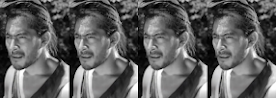
Philip Seymour Hoffman did not receive an Oscar nomination for portraying Caden Cotard in Synecdoche, New York.
Synecdoche, New York is a film one can feel free to call self-indulgent tripe, however I loved the film and its surreal and ambitious approach in the story of a theater director's rather surreal and ambitious project.
The late great Philip Seymour Hoffman is the center point of director/writer Charlie Kaufman's feature film debut, and one could argue he is very much the author's surrogate though less literally so than the Kaufman scribed
Adaptation starring Nicolas Cage. Hoffman's work very much navigates and embodies this heavily symbolic atypical narrative. This appears no simple task as the very idea of the role of Caden Cotard appears to be a man who simply observes his life while failing to participate within it directly. The very idea of such a character could leave the role to be a cipher merely to be present within the scenes, and nothing more. Hoffman's performance prevents this and also prevents the film from becoming excessively distant in my view. The other performances, and characters after all are purposefully some semi-absurd representations of people that do not strive for an exact reality. In a sense neither does Caden, as no normal person, even normal director or playwright would likely undertake his particular project, nor does anyone live a life where years seem to go by in an instance and reality bends as few things appear exactly as they are or they should be. The entire existence is broken within the film therefore Hoffman acts as this essential glue, or least bridge between the audience and the film. Hoffman is very much the anchor of the film even far beyond in the typical sense of a leading performance as the film would likely be an intangible dream without him.
Hoffman's performance as Caden is an exceedingly specific in style and approach. In that he doesn't just simply give a realistic performance, as that also would not quite be appropriate for the material at hand either. It is instead a rather striking balance that he finds within his work in order to basically funnel the high flying central concept towards something cohesive, and something much more honest. A part of this is to, in a way, play along though again nothing is simple about this film therefore Hoffman's own work needs to match the complexity. In that the strange elements within the film are not completely ignored within Hoffman's work. He never breaks the reality by in a sense noticing too much through some over the top reaction. Hoffman though does provide humor within this while still granting Caden as though he is a form of sanity within insanity. There are moments where there is a more inherent comedic element that Hoffman delivers rather brilliantly in his interactions with essentially the most deranged figures within the deranged world. The most notable of these perhaps being his interaction with his daughter's pseudo nanny and eventual lover Marie (Jennifer Jason Leigh). Hoffman's reactions to her are indeed amusing, in that he portrays a more exact realistic exasperation that would be fitting towards any man listening to some of the bizarre nonsense that she espouses.
Hoffman's work here is not to make fun of the film though but in a way it is there to make it some way digestible that is all the while still being an idiosyncratic character within the film. Caden you could potentially argue is both the most grounded and the least grounded character in the film comparing his personal attitude towards his overarching actions. This is only one of the hypocrisies of the role that Hoffman must grant coherence to. Hoffman does somehow accomplish this in his more basic portrayal of Caden as the "sensitive" artist. Hoffman realizes particularly effectively the overarching sense of ennui needed for the role. It is very much just a state of being that Hoffman creates as this essential sadness inherent within his performance. It is not something that needs to be openly stated it just is at is within Hoffman's portrayal that simple embodies that sense of weariness. This weariness though even in a way isn't as simple as it may seem. In that Hoffman captures a sense of distress that is both real and false in a sense. This juxtaposition again is one that seems hypocritical yet isn't through Hoffman's performance. In that the idea of essentially the unease of living is exuded in Hoffman as a reality of the man who in his eyes who most often seems to be trying to decipher his existence for some rational meaning. Hoffman though balances this with a more grounded anxiety almost fitting to the hypochondriac. Hoffman physically portrays Caden as man who never seems wholly comfortable within his skin, almost nervous at the prospect at being alive due to the fear of death.
A great deal of who Caden is comes within the women in his life that end up defining the periods of his experience. Hoffman is essential to realize each relationship that are similair yet subtly different. His initial relationship is with Caden's wife Adele (Catherine Keener) which is perhaps a more basic existence in terms of what we see in the film's opening. Hoffman captures the definition of a relationship based around a rift of jealousy and separation. Hoffman accentuates some history within a relationship to the point of marriage in these interactions, however they are always broken with almost an assumed unhappiness created by this history. This is in contrast to his relationship with box office attendee and later assistant Hazel (Samantha Morton) who makes her attraction to him rather obvious. Hoffman in these interactions is particularly poignant if also painful to watch in a way. In that he is able to portray in his sad eyes a combination of a genuine love in these interactions but also still this distance. His delivery always is hanging with his charge of emotion just behind it yet never quite realized fitting to a man who only goes so far within the relationship. Caden never takes that next step and the tension of this is not quite requited yet not quite unrequited love that Hoffman realizes is strangely harrowing. Hoffman doesn't waste a single relationship within the film though as each creates different insight into the man. This includes his relationship with his second wife Claire, an actress in his plays, where Hoffman grant an initial lust quickly dissolves into a cold distance. This feeling is even stronger in his brief time with Hazel's stage surrogate/lookalike Tammy (perfectly cast Emily Watson). In that brief sequence Hoffman reveals so much vulnerability and a real desperation to the woman who speaks far more openly, and in turn Hoffman brilliantly uses to scene as barely looks at her and only speaks in retiring self-loathing remarks showing Caden as to reveal a man too afraid within his desperation to be proper husband or partner to anyone.
The crux of the film is the gargantuan theater project of scene after scene of people replicating existence while not a single audience member watches them. Caden just keeps building it and continues to observe even as the lines blur all the more. This initially is commonly inter spliced with the reality of Caden following his wife's successful micro-art career, looking at every piece with a curious longing, and trying to engage with his daughter who is lost in weird symbolic life that leads to an early death. Those scenes with his daughter are pivotal to the film, and to Hoffman's performance. In part it shows his success in creating this bizarre juxtaposition of style that somehow works despite being so odd. In that once his daughter has aged Caden seems always behind a barrier from her whether it be literal, time or language based. He can only see or be told what happens to her, and again it's fascinating what Hoffman is able achieve in his work. He has those moments that are indeed comedic in just observing the strangeness. Concurrently Hoffman is heartbreaking in portraying the genuine anguish of only being the observer, and of having to see his daughter waste away at this distance. Hoffman allows the absurdity yet he humanizes it so beautifully it is an astonishing combination that he achieves by adhering to granting a reality of Caden's state which is only way to adhere to the potentially unwieldy tone. In that Hoffman's work shows how it would be a little comical to be in such a weird state, yet still there is very real tragedy if the overarching experience were true. This directly connects to the theater project in which Hoffman portrays a man constantly searching for meaning while still only being a bystander to it all. With the recreations Hoffman exudes this exhaustion of the search to find something more. Hoffman depicts the direct frustration essential to find the meaning of life, yet remains only ever with moments. This act is in itself powerful even if with a purposeful lack of catharsis as Hoffman makes this need so palatable in every moment of watching "the performances" as in his eyes there is both a longing to find, but also a confusion as he remains lost. He only seems to find any meaning when he takes part in the performance, by assuming the life of another however now with clear direction, literally, of what to do and how to exist. Hoffman finds Caden in this state of solace as he essentially is eased into the end of his life by given this direct path. Hoffman in his realization of Caden's final moments in this state of comfort yet technically decay is haunting. It is again an hypocrisy as the observant only engages in life seemingly at sort of world's end, where the only the companionship is in the form of basically a stranger, and where he is being told exactly what to do. There is a real power there again, the final moments of the film are incredibly moving. Again what connects this all is Hoffman's work, which is not lost within this concepts, or the extreme stylistic choices of the film. He gives a quietly masterful turn as he is the human conduit for it all to make this exploration of life something truly special.