Showing posts with label Woody Harrelson. Show all posts

Sunday, 18 December 2022

Alternate Best Supporting Actor 2016: Woody Harrelson in The Edge of Seventeen & Hugo Weaving in Hacksaw Ridge & Results

Woody Harrelson did not receive an Oscar nomination for portraying Mr. Bruner in The Edge of Seventeen. 

The Edge of Seventeen follows high school outcast Nadine (Hailee Steinfeld) as her life seemingly gets worse when her best friend starts dating her brother. 

This entry into the genre is particularly good for its considerable sense of humor much of which exists within the character of Woody Harrelson's history teacher Mr. Bruner, a character that is often the caring and supportive sort. The opening of the film is a flashforward featuring Nadine as she announces her intention to commit suicide to Mr. Bruner. What follows is one of the funniest scenes of 2016  via Harrelson's perfect delivery with his false sincerity as he announces that her words are "a lot to take in", followed by a perfect deadpan as he announces the fact that he had been drafting his own suicide letter at the same time, before reading it off that notes his exasperation with Nadine and his preference for the peace of a cold death rather than her taking his lunchtime away. Harrelson emphasizes every single word with a kind of honest lack of sincerity, as he makes the annoyance towards losing his time real while being as phony in the best way possible as he delivers each word as an extra degree of truth towards Nadine, before switching to the perfect excrement eating grin when he declares his hope that his indifference would get him fired. Although the film then proceeds to flashback what we get from Harrelson is random appearances of great comedy throughout the film whenever Nadine runs into him. Harrelson's embodying this note-perfect long-term teacher who has seen it all in one way or another. Harrelson's hilarious then doling out his particularly blunt wisdom when noting that Nadine does herself no favors. 

Harrelson though of course delivers these extra bluntly, such as when retorting that maybe she should have a life rather than focusing on one mistake he made during a lecture or noting that she might just be not particularly likable for her lack of friends. Harrelson delivers all of this with impeccable timing that makes his theoretical cruelty pure comic gold, although he does do a bit more to enable the character to serve his purpose beyond the comedy. Harrelson's performance always has this right knowing quality in his eyes as someone who has seen this before even with his approach that does suggest his callousness, while funny, isn't all there is. We develop more so into this as he reads out an impulsive sexually explicit text that Nadine sent, which Harrelson delivers with comic perfection as Mr. Bruner slowly uncovers its nature as he goes along starting with an initial "this isn't so bad" before starting to see it for what it is. As blunt as Mr. Bruner is, when he notes that Nadine is his favorite student and gives her part of her cookie, Harrelson is able to carry with it a more genuine sense of care even within the sarcasm that defines the man. Harrelson's great because he doesn't switch from the note, he rather carries the note authentically from who this guy is and the way he deals with students, likely students like Nadine before. It isn't a sudden shift rather just even though he's still callous, he does care but in his own way. Harrelson ends up being this source of comfort as he is able to create rather brilliantly the sense of sincerity within the sarcastic cynicism, without breaking either which is impressive. How? Well, Harrelson's comic moments again have the right sort of distance in that they definitely are jokes to him as blunt as they are, however when we do see the concern, which Harrelson plays entirely in his eyes, that is wholly genuine though not at all forced. It is a terrific comic performance from Harrelson as he runs with the humor that defines the character, but when he needs to give just the right amount of heart, he does so with a natural ease. 
Hugo Weaving did not receive an Oscar nomination for portraying Tom Doss in Hacksaw Ridge. 

Hugo Weaving exists in probably the least successful portion of the film featuring the pre-war times where the tonal clash is aggressively evident. The scenes that work best are those that follow squarely on Hugo Weaving as Tom Doss the father of our hero Desmond (Andrew Garfield). Weaving's performance is defined by Tom Doss being a man who mentally died in World War I despite surviving in the body. Weaving's performance is as a broken man specifically as everything about him seems as though he is weighted down within his existence. His face drowns down into a state of just barely holding it together so as not to fall apart constantly, his own physical being sunken and filled with a painful depression. Weaving's performance suggests almost a barely functioning corpse forced to still walk the earth while feeling the constant pain of his death all the same. Every moment we see him there is suffering laden within him whether it be just beneath the surface or constantly oozing out of him. Weaving's best moments come when his sons decide to enter World War II, first his older son Doss's brother, where Weaving is outstanding throughout the dinner scene when Doss's brother arrives in army uniform. Weaving's initial impression with quiet disbelief and an immediate sense of pain. And what is always remarkable is when a performance that is already in a deep pit can somehow go further into that pit. Weaving does this as regales a tale of a local boy who had a clean-cut uniform, and Weaving pressures into each word irony of a man with a broken yet true perspective on the situation. When he finishes the tale by noting the bloody death of the man and hoping his son's death will be cleaner, Weaving's lips quiver as the man barely able to speak the words, and his eyes only become more filled with anguish. Weaving showing as much as the father is brutal, all of this comes from a very real pain at seeing his son potentially die, and when he tells his son to get out of his sight, the anger of it is wrapped by an overpowering sadness. His conversation with Desmond when he enlists is a bit different and I like how in it, Weaving conveys a different relationship with the son he knows is different. Weaving still exudes the petrifying fear and sadness as he looks at his son, however now his trying to explain the situation is with earnest desperation trying to convince him that as a man of faith, in the way Desmond is, it can't work out. What Weaving shows with each scene as much as this is a deeply flawed man, all of what he is comes from his ptsd, and is heartbreaking in depicting his horrible state. The one scene where he seems out of this, and I think Weaving uses particularly well, is when Tom goes about helping Desmond avoid court martial by getting a letter from a General, and former comrade in arms. Weaving's performance in the scene of saving his son from legal punishment shows a potential other side to Tom. Although his eyes are still of the broken man, when Weaving speaks there is a real passion within it as he speaks of Desmond's rights and what he must've fought the previous war for. In the moment Weaving shows strength in Tom, and suggests in it the man he might've been, if he hadn't been scarred so deeply by his past.  

Next: Backlog and recommendations. 

Saturday, 21 November 2020

Alternate Best Actor 1994: Results

10. Robert De Niro in Mary Shelley's Frankenstein - De Niro is the best part of his terrible film, attempting to find some humanity in the concert of ridiculousness.
 
Best Scene: Listening to the family. 
9. Woody Harrelson in Natural Born Killers - Harrelson gives a convincing portrayal of a brutal madness, even if the character is rather limited. 

Best Scene: Interview.
8. Shah Rukh Khan in Kabhi Ha Kabhi Na - Delivers a nice charming turn as a somewhat atypical romantic hero given where the romance goes.

Best Scene: Accepting the situation.
7. Brandon Lee in The Crow - Lee tragically proves himself a capable leading man both delivering the intensity and charisma needed for the part. 

Best Scene: Before the kidnapping.
6. Kevin Bacon in The River Wild - Bacon gives a fine menacing turn bringing the right degree of sleaze with just enough charisma in there.

Best Scene: "There's no way"
5. Ge You in To Live - Although overshadowed to a definite degree, Ge You still gives a moving portrayal of man just making his way through trauma.

Best Scene: The hospital.
4. Tom Cruise in Interview With The Vampire - Cruise is surprisingly able to disappear into his role as his vampire who loves being a vampire.

Best Scene: Ending.
3. Temuera Morrison in Once Were Warriors - Morrison gives a terrific portrayal of both the brute and the charmer that allows a vicious cycle of abuse to exist.

Best Scene: Winning his wife over.
2. Xia Yu in In The Heat of the Sun - Xia gives a wonderful coming of age turn that amplifies every moment of his young man's journey into life and love.

Best Scene: "Party"
1. Ben Kingsley in Death and the Maiden - Good predictions Lucas, Tim RatedRStar, Anonymous, Matt & Jack. Kingsley delivers one of his best performances in both creating such a compelling question then delivering an unforgettable answer.
 
Best Scene: Confession.

Next: 1994 Supporting

Sunday, 18 October 2020

Alternate Best Actor 1994

And the Nominees Were Not:

Ben Kingsley in Death and the Maiden
 
Ge You in To Live
 
Temuera Morrison in Once Were Warriors
 
Shah Rukh Khan in Kabhi Ha Kabhi Na
 
Woody Harrelson in Natural Born Killers

Predict These Five, Those Five or Both:

Robert De Niro in Mary Shelley's Frankenstein
 
Kevin Bacon in The River Wild
 
Tom Cruise in Interview With The Vampire
 
Brandon Lee in The Crow 
 
Xia Yu in In the Heat of the Sun

Saturday, 27 January 2018

Best Supporting Actor 2017: Results

5. Richard Jenkins in The Shape of Water - Jenkins gives a wonderful performance very much as the type of truly "supporting" supporting performance by offering just bit of extra humor, warmth and emotion to the film.

Best Scene: Repeating the signs. 
4. Christopher Plummer in All the Money in the World - Plummer's post-last minute work here stands on its own, past the unorthodox nature of his casting, through his captivating portrayal of the world's richest man who he brings to life as indeed a commanding miser, but with a sense of humanity even within his most despicable behavior.

Best Scene: Fletcher confronting Getty.
3. Willem Dafoe in The Florida Project -Dafoe delivers one of his best performances through his earnest and always genuine portrayal of decent man trying to keep his optimism through much adversity. It's quietly poignant portrayal of an honest warmth within a rather harsh environment.

Best Scene: Dealing with a pedophile. 
2. Woody Harrelson in Three Billboards Outside Ebbing, Missouri - Harrelson grants his character here a notable charisma and brings out the best in his film's humor. He goes further though in giving a rather heartbreaking portrayal of a man facing his own mortality.

Best Scene: Interrogation room. 
1. Sam Rockwell in Three Billboards Outside Ebbing, Missouri - Good Predictions Mitchell, Giuseppe, Tahmeed, Luke, Jackiboyz, Maciej, RatedRStar, Omar, Robert, GM, Michael McCarthy, Anonymous, Matthew C. Well for me Rockwell tops this fantastic year for supporting actor nominees. Rockwell as expected brings such an energy through his performance, and where Harrelson excels in the verbal humor though Rockwell does that too, Rockwell is dynamite with the physical humor around his character's buffoonery. Rockwell's work is most remarkable though in successfully delivering his character's arc from a terrible man to a broken man finally starting to see his mistakes.

Best Scene: Dixon brings news to Mildred. 

Best Supporting Actor 2017: Woody Harrelson and Sam Rockwell in Three Billboards Outside Ebbing, Missouri

Woody Harrelson received his third Oscar nomination for portraying Chief Bill Willoughby in Three Billboards Outside Ebbing, Missouri.

Three Billboards Outside Ebbing, Missouri tells the story of Mildred Hayes (Frances McDormand), the mother of a murdered teenage girl, who rents three billboards in an attempt to force the local police force to solve the murder. I will say I loved Three Billboards the first time I saw the film, though I had a few reservations, however over time the film has come under intense criticism. Of course this likely would not be so fervent however given that it once claimed the best picture front runner position, without having any assumed "importance" in a general sense, which in the days of social media leads to more scrutiny on the film than would be received by a recently discovered Vincent van Gogh painting. Well, finally re-watching the film, with all this negativity swirling around,  I have to say...my appreciation for the film has only burgeoned. Now with the entire film in perspective I can see it is not about the heroic mother fighting for her daughter in the slightest, as I will admit I wrongly assumed it was in my initial viewing, there are no heroes here only flawed people trying to make due with their losses. Now there is major facet of the backlash I haven't dealt with, but I'll get to that with the second review.

First let's have a nice easy time looking at Woody Harrelson successfully breaking the over twenty year gap of having no two supporting actors in a single film nominated. Harrelson, despite having the smaller role, managed to find his way into this lineup even with so much praise going to two of his co-stars, one in the very same category. Harrelson's achievement then is notable and it becomes readily obvious why he was able to break that trend through his work here. On the surface it seems we might get just a good old Woody Harrelson performance as a good old boy. Not that there isn't anything inherently wrong with that as Woody Harrelson only need compete with Matthew McConaughey when comes to the primary actor for a good old boy role. In fact Harrelson quite excels in that facet particularly as it relates to director/writer Martin McDonagh's humor, which is technically is a touch more low key in this film than his previous efforts. Harrelson's comedic timing is perfection for what is to be had through Willoughby's quiet way of venting his frustrations over the situation, whether it be confusion over "a lady with a funny eye" lodging a complaint over the billboards, or in his attempt to explain to Mildred the makeup of his police force.

Now this good old boy routine goes a bit further here with Harrelson's performance as he needs to establish why everyone seems to love Willoughby, and why does everyone hate Mildred's signs for calling him out by name. Harrelson does so by being quite charming here and delivers the needed charisma to this "great" man. This includes when Willoughby is dealing with his worst man where he brings almost a fatherly manner in his reprimands and his defense of their shortcomings. Harrelson portrays Willoughby as someone willing to listen and ready to look for the good in people whether he should or not. Willoughby even when dealing with the very hostile Mildred delivers these lines particularly well. As he offers a definite sympathy even within the frustrations as he explains his legitimate reasons for his failures to catch the killer, and his disagreement with her use of the billboards. Harrelson reveals Willoughby as this inherently likable mediator who is evidently trying his best even if not given credit for it. On a slightly side note it also must be mentioned that Harrelson is particularly great in the two scenes he has with Willoughby's daughters brings such tremendous heart in every moment of his earnest interactions with them, making Willoughby a genuine and wholly believable great literal father as well.

The real key to Harrelson's work though is his portrayal of the chief dealing with his terminal pancreatic cancer diagnosis. We are first introduced to this when he brings it up to Mildred in their initial conversation. Harrelson is amazing in this scene as he more overtly reveals Willoughby's vulnerabilities to her and he is particularly affecting in revealing in his eyes just how distraught he is as she initially offers no sympathy in return. This facet of the character is something Harrelson elegantly weaves into his work even when he not directly dealing with it. One of my favorite scenes of Harrelson's is when he checks out the report on the murder near the billboards. Harrelson doesn't say anything about his own upcoming demise, yet his moments of examining the shadow of the sign as though it marks the grave of the victim he conveys the sense of Willoughby quietly seeing his own mortality in the context that he knows he'll never solve the case. Harrelson does not waste the more overt moments though which uses well as the brief times when the man simply cannot hide it anymore, or is forced to not be able to. He's downright heartbreaking when he suddenly spits up blood as Harrelson so honestly apologizes, and reveals the intensity of the very real overwhelming fear of the moment. The same is true in the scene where we see him essential make his final decision when briefly left alone at the hospital. After having just a brief moment of warmth with his wife (Abbie Cornish), where Harrelson once again projects Willoughby's seemingly unshakable charm, when alone his breakdown is incredibly moving as the complete sorrow in his expression reveals a man who knows he has no hope for survival. Harrelson exits the film soon afterwards physically though he has a few more vocal scenes through letters Willoughby left for a select few people. Harrelson delivers these in a pretty straight forward way, as a man proof reading his letters basically, though still these are rather emotional letters so this is not in a hollow sense, it is effectively handled to the point he gets one more laugh out of me even when leaving one last good-natured insult to one of the recipients. The general ideas of the letters though is Willoughby's continued influence on the story despite his departure. Well Harrelson also continues his influence on the film despite his early exit through his hard edged yet heartfelt portrayal of the tragedy of a man out of time yet with still so much left to do. 
Sam Rockwell won his Oscar from his first Oscar nomination for portraying Officer Jason Dixon in Three Billboards Outside Ebbing, Missouri.

Well this brings me to the more complicated part of the review, which would be quite different if say I was reviewing this performance in a few years from now. I could just go about looking at the performance, but unfortunately there is a bit baggage that needs unpacking. The strongest backlash of the film has been built around the character of Jason Dixon. One faction of this criticism is completely ridiculous, those who believe Rockwell should not be rewarded for playing a racist. Well I guess stop everything and re-write every acting award as best performance as a nice character and rescind the Oscars given to Anthony Hopkins, Kathy Bates, Heath Ledger and so many others for playing such despicable sorts. I'll admit that is only one faction though, the second faction requires a bit more effort to broach their criticism. This criticism against the redemptive arc of Jason Dixon as a character despite being a racist. One being it is illogical and impossible. Well that's just not the case, one can look no further than the true story of John Newton who went from slaver to abolitionist, that is frankly a far more extreme conversion than the one you witness in Three Billboards. There's of course more to this, but I'll be touching upon this in the actual review of the performance, and not just the character.

Sam Rockwell to start off takes the right approach to the role of Dixon which is to make to sure to emphasize the sheer stupidity of the character. This is from his opening scene of inspecting the billboards where he questions the men putting up the new signs on the billboards without the candor of someone you would describe as a seasoned detective. Rockwell mumbles the delivery of Dixon attempting to question the men and is rather amusing in his bungled way of attempting to threaten one of the men with arrest for improper bucket disposal. Rockwell's performance purposefully constructs the role from this outset so that we laugh at Dixon never with Dixon. In this scene there is no incisiveness as he asks them but rather we see the sheer idiocy of the man in his attempt to be any sort of cop. We see this continued in Dixon's way of speaking casually offensive language most related to homosexuals and the mentally handicapped, though notably he mostly avoids anything towards African American even attempting to revise Mildred's language, only speaking offensive words in his explanation to stop it, though more on that later. Rockwell's delivery of these words are not as comical jabs, but sloppy ramblings of a fool. He makes them just the words he's probably been saying, and taught by his mother to say as just a second nature. It's not a pretty sight and Rockwell plays it as such.

Rockwell does give a often comedic performance but this is in a very specific fashion. That is Rockwell makes every comical moments related to Dixon being something you laugh at and again never with him. When Dixon is attempting, and failing at his tough cop routine, as realized through Rockwell's approach as this over eager idiot attempting to be far more than he is. He's very funny though when ever he shows Dixon kind of fall out of this act whenever someone mentions his mother. Rockwell's hilarious in his way of slipping in thought and immediately becoming a real mama's boy in his sudden switch to this very petulant manner. Rockwell's great as whenever this happens it is an immediate almost instinctual return seemingly to a school ground dope as he either defends his mother, or awkwardly attempts to say she has less influence on him then they claim. As much as Rockwell excels with the few verbal "spars" that come from Dixon's incompetence the real comedy gold comes in his physical performance. As usually is the case for Rockwell, he's a very energetic and dynamic performer in this sense. He's terrific here in almost being a classical silent buffoon in his depiction of Dixon being a bungler in body as well as mind. This is in the more overt moments such his fearless dancing, which is always a Rockwellian treat, but more importantly in every moment Dixon is trying to be intimidating.

That can be in fairly simple ways just as the way Dixon sits back in his chair is as though he's this "badass" cop, but in fact just looks like a hapless layabout. Two favorite moments of mine is when Mildred comes to confront him, and Rockwell does this attempted dramatic get out of his chair yet get slightly caught up while doing so, or his later moment is when Dixon attempts to find his badge. Rockwell's timing just couldn't be better in making Dixon such a fool. Every one of Rockwell's little physical pratfalls is a delight that thankfully seems spring of the moment, even though they probably were not, and again is so good at reinforcing the sheer idiocy of the character that we are meant to laugh at. Of course this isn't just an entertaining look at a incompetent bully. There is that arc of the character that has become such a point of controversy in the film, making Dixon perhaps the most controversial character in any film in 2017. I stand by the idea of the reformed racist is in reality possible, but I also think what Rockwell does in the role contributes to making it feasible within the context of the film and character. The point of contention that probably most damns Dixon is the accusation that Dixon tortured an African American suspect in prison. We never learn the truth of this matter in the film, in fact Rockwell portrays the moments where this is brought as an desperate defensiveness. A defensiveness that seems ill-fitting to a truly unabashed racist, who would more likely be smugly prideful over their accomplishment, Rockwell's approach once again suggests maybe the charge is not wholly true or at least not so simple.

Of course there is evidence against old Dixon when we do see him beat a couple of people, the two whitest people in the film the main one is even called Red (Caleb Landry Jones), but that's not the point. It is important though to remember the context of the sequence. Red, the man the beatings is aimed at, is the person Dixon has been pressuring specifically due to his allowance of the billboards that Rockwell has always emphasized his distaste most strongly within the use of Willoughby's name. When Willoughby exits it is important to note Rockwell's portrayal of a complete breakdown and grief at the loss of the chief he clearly so respected. The sequence of Dixon going about beating Red, Rockwell portrays as a man with a mind set towards some act of revenge for the chief, but not a lick of intelligence within the act. Now even with having said that Dixon is not a good person, and Rockwell portrays him as such. The question though comes into the transformation of the character, which actually begins right after the beating Red scene. Rockwell reveals a real sheepishness when called upon his actions by being immediately being fired and his reaction is as though Dixon thought he was going to be thanked for "avenging" Willoughby. Dixon is instead fired leading to an important scene for Rockwell's performance. That is as his mother goes on like usual, Rockwell portrays Dixon finally with any introspection for his actions. Rockwell shows that obviously he isn't instantly changed, but is finally focusing on some of his mistakes. There's a specific modicum of shame that Rockwell finds when his mother suggests with racist mindset to get rid of the new chief who is black. His reaction infers a sense that Dixon is finally at least starting to see what his mother's words have gotten him, not that he's suddenly some progressive hero. Rockwell instead in these few scenes just reveals a pathetic man without anything really left except for his self-loathing as he seems to realize he's done wrong.

Rockwell already establishes that before Dixon gets his own letter from Willoughby that encourages him to try change his ways and solve the murder case. He is immediately greeted to a wall fire, created by Mildred via Molotov cocktails to burn the station not to hurt Dixon, leading to his first set of injuries. Dixon's first real act of change comes in the hospital where the equally injured Red comes to see if the bandaged Dixon is okay. Rockwell delivers Dixon's initial apology as just naturalistic swell of emotion as a reaction towards someone giving him sympathy despite his brutality towards them. Dixon after these scenes still doesn't become some super man in fact Rockwell shows a man drowning in his sorrows of the sorry state of his life when he's in the bar who just happens to come across as man bragging about a vicious rape. The idea of Dixon doing what the man he respected so much asked him to do is made believable. Again Rockwell doesn't make him suddenly this virtuous saint, but rather a pretty pitiful man just trying to do one thing. Rockwell is outstanding in his scene of presenting the evidence he received to Mildred. Rockwell revealing of a slightly changed man is of this timid sort with his delivering emphasizing his awkwardness of a man just trying to do what he believes is the right thing. Rockwell makes even this is still a sad state as Dixon is clearly still mostly a screw up. There is one great moment where Dixon attempts to speak some wisdom about learning things, and for a moment seems to go back to his casually offensive remarks almost by instinct. Rockwell is great in his reaction as he shows Dixon after that line just one again recognizing his past again as he holds his head in shame. Rockwell doesn't portray Dixon as finding new life as a hero, but just doing one thing his old boss asked him to do. Rockwell even in his near final sign reveals just a man in near suicidal state clearly overcome by his past, hardly as this new reformed sort, but rather a man just finally aware of the many mistakes of his life.  This is an fantastic performance by Sam Rockwell. One gets some classic Rockwellian moments, which are always nice, and he adjusts them to this character, but really what is most remarkable is his successful realization of Dixon's arc. An arc that is not of a bad man to a good man, but a bad man who is slowly realizing he's done wrong.

Tuesday, 23 January 2018

Best Supporting Actor 2017

And the Nominees Are:

Woody Harrelson in Three Billboards Outside Ebbing Missouri

Sam Rockwell in Three Billboards Outside Ebbing Missouri

Willem Dafoe in The Florida Project

Richard Jenkins in The Shape of Water

Christopher Plummer in All The Money In The World

Tuesday, 16 August 2016

Alternate Best Actor 2011: Woody Harrelson in Rampart

Woody Harrelson did not receive an Oscar nomination for portraying Officer Dave Brown in Rampart.

Rampart, which is the character study of a dirty cop in the L.A. police department, suffers as a film from disjointed storytelling and some downright obnoxious aesthetic choices by Oren Moverman.

Woody Harrelson is given the chance to take on the often juicy role of the corrupt police officer. Harrelson is an actor who I haven't always loved but I have never denied his evident talent. It is interesting to see him take on this challenging role, which seems like perhaps an even greater challenge given that the film surrounding him is not particularly good. Now Dave Brown does not have a pressing issue in the opening of the film like say Alonzo Harris in Training Day or Henry Oak in Narc. Dave is his own issue. In the early scenes we see Harrelson as Dave handles his job. Harrelson plays it as less as the master of the streets and more of a thug in a uniform. There is a moment very early on where Dave orders another one of his fellow officers to finish their french fries since he hates people wasting food despite rarely eating himself. Harrelson does not portray this as Dave offering any sort of sage thought, but rather depicts Dave's reaction as annoyance which he corrects bluntly like a proper bully.

This behavior continues as Dave gets into his first bit of PR and legal trouble after a man accidentally crashes into his cruiser. Dave proceeds to repeatedly beat the man with his billy club. Harrelson offers a surprisingly effective approach by downplaying it in a way. He does not suddenly become some deranged lunatic rather he makes the action instead feel like standard procedure for Dave. Again it's less a direct outrage, more of an annoyance, which again does not feel like Harrelson is taking it lightly. Harrelson instead suggests so well the mindset of Dave when on the job which carries a considerable sense of entitlement. Once again Harrelson makes his bully feel very real by the ease in which he shows the beat down. Harrelson keeps in mind the real motivation of Dave, which seems foolish in its simplicity. Harrelson though presents a man with an inherent disdain for people in general who is given an outlet to inflict this against others through his job as an officer. Dave's trials begin though because cameras caught this indulgence.

Dave has to deal with the legal action against him, and Harrelson continues to excel in the role as portrays this sort of switch in Dave. It's not a real switch, and it is in the same exact frame of mind Dave's usually in. That being Harrelson continues to convey this indulgence that so often defines Dave, and the fascinating thing is Harrelson manages to exude this most curious type of power. The power essentially in the lack of shame not only in terms of the crime, but also his ability to skirt any ramifications around the crime. Harrelson is simply great as he does depict Dave in his element as he takes on the assistant district attorney by breaking down exactly what he will do to deal with any charges filed against him. It is in this that Harrelson shows a control, and an understanding in man who is quite sure of his grip on the system knowing exactly how to exploit it to his will. Harrelson reveals a definite comfort in Dave when it comes to this naturally revealing the intelligence that enables his brutish actions.

I love what Harrelson does with the role because he fulfills what you'd expect from a dirty cop, but never quite in the way you might expect it. He manages to do this in a wholly authentic fashion in which he never allows for a thin characterization. There is not a scene where his Dave is one note, even at his very worst. Even in the early beating, or a later scene where he kills some thieves to rob them. Again the base motivation is clear, but that's never all there is to Harrelson's work in these scenes. As he commits the "crimes" Harrelson reveals a certain desperation all within it. Although the man is committing these acts, Harrelson does not show them as evil per se rather as reflections of man doing things the only way he still really knows how. The downfall of Dave is never Dave becoming progressively worse, or more of a bad man so to speak. Harrelson again makes it far more complex in the vivid detail he finds through the nuance he brings to every scene. In the robbery scene Dave lets one of the thieves go as he's not quite so cold blooded as to execute a man in that way. A short moment yet remarkable as Harrelson portrays an earnest humanity, even within one of his most terrible scenes, and makes it true to the character.

As Dave's professional life falls apart so does his personal, though again it's not the descent you might expect. Dave's life is already a mess living with two sisters, having a daughter with each, with all except his youngest daughter treating him with a certain disdain to begin with. Harrelson is outstanding by once more taking an atypical approach in these interactions. In the early scenes Harrelson never plays it as the mean father or husband in the traditional way. Harrelson brings a lived in quality in his cruelty which is never overt, but gentle. It is in the occasional statement which is never yelled, but there is very relaxed barbarism. This extends to the nature of his relationships, which we see the beginnings of when he picks up a lawyer at a bar. Harrelson frankly makes Dave's peculiar life believable as he is extremely charming in the moment, but even in the margins Harrelson places in the faults of the man. In this case a lapses of paranoia that she's out to get him in some way. Harrelson subtly infects the negative against the positive in the man's behavior always reinforcing that the seeds of alienation are already there as Dave cannot help himself.

Harrelson work here is exceptional as he never goes about just making you want to hate Dave, but rather goes about making you understand him which is rather something. He's never just a personification of police cruelty but always a person. Harrelson by doing this makes this into a far more affecting performance than one would expect. As Dave's mistakes only mount up he is abandoned by everyone around him including his family. Harrelson is incredibly moving in the scenes where Dave is forced to be separated from his daughters. Harrelson reveals a genuine heartbreak in Dave that feels wholly earned. This leads to a moment where he meets his daughters one last time and he admits that everything people say about him is true. Harrelson does not use this moment to show just how nasty Dave is, but rather brings such a vulnerability in the admission. He's heartbreaking as he presents a man who is aware of all that he's lost because of his hate, but still accepts who he is. Now if Rampart was a great film this would still be a great performance. What's so amazing is that despite the film's weaknesses Harrelson never falters. His work is consistent, and makes Dave consistently compelling even when the film is very messy. He rises well above the film he's in crafting a singular and complex portrait of a troubled man.

Monday, 25 July 2016

Alternate Best Actor 2011

And the Nominees Were Not:

Antonio Banderas in The Skin I Live In

Ralph Fiennes in Coriolanus

Woody Harrelson in Rampart

Michael Smiley in Kill List  

Jakub Gierszal in Suicide Room

Predict Those Five, Or These Five, Or Both

Matthias Schoenaerts in Bullhead

Peter Mullan in Tyrannosaur  

Daniel Henshall in Snowtown

Michael Fassbender in Jane Eyre

Jake Gyllenhaal in Source Code

Friday, 8 February 2013

Alternate Best Supporting Actor 2012: Sam Rockwell, Christopher Walken, Woody Harrelson, and Tom Waits in Seven Psychopaths

Sam did not receive an Oscar nomination, although he was nominated for an Independent Spirit Award, for portraying Billy Bickle in Seven Psychopaths.

Seven Psychopaths is another great film from Martin McDonagh, its not quite as good as In Bruges, but what films are? Anyway this time its about a screen writer Marty (Colin Farrell) who struggles to write a film all while insanity transpires around him due to his dog napper friend who steals the prized dog of a mobster.

Sam Rockwell plays Marty's friend Billy with the same last name as Robert De Niro troubled character Travis Bickle in Taxi Driver. Rockwell here probably gives his Rockwelliest performance as an actor, who just might be living a few too many lives all at once. He has dog napping business, has an affair with a mobster's girlfriend, and he seems to know maybe a little too much about a secretive killer who kills mobster known as the Jack of Diamonds. Rockwell plays the role in his sort of man child type style although to its most extreme here as Billy. The best word to describe him in this really is wacky.

Rockwell pretty much takes on the role of Billy as just about a looney toon character with his incredibly exaggerated faces he makes throughout the film when expressing himself. As I said in my review of the Django Unchained supporting actors it is risk for an actor to give a very exaggerated performance. Sam Rockwell is definitely an actor who can do this because Rockwell does it all so naturally. Yes he plays Billy as a wacky sort of guy, but hey Rockwell definitely makes him a believable wacky sort of guy. He never seems like he is acting in any way, and it unlikely that many actors could play Billy quite like Rockwell is able to do.

Most of the film Rockwell plays Billy as the crazy friend, and does it quite well actually getting the most out of Billy's impulsive behavior as well as making this just an enjoyable character to watch. Rockwell has a lot of good lines to say throughout the film, and he delivers them quite fantastically. My personal favorite is when he reacts to Marty's idea that his film about psychopaths should not have any shoot outs, Rockwell's annoyed disbelief he brings out in Billy due to this idea is absolutely hilarious. Rockwell has multiple times in the film with similar expert timing, and this is a very funny performance.

This is basically a fairly lighter work by Sam Rockwell for the most part, and a lot of him is just doing his Rockwell thing. This is something that is absolutely fine after all no one can do what Rockwell does here. Martin McDonaghs' script serves him particularly well here, and it really lets him basically let loose with all of his various tricks which are quite enjoyable to see him do. In fact there are multiple points where there are scenes that are there to really just let Rockwell do what he does like when he describes how the film should conclude. Rockwell simply is great at doing this wild youthful enthusiasm, and absolutely makes all of these scenes work.

Now there are semi weightier scenes but mostly they are just there to show the friendship between Billy and Marty. It is very much underplayed but Farrell and Rockwell still bring about the friendship just as they should making the ending to the film appropriately moving. One could argue the reveal in the film that he is the psychopathic murderer of mobster is a big reveal, but once the reveal occurs it seems more like just a proper conclusion more than any else. Rockwell does well to not change his performance at all from this conclusion since it is more of just showing how far his impulsive behavior goes, and really Rockwell does well in showing that his murdering is just another thing he does.

Sam Rockwell is extremely likable here, and I really loved his performance here just like any other time Rockwell gets to do his thing. He is one of those actors that has an uncanny ability to be a full on comedic performance which is very  funny as he is here, yet still at the very same time bring a weight to the proceedings that is rather surprising. In his last scene he really makes the epitome of this as he moves through the scene in his sly fashion that is very funny, but at the same time his final exchanges to Farrell's characters at the end of the film has the power he should. Rockwell is able to be as lighthearted as possible in this role making a very violent shoot out just a fun time, but at the same exact time brings a great deal of heart when it is called for. Rockwell achieves this dynamic so easily that it is a true testament to his talent.
Christopher Walken did not receive an Oscar nomination for portraying Hans Kieslowski in Seven Psychopaths.
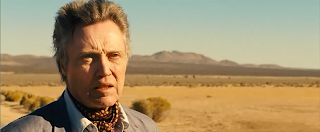
Christopher Walken plays another one of the psychopaths who is a bit of strange one considering he is a religious pacifist. Walken is probably one of the greatest actors ever when he chooses to be, and there are plenty of films where he just relies on his unique way of speaking for his performance luckily this is not one of those films. Interestingly like in the Deer Hunter and Catch Me If You Can he seems to actually tone down his speech pattern, its there, but his character he is clearly always his primary concern. 

Where Sam Rockwell is the life of the picture Christopher Walken is the heart as Billy's dog napper partner. Walken really gives the most dramatic performance in the film, although being a Martin McDonagh film there still is plenty of room for Walken to get in on the humor as well. Although where Rockwell was mostly a comedic performance with some moments of weight, Walken's gives mostly a weightier performance with some moments of comedy. Frankly the two of them fill this dynamic of the characters quite brilliantly, and the two add to the picture so well through playing their roles so they fit together in a fulfilling fashion.

Walken plays Hans as a fairly quiet old man making money from his very petty crimes, and making sure to visit his cancer stricken wife Myra (Linda Bright Clay) just about every day. In his brief early scenes Walken does well to establish Hans a likable and quirky but naturally quirky old man who is very devoted to his beliefs as well as his wife. There are two short scenes with Hans and his wife which are excellently acted by both Walken and Clay. They have a natural chemistry in their scenes with a great deal of warmth, and the two establish the long romantic history between the two quite well, this particularly important since Hans's wife soon exits the picture.

Hans quickly suffers worse grief than his wife dying from cancer as she is murdered by the mobster whose dog he and Billy stole. Walken is quite effective in this as he is very much brings about the philosophy of Hans's which is being very much in the right without much reflection to this fact. Walken is terrific in the scene where he confronts the mobster after he has murdered his wife. Walken is excellent in just that stare he gives to the man that reflects clearly that he is going through pain, but as well portrays Hans very much righteous anger that he intensely yet almost silently pressures the mobster. 

Walken is very good in his scenes with Farrell and Rockwell and the three make for some great scenes. With Rockwell as Billy being very much for violence, Farrell's Marty being very unsure of everything, and Walken showing Hans as being a man firm in his pacifism that make the three really a wonderful group. Walken gives a strong performance here and he brings to life the philosophy of his character to life quite powerfully. He is particularly good because the way he is not at all forceful about it. Instead Walken to be both quiet yet still very passionate in his beliefs, and adds a great deal of poignancy to the proceedings.

Hans easily could have been forgotten in face of Billy's antics, but Walken knows how to keep himself in a scene and he and Rockwell are great together. Their best moment in particularly is when Hans believes that he saw a vision of his wife that makes him think the afterlife is grey, but Billy claims he merely imitated his wife. He and Rockwell are magnificent in the bringing a strange power to the moment, and Walken could not be better as he so beautifully shows Hans regain his faith in just the slightest smile. This is a very effective performance by Christopher Walken because he is just so genuine in his realization of Hans.

Walken as well does have his nice moments of humor that are short most in his reactions to Billy, which are always played brilliantly. He even derives the proper humor just from how assured Hans is in his pacifistic position, and his delivery of "Too Bad" to a man wondering how Hans can ignore the man's gun is properly hilarious. This performance here shows what a shame it is that Christopher Walken does not try more often because when he gives it his all Walken has an emotional resonance that few other actors are able to create.
Woody Harrelson did not receive an Oscar nomination for portraying Charlie Costello in Seven Psychopaths.

Woody Harrelson is decidedly not one of my favorite actors because he tends to show a great deal of talent with his performances but tends to waste it by pointlessly overacting in his roles. He is in a Martin McDonagh film though and with In Bruges and this as indicators he seems to bring the best out of his actors. Harrelson tones down his problematic tendencies here, and gives a more restrained performance that usual which is rather funny considering he plays a psychotic gangster who is the main villain of the film.

Harrelson here does two things in the role and he does those two things quite well. The first being a properly threatening presence in the film. The scene where he slowly talks to Hans's wife figuring out who she is than eventually killing her is played extremely well by Harrelson. What makes the scene so good is how casual Harrelson is in his portraying the mobster's moment that he figures out who she is. He brings out the brutality of the scene because he makes Costello's interrogation to the murder such a natural process. 

The other thing that Harrelson does here is be quite an amusing presence to just the right amount. He never compromises the overarching the intensity of Costello as a vicious killer despite having some very funny moments that comes from just how much this mobster loves his dog. These moments could easily been way over played to the point of silliness yet Harrelson gives so much conviction to them. He makes the concern of this killer for his little dog entirely genuine that is actually a little sweet while being absolutely hilarious at the very same time.

Harrelson through the film makes just the perfect oddity that is Charlie Costello. He makes him convincing as just a pure killer, and because of that he gets so much humor from his role. My particular favorite moment of his performance is when comes to get his dog from Billy, and comes unarmed and alone just like Billy said. His expression when Billy just randomly shoots him in the back despite the fact he is fully complying made me burst out laughing. Harrelson is so good here becuase for the most part he could be a gangster in a serious film, and it is much funnier when that sort of gangster does the stupid things Charlie does.

This is a fantastic performance by Harrelson where he uses his considerable talent without ever going over board despite the strange dynamic that exists within his character here. He realizes that dynamic so well through finding just the perfect tone for Charlie. He never forgets to bring the ruthlessness of character in equal measure with the humor of his character. It just incredible the way he, Rockwell, and Walken all are able to share the film together so well. They all have their great individual moments, but they each play off of each other just as well.
Tom Waits did not receive an Oscar nomination for portraying Zachariah Rigby in Seven Psychopaths.

Tom Waits the musician turned character actor is someone who you expect at least something from one he appears in a film as he has such a unique screen presence which is certainly used to great effect here as Zachariah a psychopath who shows up to be interviewed after answering Billy's call for psychopaths. Waits here is basically a one scene performance as rabbit petting serial killer who spent time of his youth with a young woman going around the country murdering serial killers. Waits doesn't have a lot of time but he makes the most of it.

Waits's part of the story basically acts as a bit of a diversion for the plot, and easily could have seemed like a big waste of time. Waits therefore has quite a challenge to make sure Zachariah's story doesn't seem like a waste of time, and he certainly pulls through. Waits is very much takes a slightly somber dead pan tone as Zachariah that works particularly well in telling a story of such insanity. It is the right approach and again just like his fellow performers in this film he brings a strange combination of weight and humor that feels entirely seamless.

The reason all four of these performances work is that they each take such a differing approaches with each of the actors. None of them try to replicate each other, and Waits's mostly dead pan take is very effective. The way he says he doesn't think he sounded crazy is very amusing, and his telling of the story is certainly quite bizarre something Waits specializes bringing to screen with an absolute ease. He tells the story and makes the story of the two killers surprisingly poignant.

Waits simply adds to the strength of this film with his short little story. Tom Waits is basically a one scene wonder, although his credits sting scene is also a very entertaining moment, and he is as a one scene wonder should be. He holds the film in his command for his brief time, and is properly interesting and intriguing the point that I certainly would not have minded some more of Waits. He takes the time he has, does everything he can with it, and just is another reason why this is a great film.

Wednesday, 7 December 2011

Best Supporting Actor 2009: Results

5. Stanley Tucci in The Lovely Bones- Tucci mostly just tries to be creepy which he does do well enough. His performance though lacks the visceral power a performance like this should have.
4. Christopher Plummer in The Last Station- Plummer although certainly competent never manages to make anything special out of Tolstoy.
3. Matt Damon in Invictus- This might seem like a surprise position but out of the bottom three Damon does succeed the most in his particular role. He brings the passion and spirit that the story needs.
2. Woody Harrelson in The Messenger- Harrlson gives an intense and powerful emotional performance when he is in uniform, but when out of it he relies  a little bit too much on his usual style.
1. Christoph Waltz in Inglourious Basterds- Waltz simply gives a great memorable villainous performance that manages to be both humorous and chilling, and succeeds with every single challenge found in the role.
Deserving Performances:
Michael Fassbender in Inglourious Basterds

Monday, 5 December 2011

Best Supporting Actor 2009: Woody Harrelson in The Messenger

Woody Harrelson received his second Oscar nomination for portraying Captain Tony Stone in The Messenger.

The Messenger follows a casualty notification officer and wounded veteran Staff Sgt. Will Montgomery (Ben Foster).

Woody Harrelson portrays Captain Tony Stone is Will's superior who mentors and works with Will as a casualty notification officer. Harrelson is not one of my favorite actors as he tends to needlessly overact in many of his performances. Luckily this is not the case in this performance, for the most part. Harrelson gives a  very intense performance early on as he sets up for the ground rules on how to inform the death of soldiers to their next of kin.

Harrelson is very strong in these early scenes setting up the mood for the film. It is interesting the way he plays Stone's form of conviction in these moments. Harrelson shows that Stone very much understands the importance of his job, and that it must be done right. He shows no humor in these moments being direct and to the point about the whole affair, because in this particular part of life Stone is absolutely will take it with absolute seriousness.

Harrelson manages to show that Stone knows his sense of duty and performs it with the utmost responsibility of a true soldier. Harrelson is truly effective though because of his ability to show that Stone has been at this difficult duty for too long of a time. It is not that it still does not effect him it does as it should, but Harrelson always presents a certain knowledge in Tony that establishes his long history performing his duty.

The best scenes in the film, and the some of the best moments in Harrelson's performance are in the casualty notification scenes. Harrelson and Ben Foster actually say very little in these rather difficult to watch scenes, other than the actual notifications. Harrelson is very good and his reactions are work in perfect contrast to Foster's. Harrelson and Foster are both very effective and only add to the emotional impact of these scenes through their pitch perfect reactions. They both show the soldiers attempting trying the hardest to contain their emotions, but that it is a terrible struggle to do so.

Unfortunately Harrelson is less impressive as the unofficial Tony who acts quite differently when not in uniform perhaps a little too differently. Harrelson starts to do a little too much of his Harrelson routine although not to the extent that it seems like overacting, which he can do in some of his performances, but it does not exactly fit with the Tony Stone seen earlier in the film. Yes it makes sense for Stone to be quite different when not on duty, but Harrelson unfortunately does a little too much of his usual Harrelson thing some of the time, although not all of the time preventing it from being too distracting.

I do believe though Harrelson could have toned down more of some of his mannerisms he usually finds in these scenes and it would have helped his performance be more effective on a whole. Instead most of his scenes are just him doing his old Harrelson thing although certainly toned down most of the time. Except of course for his Oscar scene where he listens Will's description of his war time experiences. Tony breaks down in this scene, and Harrelson did not really completely earn his reaction unfortunately and his whole performance really fails to make the impact it should in the scene. His failings are almost made up by the other half of his performance which does allow this to be a powerful performance, although not a perfect one.

Thursday, 1 December 2011

Best Supporting Actor 2009

And the Nominees Were:

Woody Harrelson in The Messenger 

Matt Damon in Invictus

Christoph Waltz in Inglorious Basterds

Christopher Plummer in The Last Station

Stanley Tucci in The Lovely Bones

Saturday, 20 November 2010

Best Actor 1996: Results

5. Woody Harrelson in The People vs Larry Flynt- Harrelson is absolutely nothing special, and very standard for the first half of his performance but then the second half when he starts trying to imitate Flynt he is terrible.
4. Billy Bob Thornton in Sling Blade- I understand the point and the use of the character but this type of performance does not usually equal great acting to me. Also I never fully believed his character either which does not help a performance like this.

3. Geoffrey Rush in Shine- Rush I think does his mannerisms just fine and are close enough to the real deal, but still his performance never can really be amazing. He does succeed a little when he has the chance to show more but he also fails in his last scene.

2. Ralph Fiennes in The English Patient- I think there is something lacking in his character that holds him back, and I feel he was possibly trying too much at the beginning. Still though he succeeds well with the various aspects of the character. He shows the Count's romance, his struggles, and his end very well.

1. Tom Cruise in Jerry Maguire- I was tempted to go with Fiennes but I felt Cruise's performance was technically a little better despite his lighter material. First he uses his star quality and charisma perfectly well in his performance here, but at the same time he still develops his character along with his usual charm. The changes of the character which are abrupt are handled well, and the notable scene of the film I feel are really notable because Cruise handles them as well as he does.