Showing posts with label Ralph Fiennes. Show all posts

Sunday, 2 February 2025

Best Actor 2024: Results

 5. Timothée Chalamet in A Complete Unknown - Chalamet gives a pretty hard to believe impression that leaves Dylan as a mystery that it doesn't even seem he knows the truths of. His musical performances are fine, albeit unspectacular, at least.

Best Scene: One of the songs I guess.
4. Ralph Fiennes in Conclave - Fiennes elevates every moment of his potboiler and brings an emotional honesty to an often very silly film that takes itself very seriously. 

Best Scene: Confronting Aldo about Tremblay
3. Sebastian Stan in The Apprentice - A very close #3/#2  because I think both are great in very different ways. Stan delivering on tremendous challenge of playing Trump without falling into caricature. Instead artfully builds towards the Trump we know, while also successfully showing the steps into corruption. 

Best Scene: After his brother's death. 
2. Colman Domingo in Sing Sing - Domingo gives such soulful and genuine work in portraying such endearing and infectious energy for the healing power of acting. Finding that though with a moving portrayal of the weight of living behind bars for a crime you know you didn't commit. 

Best Scene: Parole hearing.
1. Adrien Brody in The Brutalist - Good predictions Anonymous, Calvin, Lucas, Michael McCarthy, Emi Grant, Maciej, Harris & Perfectionist. But as much as I loved Stan and Domingo, there was no competition for me here in Brody just giving one of those performances where you just feel you meet this person, every bit of his complicated traumatic history, and through every bit of his life including his ambition, his moments of joy, and his many moments of intense hardship.  

Best Scene: Car breakdown. 
Next: 2024 alternate supporting.  

Wednesday, 29 January 2025

Best Actor 2024: Ralph Fiennes in Conclave

Ralph Fiennes received his third Oscar nomination for portraying Cardinal Thomas Lawrence in Conclave. 

Conclave follows the titular event as Catholic cardinals must decide on a new Pope, naturally complications ensue.

The great actor Ralph Fiennes finally receives Oscar recognition again, after a nearly 30 year drought, despite delivering several great performances between his last nomination to now, with I’ll note that his miss for the Grand Budapest Hotel being particularly unpleasant given he was more deserving than 4 of the nominees there and in a top five contender…but I digress. The stars finally aligned again for Fiennes within the intense drama side of his oeuvre, though personally I won’t hesitate to note my preference when he gets to be more playful. Regardless Fiennes’s talent is obvious and such talent is called upon for this film in a very specific targeted performance in playing Cardinal Lawrence, the Dean of Cardinals tasked with making sure everything runs smoothly to the election of a new Pope after the death of the much beloved former Pope. What Fiennes brings more than anything here is his considerable gravitas as a performer, which is very much required to attempt to sell this Papal thriller within the film’s overarching largely very serious approach. Fiennes being the great actor he is, certainly is game to offer his dramatic ability here to bring as much reality and severity as he can to the film. Even the way he walks and maneuvers through a scene Fiennes very much steps with purpose and has that emphasis on the considerations of it all seems to be actively weighing on him at all times. Fiennes’s brow is burdened with the thoughts of what his duty is and grants us immediately that sense of a man who is filled with doubts about his faith and about himself. 

Fiennes being the consummate professional as a performer does seek to really make anything he can in the part to add a little more while very much servicing the story. Take even the very judicious albeit simple moment of taking his time with his reading glasses where Fiennes very much adds just a believability within the whole act of ceremony, that adds in the time he takes in these moments that adds the reality of someone needed to do something minor everytime in order to proceed. But further is the exposition upon exposition that Fiennes either needs to hear or deliver, such as when it comes to going from one moment to the next of setting up the titular conclave, hearing when he gets every little tidbit of potential complication as the conclave is about to begin. Fiennes has a great ability in his delivery to often underplay the gravitas, because he has such innate gravitas it comes out more naturalistic despite being often fairly overt lines. Fiennes will emphasize at times but more often benefits from his own grand presence because he can create the levels of that weight so effortlessly. Fiennes brings the right quality in the early scenes of the film as the not quite neutral head of the Conclave, however a man who will attempt to proceed with what he sees as a degree of impartiality. Something we see in his interactions with the key players vying for the papacy which includes the liberal favorite Aldo (Stanley Tucci), the African conservative Adeyemi (Lucian Msamati), the overt Italian conservative Tedesco (Sergio Castellitto), the moderate Tremblay (John Lithgow) and the obviously going to be important if you’ve seen the Best Man surprise Cardinal late entry dark horse Benitez (Carlos Diehz). 

Fiennes again just brings an ease to his performance in hitting each note with relative but wholly convincing ease. With Tucci’s Aldo, Fiennes brings a nice warmth initially where you see the sense of an old friendship, held back just a bit for being appropriate to the situation, and even a little extra modest Fiennes’s in his delivery to suggest his admiration for the man he initially wants to see as Pope. Contrasting that is with Tedesco where Fiennes is terrific in presenting the impartiality as far as he can in his reactions to the man’s overt racism and espousing beliefs that Lawrence clearly finds deplorable. Fiennes brings the restrained disgust and quiet disinterest in the man in general within a surface graciousness. With Lithgow who Lawrence suspects is untrustworthy, in part due to an unverified claim that he as fired by the Pope, but I’m thinking more so because he’s played by John Lithgow, Fiennes brings a cautious distance and an exacting stare as he tries to uncover the truth of the man. With Benitez Fiennes offers a graciousness to the man initially within his eyes a quiet sense of interest due to the secretive nature of the man’s appointment. Lawrence though surprises all by opening the voting with a speech of his own, a character point of action that I feel still comes too early, but anyway, we get Fiennes amplifying the weight with such ease in his delivery that when Fiennes gives the speech about the sin of certainty, you absolutely believe it as the truth through his power as a performer. Fortunately, or unfortunately for Lawrence it leads to him receiving unexpected votes making him a player in this race too. 

The film then becomes the game of revelations where Fiennes must be the one often delivering the moment of action, the first coming in as early favorite Adeyemi is faced with a nun he had an affair with in the past. Leading Lawrence to confront him, and Fiennes is great in the way he brings just the right degree of a comforting warmth as he informs Adeyemi he will never be Pope, while still having this direct strength with his performance as he bluntly tells the man the truth. Meanwhile he finds damning evidence that Tremblay is crooked, where Fiennes is also terrific this time in bringing no warmth but more a righteous indignation as he stares down a man he knows to be phony. He’s also very effective in his dueling scenes between Tucci and Diehz. With Diehz, Benitez admits to voting for Lawrence, which Fiennes initially brings a real humbleness and surprise to this man. When it seems more that his vote could cost Aldo the election initially, Fiennes becomes more forceful in one of his loudest deliveries of “I don’t want your vote” which while bigger still tuned ideally for the role, as he reveals less a man trying to convince Benitez he’s not worthy, but rather trying to reinforce to himself that he is unworthy in his own mind. With Tucci in each successive scene, where it goes from Lawrence cautioning action against the much more direct Aldo to eventually Lawrence being the insistent one, is strong work from Fiennes as he goes from that more deferring quality in his early scenes, to just tipping his work to a more overt confidence to the point when he says that Aldo is too cowardly, Fiennes doesn’t deliver it with a hint of hate, but just a blunt truth in seeing his friend isn’t quite there to be the true leader. Their friendship though still feels intact and when Lawrence reveals his Pope name to Aldo, as it seems like he could win, Fiennes’s simple yet just so assured delivery of “John” shows a changed state in the relationship yet still the friendship remains. 

It probably sounds like all I do is have praise for Fiennes, which is largely true and what I’m about to get into isn’t a criticism of Fiennes rather just of the limitation of the part. Lawrence states his overall conflict with his faith and his complicated relationship with the Pope’s death since he was seeking to retire from his position just before he died, but the Pope insisted he stay. And bits of here are just a little messy, particularly the relationship part as we have a key scene where Lawrence enters the Pope’s sealed chambers to find evidence against Tremblay, and we have Fiennes break down over the Pope's death. Great emotional work from Fiennes, absolutely convincing, but the weight of it is a bit obscured because the relationship just is a little too vague at a fundamental writing level. Even the idea of Lawrence’s faith, beyond the faith in himself that part works, but the faith overall always feels indistinct for much of it then too easy by the end of it as you get the simplest good versus evil showdown between Benitez and Tedesco that makes it all seem far too easy to decide the conclave. Benitez becomes the easy person to believe in, and Lawrence is all but satisfied until we get the twist that the dark horse is intersex, but thankfully the Pope already knew about making it so Lawrence has no real decision to make. The reason I jammed that altogether is because it feels jammed together narratively, and too easily so as the previous Pope being truly all knowing makes it so Lawrence gets easy certainty by the end of it without truly having to make a decision. Which by the way,  none of this is Fiennes’s fault, he does what he can with these bits, it just never becomes as powerful of an arc to acceptance of Diehz as it could’ve been. The twist is there, but the film barely reckons with it. Having said that, Fiennes still has a final moment of greatness in his performance where he returns a turtle in the Vatican to outside, where Fiennes does so much in his walk and his expression that we see the weight from before is now alleviated, and you see man content in his more modest plight. And while I wish the final revelations to get Lawrence to this point were articulated by the script in a more dynamic, less simplistic, fashion Fiennes still delivers on that final note. Much like how Fiennes delivers throughout the film, he consistently elevates the material, every line he finds the avenue for, and is the most captivating aspect of the entirety of the film. And while this might not be my favorite performance of is, it is regardless a strong testament to his immense talent. 

Monday, 27 January 2025

Best Actor 2024

 And the Nominees Are:

Timothée Chalamet in A Complete Unknown 

Colman Domingo in Sing Sing

Adrien Brody in The Brutalist

Ralph Fiennes in Conclave

Sebastian Stan in The Apprentice

Thursday, 18 July 2024

Alternate Best Supporting Actor 1998: Tom Wilkinson in Shakespeare in Love, Jeremy Davies in Saving Private Ryan, Ralph Fiennes in The Prince of Egypt & Noah Emmerich in The Truman Show

Tom Wilkinson did not receive an Oscar nomination, despite receiving a BAFTA nomination, for portraying Hugh Fennyman in Shakespeare in Love.

Let's take a moment to honor the great Tom Wilkinson, rarely was there not a time where he brought a bit of something extra to any role no matter the size, and was just a welcome addition to any ensemble. His role in Shakespeare in Love might be the truest form of this, as really my favorite aspect of the entire film, partly because it is entirely in the realm of putting on Romeo and Juliet at the Globe Theater. Wilkinson plays one of the men Philip Henslowe (Geoffrey Rush), owns money to that we see in the opening of the film where he is ready to torture the man for his earnings. Wilkinson played initially very much the powerful heel, something he was frequently called to do, and with good reason. From his stature, to his regal presence, to just his commanding manner, Wilkinson had an ease with menace, and that is certainly the case here. Even though this film is largely a comedy Wilkinson brings a very much a real threat with his calm grin as his men go about torturing Henslowe for the money, until he comes up with some situation where Wilkinson's Fennyman will become a beneficiary of the next production. Where Wilkinson makes his first easy glide over to the comedic acceptance of the terms with a great bright grin on his face, though even in that the certain danger Fennyman presents is very much alive.

The situation makes Fennyman into a new world of the theater, and in turn the man is a bit out of his element for the most part. We occasionally get another moment of threat again to Henslowe if something goes wrong, or his eagerness to join a fight of men interrupting a rehearsal, which I especially love Wilkinson's performance of. Although the former moment we get that of the brutal loan shark, the latter, while utilizing the intensity of the loan shark in the physical fight, Wilkinson brings this sense of joy as though it is just the old accustomed routine for the man to deliver a beat down so does it in stride, though there's something a little different, a sense of quiet passion about it that Wilkinson's performance portrays that now Fennyman isn't being violent just for money, there's a genuine matter of pride as he's part of this creative endeavor in the globe. The idea that is so wonderfully realized in the moment where favored actors arrive, and even largely silence, but allow Fennyman to stay as a proprietor. Wilkinson's reaction in the moment is greatness, because he's utterly convincing in his silence because he brings awe within the silence, showing the tough loan shark, genuinely lost for words when silenced by those engaging in what he sees as real artistry.

The last act of Wilkinson work, as much as he makes great use of every second he had before being hilarious as the no nonsense loan shark, to being funnier as when that loan shark gets so invested in the theater, to being even greater when he given the small but pivotal role by Shakespeare as the seller of the poison that will lead to the final tragedy. Wilkinson's so good in just portraying the immediate moment of Fennyman being lost for words and creating in that reaction the sense of the man truly treasuring this opportunity to the best of his abilities. Something we see then when the man is repeating his lines to himself, Wilkinson brings this spirit of a man gripped in fear of the task in front of him but at the same time with this absolute conviction about getting the lines right given he sees this endeavor as so valuable. A feeling that reveals itself when Fennyman's moment finally comes into the performance of the play, and Wilkinson and Fennyman steal the show, and are just marvelous as one. Because Fennyman delivers a great performance bringing such intensity in creating the sense of real dread to the nature of the poison, and Wilkinson is amazing because he shows Fennyman performing as though every line is the most important line of his life, but he's also genuinely great in being this actor bringing the utmost to a brief yet pivotal role and making sing beyond its text. Which one can take the role of Fennyman, as for me, just as Fennyman steals the play, Wilkinson steals the film. Every moment he gets he makes the most, whether he needs to bring menace, comedy or artistic passion, Wilkinson delivers and brings forth the most entertaining arc in the film, but also strangely the most compelling as well.
Jeremy Davies did not receive an Oscar nomination for portraying Private Timothy Upham in Saving Private Ryan.

As I've frequently noted, Saving Private Ryan is both a reinvention of the old fashioned WWII film, and also just an old fashioned WWII film. One way is in the colorful crew we follow through the mission, that despite some claims otherwise, very much are defined by a trait or two. One of the men theoretically in this situation is Jeremy Davies as the pencil pusher brought onto active duty due to his knowledge of foreign languages. Setup to be the cowardly inexperienced soldier of the group with somewhat faulty artistic ambitions and always out of his element. What Davies does is what any actor needs to do with such a role with potential pitfalls in this instance, is just make it seem real when it could easily be caricature. Davies does so from even the opening scene where we have him recruited by Captain Miller (Tom Hanks) and he has to do some physical maneuvers to show a klutzy manner overemphasizing, script wise, the inexperience of the character. Davies though nicely doesn't play into any misplaced comedy with his own performance, no wide eyes or silliness, rather a straightforward sense of the sudden hit of adrenaline in the less than refined movement of the man completely out of his element, but made believable by his performance. As we progress, we naturally get the experienced men low key insulting him for wanting to write a book and not knowing the lingo like Fubar. Davies consistently creates space within his performance not to go for kind of the easy delivery in emphasizing the stupidity, or at least ignorance of Upham, even when written as such. He wisely underplays the moments, like looking through his guidebook for fubar, to be genuine in Upham being lost in this situation, leaning towards creating a reality of someone just lost in the situation rather than a silly type, which I'd say Edward Burns for example very much is as the cynical guy. 

Allowing for a greater reality and power to his work when they are in battle, and Davies's performance brings the real fear to his work within every battle. Grounding each moment as we see his physical work as Upham often gripped in that state of truly being nearly paralyzed by the battle, while trying to uphold a kind of humanity. Eventually leading to the moment where he tries to keep a German soldier from being executed by the men, Davies bringing this basic humanity to his performance that brings only the sincere empathy in the plight and again, doesn't overplay to become cloying as though he is superior in the act, rather fixated on just not going towards the barbarous act. Something which ends up being the challenge of the character as they reach the titular Ryan and the final battle, where Upham's measure is tested as he acts as the ammunition delivery boy. And Davies is great in every reaction, every moment of hesitation, exhaustion and terror. Particularly when his failure to act leads to the death of a comrade, and Davies's performance delivers on a man just shivering in fear as a German soldier walks by his pathetic husk. Something that would seem potentially too much, if Davies had ever played into the caricature, but he earns it by having been honest with the role to deliver on this moment. Even more essential perhaps for his final moment of again freezing as he sees even the old German captive he had helped save being instrumental in killing his comrades, only taking action after the battle is nearly over. A scene that Davies grants a greater impact to because he does this, and shoots that German captive, Davies plays not as a machismo, but rather this quiet shame of a man still living in his cowardice even when finally doing something. Davies consistently delivers on elevating the caricature to a character and beyond the limits of the screenplay.
Ralph Fiennes did not receive an Oscar nomination for portraying Rameses in The Prince of Egypt.

Voice casting frequently is casting with a specific purpose in mind, particularly when using a known actor, and casting Fiennes as Rameses very much seems to fulfill the purpose of the villain, given his commanding voice that often emphasizes a cold menace. Interesting then that this version completely subverts that idea given the film much more looks at Moses and Rameses as brothers, rather than rivals even before Moses's true parentage is revealed. And that is where the genius of the casting reveals itself because as much as Fiennes could've played that casting choice, the even greater choice is the casting of Fiennes not for the menace he could bring but rather the fact that he's a great actor. 
Fiennes for over half the film isn't at all the expectation of a Fiennes performance even remotely, as he brings such warmth in every vocal delivery that emphasizing the brotherly connection between Rameses and Moses. When Moses learns about his true parentage and runs, Fiennes's performance emphasizes even then an earnest empathetic delivery of a brother trying to be there for his own and confused when Moses, after killing a slave driver, runs away. Only for Moses to return and even then Fiennes subverts the expectation in bringing even a cheerfulness to his replies to Moses and eagerness to connect with his brother who had been away. Even when Moses challenges him to let his people go, Fiennes's performance brings a bemused quality still keeping alive the idea of Rameses not knowing how not to deal with Moses as a brother. It is only when Moses is insistent on it that Fiennes changes tone effectively, though even then with a subtle nuance in his voice to convey a sense of betrayal in their former connection and the right degree of vulnerable insistence that he will not be a "weak link" as a Pharoah. Only bringing out the force of his voice when essentially Rameses is presenting himself as the force he wants to be rather than what he really may be. Fiennes even has the chance to sing in "Plagues", and while never going to be a focal point as a performance of his, regardless acquits himself well there in bringing a more emotional performance that again alludes to the depth of the conflict that is personal as well as political. Even after the plagues, Rameses still tries to connect with Moses, and Fiennes delivers so much within every word in creating his sense of anguish over the plagues mixed in with nostalgia for their past and sadness of what has happened to them. Fiennes bringing not a cold callousness, but an emotional rage then when Rameses threatens the children of the Jewish people, as his father has done. Leading though to the opposite when the final plague, the angel of death, comes which leads to the death of Rameses's own son. Fiennes again delivering all the raw heartbreak in just a brief line as he sends his people away, and again bringing such humanity to the technical villain of the piece. Fiennes consistently does this however, finding every nuance he can with only his voice, and doesn't waste a bit of the potential depth within the role of Rameses here. 
Noah Emmerich did not receive an Oscar nomination for portraying Louis Coltrane who is portraying Marlon in The Truman Show.

The always dependable Noah Emmerich plays the designated best friend of Truman (Jim Carrey), who is the star of the reality show he's not aware is his reality. Marlon/Louis being in one of the strangest situations as he must be one of the chief liars to Truman while also being his friend. Emmerich's performance I think might be one of the great examples of an actor getting the unfortunate short shrift in the edit, and an example of one of those things which I do really like the Truman Show, you get those glimpses for even more potential in the film. The story of Marlon/Louis is one of these things, and it might seem strange then that I am taking time to review Emmerich, but I think his performance remains a great example of an actor doing what he can with so much limited material. Because in the final edit, Marlon/Louis is basically just a stooge of the show where it doesn't get into his own feelings about living this lie of pretending to be a man's best friend, though technically you might still be his friend. And we see some of that where we see Marlon/Louis is designed to keep Truman content in his current state, while obviously also making sure the cameras catch the labels on his beer can. Emmerich gives the performance of Marlon/Louis as kind of a bad performance, though effectively so, in that Louis plays Marlon very thin in just accepting everything as is, as perfect without any need to question it. Emmerich's eyes as Louis playing Marlon are not quite lifeless, but nearly so, in showing a man truly just going through the motions of supporting the existence designed for Truman. Something that challenges only when he must convince Truman of his fake reality where Truman is in a truly conflicted state. And this is the scene of Emmerich's performance that alludes to the rest of his work, and is truly great work, because Emmerich is creating the layers of every word. As on the surface it is still just Marlon convincing Truman of the fake reality again, as he is voicing the words of his director Christof (Ed Harris). As Emmerich is feeding the nostalgic lines of the past of togetherness and how they got along, he does the surface Marlon words of supportive comfort, but in Emmerich's eyes you can see Louis genuinely filled with nostalgia but also shame for using the nostalgia in the lie. Emmerich takes an extra second in every beat of the scene that goes beyond Marlon convincing Truman, and you see Louis hating himself. A moment of extra emphasis that alludes to the truth even as he is speaking the lie. When he tells Truman that he'd have to be lying for the reality to be a lie, Emmerich is great because as he tells his sacrificial support to Truman with a caring expression, and speaks "the last thing I'd ever do is lie to you", Emmerich's performance is amazing because in his face you see Louis being genuinely torn up about what he is doing, feeling the raw emotion of lying to his friend, even as he tells the "truth" to him. Emmerich never breaks, it is with subtle throat clear, a glance, a bit of real sorrow, but shows Louis within Marlon in that moment. It is great work that alludes to an even greater performance, even as the rest of the film, despite a deleted scene showing otherwise and the script showing more, we leave Marlon/Louis as just a pawn in the end. Still even within those unfortunate edits, is a credit to Emmerich's work that he was still able to allude to the conflict of his character even if the filmmakers chose not to truly give any time to it.

Saturday, 25 February 2023

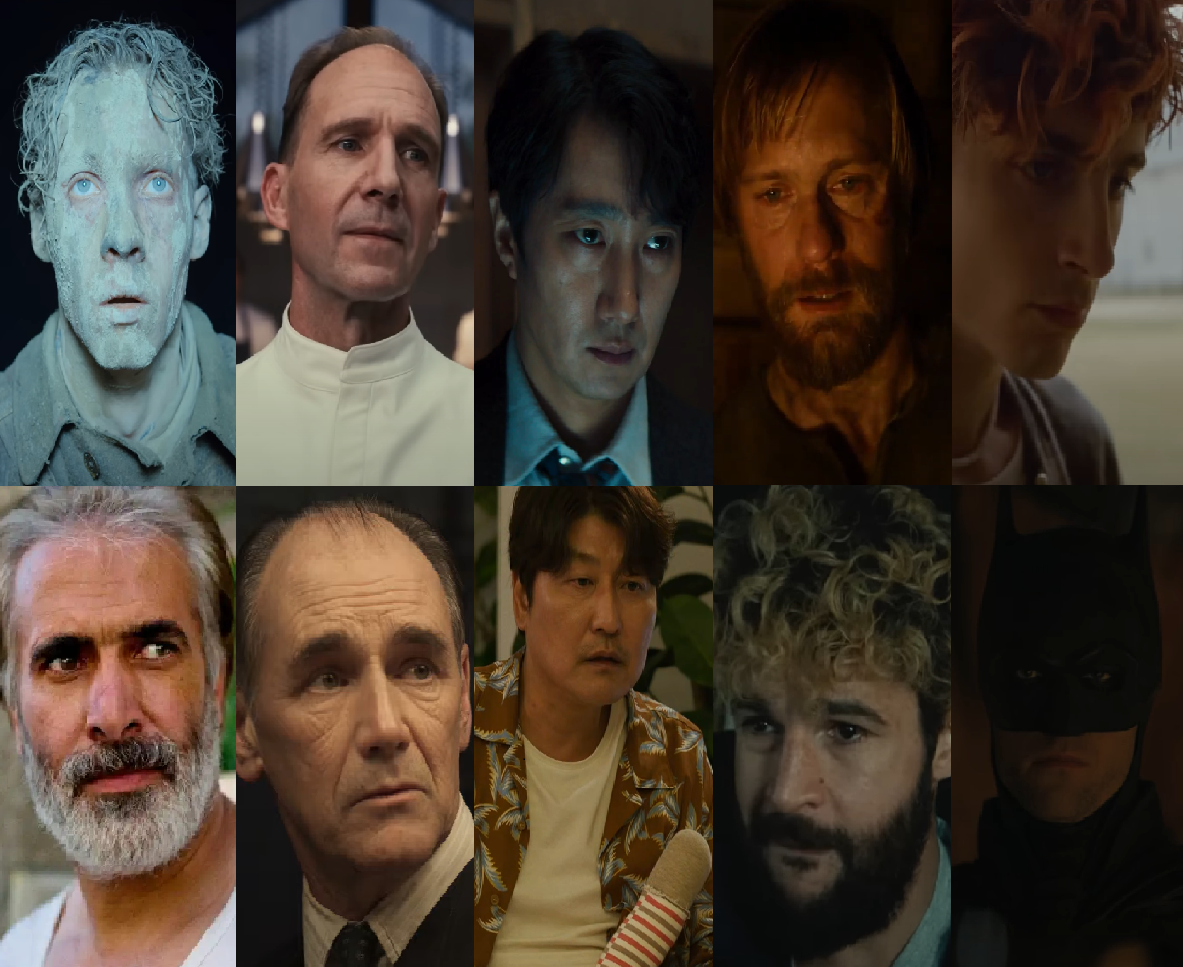
Alternate Best Actor 2022: Results

10. Song Kang-ho in Broker - Song brings a  naturalistic and charming chemistry even if the film tasks him to go into some less than natural directions for this character late in the film. 

Best Scene: Seeing his daughter. 
9. Robert Pattinson in The Batman - Pattinson gives a great depiction of Batman that gives a greater insight within the development of the character and the different shades of his identity. 

Best Scene: "Bruce WAAAYNE"
8. Christopher Abbott in On the Count of Three - Abbott gives a captivating depiction of a man on an extreme mental edge that manages to be intense, heartwrenching but also at times rather funny. 

Best Scene: Seeing the high school bully. 
7. Mehdi Bajestani in Holy Spider - Bajestani gives an extremely disturbing portrayal of a man whose depravity goes far beyond just psychopathy. 

Best Scene: "Not Crazy"
6. Mark Rylance in The Outfit - Rylance amplifies his film every step of the way, giving a consistently captivating portrayal of a man who essentially weaponizes modesty. 

Best Scene: "I'm the mole"
5. Alexander Skarsgård in the Northman - Skarsgård delivers a powerful performance that goes beyond just his tremendous physical presence and also gives a potent portrayal of the emotional weight of his journey. 

Best Scene: The Queen's truth. 
4. Felix Kammerer in All Quiet on the Western Front - Kammerer gives a heartbreaking portrayal of the effects of war, both in terms of the bonds between soldiers and of the terrible mental degradation from the losses and horrors suffered throughout his experience. 

Best Scene: In the crater. 
3. Timothée Chalamet in Bones and All - Chalamet delivers for me his best performance, that offers an honest off-beat charisma, a fantastic chemistry with his co-star, and a powerful emotional vulnerability, all in his depiction of a cannibal. 

Best Scene: What really happened with his dad. 
2. Ralph Fiennes in The Menu - Fiennes gives an amazing performance that manages to be extremely intense, but also incredibly hilarious as his hate and regret filled killer chef. 

Best Scene: A cheeseburger. 
1. Park Hae-il in Decision to Leave - Park gives an entirely captivating and absolutely haunting portrayal of obsession. 

Best Scene: The snowy mountain.
Overall:
  1. Colin Farrell in The Banshees of Inisherin
  2. Park Hae-il in Decision to Leave
  3. Bill Nighy in Living
  4. Ralph Fiennes in The Menu
  5. Timothée Chalamet in Bones and All
  6. Felix Kammerer in All Quiet on the Western Front
  7. Paul Mescal in Aftersun
  8. Alexander Skarsgård in the Northman
  9. Mark Rylance in The Outfit
  10. Mehdi Bajestani in Holy Spider - 5
  11. Ram Charan in RRR
  12. N.T. Rama Rao Jr in RRR
  13. Christopher Abbott in On the Count of Three
  14. Robert Pattinson in The Batman
  15. Mark Rylance in The Phantom of the Open
  16. Song Kang-ho in Broker
  17. Adeel Akhtar in Ali & Ava
  18. Jonathan Majors in Devotion
  19. Denis Ménochet in As Bestas
  20. Daniel Giménez Cacho in Bardo
  21. Daryl McCormack in Good Luck To You, Leo Grande
  22. Eden Dambrine in Close
  23. Gang Dong-won in Broker
  24. Jeremy Pope in The Inspection
  25. Daniel Kaluuya in Nope
  26. Austin Butler in Elvis
  27. Gabriel Labelle in The Fabelmans
  28. Ricardo Darin in Argentina, 1985
  29. Brendan Fraser in The Whale
  30. Diego Calva in Babylon 
  31. Ben Foster in The Survivor
  32. John Boyega in Breaking - 4.5
  33. Daniel Craig in The Glass Onion
  34. Michael Ward in Empire of Light
  35. Adam Driver in White Noise
  36. Antonio Banderas in Puss in Boots: The Last Wish
  37. Jack Lowden in Benediction
  38. Jerrod Carmichael in On the Count of Three
  39. Colin Farrell in After Yang 
  40. Brad Pitt in Babylon
  41. Idris Elba in Three Thousand Years of Longing
  42. Nicolas Cage in The Unbearable Weight of Massive Talent
  43. Adam Sandler in Hustle
  44. Harris Dickinson in Triangle of Sadness
  45. Rory Kinnear in Men
  46. Donald Elise Watkins in Emergency
  47. Peter Lanzani in Argentina, 1985
  48. Ali Junejo in Joyland
  49. Tom Cruise in Top Gun: Maverick
  50. Will Smith in Emancipation
  51. Viggo Mortensen in Crimes of the Future
  52. RJ Cyler in Emergency 
  53. Peter Capaldi in Benediction
  54. Sterling K. Brown in Hong For Jesus. Save Your Soul
  55. Kenneth Branagh in Death on the Nile - 4
  56. Colin Farrell in Thirteen Lives
  57. Viggo Mortensen in Thirteen Lives
  58. Jon Hamm in Confess Fletch
  59. Dali Benssalah in Athena
  60. Yahya Abdul-Mateen II in Ambulance
  61. Glen Powell in Devotion
  62. Benedict Cumberbatch in Dr. Strange in the Multiverse of Madness
  63. Christian Bale in The Pale Blue Eye
  64. Gregory Mann in Pinocchio
  65. Jake Gyllenhaal in Ambulance 
  66. Sami Slimane in Athena
  67. Elliott Crosset Hove in Godland
  68. Zach Efron in The Greatest Beer Run Ever
  69. Christoph Waltz in Dead for a Dollar
  70. Ryan Gosling in The Gray Man 
  71. Joe Alwyn in Stars At Noon - 3.5
  72. Daniel Radcliffe in Weird
  73. Chris Hemsworth in Thor: Love and Thunder
  74. Karl Urban in The Sea Beast 
  75. Luke Evans in Scrooge: A Christmas Carol
  76. Chris Evans in Lightyear 
  77. Jake Gyllenhaal in Strange World - 3
  78. Banks Repeta in Armageddon Time
  79. Sam Rockwell in See How They Run
  80. Brad Pitt in Bullet Train 
  81. Hugh Jackman in The Son - 2.5
  82. Eddie Redmayne in Fantastic Beats: The Secrets of Dumbledore 
  83. Sam Worthington in Avatar: The Way of Water
  84. Daniel Zolghadri in Funny Pages
  85. Will Ferrell in Spirited - 2
  86. John David Washington in Amsterdam
  87. Christian Bale in Amsterdam
  88. Ryan Reynolds in Spirited
  89. Chris Pratt in Jurassic World: Dominion
  90. Mason Thames in The Black Phone 
  91. Dwayne Johnson in Black Adam
  92. Peter Billingsley in A Christmas Story Christmas - 1.5
  93. Cooper Raiff in Cha Cha Real Smooth - 1
Next (eventually): 1961 Lead

Tuesday, 14 February 2023

Alternate Best Actor 2022: Ralph Fiennes in The Menu

Ralph Fiennes did not receive an Oscar nomination for portraying Chef Julian Slowik in The Menu. 

The Menu is a proper social satire remembering to actually entertain rather than just being a dogmatic screed. 

Ralph Fiennes feels easy to take granted in this role, because playing a psychopathic chef who is set to punish his wealthy guests on a remote island, seems like a role he would ace...and he does. That in itself shouldn't make it any less of an achievement, however, because yes Fiennes is a great actor, and he is great here as well. I think why he's great though speaks to his performance here which may in fact be apt to a great meal, perhaps something you'd expected in that it tastes delicious but surprising in being something new. Fiennes is expected in his powerful domineering presence as the imperious chef. The man is treated with reverence by all as we enter the island and he is granted almost a mystical quality. Fiennes's imperious presence is fully on display with Slowik's first entrance onto the scene, and the very image of him exudes a man of power, although in this instance a man of culinary power. The meat of the work is hard to ignore on its own, however, it is the spices that make it come together, the little instances of something else that make Fiennes's work here so remarkable. Take the introduction of his restaurant, Hawthorne's to the guests, it's a little thing, but a little thing that is so special as his loyal kitchen crew repeatedly announces "YES CHEF". In this moment, the little cock of Fiennes's head to the side, and the smile that comes with it. Fiennes on the immediate surface exudes that power, maybe just the power of performance initially as Slowik's own performance as he is about to introduce the first course with the grand regalness of the world's greatest chef. Fiennes's little tilt and smile though is already there's an indication of something off, small though notable as not only is sinister but there's a glint of mania that becomes all the more obvious when re-watching the film. 

The Menu introductions that set up every dish by Slowik begin unassumingly, though expectedly pointedly by Fiennes's cold yet fierce delivery of the initial request that the guests "do not eat" but rather savor the menu for all that it is worth. That initial command, though delivered with that unquestionable authority isn't immediately concerning. Just as Fiennes projects Slowik as intimidating but intimidating as a man who brings such ferocity to his art, though so it would seem. He delivers that overpowering charisma among his crew, his movements have the manner perhaps of a great chef but more accurately that of a cult leader. Every introduction though is a great bit of performance from Fiennes in itself as the further he goes the more it becomes evident that he probably has something in mind. The first instance is his denial of the guests' actual bread course, with the reason that the bread is intended only for the poor, Fiennes is able to so effortlessly emphasize the words this time around with a bit more than a pinch of venom and the whole meal begins to take upon it a certain nefarious quality. What's great though is Fiennes even in this quietly revealing sinister quality is still captivating as a storyteller and delivers every word as still this great chef even as it becomes clear more is going on. His delivery of the next speech, as he serves the guests tacos, is where we see even more in Fiennes's work as he recounts the meal as his boyhood days when he stabbed his father while he was choking his mother. Fiennes, again perhaps expectedly, is incredible as he holds the refinement in his delivery yet the painful nature of the story is evident in the trauma just beneath and subtly present in his eyes. 

The next Menu item is the turn and in a certain sense that is when Fiennes begins to start cooking with gas with his performance, but before then one must examine his relationship with the escort Margot (Anya Taylor-Joy) who only came to the restaurant for her job while everyone else was carefully chosen by Slowik. She actually questions the meal as frequently not particularly appetizing. And Fiennes's initial reactions towards her are rather fascinating because you see in his expression some sense of trying to dissect and this quiet frustration in his manner just specifically towards her. He speaks to her initially as emphatically as possible stating the quality of the menu and that she must eat. Fiennes presents these moments as a kind of fixation on her as this unease as she questions the perfection of what he has foreseen with this final menu of his. To the point we see him seek comfort in his drunkard mother for just a moment, that is such a weird moment that Fiennes manages to make natural within the state of Slowik as he rests his head against her for some kind of comfort. Back to the menu though where Fiennes introduces the next item by having its sous chef commit suicide in front of the crowd. Again Fiennes is outstanding just in the sheer will behind his voice as notes the man being good as a chef but not great, with even this dismissal feeling like a most brutal cut due to Fiennes's delivery. 

And here where it becomes open season on the guests as it becomes clear that Slowik is playing with them as he is planning a grand finale murder-suicide with the guests and his staff are all to die before the end of the night. And it is where Fiennes of course was going to be great as the cult-like megalomaniacal chef, that was a given, but there is so much more savor with this performance throughout. A performance that is carefully prepared with the satire in mind, and he never turns Slowik into a simple chilling and domineering villain, even while being wholly great at that task. This is genuinely a hilarious performance by Fiennes, hilarious however in ways that always serve the character and serve the film. Take even the aforementioned taco introduction scene where Fiennes mentions "taco Tuesday", it's funny in part just to hear Fiennes say those words with his incredibly regal voice, but he also in that bit just in that mania that again flashes against his face shows the true nature of what is going on with Slowik at this point. Fiennes though has multiple moments of comic gold, particularly impressive because he never actually lets it shatter the truly overarching menacing qualities of his work. Instead, it is perhaps that infusion of the comedic into the menace that makes him so entertaining. Take the moment where Slowik reveals his reason for wanting to kill a movie star (John Leguizamo) because of the bad movie he made which Slowik wasted a day off on. Fiennes's hilarious by saying it absolutely straight-faced and merciless with just how serious Slowik is with how his time was wasted. Or his questioning of the movie star's assistant on whether or not she has student loans which becomes the deciding factor. Fiennes's extremely sharp and short delivery of this message again is hilarious. The greatest moment in this regard though is taking on Margot's "date" Tyler who brought her along knowing everyone was going to die. Fiennes's way of initially speaking to him with this smile towards him as he pulls him along with the perfect sense of false support for the young man's artistic genius. Then ordering Tyler to cook for him, Fiennes is again so funny by being so perfectly cruel in every cutting remark towards Tyler's efforts. I especially love Fiennes's deadpan remark on Tyler's unorthodox dicing methods they've been "ignorant of". The coup de grace however is his falsely impressed reaction to just how bad Tyler's dish was. We don't need to hear Fiennes's final words to him because the sheer venom in Fiennes's face is more than enough. Although the scene is of one men convincing another man to commit suicide, Fiennes makes it so wonderfully funny with just how on-point every moment of this takedown is. 

Fiennes's performance is still more than just even the hilarious domineering villain. There is a genuine emotional current throughout this performance that we see most often evident in the scenes he shares with Taylor-Joy. The moment in which he takes her back to make her choose a side, though both sides have to die either way, Fiennes reveals in that request just how truly around the bend he is. Of course, that is already evident with what he is doing, but in his moment of insisting that everyone must die, Fiennes brings just a bit more of the insanity wrapped in desperation showing a bit more to just what is going on in the man's head. We see a bit more when he invites Margot into his office to discuss her choice where Fiennes tempers his work down just a bit more to show perhaps Slowik closer to out of his demented state as he reacts to her own unpleasant story of "servicing" a rich person. Fiennes doesn't show this to be wholly empathetic but there is a bit more of a connection he allows at this moment than is typical. In turn, when he sentences her to die with the guests later, his eyes have a sense of betrayal in them and it isn't the same cold stare that he gives everyone else. But we're not done because the final course of the meal, is the best, that being when Margot, based on seeing an old happy photograph of Slowik working a burger joint, asks just for a proper cheeseburger. The full payoff of her not being a perfect aspect of his meal in this request, however not in the way that would be expected. Fiennes gives one of the most masterful line deliveries of 2022 in the little whisp of a voice crack, that alludes to all the emotion that Slowik is holding in as he agrees to her request. The emotion not of hate for once, but a somber joy. Something we see more of as he cooks the hamburger, and Fiennes is genuinely moving in showing such real passion and heartbreak in the moment of the cook. You see someone doing something that truly loves at the moment but he also shows that sad realization that it will be the last time for him. Fiennes's performance in a way earns Margot's fate, because in this moment you see just how much that request truly meant to Slowik. I adore this performance by Ralph Fiennes, because he completely met my expectation for this meal, wholly satisfying was his constant domination of the frame as the killer cult chef, but also subverted so many times with just how much humor and even strangely heart he managed to knead into it. 

Friday, 10 February 2023

Alternate Best Actor 2022

And the Nominees Were Not:

Felix Kammerer in All Quiet on the Western Front

Ralph Fiennes in The Menu

Park Hae-il in Decision To Leave

Alexander Skarsgård in The Northman

Timothée Chalamet in Bones and All

Predict those five, these five or Both. 

Mehdi Bajestani in Holy Spider

Mark Rylance in The Outfit

Song Kang-ho in Broker

Christopher Abbott in On the Count of Three

Robert Pattinson in The Batman

Saturday, 16 November 2019

Alternate Best Actor 1999: Ralph Fiennes in Sunshine

Ralph Fiennes did not receive an Oscar nomination for portraying Ignatz Sonnenschein, Adam Sors and Ivan Sors in Sunshine.

Sunshine is an effective enough film, though rather repetitive even if that is part of the film's intention, following three generations of a Hungarian Jewish family.

Ralph Fiennes is an actor I hold in a fairly high regard. He is though an actor who I feel is at his best when he is stretching himself in some way. Whether that is mining the depths of madness in Spider, bringing to life a disturbing real evil in Schindler's List, or his two brilliant largely comic turns of In Bruges and The Grand Budapest Hotel. In those performances Fiennes is more than sort of the generalized European leading man, which is not how he started, however it is how he gained some notoriety through his turn in The English Patient. Now, as the more expected role Fiennes is far from an underwhelming actor, he's good in "Patient", but it isn't the type of work that I consider to be Fiennes at his best. Of course, Sunshine does fall into the latter group, however the change here being he plays not one European romantic lead, but three. Here playing the three generations of men of a Jewish family that is slowly ingratiating itself into the Hungarian culture, potentially by losing their own heritage for the sake of upward mobility.

The first man Ignatz Sonnenschein is introduced to us initially as a humble romantic. Fiennes as to be expected does smoulder more than finely in his portrayal of the man wishing his romance with his cousin Valerie Sonnenschein (Jennifer Ehle). Fiennes portraying largely a modest charm of the man whose romance seems to be his greatest concern initially. There is a certain detachment through the film's approach within these scenes that are bridges through the narration of the grandson of Ignatz, also provided by Fiennes, that takes upon an observational tone that leaves the transitions of the man rather swift. This is as we witness quickly the man finding success within the Hungarian world by slowly giving up on his own family's life as a Jewish family. Fiennes portrays this initially with the earnestness of a need of a man just attempting to make headway in a world that he believes is impossible to overcome otherwise. This leaves the man first to change his last name, but this process continues as he begins to fully support the Hungarian political life despite its questionable morality.

We then witness the turn of the man as he becomes more intense and bitter, as his family questions his support for the emperor. Fiennes is effective in crafting that bitterness with that trademark intensity of his. The film's approach leaves him a limited range though as we see the parts of his transformation rather than the whole, until we are led with the ailing, angry man, we haven't really felt the changes just the end of it. It's fine work, but the limits are obvious. Well we then recent as we meet Ignatz's son we move to his son Adam, also played by Fiennes. Adam begins in a stronger position in the Hungarian society than Ignatz did, as a soon to be championship fencer. Again we see basically a reset with Fiennes as the humble, more charming man. Fiennes is indeed that once again however there isn't some great distance in character. He doesn't play it exactly the same, however the nature of the roles leaves Fiennes in a very similar part. This as we see the same trajectory as he becomes more confident through his successes, and in turn more intense in his moments of trepidation.

The major change is the man completely eliminates his history by converting to Catholicism, but this is done not as cold ambition, rather more as this lack of concern. Adam's story though faces a different tragedy as his intensity realizes itself as the fascist movement takes over and he, and his son, are sent to a concentration camp. It is here that Fiennes certainly does excel in the moment of portraying the adamant refusal to deny his stature, and that slowly crumbling physical will as the prison guards slowly torture him to death. This leaves his son Ivan, now played by Fiennes, to lead the film. This begins powerfully enough as we see a different gear in the grieving Ivan trying to explain the death of his father, where Fiennes effectively shows the anguish that penetrates his entire being, with a striking pain as he is unable to verbalize what happened. Again though the nature of the narrative switches from the humble broken man quickly to the revenge seeking policeman. Again Fiennes hits the gear as to be expected however it does feel very much the same. This final man being particularly limited as we see him just go from angry police man fighting against former killer of Jews, then against the Soviets who lashes against after he sees their oppressive ways. There is an intimacy lost here, and not on Fiennes but as the film examines it as this circular process. This circular process that is very much realized in Fiennes's work. This being we see the humble man, the confident man gaining status, the intense man fighting for or against some political upheaval, the lustful man in a forbidden romance, and then finally his end. Ivan having the least tragic end as he returns to his early humble ways attempting to once again regain his lost heritage. The sameness is not a criticism against Fiennes, as this is intended in the narrative and Fiennes does not portray man as exactly the same however every apple fittingly does not fall from the tree. This of course being already that romantic leading turn that I don't believe is Fiennes at his best, however here you have it three times over. Three good performances mind you, but only just that, which don't add up to some greater achievement in the end.

Sunday, 3 November 2019

Alternate Best Actor 1999

 And the Nominees Were Not:

Anthony Hopkins in Titus

Heath Ledger in Two Hands

Nicolas Cage in Bringing Out the Dead

Tom Cruise in Eyes Wide Shut

Jim Broadbent in Topsy-Turvy

And a review Of:

Ralph Fiennes in Sunshine 

Saturday, 27 August 2016

Alternate Best Actor 2011: Results

10. Jakub Gierszal in Suicide Room - Gierszal gives an inconsistent yet still effective portrayal of the descent into a suicidal despair.

Best Scene: The end
9. Michael Smiley in Kill List - Smiley delivers a heartfelt portrayal somehow of a hitman dealing with his friend's increasing instability.

Best Scene: Comforting the son. 
8. Michael Fassbender in Jane Eyre - Fassbender's work is an affecting enough portrayal of man escaping his repression and pain through the love of another.

Best Scene: Rochester admits his love to Jane. 
7. Antonio Banderas in The Skin I Live In - Banderas creates an interesting portrayal of sadistic mind that slowly begins to love his victim.

Best Scene: Ledgard admires his "creation".
6. Daniel Henshall in Snowtown - Henshall crafts a disturbing depiction of a serial killer who casually manipulates those around him to support his violent hatred.

Best Scene: John handles the "town hall". 
5. Jake Gyllenhaal in Source Code - Gyllenhall gives a winning turn as he manages to keep pace with the film, meeting every single demand of his character, and amplifying the film's emotional resonance in turn.

Best Scene: Stevens has a perfect eight minutes.
4. Ralph Fiennes in Coriolanus - Fiennes offers a striking portrayal of a vicious yet vulnerable portrait of a man defined by war.

Best Scene: Caius meets with his family. 
3. Peter Mullan in Tyrannosaur - Mullan creates a moving depiction of a hard man finding some sort of redemption through a kind yet troubled woman.

Best Scene: Joseph confronts Hannah.
2. Woody Harrelson in Rampart - Harrelson, despite the many weaknesses of his film, manages to deliver a nuanced and wholly compelling portrayal of police officer whose brutality seems to be enabled by the system he works in.

Best Scene: Dave's daughters bring him clothes. 
1. Matthias Schoenaerts in Bullhead Good Predictions RatedRStar, Psifonian, Michael McCarthy, Calvin, GM, and Luke. Schoenaerts offers a outstanding performance as a man beneath the perceived brute. He not only gives understanding to his behavior in so few words, but offers a heartbreaking portrait of his struggle with severe detachment due to the horrible injuries he suffered as a child.

Best Scene: Jacky fails to find the words.
Updated Overall

Next Year: 2011 Supporting

Tuesday, 9 August 2016

Alternate Best Actor 2011: Ralph Fiennes in Coriolanus

Ralph Fiennes did not receive an Oscar nomination for portraying Caius Martius Coriolanus in Coriolanus. 

Coriolanus is an interesting adaptation of a lesser known Shakespeare about a successful but unpopular Roman General.  

Ralph Fiennes makes his directorial debut and stars in the titular role of the man eventually dubbed Coriolanus. It is always interesting to see exactly how an actor performs when he is directing himself especially in a leading role. Anyway the story begins with the common people launching a protest at their government with the focus being against Caius himself. Fiennes makes his entrance to confront the mob, and he establishes the character incredibly well. He bares the facial scars of a soldier who has seen many battles, but also the mental scars. In Fiennes's eyes there is the wear of many conflicts as he presents Caius as man truly hardened by his life. Fiennes is one of the masters of intensity and one of the best used examples of this is in his first scene of this film. All the rage and the hate needed for such a life is within his strict yet volcanic manner. Fiennes reveals a man ready to burst due to his past, especially when he sees a seemingly ungrateful mob dismissing his personal sacrifices. 

Caius and the people avoid a direct conflict as he commands the situation. Fiennes proves himself to be an extremely strong Shakespearean actor as the language flows so naturally, and so effectively from him. Fiennes brings the overpowering presence needed for a great general as he dominates with every word and gesture towards the crowd. It is not a clear victory though as the people's disdain is still known to him, and Fiennes importantly portrays the way this outrages the man, however he avoids acting out after the crowd has been calmed. Caius is soon called upon to save Rome again by confronting the commander of the opposing Volscian army Tullus Aufidius(a surprisingly good Gerard Butler). Fiennes is excellent in the war scenes we do see as he essentially portrays his certain devotion to the state of Rome through the devotion to the battle. Fiennes brings the conviction of a true soldier in these scenes. He also reflects the severity of the situation, and active wear caused by the stress of the situation in every halted breath.

After yet another success in battle he is only held in higher regard by the elite of Rome as he is not only given the title of Coriolanus but he begins a political career as well. Caius is triumphant but Fiennes effectively realizes a palatable discontent in Caius. Fiennes suggests an unease due to no longer being a war. Fiennes is excellent by finding the complexity of this state as the war, which paints his body with wounds, is also what he has been so acclimated to that he can understand little else. As Caius becomes senator Fiennes portrays only a growing disdain which exacerbates severely when the commoners once again use him as a specific target for attack. Now this I imagine leads to the more divisive moments in Fiennes's performance as Caius lashes out against the people. Although it is Fiennes unbound, not even held back by a director after all, but I actually find it is absolutely fitting to the character. The sheer hatred that Fiennes unleashes is equal to man having pent it up for far too long as well as makes Caius seem a monster to the masses .This makes the result of the outburst convincing as public outcry causes Caius to be banished from Rome.

There's brief scene where we see Caius wandering alone which is a pivotal moment in Fienne's performance. Fiennes is rather moving and uses well as he shows the actual vulnerability in the man after this defeat that establishes what Caius has lost. Eventually Caius finds Aufidius and his men who end up embracing their former enemy. There are few words that explain this yet it is made believable by both Butler and Fiennes as they convey the earnest respect between the two in every glance. Fiennes goes further to also show a certain comfort in Caius as he interacts with men who lived the same life he has. There is no longer the same type of repressed anger, though that is not to say the man no longer hates. Caius though now directly hates by swearing vengeance against Rome, and joins with Aufidius and his men to destroy his former home. Fiennes in these scenes essentially becomes the villain, or at least the dictator that his critics had claimed to be. Fiennes internalizes the intensity though now of a man with a specific purpose. With that purpose Fiennes loses any of that unease presenting a man made hard by war, now finding comfort in that life. The Romans attempt to assuage his rage first by various envoys, but they come to a final resort by using his family, including his wife Virgilia (Jessica Chastain) and his mother Volumnia (Vanessa Redgrave), to make a final plea for him to stop. This is perhaps Fiennes strongest scene in the film. He's largely reactionary yet incredibly affecting as he portrays the way his family's words slowly wear away on him. Fiennes is terrific by just barely revealing the weakness in the armor as that vulnerability quietly returns, and we do see his love for his family. Fiennes here not only proves himself capable of directing his own performance, but also a truly capable Shakespearean actor. Fiennes finds the power in the tragedy through his portrait of soldier unable to cope with peace, but also forever damaged by war.