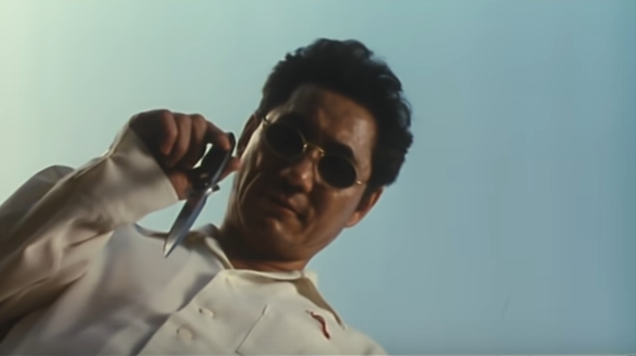
Takeshi Kitano did not receive an Oscar nomination for portraying Sgt. Gengo Hara in Merry Christmas, Mr. Lawrence.

Takeshi Kitano must have one of the most multi-faceted careers for any actor, this being a host, a comedian, an editor, a writer, a director...and tap dancer, while evidently finding quite a bit of success in each of these endeavors. This evidently wasn't always the case as this film marked an important breakout attempt for him to no longer just be seen as a comedian as an attempt to be taken seriously. Although evidently this was met with laughter in his native Japan, which is a shame, though something he apparently eventually got over. Still a shame though as one just looking at Kitano's performance here, you might only gather he was best known as a comedian, because comedians can sometimes deliver brilliant one of the kind performances. Now his role is a decently worn one, that of the brutal enforcer in a POW camp, seemingly only second to the as brutal, though in a different way, to camp commandant Captain Yonoi (Ryuichi Sakamoto). This we see in the opening of the film Hara summons British POW liaison Lawrence (Tom Conti) to inspect a situation, where a Korean guard sodomized a prisoner. Kitano of course delivers the intensity needed and expected for such a role. This just being inherent, in making his quick gestures of violence as something he doesn't require a second thought for. This portraying just a casual quality in this behavior as a man whose done this for quite awhile and does have an ease at it. This even when casually doing to Lawrence when he speaks up against the actions of Hara and the Japanese in general.
This scene alone though is brilliant work from Kitano though as he instantly establishes Hara's manner towards Lawrence with this semi-congenial recognition of him, even though he doesn't eventually mind hitting him in the same scene. In the sequence itself though Kitano is fantastic in the way he portrays the cruelty of Hara, that is essential in portraying sort of the systematic nature of it based upon the Japanese army's culture. This as he mocks both men with a derisive attitude, less of a direct attack, and more of it as this type of grilling, though no less severe in this apprach. This though broken with these little asides where Hara mentions ideas to Lawrence with this strict sincerity, such as knowing the Japanese properly by seeing a man commit harakiri. Kitano's delivery of mentioning these ideas is with an earnest educational tone. He plays it as not extra cruelty to his British prisoner, but rather as though it is something he really wants to share with the man, as terrible of a thing as that is to share. Kitano though manages in this scene to show that Hara's firm beliefs in the imperial Bushido code are not just something he uses to be cruel, rather those beliefs are what encourages him to be cruel. This is as we see the disgraced guard attempt a sloppy harakiri, the glee upon Kitano's face as he prepares to second the man (i.e. cut his head off), is that with the pride as though he is performing essentially a religious right. This as something a proper soldier should do in his mind. There is nothing simple about the way Kitano expresses this, which is what is so important. This as even as he explains his actions to his Captain, with a bit of shyness, that Kitano shows of a soldier a bit unsure of himself in front of his commanding officer, but still with a direct belief as he describes the harakiri as something that would benefit the man, Kitano makes it the truth to Hara.
The crux of this performance is in his scenes with Tom Conti, as we see more than just a captor and captive. That is part of it, but not all of it. Although even within that we find the right nuance as Lawrence argues for the mistreated prisoner, Kitano brings that usual sort of underlying menace of a cruel guard, however also delivers a more casual incredulous quality when Lawrence speaks on them all being soldiers. Kitano creating as sense of Hara more than just as his role as this captor. This is expanded, on what is one of my favorite scenes in the film, when at night Hara comes to see Lawrence in the prison barracks, along with the new captured officer Celliers (David Bowie). I love Kitano in this scene as he wakes up Lawrence less as a cruel captain, and more of as a friend at sleepover hoping to get into just a little bit of mischief in the night. This as he brings this eagerness in his curiosity of someone just genuinely interested in this supposed great soldier, and the fascination is pure in such a wonderful way. Again Kitano finds sense, in the senseless in a way, as he brings such a reasoned honesty to Hara's extremist beliefs. This as we see him continue as he talks to Lawrence asking him why he wouldn't commit suicide. Kitano's fantastic because he doesn't use it in this berating tone, as we see the men just talking as men, and Kitano in turn shows a man genuinely interested in his fellow soldier. This as even his eyes bring this interest in the other man's views though, not that he agrees with them, but what Kitano expresses is a man finding a genuine camaraderie in this interaction. We see friendship in his eyes, even if the nature of the situation prevents it. There's an amazing moment where Hara's explain he enlisted when he was 17, this as he begins speaking the words with this quiet vulnerability, as a man who really wants to share something personal with Lawrence, though then as he tells it fully, he shifs to an attempted solder's menace as he notes his belief in giving his life to the emperor. Kitano in the moment shows so well both the soldier in Hara, but the man beneath it all. My favorite moment of the scene though is as he and Lawrence briefly interact with Celliers, this as again Kitano brings a near childlike amazement, as he and Lawrence sneak in the interaction like a couple kids.
We see then this better side come out of Hara in a great scene where he gets Celliers and Lawrence released from confinement. This as a drunken Hara, Kitano is terrific by expressing all the soldier's bluster being worn mostly away by drink, and a bit of goodwill. Kitano does this in this outstanding sort of waves in his work in bringing glint of a stern expression though it gives way to the again that better man inside, with his endearing laughter from his drink, and his oh so perfect delivery of the titular line, because Kitano expresses as absolutely a wish of goodwill to his fellow man, and really friend. That is almost just the man, not the soldier, but we finally get purely just the man in Kitano's final scene. This being the final scene of the film after the war, where Hara is about to be executed for war crimes, but Lawrence visits him one more time. Kitano, who delivers the entire scene in English, is masterful in this scene. This bringing such a modesty to the moment showing Hara without any pretenses. This bringing in his performance the difficult expression of a man trying not to cry, though just almost the brink of it. This as Kitano is heartbreaking here as we see him reaching to Lawrence now purely as a friend. His line delivery regarding not understanding why he's being executed as his crimes were no different than any other soldier. While I don't quite agree with the sentiment, what I do agree with is the power found in this through Kitano's performance that again emphasizes this as truth. He shows a man who basically was raised with cruelty as the requirement to be a soldier, and in turn was cruel. There's no hypocrisy as Kitano speaks it with the strictest sincerity. This isn't without regret though as they note the death of another, and Kitano's expression does speak towards the unfortunate loss of life. The most remarkable aspect of the scene though is as the two briefly reminisce. The two striking up a chemistry of old friends once again, and we sense that the two, could've been the best of friends in a better world. Kitano's work here is simply incredible in offering such complex portrayal of a soldier bred towards cruelty yet still with humanity within him. Kitano's final seconds exemplifying this as they are again sheer perfection as he calls out Lawrence one more time, though for a last time in his soldier's voice, though as his face shows it as but joke as he wishes so poignantly one last humane "merry Christmas" to his friend.