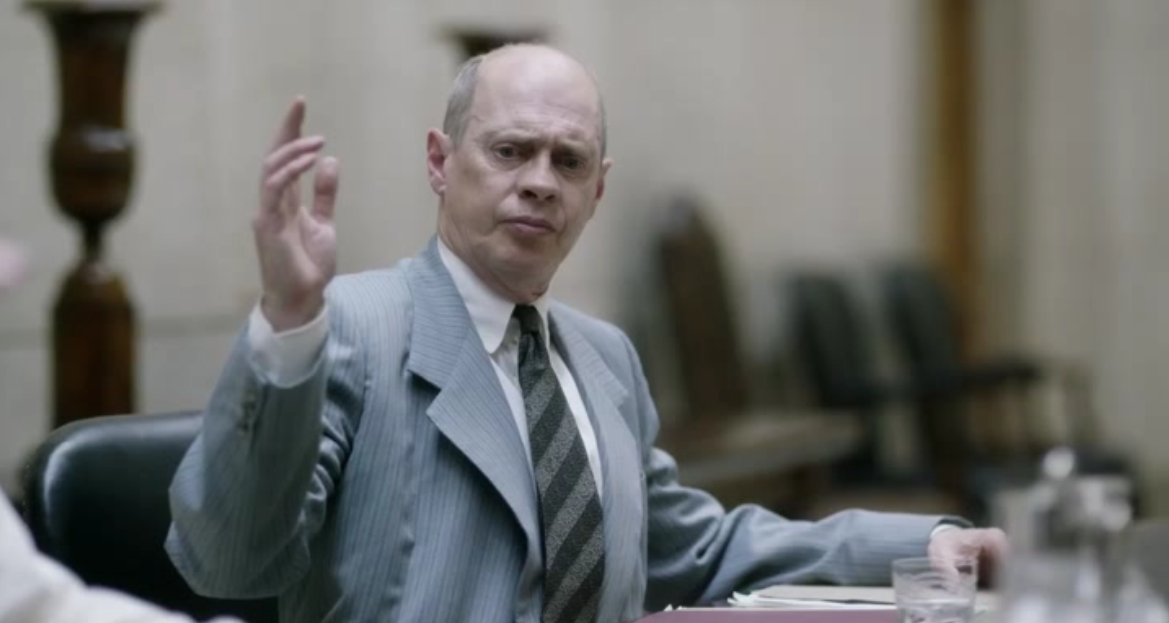
5. Michael Palin in The Meaning of Life - Although in a mixed bag of a film, Palin delivers on the best parts of that mixed bag in his various absurd comic turns.
Best Scene: "Every sperm is sacred"
4. Ian McDiarmid in Return of the Jedi- McDiarmid manages to create an instantly iconic villain that is playing on a known riff but in a different way.
Best Scene: Crossed sabres.
3. David Bowie in The Hunger - Bowie delivers again that fascinating enigmatic charisma of his, though also grants a haunting depiction of a man swiftly consumed by the ravages of age.
Best Scene: Old man seeing the pupil.
2. Jonathan Pryce in Something Wicked This Way Comes - Pryce gives an appropriately devious portrayal of a calm yet sinister omnipotent evil.
Best Scene: The library.
1. Takeshi Kitano in Merry Christmas, Mr. Lawrence - Kitano gives a brilliant performance that depicts both the cruelty of a man designed by a terrible code, but also the compromised humanity still within that.
Best Scene: Final merry Christmas.
Updated Overall
Next: 2014 Lead (though taking a brief hiatus to catch up on some 2020 releases, feel free to make any 2020 recommendations).
Showing posts with label Michael Palin. Show all posts
Monday, 11 May 2020
Wednesday, 6 May 2020
Alternate Best Supporting Actor 1983: Michael Palin in The Meaning of Life
Michael Palin did not receive an Oscar nomination for portraying Window Washer / Harry / Fish No. 5 / Mr Pycroft / Dad / Narrator No. 1 /
Chaplain / Carter / Spadger / Regimental Sergeant Major /
Pakenham-Walsh / Man in Rear End / Female TV Presenter / Mr Marvin Hendy
/ Governor / Leaf Son and Debbie Katzenberg in The Meaning of Life.
The Meaning of Life, essentially Monty Python's own History of the World Part I, is a series of vignettes supposedly about the title. I would say with this one, although there are laughs to be found, I would the success rate of jokes is fairly low, not to the point of being a terrible comedy however it is a considerable step down from their previous effort, Life of Brian. I honestly probably wouldn't even recommend the film, just rather simply watch the cut clips of the bits that work.
Well I will say it again Michael Palin is easily my favorite Python as a performer, and in general his ability in the sketch comedy also alludes to why he was also the best actor of the group in general. This as the other member typically worked within a more exact type, John Cleese as the pompous fool or genius, Eric Idle as a at least slightly daffy excitable fellow, Graham Chapman as the relative straight man, and then the director Terrys as some kind of grotesque sort. Palin's characters tend to be a bit more of just that, even in the microcosm we see of them here. This as he plays about 18 different roles, and in each Palin manages to bring a bit more than just a quick comedic bit. This as he offers the blind naivety of a dopey school boy for a moment, the excessive propriety of a tv hostess, though not say particularly proper things, even the different kind of propriety of an American wife, the low key smugness of a hospital director, the smugness of an overly proper British soldier, or the strange randomness of a man in a tiger suit at the opposite end of that soldier. In each Palin captures a bit different in his presence as these different roles, this making him typically a little bit amusing even when some of the bits he's featured in aren't all that amusing overall. There's just something about his range of voices and expression, that can garner a little chuckle. What I'm really here to discuss are his sort of central sketches, which actually Palin gets very few of, perhaps one of the issues with the film, in fact he only has two where he is the focus. The first being the film's big Oliver!esque musical number about a poor father describing to his brood of children why he needed to have so many, explaining that "Every Sperm is Sacred". Palin's performance here being an enjoyable sort of twist on the modest means father befitting an Oliver Twist novel, with an aw shucks expression and a world weary voice. This though with all the heart he can must in his eyes and of course his voice as he sings to all about his fundamental beliefs. Palin belting it out with a hilarious passion, and again that heart, even as he sends off all his kids for scientific experimentation. His other scene is as a drill sergeant. This where Palin again fashions a different personality of a wild eyes befitting the profession, and lips with mind of their own as he barks out orders like a proper English screw. This finding the comedy as Palin brings this ridiculous intensity even as the sergeant is extremely accommodating to all his soldiers who feel they could do something better than routine drills. Palin being great as he maintains that same stature no matter what happens. Both these bits are great, and for my money the best bits in the film, or at least two that wholly worked for me. Is it coincidence that they both star Palin? I'm going to say probably not, as both feature his delightful talents, as a comic performer that grants the particular type of investment in his performances that sell the comedy all the more.
The Meaning of Life, essentially Monty Python's own History of the World Part I, is a series of vignettes supposedly about the title. I would say with this one, although there are laughs to be found, I would the success rate of jokes is fairly low, not to the point of being a terrible comedy however it is a considerable step down from their previous effort, Life of Brian. I honestly probably wouldn't even recommend the film, just rather simply watch the cut clips of the bits that work.
Well I will say it again Michael Palin is easily my favorite Python as a performer, and in general his ability in the sketch comedy also alludes to why he was also the best actor of the group in general. This as the other member typically worked within a more exact type, John Cleese as the pompous fool or genius, Eric Idle as a at least slightly daffy excitable fellow, Graham Chapman as the relative straight man, and then the director Terrys as some kind of grotesque sort. Palin's characters tend to be a bit more of just that, even in the microcosm we see of them here. This as he plays about 18 different roles, and in each Palin manages to bring a bit more than just a quick comedic bit. This as he offers the blind naivety of a dopey school boy for a moment, the excessive propriety of a tv hostess, though not say particularly proper things, even the different kind of propriety of an American wife, the low key smugness of a hospital director, the smugness of an overly proper British soldier, or the strange randomness of a man in a tiger suit at the opposite end of that soldier. In each Palin captures a bit different in his presence as these different roles, this making him typically a little bit amusing even when some of the bits he's featured in aren't all that amusing overall. There's just something about his range of voices and expression, that can garner a little chuckle. What I'm really here to discuss are his sort of central sketches, which actually Palin gets very few of, perhaps one of the issues with the film, in fact he only has two where he is the focus. The first being the film's big Oliver!esque musical number about a poor father describing to his brood of children why he needed to have so many, explaining that "Every Sperm is Sacred". Palin's performance here being an enjoyable sort of twist on the modest means father befitting an Oliver Twist novel, with an aw shucks expression and a world weary voice. This though with all the heart he can must in his eyes and of course his voice as he sings to all about his fundamental beliefs. Palin belting it out with a hilarious passion, and again that heart, even as he sends off all his kids for scientific experimentation. His other scene is as a drill sergeant. This where Palin again fashions a different personality of a wild eyes befitting the profession, and lips with mind of their own as he barks out orders like a proper English screw. This finding the comedy as Palin brings this ridiculous intensity even as the sergeant is extremely accommodating to all his soldiers who feel they could do something better than routine drills. Palin being great as he maintains that same stature no matter what happens. Both these bits are great, and for my money the best bits in the film, or at least two that wholly worked for me. Is it coincidence that they both star Palin? I'm going to say probably not, as both feature his delightful talents, as a comic performer that grants the particular type of investment in his performances that sell the comedy all the more.
Sunday, 3 May 2020
Alternate Best Supporting Actor 1983
And the Nominees Were Not:
Ian McDiarmid in Return of the Jedi
David Bowie in The Hunger
Jonathan Pryce in Something Wicked This Way Comes
Jason Robards in Something Wicked This Way Comes
Michael Palin in The Meaning of Life
Takeshi Kitano in Merry Christmas, Mr. Lawrence
For prediction purposes:
Pryce
Ian McDiarmid in Return of the Jedi
David Bowie in The Hunger
Jonathan Pryce in Something Wicked This Way Comes
Jason Robards in Something Wicked This Way Comes
Michael Palin in The Meaning of Life
Takeshi Kitano in Merry Christmas, Mr. Lawrence
For prediction purposes:
Pryce
Saturday, 24 February 2018
Alternate Best Supporting Actor 2017: Steve Buscemi, Simon Russell Beale, Jason Isaacs and Michael Palin in The Death of Stalin
Steve Buscemi, Simon Russell Beale, Jason Isaacs and Michael Palin did not receive Oscar nominations for portraying Nikita Khrushchev, Lavrentiy Beria, Georgy Zhukov, and Vyacheslav Molotov respectively in The Death of Stalin.
The Death of Stalin is a hilarious and biting dark satire focusing on the immediate political fallout in the U.S.S.R from the titular "loss".
An essential ingredient to making this very exact tone of the satire to work is found within the cast. This includes just strong performances all around in the best ensemble from 2017, but it goes further than that in terms of the very nature of the casting and the performances. It's best to begin then with Steve Buscemi as he would unlikely be anyone's first casting choice for Nikita Khrushchev in a film about the history of the Soviet Union, or even in a prestige British representation of such a story. The Death of Stalin is neither of those things of course in its approach and Steve Buscemi's casting is a perfect representation of this approach. The idea isn't to represent a strict historical truth in the least, though there is historical truth to be found in the film, but rather it purposefully sets itself outside of this to create a unique satirized version of Russian. This makes Brooklyn born Buscemi as just a natural part of the film. He is not only a natural part though but Buscemi's style as an actor ends up being this rather natural fit to who Khrushchev will be in the film, which is as our "hero" the use of quotations very much needed there. Buscemi's unassuming performance style though is the right one for that of Khrushchev who is just as much of a political operator as his chief rival, but Buscemi's approach just makes him seem all the more approachable.
This is in stark contrast to Simon Russell Beale as Lavrentiy Beria the man in charge of NKVD who essentially were the police in the Soviet Union who performed the most dirty of the dirty work of Stalin's regime. Beria is the film's "villain" however again that is as much of in need of quotations as the use of hero for Khrushchev. Beale's performance though is this fascinating little juxtaposition as he makes Beria essentially the most honest dishonest man around. This is as Beale so embraces the very nature of the man in his portrayal as someone who genuinely thrives in the system. Beale conducts himself with this most definite ease in itself in almost every moment as the smoothest of political operators mainly because he so understands the situation he is in. When early on he casually mentions one of their colleagues will soon be gone, to be taken away by the police, Beale delivers it with such a glib attitude that establishes Beria so effectively before the plot even begins. Beale reveals this man as oh so comfortable with his existence within this system who unlike the other men does not put on any other personal delusional fronts. In that what Beale does is stand out among the pack as the man most comfortable with being a completely despicable human being. That devilish grin of his and wily eyes are of the man who has long fashioned himself within this life of backstabbing without a single hesitation in any facet of it.
The titular event, while at first Stalin just becomes incapacitated, springs all the men of the inner circle into action in order to attempt to find their own ways to take advantage or deal with the situation. Naturally enough Beria is the swiftest to take action, and Beale properly shows a man glorying in the acts as he for a very brief period is unencumbered by any authority above himself. There is such a horrible glee that Beale brings in every little bit of use of power in these scenes particular his exact joy when giving out a new list of people to be taken away or possibly killed. Beale delivers the needed incisiveness in every word as he goes about in his act of seizing power through his alternate source of power by quickly making a puppet out of Jeffrey Tambor's Georgy Malenkov who technically is next in line by virtue of procedure. Beale's great in his interactions with Tambor in these moments by speaking to every word with him either with the man as though he's offering specific and leading stage direction to a bad actor though occasionally with a more terrifying glance to suggest his capability to destroy the man if he doesn't properly stay in line. Beale brings the right type of physical presence in the role in a very unique way as in the way he holds sway by carrying himself with this calm command, and those eyes of his which almost always carry that unmistakable intensity of a true political, well really any kind of, cutthroat.
This is against Buscemi's portrayal of Khrushchev which he brings a bit of natural manic energy to as he first comes on the scene of Stalin fitting to a man just quickly trying to come up with a way to deal with the situation that will determine his fate. Buscemi's great here in figuring out this exact way Khrushchev puts forth his way of dealing with his office, which is much more as a proper politician, though that is not necessarily a good thing. Buscemi's very enjoyable in bringing out this sort of the need to act as the politician kicks in at seeing Stalin's soon to be corpse, as he so overly expresses his sorrow as a proper man of the people giving his respects to their leader. Buscemi oversells this in the right way as the man just really enforcing the act showing Khrushchev playing this as a man trying to make sure onlookers note that "Khrushchev almost wept at seeing Stalin's corpse". Buscemi though is careful to show that Khrushchev is not a true fool, but even that act is a maneuver that he quickly drops at the sight of Stalin's urine soaked pants. Buscemi properly switches gears in that moment to show Khrushchev basically switching to the political operative mode though, after fulfilling the politician's duty, as he begins to deliver his own incisive ways though in a different way than Beale which is a strangely key thing in this film.
This key element is in the difference between Buscemi's approach to Khrushchev against Beale's portrayal of Beria which is a fascinating interplay particularly in terms of audience perception of each. This is one of the, many, brilliant parts of the film as really Khrushchev isn't a good guy either, yet I found myself siding to him by how well these performances realize these two characters. Buscemi again brings the right unassuming quality, which is in part the politician act, however he goes further to show it with a bit of honesty in that he cannot embrace really evil in the same way Beria does. Beale on the other hand does show the more honest dishonest man by in no way hiding the gruesome grotesque nature of the man. Beale particularly puts so much hideous elation when finding a new rape victim, or delivering the mentions of his own ill deeds so brazenly. In a way this is more honest than Buscemi's portrayal who shows Khrushchev as someone, who to be fair isn't as evil anyways, but also manages to delude himself to a certain degree. Buscemi however makes Khrushchev more likable also though by bringing this emphasis on the idea of the man as having any reluctance in being a cutthroat. Buscemi again is careful in the way he reveals this in these moments as once again more for show in the reluctance, however it is much appreciated for decency's sake.
Of course these two it needs to be also said are hilarious here in just kind of a traditional comedic way in every single scene. This is in part due to the two's flawless delivery of the rich dialogue given to them. Beale delivering Beria's one liners though as more exact daggers into anyone who dare trespass him, Buscemi, again somehow being likable in this by bringing more of a sardonic energy in cutting down his opponents such his "two clowns, one joke between you" to deflect an insult by two of the less powerful members of the inner circle. Their performances also are hilarious in terms of their physical energy that is classically comedic. I have particular affection in Beale's work for his way of portraying Beria's mad dashes while disposing of and replacing files while Stalin lies dying on the floor. Buscemi also excels in this regard particularly in the scene of Stalin's funeral wake where Khrushchev tries to get a better spot to hear a conversation between members of the inner circle by attempting to make it look like it is part of the ceremony. The conviction that Buscemi brings in each step, and again a bit of that false properness of a politician, as this very refined act that is in fact just trying to be in a better place to eavesdrop. Beale and Buscemi make for a great pair though as the two true leaders of the two sides matching each other well as Beale the oh so assured monster, against Buscemi the proper harried underdog.
Of course in this power struggle there are many players with two of them perhaps being the most important as the wild cards in this game at a very grand scale. The first being Jason Isaacs's Georgy Zhukov the leader of the armed forces. Isaacs is essentially Peter Capaldi's Malcolm Tucker for this political satire as a man who doesn't give two "excrements" about making himself heard and heard well. Isaacs comes in fast and hard as a man almost with more medals than will fit on his uniform and Isaacs properly is as proud as that amount of medals would suggest. Although Beale and Buscemi do have their own form of command here, Isaacs delivers a different sort of a man who has fought hard and long with his particularly, and so deliciously blunt delivery of "What's a war hero got to do to get some lubrication around here" before being introduced in text by the film. Isaacs conducts himself as a man who kind of is aware of power in a more direct and obvious way as a proper soldier. Isaacs's gruff accent is perfect for the role as a man ready to growl and pounce at any point. Isaacs delivers every one of his take down with particularly pinpoint accuracy fitting to a man who doesn't mind risking death with words given his more hands on experience with death. Isaacs is a treat every single minute he is onscreen by in every moment conducting himself with such a comedic, yet real, intensity that is absolutely perfect. He's just a joy to watch while also wholly fulfilling his particular role which is as man who makes his points clearly and directly to make sure they are heard. Isaacs has so much fun here as the man who has no delusions in a different way in that he plays the game with a different sort of perspective on the whole thing, since again power is different to him. My favorite scene of his though has to be when Khrushchev goes to seek help from him to dispose Beria, to which Isaacs delivers a magnificent false concern about Khrushchev's idea before revealing this to be only a joke, and that he is more than eager to destroy Beria. It just a moment of pure comic gold sold to perfection by Isaacs's performance, which there is not a lot of here, but every second of it is something quite special.
The other wildcard is in Michael Palin's Vyacheslav Molotov. I have to say first off I couldn't be happier at Palin's return in this film after having not appeared in a mainstream live action film in almost 20 years. They couldn't have asked for a better actor though to pull off the tricky part of Vyacheslav Molotov, Stalin's most loyal man but also the one who was to be taken away in the opening of the film. Now this requires a certain balance of things in this role, that thankfully Palin is a master of. Molotov is of course partially defined by the fact that Stalin had his wife imprisoned, used by Beria as a sex slave, though Molotov remained working with Stalin. Palin, as always, brings an innate charm to the part here just in this way as an affable old statesman that from the moment you hear he's going to be taken away, it is very easy to feel sorry for him. Palin in addition though finds a real pathos as he remarks on the loss of his wife though, and convincingly finds this strange state of the man. He offers a genuine earnestness in portraying the feelings of a loving husband, but where the comedy comes in is how this fashions through the type of man that is Molotov. Molotov being absolutely loyal to Stalin to the point that when he hears he was originally going to be taken away by the police, Palin only offers the most honest, and in turn hilarious, concern as he ponders how he could've wronged Stalin. Palin is exceptional in the way he is able to make this sort of ridiculous state of the man actually believable by just how well he can be absurd yet believable at the same time. This becomes particularly important once Khrushchev and Beria try to fight for his support, where Beria brings Molotov's wife to bribe the man, while Khrushchev tries to play towards the man's strict loyalties. Palin plays again finds a certain quality of the loving husband when he sees his wife and reveals a most genuine jubilation at the initial sight of her. Palin though makes the love of the husband real, however he still reveals that what is more important to him is his loyalty to Stalin, which requires that he see his wife as a traitor. Palin again is equally funny when revealing Molotov's support for Khrushchev's power play, because he brings such a fervent devotion to the denouncement of his wife, since according him Stalin was right, which he feels Beria wrongly absolved her of. What's so fantastic here in his performance is that Palin is able to be extremely humorous yet he makes this absurd nature of the man seem logical in his own peculiar sense of being caused by his undying loyalty to Stalin.
Khrushchev's plan to destroy Beria comes from technically both of them causing a massacre after Beria's men going about killing or at least causing the deaths of many of the Russian citizens Khrushchev allowed in to attend Stalin's funeral. Khrushchev though makes the first step which again I love how Buscemi brings such a dogged determination that again somehow makes him seem the righteous one even though he is just about as guilty in causing the deaths as Beria is. This is against Beale's depiction of Beria who is effectively just so smug you can't help but hate the guy who seems so assured of his grotesque abuse of power. Beale naturally keeps this quality when he is initially taken prisoner and he believes he might be able to get his way out of this still. Beale carries himself with such a firm disregard for everyone around him, carrying such venom in every delivery of his as he denounces everyone around him while also lashing out at everyone around him. Beale still carries that personality of command as though he keeps such a viciousness in his hatred, though with enough of a creeping up undercurrent of unease, but mostly something Beale portrays as being overwhelmed by Beria trying to stand firm in his position of power. Of course his insults get him nowhere and the inner circle decide to blame him for the massacre, and quickly make a trial and convict him in no time at all. Now this final sequence I think is a testament to the genius of the film, and to the strength of the performances of all particularly Buscemi and Beale's. This is the one scene that strictly and mostly strongly moves closest to the purely dramatic. There have been talk of deaths, and even the sight of them, however with a purposeful distance within the satire. This one scene that makes it more tangible because the violence finally happens to a named character who we know, which is Beria. What's so brilliant about this is he's the worst of the worst, however with that in mind he still is a person we've gotten to know. In turn Beale is actually kind of heartbreaking as he loses all pretense and just brings such a palatable desperation as he begs for his life. In that moment the bluntly hits you with the reality by showing a more concrete loss of life, even though it is through the man most deserving of death in the whole film. The other touch that's so great though is Buscemi though who also changes as he loses that underdog status and reveals Khrushchev as much of a cutthroat as Beria in his ice cold deliver of his insults while the man is shot then burned in front of him. The execution of this is incredible as it is uncompromising as it reveals this story was always about a group of terrible people, though Beria might have flaunted his vile nature more openly all of the characters are very bad men. The entire ensemble here is magnificent though in realizing this duplicitous world so well in creating each and everyone of this vile sorts creating this tapestry of amorality, oh yes and being quite hilarious while doing so.
(For Isaacs and Palin)
(For Beale and Buscemi )
The Death of Stalin is a hilarious and biting dark satire focusing on the immediate political fallout in the U.S.S.R from the titular "loss".
An essential ingredient to making this very exact tone of the satire to work is found within the cast. This includes just strong performances all around in the best ensemble from 2017, but it goes further than that in terms of the very nature of the casting and the performances. It's best to begin then with Steve Buscemi as he would unlikely be anyone's first casting choice for Nikita Khrushchev in a film about the history of the Soviet Union, or even in a prestige British representation of such a story. The Death of Stalin is neither of those things of course in its approach and Steve Buscemi's casting is a perfect representation of this approach. The idea isn't to represent a strict historical truth in the least, though there is historical truth to be found in the film, but rather it purposefully sets itself outside of this to create a unique satirized version of Russian. This makes Brooklyn born Buscemi as just a natural part of the film. He is not only a natural part though but Buscemi's style as an actor ends up being this rather natural fit to who Khrushchev will be in the film, which is as our "hero" the use of quotations very much needed there. Buscemi's unassuming performance style though is the right one for that of Khrushchev who is just as much of a political operator as his chief rival, but Buscemi's approach just makes him seem all the more approachable.
This is in stark contrast to Simon Russell Beale as Lavrentiy Beria the man in charge of NKVD who essentially were the police in the Soviet Union who performed the most dirty of the dirty work of Stalin's regime. Beria is the film's "villain" however again that is as much of in need of quotations as the use of hero for Khrushchev. Beale's performance though is this fascinating little juxtaposition as he makes Beria essentially the most honest dishonest man around. This is as Beale so embraces the very nature of the man in his portrayal as someone who genuinely thrives in the system. Beale conducts himself with this most definite ease in itself in almost every moment as the smoothest of political operators mainly because he so understands the situation he is in. When early on he casually mentions one of their colleagues will soon be gone, to be taken away by the police, Beale delivers it with such a glib attitude that establishes Beria so effectively before the plot even begins. Beale reveals this man as oh so comfortable with his existence within this system who unlike the other men does not put on any other personal delusional fronts. In that what Beale does is stand out among the pack as the man most comfortable with being a completely despicable human being. That devilish grin of his and wily eyes are of the man who has long fashioned himself within this life of backstabbing without a single hesitation in any facet of it.
The titular event, while at first Stalin just becomes incapacitated, springs all the men of the inner circle into action in order to attempt to find their own ways to take advantage or deal with the situation. Naturally enough Beria is the swiftest to take action, and Beale properly shows a man glorying in the acts as he for a very brief period is unencumbered by any authority above himself. There is such a horrible glee that Beale brings in every little bit of use of power in these scenes particular his exact joy when giving out a new list of people to be taken away or possibly killed. Beale delivers the needed incisiveness in every word as he goes about in his act of seizing power through his alternate source of power by quickly making a puppet out of Jeffrey Tambor's Georgy Malenkov who technically is next in line by virtue of procedure. Beale's great in his interactions with Tambor in these moments by speaking to every word with him either with the man as though he's offering specific and leading stage direction to a bad actor though occasionally with a more terrifying glance to suggest his capability to destroy the man if he doesn't properly stay in line. Beale brings the right type of physical presence in the role in a very unique way as in the way he holds sway by carrying himself with this calm command, and those eyes of his which almost always carry that unmistakable intensity of a true political, well really any kind of, cutthroat.
This is against Buscemi's portrayal of Khrushchev which he brings a bit of natural manic energy to as he first comes on the scene of Stalin fitting to a man just quickly trying to come up with a way to deal with the situation that will determine his fate. Buscemi's great here in figuring out this exact way Khrushchev puts forth his way of dealing with his office, which is much more as a proper politician, though that is not necessarily a good thing. Buscemi's very enjoyable in bringing out this sort of the need to act as the politician kicks in at seeing Stalin's soon to be corpse, as he so overly expresses his sorrow as a proper man of the people giving his respects to their leader. Buscemi oversells this in the right way as the man just really enforcing the act showing Khrushchev playing this as a man trying to make sure onlookers note that "Khrushchev almost wept at seeing Stalin's corpse". Buscemi though is careful to show that Khrushchev is not a true fool, but even that act is a maneuver that he quickly drops at the sight of Stalin's urine soaked pants. Buscemi properly switches gears in that moment to show Khrushchev basically switching to the political operative mode though, after fulfilling the politician's duty, as he begins to deliver his own incisive ways though in a different way than Beale which is a strangely key thing in this film.
This key element is in the difference between Buscemi's approach to Khrushchev against Beale's portrayal of Beria which is a fascinating interplay particularly in terms of audience perception of each. This is one of the, many, brilliant parts of the film as really Khrushchev isn't a good guy either, yet I found myself siding to him by how well these performances realize these two characters. Buscemi again brings the right unassuming quality, which is in part the politician act, however he goes further to show it with a bit of honesty in that he cannot embrace really evil in the same way Beria does. Beale on the other hand does show the more honest dishonest man by in no way hiding the gruesome grotesque nature of the man. Beale particularly puts so much hideous elation when finding a new rape victim, or delivering the mentions of his own ill deeds so brazenly. In a way this is more honest than Buscemi's portrayal who shows Khrushchev as someone, who to be fair isn't as evil anyways, but also manages to delude himself to a certain degree. Buscemi however makes Khrushchev more likable also though by bringing this emphasis on the idea of the man as having any reluctance in being a cutthroat. Buscemi again is careful in the way he reveals this in these moments as once again more for show in the reluctance, however it is much appreciated for decency's sake.
Of course these two it needs to be also said are hilarious here in just kind of a traditional comedic way in every single scene. This is in part due to the two's flawless delivery of the rich dialogue given to them. Beale delivering Beria's one liners though as more exact daggers into anyone who dare trespass him, Buscemi, again somehow being likable in this by bringing more of a sardonic energy in cutting down his opponents such his "two clowns, one joke between you" to deflect an insult by two of the less powerful members of the inner circle. Their performances also are hilarious in terms of their physical energy that is classically comedic. I have particular affection in Beale's work for his way of portraying Beria's mad dashes while disposing of and replacing files while Stalin lies dying on the floor. Buscemi also excels in this regard particularly in the scene of Stalin's funeral wake where Khrushchev tries to get a better spot to hear a conversation between members of the inner circle by attempting to make it look like it is part of the ceremony. The conviction that Buscemi brings in each step, and again a bit of that false properness of a politician, as this very refined act that is in fact just trying to be in a better place to eavesdrop. Beale and Buscemi make for a great pair though as the two true leaders of the two sides matching each other well as Beale the oh so assured monster, against Buscemi the proper harried underdog.
Of course in this power struggle there are many players with two of them perhaps being the most important as the wild cards in this game at a very grand scale. The first being Jason Isaacs's Georgy Zhukov the leader of the armed forces. Isaacs is essentially Peter Capaldi's Malcolm Tucker for this political satire as a man who doesn't give two "excrements" about making himself heard and heard well. Isaacs comes in fast and hard as a man almost with more medals than will fit on his uniform and Isaacs properly is as proud as that amount of medals would suggest. Although Beale and Buscemi do have their own form of command here, Isaacs delivers a different sort of a man who has fought hard and long with his particularly, and so deliciously blunt delivery of "What's a war hero got to do to get some lubrication around here" before being introduced in text by the film. Isaacs conducts himself as a man who kind of is aware of power in a more direct and obvious way as a proper soldier. Isaacs's gruff accent is perfect for the role as a man ready to growl and pounce at any point. Isaacs delivers every one of his take down with particularly pinpoint accuracy fitting to a man who doesn't mind risking death with words given his more hands on experience with death. Isaacs is a treat every single minute he is onscreen by in every moment conducting himself with such a comedic, yet real, intensity that is absolutely perfect. He's just a joy to watch while also wholly fulfilling his particular role which is as man who makes his points clearly and directly to make sure they are heard. Isaacs has so much fun here as the man who has no delusions in a different way in that he plays the game with a different sort of perspective on the whole thing, since again power is different to him. My favorite scene of his though has to be when Khrushchev goes to seek help from him to dispose Beria, to which Isaacs delivers a magnificent false concern about Khrushchev's idea before revealing this to be only a joke, and that he is more than eager to destroy Beria. It just a moment of pure comic gold sold to perfection by Isaacs's performance, which there is not a lot of here, but every second of it is something quite special.
The other wildcard is in Michael Palin's Vyacheslav Molotov. I have to say first off I couldn't be happier at Palin's return in this film after having not appeared in a mainstream live action film in almost 20 years. They couldn't have asked for a better actor though to pull off the tricky part of Vyacheslav Molotov, Stalin's most loyal man but also the one who was to be taken away in the opening of the film. Now this requires a certain balance of things in this role, that thankfully Palin is a master of. Molotov is of course partially defined by the fact that Stalin had his wife imprisoned, used by Beria as a sex slave, though Molotov remained working with Stalin. Palin, as always, brings an innate charm to the part here just in this way as an affable old statesman that from the moment you hear he's going to be taken away, it is very easy to feel sorry for him. Palin in addition though finds a real pathos as he remarks on the loss of his wife though, and convincingly finds this strange state of the man. He offers a genuine earnestness in portraying the feelings of a loving husband, but where the comedy comes in is how this fashions through the type of man that is Molotov. Molotov being absolutely loyal to Stalin to the point that when he hears he was originally going to be taken away by the police, Palin only offers the most honest, and in turn hilarious, concern as he ponders how he could've wronged Stalin. Palin is exceptional in the way he is able to make this sort of ridiculous state of the man actually believable by just how well he can be absurd yet believable at the same time. This becomes particularly important once Khrushchev and Beria try to fight for his support, where Beria brings Molotov's wife to bribe the man, while Khrushchev tries to play towards the man's strict loyalties. Palin plays again finds a certain quality of the loving husband when he sees his wife and reveals a most genuine jubilation at the initial sight of her. Palin though makes the love of the husband real, however he still reveals that what is more important to him is his loyalty to Stalin, which requires that he see his wife as a traitor. Palin again is equally funny when revealing Molotov's support for Khrushchev's power play, because he brings such a fervent devotion to the denouncement of his wife, since according him Stalin was right, which he feels Beria wrongly absolved her of. What's so fantastic here in his performance is that Palin is able to be extremely humorous yet he makes this absurd nature of the man seem logical in his own peculiar sense of being caused by his undying loyalty to Stalin.
Khrushchev's plan to destroy Beria comes from technically both of them causing a massacre after Beria's men going about killing or at least causing the deaths of many of the Russian citizens Khrushchev allowed in to attend Stalin's funeral. Khrushchev though makes the first step which again I love how Buscemi brings such a dogged determination that again somehow makes him seem the righteous one even though he is just about as guilty in causing the deaths as Beria is. This is against Beale's depiction of Beria who is effectively just so smug you can't help but hate the guy who seems so assured of his grotesque abuse of power. Beale naturally keeps this quality when he is initially taken prisoner and he believes he might be able to get his way out of this still. Beale carries himself with such a firm disregard for everyone around him, carrying such venom in every delivery of his as he denounces everyone around him while also lashing out at everyone around him. Beale still carries that personality of command as though he keeps such a viciousness in his hatred, though with enough of a creeping up undercurrent of unease, but mostly something Beale portrays as being overwhelmed by Beria trying to stand firm in his position of power. Of course his insults get him nowhere and the inner circle decide to blame him for the massacre, and quickly make a trial and convict him in no time at all. Now this final sequence I think is a testament to the genius of the film, and to the strength of the performances of all particularly Buscemi and Beale's. This is the one scene that strictly and mostly strongly moves closest to the purely dramatic. There have been talk of deaths, and even the sight of them, however with a purposeful distance within the satire. This one scene that makes it more tangible because the violence finally happens to a named character who we know, which is Beria. What's so brilliant about this is he's the worst of the worst, however with that in mind he still is a person we've gotten to know. In turn Beale is actually kind of heartbreaking as he loses all pretense and just brings such a palatable desperation as he begs for his life. In that moment the bluntly hits you with the reality by showing a more concrete loss of life, even though it is through the man most deserving of death in the whole film. The other touch that's so great though is Buscemi though who also changes as he loses that underdog status and reveals Khrushchev as much of a cutthroat as Beria in his ice cold deliver of his insults while the man is shot then burned in front of him. The execution of this is incredible as it is uncompromising as it reveals this story was always about a group of terrible people, though Beria might have flaunted his vile nature more openly all of the characters are very bad men. The entire ensemble here is magnificent though in realizing this duplicitous world so well in creating each and everyone of this vile sorts creating this tapestry of amorality, oh yes and being quite hilarious while doing so.
(For Isaacs and Palin)
(For Beale and Buscemi )
Wednesday, 9 July 2014
Alternate Best Supporting Actor 1979: Results
5. James Remar in The Warriors- Remar is gives a compelling and complex portrayal of the most interesting member of the Warriors even if his performance is cut short.
Best Scene: Ajax is caught.
4. Marlon Brando in Apocalypse Now-Brando earns the build up to his character and gives a fascinating depiction of a man lost in his delusions of grandeur.
Best Scene: "An errand boy"
3. Michael Palin in Life of Brian- Palin creates several hilarious characters particularly a not particularly commanding Pontius Pilate, and a particularly pleasant Centurion.
Best Scene: The guard sends men on their way to the cross.
2. Dennis Hopper in Apocalypse Now- Hopper, despite not even giving a name, creates a fascinating depiction, worthy of his own film, of a burn out who has discovered an odd sort of faith.
Best Scene: Photojournalist greets Willard.
1. Ian Holm in Alien- Holm gives an excellent performance, which is amplified all the more by the terrific ensemble around him, of a rather unique deception and a particularly chilling depiction of a unique sort of evil.
Best Scene: Ash's final message.
Overall Ranking:
Best Scene: Ajax is caught.
4. Marlon Brando in Apocalypse Now-Brando earns the build up to his character and gives a fascinating depiction of a man lost in his delusions of grandeur.
Best Scene: "An errand boy"
3. Michael Palin in Life of Brian- Palin creates several hilarious characters particularly a not particularly commanding Pontius Pilate, and a particularly pleasant Centurion.
Best Scene: The guard sends men on their way to the cross.
2. Dennis Hopper in Apocalypse Now- Hopper, despite not even giving a name, creates a fascinating depiction, worthy of his own film, of a burn out who has discovered an odd sort of faith.
Best Scene: Photojournalist greets Willard.
1. Ian Holm in Alien- Holm gives an excellent performance, which is amplified all the more by the terrific ensemble around him, of a rather unique deception and a particularly chilling depiction of a unique sort of evil.
Best Scene: Ash's final message.
Overall Ranking:
- Robert Duvall in Apocalypse Now
- Ian Holm in Alien
- Dennis Hopper in Apocalypse Now
- Yaphet Kotto in Alien
- Michael Palin in Life of Brian
- Oliver Reed in The Brood
- Art Carney in Going in Style
- Lee Strasberg in Going in Style
- Frederic Forrest in Apocalypse Now
- Marlon Brando in Apocalypse Now
- David Warner in Time After Time
- Albert Hall in Apocalypse Now
- John Hurt in Alien
- Tom Skerritt in Alien
- Herb Rice in Apocalypse Now
- Harry Dean Stanton in Alien
- James Remar in The Warriors
- Justin Henry in Kramer vs. Kramer
- G.D. Spradlin in Apocalypse Now
- Frederic Forrest in The Rose
- Rentarō Mikuni in Vengeance is Mine
- Utpal Dutta in The Elephant God
- Laurence Fishburne in Apocalypse Now
- Vladimir Samoilov in Siberiade
- Vitaly Solomin in Siberiade
- Nikita Mikhalkov in Siberiade
- Sergey Shakurov in Siberiade
- John Cleese in Life of Brian
- Eric Idle in Life of Brian
- Bernard Blier in Série Noire
- Klaus Löwitsch in The Marriage of Maria Braun
- Denholm Elliott in Saint Jack
- Mick Ford in Scum
- Larry Hankin in Escape From Alcatraz
- Sam Neill in My Brilliant Career
- Burgess Meredith in Rocky II
- Julian Firth in Scum
- Paul Dooley in Breaking Away
- Carl Weathers in Rocky II
- Wilford Brimley in The China Syndrome
- Michael O'Keefe in The Great Santini
- Santosh Dutta in The Elephant God
- Charles Grodin in Real Life
- Richard Attenborough in The Human Factor
- Harrison Ford in Apocalypse Now
- Jackie Earle Haley in Breaking Away
- Jackie Mason in The Jerk
- Laurence Olivier in A Little Romance
- Richard Dysart in Being There
- John Friedrich in The Wanderers
- Harry Dean Stanton in Wise Blood
- Siddhartha Chatterjee in The Elephant God
- John Forsythe in And Justice For All
- Andreas Katsulas in Série noire
- Robert Morley in The Human Factor
- Patrick McGoohan in Escape From Alcatraz
- Peter O'Toole in Zulu Dawn
- Kenneth McMillan in Chilly Scenes of Winter
- Christopher Lloyd in The Onion Field
- David Patrick Kelly in The Warriors
- M. Emmet Walsh in The Jerk
- Haradhan Bandopadhyay in The Elephant God
- Donald Sutherland in Murder By Decree
- Ted Danson in The Onion Field
- Ned Beatty in Wise Blood
- Paul Benjamin in Escape From Alcatraz
- Michael Douglas in The China Syndrome
- Dan Shor in Wise Blood
- Mickey Rooney in The Black Stallion
- Deforest Kelly in Star Trek The Motion Picture
- Sam Bottoms in Apocalypse Now
- Mario Adorf in The Tin Drum
- Ray Winstone in Quadrophenia
- Michael Murphy in Manhattan
- Laurence Olivier in Dracula
- Roger Hill in The Warriors
- Joe Spinell in Rocky II
- Dennis Quaid in Breaking Away
- Hoyt Axton in The Black Stallion
- Dorsey Wright in Hair
- Matt Dillon in Over the Edge
- Roland Topor in Nosferatu The Vampyre
- G.D. Spradlin in North Dallas Forty
- John Gielgud in The Human Factor
- Ned Beatty in Promises in the Dark
- Peter Bogdanovich in Saint Jack
- Jack Warden in And Justice For All
- Leonard Nimoy in Star Trek the Motion Picture
- Daniel Stern in Breaking Away
- Warren Oates in 1941
- Toshiro Mifune in 1941
- Treat Williams in 1941
- Robert Stack in 1941
- Bobbi Di Cocci in 1941
- Christopher Lee in 1941
- Murray Hamilton in 1941
- Dan Aykroyd in 1941
- Peter Riegert in Chilly Scenes of Winter
- Daniel Olbrychski in The Tin Drum
- Walter Ladengast in Nosferatu The Vampyre
- Leigh Lawson in Tess
- Melvyn Douglas in Being There
- Peter Boyle in Hardcore
- Alan Bates in The Rose
- Erland van Lidth in The Wanderers
- Donald Pleasence in Dracula
- Bob Hoskins in Zulu Dawn
- Jose Ferrer in Natural Enemies
- Charles Durning in Starting Over
- Peter Firth in Tess
- Michael Lonsdale in Moonraker
- Willie Nelson in The Electric Horseman
- Brian Dennehy in 10
- William Andrews in The Wanderers
- Ed Begley Jr. in The In-Laws
- Burt Lancaster in Zulu Dawn
- John Gielgud in Caligula
- John Saxon in The Electric Horseman
- Steve Bisley in Mad Max
- Burt Young in Rocky II
- Robert Webber in 10
- Melvyn Douglas in The Seduction of Joe Tynan
- Jack Warden in Being There
- Marcelino Sanchez in The Warriors
- Terry Jones in Life of Brian
- John Belushi in 1941
- David Hemmings in Murder By Decree
- Trevor Eve in Dracula
- Richard Libertini in The In-Laws
- Tim Matheson in 1941
- Rod Steiger in The Amityville Horror
- Richard Keel in Moonraker
- Sam J. Jones in 10
- Jeffrey Tambor in And Justice For All
Thursday, 3 July 2014
Alternate Best Supporting Actor 1979: Michael Palin in Life of Brian
Michael Palin did not receive an Oscar nomination for portraying Mr Big-Nose, Francis, Mrs A, Ex-leper, Ben, Pontius Pilate, Boring Prophet, Eddie, Nisus Wettus, and the 3rd wise man in Life of Brian.
I have not seen a great deal of what Monty Python has to offer, as I have not seen many of their old sketches, nor all that many of their films. Nevertheless whenever a film involves multiple Pythons the one who almost always stands out to me is Michael Palin. This is once again the case here in Life of Brian. Graham Chapman is fine as the straight man, John Cleese and Eric Idle are quite enjoyable as their various character but the highlight of the film is Michael Palin and his various characters. Cleese and Idle are both enjoyable in their various characters but they are not excessively dissimilar in nature. Cleese and Idle's main goal is just to be funny though and they certainly succeed at that, but Palin really goes the extra distance with his performance. Palin does this by never allows one of his characters to be just a copy of another.
One of the way that Palin does this is that he makes a far better use of the physical side of his performance than Cleese and Idle do. Palin changes more than just his voice or merely just his lines, but he changes himself with each new character. For example there is when he is Mr. Big-Nose for example he is sure footed and withdrawn as the manner of a man restraining his anger. As the cured leper Palin walks with a particularly strong stand and every movement is especially robust to fully suggest that the man is in the best physical condition. There is also his Pontius Pilate where Palin very brilliantly suggests the previous Pilate portrays as his movements have that stoic quality fitting for the man of the Pilate position. Almost every one of Palin's characters has a different feeling about them, and Palin never just makes it Michael Palin being funny in another costume.
This is a comedic performance though so is he funny. Well yes he is. Palin in fact by physically playing Pilate so "correctly" it makes it all the funnier when he speaks with his speech impediment. The speech impediment would not be funny all by itself, but Palin makes it funny because he still carries Pilate as if he is this great authority figure despite the fact that everyone has to hold back laughter well around him. My favorite of Palin's character here though is as a prison official in charge of telling prisoners where they need to go. Palin creates some pure comedic gold as he keeps the prison official so overly courteous and gentle as he directs various people to their deaths by crucifixion. It only gets better in that these scenes are paired with his Pilate ones making it so Palin just gets to top himself with the amount of laughs he is able to derive with his competing performances.
Michael Palin here does not have any character arcs just characters to have some fun with. In this task he completely succeeds as he is consistently entertaining in his various random appearances throughout the film. He's always a bright spot in his quick appearances, and his largest role of Pilate is one of the true high points of the film. Palin steals this film quite efficiently yet rather modestly with his particular manner of comedic style. Honestly I think Palin probably could have just played all the character and it would have worked out fine as he's so good in creating those different types of characters to make them unique in some way while making sure that he never forgets to be very amusing as well. Palin serves the film with his set of supporting performances probably just as well as he possibly could since he certainly adds plenty of comedy to this comedy.
I have not seen a great deal of what Monty Python has to offer, as I have not seen many of their old sketches, nor all that many of their films. Nevertheless whenever a film involves multiple Pythons the one who almost always stands out to me is Michael Palin. This is once again the case here in Life of Brian. Graham Chapman is fine as the straight man, John Cleese and Eric Idle are quite enjoyable as their various character but the highlight of the film is Michael Palin and his various characters. Cleese and Idle are both enjoyable in their various characters but they are not excessively dissimilar in nature. Cleese and Idle's main goal is just to be funny though and they certainly succeed at that, but Palin really goes the extra distance with his performance. Palin does this by never allows one of his characters to be just a copy of another.
One of the way that Palin does this is that he makes a far better use of the physical side of his performance than Cleese and Idle do. Palin changes more than just his voice or merely just his lines, but he changes himself with each new character. For example there is when he is Mr. Big-Nose for example he is sure footed and withdrawn as the manner of a man restraining his anger. As the cured leper Palin walks with a particularly strong stand and every movement is especially robust to fully suggest that the man is in the best physical condition. There is also his Pontius Pilate where Palin very brilliantly suggests the previous Pilate portrays as his movements have that stoic quality fitting for the man of the Pilate position. Almost every one of Palin's characters has a different feeling about them, and Palin never just makes it Michael Palin being funny in another costume.
This is a comedic performance though so is he funny. Well yes he is. Palin in fact by physically playing Pilate so "correctly" it makes it all the funnier when he speaks with his speech impediment. The speech impediment would not be funny all by itself, but Palin makes it funny because he still carries Pilate as if he is this great authority figure despite the fact that everyone has to hold back laughter well around him. My favorite of Palin's character here though is as a prison official in charge of telling prisoners where they need to go. Palin creates some pure comedic gold as he keeps the prison official so overly courteous and gentle as he directs various people to their deaths by crucifixion. It only gets better in that these scenes are paired with his Pilate ones making it so Palin just gets to top himself with the amount of laughs he is able to derive with his competing performances.
Michael Palin here does not have any character arcs just characters to have some fun with. In this task he completely succeeds as he is consistently entertaining in his various random appearances throughout the film. He's always a bright spot in his quick appearances, and his largest role of Pilate is one of the true high points of the film. Palin steals this film quite efficiently yet rather modestly with his particular manner of comedic style. Honestly I think Palin probably could have just played all the character and it would have worked out fine as he's so good in creating those different types of characters to make them unique in some way while making sure that he never forgets to be very amusing as well. Palin serves the film with his set of supporting performances probably just as well as he possibly could since he certainly adds plenty of comedy to this comedy.
Saturday, 28 June 2014
Alternate Best Supporting Actor 1979
And the Nominees Were Not:
Dennis Hopper in Apocalypse Now
Marlon Brando in Apocalypse Now
Ian Holm in Alien
Michael Palin in Life of Brian
James Remar in The Warriors
Dennis Hopper in Apocalypse Now
Marlon Brando in Apocalypse Now
Ian Holm in Alien
Michael Palin in Life of Brian
James Remar in The Warriors
Saturday, 5 January 2013
Alternate Best Supporting Actor 1988: Results
5. Tim Robbins in Bull Durham- Robbins gives an entertaining performance finding the endearing qualities within his rather unintelligent character.
Best Scene: Nuke offers his words of "wisdom".
4. Philippe Noiret in Cinema Paradiso- Noiret gives a moving performance that nicely conveys the warmth and wisdom his character has.
Best Scene: Alfredo says goodbye to Toto.
3. Christopher Lloyd in Who Framed Roger Rabbit- Lloyd gives an effective villainous turn by putting so much conviction in his performance even when saying the most absurd things.
Best Scene: The Freeway speech.
2. Alan Rickman in Die Hard- Rickman creates a deliciously evil villain and is effectively amusing and imposing sometimes even in the same scene.
Best Scene: Hans pretends to be a hostage.
1. Michael Palin in A Fish Called Wanda- Good Prediction Lezlie. My favorite this whole year is Michael Palin, although it was close between his Oscar winning co-star and Alan Rickman. Despite loving all three though Palin's performance, which succeeds in making assassination and dog killing funny, is my favorite.
Best Scene: Fish and Chips.
Overall Rank:
Best Scene: Nuke offers his words of "wisdom".
4. Philippe Noiret in Cinema Paradiso- Noiret gives a moving performance that nicely conveys the warmth and wisdom his character has.
Best Scene: Alfredo says goodbye to Toto.
3. Christopher Lloyd in Who Framed Roger Rabbit- Lloyd gives an effective villainous turn by putting so much conviction in his performance even when saying the most absurd things.
Best Scene: The Freeway speech.
2. Alan Rickman in Die Hard- Rickman creates a deliciously evil villain and is effectively amusing and imposing sometimes even in the same scene.
Best Scene: Hans pretends to be a hostage.
1. Michael Palin in A Fish Called Wanda- Good Prediction Lezlie. My favorite this whole year is Michael Palin, although it was close between his Oscar winning co-star and Alan Rickman. Despite loving all three though Palin's performance, which succeeds in making assassination and dog killing funny, is my favorite.
Best Scene: Fish and Chips.
Overall Rank:
- Michael Palin & Kevin Kline in A Fish Called Wanda (TIE)
- Alan Rickman in Die Hard
- John Lone in The Moderns
- Christopher Lloyd in Who Framed Roger Rabbit
- Michael Keaton in Beetlejuice
- Philippe Noiret in Cinema Paradiso
- Martin Landau in Tucker: The Man and his Dream
- Jacques Perrin in Cinema Paradiso
- Salvatore Cascio in Cinema Paradiso
- Dean Stockwell in Tucker: The Man and His Dream
- Raul Julia in Moon Over Parador
- M. Emmet Walsh in Clean and Sober
- Douglas Seale in Ernest Saves Christmas
- Giancarlo Esposito in School Daze
- Tim Robbins in Bull Durham
- Jacky Cheung in As Tears Go By
- Reginald VelJohnson in Die Hard
- Michael Wincott in Talk Radio
- Williem Dafoe in Mississippi Burning
- Pete Postlethwaite in Distant Voices, Still Lives
- Eric Idle in The Adventures of Baron Munchausen
- Harvey Keitel in The Last Temptation of Christ
- Raul Julia in Tequila Sunrise
- Charles Fleischer in Who Framed Roger Rabbit
- David Strathairn in Eight Men Out
- John Forsythe in Scrooged
- John Amos in Coming to America
- Harry Dean Stanton in The Last Temptation of Christ
- Gene Hackman in Another Woman
- Christopher Lloyd in Eight Men Out
- Kevin J. O'Connor in The Moderns
- David Suchet in A World Apart
- Morgan Freeman in Clean and Sober
- Ian Holm in Another Woman
- Tom Georgeson in A Fish Called Wanda
- John Cusack in Eight Men Out
- John Houseman in Another Woman
- Wallace Shawn in The Moderns
- John Mahoney in Eight Men Out
- Yaphet Kotto in Midnight Run
- Laurence Fishburne in School Daze
- John Glover in Scrooged
- Brad Dourif in Mississippi Burning
- Dean Stockwell in Married to the Mob
- Robert Mitchum in Scrooged
- Judd Hirsch in Running on Empty
- David Johansen in Scrooged
- Alex Man in As Tears Go By
- William Atherton in Die Hard
- Robert Loggia in Big
- Robert Prosky in Things Change
- Stephen Tobolowsky in Mississippi Burning
- Michael Rooker in Eight Men Out
- Clancy Brown in Shoot to Kill
- John Ashton in Midnight Run
- John Murray in Scrooged
- Richard Masur in Shoot to Kill
- Harrison Ford in Working Girl
- Lloyd Bridges in Tucker: A Man and His Dream
- Spike in School Daze
- David Strathairn in Dominick and Eugene
- Alexander Godunov in Die Hard
- George Kennedy in The Naked Gun
- Arsenio Hall in Coming to America
- Lou Diamond Phillips in Stand and Deliver
- Charles Durning in Cop
- Jeffrey Jones in Beetlejuice
- Andre Gregory in The Last Temptation of Christ
- Bobcat Goldthwait in Scrooged
- R L. Ermey in Mississippi Burning
- Jonathan Pryce in The Adventures of Baron Munchausen
- Fernando Guillen in Woman on the Verge of a Nervous Breakdown
- Elias Koteas in Tucker: A Man And His Dream
- Marco Leonardi in Cinema Paradiso
- Val Kilmer in Willow
- Frederic Forrest in Tucker: A Man And His Dream
- Ricky Jay in Things Change
- Raymond J. Barry in Cop
- Alan Tilvern in Who Framed Roger Rabbit
- Charles McKeown in The Adventures of Baron Munchausen
- Keith David in They Live
- Robin Williams in The Adventures of Baron Munchausen
- Glenn Shadix in Beetlejuice
- Brian Kerwin in Torch Song Trilogy
- Jason Robards in Bright Lights Big City
- Erland Josephson in Hanussen
- Oliver Reed in The Adventures of Baron Munchausen
- Bryan Brown in Gorillas in the Mist
- Bill Pullman The Accidental Tourist
- Donald Moffat in The Unbearable Lightness of Being
- Kiefer Sutherland in Bright Lights Big City
- Matthew Broderick in Torch Song Trilogy
- Antonio Banderas in Woman on the Verge of a Nervous Breakdown
- JT Walsh in Tequila Sunrise
- John Mahoney in Frantic
- Tray Wilson in Bull Durham
- Christian Slater in Tucker: A Man And His Dream
- Robert Wuhl in Bull Durham
- Paul Gleason in Die Hard
- Gérard Depardieu in Camille Claudel
- John Kapelos in The Boost
- Bernie Coulson in The Accused
- Liam Neeson in The Dead Pool
- John Heard in Big
- Steven Hill in The Boost
- Leo Rossi in The Accused
- Todd Graff in Dominick and Eugene
- Joe Pesci in Moonwalker
- Jim Carrey in The Dead Pool
- Keanu Reeves in Dangerous Liaisons
Friday, 4 January 2013
Alternate Best Supporting Actor 1988: Michael Palin in A Fish Called Wanda
Michael Palin did not receive an Oscar nomination, despite winning a BAFTA, for portraying Ken Pile in A Fish Called Wanda.
Michael Palin plays Ken one of the diamond thieves in the film who has a stutter that leaves him constantly harassed by his violent cohort Otto (Kevin Kline). Michael Palin here is one of the comedic gems of the film as Ken, who handles the stutter a big part of the character incredibly well. He makes it actually seem entirely natural, far more than Colin Firth realized a stammer in what was suppose to be a serious film, and although it is used for comedy the stutter never really seems to be that is ridiculed really. Palin instead of trying to make the stutter funny, because a stutter is not funny, Palin instead uses for expert comedic timing instead.
Due to using the stutter so firmly as part of the character Palin really relies quite a lot on his skills as a silent actor which are considerable. What is probably my favorite part of the film details Ken attempting to assassinate an old lady who is the sole witness against the leader of the group Tom. Ken proves not to be much of assassin though much more often killing the old lady's dogs one by one more than her. Again assassination is not something that screams comedy on its lonesome in any way, but Palin makes these scenes absolutely hilarious through his portrayal of Ken's incompetence, but even more amusingly showing the intense heartbreak Ken has after he keeps accidentally killing the dogs because he is an animal lover.
Although I do enjoy the entire film I must say my favorite parts always do entail Palin with his perfect comedic work as Ken. Palin works well in the middle of the film as the rather hapless individual who unlike everyone else in the film he is not trying to double cross anyone else. Palin makes Ken easily the most likable character in the film through the earnestness of his portrayal of Ken, whether it is his loyalty to Wanda (Jamie Lee Curtis) or his quiet unrequited love for her or his similar love and devotion to his fish including one called Wanda, Palin is very enjoyable in portraying this very particular nature of Ken with an uncompromising honesty.
The film depicts many of the interactions between the thieves and a barrister (John Cleese). The best interactions in the film come between Otto and Ken. Palin and Kline are just brilliant together as Otto constantly harasses Ken for basically every reason he can come up with whether it is his stutter, or his love of animals. Their scenes together as Otto constantly barrages Ken with insults or even come on as Otto pretends he's gay, are made into comedic gold by both actors. These scenes are just great with Kline moves all over the place with Otto's deranged behavior, but Palin matching him every part of the way through his more reserved portrayal of Ken's reactions to Otto. Their comedic timing is flawless.
Palin and Kline never wastes a single scene as they are together and the play of the comedy for all that its worth. Palin is terrific as Ken moves from his distaste toward Otto, with a hint of hatred, that moves to more of awkward uncomfortable feeling around Otto. Every reaction is extremely funny in every situation but the best comes near the end of the film in the fish and chips. In the scene as Otto tortures Ken by putting two chips up his nose and more egregiously by eating his fish. This is a laugh riot as Kline and Palin are so good together. Palin is perfect though because he does not even try to go for laughs directly here instead plays the part with a very serious conviction making it funny simply because of how much he suffers from seeing his fish eaten.
All I can really say is that I absolutely love this performance that never makes me smile as I watch. He also though is terrific in making a character we honestly can care about in his plight even if is about his very small fish. Palin in his last scene where Ken attempts to get revenge against Otto is extremely funny because of how intense and unwavering Palin makes Ken's want for revenge over his fish. His final moment where he finally wins over Otto is incredibly enjoyable both for its high comedic value as well as just the way Palin allows us to enjoy the success along with Ken due to his sympathetic portrayal through the film. This is a terrific comic performance from Micheal Palin. He has the biggest challenge out of the case considering that both the stutter and the assassin parts could have seemed in just bad taste, but Palin handles them perfectly by only ever deriving humor from the situations in the film.
Michael Palin plays Ken one of the diamond thieves in the film who has a stutter that leaves him constantly harassed by his violent cohort Otto (Kevin Kline). Michael Palin here is one of the comedic gems of the film as Ken, who handles the stutter a big part of the character incredibly well. He makes it actually seem entirely natural, far more than Colin Firth realized a stammer in what was suppose to be a serious film, and although it is used for comedy the stutter never really seems to be that is ridiculed really. Palin instead of trying to make the stutter funny, because a stutter is not funny, Palin instead uses for expert comedic timing instead.
Due to using the stutter so firmly as part of the character Palin really relies quite a lot on his skills as a silent actor which are considerable. What is probably my favorite part of the film details Ken attempting to assassinate an old lady who is the sole witness against the leader of the group Tom. Ken proves not to be much of assassin though much more often killing the old lady's dogs one by one more than her. Again assassination is not something that screams comedy on its lonesome in any way, but Palin makes these scenes absolutely hilarious through his portrayal of Ken's incompetence, but even more amusingly showing the intense heartbreak Ken has after he keeps accidentally killing the dogs because he is an animal lover.
Although I do enjoy the entire film I must say my favorite parts always do entail Palin with his perfect comedic work as Ken. Palin works well in the middle of the film as the rather hapless individual who unlike everyone else in the film he is not trying to double cross anyone else. Palin makes Ken easily the most likable character in the film through the earnestness of his portrayal of Ken, whether it is his loyalty to Wanda (Jamie Lee Curtis) or his quiet unrequited love for her or his similar love and devotion to his fish including one called Wanda, Palin is very enjoyable in portraying this very particular nature of Ken with an uncompromising honesty.
The film depicts many of the interactions between the thieves and a barrister (John Cleese). The best interactions in the film come between Otto and Ken. Palin and Kline are just brilliant together as Otto constantly harasses Ken for basically every reason he can come up with whether it is his stutter, or his love of animals. Their scenes together as Otto constantly barrages Ken with insults or even come on as Otto pretends he's gay, are made into comedic gold by both actors. These scenes are just great with Kline moves all over the place with Otto's deranged behavior, but Palin matching him every part of the way through his more reserved portrayal of Ken's reactions to Otto. Their comedic timing is flawless.
Palin and Kline never wastes a single scene as they are together and the play of the comedy for all that its worth. Palin is terrific as Ken moves from his distaste toward Otto, with a hint of hatred, that moves to more of awkward uncomfortable feeling around Otto. Every reaction is extremely funny in every situation but the best comes near the end of the film in the fish and chips. In the scene as Otto tortures Ken by putting two chips up his nose and more egregiously by eating his fish. This is a laugh riot as Kline and Palin are so good together. Palin is perfect though because he does not even try to go for laughs directly here instead plays the part with a very serious conviction making it funny simply because of how much he suffers from seeing his fish eaten.
All I can really say is that I absolutely love this performance that never makes me smile as I watch. He also though is terrific in making a character we honestly can care about in his plight even if is about his very small fish. Palin in his last scene where Ken attempts to get revenge against Otto is extremely funny because of how intense and unwavering Palin makes Ken's want for revenge over his fish. His final moment where he finally wins over Otto is incredibly enjoyable both for its high comedic value as well as just the way Palin allows us to enjoy the success along with Ken due to his sympathetic portrayal through the film. This is a terrific comic performance from Micheal Palin. He has the biggest challenge out of the case considering that both the stutter and the assassin parts could have seemed in just bad taste, but Palin handles them perfectly by only ever deriving humor from the situations in the film.
Tuesday, 1 January 2013
Alternate Best Supporting Actor 1988
And the Nominees Were Not:
Michael Palin in A Fish Called Wanda
Tim Robbins in Bull Durham
Philippe Noiret in Cinema Paradiso
Alan Rickman in Die Hard
Christopher Lloyd in Who Framed Roger Rabbit
Michael Palin in A Fish Called Wanda
Tim Robbins in Bull Durham
Philippe Noiret in Cinema Paradiso
Alan Rickman in Die Hard
Christopher Lloyd in Who Framed Roger Rabbit
Subscribe to:
Posts (Atom)