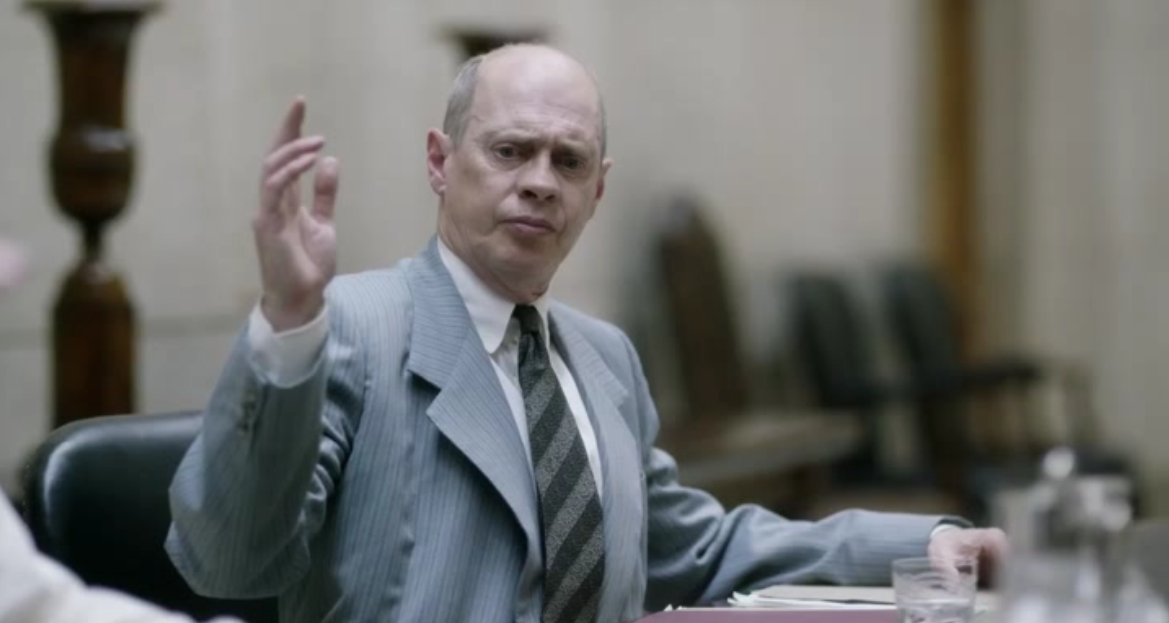
Steve Buscemi, Simon Russell Beale, Jason Isaacs and Michael Palin did not receive Oscar nominations for portraying Nikita Khrushchev, Lavrentiy Beria, Georgy Zhukov, and Vyacheslav Molotov respectively in The Death of Stalin.
The Death of Stalin is a hilarious and biting dark satire focusing on the immediate political fallout in the U.S.S.R from the titular "loss".
An essential ingredient to making this very exact tone of the satire to work is found within the cast. This includes just strong performances all around in the best ensemble from 2017, but it goes further than that in terms of the very nature of the casting and the performances. It's best to begin then with Steve Buscemi as he would unlikely be anyone's first casting choice for Nikita Khrushchev in a film about the history of the Soviet Union, or even in a prestige British representation of such a story. The Death of Stalin is neither of those things of course in its approach and Steve Buscemi's casting is a perfect representation of this approach. The idea isn't to represent a strict historical truth in the least, though there is historical truth to be found in the film, but rather it purposefully sets itself outside of this to create a unique satirized version of Russian. This makes Brooklyn born Buscemi as just a natural part of the film. He is not only a natural part though but Buscemi's style as an actor ends up being this rather natural fit to who Khrushchev will be in the film, which is as our "hero" the use of quotations very much needed there. Buscemi's unassuming performance style though is the right one for that of Khrushchev who is just as much of a political operator as his chief rival, but Buscemi's approach just makes him seem all the more approachable.

This is in stark contrast to Simon Russell Beale as Lavrentiy Beria the man in charge of NKVD who essentially were the police in the Soviet Union who performed the most dirty of the dirty work of Stalin's regime. Beria is the film's "villain" however again that is as much of in need of quotations as the use of hero for Khrushchev. Beale's performance though is this fascinating little juxtaposition as he makes Beria essentially the most honest dishonest man around. This is as Beale so embraces the very nature of the man in his portrayal as someone who genuinely thrives in the system. Beale conducts himself with this most definite ease in itself in almost every moment as the smoothest of political operators mainly because he so understands the situation he is in. When early on he casually mentions one of their colleagues will soon be gone, to be taken away by the police, Beale delivers it with such a glib attitude that establishes Beria so effectively before the plot even begins. Beale reveals this man as oh so comfortable with his existence within this system who unlike the other men does not put on any other personal delusional fronts. In that what Beale does is stand out among the pack as the man most comfortable with being a completely despicable human being. That devilish grin of his and wily eyes are of the man who has long fashioned himself within this life of backstabbing without a single hesitation in any facet of it.
The titular event, while at first Stalin just becomes incapacitated, springs all the men of the inner circle into action in order to attempt to find their own ways to take advantage or deal with the situation. Naturally enough Beria is the swiftest to take action, and Beale properly shows a man glorying in the acts as he for a very brief period is unencumbered by any authority above himself. There is such a horrible glee that Beale brings in every little bit of use of power in these scenes particular his exact joy when giving out a new list of people to be taken away or possibly killed. Beale delivers the needed incisiveness in every word as he goes about in his act of seizing power through his alternate source of power by quickly making a puppet out of Jeffrey Tambor's Georgy Malenkov who technically is next in line by virtue of procedure. Beale's great in his interactions with Tambor in these moments by speaking to every word with him either with the man as though he's offering specific and leading stage direction to a bad actor though occasionally with a more terrifying glance to suggest his capability to destroy the man if he doesn't properly stay in line. Beale brings the right type of physical presence in the role in a very unique way as in the way he holds sway by carrying himself with this calm command, and those eyes of his which almost always carry that unmistakable intensity of a true political, well really any kind of, cutthroat.
This is against Buscemi's portrayal of Khrushchev which he brings a bit of natural manic energy to as he first comes on the scene of Stalin fitting to a man just quickly trying to come up with a way to deal with the situation that will determine his fate. Buscemi's great here in figuring out this exact way Khrushchev puts forth his way of dealing with his office, which is much more as a proper politician, though that is not necessarily a good thing. Buscemi's very enjoyable in bringing out this sort of the need to act as the politician kicks in at seeing Stalin's soon to be corpse, as he so overly expresses his sorrow as a proper man of the people giving his respects to their leader. Buscemi oversells this in the right way as the man just really enforcing the act showing Khrushchev playing this as a man trying to make sure onlookers note that "Khrushchev almost wept at seeing Stalin's corpse". Buscemi though is careful to show that Khrushchev is not a true fool, but even that act is a maneuver that he quickly drops at the sight of Stalin's urine soaked pants. Buscemi properly switches gears in that moment to show Khrushchev basically switching to the political operative mode though, after fulfilling the politician's duty, as he begins to deliver his own incisive ways though in a different way than Beale which is a strangely key thing in this film.
This key element is in the difference between Buscemi's approach to Khrushchev against Beale's portrayal of Beria which is a fascinating interplay particularly in terms of audience perception of each. This is one of the, many, brilliant parts of the film as really Khrushchev isn't a good guy either, yet I found myself siding to him by how well these performances realize these two characters. Buscemi again brings the right unassuming quality, which is in part the politician act, however he goes further to show it with a bit of honesty in that he cannot embrace really evil in the same way Beria does. Beale on the other hand does show the more honest dishonest man by in no way hiding the gruesome grotesque nature of the man. Beale particularly puts so much hideous elation when finding a new rape victim, or delivering the mentions of his own ill deeds so brazenly. In a way this is more honest than Buscemi's portrayal who shows Khrushchev as someone, who to be fair isn't as evil anyways, but also manages to delude himself to a certain degree. Buscemi however makes Khrushchev more likable also though by bringing this emphasis on the idea of the man as having any reluctance in being a cutthroat. Buscemi again is careful in the way he reveals this in these moments as once again more for show in the reluctance, however it is much appreciated for decency's sake.
Of course these two it needs to be also said are hilarious here in just kind of a traditional comedic way in every single scene. This is in part due to the two's flawless delivery of the rich dialogue given to them. Beale delivering Beria's one liners though as more exact daggers into anyone who dare trespass him, Buscemi, again somehow being likable in this by bringing more of a sardonic energy in cutting down his opponents such his "two clowns, one joke between you" to deflect an insult by two of the less powerful members of the inner circle. Their performances also are hilarious in terms of their physical energy that is classically comedic. I have particular affection in Beale's work for his way of portraying Beria's mad dashes while disposing of and replacing files while Stalin lies dying on the floor. Buscemi also excels in this regard particularly in the scene of Stalin's funeral wake where Khrushchev tries to get a better spot to hear a conversation between members of the inner circle by attempting to make it look like it is part of the ceremony. The conviction that Buscemi brings in each step, and again a bit of that false properness of a politician, as this very refined act that is in fact just trying to be in a better place to eavesdrop. Beale and Buscemi make for a great pair though as the two true leaders of the two sides matching each other well as Beale the oh so assured monster, against Buscemi the proper harried underdog.

Of course in this power struggle there are many players with two of them perhaps being the most important as the wild cards in this game at a very grand scale. The first being Jason Isaacs's Georgy Zhukov the leader of the armed forces. Isaacs is essentially Peter Capaldi's Malcolm Tucker for this political satire as a man who doesn't give two "excrements" about making himself heard and heard well. Isaacs comes in fast and hard as a man almost with more medals than will fit on his uniform and Isaacs properly is as proud as that amount of medals would suggest. Although Beale and Buscemi do have their own form of command here, Isaacs delivers a different sort of a man who has fought hard and long with his particularly, and so deliciously blunt delivery of "What's a war hero got to do to get some lubrication around here" before being introduced in text by the film. Isaacs conducts himself as a man who kind of is aware of power in a more direct and obvious way as a proper soldier. Isaacs's gruff accent is perfect for the role as a man ready to growl and pounce at any point. Isaacs delivers every one of his take down with particularly pinpoint accuracy fitting to a man who doesn't mind risking death with words given his more hands on experience with death. Isaacs is a treat every single minute he is onscreen by in every moment conducting himself with such a comedic, yet real, intensity that is absolutely perfect. He's just a joy to watch while also wholly fulfilling his particular role which is as man who makes his points clearly and directly to make sure they are heard. Isaacs has so much fun here as the man who has no delusions in a different way in that he plays the game with a different sort of perspective on the whole thing, since again power is different to him. My favorite scene of his though has to be when Khrushchev goes to seek help from him to dispose Beria, to which Isaacs delivers a magnificent false concern about Khrushchev's idea before revealing this to be only a joke, and that he is more than eager to destroy Beria. It just a moment of pure comic gold sold to perfection by Isaacs's performance, which there is not a lot of here, but every second of it is something quite special.

The other wildcard is in Michael Palin's Vyacheslav Molotov. I have to say first off I couldn't be happier at Palin's return in this film after having not appeared in a mainstream live action film in almost 20 years. They couldn't have asked for a better actor though to pull off the tricky part of Vyacheslav Molotov, Stalin's most loyal man but also the one who was to be taken away in the opening of the film. Now this requires a certain balance of things in this role, that thankfully Palin is a master of. Molotov is of course partially defined by the fact that Stalin had his wife imprisoned, used by Beria as a sex slave, though Molotov remained working with Stalin. Palin, as always, brings an innate charm to the part here just in this way as an affable old statesman that from the moment you hear he's going to be taken away, it is very easy to feel sorry for him. Palin in addition though finds a real pathos as he remarks on the loss of his wife though, and convincingly finds this strange state of the man. He offers a genuine earnestness in portraying the feelings of a loving husband, but where the comedy comes in is how this fashions through the type of man that is Molotov. Molotov being absolutely loyal to Stalin to the point that when he hears he was originally going to be taken away by the police, Palin only offers the most honest, and in turn hilarious, concern as he ponders how he could've wronged Stalin. Palin is exceptional in the way he is able to make this sort of ridiculous state of the man actually believable by just how well he can be absurd yet believable at the same time. This becomes particularly important once Khrushchev and Beria try to fight for his support, where Beria brings Molotov's wife to bribe the man, while Khrushchev tries to play towards the man's strict loyalties. Palin plays again finds a certain quality of the loving husband when he sees his wife and reveals a most genuine jubilation at the initial sight of her. Palin though makes the love of the husband real, however he still reveals that what is more important to him is his loyalty to Stalin, which requires that he see his wife as a traitor. Palin again is equally funny when revealing Molotov's support for Khrushchev's power play, because he brings such a fervent devotion to the denouncement of his wife, since according him Stalin was right, which he feels Beria wrongly absolved her of. What's so fantastic here in his performance is that Palin is able to be extremely humorous yet he makes this absurd nature of the man seem logical in his own peculiar sense of being caused by his undying loyalty to Stalin.
Khrushchev's plan to destroy Beria comes from technically both of them causing a massacre after Beria's men going about killing or at least causing the deaths of many of the Russian citizens Khrushchev allowed in to attend Stalin's funeral. Khrushchev though makes the first step which again I love how Buscemi brings such a dogged determination that again somehow makes him seem the righteous one even though he is just about as guilty in causing the deaths as Beria is. This is against Beale's depiction of Beria who is effectively just so smug you can't help but hate the guy who seems so assured of his grotesque abuse of power. Beale naturally keeps this quality when he is initially taken prisoner and he believes he might be able to get his way out of this still. Beale carries himself with such a firm disregard for everyone around him, carrying such venom in every delivery of his as he denounces everyone around him while also lashing out at everyone around him. Beale still carries that personality of command as though he keeps such a viciousness in his hatred, though with enough of a creeping up undercurrent of unease, but mostly something Beale portrays as being overwhelmed by Beria trying to stand firm in his position of power. Of course his insults get him nowhere and the inner circle decide to blame him for the massacre, and quickly make a trial and convict him in no time at all. Now this final sequence I think is a testament to the genius of the film, and to the strength of the performances of all particularly Buscemi and Beale's. This is the one scene that strictly and mostly strongly moves closest to the purely dramatic. There have been talk of deaths, and even the sight of them, however with a purposeful distance within the satire. This one scene that makes it more tangible because the violence finally happens to a named character who we know, which is Beria. What's so brilliant about this is he's the worst of the worst, however with that in mind he still is a person we've gotten to know. In turn Beale is actually kind of heartbreaking as he loses all pretense and just brings such a palatable desperation as he begs for his life. In that moment the bluntly hits you with the reality by showing a more concrete loss of life, even though it is through the man most deserving of death in the whole film. The other touch that's so great though is Buscemi though who also changes as he loses that underdog status and reveals Khrushchev as much of a cutthroat as Beria in his ice cold deliver of his insults while the man is shot then burned in front of him. The execution of this is incredible as it is uncompromising as it reveals this story was always about a group of terrible people, though Beria might have flaunted his vile nature more openly all of the characters are very bad men. The entire ensemble here is magnificent though in realizing this duplicitous world so well in creating each and everyone of this vile sorts creating this tapestry of amorality, oh yes and being quite hilarious while doing so.

(For Isaacs and Palin)
(For Beale and Buscemi )