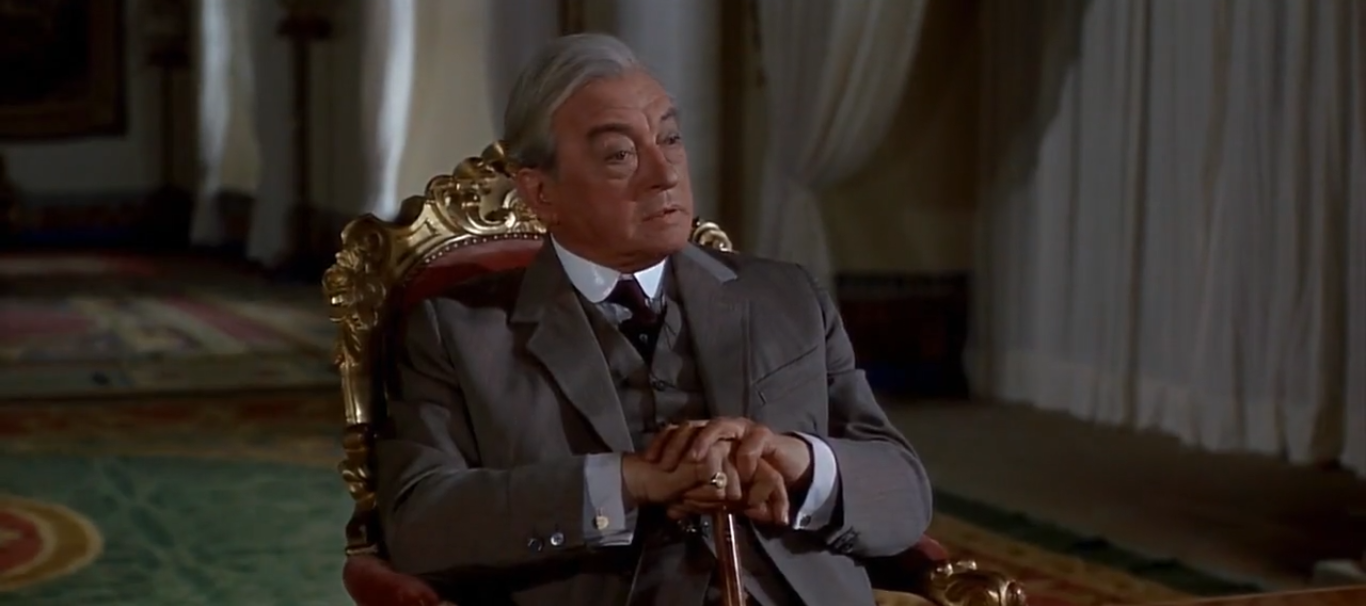
Lawrence of Arabia is often touted as one of the greatest films of all time, and deservedly so. However it's one of those films were some elements are often overlooked in its praise. Of course the masterful vision of David Lean's direction, the sheer scope, and Peter O'Toole performance as Lawrence are praised, again deservedly so. What seems more often a little overlooked is how well developed the cast of characters are along with Lawrence, it is not a one character piece. These smaller, yet not underdeveloped roles, are help realized by the film's brilliant screenplay and of course its large ensemble.
Alec Guinness did not receive an Oscar nomination for portraying Prince Faisal in Lawrence of Arabia.

Naturally David Lean's frequent collaborator is in the mix here as the Arab Prince who is most active in his rebellion against the Turkish Empire. Alec Guinness disappears into the role of Faisal, which could be surprising if this were not Alec Guinness. Guinness somehow wears the makeup particularly well, and his adjustment to his accent is especially effective in realizing Faisal's character. Guinness carries himself with the needed quiet dignity of a man who does not use many words, but only seems to make use of important words. Guinness is rather captivating in the way exudes the authority of Faisal with such an ease. He has the grace of a truly great leader. The intelligence of the man just seems a given by Guinness's performance as he very plays Faisal as a leader who is constantly listening to those around him. There's something so special about Guinness's use of his eyes here as they are piercing yet comforting at the same time realizing Faisal as both a man that does not enforce himself upon you, however you cannot ignore his presence.
This is something very interesting about the way Guinness manages to conduct himself as Faisal in that he makes him seem as though he's somewhat aloof, though paints this as merely a facade in order disarm those around him. Guinness presents Faisal as an educated man, but one who purposefully does not try to remove himself from the simple view that a foreigner may take from him. Guinness's approach here is very effective as he shows the way that Faisal does this in order for his more important remarks to be all the more incisive. Guinness utilizes the set up so well as he has this the overriding feature of Faisal yet still suggests so much more about him. There's a great scene for Guinness when the Prince is interviewed about
his campaign. Guinness is so good as he keeps Faisal the proper Prince
on the surface, however underneath it Guinness finds a striking cutting edge to the man when he states that for him mercy is only good manners. The same holds true in the scenes where he directly interacts with the British high command. There is a definite determination, a far more fervent desire, that Guinness brings within this as Faisal questions the British intentions, and later when he goes into direct negotiations with them. Speaking of the British High Command.
Jack Hawkins did not receive an Oscar nomination for portraying General Allenby in Lawrence of Arabia.

Hawkins, having already collaborated with Lean on The Bridge on the River Kwai, once again returns as a British Officer this one of a somewhat different sort. Hawkins's carries himself as one would expect from a proper British General, that being an assured yet respectful command. Now this is the sort of role that very well could have been just the standard authority figure there to occasionally move along Lawrence's story. That's never the case as Hawkins's performance brings much more nuance to the role than one might even expect. Already important whenever Allenby speaks of military matters Hawkins portrays that proper assurance and passion for his duties. Whenever a political working comes up Hawkins infuses the right sort of exasperation delivering well Allenby's frequent aside of "I'm not a politician, thank God!", though this in itself is not simplified by Hawkins as indifference. Hawkins instead presents an underlying understanding in Allenby that he definitely knows the political issues, but uses this exasperation as basically a defense to make it so he barely has to speak of it.
Hawkins is especially strong in his scenes where he converses with Lawrence directly. Hawkins does well to show the different wavelengths that Allenby is playing at. He keeps the stature of the General correctly when trying support Lawrence's ideas, or attempt to explain away that the English may intend to take Arabia for themselves. Hawkins does not leave it at that though revealing a bit of introspection in Allenby as he puts forth some casual jealousy in the man when he ponders about his own stature when compared to Lawrence's. My favorite moments of Hawkins's though is when Allenby attempts to get Lawrence back on track in terms of defeating the Turkish empire. These moments could have been easy enough to show Allenby attempting to get Lawrence to tow the line so to speak. I love that Hawkins does not play it that way as he calls upon the certain chemistry he has with O'Toole to make it more than that. Hawkins exudes an underlying respect Allenby has as his glances which suggest that Allenby sees the man he wishes he could be. When Allenby encourages Lawrence to take back the fight once again Hawkins is genuinely inspirational as he brings so much vigor in his eyes and words as he tells Lawrence to go on and fulfill his destiny.
Now a favorite scene of mine for both Hawkins and Guinness is near the end of the film where the two argue over who Lawrence belongs to, and the two are forced to decide that he is equally useless for the both of them since either side can lay claim to his actions. Both Hawkins and Guinness are rather cold in this moment by speaking as men of straight duty trying to simply get their demands across without much care for who it might effect. The two do share an equally memorable moment though just as they agree to basically forget Lawrence and get onto more business. Before that though Hawkins and Guinness each have a silent reaction that is quietly moving as Faisal and Allenby each for the moment suggest what Lawrence really does mean to them, before overcoming their emotional connection and moving on. Both Guinness and Hawkins do very commendable work here since either could have been reduced to caricatures of just an Arab Prince or a British General, and could have been just there to occasionally move the plot along. Neither actor allows this to be the case. They both are able to realize not only what are Allenby's and Faisal's motivations, but also who they are as men as well as what their relationship with Lawrence truly is.

(For Hawkins and Guinness)
Anthony Quinn did not receive an Oscar nomination for portraying Auda Ibu Tayi in Lawrence of Arabia.
Anthony Quinn plays Auda Ibu Tayi who appears as the leader of a large tribe who Lawrence convinces to join the cause, despite Tayi originally being paid to fight for the Turks. Now this is a role where you get technically what you'd expect, but that's not a problem. This is a very much in Quinn's wheelhouse as a larger than life warrior type which is fitting for a man who will ride into battle because it is "his pleasure" to do so. Quinn brings that boisterous power to his performance, that grand stature of a man who is a true leader of his people, and wholly embraces his life style of war. Quinn's performance excels in just being the spirited aggressive force he should be, as his ability and willingness to ride into war is something that it is obvious he lives for with every breath that he takes. Quinn stands as high as he can in the role as he frankly does not hold back in terms of the exuberance he brings to the part, and nor should he. It fits so well with who Auda Ibu Tayi needs to be for the film, and Quinn stands out by presenting someone in the story who fights exactly for what he says he fights for. He has no hidden motives for his war path.
Quinn is indeed very entertaining in the role as he enlivens the screen with his presence at any given moment he is in. He has some very enjoyable moments as he shows Tayi's personal beliefs that he is very passionate about. He is also effective in showing the certain callousness that comes from such a man, particularly in his brutally straight forward delivery of "It was written then" when he hears that Lawrence had to execute man he previously risked his life to save. Quinn though does well to not make Tayi too simplistic ever. He carefully throughout the film portrays Tayi's growing personal respect for Lawrence. I really like the way he does this still within in his own blunt personal style of course. There's a moment towards the end of the film between Lawrence's right hand man Sherif Ali (Omar Sharif), and Auda Ibu Tayi, where Ali actually threatens Tayi with violence. However it's actually made a rather poignant scene by both actors as they reveal a stronger concern for Lawrence than they are willing to let on. I like how Quinn keeps Tayi rather uncouth as speaks to Ali on the matter, yet he still alludes to Tayi's own honest sympathy for their ally. Quinn's work contributes well to the film offering the right larger than life figure in Tayi, while still finding some depth within him.

Anthony Quayle did not receive an Oscar nomination for portraying Colonel Brighton in Lawrence of Arabia.

Quayle's performance here is actually rather interesting one to examine since just with a cursory glance there may not seem to be much to the character, though there actually is as he has perhaps the third most dynamic character arc after Lawrence and Sherif Ali. The earliest point chronologically speaking that we meet Brighton is when Lawrence first appears to Prince Faisal's camp. Brighton in these scenes very much is the proper British officer who just wants Lawrence to keep quiet, and stick to the plans devised by the British high command. Now apparently Quayle and Lean argued over the portrayal of Brighton as a character with Quayle wishing to play him as a fool while Lean wished for him to be shown as an honorable man. The intriguing part of this is that watching the performance you can take either interpretation to what interpretation took precedence. In that it seems Quayle went about playing it that Brighton's foolishness in fact allows him to be honorable. This is shown even when he's the British officer telling Prince Faisal to do things that mainly benefit the British, but Quayle actually does play Brighton as genuinely believing this to be their best course of action.
Now Brighton's arc is not heavily focused upon but based around his view of Lawrence changing throughout the film. Obviously he begins frankly as an obstacle who wishes to keep Lawrence from making any sort of real impact. However Lawrence proves everyone wrong by taking an important city in a way that no one believed could have been done. When Brighton continues to work along with Lawrence as they proceed to attack the Turkish rail lines. Quayle keeps the skepticism with Brighton, though it is not nearly as strong as it was a before. Quayle though is in one very good scene where he questions some of the Arabs' motivation including Auda Ibu Tayi's. Again both interpretations potentially shine through though it is no less effective as Quayle reveals the intense discontent in Brighton against them. Again Quayle manages both because, he may be foolish to hold such a simple view, yet he is honorable as Quayle once again brings only a genuine passion to Brighton as man who believes one should fight for what one believes in. Now the character's transition in regards to Lawrence continues throughout the film, and Quayle gradually reflects in Brighton as a further understanding of the man. That brings it to his most pivotal moments of the film, that are at completely opposite points in the film. That being his first and last scene, his first scene taking place after Lawrence's death, but each show Brighton's final perspective on the man. The first scene Quayle is rather moving in showing Brighton fully accepting the important, and rather great man that Lawrence was at his funeral, as in the end both men fought for what they believed was right. His last scene is equally strong as Quayle presents Brighton as the one man who can appreciate what Lawrence did without exception through his depiction of Brighton's disdain as he sees that everyone else in the end was merely using him for their own ends. This somewhat brief work once again brings so much unexpected depth to the role, and in turn the film, as Quayle makes Brighton anything but a stock side character.
Arthur Kennedy did not receive an Oscar nomination for portraying Jackson Bentley in Lawrence of Arabia.

Arthur Kennedy plays an American photojournalist based upon the real Lowell Thomas who helped to make Lawrence famous. Kennedy's not an actor who has always been a favorite of mine, though I don't dislike him, but his performance style works quite well for this part. That being Kennedy's usual method of rather accentuated delivery. This feels completely fitting for the role of Bentley as he depicts Bentley very much as a man ready to make a radio broadcast with his words. Kennedy is very good in the scenes where he is in essentially interviewer mode. Kennedy feels like a true broadcaster in these scenes as he kind of has that false refinement of sorts as he speaks so directly, and specifically about topics yet one can't help but feel he's reciting from a script. Kennedy's good in the way he undercuts that when someone basically ask Bentley for a more direct, more honest answer. Such as when Faisal asks really why Bentley's interested in Lawrence after receiving some platitudes previously. Kennedy drops the act for a moment, but importantly does not show Bentley to stumble with this. He still shows him to be an intelligent man, but rather just more naturally responds as he states the exact reason for wishing to cover Lawrence.
Kennedy's good in the scenes where he interacts with Lawrence, and the rest of the party. This is largely because Kennedy embraces the idea that Bentley is able to be the most detached from the situation given that he's really there just to get a good story out of Lawrence. Kennedy reveals the right enthusiasm as he goes about taking Lawrence's picture, and getting the icon he's looking for. Kennedy again brings back the proper broadcaster routine as he interviews Lawrence, as well as Sherif Ali, and he's very effective in the way he drifts from that to a semi-sardonic observer whenever Bentley decides on a bit of an editorial. One of his best moments is in his first scene as he eulogizes Lawrence first in a proper memorial ready for a headline which Kennedy delivers with the utmost passion and respect, then a second later the truth about the man's shortcoming which Kennedy delivers with a definite sarcastic edge. I love that not even the understandably detached Bentley is not only defined by that. Kennedy has a great final scene where he must witness a changed Lawrence as he goes on a massacre of a Turkish brigade. It's a brief moment but rather affecting one as Kennedy bluntly shows that Bentley cannot be detached from what Lawrence has done. Kennedy's excellent in revealing how disturbed Bentley is by what he sees and the outrage as he still must go about his duty to glorify Lawrence. Again this is not a huge role yet Kennedy makes a definite impact with Bentley. He successfully, in just his few scenes, creates a portrait of this journalist as man ready to make stories for more mainstream public consumption yet is well aware of the reality.
Jose Ferrer did not receive an Oscar nomination for portraying the Turkish Bey in Lawrence of Arabia.

Jose Ferrer has the smallest role out of everyone listed here. He only appears in two scenes, one for only a few seconds. His second scene takes place as Lawrence is caught by a few Turkish soldiers and taken to their superior played by Ferrer. Ferrer apparently believed this to be his greatest performance, and I'm a bit inclined to agree despite its brevity. Ferrer is brilliant as he instantly set up his character in the way he simply looks up from his desk as we see a truly exhausted individual. Physically speaking of course but more so mentally. The way he walks even keeps the proper military step yet so labored it is of a man who just is barely keeping to his step. The man then proceeds to look over the potential suspects and Ferrer again is outstanding in the way he slowly reveals more of this man. At first it seems like he might be looking for someone important as he scans the man. As we see a little longer though Ferrer's expression becomes somewhat more peculiar as he decides on Lawrence to be the man who is kept. At first it seems that Lawrence may be found out, which would mean his death, as the Bey notes his eye color. Ferrer though notes this not as though Bey is making a great discovering as an officer in the Turkish army, but rather has found something he finds rather appealing. When the Bey ponders on the fact that he's the only one who notices interesting faces where he is particularly stationed, Ferrer alludes to a consternation. This consternation is not made by Ferrer as that of a man frustrated by the lack intelligent discussion, but rather that of sexual frustration. Ferrer is terrific as he subtly reveals a bit of ache in the Bey as he examines Lawrence, and that ache he's ready to satisfy as he states to his men to "beat him" with a understated glee. After Lawrence is released he's never quite the same man. We know he was beaten but largely due to Ferrer's work we can assume it did not stop there. Ferrer's performance is outstanding as he effortlessly realizes the subtext of the scene. Ferrer like the rest of the cast, though with even less time, makes Bey more than simply a Turkish officer who detains Lawrence, far far more.
Claude Rains did not receive an Oscar nomination for portraying Mr. Dryden in Lawrence of Arabia.
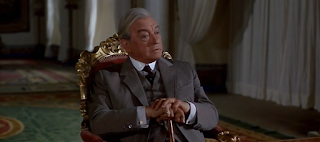
Now as for Claude Rains we have one of the greatest actors of all time in one of his final roles. A quick side note I must admit there is something enjoyable to see as he and the man he shares the record for most supporting actor nominations without a win with, Arthur Kennedy, share a direct interaction with one another. Anyway Rains's performance is sort of a hidden treasure in the film. Say on a initial viewing you pay no mind to Dryden, you're missing something rather special hidden right in front of you. Rains plays Dryden the head of the Arab bureau basically the man who deals with the political matters connected with the Arab campaign. Dryden is in a more than a handful of scenes, and though he does not have an excessive amount of lines he has some pivotal ones. The thing is that the lines themselves, though well written, could often be meaningless if it weren't for Rains's delivery of them. Rains conducts himself so well here as he has Mr. Dryden be someone who takes his time in his movement, yet there is never a question that he's a man who knows exactly where he should be. The level of assurance that Rains conveys with such ease makes the strong willed characters seem meek in way, even though Rains keeps Mr. Dryden so carefully unassuming in his personal style.
Rains is terribly clever here as he makes a man so terribly clever in such a tricky way. When he sends Lawrence on his original mission it seems simple enough, yet the potential involved from the mission seems in Rains's expression the whole time. Rains makes Dryden actually the most powerful man in the film, even though he never states his power in least. In fact he acts as though he's just a modest official who has no great ambitions. There's one magnificent scene where he, Brighton, and Allenby discuss the ability to give the Arabs artillery. It is Dryden who makes decision, even though he specifically states it's Allenby's decision, yet the way Rains conveys the message within a question seems so incisive, more than if even directly told Allenby what to do. There's another great moment when Allenby inquires to Dryden if Britain has any plans for Arabia. Dryden states only that "it's a difficult question" but Rains is so perfect in making it a casual deflection yet in his expression there is no question on the matter in Dryden's mind. Rains is amazing in the way he makes it that Dryden really is always in charge even though he never in fact gives away his position. Rains could not be smoother in how eloquent he is in the depiction of a truly seasoned political operator. Rains is even fantastic when he's not do anything. Even in scenes where he is silent every glance is worth something due to Rains. He suggests Dryden analyzing and dissecting everything he sees. It is fascinating to just watch Rains in any given scene as there's not a wasted second in the entirety of his performance. One favorite moment of mine is when Dryden notices cuts have reopened on Lawrence's back, and Dryden for brief instance tries to inform Lawrence of this. Rains's reaction is so good, even humorous in a way, as he shows as Dryden quickly evaluates the situation and decides it's best not get involved with this issue. Another magnificent moment for Rains is at the end of the film is when he finally responds to Allenby claiming not to be a politician. Rains is hilarious, but also oh so shrewd as Dryden subtly scoffs at hearing the rather false claim once again. I love everything about this performance as Rains adds so much to film with a part that with the wrong actor have easily almost just been part of the background. It's such an astute piece of work by Rains as he does so much with so little.