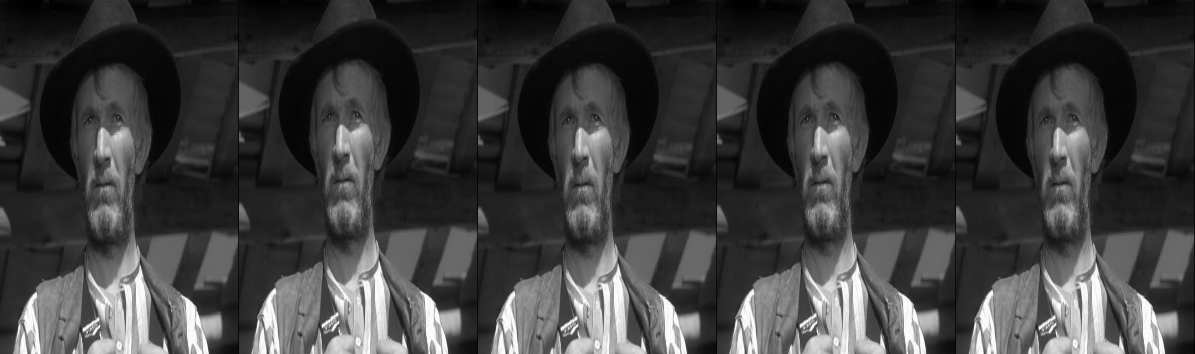
5. George Sanders in Journey to Italy - Sanders gives a somewhat interesting alternate take on his usual persona, though the film's limitations limit his work as well.
Best Scene: Breaking it off.
4. Fredric March in Executive Suite - March gives a terrific performance that refuses to ever make his character a straw man as he gives credence to his character and his views in every one of his scenes.
Best Scene: His philosophy.
3. Anthony Quinn in La Strada - Quinn, despite being dubbed, makes quite the impact in his depiction of a real man of the earth in his blunt physical performance though with the nuance of a man rather than just a symbol.
Best Scene: The Beach
2. Jean Gabin in Touchez Pas Au Grisbi - Gabin sets the standard for the old badass back for one more job trope, by delivering a compelling, charming and always confident performance.
Best Scene: The Exchange
1. Alec Guinness in The Detective - Guinness gives a brilliant portrayal of Father Brown managing to cohere both the detective and the priest in a single incredibly entertaining performance.
Best Scene: Final meeting with Flambeau.
Updated Lead Overall
Update Supporting Overall
Next Year: 1992 Lead
Showing posts with label Fredric March. Show all posts
Tuesday, 1 August 2017
Monday, 24 July 2017
Alternate Best Supporting Actor 1954: Fredric March in Executive Suite
Fredric March did not receive an Oscar nomination, despite being nominated for a BAFTA, for portraying Loren Phineas Shaw in Executive Suite.
Executive Suite is a rather effective drama about the power struggle that ensues in a successful company after their president dies without leaving an obvious successor.
Executive Suite follows the several vice presidents of the company dealing with the calamity. The two strongest figures shown in the film are William Holden's McDonald "Don" Wallin against March's Shaw. Now March's performance is essential to the film in more ways than you may initially expect. Now on one hand this is simply an engaging performance, as March tends to be when he dials it back a bit playing to his strengths as a performer. That is what March does here as he carries his very distinct and assured presence to the role of Shaw. March brings that confidence to the role to create Shaw as a powerful figure in the company. March is innately compelling here as he offers such an efficiency in his performance, so rarely wasting time on the wrong emotions which is quite fitting to his character. This is part of March's performance which is always very much on point and straight forward in a remarkable way. In that there is nothing dull in this as March in particular makes the technical dialogue involving the company not only effortless in his delivery yet always comprehensible. When in the early scenes of the film Shaw figures out what happens and takes immediate action, March brings an incisiveness not only in words but also through his very assured physical body language as he carefully breaks down the reasoning behind his actions.
Now this is where March's performance though goes beyond in terms of how it amplifies the film. There are elements to the film that could have made it potentially into a more hamfisted morality play particularly in the role of Shaw. March's work is what avoids this problem. It would easy to imagine Shaw being made into an overt villain, but March wisely avoids this and in turn avoids simplifying the drama. March importantly always plays the role as a man who believes he is doing the right thing throughout the film. Again in that early scene where he establishes basically his authority, where technically Shaw is just assuring that the company will not collapse, March presents a confidant man yet not an egotistical one as he could have been here. There is a sense of righteousness but not a sanctimonious self-righteousness. March brings what is a genuine passion within his words that reflect the will of a man who is looking beyond himself even as he does take steps to try to secure his position as president. When he's making his moves within the story Shaw moves with precision but again March plays these scenes by emphasizing how Shaw working towards his goal. When he negotiates even with the less savory men of the company, March delivers his lines in a direct fashion again reinforcing that this is not a game to Shaw, but something he feels must be done.
The plot comes to a head with the final voting to determine who will be the next president and what their exact vision for the company is. Shaw offers his vision which is essentially to keep things as they are but in doing so ensuring the greatest dividends to their stockholders. In this explanation March gives it all the sincerity and certainty of a seasoned and intelligent businessman. There is no purposeful stubbornness in March's approach but a very direct earnestness behind the explanation. Now this is a low key earnestness to be sure, but March uses that so well to give his view that paints Shaw as a reasonable man who wants what he believes to be best for the company. Even as the first vote does not exactly go his way March is very good in revealing a bit more emotion in Shaw. March even in this stays true to his approach and plays this emotion most strongly as a quiet frustration that they are making things more difficult for the company. I particularly like his scene with Louis Calhern's more amoral board member, where March just presents such a genuine disbelief that the fool would sabotage his own desires by voting against him. March portrays no real anger, but rather reinforces the nature of Shaw by only being confused by the man's actions. When Holden's Don presents his view with a stirring speech, March earns the acceptance in Shaw due to his reactions not being of a man being defeated but rather taking in the idea and seeing that they could work towards the success of the company. March's performance here keeps the film from becoming too black and white by providing a real opposition to what becomes the final message. He never allows Shaw to be a straw man by not only delivering his view as a reasonable alternative but also creating three dimensional character who is merely doing what he believes is the right.
Executive Suite is a rather effective drama about the power struggle that ensues in a successful company after their president dies without leaving an obvious successor.
Executive Suite follows the several vice presidents of the company dealing with the calamity. The two strongest figures shown in the film are William Holden's McDonald "Don" Wallin against March's Shaw. Now March's performance is essential to the film in more ways than you may initially expect. Now on one hand this is simply an engaging performance, as March tends to be when he dials it back a bit playing to his strengths as a performer. That is what March does here as he carries his very distinct and assured presence to the role of Shaw. March brings that confidence to the role to create Shaw as a powerful figure in the company. March is innately compelling here as he offers such an efficiency in his performance, so rarely wasting time on the wrong emotions which is quite fitting to his character. This is part of March's performance which is always very much on point and straight forward in a remarkable way. In that there is nothing dull in this as March in particular makes the technical dialogue involving the company not only effortless in his delivery yet always comprehensible. When in the early scenes of the film Shaw figures out what happens and takes immediate action, March brings an incisiveness not only in words but also through his very assured physical body language as he carefully breaks down the reasoning behind his actions.
Now this is where March's performance though goes beyond in terms of how it amplifies the film. There are elements to the film that could have made it potentially into a more hamfisted morality play particularly in the role of Shaw. March's work is what avoids this problem. It would easy to imagine Shaw being made into an overt villain, but March wisely avoids this and in turn avoids simplifying the drama. March importantly always plays the role as a man who believes he is doing the right thing throughout the film. Again in that early scene where he establishes basically his authority, where technically Shaw is just assuring that the company will not collapse, March presents a confidant man yet not an egotistical one as he could have been here. There is a sense of righteousness but not a sanctimonious self-righteousness. March brings what is a genuine passion within his words that reflect the will of a man who is looking beyond himself even as he does take steps to try to secure his position as president. When he's making his moves within the story Shaw moves with precision but again March plays these scenes by emphasizing how Shaw working towards his goal. When he negotiates even with the less savory men of the company, March delivers his lines in a direct fashion again reinforcing that this is not a game to Shaw, but something he feels must be done.
The plot comes to a head with the final voting to determine who will be the next president and what their exact vision for the company is. Shaw offers his vision which is essentially to keep things as they are but in doing so ensuring the greatest dividends to their stockholders. In this explanation March gives it all the sincerity and certainty of a seasoned and intelligent businessman. There is no purposeful stubbornness in March's approach but a very direct earnestness behind the explanation. Now this is a low key earnestness to be sure, but March uses that so well to give his view that paints Shaw as a reasonable man who wants what he believes to be best for the company. Even as the first vote does not exactly go his way March is very good in revealing a bit more emotion in Shaw. March even in this stays true to his approach and plays this emotion most strongly as a quiet frustration that they are making things more difficult for the company. I particularly like his scene with Louis Calhern's more amoral board member, where March just presents such a genuine disbelief that the fool would sabotage his own desires by voting against him. March portrays no real anger, but rather reinforces the nature of Shaw by only being confused by the man's actions. When Holden's Don presents his view with a stirring speech, March earns the acceptance in Shaw due to his reactions not being of a man being defeated but rather taking in the idea and seeing that they could work towards the success of the company. March's performance here keeps the film from becoming too black and white by providing a real opposition to what becomes the final message. He never allows Shaw to be a straw man by not only delivering his view as a reasonable alternative but also creating three dimensional character who is merely doing what he believes is the right.
Monday, 17 July 2017
Alternate Best Actor 1954
And the Nominees Were Not:
Anthony Quinn in La Strada
Fredric March in Executive Suite
Jean Gabin in Touchez Pas Au Grisbi
George Sanders in Journey to Italy
Alec Guinness in The Detective
Anthony Quinn in La Strada
Fredric March in Executive Suite
Jean Gabin in Touchez Pas Au Grisbi
George Sanders in Journey to Italy
Alec Guinness in The Detective
Thursday, 12 December 2013
Alternate Best Supporting Actor 1964: Results
5. Frank Overton in Fail-Safe- Overton gives a moving performance as a General who must deal with a Nuclear crises as well as a hostile room of men.
Best Scene: General Bogan speaks with his Russian counterpart.
4. Nigel Green in Zulu- Green gives a strong performance as a career soldier who has the utmost conviction in his code.
Best Scene: Sergeant Bourne calls out the roster.
3. Fredric March in Seven Days in May- March gives possibly the best performance of his career in his assured and remarkable depiction of the President of the United States who must prevent a coup.
Best Scene: President Lyman confronts General Scott.
2. George C. Scott in Dr. Strangelove- Scott's performance is pure comedic gold as an off the wall General who he appropriately plays in an off the wall fashion. Scott's whole performance is one great risk that completely pays off.
Best Scene: Turgidson gives his own thoughts on what they should do.
1. Sterling Hayden in Dr. Strangelove - Sterling Hayden gives a hilarious performance where he does not exactly play it straight nor does he play it funny, but whatever he does do it's perfect. My win is Hayden as I enjoyed his performance the most on this watch although if I watched it again I might switch over to Scott.
Best Scene: Ripper asks Mandrake about being tortured.
Overall Rank:
Best Scene: General Bogan speaks with his Russian counterpart.
4. Nigel Green in Zulu- Green gives a strong performance as a career soldier who has the utmost conviction in his code.
Best Scene: Sergeant Bourne calls out the roster.
3. Fredric March in Seven Days in May- March gives possibly the best performance of his career in his assured and remarkable depiction of the President of the United States who must prevent a coup.
Best Scene: President Lyman confronts General Scott.
2. George C. Scott in Dr. Strangelove- Scott's performance is pure comedic gold as an off the wall General who he appropriately plays in an off the wall fashion. Scott's whole performance is one great risk that completely pays off.
Best Scene: Turgidson gives his own thoughts on what they should do.
1. Sterling Hayden in Dr. Strangelove - Sterling Hayden gives a hilarious performance where he does not exactly play it straight nor does he play it funny, but whatever he does do it's perfect. My win is Hayden as I enjoyed his performance the most on this watch although if I watched it again I might switch over to Scott.
Best Scene: Ripper asks Mandrake about being tortured.
Overall Rank:
- Sterling Hayden in Dr. Strangelove
- George C. Scott in Dr. Strangelove
- Fredric March in Seven Days in May
- Christopher Plummer in The Fall of the Roman Empire
- David Tomlinson in Mary Poppins
- Alan Bates in The Caretaker
- Shailen Mukherjee in Charulata
- Nigel Green in Zulu
- Frank Overton in Fail-Safe
- Keenan Wynn in Dr. Strangelove
- Karl Malden in Dead Ringer
- Gian Maria Volonté in A Fistful of Dollars
- Jack Hawkins in Zulu
- Burt Lancaster in Seven Days in May
- Dan O'Herlihy in Fail-Safe
- Patrick Magee in Zulu
- Wilfrid Brambell in A Hard Day's Night
- John Gielgud in Becket
- Stanley Holloway in My Fair Lady
- Slim Pickens in Dr. Strangelove
- James Booth in Zulu
- Walter Matthau in Fail-Safe
- Lee Tracy in The Best Man
- Edmond O'Brien in Seven Days in May
- Peter Finch in The Girl with Green Eyes
- Umberto Spadaro in Seduced and Abandoned
- James Mason in The Fall of the Roman Empire
- Kei Satō in Onibaba
- James Stewart in Cheyenne Autumn
- John Mills in The Chalk Garden
- Tatsuya Nakadai in Kwaidan
- Anthony Franciosa in Rio Conchos
- Gert Fröbe in Goldfinger
- Robert Morley in Topkapi
- Robert Earl Jones in One Potato, Two Potato
- Larry Hagman in Fail-Safe
- Peter Bull in Dr. Strangelove
- Martin Balsam in Seven Days in May
- Trevor Howard in Father Goose
- Paul Scofield in The Train
- Aldo Puglisi in Seduced and Abandoned
- Ed Wynn in Mary Poppins
- Leo McKern in King & Country
- Gert van den Bergh in Zulu
- Dick Van Dyke in What a Way to Go
- James Coburn in The Americanization of Emily
- Alec Guinness in The Fall of the Roman Empire
- Lando Buzzanca in Seduced and Abandoned
- Percy Herbert in Guns at Batasi
- Cecil Kellaway in Hush... Hush, Sweet Charlotte
- Herbert Lom in A Shot in the Dark
- John Junkin in A Hard Day's Night
- José Calvo in A Fistful of Dollars
- Jack Hawkins in Guns at Batasi
- Errol John in Guns at Batasi
- John Houseman in Seven Days in May
- Melvyn Douglas in The Americanization of Emily
- Arthur O'Connell in 7 Faces of Dr. Lao
- Robert Mitchum in What a Way to Go
- Yaphet Kotto Nothing But a Man
- John Leyton in Guns at Batasi
- Norman Rossington in A Hard Day's Night
- Victor Buono in Hush... Hush, Sweet Charlotte
- Ivor Emmanuel in Zulu
- Rentarō Mikuni in Kwaidan
- Gene Kelly in What a Way to Go
- Stanley Green in Nothing but a Man
- Donald Wolfit in Becket
- Andrew Duggan in Seven Days in May
- Akim Tamiroff in Topkapi
- Glynn Edwards in Zulu
- Dean Martin in What a Way to Go
- Peter Lawford in Dead Ringer
- Desmond Llewelyn in Goldfinger
- Patrick Magee in Seance on a Wet Afternoon
- Yuri Tolubeyev in Hamlet
- Dom Deluise in Fail-Safe
- Takashi Shimura in Kwaidan
- James Mason in The Pumpkin Eater
- Felix Aylmer in The Chalk Garden
- Eli Wallach in Kisses for My President
- James Earl Jones in Dr. Strangelove
- Mikhail Nazvanov in Hamlet
- Joseph Cotten in Hush... Hush, Sweet Charlotte
- Edmond O'Brien in Rio Conchos
- George Sanders in A Shot in the Dark
- George Macready in Dead Ringers
- Sotiris Moustakas in Zorba the Greek
- Kevin McCarthy in The Best Man
- David Kernan in Zulu
- Richard Attenborough in The Third Secret
- Katsuo Nakamura in Kwaidan
- James Ward in The Night of the Iguana
- Jack Weston in The Incredible Mr. Limpet
- Shelley Berman in The Best Man
- Bernard Lee in Goldfinger
- Martin Gabel in Marnie
- David Weston in Becket
- Bruce Dern in Hush... Hush, Sweet Charlotte
- Richard Mulligan in One Potato, Two Potato
- Mark Eden in Seance on a Wet Afternoon
- Jean Servais in That Man From Rio
- Bruce Dern in Marnie
- Arthur Kennedy in Cheyenne Autumn
- Giacomo Rossi-Stuart in The Last Man on Earth
- John Henry Falk in The Best Man
- Harold Sakata in Goldfinger
- Stuart Whitman in Rio Conchos
- Wilfrid Hyde-White in My Fair Lady
- Paul Newman in What a Way to Go
- Leon Ames in The Misadventures of Merlin Jones
- Joseph Egger in A Fistful of Dollars
- Hugh Marlowe in Seven Days in May
- Anthony Eisley in The Naked Kiss
- Norm Grabowski in The Misadventure of Merlin Jones
- Matthew Garber in Mary Poppins
- Fritz Weaver in Fail-Safe
- Paolo Stoppa in Becket
- Jeremy Brett in My Fair Lady
- Vincent Beck in Santa Clause Conquers the Martians
- Bill McCutcheon in Santa Clause Conquers the Martians
- Carl Don in Santa Clause Conquers the Martians
Tuesday, 10 December 2013
Alternate Best Supporting Actor 1964: Fredric March in Seven Days in May
Fredric March did not receive an Oscar nomination, despite being nominated for a Golden Globe, for portraying President Jordan Lyman in Seven Days in May.
1964 in film could be described as the year of the London set musical, or maybe the year where Bruce Dern is brutally murdered, but I would call it the year of the President of the United States. There was Fred MacMurray being the husband of the first Female President, there was presidential hopefuls vying for favor of a former president, there was two presidents negotiating with the enemy to avoid mutual destruction, and there is the president of this film who must avoid being overthrown by a coup d'état lead by a General Scott (Burt Lancaster). Fredric March had some trouble adapting after his earlier days during the Golden Age of Hollywood. In films like Inherit the Wind and Death of a Salesman March seemed out of his element giving performances where he overacted wildly, that is not the case here which was one of his final performances.
Fredric March plays the President Jordan Lyman who is not a very popular guy as no one seems to like him, but he is a man who stands by his convictions doing what he thinks is right even if many people think otherwise. March has the most difficult role actually because he has to make the President compelling even though Lyman stands by what he believes through the film. Kirk Douglas gets to show the conflict of loyalties, Lancaster is straight forward but gets to be a vicious villain, Edmond O'Brien stays on the same side but hey he gets to be a sweaty drunkard, this leave March to be man standing his ground firmly and it is amazing because March actually steals the film. March wipes the slate clean of some his other late period performance with his very assured performance here.
March is excellent because he basically goes about showing all the complexities there are within a man who is so convicted in terms of his personal beliefs. March brings the right type of dignity to his role, a natural dignity. He never glorifies the President as a Saint like man, but shows him to be simply an honest statesman. March makes it believable that he would be such a good man, but as well would be a man that so many other people could hate. March is great in his early scenes as he explains his reasons for standing by his position no matter what. There is not a hint of sanctimony in anything that March says and he brings a naturalism to all of the Lyman's points. March never gives speeches to anyone, other than his actual speech at the end, he just makes Lyman a real man just trying to do what he thinks is best.
March really makes himself stand out though because he always brings more than just conviction to the part of President Lyman. March actually nicely brings some doubt in Lyman. This is never something that overwhelms the portrayal but March brings it in nicely though to flesh out Lyman. By bringing these slight hesitations in his performance March humanizes Lyman very effectively as he shows the mind of an actual president who has to think about too many things at too many times. Importantly March never makes as if Lyman is really doubts about what he believes, but rather doubts in regards due to the way so many around him are look at his desires for peace. There is an underlying fear March suggests, not fear of war, but a fear in Lyman over an apparent hysteria gripping the people.
President Lyman, despite his unpopularity, is no fool and takes it very seriously when he hears about the possible coup which brings out the strategist in the man. March is terrific in his scenes of showing how Lyman plays the game against General Scott and how he mediates his own room of allies. March stays unassuming to a certain point but always suggests a intelligence in the man. March is very good because as the other men say their peace he always has Lyman reasoning and deciphering what they are saying in an attempt to get to the bottom of it and make his next move. March never makes Lyman a machine though and one of his best moments is when one of his close aids have died. March is very moving as he shows that it really does hit him hard, but he can't do anything other than continue working to stop the coup.
The real test of March comes down to his confrontation scene with Lancaster. March has to go toe to toe with Lancaster and make it so we the audience believe that Lyman wins against the argument, and Lancaster is not pitching softballs. March not only stands his ground in the scene he actually overtakes Lancaster with the tremendous drive he brings with his performance. Every single line March delivers like a bullet at Lancaster. Every word he has March finds the passion behind it, and leaves no one to question who wins the day when the General leaves the room. I just love seeing March really give it his all with his performance and never once indulging in overacting as he very easily could have. Fredric March gives a great performance, giving the greatest presidential performance of 1964, and I would argue his personal best as an actor.
1964 in film could be described as the year of the London set musical, or maybe the year where Bruce Dern is brutally murdered, but I would call it the year of the President of the United States. There was Fred MacMurray being the husband of the first Female President, there was presidential hopefuls vying for favor of a former president, there was two presidents negotiating with the enemy to avoid mutual destruction, and there is the president of this film who must avoid being overthrown by a coup d'état lead by a General Scott (Burt Lancaster). Fredric March had some trouble adapting after his earlier days during the Golden Age of Hollywood. In films like Inherit the Wind and Death of a Salesman March seemed out of his element giving performances where he overacted wildly, that is not the case here which was one of his final performances.
Fredric March plays the President Jordan Lyman who is not a very popular guy as no one seems to like him, but he is a man who stands by his convictions doing what he thinks is right even if many people think otherwise. March has the most difficult role actually because he has to make the President compelling even though Lyman stands by what he believes through the film. Kirk Douglas gets to show the conflict of loyalties, Lancaster is straight forward but gets to be a vicious villain, Edmond O'Brien stays on the same side but hey he gets to be a sweaty drunkard, this leave March to be man standing his ground firmly and it is amazing because March actually steals the film. March wipes the slate clean of some his other late period performance with his very assured performance here.
March is excellent because he basically goes about showing all the complexities there are within a man who is so convicted in terms of his personal beliefs. March brings the right type of dignity to his role, a natural dignity. He never glorifies the President as a Saint like man, but shows him to be simply an honest statesman. March makes it believable that he would be such a good man, but as well would be a man that so many other people could hate. March is great in his early scenes as he explains his reasons for standing by his position no matter what. There is not a hint of sanctimony in anything that March says and he brings a naturalism to all of the Lyman's points. March never gives speeches to anyone, other than his actual speech at the end, he just makes Lyman a real man just trying to do what he thinks is best.
March really makes himself stand out though because he always brings more than just conviction to the part of President Lyman. March actually nicely brings some doubt in Lyman. This is never something that overwhelms the portrayal but March brings it in nicely though to flesh out Lyman. By bringing these slight hesitations in his performance March humanizes Lyman very effectively as he shows the mind of an actual president who has to think about too many things at too many times. Importantly March never makes as if Lyman is really doubts about what he believes, but rather doubts in regards due to the way so many around him are look at his desires for peace. There is an underlying fear March suggests, not fear of war, but a fear in Lyman over an apparent hysteria gripping the people.
President Lyman, despite his unpopularity, is no fool and takes it very seriously when he hears about the possible coup which brings out the strategist in the man. March is terrific in his scenes of showing how Lyman plays the game against General Scott and how he mediates his own room of allies. March stays unassuming to a certain point but always suggests a intelligence in the man. March is very good because as the other men say their peace he always has Lyman reasoning and deciphering what they are saying in an attempt to get to the bottom of it and make his next move. March never makes Lyman a machine though and one of his best moments is when one of his close aids have died. March is very moving as he shows that it really does hit him hard, but he can't do anything other than continue working to stop the coup.
The real test of March comes down to his confrontation scene with Lancaster. March has to go toe to toe with Lancaster and make it so we the audience believe that Lyman wins against the argument, and Lancaster is not pitching softballs. March not only stands his ground in the scene he actually overtakes Lancaster with the tremendous drive he brings with his performance. Every single line March delivers like a bullet at Lancaster. Every word he has March finds the passion behind it, and leaves no one to question who wins the day when the General leaves the room. I just love seeing March really give it his all with his performance and never once indulging in overacting as he very easily could have. Fredric March gives a great performance, giving the greatest presidential performance of 1964, and I would argue his personal best as an actor.
Sunday, 8 December 2013
Alternate Best Supporting Actor 1964
And the Nominees Were Not:
Nigel Green in Zulu
Fredric March in Seven Days in May
Frank Overton in Fail-Safe
George C. Scott in Dr. Strangelove
Sterling Hayden in Dr. Strangelove
Nigel Green in Zulu
Fredric March in Seven Days in May
Frank Overton in Fail-Safe
George C. Scott in Dr. Strangelove
Sterling Hayden in Dr. Strangelove
Saturday, 11 June 2011
Best Actor 1932: Results
3. Alfred Lunt in The Guardsman- Lunt plays a hammy actor in a hammy way, which would be fine if he was funny, or had some great chemistry with his co-star. Unfortunately Lunt never becomes more than slightly enjoyable on occasion, and there is absolutely no chemistry between he and his real life wife.
2. Wallace Beery in The Champ- There is never anything special about Berry portrayal as the Champ. He fails to add depth to his character when there is easily could have been, and fails to create a strong relationship with his co-star Cooper.
1. Fredric March in Dr. Jekyll and Mr. Hyde- Good prediction Dinasztie since you correctly predicted I would completely agree with the ranking the academy supposedly gave them in terms of votes. March is a very easy winner for me. His is not a perfect performance, and certianly is from its time, but where it succeeds it really succeeds. I think a lot of actors would play each side of man on a one note, but Fredric March plays them both in a far more complex fashion
2. Wallace Beery in The Champ- There is never anything special about Berry portrayal as the Champ. He fails to add depth to his character when there is easily could have been, and fails to create a strong relationship with his co-star Cooper.
1. Fredric March in Dr. Jekyll and Mr. Hyde- Good prediction Dinasztie since you correctly predicted I would completely agree with the ranking the academy supposedly gave them in terms of votes. March is a very easy winner for me. His is not a perfect performance, and certianly is from its time, but where it succeeds it really succeeds. I think a lot of actors would play each side of man on a one note, but Fredric March plays them both in a far more complex fashion
Friday, 10 June 2011
Best Actor 1932: Fredric March in Dr. Jekyll and Mr. Hyde
Fredric March won his first Oscar from his second nomination for portraying the two sides of man in Dr. Jekyll and Mr. Hyde.
This version of Dr. Jekyll and Mr. Hyde is fairly well made, and interesting, with some unique techniques used in the film which work quite well.
Fredric March portrays both roles of course, one of the civilized doctor, and the other of the evil animalistic Hyde. March first portrays the doctor, in what is mostly a normal sort of leading man role. He shows that Jekyll is most upstanding fellow, as well as intelligent and very proper.
The doctor is perhaps even a little on the dull side, March is not at all dull in terms of his portrayal, but March just shows as part of his performance that the doctor is a little simple in his simple desires and wants in life. After he basically wants to marry the woman of his dreams Muriel and have his scientific ideas about the two natures of man be recognized. In that was March is properly simple in being just a honest man.
Due to the fact that his ideas are questioned, his relationship with Muriel is troubled by her reluctant father, and Jekyll is tempted by a lower class woman Ivy he encounters. Dr. Jekyll refuses to jump at such temptations himself, but instead decides to use his formula to bring out his primitive side. He does this to both prove his point, but also to allow him to pursue Ivy. It is interesting because here March shows that when everything is no longer perfect for Jekyll, he himself stops being perfect, slowly bringing out more complexity to his the character of Jekyll.
March then becomes Hyde in quite an impressive transformation scene by both the special effects, and March sells it as well even if overall he is not required to do that much. He then becomes Hyde who resembles as Neanderthal. His make up is possibly a bit much, particularly his teeth that are large, and March clearly has to speak over them in his performance. The make up though certianly works, as does the way March begins to move more like an animal, and changes his voice to show a complete transformation.
March is good as Hyde, particularly at first where he is constantly moving his arms all around, like Hyde was always there but has finally broken out. March though perhaps over does it just a little in his I am evil ha ha ha ha ha, sort of way he starts out as Hyde, but I still enjoyed what he did, becuase March infuses a lot of energy and terrible joy into Hyde, showing that Hyde loves to be Hyde.
March is best as Hyde though in his scenes with Miriam Hopkins as Ivy, because he shows the true primitive nature of Hyde. March is rather chilling in how he mixes Hyde's constant lusting after Ivy, along with his constant jealousy and cruelty toward her. It really is notable because March portrays the brutality of Hyde as non stop, as it is completely his nature to be that way. March also is quite good in his physical presentation of Hyde, as a true primitive, but also how Hyde has even more ability in his ape like abilities.
The best moments of March's performance though I think when Jekyll has realized what he has done as Hyde. March's is terrific in showing the guilt that he feels so strongly from what he has, a guilt that truly effects him deeply making Jekyll lose his uprightness at the beginning of the film. It is quite disheartening to see this other transformation of Jekyll where he loses everything he had, and breaks down as a man because of his mistake in ever wishing to become Hyde.
This is not a perfect performance, and certianly is from its time, but where it succeeds it really succeeds. I think a lot of actors would play each side of man on a one note, but Fredric March plays them both in a far more complex fashion particularly Doctor Jekyll who he develops through the film marvelously from a simple man who seems to find the complexities within himself, and as well as Hyde who he really conveys a wide range of primitive feelings coming from that character as well. This a performance that does not take the safe route with either character, and succeeds with both very well.
This version of Dr. Jekyll and Mr. Hyde is fairly well made, and interesting, with some unique techniques used in the film which work quite well.
Fredric March portrays both roles of course, one of the civilized doctor, and the other of the evil animalistic Hyde. March first portrays the doctor, in what is mostly a normal sort of leading man role. He shows that Jekyll is most upstanding fellow, as well as intelligent and very proper.
The doctor is perhaps even a little on the dull side, March is not at all dull in terms of his portrayal, but March just shows as part of his performance that the doctor is a little simple in his simple desires and wants in life. After he basically wants to marry the woman of his dreams Muriel and have his scientific ideas about the two natures of man be recognized. In that was March is properly simple in being just a honest man.
Due to the fact that his ideas are questioned, his relationship with Muriel is troubled by her reluctant father, and Jekyll is tempted by a lower class woman Ivy he encounters. Dr. Jekyll refuses to jump at such temptations himself, but instead decides to use his formula to bring out his primitive side. He does this to both prove his point, but also to allow him to pursue Ivy. It is interesting because here March shows that when everything is no longer perfect for Jekyll, he himself stops being perfect, slowly bringing out more complexity to his the character of Jekyll.
March then becomes Hyde in quite an impressive transformation scene by both the special effects, and March sells it as well even if overall he is not required to do that much. He then becomes Hyde who resembles as Neanderthal. His make up is possibly a bit much, particularly his teeth that are large, and March clearly has to speak over them in his performance. The make up though certianly works, as does the way March begins to move more like an animal, and changes his voice to show a complete transformation.
March is good as Hyde, particularly at first where he is constantly moving his arms all around, like Hyde was always there but has finally broken out. March though perhaps over does it just a little in his I am evil ha ha ha ha ha, sort of way he starts out as Hyde, but I still enjoyed what he did, becuase March infuses a lot of energy and terrible joy into Hyde, showing that Hyde loves to be Hyde.
March is best as Hyde though in his scenes with Miriam Hopkins as Ivy, because he shows the true primitive nature of Hyde. March is rather chilling in how he mixes Hyde's constant lusting after Ivy, along with his constant jealousy and cruelty toward her. It really is notable because March portrays the brutality of Hyde as non stop, as it is completely his nature to be that way. March also is quite good in his physical presentation of Hyde, as a true primitive, but also how Hyde has even more ability in his ape like abilities.
The best moments of March's performance though I think when Jekyll has realized what he has done as Hyde. March's is terrific in showing the guilt that he feels so strongly from what he has, a guilt that truly effects him deeply making Jekyll lose his uprightness at the beginning of the film. It is quite disheartening to see this other transformation of Jekyll where he loses everything he had, and breaks down as a man because of his mistake in ever wishing to become Hyde.
This is not a perfect performance, and certianly is from its time, but where it succeeds it really succeeds. I think a lot of actors would play each side of man on a one note, but Fredric March plays them both in a far more complex fashion particularly Doctor Jekyll who he develops through the film marvelously from a simple man who seems to find the complexities within himself, and as well as Hyde who he really conveys a wide range of primitive feelings coming from that character as well. This a performance that does not take the safe route with either character, and succeeds with both very well.
Thursday, 9 June 2011
Best Actor 1932
And the Nominees Were:
Fredric March in Dr. Jekyll And Mr. Hyde
Wallace Beery in The Champ
Alfred Lunt in The Guardsman
Poor Alfred Lunt, that year it would have been faster to announce, and the loser is....
Fredric March in Dr. Jekyll And Mr. Hyde
Wallace Beery in The Champ
Alfred Lunt in The Guardsman
Poor Alfred Lunt, that year it would have been faster to announce, and the loser is....
Labels:
1932,
Alfred Lunt,
Best Actor,
Fredric March,
Wallace Beery
Saturday, 4 June 2011
Best Actor 1951: Results
5. Fredric March in Death of a Salesman- March portrays Wily Loman as completely insane, this one performance I really do not what to make of, but I certainly can say that it is not good.
4. Humphrey Bogart in The African Queen- Bogart's performance is largely functional for me. He sometimes goes above functionality and sometimes goes below it.
3. Arthur Kennedy in Bright Victory- Kennedy gives a very good performance as a blinded soldier. He is particularly strong when coming to grips with his situation, the performance becomes less interesting as the film goes on, but overall it is a strong performance.
2. Marlon Brando in A Streetcar Named Desire- Marlon Brando's performance is most certianly a great performance doing wonders with in some ways a simple character. Brando gives virile, as well as brutal performance, that somehow always is a pleasure to watch.
1. Montgomery Clift in A Place in the Sun- This is one big upset I suppose, even an upset to myself I think. Both Clift and Brando are in top form, and each give unforgettable performances. Clift's performance has the even greater emotional pull for me, and it is the performance I believe I will remember most from this year. This is not a slight at all to Brando, their performances are both brilliant, I just loved Clift's performance even more.
Deserving Performances:
Alastair Sim in Scrooge
Robert Walker in Strangers on a Train
4. Humphrey Bogart in The African Queen- Bogart's performance is largely functional for me. He sometimes goes above functionality and sometimes goes below it.
3. Arthur Kennedy in Bright Victory- Kennedy gives a very good performance as a blinded soldier. He is particularly strong when coming to grips with his situation, the performance becomes less interesting as the film goes on, but overall it is a strong performance.
2. Marlon Brando in A Streetcar Named Desire- Marlon Brando's performance is most certianly a great performance doing wonders with in some ways a simple character. Brando gives virile, as well as brutal performance, that somehow always is a pleasure to watch.
1. Montgomery Clift in A Place in the Sun- This is one big upset I suppose, even an upset to myself I think. Both Clift and Brando are in top form, and each give unforgettable performances. Clift's performance has the even greater emotional pull for me, and it is the performance I believe I will remember most from this year. This is not a slight at all to Brando, their performances are both brilliant, I just loved Clift's performance even more.
Deserving Performances:
Alastair Sim in Scrooge
Robert Walker in Strangers on a Train
Thursday, 2 June 2011
Best Actor 1951: Fredric March in Death of a Salesman
Fredric March received his fifth and final Oscar nomination for portraying Willy Loman in Death of a Salesman.
This version of Death of a Salesman is rather strange in that it portrays every flashback, as something Willy is currently seeing, no matter what the situation.
After just speaking of Stanley Kowalski it is interesting to jump to Willy Loman certainly two of the most famous leads of the modern theater. Where Marlon Brando would reprise his role, the original Willy, Lee J. Cobb did not, leaving March in the role. Also what should be noted is the original director of Streetcar Elia Kazan directed the film version, Kazan did not direct the film version of Death of a Salesman, even though he was the director of the original production of the play.
I think all these changes most certainly lead to this bizarre interpretation of both the play and the character that is found in this film. A film that the movie company had so little respect for they almost put a short film "Life of a Salesman" before the main film, to basically contradict everything the film was going to say before it said it. I think with that little piece of trivia, one can see why this film does not work at all, because it seems the people who made it had know idea what the play meant.
This is the most true because of the character of Willy Loman in this film, that is suppose to be a beaten down salesman, beaten down due to his failure to live up to the dream he made up for himself, as well as his disappointment in his son Biff's inability to do the same. In this film though I certainly felt he was on the end of his rope, but I felt what got him there was not so much the failure, but the fact that Willy is plainly insane, not just slowly losing it as the play seems to say, and he just continued to become even more insane as time went on, with the failure simply contributing to that.
Now I do not think the filmmakers meant this really, and the original play most certainly did not mean this, but it comes out this way because of the odd direction, and March's performance. March plays basically every scene as basically a manic insane man, who only comes down on occasion, but only for a short while. It is an odd performance most certainly because of this, and I do not think it is all March's fault since it is the film who always has him talking to himself out loud, thinking he is talking to someone.
I suppose one could say this is how March is trying to show how much of a defeated man Willy is, but even that would seem an odd way to show Willy's defeat. Also he basically plays Willy in this insane fashion in many of the past remembrance scenes as well. March still plays each of these scenes in too manic of a fashion, especially his scenes with his brother Ben. Willy sees Ben as successful, and wants to achieve in the same fashion. March though does not make it like this is an idea Willy has that is extremely important, but instead just a completely insane obsession.
March is an actor I do like, but here the direction makes him go off the deep end. Now I think this is quite the misinterpretation on March's part, as well as the directors. This is an incredibly hammy performance, but Willy here is basically insane, so the hamminess is not entirely misplaced. A misinterpretation that does not work, but I must say a misinterpretation that March is quite consistent about. He seems to be entirely insane, and March's moments of clarity such as his quiet talks with his wife, or his talk with Biff, after Biff sees Willy is having an affair are sort of well handled.
This is a performance I really do not know how to rate. I most certainly can't rate it highly because this is such an odd, and frankly incorrect way to play the part, but really the direction definitely wanted him to play this part in this way as well, so I almost want to say it is not entirely March's fault, they wanted him to play it insane so he did, I guess. I don't know really, his insanity is not exactly poorly done as it very well could have been, but it does work incredibly poorly for the story and the character. All I really can say about March is watch at least part of this one for yourself, it most certainly is something, that is for sure. I will say this is one of the hardest performances I ever have had to judge just due to the strangeness of the whole thing.
This version of Death of a Salesman is rather strange in that it portrays every flashback, as something Willy is currently seeing, no matter what the situation.
After just speaking of Stanley Kowalski it is interesting to jump to Willy Loman certainly two of the most famous leads of the modern theater. Where Marlon Brando would reprise his role, the original Willy, Lee J. Cobb did not, leaving March in the role. Also what should be noted is the original director of Streetcar Elia Kazan directed the film version, Kazan did not direct the film version of Death of a Salesman, even though he was the director of the original production of the play.
I think all these changes most certainly lead to this bizarre interpretation of both the play and the character that is found in this film. A film that the movie company had so little respect for they almost put a short film "Life of a Salesman" before the main film, to basically contradict everything the film was going to say before it said it. I think with that little piece of trivia, one can see why this film does not work at all, because it seems the people who made it had know idea what the play meant.
This is the most true because of the character of Willy Loman in this film, that is suppose to be a beaten down salesman, beaten down due to his failure to live up to the dream he made up for himself, as well as his disappointment in his son Biff's inability to do the same. In this film though I certainly felt he was on the end of his rope, but I felt what got him there was not so much the failure, but the fact that Willy is plainly insane, not just slowly losing it as the play seems to say, and he just continued to become even more insane as time went on, with the failure simply contributing to that.
Now I do not think the filmmakers meant this really, and the original play most certainly did not mean this, but it comes out this way because of the odd direction, and March's performance. March plays basically every scene as basically a manic insane man, who only comes down on occasion, but only for a short while. It is an odd performance most certainly because of this, and I do not think it is all March's fault since it is the film who always has him talking to himself out loud, thinking he is talking to someone.
I suppose one could say this is how March is trying to show how much of a defeated man Willy is, but even that would seem an odd way to show Willy's defeat. Also he basically plays Willy in this insane fashion in many of the past remembrance scenes as well. March still plays each of these scenes in too manic of a fashion, especially his scenes with his brother Ben. Willy sees Ben as successful, and wants to achieve in the same fashion. March though does not make it like this is an idea Willy has that is extremely important, but instead just a completely insane obsession.
March is an actor I do like, but here the direction makes him go off the deep end. Now I think this is quite the misinterpretation on March's part, as well as the directors. This is an incredibly hammy performance, but Willy here is basically insane, so the hamminess is not entirely misplaced. A misinterpretation that does not work, but I must say a misinterpretation that March is quite consistent about. He seems to be entirely insane, and March's moments of clarity such as his quiet talks with his wife, or his talk with Biff, after Biff sees Willy is having an affair are sort of well handled.
This is a performance I really do not know how to rate. I most certainly can't rate it highly because this is such an odd, and frankly incorrect way to play the part, but really the direction definitely wanted him to play this part in this way as well, so I almost want to say it is not entirely March's fault, they wanted him to play it insane so he did, I guess. I don't know really, his insanity is not exactly poorly done as it very well could have been, but it does work incredibly poorly for the story and the character. All I really can say about March is watch at least part of this one for yourself, it most certainly is something, that is for sure. I will say this is one of the hardest performances I ever have had to judge just due to the strangeness of the whole thing.
Tuesday, 31 May 2011
Best Actor 1951
And the Nominees Were:
Montgomery Clift in A Place in the Sun
Marlon Brando in A Streetcar Named Desire
Humphrey Bogart in The African Queen
Arthur Kennedy in Bright Victory
Fredric March in Death of a Salesman
Montgomery Clift in A Place in the Sun
Marlon Brando in A Streetcar Named Desire
Humphrey Bogart in The African Queen
Arthur Kennedy in Bright Victory
Fredric March in Death of a Salesman
Monday, 9 May 2011
Best Actor 1931: Results
5. Richard Dix in Cimarron- Well this was an easy choice. Dix really is just terrible, he is either incredibly dull, or very odd when he breifly over acts with a hoot and holler he does on occasion.
4. Adolphe Menjou in The Front Page- Menjou's performance overall is rather brief, but he gives a properly commanding and manipulative performance that works well enough.
3. Fredric March in The Royal Family of Broadway- March's performance is just about crazy as they get, and I really enjoyed his insane work here, I wish the film knew what it had though, since it certainly just does not give March enough to work with.
2. Jackie Cooper in Skippy- Jackie Cooper gives a very nice performance, that is filled with the right amount of charm, he is also emotionally effective, when tragedy strikes in the film.
1. Lionel Barrymore in A Free Soul- Lionel Barrymore's performance is a strong piece of work, even if dated in a few ways. Barrymore gives a strong portrait of an alcoholic lawyer, showing more to it that just drunkenness but rather a deep pain. Barrymore's performance only gets stronger as the film continues, and climaxes with a very powerful final speech.
Deserving Performances:
Peter Lorre in M
Edward G. Robinson in Little Caesar
3. Fredric March in The Royal Family of Broadway- March's performance is just about crazy as they get, and I really enjoyed his insane work here, I wish the film knew what it had though, since it certainly just does not give March enough to work with.
2. Jackie Cooper in Skippy- Jackie Cooper gives a very nice performance, that is filled with the right amount of charm, he is also emotionally effective, when tragedy strikes in the film.
1. Lionel Barrymore in A Free Soul- Lionel Barrymore's performance is a strong piece of work, even if dated in a few ways. Barrymore gives a strong portrait of an alcoholic lawyer, showing more to it that just drunkenness but rather a deep pain. Barrymore's performance only gets stronger as the film continues, and climaxes with a very powerful final speech.
Deserving Performances:
Peter Lorre in M
Edward G. Robinson in Little Caesar
Sunday, 8 May 2011
Best Actor 1931: Fredric March in The Royal Family of Broadway
Fredric March received his first Oscar nomination for portraying Tony Cavendish in The Royal Family of Broadway.
The Royal Family of Broadway is a poor film because it does not really decide what it wants to be, it could have been a screwball comedy about a crazy parody of the Barrymore family, which it is part of the time, but it also is most of the time drama about deciding whether to keep with the family's acting tradition or to change for love, that majority side is boring.
Fredric March's performance is the whole of the screwball section of the film, and therefore is the best, and only good part of the film. He plays an insane parody of John Barrymore in Tony Cavendish. March is in an odd place in this film because it is a film with straight characters and he is the only one who is not. His performance is just about entirely comedic, without only a few brief moments when he is not acting insane.
It is rather interesting to see this performance because it is parody of the hammy over the top performances of this period, meaning this is a hammy over the top performance, except it is suppose to be funny rather than serious. I also think March although stays in character, does give off the right idea that he clearly knows what he is doing in the role, and that it definitely is suppose to be a parody.
I like what he did being a completely egomaniac who never stops acting, even with his family around. Also walking with this perfect pompous walk that is just right for the role, as well as always acting like he is a larger than life constantly. March throws himself completely in every scene, and never stops. He has a few moments where he becomes sad over his mother being sick, but even in those March plays them in a comedic fashion, acting like a little kid.
Now the most important question is he funny. Well I will say his performance never quite made me laugh too much, but I enjoyed watching his performance nevertheless. I think though that the film is constantly working against his performance unfortuantely. No one is really working with his comedic pieces, and instead they stay serious and in their own boring stories. Also the film just needed even more of him, and frankly should have been built around him. Overall I liked this performance but the rating troubles me. When I think of the film I say 3.5, but when I think of his performance I think of 4, so I guess I will think of his performance last.
The Royal Family of Broadway is a poor film because it does not really decide what it wants to be, it could have been a screwball comedy about a crazy parody of the Barrymore family, which it is part of the time, but it also is most of the time drama about deciding whether to keep with the family's acting tradition or to change for love, that majority side is boring.
Fredric March's performance is the whole of the screwball section of the film, and therefore is the best, and only good part of the film. He plays an insane parody of John Barrymore in Tony Cavendish. March is in an odd place in this film because it is a film with straight characters and he is the only one who is not. His performance is just about entirely comedic, without only a few brief moments when he is not acting insane.
It is rather interesting to see this performance because it is parody of the hammy over the top performances of this period, meaning this is a hammy over the top performance, except it is suppose to be funny rather than serious. I also think March although stays in character, does give off the right idea that he clearly knows what he is doing in the role, and that it definitely is suppose to be a parody.
I like what he did being a completely egomaniac who never stops acting, even with his family around. Also walking with this perfect pompous walk that is just right for the role, as well as always acting like he is a larger than life constantly. March throws himself completely in every scene, and never stops. He has a few moments where he becomes sad over his mother being sick, but even in those March plays them in a comedic fashion, acting like a little kid.
Now the most important question is he funny. Well I will say his performance never quite made me laugh too much, but I enjoyed watching his performance nevertheless. I think though that the film is constantly working against his performance unfortuantely. No one is really working with his comedic pieces, and instead they stay serious and in their own boring stories. Also the film just needed even more of him, and frankly should have been built around him. Overall I liked this performance but the rating troubles me. When I think of the film I say 3.5, but when I think of his performance I think of 4, so I guess I will think of his performance last.
Thursday, 5 May 2011
Best Actor 1931
And the Nominees Were:
Richard Dix in Cimarron
Adolphe Menjou in The Front Page
Lionel Barrymore in A Free Soul
Jackie Cooper in Skippy
Fredric March in The Royal Family of Broadway
With the recent passing of Jackie Cooper, I thought I ought to take a look at at this year where he received his only Oscar nomination.
Richard Dix in Cimarron
Adolphe Menjou in The Front Page
Lionel Barrymore in A Free Soul
Jackie Cooper in Skippy
Fredric March in The Royal Family of Broadway
With the recent passing of Jackie Cooper, I thought I ought to take a look at at this year where he received his only Oscar nomination.
Tuesday, 23 November 2010
Best Actor 1937: Results
5. Spencer Tracy in Captain Courageous- Tracy I just think is completely unbelievable in this role, I never was convinced by his accent or his performance.
4. Paul Muni in The Life of Emile Zola- Muni does do some overacting in some scenes, and Zola is portrayed rather simply in the film itself. Still though he handles the speeches of Zola pretty well, and his changes as Zola ages are very well done.
3. Charles Boyer in Conquest- Boyer is perfectly cast as Napoleon, but unfortunately napoleon is portrayed incredibly inconsistently. Still Boyer does have some strong moments, and shows if the film had been better than he probably could have been great.
2. Fredric March in A Star is Born- Like Boyer I do feel March is hurt a little by the film, but he still gives a very charming performance as Norman Maine. Then as Norman's stardom falls he gives a pretty effective portrait of a man who continues to drift downward, despite the fact the film rushes this far too much.
1. Robert Montgomery in Night Must Fall- Montgomery is absolutely brilliant in his performance here. He is both charming and incredibly chilling. His performance is truly great, giving the right hints of the true nature of the character throughout, and mixes his charm with his psychotic nature incredibly well. And his final look at himself in the mirror that is just a truly outstanding scene.
Deserving Performances:
Cary Grant in The Awful Truth
Stan Laurel in Way Out West
Oliver Hardy in Way Out West
4. Paul Muni in The Life of Emile Zola- Muni does do some overacting in some scenes, and Zola is portrayed rather simply in the film itself. Still though he handles the speeches of Zola pretty well, and his changes as Zola ages are very well done.
3. Charles Boyer in Conquest- Boyer is perfectly cast as Napoleon, but unfortunately napoleon is portrayed incredibly inconsistently. Still Boyer does have some strong moments, and shows if the film had been better than he probably could have been great.
2. Fredric March in A Star is Born- Like Boyer I do feel March is hurt a little by the film, but he still gives a very charming performance as Norman Maine. Then as Norman's stardom falls he gives a pretty effective portrait of a man who continues to drift downward, despite the fact the film rushes this far too much.
1. Robert Montgomery in Night Must Fall- Montgomery is absolutely brilliant in his performance here. He is both charming and incredibly chilling. His performance is truly great, giving the right hints of the true nature of the character throughout, and mixes his charm with his psychotic nature incredibly well. And his final look at himself in the mirror that is just a truly outstanding scene.
Deserving Performances:
Cary Grant in The Awful Truth
Stan Laurel in Way Out West
Oliver Hardy in Way Out West
Labels:
1937,
Best Actor,
Charles Boyer,
Fredric March,
oscar,
Paul Muni,
Robert Montgomery,
Spencer Tracy
Best Actor 1937: Fredric March in A Star is Born
Fredric March received his third Oscar nomination for portraying Norman Maine in A Star is Born.
The original Star is Born really does not work all too well especially when you have seen the 1954 version which is better in just about every single way. This version seems rushed, and the whole story of Vicki Lester does not work particularly well, since in this version it seems her success really is entirely because of Norman Maine.
Norman Maine actually takes little bit to show up and does not appear until being bothered by paparazzi in an opera house and violently reacting toward them bothering him. Later he meets Vicki, and that get on famously as he moves to have her become a star. March is just fine in these early scenes he has the right amount of charm as Maine in these early scenes, along with adding a little humor when he can as well.
His chemistry with Janet Gaynor as Vicki is not anything all that special unfortunately even though I feel that is because of Gaynor more than March. March tries his best to be charming and romantic scenes in their scenes together, and I think he does a good job. The problem though is Gaynor always stays basically the same throughout her performance, and really does not adjust well along with March, to really be convincing in their romantic scenes. March I do think is charming in these scenes but the scenes remain unspectacular due to Gaynor.
One aspect of Maine that is very underdeveloped is Maine's alcoholism. In the 1954 there is always an inkling of it with Maine at almost all times. Here it is not consistent, March does not make it so nor does the film. His whole presentation of Maine's alcoholism is not perfect because the film is incredibly inconsistent. It never really shows it to be that much of a problem for him, until the plot requires that it be.
I will say March is fine when showing the alcoholism or his problems involving this problem but unfortunately this whole aspect of the film is poorly done because it is not given enough time, and again it is not consistent. For example in the 1954 his drunken tirade at the Oscars is well lead to and well handled, in this version it sort of comes out of nowhere, and the actual occurrence of the scene seems strange. March handles it well, but the film certainly holds him back, from giving a great performance. Like Boyer's performance from this year there are certainly good examples of the performance throughout the film especially his final scene, but still the film has a character written fairly poorly disabling the actor to be truly effective. I moved up to a 4 because he is still very charming, and I felt he deserved more credit for what he did well.
The original Star is Born really does not work all too well especially when you have seen the 1954 version which is better in just about every single way. This version seems rushed, and the whole story of Vicki Lester does not work particularly well, since in this version it seems her success really is entirely because of Norman Maine.
Norman Maine actually takes little bit to show up and does not appear until being bothered by paparazzi in an opera house and violently reacting toward them bothering him. Later he meets Vicki, and that get on famously as he moves to have her become a star. March is just fine in these early scenes he has the right amount of charm as Maine in these early scenes, along with adding a little humor when he can as well.
His chemistry with Janet Gaynor as Vicki is not anything all that special unfortunately even though I feel that is because of Gaynor more than March. March tries his best to be charming and romantic scenes in their scenes together, and I think he does a good job. The problem though is Gaynor always stays basically the same throughout her performance, and really does not adjust well along with March, to really be convincing in their romantic scenes. March I do think is charming in these scenes but the scenes remain unspectacular due to Gaynor.
One aspect of Maine that is very underdeveloped is Maine's alcoholism. In the 1954 there is always an inkling of it with Maine at almost all times. Here it is not consistent, March does not make it so nor does the film. His whole presentation of Maine's alcoholism is not perfect because the film is incredibly inconsistent. It never really shows it to be that much of a problem for him, until the plot requires that it be.
I will say March is fine when showing the alcoholism or his problems involving this problem but unfortunately this whole aspect of the film is poorly done because it is not given enough time, and again it is not consistent. For example in the 1954 his drunken tirade at the Oscars is well lead to and well handled, in this version it sort of comes out of nowhere, and the actual occurrence of the scene seems strange. March handles it well, but the film certainly holds him back, from giving a great performance. Like Boyer's performance from this year there are certainly good examples of the performance throughout the film especially his final scene, but still the film has a character written fairly poorly disabling the actor to be truly effective. I moved up to a 4 because he is still very charming, and I felt he deserved more credit for what he did well.
Subscribe to:
Comments (Atom)