Showing posts with label George C. Scott. Show all posts

Sunday, 24 July 2022

Alternate Best Actor 1979: Results


10. James Mason in Murder By Decree - Mason gives one of the best turns as Watson, emphasizing the character's low key manner compared to Christopher Plummer's Sherlock. 

Best Scene: Dealing with the prostitute. 
9. Steve Martin in The Jerk - Martin gives an entertaining turn of just emphasizing the blunt dumbness of his character. 

Best Scene: Unearned excitement. 
8. Frank Langella in Dracula - Langella successfully reworks the role of Dracula to that of a cunning and alluring romantic figure, though still vicious in his own right.  

Best Scene: Introduction. 
7. George C. Scott in Hardcore - Although I wouldn't say the film around him is the strongest, Scott gives a compelling portrayal of a man descent into both violence and the world of pornography.  

Best Scene: Attempted apology.
6. Klaus Kinski in Woyzeck - Kinski gives one of his most subdued performances, powerfully showing a man pushed around until  he's pushed too far.  

Best Scene: The murder. 
5. Malcolm McDowell in Time After Time - McDowell delivers a surprisingly charming and endearing turn that makes for a proper hero, a proper romantic and a proper man out of his time. 

Best Scene: Negotiations with Ripper.
4. Ben Gazzara in Saint Jack -  Gazzara gives a vivid characterization that so well realizes this man who seems to not care, but probably cares more than anyone would ever believe. 

Best Scene: CPR
3. Alexander Kaidanovsky in Stalker - Kaidanovsky gives a brilliant portrayal of a guide who treats his particular expertise with a religious like reverence, conviction and even anxiety. 

Best Scene: Ending. 
2. Patrick Dewaere in Série Noire - Dewaere delivers a brilliant completely off the wall performance, that just has so many weird choices yet they all pay off so wonderfully well. 

Best Scene: Final conversation with his wife.
1. Ken Ogata in Vengeance is Mine - Good prediction Bryan. Ogata gives a great uncompromising depiction of a serial killer, showing the callousness of the man through ever step of his merciless journey. I'll admit in this list, and the overall, my winner isn't decided by unanimous thought, nor is this even an example of having to choose between two performances, I could make a case in my mind for any of my top five. Ogata's cold brilliance, Burns's heartbreaking earnestness, Dourif's pure id, Dewaere's off the wall insanity, or Scheider going against type and achieving sheer greatness. I could swing to any five on the right day, I'll admit that but for now #1 is the #1. 

Best Scene: Final conversation with his father. 

Next: 1979 Supporting

Sunday, 26 June 2022

Alternate Best Actor 1979: George C. Scott in Hardcore

George C. Scott did not receive an Oscar nomination for portraying Jake Van Dorn in Hardcore. 

Hardcore follows a devout Midwesterner who goes in search of his daughter in California after she appears in a pornographic film. 
 
This film marks the second film written and directed by Paul Schrader after his excellent debut in Blue Collar. It is once again working within the same starting point, as Schrader starts in almost every one of his films written or directed, that is a man on some kind of edge, usually inhabiting a world in some kind of fringe. Although this film isn't nearly as effective as that film, a bit of a mixed bag overall, particularly with some of the "action" scenes but certainly with some intensely effective emotional moments. The film opens though with a snowy Michigan with a quiet seemingly peaceful religious life. Scott is barely even particularly present in these moments as basically just a quiet father figure, not even exactly stern as the man keeps his distance from his daughter who soon disappears on a religious school trip. The most we get with Scott is the man handling his business with a certain cordiality but a hard line in terms of what it is that he wants and doesn't want with his company. A lot of what makes the character have a presence in these scenes is just Scott himself being such a strong presence innately within himself. We get him though as this kind of hard rock of a man who then the film is going to challenge, the first challenge being when a sleazy Private detective (Peter Boyle) hired by him brings Jake some evidence of his daughter, that being a low rent pornographic film staring her. A great scene for Scott in his reaction to the film as you see the striking different emotions of initial disbelief, then heartbreak then intense anger that all flash against his face. 

We then follow him as he goes about infiltrating the world of the sex trade Scott's performance is basically these different mixtures of this outsider experiencing this. Scott is quite effective in managing to modulate between the states of the character. There are moments of intense anger of course that are these pent-up snaps well performed as the innate reaction of the man towards the world. This amidst moments of trying to infiltrate it as some wannabe producer which Scott brings the right awkwardness to in each scene never quite hiding his true nature all that well as he either is just barely hiding his disgust or anger towards the various people he comes across in his intense search. Eventually, this changes slightly when he meets a prostitute Nikki, who offers some kind of help to him, while also offering a more human expression within this world that feels so alien. This is an aspect that I don't think quite hits the sweet spot in terms of its realization of it though the general idea is a good one. Scott is effective though for his part in portraying many steadfast aspects of Jake as he states all his beliefs regarding his religion and against sex with this certain strict certainty in his delivery. This is against his moments of interacting with Nikki on a slightly more human level where Scott brings these excellent glints of a momentary empathy though he never seems to fully embrace Nikki as a person in her own right
 
The last act of the film is Jake getting closer to his daughter as he explores the even more extreme fringes of a fringe world. This has some truly pointed moments in there where Scott shows the intensity of the unnerving qualities as he seems to find a snuff film, and more expectedly I think brings the powerful sense of bluntness in the character's conviction to find his daughter. What is unique though is that Scott never feels the avenging angel for a moment, and there is always a greater kind of messiness with it, even a sense of coldness about it that suggests what maybe made her leave to begin with. Scott shows this measured man in conflict with himself in every scene of letting the emotions of a given moment only out carefully most of the time either because Jake is hiding essentially undercover, but just as often because that is the nature of Jake as a man. Scott earns the final moment of meeting his daughter again, who blames him for being loveless. This is an uneven scene because the actress as his daughter is pretty terrible. Scott though is excellent in the way he shows the struggle for Jake to show his genuine emotions to this daughter, the strain of it is wearing on him, but also the force within himself to show it all in attempt to connect with her. Scott is powerful in the scene because he shows that every tear is being forced out, not as an unnatural act, but rather the man fighting against his nature to bluntly show his love finally.

Friday, 20 May 2022

Alternate Best Actor 1979

And the Nominees Were Not:

Frank Langella in Dracula
 
Malcolm McDowell in Time After Time 

Steve Martin in The Jerk
 
Alexander Kaidanovsky in Stalker

James Mason in Murder By Decree

Predict Those Five, These Five or Both:

Ken Ogata in Vengeance is Mine
 
Patrick Dewaere in Série Noire
 
Ben Gazzara in Saint Jack

Klaus Kinski in Woyzeck

George C. Scott in Hardcore

Thursday, 12 December 2013

Alternate Best Supporting Actor 1964: Results

5. Frank Overton in Fail-Safe- Overton gives a moving performance as a General who must deal with a Nuclear crises as well as a hostile room of men.

Best Scene: General Bogan speaks with his Russian counterpart.
4. Nigel Green in Zulu- Green gives a strong performance as a career soldier who has the utmost conviction in his code.

Best Scene: Sergeant Bourne calls out the roster.
3. Fredric March in Seven Days in May- March gives possibly the best performance of his career in his assured and remarkable depiction of the President of the United States who must prevent a coup.

Best Scene: President Lyman confronts General Scott.
2. George C. Scott in Dr. Strangelove- Scott's performance is pure comedic gold as an off the wall General who he appropriately plays in an off the wall fashion. Scott's whole performance is one great risk that completely pays off.

Best Scene: Turgidson gives his own thoughts on what they should do.
1. Sterling Hayden in Dr. Strangelove - Sterling Hayden gives a hilarious performance where he does not exactly play it straight nor does he play it funny, but whatever he does do it's perfect. My win is Hayden as I enjoyed his performance the most on this watch although if I watched it again I might switch over to Scott.

Best Scene: Ripper asks Mandrake about being tortured. 
Overall Rank:
  1. Sterling Hayden in Dr. Strangelove
  2. George C. Scott in Dr. Strangelove
  3. Fredric March in Seven Days in May
  4. Christopher Plummer in The Fall of the Roman Empire
  5. David Tomlinson in Mary Poppins 
  6. Alan Bates in The Caretaker
  7. Shailen Mukherjee in Charulata
  8. Nigel Green in Zulu
  9. Frank Overton in Fail-Safe
  10. Keenan Wynn in Dr. Strangelove
  11. Karl Malden in Dead Ringer
  12. Gian Maria Volonté in A Fistful of Dollars
  13. Jack Hawkins in Zulu 
  14. Burt Lancaster in Seven Days in May  
  15. Dan O'Herlihy in Fail-Safe
  16. Patrick Magee in Zulu
  17. Wilfrid Brambell in A Hard Day's Night
  18. John Gielgud in Becket
  19. Stanley Holloway in My Fair Lady
  20. Slim Pickens in Dr. Strangelove 
  21. James Booth in Zulu 
  22. Walter Matthau in Fail-Safe
  23. Lee Tracy in The Best Man
  24. Edmond O'Brien in Seven Days in May 
  25. Peter Finch in The Girl with Green Eyes
  26. Umberto Spadaro in Seduced and Abandoned
  27. James Mason in The Fall of the Roman Empire
  28. Kei Satō in Onibaba
  29. James Stewart in Cheyenne Autumn
  30. John Mills in The Chalk Garden
  31. Tatsuya Nakadai in Kwaidan 
  32. Anthony Franciosa in Rio Conchos
  33. Gert Fröbe in Goldfinger 
  34. Robert Morley in Topkapi 
  35. Robert Earl Jones in One Potato, Two Potato
  36. Larry Hagman in Fail-Safe
  37. Peter Bull in Dr. Strangelove
  38. Martin Balsam in Seven Days in May 
  39. Trevor Howard in Father Goose
  40. Paul Scofield in The Train   
  41. Aldo Puglisi in Seduced and Abandoned
  42. Ed Wynn in Mary Poppins
  43. Leo McKern in King & Country
  44. Gert van den Bergh in Zulu  
  45. Dick Van Dyke in What a Way to Go
  46. James Coburn in The Americanization of Emily
  47. Alec Guinness in The Fall of the Roman Empire
  48. Lando Buzzanca in Seduced and Abandoned
  49. Percy Herbert in Guns at Batasi
  50. Cecil Kellaway in Hush... Hush, Sweet Charlotte
  51. Herbert Lom in A Shot in the Dark
  52. John Junkin in A Hard Day's Night
  53. José Calvo in A Fistful of Dollars
  54. Jack Hawkins in Guns at Batasi
  55. Errol John in Guns at Batasi
  56. John Houseman in Seven Days in May 
  57. Melvyn Douglas in The Americanization of Emily
  58. Arthur O'Connell in 7 Faces of Dr. Lao
  59. Robert Mitchum in What a Way to Go 
  60. Yaphet Kotto Nothing But a Man
  61. John Leyton in Guns at Batasi
  62. Norman Rossington in A Hard Day's Night 
  63. Victor Buono in Hush... Hush, Sweet Charlotte
  64. Ivor Emmanuel in Zulu 
  65. Rentarō Mikuni in Kwaidan
  66. Gene Kelly in What a Way to Go 
  67. Stanley Green in Nothing but a Man
  68. Donald Wolfit in Becket  
  69. Andrew Duggan in Seven Days in May
  70. Akim Tamiroff in Topkapi
  71. Glynn Edwards in Zulu 
  72. Dean Martin in What a Way to Go
  73. Peter Lawford in Dead Ringer
  74. Desmond Llewelyn in Goldfinger
  75. Patrick Magee in Seance on a Wet Afternoon 
  76. Yuri Tolubeyev in Hamlet
  77. Dom Deluise in Fail-Safe 
  78. Takashi Shimura in Kwaidan
  79. James Mason in The Pumpkin Eater 
  80. Felix Aylmer in The Chalk Garden
  81. Eli Wallach in Kisses for My President 
  82. James Earl Jones in Dr. Strangelove 
  83. Mikhail Nazvanov in Hamlet
  84. Joseph Cotten in Hush... Hush, Sweet Charlotte 
  85. Edmond O'Brien in Rio Conchos
  86. George Sanders in A Shot in the Dark
  87. George Macready in Dead Ringers
  88. Sotiris Moustakas in Zorba the Greek
  89. Kevin McCarthy in The Best Man
  90. David Kernan in Zulu 
  91. Richard Attenborough in The Third Secret
  92. Katsuo Nakamura in Kwaidan
  93. James Ward in The Night of the Iguana
  94. Jack Weston in The Incredible Mr. Limpet 
  95. Shelley Berman in The Best Man
  96. Bernard Lee in Goldfinger
  97. Martin Gabel in Marnie
  98. David Weston in Becket
  99. Bruce Dern in Hush... Hush, Sweet Charlotte 
  100. Richard Mulligan in One Potato, Two Potato
  101. Mark Eden in Seance on a Wet Afternoon 
  102. Jean Servais in That Man From Rio
  103. Bruce Dern in Marnie 
  104. Arthur Kennedy in Cheyenne Autumn
  105. Giacomo Rossi-Stuart in The Last Man on Earth
  106. John Henry Falk in The Best Man
  107. Harold Sakata in Goldfinger  
  108. Stuart Whitman in Rio Conchos
  109. Wilfrid Hyde-White in My Fair Lady 
  110. Paul Newman in What a Way to Go
  111. Leon Ames in The Misadventures of Merlin Jones 
  112. Joseph Egger in A Fistful of Dollars
  113. Hugh Marlowe in Seven Days in May
  114. Anthony Eisley in The Naked Kiss
  115. Norm Grabowski in The Misadventure of Merlin Jones 
  116. Matthew Garber in Mary Poppins  
  117. Fritz Weaver in Fail-Safe 
  118. Paolo Stoppa in Becket
  119. Jeremy Brett in My Fair Lady
  120. Vincent Beck in Santa Clause Conquers the Martians
  121. Bill McCutcheon in Santa Clause Conquers the Martians
  122. Carl Don in Santa Clause Conquers the Martians
Next Year: 1955 lead

Alternate Best Supporting Actor 1964: George C. Scott in Dr. Strangelove

George C. Scott did not receive an Oscar nomination for portraying General Buck Turgidson in Dr. Strangelove.

The apparent story behind George C. Scott's performance in this film is a rather interesting one. Scott apparently wanted to play the role straight, but Kubrick wanted Turgidson to be an absurd character. Scott supposedly refused, but Kubrick would have him do just one wild take then Kubrick proceeded to only use those takes in the final film. It's a story that certainly shows the importance of a director hand in performances, but the reason I don't usually mention this in reviews is two fold. One being it is impossible to tell exactly who came up with the way to play a character in every single film, and more importantly no matter what the basis may be for the character George C. Scott is the one still making or not making this idea work through his performance.

Anyway with that out of the way how about what Scott does with the approach of making Buck Turgidson perhaps the wackiest character in the film. This is rather a departure for Scott particularly from his Oscar nominated works in The Hustler and the Anatomy of the Murder, and is really something to see Scott, who often plays rather controlled and strict characters, go completely off the wall in his performance. Scott never stops with his performance always moving in some way and gives a completely insane performance to go along with his rather insane character the entire time. It is so easy to see how this whole approach could have seriously failed because Scott makes Turgidson so big and it all could exploded but this never happens and there is a reason for that.

The reason being he's George C. Scott. Scott is on top of it every step of the way and makes his performance one absurdly entertaining moment after another. Buck Turgidson is a General called in by the President to find out why bomber planes have been launched by General Ripper (Sterling Hayden), and then proceeds to act as one of the advisers during the crisis. Scott is great playing Turgidson as a man who is far too pumped up for his own good so, unlike everyone else who sits nicely in their sits around the large table, whenever we Turgidson he can't seem to relax always moving slightly in his chair or chewing gum. Frankly Scott is always doing something and it all simply works in one building up his boisterous character, but as well being just plain funny.

Where Sterling Hayden wore his character's insanity in an icy stare, Scott wears Buck Turgidson's in just one big smile. Scott with his boundless energy portrays Turgidson as a man who believes in practically everything he says and some of the most extreme things he says is all the funnier because of the personal conviction Scott shows it as. When Buck Turgidson tells one of his ideas he does not just like his idea Scott plays it as he is deeply in love the with idea. Scott's hilarity never ceases as he brings the utmost enthusiasm to every single word that Turgidson spews out no matter how crazy it seems and well is. Scott never misses his mark once and makes every scene more enjoyable with his mere presence.

Scott is magnificent and never feels stale in this turn nicely avoiding this by not making Turgidson one note even if the character, and his performance are rather extreme. One of Scott's best moments is when Turgidson is reading off information to the President presenting a less assured Turgidson and being rather amusing by showing Turgidson as a man who really does not know all that much. Another great moment is while in the war room he gets the call from the secretary he is having an affair with who wants to talk about their relationship. Scott again brings the very best out of the comedic possibilities of the character by making the man who is so comfortable talking about the deaths of millions, but instantly appears to be queasy when faced with talking to his girlfriend.

It is strange to learn about the behind the scene story because Scott is the clown needed for the war room scenes with his constant physical antics that Scott pulls off so flawlessly, heck apparently Scott actually did fall in the role but Scott just went with making it classic moment that fits Turgidson so well since he never stops moving anyways. This is a case of Scott pretty much going all in as this performance is an all or nothing characterization, and taking home the pot. This performance simply works that is all there is to it, and Scott turns in one of the all time great comic performances. He is incredibly loud, extremely flamboyant and downright crazy, and you know what, I would not want Buck Turgidson any other way.

Sunday, 8 December 2013

Alternate Best Supporting Actor 1964

And the Nominees Were Not:

Nigel Green in Zulu

Fredric March in Seven Days in May

Frank Overton in Fail-Safe

George C. Scott in Dr. Strangelove

Sterling Hayden in Dr. Strangelove

Thursday, 5 January 2012

Best Supporting Actor 1959: Results

5. Ed Wynn in The Diary of Anne Frank- Ed Wynn, although not the most memorable of the cast, still gives a performance showing another honest portrait of a man living in a terrible situation, and he does add a little humor nicely enough when he can.
4. Robert Vaughn in The Young Philadelphians- Although Vaughn mostly gives functional work for the most of the film he makes up for it in two pivotal scenes where he nails the pain and trauma that his character is going through.
3. Arthur O'Connell in Anatomy of a Murder- O'Connell has a nice supporting turn offering a charming and warm presence in the film, and as well succeeds with the slightly more dramatic material also needed of him.
2. Hugh Griffith in Ben-Hur- Griffith is the comic relief purely and simply and he suceeds completely at being so. In his few scenes he successfully lightens the mood, and offers some much needed laughs for his film.
1. George C. Scott in Anatomy of a Murder- George C. Scott easily takes the win though in what one could almost argue is the simplest character of the nominees yet Scott makes it so he has the greatest impact out of all the nominees. His performance as Dancer is an intense piece of acting that absolute holds your attention on screen. Every second he has Scott makes the most of, and is the perfect rival for James Stewart in that film.
Deserving Performances:
Joseph Schildkraut in The Diary of Anne Frank
Stephen Boyd in Ben-Hur
Laurence Olivier in The Devil's Disciple
James Mason in North by Northwest

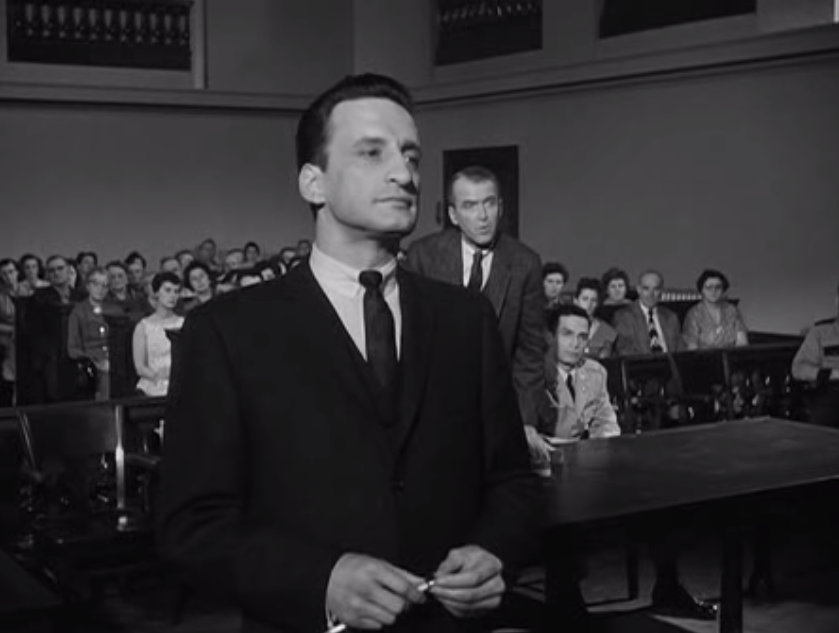
Best Supporting Actor 1959: George C. Scott in Anatomy of a Murder

George C. Scott received his first Oscar nomination for portraying Assistant State Attorney General Claude Dancer in Anatomy of a Murder.


When I reviewed Arthur O'Connell in this same film I said he was the sort of supporting performance that's whole purpose was to literally support the lead, and never really attempt to steal a scene for himself as the loyal confidant of James Stewart's defense attorney Paul Biegler. George C. Scott on the other hand plays the Assistant State Attorney General who comes to help the local D.A. prosecute the murder case. The whole point of Scott's performance is to basically attempt to up show James Stewart's performance in the court room scenes as the lawyers basically play a game a showmanship, with some keen observation  and attacks against each other's cases for and against the defendant.

The character of Dancer is very simple in that he is in the film purely for the reason stated in the film There are no scenes to indicate his life outside of the courtroom, but just because a performance a relatively simple task, does not mean the performance of that character cannot be great, and a fully realized characterization. Scott shows that a character does not need to the most complex to create a wonderful performance nevertheless. Scott from his first scene knows what his part should be, and knows exactly how to make a huge impact in the film as the prosecutor Dancer.

In everyone one of his scenes Scott makes his presence known in the film, even when he is just sitting down at the prosecutors table and saying nothing at all. Scott in every silent moments always shows an intelligence in Dancer, and you can just tell that he is dissecting everything that is being said. It abundantly clear that Dancer is just waiting for his time to attack. Scott also with absolute ease shows the control and superiority Dancer has over the D.A. through the way he always speaks with absolute control but never visible seems to be trying he just simply is.

Scott's best scenes come out when Dancer finally attacks and he and Stewart face off interestingly enough as not only their character but really as actors as well. Stewart gives one of his best performances, but Scott manages to match him just about every turn, creating the best scenes in the film. Scott is completely on in everyone of his cross examination scenes. Scott is striking in every one of these moments as he intensely interrogates every witness. Scott is able to portray Dancer quick thinking and pressure tactics perfectly, and he makes it absolutely believable that the witnesses would be overwhelmed by him.

Scott is incredible for every moment he is on screen and never lets Stewart really win, making Dancer the perfect adversary for Stewart's Biegler. Scott has such a great impact on the film, that really it is unthinkable to see anyone else in the role. Scott simply is fantastic as Dancer who was essential to the success of the film which would not have worked if Stewart seemed in charge the entire time. Instead Scott though matches Stewart, and shows that a great actor can make an undeniable impression even if their character as written might seem simple.

Tuesday, 3 January 2012

Best Supporting Actor 1959

And the Nominees Were:

Arthur O'Connell in Anatomy of a Murder

George C. Scott in Anatomy of a Murder

Hugh Griffith in Ben-Hur

Ed Wynn in The Diary of Anne Frank

Robert Vaughn in The Young Philadelphians

Monday, 16 May 2011

Best Actor 1970: Results

5. Ryan O'Neal in Love Story- It is easy perhaps to mock this film, and perhaps this performance, but it actually works for the film.
4. James Earl Jones in The Great White Hope- Jones is hampered down by a rather lackluster film, and a rather lackluster co-star, but he still is effective nonetheless.

3. Melvyn Douglas in I Never Sang for My Father- Douglas despite not always being given that much screen time is still able to create an interesting portrait of a father who despite loving his son, he refuses to give into anything that goes against his personal beliefs.
 

 2. Jack Nicholson in Five Easy Pieces- Nicholson is simply amazing here, and it is shame that both he and Scott were nominated in the same year. It really is hard to compare the performances in anyway other than that they are both brilliant. Nicholson portrait of his character is intense, and incredibly effective. He never seems to seek sympathy from the audience, but it is exceedingly hard to not to become invested in his incredible performance.

1. George C. Scott in Patton- Good prediction Dinasztie. Now this a rather difficult decision, although I felt perhaps with going with Nicholson, but that was before I re-watched Patton. It is not that this is a performance that stands far above Nicholson's performance, both their performances simply stand beyond other performances that it is hard to compare performances this good. They are both incredible in their depictions. I pick Scott's performance not because of any difference in quality, but I just love Scott's amazing characterization of Patton, that is flawless. I really can't say anything why he beats Nicholson, but I simply have to choose just one, I suppose if I was an actual voter I would have voted for Nicholson though, since Nicholson wanted to win, Scott supposedly did not care. 

Sunday, 15 May 2011

Best Actor 1970: George C. Scott in Patton

George C. Scott won his Oscar from his third nomination for portraying George S. Patton in Patton.

Patton of course tells the story of General George S. Patton's victories, and problems during the second World War.

George C. Scott's performance is quite the legendary performance in this film, not only because of the quality of the performance, but also the effect the performance had on public perception. George C. Scott's portrayal of Patton has many times been almost juxtaposed over how the real Patton was frankly, so much so that many times when one mentions Patton it is the George C. Scott's portrayal of Patton that is thought of, not the actual Patton, it is simply a fascinating side effect of this performance.

There really is no question really why Scott's portrayal has had such an influence, from the very first moment of the film in the iconic American flag scene Scott instantly dominates the part. There simply is never one question in who Scott is in this film, he just is Patton, not for a moment do I feel that there is any apparent acting going in the part, Scott simply becomes the part.

Scott commands every moment with his awesome presence in this film. Patton was a larger than life figure, and Scott made him so just the same. He holds command over every moment, he just is fascinating to watch, because he simply pulls one in with the power for his performance.  The most fascinating part is how easy Scott makes this command of Patton look, and that is why his performance is so incredibly effective.

What is amazing about Scott though is the way he combines the various of facets of Patton in such a compelling fashion. He is of course commanding in the part, but he does not ever treat Patton in a way of only the General, but always shows there is more to him than a single aspect of the man. He infuses a multitude of emotions and layers into Patton that never comprises another aspect of Patton, nor the overall towering strength of the performance.

Scott certainly is good as the commanding Patton, and quite entertaining as well, without ever making him anywhere near a parody, instead showing that Patton simply was entertaining. It is interesting to see when he is not as commanding as well, and when he faces disappointment or defeat in some way. Scott brilliantly uses these moments to add layers to Patton.

Scott shows that Patton does certianly feel personal defeats deeply inside himself, in scene which are almost completely silent in reaction. He particularly strong when he hears that he has been overlooked for a commanding position, and instead it has been given to his former second in command Omar Bradley (Karl Malden) instead. Scott reaction is subtle, but extremely effective showing that Patton can still be hurt despite his tough exterior. 

Scott also insures that although Patton is a soldier, he shows more deeply into Patton's sense of a soldier. He does not show him as just a man who gives orders, or takes them, but Scott instead shows a deep philosophy behind Patton's view of being a soldier is something profound for him. Scott believes in a pride, and a strong will of a soldier, and his view of the shell shocked soldier is shown by Scott as almost just something he could not understand as a soldier, a soldier not willing to fight for anything from cowardice Scott shows is something simply against Patton's point of view.

Patton though has a deep respect for a wounded, or killed soldier, and it interesting to see the tenderness which Scott brings in his scenes of respect for his soldiers. Scott shows that Patton really does have a heart for his soldiers, and that there is nothing more to him than a true soldier in his view. Scott again never forces this aspect of Patton, but it comes as naturally as his scenes of command.

Perhaps one of the most challenging aspects of the part though might be the presentation of Patton's belief that he was a reincarnated several times as several groups of soldiers. Scott again never makes this seem unnatural which is frankly amazing. Scott once more presents this as part of the whole person who was Patton, as most certianly his belief, a belief he believed in strongly, even if it would seem it would conflict with the rest of the man such as his deep Christian beliefs, Scott though is able to make this contradiction entirely believable though.

George C. Scott performance as Patton is simply an outstanding performance. He takes a large than life figure, and fully realizes that figure. He never seems to be acting, in a performance that could have been filled with that, he never makes him a simple character, but a complex, complicated man. This is just simply one of the best winners in this category, and one of the performances period.

Monday, 9 May 2011

Best Actor 1970

And the Nominees Were:

Melvyn Douglas in I Never Sang for My Father

Ryan O'Neal in Love Story

George C. Scott in Patton

Jack Nicholson in Five Easy Pieces

James Earl Jones in The Great White Hope

Sunday, 3 April 2011

Best Actor 1971: Results

5. Walter Matthau in Kotch- This performance really is nothing but smiles, and sunshine.  There is nothing to really note here except that he really is not particularly believable as an old man.
4. George C. Scott in The Hospital- A lacking character, but Scott does show the emotions he has to quite well, even if it does not form a compelling character.
3. Peter Finch in Sunday Bloody Sunday- Finch's performance is an effective enough performance, that gives a portrait of a repressed man who yearns for love.
2. Topol in The Fiddler on The Roof- Topol gives a very good joyous performance, and puts his full heart into a delightful role.
1. Gene Hackman in The French Connection- Hackman gives a commanding interesting memorable performance. I thoroughly enjoy every moment of Hackman's performance and I especially found his portrait of the obsession of the narcotics detective particularly powerful and effective.
Deserving Performances:
Clint Eastwood in Dirty Harry
Michael Caine in Get Carter
Gene Wilder in Willy Wonka and the Chocolate Factory

Friday, 1 April 2011

Best Actor 1971: George C. Scott in The Hospital

George C. Scott received his fourth and final Oscar nomination for portraying Dr. Herbert Bock in The Hospital.

The Hospital is a dark satire on hospitals by Paddy Chayefsky who later did the dark satire on television Network, both film have a very similar feeling.

George C. Scott's performance here is quite interesting in that it is his only nominated performance where he was not portraying a domineering commanding character. Dr. Herbert Bock is just a stressed out surgeon, who is very tired of his work and his life. I have to say I was a little surprised but how little of Scott is in the film. He is the lead certainly, but he really is only partially the focus, which I think is a bit of a problem with his character. The film only gives a little bit of time to the actual of development of his character, and the time that is given is quite rushed feeling.

Frankly this film seemed to me Paddy Chayefsky's picture more than anyone else's, since every facet of the characters and the performances seemed mostly there just to orchestrate his satire. This leaves Bock fairly underdeveloped in my opinion, otherwise than to show him a doctor who is almost a little mad do to stress, and can't take it anymore. Now this worked marvelously in Chayefsky's later film with Peter Finch's Howard Beale, but here Herbert Bock is still made to still seem human, so it does not work as well.

George C. Scott is good in the role, he shows the emotions of the character well. He is great at being stressed out, and his big yelling scene about impudence is well done, but I frankly wanted more out of his character. I understood exactly who he was in basically the first scene he was in, which was not Scott's fault, but rather the script's. Bock as a character just really leaves Scott to do all the work for the performance.

Scott's unique presence does work interestingly with this stressed character. His reaction to the craziness around him is well timed, and his sort of sanity is a good grounding for the film brought on by Scott, but still he could not make everything about his performance believable. I think mostly is his character's relationship with Diana Rigg's character. Well I certainly believed he jump on her the first chance he got, but the love relationship seemed rather phony to tell you the truth. Again I do not blame Scott so much but rather the script, it gives them little more than a dramatic monologue each to develop their relationship.

Overall this is a hard performance for me to rate. On the surface it is a finely acted performance. Scott does know what he is doing, and is good technically in the role. He was not perfect though, and the role itself left a whole lot to be desired for me. I don't know really this is a tough one for me, am I being too hard on Scott because of the weakness of the role, or am I giving Scott too much credit. I am not sure, he definitely hit the right emotional notes, and was realistic, but his character never became compelling or in many ways convincing.

Wednesday, 30 March 2011

Best Actor 1971

And the Nominees Were:

Peter Finch in Sunday Bloody Sunday

Walter Matthau in Kotch

Gene Hackman in The French Connection

George C. Scott in The Hospital

Topol in Fiddler on the Roof