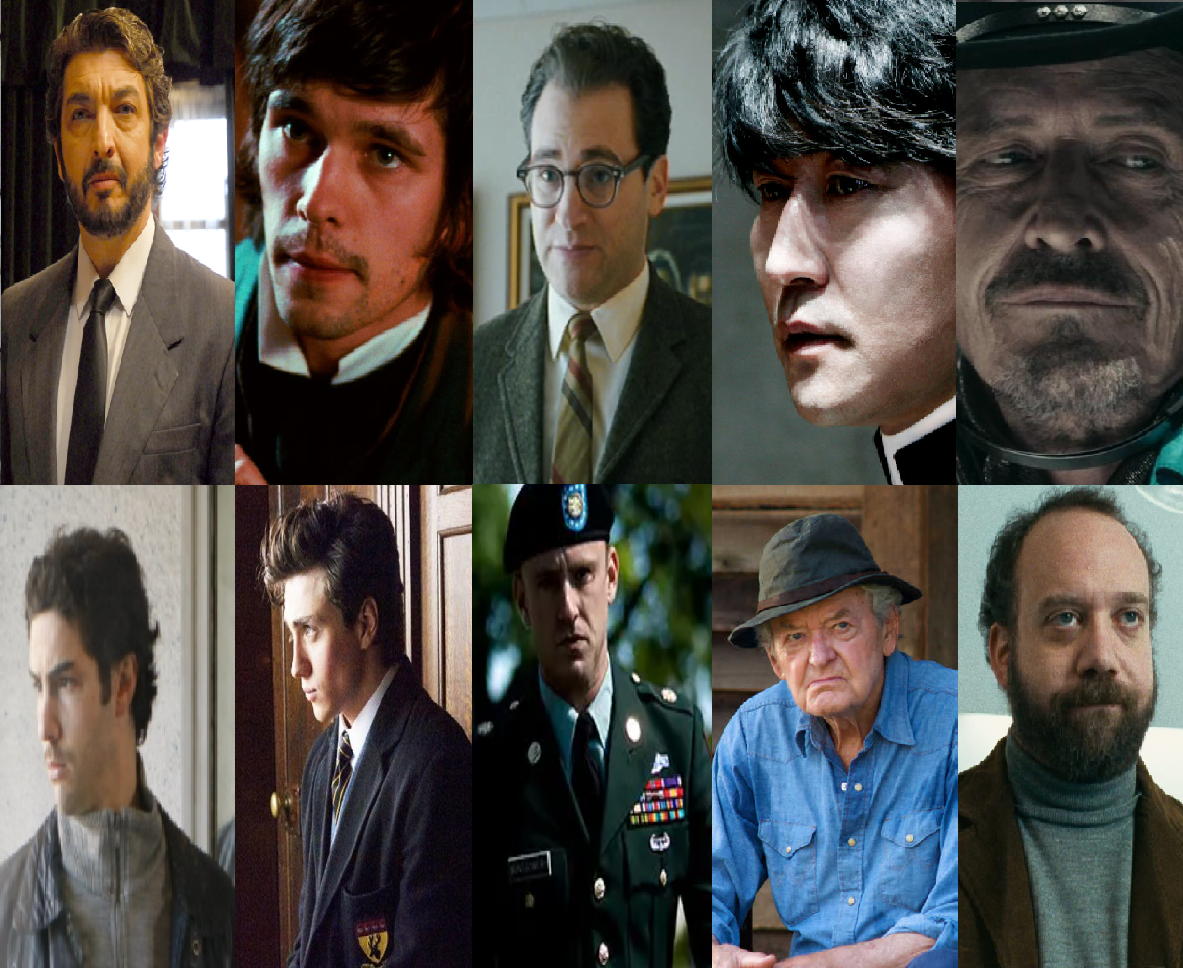
Ben Foster did not receive an Oscar nomination for portraying Will in Leave No Trace.
Leave No Trace follows a war veteran and his daughter, Tom (Thomasin Harcourt McKenzie) as they try to live off away from society.
Apparently once Ben Foster was cast in this film he worked with writer/director Debra Granik to remove a large portion of the film's dialogue. This reminds of a story about
Hoosiers, where after Gene Hackman was cast he gave that film's director a marked up script with exercised bits of dialogue from that film. Hackman's explanation for the removal was that he could simply convey what had been written through his acting. Foster seems to have engaged in a similar activity which makes sense as I would not be one to hesitate to compare to Hackman. Both actors are favorites of mine, however there is similarity in performance style often, as their work very much strives to exist within the material, and a consistency in terms of the intense devotion of their work. The strength of this comparison only seems to grow as Foster gets older. The idea for both seems to just get the right to the truth of their role, though in turn they are rather underrated within the general public, Hackman, wrongly, not being seen on the level of the other "radical" leading actors of the seventies like Pacino and De Niro, and Foster still failing to receive the sort of recognition so many of his contemporaries have found at this point. His work in
Leave No Trace, is very much almost a refinement of a raw talent as that removal of material, leaves almost the entirety of the character to Foster.
Although I will say they perhaps pared down the script perhaps just a bit more than they needed to, I do like the film quite a great deal but I don't think a little additional information would necessarily have been detrimental to the narrative. Foster's work however is more than up to essentially taking upon the task of covering everything that is missing from the dialogue to try to explain to us the man that is Will. The man who in the opening of the film we find him in a little shelter with his daughter within a national park, illegally. Foster has become known for his intense characters and this is another one of these characters. As I've often written though, a great actor is as much defined by how they can make a similar characters distinct just as they can handle very different roles. Foster proves his measure here in portraying a different type of intense man, which is notable since Foster even has already portrayed a war veteran in
The Messenger. Where there though Foster portrayed more so the controlled rawness of a recent experience, here Foster is able to convincingly portray a man the years removed from the war. His Will is a man who more than anything would like to forget. In that we see this in his interactions with his daughter. He portrays just a genuine father's warmth with McKenzie, and the two have an unassuming yet lovely chemistry together. They clearly love each other however this is never portrayed as a simplistic idea.
Foster shows the right sort of father's concern and teaching spirit in his interactions. He finds just the right middle ground in a firm delivery but always with this undercurrent of warmth within it of a man who unquestionably loves his daughter. In this approach Foster finds the man who has been caring for his daughter since he lost his wife as well as has been training with her to survive in an atypical living experience. There is the right bluntness in his manner with her as the idea of their circumstances is always present even in their most earnest moments of affection. Foster realizes the two sides and in that as he manages to bring to life the idea of that he's been nothing but a good father to Tom, but also that there has certainly been a burden within this existence all the same. Foster is able to convey what likely brought both of them there in this approach. As there is the articulation of concern for the outsiders finding them but within these quiet moments of calm. In these moments Foster is able to grant us a man who is hiding away from this all with the one person that he seems as though he can connect to. This person being his daughter where both McKenzie and Foster are able to create this unquestioned connection between the two. Their love for one another is made to be a constant, and there are not a lot of words to this, but rather just in their moments of interaction, which in this instance say more than enough.
We are granted just a bit more to Will when the two are caught and brought to be evaluated by social workers. Foster has a downright amazing scene where Will is asked to answer a series of true or false questions that gauge his mental state. Foster's performance is subtle, and absolutely brilliant in the way he conveys the thoughts going through his head. This being when initially the questions of a more overt potentially deranged person there is a confusion in him, that slowly falls into a severe discontent as some of the questions relating to having some severe trauma, that he has not recovered from, and quickly relate towards his subdued distress. Foster shows a man being forced to really evaluate himself in the moment and is haunting in creating the sense of pain in a man who has to be forced to face, at least in some way, the horrors of his mind. His performance is wholly haunting in the moment because we get two separate senses of the man that Foster is able to realize who Will was and currently now is. In just the way he says he "used to" to work well as a team, Foster is able to show that at one time Will was a healthy man, unlike many of the on edge characters Foster typically plays. Foster is powerful then by showing how terrible the struggle in the man is. Foster portrays that the intensity here is something Will is burdened by, not even as the man he truly is, but rather created through whatever horrors he may have faced in the war.
Again the film still doesn't take long to speak what Will is going through, as he and Tom are given a home and Will is given a job, as well as a chance to renter society. Foster is great in these settlement scenes as initially in his interactions with others we see a subdued man, still troubled, but at least with the sense of the attempt to try to exist in the world. In a short amount of time, within the idea of dealing with any of the random nonsense of basic society, Foster is again fantastic in showing the immediately growing discontent. There's an especially important moment where Tom comes to Will with her concerns of what others will think of her when they go to school. In this moment Foster does not portray a loving father, but rather a man on edge as his face expresses this strict hatred to even the speaking of the idea. Foster properly doesn't portray this as something towards Tom, but rather in this delivery just Foster is able to convey the idea of how anything from society, that are beyond just basic survival, is this horrible struggle for him to deal with. Foster in his reactions conveys this growing unease not of a man who feels he's above it all, but rather is able to show a man who mentally is just simply unable to take what it means to be part of society. Although it is not explained in words, Foster is able to express entirely what it is that pushes Will to wish to hide away, both in the way he reacts with such internalized distress in his eyes in the moments that reminds him of his old wounds, but also just the way the sort of BS/disinterest of society is no longer something he can tolerate.
It is then just a natural reaction as Will forces Tom, who was settling into society, to move again. The two continue their trek and again Foster is create in conveying the paranoia in these sequences as Will is completely unstable in what is essentially the "open" area of society. Eventually, with Will almost dying, they find a shelter again, though once again in society even if it is a very secluded one. Foster again realizes powerfully the state of hollowness in Will's eyes as though he is trying so desperately to separate himself from his demons but again being in such a place still keeps his mind painfully occupied. Will again wishes to leave, but now Tom refuses to go on recognizing that she is not broken in the way her father is. Their final scene together is the most expressive moment in the film, and not at all wasted in this sense. Every moment that we've seen them together builds to this scene, and it feels wholly earned as the daughter decides to leave her father. Foster's performance in this scene is absolutely heartbreaking as in the moment he unleashes in his breakdown a moment not defined by the horrors of his mind, but rather the sense of losing his daughter. It is a reaction of pure love, rather than any sort of desperation, as he conveys, again nearly without words fully this moment of understanding between father and daughter as they say goodbye. This is an outstanding turn by Ben Foster, and I'll fully accept my broken recordness when it comes to his work. This is a unique challenge and in turn achievement by him though as he is able to vividly create this portrait of a wounded war veteran, with so few words, and even an often distant perspective, almost entirely through his considerable ability as a performer.