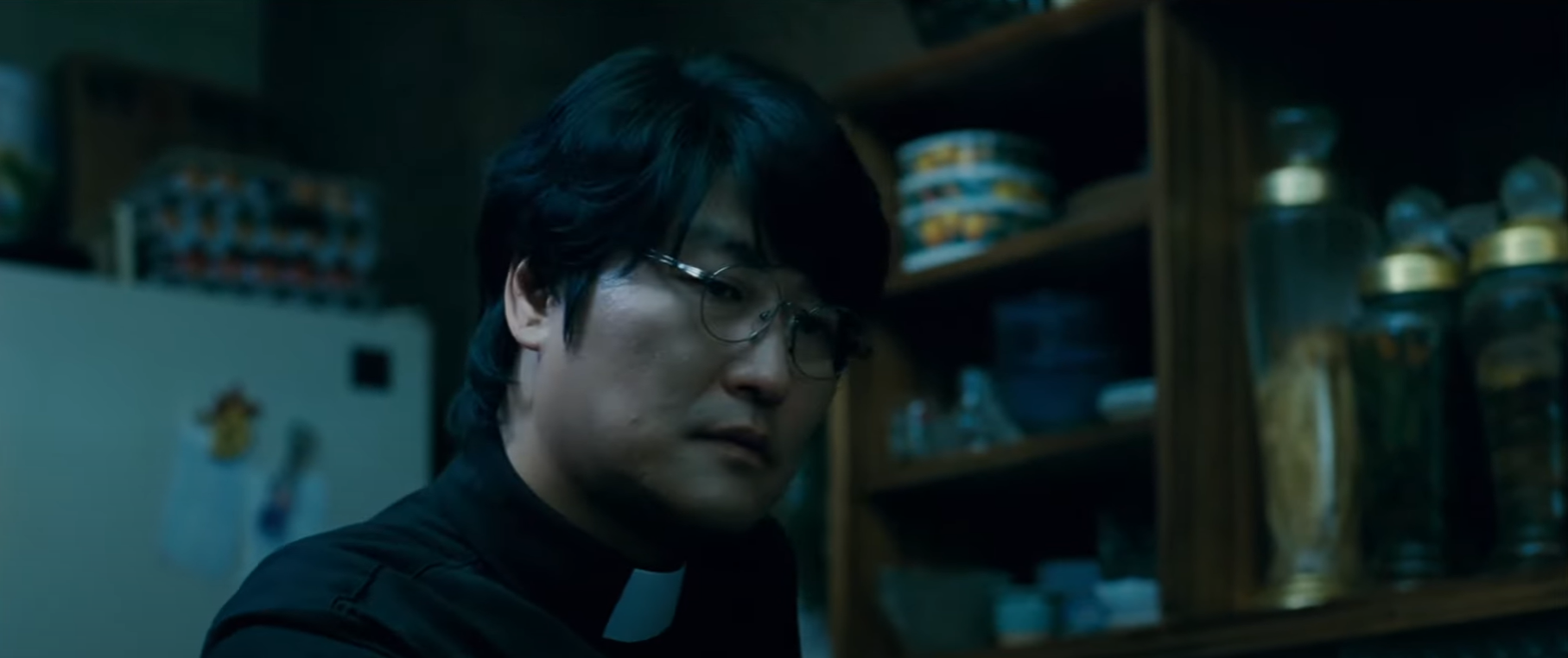
Song Kang-ho and Choi Woo-shik did not receive Oscar nominations for portraying Kim Ki-taek and Kim Ki-woo respectively in Parasite.
Parasite is the perfect cinematic sendoff for the decade by director Bong Joon-ho, a film that I loved upon first viewing and has only grown in my estimation on each subsequent viewing, following a poor family who attempts to infiltrate a rich family by taking all their service jobs. This is a film, where if you have not seen it, I would just say read no further, and just see it already. Though as much as I've loved it every time I've watched, one should never forgo the great experience of discovering this film for the first time.
Regardless of what aspect of the film one examines, Parasite is great, a trademark of a masterpiece I'd say, one of the aspects that carries this greatness is the cast. Everyone fills their parts out so well, making it perhaps the most deserving SAG ensemble winner, ever. Two of the essential performances come in the men I've chosen to focus on here, though as Song Kang-ho plays the father and Choi-Woo-shik plays the son of the poor family. The poor family we first meet as they seem like they can only go up, living in the basement of a building where they struggle to find wi-fi support, and are "treated" to bug spray and a serial unrinator as regular sights. The family, which also includes the mother Chung-sook (Chang Hyae-jin) and the daughter Kim Ki-jeong (Park So-dam), eking out a more than meager living as pizza box makers. So in this sense we get the family in sort of their purest form, which is essential in creating really the state of each character established so well in the performances. With Choi Woo-shik, similar to his not particularly loyal corporate truck driver in Bong's previous film
Okja, brings a sort of foolish energy of sorts. This in there is an inherent haplessness in his manner. Choi portraying a lack of certainty with really every interaction in the basement, suggesting the young man unable to build up even the slightest hint of success in his life, having failed university exams multiple times. Bong's frequent collaborator Song Kang-ho, of course is right at home in the director's style, but also makes this important portrayal of the dad's state in the home. This as he brings a sort of goofy enthusiasm of just a typical dad, who actually may be a little too content in his surrounding scenery, this as even though we don't know how the family got here, Song gives a good idea how. This as when the basement is sprayed for bugs, while the other shudder, Song takes in almost a cleansing embrace of what his life is.

Their chance in a turn around comes as the son is offered a chance at a tutoring gig with a wealthy family by his friend, largely because his friend thinks he'll be less romantic competition for the daughter in the rich family. Choi's great in this scene of hearing of the prospects by in a way being everything his friend is not, portraying a certain fear almost at the prospect, and this consistent physical approach that accentuates the son's apparent lack of potential on the surface. He finds himself invited though into the home of the rich family and the particularly gullible rich mother (Cho Yeo-jeong). Choi's performance creates the sort of operation that defines the first act of the film. This as he sees just how quickly she accepts his ideas, we see an immediate change in his manner, and Choi loses his more unassuming demeanor to create a more striking manner, closer to his visiting friend who recommended him for the job. It isn't though as the man is showing a great confidence as himself, but rather it is essential in the way Choi portrays this as a placed in facade over the apparent sort of fearful young man otherwise. This is most evident within his first tutoring session, where Choi portrays this sort of breakout that is as a performance as some great thinker, where he is just really putting on an act. This act that gets his sister a job as an art tutor for the rich family's son, and eventually his father to replace the rich father's driver. Song is terrific as he continues showing the way the poor father is by far the most at home in the basement, with his proud goofy demeanor. This as we see him take on the job for the father, he is by far the "worst" actor of the bunch. Song's brilliant though in his comic way of bringing to life Song's methods as a proper seasoned driver, who really isn't that great. This with an over eagerness he brings to every word, and a far too casual ease with the rich father, that frequently pushes boundaries. We see more of this as the three attempt to get their mother a job replacing the rich family's housekeeper. Song's terrific in the scenes of preparing for the "performance" in his over the top delivery as he practices it, showing very much the effort the poor father must put into every ounce of the scheme, compared to his children who are a little more prepared. I do though also love the brief moments of pride that Song expresses with such an affectionate grin as he speaks of his children's success with the scheme as though they had all gotten successful jobs without subterfuge, and grants the sense of it being almost a dream beyond any expectation.
The family pushes their success though by using the family's home when they're out for a trip. This is an essential scene though for both Choi and Song. Choi in reverting to more meekness though with this quiet hope as he speaks of his belief that he'll be able to marry the daughter and get the riches for himself. Choi speaking with this earnest delivery, and this way of looking towards some future in the moment, that is an essential seed. Speaking of essential seeds though, when the poor mother, speaks of the father's likely cowardice in the face of the rich family potentially discovering them, he lashes out. Song portraying the moment with a real intensity of a deeper anger, though that he quickly laughs off as though it was all a joke. This release though being an important seed as Song uses that moment to suggest a bit more within the father's certain state of being poor. What happens next though is a sequence of insanity as the family discovers the first housekeeper was storing her deeply in-debt husband into a dark basement, just before the rich family unexpectedly returns home from a flood, which gives the rich house a rather serene appearance. The ensuing chaos is really tour de force for every actor within the cast in terms of portraying the different moments of the scene, and adding so much to the craziness and comedy of each moment. They highlight each instance brilliantly and makes the whole sequence all the more compelling. I have particular affection though for Song's reaction as he witnesses his wife purposefully push the old housekeeper, though accidentally cause great injury, as it instantly evokes the terror of the change in severity of the situation. Eventually the situation leads much of the poor family to hide for some time under the rich's family's table, whilethe rich couple watch their son camp out in the rain. This as the rich father (Lee Sun-kyun) comments on the poor father's smell. Song's silent reaction to just taking this in, and just a moment of quiet sadness and anger, is fantastic bit of acting essential to the story, as we'll see.
The family escapes though only to find that their basement home is flooded, leaving them to take refuge. Although Choi is very good in his reactions to these scenes, Song's work is remarkable in showing the loss of that sort of contentment and pride of the father. There taking hold more of an exasperation within him that in Song's expression creates the sense of a penetrating loss. This creates a terrific contrast though between Song and Choi, this as Choi speaks still with some optimism of a plan to handle all their problems with this youthful wish again, against Song who speaks each word so bluntly that plans are basically without purpose, as they always go wrong. All of this comes to a head as the poor family is called in by the rich family for their son's birthday party, oblivious to their lost home from the flooding. Choi has a marvelous bit of physical comedy actually as we see him exploring the hidden basement in some foolish attempt to resolve the situation with a rock of his, and his fumbling around expertly realizes his plan going the opposite of fruition. This is against Song who is first needed to slowly prepare the party by driving around the wife, before being made by the rich father to pretend to be a bad native for a birthday celebration. Song's face says it all as just this simmering silent bitterness and hate. This not a man wounded so by his experience, and his reactions that show a very real pain that seems as defined by the lack of empathy from those he is looking at as it is his own suffering. All of course does not go to plan in the party as the husband from the basement goes on the attack first, delivering a near fatal blow to the poor son's head, via his own rock, before stabbing the poor daughter. Everything Song does in this scene is downright amazing, but also realizing quite the challenge in what he needs to do. It's effortless though and powerful. This in his portrayal first of sheer horror at seeing his daughter stabbed, and disbelief at the violent chaos. This though as the rich father stepping once too far himself, by not only showing no concern whatsoever over the bleeding Ki-jeong, but also his revulsion at the basement dwelling husband's smell as he picks up the car keys tossed by the poor father. There's a break in Song's eyes as he moves almost in this detached state as he outright murders the rich father. This is such a brilliant moment as we see the spark of anger and intensity, seeded before, but portrayed as this almost instinctual release of pent up rage by Song in the killing. This that he makes as this temporary insanity as his stare the moment afterwards is this incredible realization of what he has done, one of both fear of the consequences but a despair of that he went through with such an act.
The film's epilogue is one of the greatest endings of a film that I've seen in sometime, and two of the reasons for this are the performances of Choi and Song. We see Choi as he recovers from his brain injuries, though with initially a broken laugh, that is so well realized in Choi's nearly vacant expression of a man whose mind just isn't quite fully together yet. This as he finds he and his mother just barely avoiding jail time and falling right back into their basement home once again. This compared to against where we see the father who managed to avoid arrest by retreating into the hidden basement. Song is outstanding once again as we see the immediate desperation after the act, and the moment of realization expanded to a true shame for the act. This now portraying that man without any contentment just now living within a fear of a life lower than the one he had seemingly come to accept in the opening of the story. The son learns of this through Morse code from a light operated by the father, leaving the son to plan an escape for his father. The escape scene that we first see depicted as the son appears rich, and now earnestly confident as himself. This with one particularly brilliant glimpse from Choi as he's just about to enter the house, of a quiet eagerness and almost disbelief at the prospect. Then we witness the father apparently come from his layer, with his son and wife ready to greet him, where Song wears such a haunting expression of years of a form of captivity as he moves to embrace his loved ones once again. This before we cut back to still just the son stuck in his basement thinking of that plan, with Choi's expression being this so poignant combination of that optimistic wistfulness but also an underlining hopelessness as well. Both actors great such emotional detail, largely in silence, and help to create the unforgettable ending it is as this cruel dream that is likely to never exist. Both actors deliver great performances in Choi's portrait of a youth attempting to find the plan that will save his family, and Song's tragic realization of a poor man somehow slowly descending down a path he cannot return from.