Friday, 3 April 2020

Alternate Best Actor 1978: Steve McQueen in An Enemy of the People

Steve McQueen did not receive an Oscar nomination for portraying Dr. Thomas Stockmann in An Enemy of the People.

An Enemy of the People isn't a terrible, but rather a largely inert drama that unfortunately cannot live beyond its allegory.

This role is a major departure for the king of cool at the tail end of his unfortunately all too brief career, given he plays a period role that is alien compared to the majority of his roles. Although we've seen McQueen play period before, typically westerns, this is a very different role for him as there isn't the slightest sense of playing within the idea of cool, but rather attempting to wholly disappear inside a very different role for himself. This evidently was a passion project for McQueen, in a self-described attempt to prove to people that he could act. Well he perhaps should've just referred them to his career best work in Papillon, that which used his presence in part, however showed a far greater emotional range than he had ever showed before. Honestly that is where McQueen excelled as an actor, and perhaps where he should've explored more of as a performer. For example, he was the intended lead for William Friedkin's Sorcerer, where he would've been an ideal lead, in a role that again would've utilized his best qualities as an onscreen while also tasking him to "act", by delivering more within that presence. I bring this up as this role is a somewhat mistaken attempt to wholly erase one's understanding of McQueen as a performer. This is pretty obvious right from the outset as his long hair, beard and glasses, all seem to say "this is not the McQueen you know".

Well in this sense, the performance is not a failure as McQueen does successfully not fall upon his typical presence. He becomes believable enough within the role as this more seasoned intellectual doctor, by not calling upon one ounce of his typical king of cool presence. I'll say I didn't even find it jarring to see McQueen as such, as he wholly gives himself to the performance and clearly gives a devoted turn. The role, despite the dramatic intentions of the piece, is limited. This as we see this doctor who must do what he believes is right, which is call out the town's local water supply that is poisonous, despite the town's top brass, including his brother, wanting to silence this as any removal of the water supply will slow down the progress of the town. So we have the set-up then of the character, of this man with conviction and the family man. The latter element brief as his interactions with any of his family are as to the point as possible. This as even his relationship with Bibi Andersson as the doctor's wife, is barely even touched upon even with the unlikely pairing of performers. The two I'll give credit don't exactly lack chemistry, they just also don't really have the moments to realize any. The same goes for the whole idea of the doctor and the family. We never get a real sense of them as people, before getting into the dramatic situation they are in, making it so they are more figures to voice the message of the story, rather than living as people who also speak the message.

I think the greatest failure in this is in the characters of the doctor and his brother Peter (Charles Durning) who are at opposite ends of one another. We are granted no real history between the two, and you'd never even guess they were brothers. I guess I can take this one from the performers a bit in this instance as neither McQueen or Durning really grant the sense of any sibling familiarity even that of a distant relationship. The screenplay does not help them at all in this regard, as their scenes together are only of an argument of the same points with Peter yelling at the doctor, and the doctor looking solemn. This is much of McQueen's work here honestly, that of just keeping a slightly disturbed, annoyed but still determined expression as others threat and berate him. McQueen to his credit does this with enough of the sense of the state of the doctor but little more than that. The rest of the time McQueen largely is looking dignified as this man of importance, the town's good doctor. Well again, McQueen delivers this with that different presence than was typically expected from him, however I won't say even this makes that much of an impact. McQueen finally gets a bit more to do as the doctor gets to plead his case among the collective people, fighting for his beliefs and against the idea of mob mentality. Well McQueen delivers this speech with a decisive passion and strength of conviction in his voice and eyes. We see the same soon after when the man refuses an offer to join the corruption delivering a earnest rejection of the values with the sense of the weight of the decision on his brow and just exasperation in his voice. McQueen doesn't compeltely fail to reinvent himself here, but this role isn't ideal for that reinvention. It is a limited role that McQueen only can do so much with, and I will say does falter a bit with in certain elements of it, namely the central relationships. I think that it is as much of a problem within the material as McQueen work however, McQueen doesn't overcome it. This performance is not a revelation, but it is a decent curiosity of an attempt by McQueen to expand his repertoire, though sadly at a time in his career where he would not be able to ever make a second attempt later on.

Thursday, 2 April 2020

Alternate Best Actor 1978

And the Nominees Were Not:

Harvey Keitel in Fingers

Richard Pryor in Blue Collar

Alan Bates in The Shout

Elliott Gould in The Silent Partner

Steve McQueen in An Enemy of the People

Wednesday, 1 April 2020

Alternate Best Actor Lead/Supporting 1943 Update

Here are the updated lists for 1943, a year that is one of the weakest I've come across. This as 49 % of the films seem to be about someone going on a spy mission, the other 49% being about people in an occupied country. One is better off just watching Casablanca and forgetting the rest, as though the films aren't terrible, they are so predictable and repetitive they naturally become a little dull. Although I'll grant my conditions of watching several in succession, isn't ideal, and only reinforces their obvious similarities. Understandably the world was preoccupied with other things at the time, and that's why 98% of the films have the same message, but for retrospective purposes, you can skip most of them.

Updated Lead
Updated Supporting

Next: 1978 Lead

Monday, 30 March 2020

Alternate Best Supporting Actor 1996: Results

5. Eric Tsang in Comrades: Almost a Love Story - Tsang delivers a moving portrayal of a gangster with more heart than you'd expected.

Best Scene: Many wives.
4. Ed Harris in The Rock - Harris, despite being in a dumb film, gives a complex portrayal of a soldier whose convictions slowly bring about his tragic downfall.

Best Scene: Breakdown of command.
3. Harry Belafonte in Kansas City - Belafonte gives a film stealing performance by subverting his typically affable presence, in his portrayal of almost demonic philosopher/gangster.

Best Scene: Racist joke.
2. Charlton Heston in Hamlet - Heston proves his measure with Shakespeare in making the words sing, but also offering such potent emotion within it.

Best Scene: Monologue
1. Peter Stormare in Fargo - Good predictions Razor and Bryan. Stormare offers the perfect other half along with Steve Buscemi, as two less than professional criminals, in his performance that works both as a hilarious deadpan comedic partner, and a chilling portrayal of a truly amoral killer.

Best Scene: Highway Massacre
Updated Overall

Next: Back to 1943 (will be brief)

Alternate Best Supporting Actor 1996: Eric Tsang in Comrades: Almost a Love Story

Eric Tsang did not receive an Oscar nomination for portraying Pao Au-Yeung in Comrades: Almost a Love Story.

Comrades: Almost a Love Story is a sweet, if a touch overlong, film about two mainlanders in Hong Kong, who can't quite seem to come together.

Eric Tsang plays one of the potential obstacles between the love story that seems always on some sort of on the brink between  Qiao Li (Maggie Cheung) and XiaoJun (Leon Lai). This as Tsang portrays a mob boss costumer of Qiao's, at a message parlor. Eric Tsang would later play notably a mob boss in Infernal Affairs, however Pao Au-Yeung here is a far cry from that more dramatic criminal he would later play. This as we really come in at first to the man, mostly head down, just receiving his massage and attempting to flirt with Qiao. Tsang delivers a bit of the expected "brunt" to the role when he demands force be used to handle some issue relayed by his men, but even this is just a perfunctory statement. We we get more passion is as he speaks to Qiao of his new tattoo adorning his back, along with his more expected tattoos, that of Mickey Mouse, her favorite character. It is then we see that Pao isn't your standard mob boss as we see the two begin an actual romance. Though this first seems likely to be short lived as Pao essentially tries to allow her to leave by speaking of all the wives he has in other countries, Tsang handling this moment as one of false bravado. This not as a boast, but as a man attempting to not only soften his own wound, but to most earnestly make Qiao feel better about herself. This in his face though a real sorrow of the loss, that Tsang strictly conveys the genuine sense of love in the moment. This showing the real heartbreak in the man in the moment, before Qiao decides to marry him. Although the scenes following this are brief, however Tsang uses them well. This in providing a real warmth in the interactions and a purity of the man's manner, as though this is Pao as his truest self. This in portraying just a to the point sweet man, who loves his wife, and wants to just live a good life with her. Tsang naturally delivers a potent affection this as he makes it natural from that of the former gangster, to just a caring husband in every sense. This making it so when he makes his untimely exit it is something that is felt, and not just an obstacle to get gotten over for the sake of the leads finally getting together. This in Tsang successfully creating a sympathetic portrait of both the typical "other guy" of the narrative and of a gangster. It's a relatively short performance but Tsang delivers still a memorable impression within that screentime.

Sunday, 29 March 2020

Alternate Best Supporting Actor 1996: Peter Stormare in Fargo

Peter Stormare did not receive an Oscar nomination for portraying Gaear Grimsrud in Fargo.

Now I previously reviewed Steve Buscemi's great work, as the largely incompetent Carl, the one half of two criminals hired by used car salesman Jerry Lundergaard (William H. Macy), to kidnap his own wife to extort money from his father-in-law, but I was remiss in forgetting Carl's, mostly, silent partner...in crime. Stormare's performance is an anti-thesis that I will get to, but it is also brilliant that I will preface, although since he was my runner-up even before this review, so that might be obvious. This is actually one of those interesting performances in that I've enjoyed Fargo multiple times, yet I forget that Stormare is only a few scenes, as he seems such an essential element of the film. This is as his impact is essential, and we must look to Stormare's work for leaving such an impression. This is as his work is almost a silent performance, though the few words he does make leave an incredible impact, Stormare, unlike the rest of the cast has a limited amount of that wonderful Coen dialogue to work with. In fact Stormare more of just has a few lines in total, and a great deal of silence, though this is all he needs to create two different achievements within the film. The first is this is a hilarious performance, oddly enough despite being the most terrifying character, as we find Carl and Gaear, in some ways have more in common with Laurel & Hardy than a Leopold & Loeb. This as we have Buscemi's Carl as the man who never stops talking against Gaear who rarely says a word, unless he deems it essential. The few words being each in themselves idiosyncratic, yet so fascinating of deliveries every time. This in "Where's pancakes house" with his face of sincere questioning then disbelief as Carl doesn't agree to get some proper pancakes at the pancakes house. Stormare's face is something special here, as in a scene like that it is to such great comedy in his nearly dead eyes towards Buscemi, before Carl relents to agree to pancakes after all. He is the fantastic deadpan straight man of sorts Buscemi, like in their later conversation where Carl attempts to get a few words to which Stormare delivers his "Nope" and "I just did" as a fountain of conversation with such beautiful bluntness. This though maintaining this indifference towards slight annoyance at his chattering partner. 

There is something just fascinating yet perfect about how Stormare approaches every scene in creating Gaear as a whole different kind of sort. And initially this seems to be fun and games, in ignoring his partner, berating Jerry briefly for the stupidity of his plan, but then they do kidnap Jerry's wife, and we get part of where Gaear may not be so much fun, though still hilarious. This as when Jerry's wife bites him first to escape him, we get another classic bit of oddness from Stormare in his "I need unguent" that is marvelous by how detached from the situation he is in the scene. This distance, that same detachment, brings upon a more eerie quality however when he finds that much need unguent along with Jerry's wife attempting to hide in a shower. This as he notices her, but with those hollow eyes now finding a more menacing quality within them in that distance Stormare brings. The same distance he brings as he follows Jerry's wife as she falls upon the floor knocking herself out, and Stormare pocks her not as a sadist, but as someone might interact with an object or insect. This strange nature of Gaear coming out more directly, as the two men, with their kidnapped in tow, are stopped on a remote road. Stormare's manner becomes most unnerving as we begin to feel a bit of what he can do. This coming up initial as Carl attempts to bribe the highway patrol officer, leading to Gaear instead to kill the officer without hesitation when that doesn't work. Stormare's way of speaking towards Carl's claim "You'll take care of it" is with a chilling blase quality to it. This as we see only spark of anger, when directly annoyed by Jerry's wife's screeching only as it seems to interfere with him directly in some way. Stormare is terrifying and strangely mesmerizing as the sequence continues, as while Carl is attempting to cover up the murder, two onlookers driving by leaving Gaear to finish the job. This as Stormare portrays Gaear in almost this zen state and quiet determination, where this business seemingly is nothing out of the strict ordinary for him. I especially love, though that might not be the right word, as he catches up with the onlookers who crashed their car. Stormare's is unnerving as his manner is relaxed, his state calm, but calmer than calm. This as we see him particularly look at one of the witnesses stuck within her car. Stormare doesn't smile or wince, he rather seems almost observant of not a man looking at a person, but rather how a man look like something that which he shares no connection. Now I could've sworn there was a great deal more of Stormare after this scene, I mean I could swear it right now, even though he only has 2 brief, 1 relatively brief, and one major scene, all with few words after this pivotal scene. The reason I could still swear it is the impact he leaves nonetheless, and even in these scenes, where we see this horrifying force of evil in Stormare's performance, that nonetheless is captivating. Whether that is as he looks on at, Jerry's wife failing to escape, or Carl's struggle to get a signal on the TV at their cabin hideout. In each moment the power of Stormare's work is evident, and all the greater the more we see him. Although I do have to take one moment to refer to his more comic work in the first half in his one major, albeit short, comic moment later on. This as we see Gaear waiting by watching a Soap Opera, and Stormare's genuine surprised look as Gaear hears the revelation, is pure comic gold. Now though, back to the more fundamental purpose of his work later in the film. Where we have two immediate scenes of Stormare's terror in a way, because of how at ease he is, whether it is mentioning the murder of Jerry's wife, as though he's explaining why he took out the trash, or his killing of Carl as though he's going out to shovel snow. This as we find him that antithesis to the chief investigator of Jerry's scheme, Marge Gunderson (Frances McDormand). Where she is a morally good character, to the point her greatest frustration in the film is shown towards Gaear for doing all his ill-deeds for money even on "such a beautiful day". Where Marge is defined by positivity and a love for life, we have instead Stormare as Gaear as a strictly amoral individual detached from life. This even compared to Jerry and Carl who are too human in how pathetic they are to be pure in their despicable nature. Stormare doesn't make Gaear just a bad man, but rather a fundamentally amoral force within the film. This right down to his "conversation" with Marge, where she questions his actions, and with Stormare there is no regret on his face, or even anger, rather he shows a man whose violent actions where in a way meaningless to him. This is a downright brilliant performance from Peter Stormare, as he is endlessly captivating through so many wordless moments, while being a proper comedic partner to Buscemi, while also wholly finding the needed menace and evil to create the purest villain in the piece.

Saturday, 28 March 2020

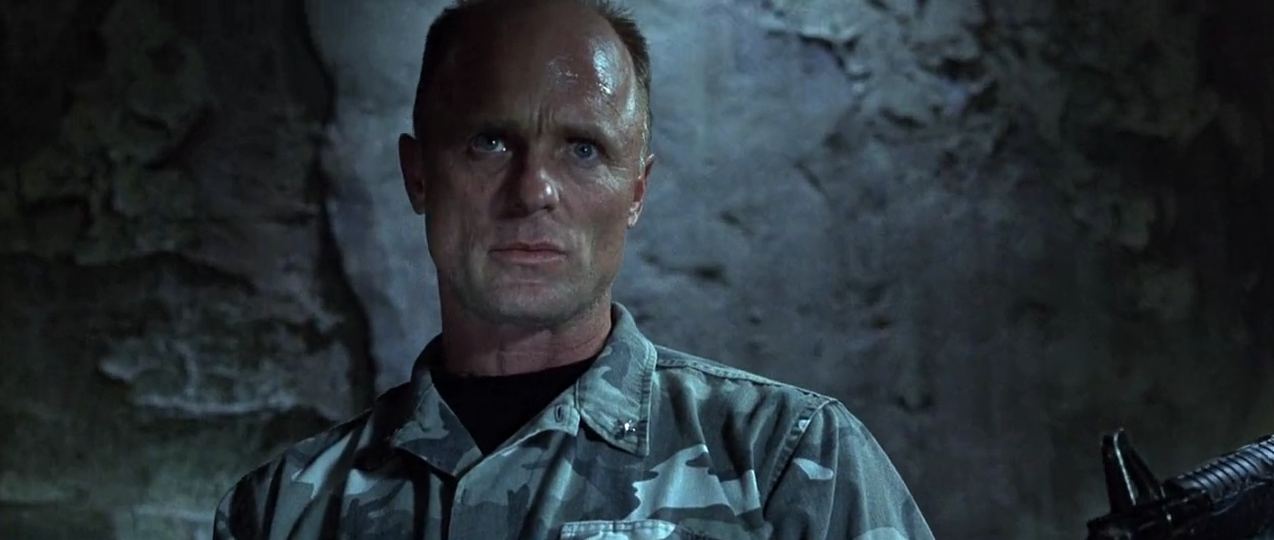
Alternate Best Supporting Actor 1996: Ed Harris in The Rock

Ed Harris did not receive an Oscar nomination for portraying Brigadier General Francis X. "Frank" Hummel in The Rock.

The Rock follows an improbably named chemist, Stanley Goodspeed (Nicolas Cage), and an imprisoned SAS soldier, Mason (Sean Connery), who must infiltrate Alcatraz to stop a group of rogue marines. Marines who have taken control of the island with hostages along with missiles carrying a deadly poison.

Michael Bay movies are stupid. This is known. This is the good Michael Bay movie, on the virtues that it is a successful action picture, though his unfunny juvenile humor often rears its head indicating his later features though thankfully more minimally here. It might also help is one thing that Michael Bay seems to take pretty damn seriously is the US military. This creating then at least the allowance for anything of even a remote substance, though I will still say in a limited fashion, in the character of General Hummel played by Ed Harris. Harris's performance here, honestly is in a different movie than Cage and Connery, but that's alright, since he barely shares any scenes with them, and we can essentially take in what he is doing separately from their antics which are of a more ridiculous, though definitely entertaining, action spectacle. Harris basically is there to take upon all serious intentions and gravity of the film on his shoulders. This is something he seems more than ready to perform from the opening scene of the film. This is right from the outset of the film as we see Hummel making his technically villainous decision, at the grave of his wife. Harris does not play the scene like a dumb action movie, what the Rock is, but rather reflect the grief within a conviction in his voice. This as Hummel offers almost an apology to his wife in explaining his soon to be actions. Harris offering the devotion of a drama in the moment by reflecting the sadness in the General as some sense of motivation for what it is that he is about to do.

What he is about to do is a lead a group of his solders, and a few extra wild cards (for the sake of a last act villain switch), to steal chemical weapons then take Alcatraz. Harris, as shown elsewhere, excels as the company man military role to begin with. His innately intense delivery, and rigid demeanor help to reflect a man who has lived life by a code of discipline. This even being shown as we see the man in his villainous enterprise,  as Harris doesn't portray Hummel as a lunatic, but rather a General prepping for a mission he deeply cares about. This as we see him running it as he would any mission, with Harris delivering each line with a careful measure, and even subtly in his eyes, showing a real sense of loss, when one of his men dies, though hiding it within the veneer of maintaining order as a leader. This is even in a brief, but important moment, when taking Alcatraz, where Hummel asks children to leave the island before he takes it. Harris doesn't make the moment a sociopath putting on an act, but an honestly caring guy asking the children to be out of harms way. This supports as we finally hear the General's demands, which is money, however money specifically for the sake of the families of soldiers killed in Black ops mission, disavowed by the government. Harris delivers on the idea in the initial threat in offering a controlled passion, showing the man absolute belief in his objective, while again still presenting himself as the controlled General feeling he is performing just yet another mission.

Harris makes for a good villain in that he manages to deliver on the idea of the menace within the controlled certainty of the character. Where his performance though goes beyond that is creating a definite tragedy within the role, that he manages to weave from that opening scene and throughout the film. This is that he doesn't just make him some military mad man, but a genuinely caring person. This is within the film as written, however Harris is essentially in not only giving it sense, but even a power to it. Take the scene where his men kill all the government's infiltration team, sans Mason and Goodspeed. The argument that prefaces the massacre, Harris makes more out of the scene, this as he begins with the strict intensity of the General asking for surrender, however as it continues his delivery offers a greater frustration. This not being a frustration at disobedience, but rather seeing the situation is about to go out of his control with innocent lives being taken. His yells of "cease fire" is with harried expression from Harris as man whose resolve has been shaken, and his moment of looking upon the dead soldiers, Harris grants an honest poignancy to as he subtly reflects the real regret in the General within the moment. The one scene where the two sides do collide is where Mason, briefly, turns himself into the marines, and he and Hummel have a brief battle of words. Even in this scene, that is primed as the testing the villain moment, Harris manages carry on the specific arc of the General. This as even reaction to Mason's words, it is with a greater internalized frustration that externalizes as violence.Those that Harris does not act as a beat down for sadism, but rather a gut reaction of a man who can't fully rationalize his choices in the moment. Harris is consistently compelling in granting a severity to the worsening situation, as the General is pushed by his men to launch his poisoned missiles. This as he continues to capture it as the idea of the man slowly getting in over his head on his idea, than a lunatic. This as when they launch one missile, where Harris portrays with a resignation. This not being a resignation to kill, but rather a resignation that his plan is a failure. This naturally comes to a head when his additional wild cards, question his actions and attempt to relieve him of his command. Harris is fantastic in this scene. This as he begins it first with the same conviction explaining his plan was a bluff, therefore it is over. This with the same determination in his voice in his threat as he does explain that he never had intention to kill innocents. I love the moment in which Harris attempts though to tell one of rogue men to stand down, first with his General's confidence, however as the man doesn't listen the second time Harris's voice cracks. This emphasizing the man not only losing his confidence, but also realizing he's lost his control of the situation. Harris finally fully realizing the real desperation of the General as loses that strict assurance of himself essentially. This in his very final moment, that Harris does not waste, in speaking with a genuine regret as he asks "What have I done". This is terrific work from Harris, as he finds a real tragedy within his villain. This even in an absurd action picture, Harris maintains a gravitas within his role, and even offers a semblance humanity into the plot, that is pretty ridiculous when you break it down.