Thursday, 23 March 2023

Alternate Best Actor 1961: Peter Finch in No Love For Johnnie

Peter Finch did not receive an Oscar nomination, despite winning a BAFTA, for portraying Johnnie Byrne in No Love For Johnnie. 

No Love For Johnnie follows an MP as he struggles with love and his political career. As the Labor party refuses to give him a cabinet position and his wife leaves him. 

A quick sidebar I will say the more I see from Peter Finch the more I am impressed by his career-best work in Network, if only because this has been a bit of a reverse-engineered look, where I started with his final and best feature film performance, and have retroactively seen what his more expected presence was. This is to the point, I imagine if I had gone in the opposite direction I likely would've said "I didn't know he had THAT in him in" regarding his final film. Because the rest of his work, while consistently good and often more than that, fits much more within a certain type of somewhat repressed Englishman, dealing with emotional turmoil in a rather subdued way, as seen in Far From the Madding Crowd, Sunday Bloody Sunday, Girl with Green Eyes, and I'm sure more than that. No Love For Johnnie fits right into that ilk, as we enter into the film as we meet the middle-aged man trudging along in his existence, noted because of his political status, though that seemingly goes only so far. 

I'll say perhaps a flaw with the film itself is how it limits our sympathies with Johnnie, I mean come on, young Billie Whitelaw is into you, and she's literally a stairwell away, and you DON'T GO FOR THAT, get your stuff together Johnnie! I mean...uh we don't get really any of the men before this current situation, we get some mentions but even those are limited, so we start with the man in his hole, which is a bit of a curious start. The most we get before this is a brief interview with Johnnie over his party's success, and Finch delivers it with a politician's direct overtures and sort of muted emotion. He presents Johnnie as the statesman even as he suffers disappointment in not being selected for the "front row" and any kind of important position in the government. Finch portrays this rejection with a quiet resignation over the disappointment rather than any kind of more extreme heartbreak. His Johnnie as a politician seems set within a certain line of experience, of a man never quite where he'd like to be, but as someone who managed to be somewhere. 

We follow Johnnie home where his wife announces she's leaving him, and Johnnie is left alone, despite again his upstairs neighbor being quite eager to comfort Johnnie. Again what we see in Finch's performance is mainly resignation over this fact as he just seems to exist within this general sorrow, though honestly only turns to overt frustration when Whitelaw's Mary tries to comfort him. There we see a very aggressive side to the man, one that isn't all that pleasant honestly, and decreases any sympathies one can have for the man, even if he does halfheartedly apologize later on. Finch's performance I should say isn't the issue I have in this, mostly, in that everything he is depicting feels authentic, and in that sense, he makes Johnnie feel real, even if real in the sense Johnnie's isn't someone I'd particularly like to give my time or attention to. I would say perhaps another actor could've had more overt charm, which would've created a more inherent sympathy, even with the character's flaws, that isn't really the case for Finch whose general presence is fairly cold. 

Johnnie's journey is about attempting to reclaim love and his political life, one by dating a young model and the other by attempting some minor disruption of his party. In both, Finch is entirely convincing, albeit not entirely compelling in depicting both of these aspects. We see him in the depiction with the younger woman where Finch presents the sort of dormant lust in the man, and a bit more human desperate need for affection from the woman. Contrasting that as the politician we do get shades of a man a bit shrewder in his methods, whereas Finch does have this sort of precise delivery and manner as per expected of a man deep within the system. Again in both Finch does make the struggle feel real of the man filled with the need for happiness as he pours out all he's got towards the young woman, and contrasting that determination of the man trying to regain his power as best he can. I'll admit as much as I found Finch made all this believable, all this feel real, I just still didn't really care about Johnnie or anything that was going on with him at any point. And I can care about some reprehensible characters if compelling enough, but Johnnie isn't quite there. 

Part of this disconnect for me I do think is that we come into Johnnie with this perspective, where we are barely given a sense of the passion that put the man into politics. This is touched upon very briefly, and Finch has little to work with in terms of establishing this as something more substantial within his performance. The fact that he's even a further left labor politician feels cursory because what the man really stands for doesn't really come up. The most we get otherwise is Johnnie explaining his old struggles with his wife who never shared or showed that much affection for him. Finch is certainly good in the scene in showing the old pains as something that is quite severe in his manner, as tension in his eyes as something he's held onto for some time, but also something he just continues to live with it, even in pain. We see the slow defeat of the man, who has apparently been defeated personally all his life, as the title says there's "No Love for Johnnie". Finch depicts this breakout effectively enough as this breakdown of self-pity, with the emotion of it feeling real, though again still the emotional impact on me, as a viewer stays quite limited. Johnnie never becomes someone I terribly find all that engaging to explore, so he just kind of exists as he is. So when he finally finds some success, with a key conflict within, I personally just felt indifferent. And is this Finch or the writing? Well, mostly the latter I think, which I don't think does Johnnie any favors throughout because I do think the film needed more meat within the character's passions and his loneliness. Finch on the other hand does what he can, and does deliver a good performance, though I do feel strangely limited by shortcomings of that script. 

Saturday, 18 March 2023

Alternate Best Actor 1961: Peter Cushing in Cash on Demand

Peter Cushing did not receive an Oscar nomination for portraying Harry Fordyce in Cash on Demand. 

Cash on Demand is a slight but effective thriller about a bank robber forcing a bank manager to comply with his robbery.

With the Christmas setting and the lead being a money lender, this film is in a strange way kind of reworking of the Scrooge story with Peter Cushing getting his chance to play Ebenezer Scrooge in a roundabout way as the then-modern bank manager Harry Fordyce. Peter Cushing is known best for his role in Star Wars or in various horror films, where he plays on some variation of chilling, kindly, or chilling while being kind. This is a completely different kind of performance from him as Harry Fordyce is just a man, and gives Cushing the chance to very much accentuate different aspects of his screen personality than one often sees from him. Even in the opening of the film where we see Fordyce go about his duties, it is notable that while this could've been the note for a classic cold Cushing note, Cushing actually makes much more of a variation here than that. His performance is actually almost entirely dissimilar, despite being quite effective with that known Cushing chill, this is a much more human depiction of a cold man.

And what that really means is that Cushing very much wants us to meet the manager Fordyce as a particular man but also in many ways a normal man as he comes into the bank. He has an uncaring expression about him, however an uncaring expression of a man who just doesn't care about anything other than doing his job. Cushing stare isn't penetrating rather it is just uncaring and focused upon his position. His delivery toward everyone in the bank is with a careless disregard and just a focus on business. Cushing modulates his work effectively though in portraying a man truly distant yet not nefarious in a traditional sense, just more bluntly kind of a jerk who isn't affectionate towards anyone. When an action leaves some cash missing in the bank by an employee, despite that employee having enough of a reason in his explanation, Cushing has no reaction other than uncaring disregard. His delivery is that of the bank official cutting down any notions of humanity as he is a man fixed just on keeping towards his task with the teller just being in his way. Cushing's performance though doesn't play it as overtly evil, as he certainly could've, but rather just the callousness of a man who puts the profits over people. 

Things change though as our plot begins with the entrance of a man Gore (AndrĂ© Morell) who claims to be there for the security of the bank yet instead is there in fact to rob the bank which he privately reveals to Fordyce. Cushing's performance is terrific even just the introduction of the man we see the coldness becomes alleviated as the man is a technical superior seemingly in the positioning around the bank and Cushing delivers a natural slight insecurity as Fordyce tries to impress the man. When the turn happens though that is even more of a switch as the hectoring Gore reveals he has Fordyce's family held captive, and they will be tortured if he doesn't comply with Gore's demands for cash. Cushing is excellent in showing the man completely and instantly thrown from his cold comfort as he becomes filled with tension and anxiety from the situation. And here is where really his setup was so important because Cushing never showed Fordyce as truly inhuman just very cold, and we see the man forced out of that cold authority with just a scared man beneath it all. Cushing is wholly genuine in reflecting the private man within the professional as his concern for his wife and child is immediate with an authentic immediate sense of real desperation. 

Gore has a complicated plan of robbing the safe which he needs Fordyce to follow every step of the way, and this is where the film becomes a two-hander of Gore purposefully pestering and mentally torturing Fordyce while Fordyce has no choice but to comply in order to save his family. Cushing really makes the movie, though Morell is quite a bit of fun in portraying just how much joy Gore gets out of this act, by creating the essential tension of a thriller of this sort. Every step of the process Cushing is 100 percent dialed in and you get the sense of the man making these split seconds decisions and the extreme nerves of the man every time they come close to failure. Cushing's performance is fascinating because, within this sense of desperation, he also begins to reveal an actual greater warmth beneath all the man. Every moment they come close to it, Cushing shows in his physical performance and with every line delivery how much the man tremendously does care about his family and is truly in pain within every moment of it. The man loses any of that cold control we saw before and just shows the very real fear of a father and husband needing to make sure his family will be safe. Cushing in every turn of the plot is exceptional in showing just how dialed in he is into the situation, making every moment far more tension-filled because within it all you see how much meaning this all has. Combine that with his reactions towards so many of Gore's pestering remarks, Cushing is rather moving even in showing the gradual sense of reflection in the man and sort of this intimate opening up of the man to having a greater sense for others around him. When he eventually pleads to note his family is all he has, Cushing is honestly powerful because in every word the sense of real love for the family but also the desperate loneliness of the man separated by that is remarkably performed. He manages to really play every scene with more than one layer in creating the sense of the immediate concern of "helping" Gore while also seeing that ever-constant anxiety combined with real a man seeing the faults he has in clear view. Cushing successfully brings you into the mind of such a cold man, in the beginning, to create some genuine empathy particularly later on when every one of his pleas is so deeply felt within Cushing's delivery. He even manages to create a convincing change of heart as at the end of the ordeal his greater sympathy to his workers, Cushing makes convincing because he's shown throughout the way the situation has broken down his reserve and forced a better man to come out of it despite it being a terrible situation. It is a terrific performance from Peter Cushing that shows he was very capable even outside of the types of performances he is most known for. 

Sunday, 12 March 2023

Alternate Best Actor 1961

 And the Nominees Were Not:

Peter Finch in No Love For Johnnie

Alberto Sordi in A Difficult Life

Tatsuya Nakadai in The Human Condition III: A Soldier's Prayer

Franco Citti in Accattone 

Peter Cushing in Cash on Demand

Wednesday, 8 March 2023

Alternate Best Actor 2022: Ram Charan & N.T. Rama Rao Jr. in RRR

Ram Charan and N.T. Rama Rao Jr did not receive Oscar nominations for portraying Alluri Sitarama Raju and Komaram Bheem respectively in RRR. 

RRR is a hyper-stylized film about two hyper-powered men during the time of British Imperialism in India. 

Although I wouldn't say my knowledge of Indian cinema is that deep, I'd argue a bit better than the average westerner, however common from what I've seen is the mixing of genres within a singular film, even from that RRR seems a particular extreme even in that regard. It is a dramatic, and at times brutal, Braveheart-style tale of a freedom fighter, it is a wild Fast and Furious-style reality-defying stunt set piece, it is a romantic comedy, it is a joyful musical, and a few more things than that. What is impressive is that all these works are at their extreme and an essential aspect of why that does fall to the performances of Ram Charan and N.T. Rama Rao Jr. Their performances basically must also be all these tones and genres leads of each type of genre as per needed for any given aspect of the film. The two begin from very different places however each initially portrays a sort of the most intense aspects of their characters. Rao begins as a man from a rural tribe determined to find his sister who has been captured by the villainous British. We find him as he's literally capturing a tiger for part of his quest. And in this aspect, this is largely not Rao's presence in the role of Bheem. This is kind of what we eventually see is kind of his fight mode. His fight mode though is that of a very intense pointed quality that shows the man really as his most focused. It is the right offering as it makes Bheem's manner clear as a man you do not want to mess with but is not vicious in that intensity. That is different from as we see Ram Charan as an Indian soldier in the British colonial army who single handed quashes an uprising. Charan's performance now is as intense as you could name any brutal thriller as his eyes are piercing, and on his side in this vicious sense of a man with purpose. Both Charan and Rao are intense, but what is impressive is the way they are intense in very different ways as one is a man with a specific family mission against Charan who at first seems as though he's set up against the world entirely. 

The men, despite being seemingly on opposite sides of a potential conflict, end up becoming friends by chance after a most epic rescue that involves one of the most epic handshakes in cinematic history. And with that, we get perhaps one of the strongest aspects which is the bromantic power the two have in their chemistry with one another. The two in a way take upon a bit of a city/country mouse kind of thing as Charan's Raju and Bheem take on a natural chemistry with one another that just is really a constant exuding of warmth between the two in their interactions. The slight difference being Raju occasionally shows Bheem the ropes about something as Bheem is out of his setting compared to the more seasoned Raju. As much as the two were so convincing when they were intense they are as convincing when they are just being easygoing. The two really manage to bring you into the endearing energy they share together and it is hard not to believe them instantly as an ideal friendship, even while they are technically seemingly dramatically opposed. There is more to this than just a positive outgoing quality though as we see the dynamic between the two as Bheem tries to talk, to the degree that he can due to the language barrier, to an Englishwoman he chances upon. Rao manages to find just the right preciousness in his portrayal of the rather meek way in which Bheem approaches this, and portrays sort of that shy insecurity in a way that is once again very endearing. This particularly contrasts well against Charan's performance that always exudes a tremendous amount of confidence but in turn, when we see him encouraging and advising Bheem, it is conveyed with both a real sense of wisdom on how to project confidence but also this sense of unguarded support towards a friend. 

Within this aspect is the highlight of the film where Bheem and Raju take on the pompous British in a dance off "Naatu Naatu". Something we also get in the closing number "Sholay" is the level of exuberance rarely seen in any performance, and we get that times two here with Rao and Charan. It isn't just that they sing and dance, they sing and dance with as much intensity as they do anything else in the film, except the purpose here is for the sake of just being purely joyous. And the thing is, it is hard not to get caught up with that energy when watching them as the joy is truly infectious as they make for an extremely entertaining pair just to watch have fun in this way. In a weird way, their dance scene doesn't feel like a show-off moment, but rather like a let's all have fun together moment where they bring you into just enjoying the moment with them because their expression of the moment is so very pure. And pure together, as again that bond the two actors establish really is just so very powerful, making everything seem tragic early on as we know the two are on opposite sides, but they don't. And it is an example where earnestness to the extreme works because the two of them are earnest in such an effectively sincere way. When we see Rao playing so shyly, and Charan having that confidence between the two, it is hard not to just see the best for them because every moment of it just feels right even as it is extreme in this sense. We even have a theoretical very melodramatic situation as Raju gets poisoned and finds out that Bheem is a man he is supposed to stop as a soldier. And Charan's quiet reaction of heartbreak very much goes right for the most obvious heartstring, but it is a time when that heartstring is just the right one to be played. 

That is again combined though with the two as these pure action hero types who must also sell every dramatic swing, of which there are many. Both are a bit different in this sense, and again an effective contrast between the two. Rao's performance is consistent as the humble warrior with conviction. His conviction though is very specific in showing it from this modest sort of emotional drive which he depicts well in his one scene in showing his sorrow in seeing his caged sister, and just overwhelming passion as the man of attack. His scenes of action are very specific with this sort of controlled power of the man with this sort of righteous energy that defines him. Rao's performance is effectively straightforward in the right way where he shows really the power in the character's singular conviction to his particular cause that is more so defined by family than anything. Against that is Charan's performance which works in contrast as the more complex depiction of the man really has two shades constantly, and again this singular intensity could be of the villain or of a proper naturally violently inclined protagonist. Charan effectively plays this note and doesn't skim over it showing really the sense of a more pointed manner, that often is speaking two things at once. One is often the friend, with the man trying to find the man, who is his friend, or later when we see him with the British, he presents the perfect soldier, but his eyes always denote that there is definitely more going on. And that is the case as we eventually learn that he too is fighting against the British but in the form of an extremely long-game attempt to try to get weapons for his home army to fight the British. This works as a revelation of a man of the intensity of a man with a singular purpose, but who has also been holding in so much. When the revelation happens it does work because Charan reveals that the intensity was for that purpose, and not for being any sort of brutal investigator. Although I wouldn't say this film gets into too much of the deep problems of being so deep cover, Charan in what the film needs delivers well on a sense of that even if we don't dive beyond a certain point with that. Eventually, the two men do come together, and it completely works because the friendship was so real we just naturally see the two become a team with their intensity coming together in a cathartic act of the two teaming up to take down the British. And with each man, we see their separate power in a way with Rao depicting that kind of more controlled power of Rheem against the more firebrand quality of Raju. The two become proper William Wallaceesque freedom fighters that are extremely easy to root for as they take down their oppressors. Both excel in this ending action, but they really excel in every disparate aspect of the film. The two ease every transition themselves because they sell every aspect with as much heart and passion as possible. Both are intense heroes, charming romantic leads, and wonderful song and dance men. There is no split, they are all of it, and they do it together. 

Saturday, 25 February 2023

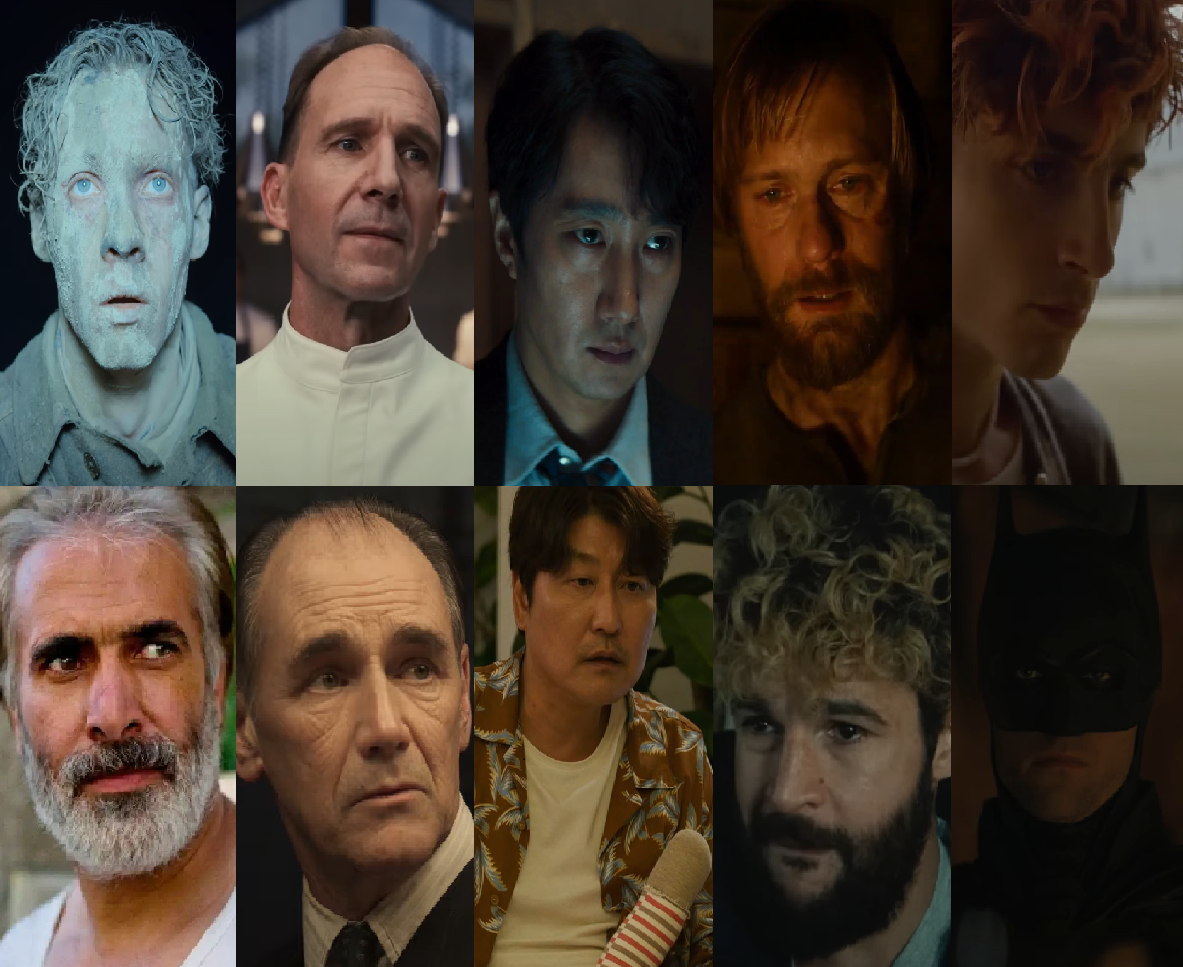
Alternate Best Actor 2022: Results

10. Song Kang-ho in Broker - Song brings a  naturalistic and charming chemistry even if the film tasks him to go into some less than natural directions for this character late in the film. 

Best Scene: Seeing his daughter. 
9. Robert Pattinson in The Batman - Pattinson gives a great depiction of Batman that gives a greater insight within the development of the character and the different shades of his identity. 

Best Scene: "Bruce WAAAYNE"
8. Christopher Abbott in On the Count of Three - Abbott gives a captivating depiction of a man on an extreme mental edge that manages to be intense, heartwrenching but also at times rather funny. 

Best Scene: Seeing the high school bully. 
7. Mehdi Bajestani in Holy Spider - Bajestani gives an extremely disturbing portrayal of a man whose depravity goes far beyond just psychopathy. 

Best Scene: "Not Crazy"
6. Mark Rylance in The Outfit - Rylance amplifies his film every step of the way, giving a consistently captivating portrayal of a man who essentially weaponizes modesty. 

Best Scene: "I'm the mole"
5. Alexander SkarsgĂ¥rd in the Northman - SkarsgĂ¥rd delivers a powerful performance that goes beyond just his tremendous physical presence and also gives a potent portrayal of the emotional weight of his journey. 

Best Scene: The Queen's truth. 
4. Felix Kammerer in All Quiet on the Western Front - Kammerer gives a heartbreaking portrayal of the effects of war, both in terms of the bonds between soldiers and of the terrible mental degradation from the losses and horrors suffered throughout his experience. 

Best Scene: In the crater. 
3. TimothĂ©e Chalamet in Bones and All - Chalamet delivers for me his best performance, that offers an honest off-beat charisma, a fantastic chemistry with his co-star, and a powerful emotional vulnerability, all in his depiction of a cannibal. 

Best Scene: What really happened with his dad. 
2. Ralph Fiennes in The Menu - Fiennes gives an amazing performance that manages to be extremely intense, but also incredibly hilarious as his hate and regret filled killer chef. 

Best Scene: A cheeseburger. 
1. Park Hae-il in Decision to Leave - Park gives an entirely captivating and absolutely haunting portrayal of obsession. 

Best Scene: The snowy mountain.
Overall:
  1. Colin Farrell in The Banshees of Inisherin
  2. Park Hae-il in Decision to Leave
  3. Bill Nighy in Living
  4. Ralph Fiennes in The Menu
  5. Timothée Chalamet in Bones and All
  6. Felix Kammerer in All Quiet on the Western Front
  7. Paul Mescal in Aftersun
  8. Alexander SkarsgĂ¥rd in the Northman
  9. Mark Rylance in The Outfit
  10. Mehdi Bajestani in Holy Spider - 5
  11. Ram Charan in RRR
  12. N.T. Rama Rao Jr in RRR
  13. Christopher Abbott in On the Count of Three
  14. Robert Pattinson in The Batman
  15. Mark Rylance in The Phantom of the Open
  16. Song Kang-ho in Broker
  17. Adeel Akhtar in Ali & Ava
  18. Jonathan Majors in Devotion
  19. Denis Ménochet in As Bestas
  20. Daniel Giménez Cacho in Bardo
  21. Daryl McCormack in Good Luck To You, Leo Grande
  22. Eden Dambrine in Close
  23. Gang Dong-won in Broker
  24. Jeremy Pope in The Inspection
  25. Daniel Kaluuya in Nope
  26. Austin Butler in Elvis
  27. Gabriel Labelle in The Fabelmans
  28. Ricardo Darin in Argentina, 1985
  29. Brendan Fraser in The Whale
  30. Diego Calva in Babylon 
  31. Ben Foster in The Survivor
  32. John Boyega in Breaking - 4.5
  33. Daniel Craig in The Glass Onion
  34. Michael Ward in Empire of Light
  35. Adam Driver in White Noise
  36. Antonio Banderas in Puss in Boots: The Last Wish
  37. Jack Lowden in Benediction
  38. Jerrod Carmichael in On the Count of Three
  39. Colin Farrell in After Yang 
  40. Brad Pitt in Babylon
  41. Idris Elba in Three Thousand Years of Longing
  42. Nicolas Cage in The Unbearable Weight of Massive Talent
  43. Adam Sandler in Hustle
  44. Harris Dickinson in Triangle of Sadness
  45. Rory Kinnear in Men
  46. Donald Elise Watkins in Emergency
  47. Peter Lanzani in Argentina, 1985
  48. Ali Junejo in Joyland
  49. Tom Cruise in Top Gun: Maverick
  50. Will Smith in Emancipation
  51. Viggo Mortensen in Crimes of the Future
  52. RJ Cyler in Emergency 
  53. Peter Capaldi in Benediction
  54. Sterling K. Brown in Hong For Jesus. Save Your Soul
  55. Kenneth Branagh in Death on the Nile - 4
  56. Colin Farrell in Thirteen Lives
  57. Viggo Mortensen in Thirteen Lives
  58. Jon Hamm in Confess Fletch
  59. Dali Benssalah in Athena
  60. Yahya Abdul-Mateen II in Ambulance
  61. Glen Powell in Devotion
  62. Benedict Cumberbatch in Dr. Strange in the Multiverse of Madness
  63. Christian Bale in The Pale Blue Eye
  64. Gregory Mann in Pinocchio
  65. Jake Gyllenhaal in Ambulance 
  66. Sami Slimane in Athena
  67. Elliott Crosset Hove in Godland
  68. Zach Efron in The Greatest Beer Run Ever
  69. Christoph Waltz in Dead for a Dollar
  70. Ryan Gosling in The Gray Man 
  71. Joe Alwyn in Stars At Noon - 3.5
  72. Daniel Radcliffe in Weird
  73. Chris Hemsworth in Thor: Love and Thunder
  74. Karl Urban in The Sea Beast 
  75. Luke Evans in Scrooge: A Christmas Carol
  76. Chris Evans in Lightyear 
  77. Jake Gyllenhaal in Strange World - 3
  78. Banks Repeta in Armageddon Time
  79. Sam Rockwell in See How They Run
  80. Brad Pitt in Bullet Train 
  81. Hugh Jackman in The Son - 2.5
  82. Eddie Redmayne in Fantastic Beats: The Secrets of Dumbledore 
  83. Sam Worthington in Avatar: The Way of Water
  84. Daniel Zolghadri in Funny Pages
  85. Will Ferrell in Spirited - 2
  86. John David Washington in Amsterdam
  87. Christian Bale in Amsterdam
  88. Ryan Reynolds in Spirited
  89. Chris Pratt in Jurassic World: Dominion
  90. Mason Thames in The Black Phone 
  91. Dwayne Johnson in Black Adam
  92. Peter Billingsley in A Christmas Story Christmas - 1.5
  93. Cooper Raiff in Cha Cha Real Smooth - 1
Next (eventually): 1961 Lead

Alternate Best Actor 2022: Mehdi Bajestani in Holy Spider

Mehdi Bajestani did not receive an Oscar nomination for portraying Saeed Hanei in Holy Spider. 

Holy Spider depicts a reporter trying to track a serial killer who targets prostitutes in Iran. 

Mehdi Bajestani plays the role of the serial killer, whom we know is the serial killer fairly quickly within the narrative, and the film is less about catching the killer than looking at the society around this killer. Bajestani's performance is bluntly very disturbing, and disturbing in a way that is unique within portrayals of a serial killer, no small feat in itself given how oft portrayed of a type of character it is. Bajestani's performance is disturbing in particular because it is so many things in it that make it such a chilling portrait of such a man. On the most immediate surface are the moments of the actual killings. The actual killings are extremely unnerving as Bajestani's performance accentuates two things that make Hanei such a nefarious figure. One aspect is the ease of the transition to the killings. Bajestani never portrays these moments as something that Hanei needs to work up rather the nature of the man is to kill and to kill is not something that is difficult for him. The actual killing that comes off as so quick, but also is truly so sickening is the sense of satisfaction that he presents in everyone. Bajestani doesn't portray it as an urge the man needs to control, rather it is the urge that propels him forward to do so at all times. It is something that gives him great satisfaction and we see this in his intense manner in every moment. It is very much a sexually vicious and horrible act and his face expresses this evil as the innate nature of the man simply doing what it does. 

The performance actually has some things in common with films like The Vanishing, because we also see the serial killer in his home life with his wife and son, as the loving family man. Bajestani is as convincing as the loving family man as the killer, but I think the interesting thing about his work is he doesn't put on a false face in either depiction. In both, he is the same man, and in a very disturbing sense, the man is as comfortable in both lives and therefore doesn't really even hide anything beyond avoiding being caught as a criminal. Bajestani honestly brings a great deal of warmth in the moments that Hanei is interacting with his son. He doesn't subvert either at any point he shows that the man does love his son at every one of his points. He even loves his wife as again Bajestani presents it with real sincerity. The man simply is living as a seemingly normal man successfully there is no strain to this there is nothing suggesting that he isn't comfortable in this life. This may seem like something is missing in Bajestani's performance but this choice to actually make the man as convincing in both lives is essential in crafting the true motivations of this man, which is in part psychopathy, but it isn't only psychopathy that fuels the man. As we see Bajestani doesn't portray the two sides of the man as the real and the fake, or the evil and the good, he rather shows the man at home, and the man living out essentially his hobby. 

We see this in the scenes before the killing itself which Bajestani portrays in a particularly insidious way because it is two-fold, one is the man going about his evil in a way, but the other is the man indulging even before he gets to the killing. We see the scenes of him with the prostitutes before the killing begins and Bajestani is again sincere in the enjoyment of the debauchery even before the killing. He shows that the man loves the act of playing with the prostitutes, not even as prey, but wholly with their services at first. Bajestani very much emphasizes the enjoyment of the man getting out of the fantasies he does enjoy as a pure hypocrite as we will later learn. And with that Bajestani reveals it as part of the disgusting process of the man indulging in this kind of behavior before going about the killing as this merged act. It isn't one other the other, but a combination that brings the man such horrible pleasure as he goes indulging in his appetite for sex and violence in equal measure. The key to this is one scene where one of the prostitute kind of equally enjoys the "game" at first and kind of plays with the whole twisted sensibility a bit. Bajestani is amazing in this scene because of just how scared he shows Hanei becomes in the moment. His manner becomes impotent and almost terrified as the woman gets the upper hand on him and questions him in a way. Bajestani shows the real sick pathetic nature of the man as the moment his fantasy is broken in the slightest he's completely lost. 

Hanei eventually gets caught when the reporter goes undercover and finds him. And the scene of Hanei getting arrested is where we enter the next phase of his performance which is equally disturbing just in a completely different way. This is when Hanei is approached by cops Bajestani basically plays with a kind of slightly ashamed but almost joyful manner of the man just as though he's going to need to explain something silly away. There is no sense of the man being concerned about being caught even rather there is almost a strange kind of pride in him as he's going to be called upon for his crimes. This only worsens as he stands trial for his crimes, despite the joy of his sexual depravity, he positions himself as a moral crusader against "low" women. Here is where we see such true insidious work by Bajestani because he presents Hanei as wholly believing his argument and selling every word of it with the utmost conviction. He is is a man who does believe himself in this delusion that he was doing the right thing all along. Bajestani's whole manner is as a moral crusader firebrand in the courtroom scenes. He brandishes his crimes as accomplishments without a hint of shame or anything other than a disparaging manner to his victims and a despicable attempt to portray himself as morally righteous. We see specific moments where he speaks this fact with his son around and his manner towards his son as basically "Look at what dad did", and Bajestani is outstanding in presenting this moral corruption with such ease. 

The only point in which there is any hesitation whatsoever on the side of Hanei is when his lawyers want to save him from the death penalty by presenting him as insane. Bajestani oddly shows the only pure humanity in the character in the little bit of concern he expresses in seeing how his son will see him if he is seen as insane. Of course, that bit of humanity is wrapped around the diseased idea that he is any kind of moral man and therefore needs to present himself as such to his son. Bajestani is fantastic because he is able to make this derangement so very natural in its state and shows the man basically getting gratification for his crimes based on believing it is what is right. Bajestani's whole performance is this twisted "on the stand testimony" moment of grandiose grandstanding, but for his hideous cause as refuses to be seen as crazy. Even after being sentenced to death Bajestani's performance still exudes a man so confident in his state of being that is particularly horrible to see as he so smugly takes in an "offer" from some men that instead of being executed he will be taken away to freedom. Bajestani through the whole process of Hanei's execution consistently shows this man still soaking up seemingly this sense of righteousness as though he will get away with his crimes, and makes these moments particularly frustrating because of how genuine they feel. In turn, it is hard not to feel some catharsis when it is revealed the whole "escape" was nothing but a ruse to get him to the execution chamber without raising a fuss. Bajestani's performance is great at the moment because you finally see the illusion shattered and since his imprisonment a real sense of fear of actually receiving justice for his crimes. Bajestani presents this as the man finally realizing that his society won't protect his hatred of women up to this point. Bajestani showing the fundamental fall of the man becoming a pathetic mess as he can no longer hold onto his delusions. This is a great performance by Mehdi Bajestani as he doesn't give one disturbing portrait of depravity but multiple. He is the psychopath, he is the disgusting sexual sadist, but perhaps worst of all, he is utterly convincing as a man who views his moral depravity as a righteous cause.   

Friday, 24 February 2023

Alternate Best Actor 2022: Park Hae-il in Decision to Leave

Park Hae-il did not receive an Oscar nomination for portraying Det. Jang Hae-jun in Decision to Leave. 

Decision to Leave is the captivating neo-noir of a detective dealing with the mysterious wife of a man who fell off a mountain. 

Park Hae-il fills a classical role, mixed in with a whole lot of different ideas from this genre as crafted by Park Chan-wook. You have at the center very much the lead of so many noirs, as the straightlaced detective whose moral state is questioned by a femme fatale, a bit of very directly the detectives from both versions of Insomnia, and of course a strong dose of Jimmy Stewart from Vertigo. We open the film fittingly then with Park as the upright detective, against his less-so partner Soo-wan, as they go about their duties in the police department. Park's performance leans into the strait lace in the way of just a very precise man as he goes about his initial duties. He speaks to Soo-wan with an innate kind of authority as he speaks about their ongoing investigation of a known murder. That is wrapped around the idea of the character being constantly in a state of insomnia. Park makes this a fundamental aspect of his performance, as there is just some pressure within him that speaks to this at all times. He succeeds importantly in making it a given in always seeming at least slightly tired in these opening scenes, and showing a man where there is just a cloud over him. He doesn't overdo it, doesn't make it too severe, but rather creates the quiet sense of the man's burdens in his job wrapped within this state. 

We see his theoretical solace with his wife Jung-an (Lee Jung-hyun), a nuclear power plant worker who lives away from the big city, where Jang visits only on the weekends. This relationship is interesting because it isn't quite the obvious bad relationship you might see in a lesser version of this story. Rather Jung-an is perfectly loving towards Jang in an often very flirtatious way even if in a slightly overbearing way in which she kind of diagnoses him and makes regular check-ins regarding the state of their relationship. Park doesn't present Jang's manner in this relationship as anything that is not pure in the stance of just trying to love Jung-an back as much as he can, as he makes always make dinner for them and certainly frequently attentively listens to her. Park doesn't present as something that is actively weighing on him in any way, however, what Park manages to do with his performance is show the way this relationship is very much a passive one for Jang. He shows that Jang is very much listening to his wife, but in a way too often just listening to the point she is always the one talking without really the natural give and take you might expect. Park presents the way Jang very much differs just into a state of malaise, not of one that seems actively painful, but at the same time, there is not the sense of comfort or intrigue in it either. They are together, but it isn't a sense of a striking connection by any means. 

What Park effectively does between the at-home scenes and his working scenes is show the contrast between the two sides of Jang and in a way show that at home Jang is very different, maybe too different, from his existence at work. Because at work, even with the sense of the man's insomnia, Park shows a man much more active and assured in his manner. He presents Jang as very much a detective with conviction as he goes about his task, and creates the right striking presence of someone with that innate drive within his profession. When he discovers a man who has died falling off a mountain even, Jang investigates this by going up the mountain the same way, and in presenting this Park's performance is very much of this sense of calculation and care to his approach as an investigator. Park does what is really essential for any great portrayal of a detective whom we are following, which is to bring the audience into his sense of investigative thinking, so we are with the detective rather than just merely watching him. Park achieves is this in any scene where Jang and his partner are investigating it is never just simple reaction shots from him, rather he consistently creates the potent sense of Jang's mind taking the various clues in and trying to decipher what it is that is going on at this crime scene. He manages within his performance to create the appropriate sense of the investigative mind that defines who detective Jang is. 

The key complication of the film is the death of the man which leads Jang and his partner to look at his much younger wife, also a Chinese immigrant, Song Seo-rae (Tang Wei). And this is the central relationship within the film which develops itself in very unexpected ways throughout the film. In the beginning, she is just a suspect, however, Park's performance effectively plants the seeds right away just in his reactions to seeing Seo-rae where there is this subtle sense of captivation in her. It could be mistaken for just the suspicion of a detective but soon it is clear more than that. We see this initially through the contrasting opinions of the case between the more seasoned and professional Jang, against his fairly slobbish partner Soo-wan (Go Kyung-pyo), who may be a bit of a slob however his suspicions about Seo-rae do make some good points. Park's performance is terrific in being able to find the nuance in this state of denial in approaching it as such. For example denies her lack of obvious grief with a bit of a poetic aside, which Park delivers with sincerity but sincerity that alludes to fascination. When asking her to do anything to get more information for the investigation, Park speaks every word with kindness, perhaps too much kindness, and an obviously kind of strict sort of patience. 

The development of the relationship between the two is quite fascinating because it isn't initially this standard sort of chemistry between the two. Rather initially it is of the flirtation between the surface. Such as when Park takes a more intimate photo of injuries she has sustained from her husband. Park initially falls into this expected professional routine of calling in a policewoman to handle the photo and is perfectly awkward in trying to avoid the more overt sexual nature of the moment. When Seo-rae balks at the suggestion, Park's reaction denotes this internalized intrigue in the act and the growth of an essential fascination with her even while technically going about his duty. And what we see Park cultivate in the successive scenes of further investigation, prodded on by Soo-wan who thinks Jang is smitten with the woman, we see in Park's performance a particularly potent combination in the act of observation. It is great to work as performed because Park is able to convey still Park's attempt to maintain his professional distance, however, when observing her there is this combination of a building intensity of obsession and this strange kind of comfort when observing her. Park doesn't present it as an obvious lust but rather the man experiencing some notions that he simply doesn't get from seeing his wife, and Parks shows Jang being pulled into woman's allure. 

Importantly in this progression towards obsession, we do see Jang still very much the professional in another seemingly more straightforward murder investigation where we see him take down one of the men with a strict sense of determination and really aliveness within the act. We see him further admonish Soo-wan less than deft hand at faulty interrogation, and Park is great in his delivery of the correcting description with a specific sense of duty within it. His eyes are disappointed towards Soo-wan as a teacher disappointed in a student going in the wrong direction. In all of this, we see Jang as the investigator a man in his wheelhouse who is great at his job. And with Seo-rae we see the meeting of the world of the potentially romantic with this world. And the interaction between the two really is about all the little moments of interaction that build towards something more substantial. That is in a suggestive glance, but also just the way the two eat a sushi meal together. I love the performance of Wei and Park in this scene because it isn't about going big in any kind of lust in that moment, rather the sense of this strict sort of pleasant comfort between the two in what is a normal act, made less so by circumstance but not by the process in which we see the two go about it. 

Seo-rae ends up becoming more than suspect, not as an obvious sort of lust-filled interest, but rather a genuine romantic interest as the two progress. As the two connect not based on overt sexuality but rather a connection of personal interest. And the two's chemistry is unusual because the development is more gradual almost as we see them through the first few dates of a relationship where both parties are a little bit reserved. Take just the moment when Park takes in their mutual interest in the sea, where Jang doesn't hold on to it long just long enough to appreciate it. Then when she visits his apartment, providing guidance on a murder investigation, the sheer energy in the expression of the act we see Park as a new man in some respects. When he cooks for her there is so much spirit to it, far less than a domestic chore. When she provides some ASMR to help get him to sleep, Park expresses the purest form of a man finding true relaxation in her lullaby of sorts. The performances of both Wei and Park in their sort of "date" scene are amazing to work because each, especially Park who shows Jang isn't trying to get anything extra out of it other than be with her, put so little weight in the scene. Rather if you took the scene in isolation it could nearly be just a wonderful full date between the two, as at the moment they no longer feel like detective and suspect but something far more. 

And for the rest of the review to go on a spoiler alert is essential to dive into the intricacies of it, as both murder investigations come to a head. The first is the street gangster which just deserves mention for Park's performance which is so different from the rest of his performance but it wholly works at the moment. When he has the criminal dead to rights but is still threatened with a weapon, Jang distracts him by noting his romantic concerns, and Park shifts his delivery wholly to something kind of overtly romantic and of a different man from Jang. As almost a comic moment that wholly works though as we see it as a play, even if there seems some genuine emotion in it, as Jang basically says "psyche" and shoots the man to drop him quickly. The other is the investigation of Seo-rae, which is first closed as a suicide, however by chance further evidence proves that she in fact did kill her husband, while also destroying key evidence seemingly having manipulated Jang to help her do this. Park is outstanding in the confrontation scene because of how bluntly he expresses he presents the feeling of betrayal. The betrayal though is wrapped not in hate but actually in a sense of love in it. Park's delivery of Jang's frustration isn't as negatively inclined as it probably should be rather he effectively shows the profound effect Seo-rae has had on him by just how lost he is in every word. Park shows a man who unfortunately is still obsessed by Seo-rae and broken for it. 

To escape it all Jang moves to a smaller city with his wife, where the relationship really is even less than it was before, though again I appreciate that Park doesn't overplay this discontent. Rather he shows this sense of resignation as she continues to make all sorts of suggestions for him and we see a man just going through the motions, and indeed perhaps dying a bit inside at every turn. Unfortunately, things only get more complicated when Seo-rae appears with a new husband and the couple meet each other at a fish market. This is low-key one of Park's best scenes because he is able to say so much really in every moment of it. This is from his subdued yet still the extremely potent reaction to seeing Seo-rae and embodies still his fascination with her, the surprise of seeing her, and the desperate frustration within himself associated with her. My favorite aspect is Park's performance as a reflection to see how he is with his wife around others. Where he is nearly a husk who just directly repeats anything she particularly would like to hear from him, without any real passion but just the slightest hint of a husbandly duty that propels him through it. Park in the moment though shows the sorry state of Jang in the moment who just is completely lost in this relationship and in this city at this point. 

Matter quickly get more complicated as Seo-rae's new husband is also found dead. Park is amazing in the scene of the investigation in being just completely fed up with her at first, and just exuding this pent-up frustration in thinking she's purposefully played him again. Where now Jang was slow peddling the suspicion towards her, Park now exuding a determined suspicion since really he does know better, despite his small-time new partner, who also hero-worships him, wanted to take Seo-rae at her word not knowing any better. This investigation to doesn't go the expected way, and Park is incredible in embodying the immediate switches, and the emotional swings of Jang throughout this sequence. Where his performance is outstanding is the fact that he never gets lost for a moment, nor does one moment seem too sudden to the next. As his determination changes to release his old fascination with Seo-rae again, as she insists there was genuine feeling between them. Park's reaction in the scene is great because he doesn't show himself going to their old state, even when kissing her, in that he is almost in this state of arrested emotional development in being just wholly lost on how exactly to react as his eyes denote the feelings for her are unquestionably strong yet still is the state of frustration over the past betrayal. 

Jang through this still trying to investigate properly, where he finds Seo-rae didn't kill her husband but did kill someone else to lead to her husband's death. In each revelation Park now shows the building towards the climax of the film, as every bit of the sheer complication of this relationship is in Park's increasingly frantic and really broken state, which only exacerbates things his wife leaves him based on her suspicions of an affair. Park shows the man as no longer able to really hold himself together through his duties as a detective, even as all of it leads to the revelation that Seo-rae is a murderer, but also did love him. Leading to a final scene of Jang desperately trying to find her, unbeknownst to him she has already set up her suicide. Park is astonishing in this scene because he shows all of it come out in this moment, and is this earned release of everything Jang has been holding out. Park now shows Jang wearing his desperation, his obsession for her, his love for her but also the tragedy of losing her in this moment. Park makes Jang this complete mess and is heartbreaking in showing the man truly just lost both in terms of finding her and completely emotionally as he searches for the woman who broke his very existence. This is a masterful performance by Park Hae-il, because he never gets lost in the narrative even when the character technically often is. He brings us so tangibly into this man's state, through every facet of his investigation but also more importantly his obsession.