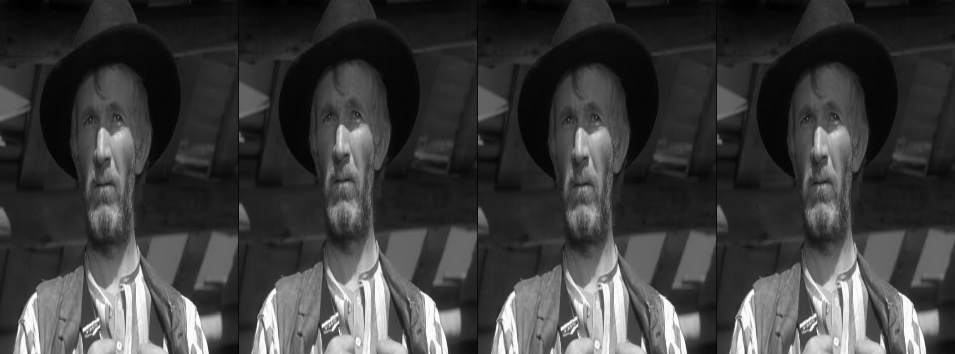
5. Pierre Brasseur in Eyes Without a Face - Brasseur gives an unorthodox and effective portrayal of a mad scientist, by emphasizing a subdued professionalism that is rather chilling.
Best Scene: The Doctor encourages his daughter to enjoy her new face.
4. Karlheinz Böhm in Peeping Tom- Böhm's work is unsettling as he allows the viewer to understand his killer's mind.
Best Scene: The studio murder.
3. Alain Delon in Purple Noon- Delon gives a very strong performance as he manages to capture the peculiar nature of Tom Ripley.
Best Scene: Tom tells Phillipe his plan.
2. Alec Guinness in Tunes of Glory- Guinness gives a compelling performance capturing a peculiar sort of bully who struggles to understand his own wrongdoing.
Best Scene: The final speech.
1. Richard Attenborough in The Angry Silence- Attenborough gives a moving and very effective portrayal of a modest man being slowly pushed to the edge.
Best Scene: "Shut up"
Updated Overall
Next Year: 1960 Supporting
Showing posts with label Richard Attenborough. Show all posts
Saturday, 15 October 2016
Monday, 10 October 2016
Alternate Best Actor 1960: Richard Attenborough in The Angry Silence
Richard Attenborough did not receive an Oscar nomination, despite receiving a BAFTA nomination, for portraying Tom Curtis in The Angry Silence.
The Angry Silence is a rather effective film about a man who refuses to join in his Union in an unofficial strike.
Richard Attenborough will always be one of the most underrated and best actors who has ever lived. I've had the privilege to cover several of Attenborough's underrated turns, there's no such thing as an overrated or even properly praised turn by him.The Angry Silence though seems even under seen as Attenborough fair goes, although that falls right in line with the work of the underrated Guy Green as a director. Attenborough here plays a very modest role. Tom Curtis is just a factory worker with a family. He has a wife Anna (Pier Angeli) and two kids, there's nothing out of the ordinary about the man. Attenborough gives a matching performance in the early scenes of the film. He's got that usual low key Attenborough charm, but just in a very natural fashion. It is interesting the way Attenborough actually doesn't try to make Tom stand out in these scenes. Oh he's still engaging, Attenborough just naturally has this certain magnetism about him, but Attenborough really let's Tom just be a normal guy, no more no less.
There is such honesty in Attenborough's depiction of essentially the nature of Tom. In the scenes with his wife Attenborough is excellent in exuding a genuine love though with understandable minor difficulties that still are apparent. I particularly love the way Attenborough brings so much real affection in whenever Tom apologizes for yelling, which he also depicts as only short minor outbursts natural to basically anyone. Tom is probably even more modest at work. Attenborough only presents him as a man who just wants to be able to go about his business. He shows a man who just really wants to work, though he always portrays a proper camaraderie with the other workers as they go about their duties. A curious problem arises though when the talk of a strike begins, mainly through the efforts of a purposeful rabble rouser, despite the fact that that Union itself is not properly officiating it. When the vote is called, Tom votes against it, but Attenborough's earnest face only reveals a man voting with only his conscience, though with perhaps a bit of nervousness due to being part of the minority group.
The group Tom is part of, because of the unofficial nature of the strike, decide to continue to work much to the outrage of the rest of the workers. This leads to reprisals by the rest of the workers as they harass the other men. This leads the anti-strikers group to just join the strike. Tom though is visited by one of the heads of the strike Bert (Bernard Lee). Attenborough is great in this scene because he very much keeps Tom his modest self as he speaks about why he continued to work. The passion Attenborough brings behind this is clear but muted fitting the man who we have known up until this point. Tom even seems to be even willing to agree to stop their counter strike of sorts, just to get it all over with. The problem is Bert decides to push the issue and attempts to illicit some sort of apology from Tom. Attenborough brings such power in his reaction as he reveals a man who doesn't really wish to act out but has no other choice. The real passion in Tom is shown by Attenborough as he states with such conviction his distaste in the strikers' actions because they threatened his family.
Tom decides to continue to strike, even though they other dissenters have stopped, so when they return to work the remaining workers choose to ostracize Tom by giving him the silent treatment. Attenborough is incredibly moving in portraying such quiet sadness in Tom as he's so poorly treated by his former friends. Again Attenborough makes it all the more palatable because he stays true to Tom's nature at every turn. Attenborough though wears the pain so well as a man who still always tries to hide it best he can. There's a terrific moment where Tom is interviewed by a reporter, who doesn't wish to help Tom at all, about his treatment. Attenborough conveys the way Tom is holding back as he does not want to say to much, but cannot help but still stay the true in his own unassuming way. This only becomes worse for Tom though as the management really doesn't care for him, and the workers only continue to make his life worse. This goes so far as they begin to do whatever it takes to get him to leave, which eventually leads to his son being attacked at school.
Attenborough is incredible in the way he builds the volcanic pressure in Tom. It is gradual yet especially striking through the way Attenborough earns this from the modest man that it is Tom. He never rushes this yet lets it build to the moment in which Tom breaks and he finally unleashes his outrage against the crowd. Attenborough is tremendous as you feel that everything Tom has pent up is coming out in this moment. Attenborough also makes the scene rather heartbreaking though because he shows how this treatment has brought Tom to a point that is essentially against his nature as a person. Tom ends up going against the second unofficial strike and Attenborough unquestionably makes this believable. He's outstanding because he realizes such a strong conviction that is always that of the man Tom has always been, and is actually the cruelty he has suffered that has caused him to reach this point. It's a brilliantly realized arc by Attenborough since he so naturally portrays this quiet man being pushed to the edge.
The Angry Silence is a rather effective film about a man who refuses to join in his Union in an unofficial strike.
Richard Attenborough will always be one of the most underrated and best actors who has ever lived. I've had the privilege to cover several of Attenborough's underrated turns, there's no such thing as an overrated or even properly praised turn by him.The Angry Silence though seems even under seen as Attenborough fair goes, although that falls right in line with the work of the underrated Guy Green as a director. Attenborough here plays a very modest role. Tom Curtis is just a factory worker with a family. He has a wife Anna (Pier Angeli) and two kids, there's nothing out of the ordinary about the man. Attenborough gives a matching performance in the early scenes of the film. He's got that usual low key Attenborough charm, but just in a very natural fashion. It is interesting the way Attenborough actually doesn't try to make Tom stand out in these scenes. Oh he's still engaging, Attenborough just naturally has this certain magnetism about him, but Attenborough really let's Tom just be a normal guy, no more no less.
There is such honesty in Attenborough's depiction of essentially the nature of Tom. In the scenes with his wife Attenborough is excellent in exuding a genuine love though with understandable minor difficulties that still are apparent. I particularly love the way Attenborough brings so much real affection in whenever Tom apologizes for yelling, which he also depicts as only short minor outbursts natural to basically anyone. Tom is probably even more modest at work. Attenborough only presents him as a man who just wants to be able to go about his business. He shows a man who just really wants to work, though he always portrays a proper camaraderie with the other workers as they go about their duties. A curious problem arises though when the talk of a strike begins, mainly through the efforts of a purposeful rabble rouser, despite the fact that that Union itself is not properly officiating it. When the vote is called, Tom votes against it, but Attenborough's earnest face only reveals a man voting with only his conscience, though with perhaps a bit of nervousness due to being part of the minority group.
The group Tom is part of, because of the unofficial nature of the strike, decide to continue to work much to the outrage of the rest of the workers. This leads to reprisals by the rest of the workers as they harass the other men. This leads the anti-strikers group to just join the strike. Tom though is visited by one of the heads of the strike Bert (Bernard Lee). Attenborough is great in this scene because he very much keeps Tom his modest self as he speaks about why he continued to work. The passion Attenborough brings behind this is clear but muted fitting the man who we have known up until this point. Tom even seems to be even willing to agree to stop their counter strike of sorts, just to get it all over with. The problem is Bert decides to push the issue and attempts to illicit some sort of apology from Tom. Attenborough brings such power in his reaction as he reveals a man who doesn't really wish to act out but has no other choice. The real passion in Tom is shown by Attenborough as he states with such conviction his distaste in the strikers' actions because they threatened his family.
Tom decides to continue to strike, even though they other dissenters have stopped, so when they return to work the remaining workers choose to ostracize Tom by giving him the silent treatment. Attenborough is incredibly moving in portraying such quiet sadness in Tom as he's so poorly treated by his former friends. Again Attenborough makes it all the more palatable because he stays true to Tom's nature at every turn. Attenborough though wears the pain so well as a man who still always tries to hide it best he can. There's a terrific moment where Tom is interviewed by a reporter, who doesn't wish to help Tom at all, about his treatment. Attenborough conveys the way Tom is holding back as he does not want to say to much, but cannot help but still stay the true in his own unassuming way. This only becomes worse for Tom though as the management really doesn't care for him, and the workers only continue to make his life worse. This goes so far as they begin to do whatever it takes to get him to leave, which eventually leads to his son being attacked at school.
Attenborough is incredible in the way he builds the volcanic pressure in Tom. It is gradual yet especially striking through the way Attenborough earns this from the modest man that it is Tom. He never rushes this yet lets it build to the moment in which Tom breaks and he finally unleashes his outrage against the crowd. Attenborough is tremendous as you feel that everything Tom has pent up is coming out in this moment. Attenborough also makes the scene rather heartbreaking though because he shows how this treatment has brought Tom to a point that is essentially against his nature as a person. Tom ends up going against the second unofficial strike and Attenborough unquestionably makes this believable. He's outstanding because he realizes such a strong conviction that is always that of the man Tom has always been, and is actually the cruelty he has suffered that has caused him to reach this point. It's a brilliantly realized arc by Attenborough since he so naturally portrays this quiet man being pushed to the edge.
Monday, 19 September 2016
Alternate Best Actor 1960
And the Nominees Were Not:
Richard Attenborough in The Angry Silence
Pierre Brasseur in Eyes Without a Face
Alec Guinness in Tunes of Glory
Karlheinz Böhm in Peeping Tom
Alain Delon in Purple Noon
Richard Attenborough in The Angry Silence
Pierre Brasseur in Eyes Without a Face
Alec Guinness in Tunes of Glory
Karlheinz Böhm in Peeping Tom
Alain Delon in Purple Noon
Sunday, 9 November 2014
Alternate Best Supporting Actor 1977: Results
5. Peter Cushing in Star Wars - Cushing gives an effectively evil performance making the most out of his very simple role.
Best Scene: Testing the Death Star.
4. Dirk Bogarde in Providence - Bogarde is good enough in his rather broad scenes as an excessively cold man, but his best scene is in portraying the warm version of the man.
Best Scene: Clive's Birthday.
3. Richard Attenborough in The Chess Players - Attenborough has a limited part but makes a strong impact as usual with his powerful screen presence.
Best Scene: Outram's introduction.
2. James Mason in Cross of Iron - Mason gives a great portrait of the quiet exasperation and sadness of a man who still fulfills his duties while having no real passion for it.
Best Scene: Colonel Brandt sends Captain Kiesel away.
1. Dennis Hopper in The American Friend - Well this was no contest for me as Hopper just stood easily above the rest. Hopper's version of Tom Ripley is absolutely compelling, chilling and yet surprisingly moving.
Best Scene: The Train Murder.
Overall Rank:
Best Scene: Testing the Death Star.
4. Dirk Bogarde in Providence - Bogarde is good enough in his rather broad scenes as an excessively cold man, but his best scene is in portraying the warm version of the man.
Best Scene: Clive's Birthday.
3. Richard Attenborough in The Chess Players - Attenborough has a limited part but makes a strong impact as usual with his powerful screen presence.
Best Scene: Outram's introduction.
2. James Mason in Cross of Iron - Mason gives a great portrait of the quiet exasperation and sadness of a man who still fulfills his duties while having no real passion for it.
Best Scene: Colonel Brandt sends Captain Kiesel away.
1. Dennis Hopper in The American Friend - Well this was no contest for me as Hopper just stood easily above the rest. Hopper's version of Tom Ripley is absolutely compelling, chilling and yet surprisingly moving.
Best Scene: The Train Murder.
- Dennis Hopper in The American Friend
- Maximilian Schell in Cross of Iron
- Harvey Keitel in The Duellists
- Harrison Ford in Star Wars
- James Mason in Cross of Iron
- David Warner in Cross of Iron
- Alec Guinness in Star Wars
- James Caan in A Bridge Too Far
- Anthony Hopkins in A Bridge Too Far
- Barry Miller in Saturday Night Fever
- Richard Attenborough in The Chess Players
- Anatoly Solonitsyn in The Ascent
- Jeroen Krabbe in Solider of Orange
- Robert Redford in A Bridge Too Far
- John Cassavetes in Opening Night
- David Gulpilil in The Last Wave
- Edward Fox in A Bridge Too Far
- Dirk Bogarde in Providence
- Gerard Blain in The American Friend
- Jason Robards in Julia
- Robert Fortier in 3 Women
- Tom Conti in The Duellists
- Sean Connery in A Bridge Too Far
- Peter Cushing in Star Wars
- Maximilian Schell in A Bridge Too Far
- Fancisco Rabel in Sorcerer
- James Earl Jones in Star Wars
- James Whitmore in The Serpent's Egg
- Oleg Basilashvili in Office Romance
- Bill Macy in The Late Show
- Edward Fox in Soldier of Orange
- Amidou in Sorcerer
- Laurence Olivier in A Bridge Too Far
- Martin Shakar in Saturday Night Fever
- Norman Alden in I Never Promised You a Rose Garden
- Bob Balaban in Close Encounters of the Third Kind
- Klaus Lowitsch in Cross of Iron
- Edward Fox in The Duellists
- Christopher Walken in Annie Hall
- Dirk Bogarde in A Bridge Too Far
- Alun Armstrong in The Duellists
- Francois Trauffaut in Close Encounters of the Third Kind
- Albert Finney in The Duellists
- Klaus Kinski in Operation Thunderbolt
- Gene Hackman in A Bridge Too Far
- Eugene Roche in The Late Show
- David Warner in Providence
- Michael Caine in A Bridge Too Far
- Vincenzo Crocitti in An Average Little Man
- Hardy Kruger in A Bridge Too Far
- Bruno Cremer in Sorcerer
- Vas Bisoglio in Saturday Night Fever
- Romolo Valli in An Average Little Man
- Amjad Kahn in The Chess Players
- Tommy Lee Jones in Rolling Thunder
- Warren Oates in Sleeping Dogs
- Tony Roberts in Annie Hall
- Vadim Glowna in Cross of Iron
- Victor Banerjee in The Chess Players
- Roberts Blossom in Close Encounters of the Third Kind
- Maximilian Schell in Julia
- Tom Skerritt in The Turning Point
- Curd Jurgens in The Spy Who Loved Me
- John Considine in The Late Show
- Strother Martin in Slap Shot
- Paul Benedict in The Goodbye Girl
- Geoffrey Hearn in The Spy Who Loved Me
- Anthony Daniels in Star Wars
- James Earl Jones in The Exorcist II: The Heretic
- Ed McMahon in Fun With Dick and Jane
- Dick van Patten in High Anxiety
- Desmond Llewelyn in The Spy Who Loved Me
- Denholm Elliot in A Bridge Too Far
- Harvey Korman in High Anxiety
- Lou Gossett Jr. in The Deep
- James Stewart in Airport '77
- Bernard Lee in The Spy Who Loved Me
- Nicholas Ray in The American Friend
- Roger Fritz in Cross of Iron
- Elliot Gould in A Bridge Too Far
- Tom Berenger in Looking For Mr. Goodbar
- Fritz Weaver in Black Sunday
- Christopher Lee in Airport '77
- Paul Sorvino in Oh, God!
- Jim Jordan in The Rescuers
- Michael V. Gazzo in Black Sunday
- Ralph Bellamy in Oh, God!
- Jackie Gleason in Smokey and The Bandit
- Richard Kiel in The Spy Who Loved Me
- Max von Sydow in The Exorcist II: The Heretic
- Rena Santoni in I Never Promised You A Rose Garden
- John Vernon in A Special Day
- Jeff Carlson in Slap Shot
- Steve Hanson in Slap Shot
- William Atherton in Looking For Mr. Goodbar
- Colin Blakely in Equus
- Harrison Ford in Heroes
- Donald Pleasence in Oh, God!
- Mike Henry in Smokey and The Bandit
- Ryan O'Neal in A Bridge Too Far
- Mickey Rooney in Pete's Dragon
- Lionel Stander in New York, New York
- Ron Carey in High Anxiety
- Alan Feinstein in Looking For Mr. Goodbar
- James Mitchell in The Turning Point
- Lawrason Driscoll in Rolling Thunder
- Harry Andrews in Equus
- Lou Salerni in Sasquatch The Legend of Bigfoot
- Mikhail Baryshnikov in The Turning Point
- Richard Gere in Looking For Mr. Goodbar
Thursday, 6 November 2014
Alternate Best Supporting Actor 1977: Richard Attenborough in The Chess Players
Richard Attenborough did not receive an Oscar nomination for portraying General James Outram in The Chess Players.
The Chess Players is an interesting enough and enjoyable film about the comic story of two chess players as well the process that results of the Indian Kingdom that they live is about be taken over by the British.
Richard Attenborough is the one major western actor in the film as the British General in charge of dealing with Britain's involvement in India. Attenborough has about four scenes or so and often it is to state some sort of exposition that moves the plot of the British takeover a little bit more. Thankfully it's Attenborough in this role which could have been easily forgotten in a lesser actor's hands. Attenborough's considerable presence is once again on display as he instantly commands every scene he is in, in the way a General like Outram should do. Attenborough though is always so fantastic, once again here, in just providing character in the way in which he delivers his fairly simple lines as in Outram's first scene where he is asking for information on the culture of the Kingdom from one of his men.
Attenborough always lively performance style works particularly well here to keep these scenes quite engaging even with their relatively simple intents. Attenborough knows how to play the proper British type, after all he played that part to perfection in Guns of Batasi, but it does not feel though Attenborough is simply playing his character from that earlier film Major Lauderdale. General Outram is not there to push his own personal conviction rather those of the crown. Attenborough though carries himself beautifully with that right manner but in this case kinda makes it a tad less intense. Outram, for the moment, is trying to find a peaceful solution and Attenborough fittingly conveys a certain ease in this performance. This is not to say he portrays Outram as not slightly taken aback by the Indian ways as Attenborough has a gentle critical manner as Outram asks certain questions to his man to try to get a bead on the people he must deal with.
Attenborough is quite effective here as he does not portray Outram as simply wishing to brush of the Indians as quickly as possible. Attenborough does portray the right forceful and that restricted passion key for his character. There's a palatable power in the personality he gives Outram as he learns of the new developments as well as goes about trying to negotiate with either the King or even his mother. What I really like about Attenborough's performance is the subtle way he does express a slight sympathy that Outram has for the plight of the King. It is not overpowering, as he's obviously must do his job, but Attenborough is quite effective in showing in Outram's eyes that he finds no pleasure in doing his duty. I do wish the film had let Attenborough explore the character a little more, you really can never have enough Attenborough after all, or at least a conclusion scene since his performance feels cut short. Nevertheless this is fine work from Richard Attenborough as he still manages to make Outram a compelling man with just a few minor scenes.
The Chess Players is an interesting enough and enjoyable film about the comic story of two chess players as well the process that results of the Indian Kingdom that they live is about be taken over by the British.
Richard Attenborough is the one major western actor in the film as the British General in charge of dealing with Britain's involvement in India. Attenborough has about four scenes or so and often it is to state some sort of exposition that moves the plot of the British takeover a little bit more. Thankfully it's Attenborough in this role which could have been easily forgotten in a lesser actor's hands. Attenborough's considerable presence is once again on display as he instantly commands every scene he is in, in the way a General like Outram should do. Attenborough though is always so fantastic, once again here, in just providing character in the way in which he delivers his fairly simple lines as in Outram's first scene where he is asking for information on the culture of the Kingdom from one of his men.
Attenborough always lively performance style works particularly well here to keep these scenes quite engaging even with their relatively simple intents. Attenborough knows how to play the proper British type, after all he played that part to perfection in Guns of Batasi, but it does not feel though Attenborough is simply playing his character from that earlier film Major Lauderdale. General Outram is not there to push his own personal conviction rather those of the crown. Attenborough though carries himself beautifully with that right manner but in this case kinda makes it a tad less intense. Outram, for the moment, is trying to find a peaceful solution and Attenborough fittingly conveys a certain ease in this performance. This is not to say he portrays Outram as not slightly taken aback by the Indian ways as Attenborough has a gentle critical manner as Outram asks certain questions to his man to try to get a bead on the people he must deal with.
Attenborough is quite effective here as he does not portray Outram as simply wishing to brush of the Indians as quickly as possible. Attenborough does portray the right forceful and that restricted passion key for his character. There's a palatable power in the personality he gives Outram as he learns of the new developments as well as goes about trying to negotiate with either the King or even his mother. What I really like about Attenborough's performance is the subtle way he does express a slight sympathy that Outram has for the plight of the King. It is not overpowering, as he's obviously must do his job, but Attenborough is quite effective in showing in Outram's eyes that he finds no pleasure in doing his duty. I do wish the film had let Attenborough explore the character a little more, you really can never have enough Attenborough after all, or at least a conclusion scene since his performance feels cut short. Nevertheless this is fine work from Richard Attenborough as he still manages to make Outram a compelling man with just a few minor scenes.
Tuesday, 4 November 2014
Alternate Best Supporting Actor 1977
And the Nominees Were Not:
James Mason in Cross of Iron
David Warner in Cross of Iron
Peter Cushing in Star Wars
Dennis Hopper in The American Friend
Dirk Bogarde in Providence
Richard Attenborough in The Chess Players
For the Prediction Contest:
Mason
Sunday, 26 October 2014
Alternate Best Supporting Actor 1967: Results
Best Scene: Boldwood finally snaps.
Best Scene: Gabriel just before he is about to leave.
3. Terence Stamp in Far From the Madding Crowd - Stamp is exceedingly good at making Frank Troy both a scoundrel and someone its hard not to like.
Best Scene: Troy shows off his swordsmanship.
2. Richard Attenborough in Doctor Dolittle - He's a one scene wonder but what a one scene wonder he is. Although the rest of the film is quite dull Attenborough makes it absolutely delightful for the few minutes he's onscreen.
Best Scene: "I've Never Seen Anything Like It"
1. Alan Arkin in Wait Until Dark - Arkin gives an entertaining as well as appropriately chilling performance that contributes to one memorable finale for his film.
Best Scene: Roat requests the doll.
Best Scene: "I've Never Seen Anything Like It"
1. Alan Arkin in Wait Until Dark - Arkin gives an entertaining as well as appropriately chilling performance that contributes to one memorable finale for his film.
Best Scene: Roat requests the doll.
Overall Rank:
- Alan Arkin in Wait Until Dark
- Donald Pleasence in Will Penny
- Terence Stamp in Far From the Madding Crowd
- Dick Shawn in The Producers
- Richard Attenborough in Doctor Dolittle
- Gene Hackman in Bonnie and Clyde
- Kenneth Mars in The Producers
- Alan Bates in Far From the Madding Crowd
- Peter Finch in Far From the Madding Crowd
- Tom Courtenay in The Night of the Generals
- Scott Wilson in In The Heat of the Night
- Martin Sheen in The Incident
- Tatsuya Nakadai in Samurai Rebellion
- George Kennedy in Cool Hand Luke
- Gene Wilder in Bonnie and Clyde
- Patrick Magee in Marat/Sade
- Maximilian Schell in The Deadly Affair
- Chishū Ryū in Japan's Longest Day
- Richard Crenna in Wait Until Dark
- Harry Andrews in The Deadly Affair
- Alec Guinness in The Comedians
- Richard Boone in Hombre
- Anthony Zerbe in Will Penny
- Hideyo Amamoto in Age of Assassins
- George Sanders in The Jungle Book
- Strother Martin in Cool Hand Luke
- Warren Oates in In The Heat of the Night
- James Earl Jones in The Comedians
- Jason Robards in Hour of the Gun
- Martin Balsam in Hombre
- Nigel Green in Tobruk
- Jeff Corey in In Cold Blood
- Phil Harris in The Jungle Book
- Eric Portman in The Whisperers
- Stanley Baker in Accident
- Roy Glenn in Guess Who's Coming to Dinner
- Charles Boyer in Barefoot in the Park
- J. Pat O'Malley in The Jungle Book
- Louis Sheldon William in In Our Mother's House
- Michael J. Pollard in Bonnie and Clyde
- Sebastian Cabot in The Jungle Book
- Go Kato in Samurai Rebellion
- George Peppard in Tobruk
- Francois Perier in Le Samourai
- Donald Pleasence in You Only Live Twice
- Charles McGraw in In Cold Blood
- Jason Robards in Divorce American Style
- Telly Savalas in The Dirty Dozen
- Jack Weston in Wait Until Dark
- Ben Johnson in Will Penny
- Fredric March in Hombre
- Ernest Borgnine in The Dirty Dozen
- Lee Majors in Will Penny
- Keenan Wynn in Point Blank
- Donald Sutherland in The Dirty Dozen
- Brock Peters in The Incident
- Sterling Holloway in The Jungle Book
- Bruce Dern in Will Penny
- Peter Lazer in Hombre
- Mark Lester in In Our Mother's House
- Takashi Shimura in Japan's Longest Day
- Christian Roberts in To Sir, With Love
- Rudy Vallee in How To Succeed in Business Without Really Trying
- Murray Hamilton in The Graduate
- Harry Morgan in The Flim-flam Man
- Larry Gates in In The Heat of the Night
- Beau Bridges in The Incident
- Donald Pleasence in The Night of the Generals
- Anthony James in In The Heat of the Night
- Buck Henry in The Graduate
- Tony Musante in The Incident
- Roy Kinnear in The Deadly Affair
- David Hemmings in Camelot
- Robert Ryan in Hour of the Gun
- Jon Gries in Will Penny
- Christopher Hewett in The Producers
- Jack Albertson in The Flim-flam Man
- Charles Gray in The Night of the Generals
- Charles Bronson in The Dirty Dozen
- Jack Gilford in The Incident
- John Cassavetes in The Dirty Dozen
- Michael Hordern in The Taming of the Shrew
- John Vernon in Point Blank
- Robert Ryan in The Dirty Dozen
- Peter Ustinov in The Comedians
- Van Johnson in Divorce American Style
- Desmond Llewelyn in You Only Live Twice
- Gary Merrill in The Incident
- Efrem Zimbalist in Wait Until Dark
- Michael York in The Taming of the Shrew
- Carroll O'Connor in Point Blank
- Barry Humphries in Bedazzled
- Jim Brown in The Dirty Dozen
- William Daniels in Two for the Road
- Charles Gray in You Only Live Twice
- Richard Jaeckel in The Dirty Dozen
- Anthony Teague in How To Succeed in Business Without Really Trying
- Keenan Wynn in The War Wagon
- Keir Dullea in The Fox
- Cecil Kellaway in Guess Who's Coming to Dinner
- William Daniels in The Graduate
- Peter Bull in Doctor Dolittle
- John Forsythe in In Cold Blood
- Phillipe Noiret in The Night of the Generals
- Howard Keel in The War Wagon
- Herb Edelman in Barefoot in the Park
- Geoffrey Holder in Doctor Dolittle
- Robert Walker in The War Wagon
- Tim Matheson in Divorce American Style
- Albert Salmi in Hour of the Gun
- Anthony Newley in Doctor Dolittle
- Laurence Naismith in Camelot
- William Dix in Doctor Dolittle
- Sammy Jackson in The Fastest Guitar Alive
- Denver Pyle in Bonnie and Clyde
- Franco Nero in Camelot
Thursday, 23 October 2014
Alternate Best Supporting Actor 1967: Richard Attenborough in Doctor Dolittle
Richard Attenborough did not receive an Oscar nomination, despite winning the Golden Globe, for portraying Albert Blossom in Doctor Dolittle.
Doctor Dolittle is an overlong and often dull musical about a veterinarian (Rex Harrison) who can talk to the animals. Also there's not nearly enough Albert Blossom in it.
Well one must give credit to the HFPA when it came to recognizing Richard Attenborough as they gave him back to back wins while the academy chose to ignore him both times. What is particularly egregious about this is that his wins account for two of the seven times that the winner in supporting actor was not at least Oscar nominated for their work. What ever was the Academy's problem with Attenborough's acting? This is only made more criminal because the academy bothered to show they had no shame in nominating Doctor Dolittle for several other awards including best picture which many say was due to a some very intense campaigning on part of the studio to try to earn the film some commercial success. This means the academy did not mind saying it was one of the best pictures of the year but could not be bothered to recognize the one major part of the film that deserved to be recognized.
Anyway Attenborough plays Albert Blossom a circus owner that Doctor Dolittle takes a two headed llama type creature to. Attenborough enjoyably scoffs at the prospect at something he hasn't seen before until he finally see the creature and what follows is the only musical number that works in the film. Attenborough leads the song as he portrays an absolute amazement in Blossom at this creature. Attenborough is a unbounded ball of energy here as moves about the screen in portraying the rather extreme excitement Blossom feels at this new discovery. Attenborough is so thoroughly charming in his portrayal of this frantic reaction that he manages to suddenly energizes the picture, which had been sorely lacking up until this point. He makes Blossom such a delightful soul to watch as he first negotiates then proceeds to greatly profit off of his deal with Dolittle.
This is a musical and technically almost the entirety of his performance is singing and dancing. Well Attenborough obviously is not the greatest singer or dancer but this is case where his tremendous acting ability actually manages to completely make up for that. The way he hops up and down and around in every scene is just marvelous to watch and is so fitting to the character of Blossom. This only continues with his singing of the song "I've never seen anything like it". I don't know if the song is, as written, even necessarily better than the other songs in the film but rather it seems to come to life by the completely wonderful way Attenborough sings it. He having so much fun with the way he shows basically the revelatory way Blossom has seen everything in a new light that it's hard not to have the fun right along with him. Almost every second of the song is pure joy because of Attenborough.
Of course then something odd happens. The film keeps on going and when I first watched it I kept wondering when Blossom was going to show up again. Of course he never does and the rest of the film is just one big let down after the pure jubilation felt with Attenborough's number. I don't know if the song was meant to be a showstopper but, by George, Attenborough makes it one. It's funny to note that the next time that Attenborough would be working with Dolittle's director Richard Fleishcer, who must be one of the most inconsistent directors of all time, would be in 10 Rillington Place. Actually I have to say it almost seems as though Attenborough may have brought out the best out of Fleishcer. Attenborough unfortunately is a one scene wonder, frankly the film should have been about Blossom, but what a one scene wonder he is. Although it's very easy to forget the rest of the boring musical I'll actually come back to the film just to watch Attenborough's scene again.
Doctor Dolittle is an overlong and often dull musical about a veterinarian (Rex Harrison) who can talk to the animals. Also there's not nearly enough Albert Blossom in it.
Well one must give credit to the HFPA when it came to recognizing Richard Attenborough as they gave him back to back wins while the academy chose to ignore him both times. What is particularly egregious about this is that his wins account for two of the seven times that the winner in supporting actor was not at least Oscar nominated for their work. What ever was the Academy's problem with Attenborough's acting? This is only made more criminal because the academy bothered to show they had no shame in nominating Doctor Dolittle for several other awards including best picture which many say was due to a some very intense campaigning on part of the studio to try to earn the film some commercial success. This means the academy did not mind saying it was one of the best pictures of the year but could not be bothered to recognize the one major part of the film that deserved to be recognized.
Anyway Attenborough plays Albert Blossom a circus owner that Doctor Dolittle takes a two headed llama type creature to. Attenborough enjoyably scoffs at the prospect at something he hasn't seen before until he finally see the creature and what follows is the only musical number that works in the film. Attenborough leads the song as he portrays an absolute amazement in Blossom at this creature. Attenborough is a unbounded ball of energy here as moves about the screen in portraying the rather extreme excitement Blossom feels at this new discovery. Attenborough is so thoroughly charming in his portrayal of this frantic reaction that he manages to suddenly energizes the picture, which had been sorely lacking up until this point. He makes Blossom such a delightful soul to watch as he first negotiates then proceeds to greatly profit off of his deal with Dolittle.
This is a musical and technically almost the entirety of his performance is singing and dancing. Well Attenborough obviously is not the greatest singer or dancer but this is case where his tremendous acting ability actually manages to completely make up for that. The way he hops up and down and around in every scene is just marvelous to watch and is so fitting to the character of Blossom. This only continues with his singing of the song "I've never seen anything like it". I don't know if the song is, as written, even necessarily better than the other songs in the film but rather it seems to come to life by the completely wonderful way Attenborough sings it. He having so much fun with the way he shows basically the revelatory way Blossom has seen everything in a new light that it's hard not to have the fun right along with him. Almost every second of the song is pure joy because of Attenborough.
Of course then something odd happens. The film keeps on going and when I first watched it I kept wondering when Blossom was going to show up again. Of course he never does and the rest of the film is just one big let down after the pure jubilation felt with Attenborough's number. I don't know if the song was meant to be a showstopper but, by George, Attenborough makes it one. It's funny to note that the next time that Attenborough would be working with Dolittle's director Richard Fleishcer, who must be one of the most inconsistent directors of all time, would be in 10 Rillington Place. Actually I have to say it almost seems as though Attenborough may have brought out the best out of Fleishcer. Attenborough unfortunately is a one scene wonder, frankly the film should have been about Blossom, but what a one scene wonder he is. Although it's very easy to forget the rest of the boring musical I'll actually come back to the film just to watch Attenborough's scene again.
Alternate Best Supporting Actor 1967
And the Nominees Were Not:
Alan Arkin in Wait Until Dark
Richard Attenborough in Doctor Dolittle
Alan Bates in Far From the Madding Crowd
Peter Finch in Far From the Madding Crowd
Terence Stamp in Far From the Madding Crowd
Alan Arkin in Wait Until Dark
Richard Attenborough in Doctor Dolittle
Alan Bates in Far From the Madding Crowd
Peter Finch in Far From the Madding Crowd
Terence Stamp in Far From the Madding Crowd
Sunday, 15 June 2014
Alternate Best Supporting Actor 1958: Results
5. Christopher Lee in Horror of Dracula - Lee is menacing with his vicious depiction of Dracula, but the film barely gives him anything to do.
Best Scene: Dracula attacks.
4. Robert Donat in The Inn of the Sixth Happiness- The part is ripe for embarrassment but Donat avoids it by giving a likable and honest performance that avoids the pitfalls of such a part.
Best Scene: The Mandarin's message to his people as the Japanese invade.
3. Richard Attenborough in Dunkirk- The film limits him too much but Attenborough still shines by giving humanity to the character of a man who profits from a war he does not support.
Best Scene: Holden helps his wife test out the infant gas mask.
2. Burl Ives in Cat on a Hot Tin Roof - Ives is fantastic as Big Daddy bringing the larger than life presence needed for such a character, but along with the genuine depth needed.
Best Scene: Big Daddy recounts the death of his own father.
1. Orson Welles in Touch of Evil - Good Predictions Kooo160, Mark, Michael Patison, RatedRStar, and Michael McCarthy. Technically I should give this to Ives if I was doing on who had the best year overall, and I also should do it if I rated it by Humphrey Bogart's measurement of acting which is rating two actors in the same role. Well Welles played a rip off of Big Daddy in a Long Hot Summer, and Ives wipes the floor with Welles if you compare those performances. I only go by the individual performances themselves though, and although it is close, the supporting performance that left the greatest impact on me was Welles's portrayal of Hank Quinlan. It's a great depiction of dirty cop, not just because he brings the menace and the decay of such a character, but also because he turns it into a tragic portrait of a potentially great man who has lost his way.
Best Scene: Quinlan visits Tanya
Overall Rank:
Best Scene: Dracula attacks.
4. Robert Donat in The Inn of the Sixth Happiness- The part is ripe for embarrassment but Donat avoids it by giving a likable and honest performance that avoids the pitfalls of such a part.
Best Scene: The Mandarin's message to his people as the Japanese invade.
3. Richard Attenborough in Dunkirk- The film limits him too much but Attenborough still shines by giving humanity to the character of a man who profits from a war he does not support.
Best Scene: Holden helps his wife test out the infant gas mask.
2. Burl Ives in Cat on a Hot Tin Roof - Ives is fantastic as Big Daddy bringing the larger than life presence needed for such a character, but along with the genuine depth needed.
Best Scene: Big Daddy recounts the death of his own father.
1. Orson Welles in Touch of Evil - Good Predictions Kooo160, Mark, Michael Patison, RatedRStar, and Michael McCarthy. Technically I should give this to Ives if I was doing on who had the best year overall, and I also should do it if I rated it by Humphrey Bogart's measurement of acting which is rating two actors in the same role. Well Welles played a rip off of Big Daddy in a Long Hot Summer, and Ives wipes the floor with Welles if you compare those performances. I only go by the individual performances themselves though, and although it is close, the supporting performance that left the greatest impact on me was Welles's portrayal of Hank Quinlan. It's a great depiction of dirty cop, not just because he brings the menace and the decay of such a character, but also because he turns it into a tragic portrait of a potentially great man who has lost his way.
Best Scene: Quinlan visits Tanya
Overall Rank:
- Orson Welles in Touch of Evil
- Burl Ives in Cat on a Hot Tin Roof
- Burl Ives in The Big Country
- Anthony Quayle in Ice Cold in Alex
- Harry Andrews in Ice Cold in Alex
- Gunnar Björnstrand in The Magician
- Richard Attenborough in Dunkirk
- Leslie French in Orders to Kill
- Lee J. Cobb in The Brothers Karamazov
- Gig Young in Teacher's Pet
- Richard Attenborough in The Man Upstairs
- Tulsi Lahiri in Jalsaghar
- Michel Simon in It Happened in Broad Daylight
- Philip Pine in Murder by Contract
- Herschel Bernardi in Murder By Contract
- Ganjirō Nakamura in Summer Clouds
- Trevor Howard in The Key
- Gérard Séty in Lovers of Montparnasse
- Tadeusz Fijewski in The Noose
- Myron McCormack in No Time For Sergeants
- Eddie Albert in Orders to Kill
- Lee Van Cleef in The Bravados
- Ernest Borgnine in The Vikings
- Stephen Boyd in The Bravados
- Lino Ventura in Lovers of Montparnasse
- Walter Matthau in King Creole
- Erich Maria Remarque in A Time to Love and A Time to Die
- Robert Donat in The Inn of the Sixth Happiness
- Christopher Lee in Horror of Dracula
- Klaus Kinski in A Time to Love and A Time To Die
- Ray Walston in Damn Yankees
- James Robertson Justice in Orders to Kill
- Joseph Calleia in Touch of Evil
- Lon Chaney Jr. in The Defiant Ones
- John Dehner in Man of the West
- Maximilian Schell in The Long Lions
- Murray Hamilton in No Time For Sergeants
- Robert Ryan in Lonelyhearts
- Dennis Weaver in Touch of Evil
- Leslie Nielsen in The Sheepman
- Thayer David in A Time to Love and a Time to Die
- Chishū Ryū in Equinox Flower
- Kieron Moore in The Key
- Richard Attenborough in Sea of Sand
- Gert Frobe in It Happened in Broad Daylight
- Robert Keith in The Lineup
- Harry Dean Stanton in The Proud Rebel
- Jean Desailly in Maigret Sets a Trap
- Paul Scofield in Carve Her Name With Pride
- Bengt Ekerot in The Magician
- Susumu Fujita in The Hidden Fortress
- Dean Jagger in The Proud Rebel
- Peter Sellers in Tom Thumb
- Terry Thomas in Tom Thumb
- Torin Thatcher in 7th Voyage of Sinbad
- Adam Pawlikowski in Ashes and Diamonds
- Ernest Thesiger in The Horse's Mouth
- Vic Morrow in King Creole
- Keenan Wynn in A Time to Love and a Time to Die
- Arthur O'Connell in Man of the West
- Ray Walston in South Pacific
- Akim Tamiroff in Touch of Evil
- Alan Young in Tom Thumb
- David Ladd in The Proud Rebel
- Richard Basehart in The Brothers Karamazov
- Akim Tamiroff in Me and the Colonel
- Kali Sarkar in Jalsagar
- Henry Silva in The Bravados
- Bernard Miles in Tom Thumb
- Jack Warner in Carve Her Name With Pride
- Jack Lord in Man of the West
- Albert Salmi in The Bravados
- Ernie Kovacs in Bell Book and Candle
- Valetin de Vargas in Touch of Evil
- Richard Jaeckel in The Lineup
- Jack Lemmon in Bell Book and Candle
- Royal Dano in Man of the West
- Tom Helmore in Vertigo
- Mike Morgan in The Horse's Mouth
- Robert Shafer in Damn Yankees
- Chuck Connors in The Big Country
- Takashi Shimura in The Hidden Fortress
- Lars Ekborg in The Magician
- Max von Sydow in The Brink of Life
- Vincent Price in The Fly
- Cecil Kellaway in The Proud Rebel
- Murray Hamilton in Houseboat
- Herbert Marshall in The Fly
- Nick Adams in No Time For Sergeants
- Dan O'Herilhy in Home Before Dark
- Lino Ventura in Elevator to the Gallows
- Theodore Bikel in The Defiant Ones
- Don Rickles in Run Silent Run Deep
- Efrem Zimbalist Jr. in Home Before Dark
- Rod Taylor in Separate Tables
- John Carradine in The Last Hurrah
- Jack Warden in Run Silent Run Deep
- James Donald in The Vikings
- Orson Welles in The Long, Hot Summer
- Albert Salmi in The Brothers Karamazov
- Michael Gough in The Horse's Mouth
- Charlton Heston in The Big Country
- Basil Rathbone in The Last Hurrah
- Michael Gough in Horror of Dracula
- Pat O'Brien in The Last Hurrah
- Stephen Chase in The Blob
- Brad Dexter in Run Silent Run Deep
- Robert Fields in The Blob
- Lee Van Cleef in The Long Lions
- Dean Martin in Some Came Running
- John Benson in The Blob
- Jack Carson in Cat on a Hot Tin Roof
- John Van Eyssen in Horror of Dracula
- Nick Adams in Teacher's Pet
- Ray Collins in Touch of Evil
- James Bonnet in The Blob
- Theodore Bikel in I Want to Live!
- Arthur Kennedy in Some Came Running
- Earl Rowe in The Blob
- Maurice Chevalier in Gigi
- Jeffrey Hunter in The Last Hurrah
- Georges Poujouly in Elevators to the Gallows
- Charles McGraw in The Defiant Ones
- Harry Guardino in Houseboat
- Alfonso Bedoya in The Big Country
- Larry Gates in Some Came Running
- Curt Jurgens in The Inn of the Sixth Happiness
- Charles Bickford in The Big Country
- Audie Murphy in The Quiet American
- Felipe Pazos Jr. in The Old Man and the Sea
- Keith Almoney in The Blob
- Anthony Franciosa in The Long, Hot Summer
Alternate Best Supporting Actor 1958: Richard Attenborough in Dunkirk
Richard Attenborough did not receive an Oscar nomination for portraying John Holden in Dunkirk.
Dunkirk is a well shot and solid, if perhaps slightly too by the books, depiction of two stories around the Dunkirk evacuation of British Soldiers during World War II.
Dunkirk is broken off into two stories one that depicts John Mills as a British soldier trying to get his small group of men safely home, and the other portraying Bernard Lee as a civilian who decides to do something to help the men stuck in France. Both those men are portrayed as perhaps having a few hesitations just in terms of self preservation and general worry but both are shown to be fairly admirable at the beginning and only become more admirable as the film continues. That is not the case for the character of John Holden played by Richard Attenborough. John Holden a businessman who makes money from the war through manufacturing belt buckles, but nevertheless treats the war with a certain ambivalence going so far as to proclaim it as a "phony war".
Richard Attenborough is terrific here in playing a somewhat standard character of the man's who does not seem to believe in anything. Attenborough's performance works though because he finds hidden depth within what seems like a shallow character. Attenborough even in the early scenes where Holden is basically complaining about a war that is making him money does not play as if Holden is just some jerk, even though he technically is. Attenborough instead creates Holden as a fearful and nervous man, and his portrayal suggests that more than anything Holden would prefer that the war was truly phony and offered no threat at all to his existence. When Holden voices his opinions on the uncaring side of things Attenborough makes them less despicable because Attenborough shows that it comes from a particularly honest fear through his performance.
As the story plays out though Holden is tasked to do something since he has a boat, and civilians are asked to contribute their boats to the Dunkirk evacuation. Attenborough makes the most out of what he is given and shows the growth in courage of Holden quite effectively. The reason is that Attenborough does not all of the sudden show Holden have some sort of revelatory moment that gives him strength, nor does he even show the fear completely leave Holden. Attenborough rather completely earns the transformation and makes it rather poignant by convincingly showing the strength to slowly emerge out of the fear. Attenborough stays particularly subtle in the transition yet never underwhelming in the power as Attenborough makes it a completely believable strength that comes from this rather meek man.
Overall the film Dunkirk would have benefited from more Richard Attenborough as most films tend to. The more that one gives Attenborough the more that he delivers, and this film does not quite give Attenborough enough to do. Every moment Attenborough does have is a remarkable as he humanizes Holden and his whole standpoint wonderfully well even when morally dubious in nature. The only problem is that Dunkirk does not care all that much about Holden's story especially near the end of the film where Attenborough is basically stuck getting a boat started, although his portrayal of Holden's reaction to hearing about the death one of his friends is quite affecting. The film particularly seems to give Attenborough the short straw in that it seems he's suppose to have one final scene that we never, which is a shame since I'm sure Attenborough would have been great as usual. Despite the limitations Attenborough still manages some fine work as usual, and is one of the best elements in the film.
Dunkirk is a well shot and solid, if perhaps slightly too by the books, depiction of two stories around the Dunkirk evacuation of British Soldiers during World War II.
Dunkirk is broken off into two stories one that depicts John Mills as a British soldier trying to get his small group of men safely home, and the other portraying Bernard Lee as a civilian who decides to do something to help the men stuck in France. Both those men are portrayed as perhaps having a few hesitations just in terms of self preservation and general worry but both are shown to be fairly admirable at the beginning and only become more admirable as the film continues. That is not the case for the character of John Holden played by Richard Attenborough. John Holden a businessman who makes money from the war through manufacturing belt buckles, but nevertheless treats the war with a certain ambivalence going so far as to proclaim it as a "phony war".
Richard Attenborough is terrific here in playing a somewhat standard character of the man's who does not seem to believe in anything. Attenborough's performance works though because he finds hidden depth within what seems like a shallow character. Attenborough even in the early scenes where Holden is basically complaining about a war that is making him money does not play as if Holden is just some jerk, even though he technically is. Attenborough instead creates Holden as a fearful and nervous man, and his portrayal suggests that more than anything Holden would prefer that the war was truly phony and offered no threat at all to his existence. When Holden voices his opinions on the uncaring side of things Attenborough makes them less despicable because Attenborough shows that it comes from a particularly honest fear through his performance.
As the story plays out though Holden is tasked to do something since he has a boat, and civilians are asked to contribute their boats to the Dunkirk evacuation. Attenborough makes the most out of what he is given and shows the growth in courage of Holden quite effectively. The reason is that Attenborough does not all of the sudden show Holden have some sort of revelatory moment that gives him strength, nor does he even show the fear completely leave Holden. Attenborough rather completely earns the transformation and makes it rather poignant by convincingly showing the strength to slowly emerge out of the fear. Attenborough stays particularly subtle in the transition yet never underwhelming in the power as Attenborough makes it a completely believable strength that comes from this rather meek man.
Overall the film Dunkirk would have benefited from more Richard Attenborough as most films tend to. The more that one gives Attenborough the more that he delivers, and this film does not quite give Attenborough enough to do. Every moment Attenborough does have is a remarkable as he humanizes Holden and his whole standpoint wonderfully well even when morally dubious in nature. The only problem is that Dunkirk does not care all that much about Holden's story especially near the end of the film where Attenborough is basically stuck getting a boat started, although his portrayal of Holden's reaction to hearing about the death one of his friends is quite affecting. The film particularly seems to give Attenborough the short straw in that it seems he's suppose to have one final scene that we never, which is a shame since I'm sure Attenborough would have been great as usual. Despite the limitations Attenborough still manages some fine work as usual, and is one of the best elements in the film.
Monday, 9 June 2014
Alternate Best Supporting Actor 1958
And the Nominees Were Not:
Burl Ives in Cat on a Hot Tin Roof
Orson Welles in Touch of Evil
Richard Attenborough in Dunkirk
Christopher Lee in Horror of Dracula
Robert Donat in The Inn of the Sixth Happiness
Burl Ives in Cat on a Hot Tin Roof
Orson Welles in Touch of Evil
Richard Attenborough in Dunkirk
Christopher Lee in Horror of Dracula
Robert Donat in The Inn of the Sixth Happiness
Saturday, 7 December 2013
Alternate Best Actor 1964: Results
5. Michael Caine in Zulu- Caine makes a misstep with his characterization at the beginning of the film, but makes up for it through his more assured performance later in the film.
Best Scene: The volley.
4. Dirk Bogarde in King & Country- Bogarde gives a very solid and rather unique performance as a soldier who slowly grows more invested into his case even if that growing investment means a growing personal shame.
Best Scene: Captain Hargreaves questions his superior after the trial.
3. Clint Eastwood in A Fistful of Dollars- Eastwood is terrific in his creation of the Man with No Name who can be enjoyably deadpan but is as well can bring emotional poignancy when necessary.
Best Scene: The final duel.
2. Tom Courtenay in King & Country- Courtenay gives a heartbreaking portrait of the end result of an endless time in the trenches of World War I.
Best Scene: Private Hamp tells why he deserted.
1. Richard Attenborough in Guns at Batasi- Good Prediction RatedRStar. Attenborough gives two great performances this year with his moving portrayal of a weak man in Seance on a Wet Afternoon and his absurdly entertaining performance as Major Lauderdale a man with unshakable resolve.
Best Scene: The Major refuses to give up his arms.
Overall Rank:
Best Scene: The volley.
4. Dirk Bogarde in King & Country- Bogarde gives a very solid and rather unique performance as a soldier who slowly grows more invested into his case even if that growing investment means a growing personal shame.
Best Scene: Captain Hargreaves questions his superior after the trial.
3. Clint Eastwood in A Fistful of Dollars- Eastwood is terrific in his creation of the Man with No Name who can be enjoyably deadpan but is as well can bring emotional poignancy when necessary.
Best Scene: The final duel.
2. Tom Courtenay in King & Country- Courtenay gives a heartbreaking portrait of the end result of an endless time in the trenches of World War I.
Best Scene: Private Hamp tells why he deserted.
1. Richard Attenborough in Guns at Batasi- Good Prediction RatedRStar. Attenborough gives two great performances this year with his moving portrayal of a weak man in Seance on a Wet Afternoon and his absurdly entertaining performance as Major Lauderdale a man with unshakable resolve.
Best Scene: The Major refuses to give up his arms.
Overall Rank:
- Richard Attenborough in Guns at Batasi
- Anthony Quinn in Zorba the Greek
- Peter Sellers in Dr. Strangelove
- Donald Pleasence in The Caretaker
- Innokenty Smoktunovsky in Hamlet
- Peter Ustinov in Topkapi
- Tom Courtenay in King & Country
- Peter O'Toole in Becket
- Richard Attenborough in Seance on a Wet Afternoon
- Robert Shaw in The Caretaker
- Saro Urzì in Seduced and Abandoned
- Richard Burton in Becket
- Eiji Okada in Woman in the Dunes
- Clint Eastwood in A Fistful of Dollars
- Dirk Bogarde in King & Country
- Ivan Dixon in Nothing But a Man
- Ryō Ikebe in Pale Flower
- Burt Lancaster in The Train
- Sean Connery in Goldfinger
- Peter Sellers in A Shot in the Dark
- Stanley Baker in Zulu
- Richard Burton in Night of the Iguana
- Vincent Price in The Masque of the Red Death
- Yūzō Kayama in Yearning
- Jean Desailly in The Soft Skin
- Cary Grant in Father Goose
- Henry Fonda in Fail-Safe
- Alan Bates in Zorba the Greek
- Soumitra Chatterjee in Charulata
- Cliff Robertson in The Best Man
- Kirk Douglas in Seven Days in May
- Sean Connery in Marnie
- Marcello Mastroianni in Marriage, Italian Style
- James Garner in The Americanization of Emily
- Stephen Boyd in The Third Secret
- Michael Caine in Zulu
- Vincent Price in The Last Man on Earth
- Maximilian Schell in Topkapi
- Henry Fonda in The Best Man
- Peter Finch in The Pumpkin Eater
- Rex Harrison in My Fair Lady
- Bernie Hamilton in One Potato, Two Potato
- Jean-Paul Belmondo in That Man From Rio
- Glenn Ford in Dear Heart
- Stephen Boyd in The Fall of the Roman Empire
- Bendt Rothe in Gertrud
- Richard Widmark in Cheyenne Autumn
- Richard Boone in Rio Conchos
- Nino Castelnuovo in The Umbrellas of Cherbourg
- Richard Harris in Red Desert
- Harve Presnell in The Unsinkable Molly Brown
- Tony Randall in 7 Faces of Dr. Lao
- Dick Van Dyke in Mary Poppins
- Fred MacMurray in Kisses for My President
- Cameron Mitchell in Blood and Black Lace
- Don Knotts in The Incredible Mr. Limpet
- Tommy Kirk in The Misadventures of Merlin Jones
- Ringo Starr in A Hard Day's Night
- Paul McCartney in A Hard Day's Night
- John Lennon in A Hard Day's Night
- George Harrison in A Hard Day's Night
- John Call in Santa Clause Conquers the Martians
- Victor Stiles in Santa Clause Conquers the Martians
- Leonard Hicks in Santa Clause Conquers the Martians
Thursday, 5 December 2013
Alternate Best Actor 1964: Richard Attenborough in Guns at Batasi and Seance on a Wet Afternoon
Richard Attenborough did not receive an Oscar nomination, despite winning a BAFTA, for portraying Regimental Sgt. Major Lauderdale in Guns at Batasi or for portraying Billy Bates in Seance on a Wet Afternoon.
Guns at Batasi is a surprisingly entertaining film about a small group of British soldiers in colonial Africa who find themselves in the middle of a coup d'etat. Seance on a Wet Afternoon is very effective psychological thriller about a kidnapping plot conceived by a psychic to allow her to achieve fame.
Richard Attenborough won his BAFTA for both his performance in this film and Seance on a Wet Afternoon. Many times actors who are recognized for two or three performances they may only really be worthy for one of their performances, but that is not the case of Richard Attenborough in 1964. Attenborough plays basically polar opposite characters in his two films from the year, and both of the performances are testament to his tremendous talent as an actor. In Guns at Batasi he plays a strong willed soldier Major Lauderdale, who is not to be bossed around by anyone, but in Seance on a Wet Afternoon he plays the antithesis of Lauderdale as Billy Bates a meek man henpecked by his wife to commit a kidnapping.
I might as well talk about both performances since Attenborough is amazing in both roles despite the character being so very different. As Regimental Sgt. Major Lauderdale Attenborough is absurdly entertaining at the beginning of the film in playing up the extreme devotion of the Major to the military life. Attenborough goes out of his way to accentuate the military background to Lauderdale in his extremely stiff spine and firm meticulous step. His speaking voice is that of sharp spikes it seems as his accent well accentuates the forcefulness of his personality as well his proper style. Lauderdale is a man of the books and Attenborough has an absolute conviction in his portrayal of this.
Attenborough goes all out here, he even seems to adjust the way his mouth moves, and even the shape of his face to further make Lauderdale into a very distinct character. Attenborough pulls off his whole physical characterization of Lauderdale. Attenborough proves himself as one of the best here because even though the performance technically speaking is very much a performance it never feels as such as he realizes Lauderdale as his own man rather than just a series of mannerisms he may have been in the hands of a lesser actor. The whole demeanor of Lauderdale is brilliantly brought to life by Attenborough which only ever succeeds in amplifying the impact of his character.
Attenborough seems almost another actor as he portrays Billy Bates in Seance on a Wet Afternoon. Attenborough once again is careful in his physical creation of the character as he shows Billy to be a very reserved man who really does not look anyone in the eye when speaking and always seems to have a general nervousness about him. Attenborough face is a man always of some fear, a fear of his whole life with his domineering and mentally disturbed wife Myra (Kim Stanley). He walks with a weak step his posture always that of a man retiring from others Attenborough always keeps Billy as at least somewhat uncomfortable and clearly a man who is more of a prisoner than a husband.
Attenborough is excellent as Bates because he does not make him just a foolish pathetic man as Bates could easily be seen as since Bates does just follow what his wife says which includes kidnapping the daughter of rich parents for some absurd plot she has concocted. Attenborough does well to make Billy the sympathetic one of the two leads always pushing the idea that Billy is the one who is trapped. There is never any malice in Attenborough depiction of Billy even as he is launching the crime rather he just portrays him as a very sad man going along with his wife says because that is all he really can do. It is said that Billy failed to leave her in the film, and in Attenborough work we can see the way the man has resigned himself to this fate.
Well enough of that somber stuff let's go back to Attenborough as Lauderdale where he is absurdly entertaining in the role. Attenborough has so much fun bringing to life the type that is Lauderdale in both a believable and enjoyable way. He strikes just the right tone never over stepping his boundary. His very first scene is great where he stops a sulking soldier to make that soldier get his step right. Attenborough is hilarious showing just how ticked off and disgusted Lauderdale is by such a simple mistake, yet he makes it seem natural that Lauderdale would react such a way. Attenborough does this with every little detail of Lauderdale and it just terrific whether it be his telling of the same old stories, or his instant spotting of an important picture not being on the mess room wall.
Lauderdale eventually is called into an action of sorts involving a coup whose leader just wants the British to sit out on. Lauderdale refuses to accept such things and Attenborough is brilliant once again when it comes time for action for Lauderdale. Attenborough makes this something that Lauderdale is in utter command of without question. Where Bates only follows orders Lauderdale is a man knows how to give them, and Attenborough has such a forcefulness here. Lauderdale commands a battle wills between the few British and a large group of African soldiers that surround, and even though they are outnumber he puts up more than just a fight. Attenborough is a master of the confrontation scenes as he makes the power of Lauderdale's personality unquestionable making every one of his victories easy to believe.
Poor Billy Bates though does not have the power of personality though as he is forced to watch his wife's scheme come to fruition. Attenborough easily could have been forgotten in this film considering that Billy is the sane one and is the shy one throughout the film, but actually I think Attenborough steals the film from Stanley with his genuine portrayal of Billy's fears and reservations as the plan go through. Attenborough adds a real dramatic weight to the film that may have been absent otherwise in his his reactionary role as Billy. Attenborough is very moving through the film by being the reluctant accomplish, who unlike Stanley who shows Myra going more and more insane, begins to more filled with regret that slowly force Billy to actually attempt to confront his wife.
Lauderdale is a man who needs no such prodding and Guns at Batasi is such an entertaining film because Attenborough makes Lauderdale such an entertaining hero to watch wage his personal fight. Lauderdale is not even necessarily the real hero though but Attenborough is so great in the role that you get behind him. Attenborough makes Lauderdale one of the stuffiest shirts around but hey he makes him an endearing stuff shirt who gets results. Poor Billy gets some results to, but not in the same way. Where Attenborough turn as Lauderdale is that of steely conviction just about throughout the course of the story, with Bates Attenborough shows a long process of finally having any self determination, and even then Attenborough shows that even his final objections is truly a painful thing for Billy to do as he has been so weak for so long.
Well leave it to Richard Attenborough to give not just one but two of the best performances of 1964. That is clearly not enough for Attenborough as they also have to be characters who could not be more different. Attenborough proves himself a master of the humble character in his poignant turn as Billy Bates uncompromising in his depiction of a humble man unable to meet the demands of his insane wife. Attenborough also proves himself a master of the boisterous larger than life character with that of Major Lauderdale. I just loved every single second of his performance as Major Lauderdale. It is just a joy to watch him in the role, and by the end of the film I only wanted to see more of the man. Well there it is two characters that share nothing in common other than the fact that they are flawlessly played by one of the greatest actors of all time Richard Attenborough.
Guns at Batasi is a surprisingly entertaining film about a small group of British soldiers in colonial Africa who find themselves in the middle of a coup d'etat. Seance on a Wet Afternoon is very effective psychological thriller about a kidnapping plot conceived by a psychic to allow her to achieve fame.
Richard Attenborough won his BAFTA for both his performance in this film and Seance on a Wet Afternoon. Many times actors who are recognized for two or three performances they may only really be worthy for one of their performances, but that is not the case of Richard Attenborough in 1964. Attenborough plays basically polar opposite characters in his two films from the year, and both of the performances are testament to his tremendous talent as an actor. In Guns at Batasi he plays a strong willed soldier Major Lauderdale, who is not to be bossed around by anyone, but in Seance on a Wet Afternoon he plays the antithesis of Lauderdale as Billy Bates a meek man henpecked by his wife to commit a kidnapping.
I might as well talk about both performances since Attenborough is amazing in both roles despite the character being so very different. As Regimental Sgt. Major Lauderdale Attenborough is absurdly entertaining at the beginning of the film in playing up the extreme devotion of the Major to the military life. Attenborough goes out of his way to accentuate the military background to Lauderdale in his extremely stiff spine and firm meticulous step. His speaking voice is that of sharp spikes it seems as his accent well accentuates the forcefulness of his personality as well his proper style. Lauderdale is a man of the books and Attenborough has an absolute conviction in his portrayal of this.
Attenborough goes all out here, he even seems to adjust the way his mouth moves, and even the shape of his face to further make Lauderdale into a very distinct character. Attenborough pulls off his whole physical characterization of Lauderdale. Attenborough proves himself as one of the best here because even though the performance technically speaking is very much a performance it never feels as such as he realizes Lauderdale as his own man rather than just a series of mannerisms he may have been in the hands of a lesser actor. The whole demeanor of Lauderdale is brilliantly brought to life by Attenborough which only ever succeeds in amplifying the impact of his character.
Attenborough seems almost another actor as he portrays Billy Bates in Seance on a Wet Afternoon. Attenborough once again is careful in his physical creation of the character as he shows Billy to be a very reserved man who really does not look anyone in the eye when speaking and always seems to have a general nervousness about him. Attenborough face is a man always of some fear, a fear of his whole life with his domineering and mentally disturbed wife Myra (Kim Stanley). He walks with a weak step his posture always that of a man retiring from others Attenborough always keeps Billy as at least somewhat uncomfortable and clearly a man who is more of a prisoner than a husband.
Attenborough is excellent as Bates because he does not make him just a foolish pathetic man as Bates could easily be seen as since Bates does just follow what his wife says which includes kidnapping the daughter of rich parents for some absurd plot she has concocted. Attenborough does well to make Billy the sympathetic one of the two leads always pushing the idea that Billy is the one who is trapped. There is never any malice in Attenborough depiction of Billy even as he is launching the crime rather he just portrays him as a very sad man going along with his wife says because that is all he really can do. It is said that Billy failed to leave her in the film, and in Attenborough work we can see the way the man has resigned himself to this fate.
Well enough of that somber stuff let's go back to Attenborough as Lauderdale where he is absurdly entertaining in the role. Attenborough has so much fun bringing to life the type that is Lauderdale in both a believable and enjoyable way. He strikes just the right tone never over stepping his boundary. His very first scene is great where he stops a sulking soldier to make that soldier get his step right. Attenborough is hilarious showing just how ticked off and disgusted Lauderdale is by such a simple mistake, yet he makes it seem natural that Lauderdale would react such a way. Attenborough does this with every little detail of Lauderdale and it just terrific whether it be his telling of the same old stories, or his instant spotting of an important picture not being on the mess room wall.
Lauderdale eventually is called into an action of sorts involving a coup whose leader just wants the British to sit out on. Lauderdale refuses to accept such things and Attenborough is brilliant once again when it comes time for action for Lauderdale. Attenborough makes this something that Lauderdale is in utter command of without question. Where Bates only follows orders Lauderdale is a man knows how to give them, and Attenborough has such a forcefulness here. Lauderdale commands a battle wills between the few British and a large group of African soldiers that surround, and even though they are outnumber he puts up more than just a fight. Attenborough is a master of the confrontation scenes as he makes the power of Lauderdale's personality unquestionable making every one of his victories easy to believe.
Poor Billy Bates though does not have the power of personality though as he is forced to watch his wife's scheme come to fruition. Attenborough easily could have been forgotten in this film considering that Billy is the sane one and is the shy one throughout the film, but actually I think Attenborough steals the film from Stanley with his genuine portrayal of Billy's fears and reservations as the plan go through. Attenborough adds a real dramatic weight to the film that may have been absent otherwise in his his reactionary role as Billy. Attenborough is very moving through the film by being the reluctant accomplish, who unlike Stanley who shows Myra going more and more insane, begins to more filled with regret that slowly force Billy to actually attempt to confront his wife.
Lauderdale is a man who needs no such prodding and Guns at Batasi is such an entertaining film because Attenborough makes Lauderdale such an entertaining hero to watch wage his personal fight. Lauderdale is not even necessarily the real hero though but Attenborough is so great in the role that you get behind him. Attenborough makes Lauderdale one of the stuffiest shirts around but hey he makes him an endearing stuff shirt who gets results. Poor Billy gets some results to, but not in the same way. Where Attenborough turn as Lauderdale is that of steely conviction just about throughout the course of the story, with Bates Attenborough shows a long process of finally having any self determination, and even then Attenborough shows that even his final objections is truly a painful thing for Billy to do as he has been so weak for so long.
Well leave it to Richard Attenborough to give not just one but two of the best performances of 1964. That is clearly not enough for Attenborough as they also have to be characters who could not be more different. Attenborough proves himself a master of the humble character in his poignant turn as Billy Bates uncompromising in his depiction of a humble man unable to meet the demands of his insane wife. Attenborough also proves himself a master of the boisterous larger than life character with that of Major Lauderdale. I just loved every single second of his performance as Major Lauderdale. It is just a joy to watch him in the role, and by the end of the film I only wanted to see more of the man. Well there it is two characters that share nothing in common other than the fact that they are flawlessly played by one of the greatest actors of all time Richard Attenborough.
Monday, 2 December 2013
Alternate Best Actor 1964
And the Nominees Were Not:
Clint Eastwood in A Fistful of Dollars
Michael Caine in Zulu
Richard Attenborough in Guns At Batasi
Dirk Bogarde in King & Country
Tom Courtenay in King & Country
Clint Eastwood in A Fistful of Dollars
Michael Caine in Zulu
Richard Attenborough in Guns At Batasi
Dirk Bogarde in King & Country
Tom Courtenay in King & Country
Saturday, 26 October 2013
Alternate Best Actor 1971: Richard Attenborough in 10 Rillington Place
Richard Attenborough did not receive an Oscar nomination for portraying John Reginald Christie in 10 Rillington Place.
I think this is probably the best time to cover Attenborough's performance in 10 Rillington place since he is my win in the extremely strong leading category of 1971.
Serial killers are often portrayed characters on screen often portrayed through fairly flamboyant often theatrical performances. This is not necessarily a bad thing as many good to great performances have come from this approach, but this is not the approach taken by Richard Attenborough as John Reginald Christie. Attenborough approaches his part in tune with the film which goes for a bluntly realistic look into the events surrounding the murderer. Richard Attenborough seeks to make John Reginald Christie a real man who is doing what Christie does in this film. Attenborough doing so lets us into a very dark place as he simply shows this man for exactly who he is in all of his horrible detail.
Attenborough sets out to make Christie entirely his own man with his accent he uses and an off putting thin voice he uses in the role. Also Attenborough has a very unique body language that always seems to keep Christie away form others. Attenborough makes the man who in his natural state a man without any warmth in his body or spirit. There is just an air to him that is unnerving which Attenbrough brings out in an entirely natural fashion. Attenborough never alludes to a performance as he never over steps the role. This only adds to absolutely frightening quality to his performance as it feels as though we simply are just watching a killer on screen. There is no actor acting up the part of a serial killer, no Attenborough instead lets us simply observe the natural behavior of Christie.
Attenborough makes Christie a man you can't trust or maybe you can trust to be who he is making watching him a very chilling affair. The simple way Christie checks to see who has arrived at 10 Rillington place is nerve racking as that small man peers out the window examining whoever it may be, a normal reaction for Christie it seems, as played by Attenborough, as though he always checked first to see whether they might be a potential victim or perhaps even the police finally making an inquiry on his behavior. There are many constants that Attenborough brings to the part of Christie and all of his behavior that would be that of a serial killer, such as looking for victims or checking on his garden of corpses, is all part of his day in the way Attenborough portrays it.
Although the film depicts more then one of his murders the film focuses mostly on giving all the details on Christie's murder of Beryl Evans, who along with her husband Timothy (John Hurt) has moved in the top floor of the same house where Christie lives. Attenborough is terrifying as Christie interacts with the Evans family with at first an annoyance as their constant fighting bores him, but there is just a moment though when the Evans first arrive. The Evans family is walking up and Attenborough has Christie take a quick glance at Beryl as she walks up the stance. A most inappropriate glance only a momentary for sure but such an uneasy moment as in Attenborough eyes do we see the beginning of a lust in Christie which is sexual but for him a sexual lust means murder.
A way to commit the murder comes to Christie when Beryl wishes to have an abortion, as she as Timothy have very little money, and suddenly Christie seems to like them so much more. Attenborough is absolutely devious in the part as he shows Christie lying through his nose as he tells both husband and wife of his so called experience with medicine that would allow him to perform the abortion. Although Christie is now lying Attenborough still stays perfectly natural and at ease as this is the way Christie operates, as we see a murder before and set up for another murder after where Christie also tells his victim about his false medical credentials. Attenborough in these scenes brings out the welcoming, even tender side of Christie and is convincing that Christie could bring the women into his "care".
When Christie finally sets about giving Beryl an "abortion" the scene is given great detail as we follow Christie through every single step in his process. This is a horror scenes like few horror scenes are. There are dramatic cuts, or a pounding soundtrack rather it leaves Richard Attenborough merely to bring the horror of the scene through his matter of fact portrayal of Christie's method. Attenborough brings us right into Christie's mind as he tasks himself with murder and we see him proceed in an unbearably believable fashion. Attenborough portrays Christie as almost a workmen who is just going about his task as he grabs all of his equipment and material, making sure everything is just right when he goes to commit a murder once again.
The murder itself is particularly disconcerting as Attenborough makes Christie like a gentle doctor as he talks Beryl into breathing in poisonous gas which he says will be safe because it is going through a special liquid. The murder is shown in unflinching detail as Christie kills her and Attenborough brings out the full psychopath. Attenborough shows the killing as relatively quick and to the point and his expressions are especially disturbing as Attenborough shows a determination and pleasure as he makes sure Beryl is dead with a rope. It does not end there as we see that lust come from Christie again and Attenborough is does not hold anything back in showing the unbridled depravity as Christie embraces and passionately kisses her dead corpse.
What is so striking about all of it though is that Attenborough never makes Christie a monster, but rather a man committing monstrous actions. A very effective moment comes just as he has finished with the murder and his "fun" with Beryl as someone comes to the door. Attenborough shows the man in Christie in the fear in his face as he tries his most to hold back the door with all of his strength. This humanity that Attenborough gives to Christie though does not make us sympathize with him but rather makes these scenes all the harder to watch. Christie is not some creature that is from another world, or even a man who lacks any connections with emotions. No, Attenborough makes John Christie an actual man who knows exactly what he is doing and does it anyway.
The evil of Christie does not end with that murder though and it continues as Timothy comes home to find his wife dead. Attenborough brings such sadism to every line as Christie offers no condolences to Timothy's loss but only very coolly manipulates Timothy into doing what he wants. Attenborough makes Christie almost as vicious as he was in the murder scene through the very calmly yet so incisively directs Timothy into doing exactly what Christie wants him to do. He and Hurt are terrific together as Hurt's makes Timothy such a heartbreaking emotional wreck at the time well Attenborough plays against that in a perfectly jarring fashion by keeping Christie always in control of the situation making Timothy even agree to Christie to tending to Timothy's daughter.
After Christie gets Timothy to leave comes the scariest moment in the whole film where Timothy's daughter is crying and it soon becomes clear that Christie had no intention of sending her to a loving family. The face Attenborough has as he tightens the tie, and prepares to deal with something as though it were a nuance rather then a human being is spine chilling. Of course we do get a reprieve of sorts when Timothy nuisance is put on trial for his wife's murder, and Christie is called in to testify. Attenborough finds the right balance in his performance to give the sense of worry in the man from being found out, but leaving that as an underlying factor which is outmatched by his ability to keep calm and stay with his lie. He only becomes emotional when Timothy's verdict is read. It is a remarkable moment for Attenborough as Christie almost seems to cry for it. I like that Attenborough and the film keep the moment open to interpretation whether it was a cry of relief or a cry of regret.
The closing scenes of the film depict Christie getting on with his life which is not a good thing as that means continuing on with his routine of murdering. These scenes are still gruesomely fascinating because of Attenborough's portrait of Christie. Like Hurt's work, Attenborough does not make one facet of this man completely define him and particularly in the closing scenes of the film we see normal problems for Christie as he suffers from a bad back and poverty. Attenborough shows Christie bears these things like any man would and in doing this only serves in making his continued murders all the more distressing. Christie is a man when you get right down to it but a man whose hobby is to murder women in the most unpleasant, and really the only reason he stops is because he runs out of money which also contributes to why he is finally caught. This is astonishing uncompromising turn by Richard Attenborough that is one of the horrifying performances ever given.
I think this is probably the best time to cover Attenborough's performance in 10 Rillington place since he is my win in the extremely strong leading category of 1971.
Serial killers are often portrayed characters on screen often portrayed through fairly flamboyant often theatrical performances. This is not necessarily a bad thing as many good to great performances have come from this approach, but this is not the approach taken by Richard Attenborough as John Reginald Christie. Attenborough approaches his part in tune with the film which goes for a bluntly realistic look into the events surrounding the murderer. Richard Attenborough seeks to make John Reginald Christie a real man who is doing what Christie does in this film. Attenborough doing so lets us into a very dark place as he simply shows this man for exactly who he is in all of his horrible detail.
Attenborough sets out to make Christie entirely his own man with his accent he uses and an off putting thin voice he uses in the role. Also Attenborough has a very unique body language that always seems to keep Christie away form others. Attenborough makes the man who in his natural state a man without any warmth in his body or spirit. There is just an air to him that is unnerving which Attenbrough brings out in an entirely natural fashion. Attenborough never alludes to a performance as he never over steps the role. This only adds to absolutely frightening quality to his performance as it feels as though we simply are just watching a killer on screen. There is no actor acting up the part of a serial killer, no Attenborough instead lets us simply observe the natural behavior of Christie.
Attenborough makes Christie a man you can't trust or maybe you can trust to be who he is making watching him a very chilling affair. The simple way Christie checks to see who has arrived at 10 Rillington place is nerve racking as that small man peers out the window examining whoever it may be, a normal reaction for Christie it seems, as played by Attenborough, as though he always checked first to see whether they might be a potential victim or perhaps even the police finally making an inquiry on his behavior. There are many constants that Attenborough brings to the part of Christie and all of his behavior that would be that of a serial killer, such as looking for victims or checking on his garden of corpses, is all part of his day in the way Attenborough portrays it.
Although the film depicts more then one of his murders the film focuses mostly on giving all the details on Christie's murder of Beryl Evans, who along with her husband Timothy (John Hurt) has moved in the top floor of the same house where Christie lives. Attenborough is terrifying as Christie interacts with the Evans family with at first an annoyance as their constant fighting bores him, but there is just a moment though when the Evans first arrive. The Evans family is walking up and Attenborough has Christie take a quick glance at Beryl as she walks up the stance. A most inappropriate glance only a momentary for sure but such an uneasy moment as in Attenborough eyes do we see the beginning of a lust in Christie which is sexual but for him a sexual lust means murder.
A way to commit the murder comes to Christie when Beryl wishes to have an abortion, as she as Timothy have very little money, and suddenly Christie seems to like them so much more. Attenborough is absolutely devious in the part as he shows Christie lying through his nose as he tells both husband and wife of his so called experience with medicine that would allow him to perform the abortion. Although Christie is now lying Attenborough still stays perfectly natural and at ease as this is the way Christie operates, as we see a murder before and set up for another murder after where Christie also tells his victim about his false medical credentials. Attenborough in these scenes brings out the welcoming, even tender side of Christie and is convincing that Christie could bring the women into his "care".
When Christie finally sets about giving Beryl an "abortion" the scene is given great detail as we follow Christie through every single step in his process. This is a horror scenes like few horror scenes are. There are dramatic cuts, or a pounding soundtrack rather it leaves Richard Attenborough merely to bring the horror of the scene through his matter of fact portrayal of Christie's method. Attenborough brings us right into Christie's mind as he tasks himself with murder and we see him proceed in an unbearably believable fashion. Attenborough portrays Christie as almost a workmen who is just going about his task as he grabs all of his equipment and material, making sure everything is just right when he goes to commit a murder once again.
The murder itself is particularly disconcerting as Attenborough makes Christie like a gentle doctor as he talks Beryl into breathing in poisonous gas which he says will be safe because it is going through a special liquid. The murder is shown in unflinching detail as Christie kills her and Attenborough brings out the full psychopath. Attenborough shows the killing as relatively quick and to the point and his expressions are especially disturbing as Attenborough shows a determination and pleasure as he makes sure Beryl is dead with a rope. It does not end there as we see that lust come from Christie again and Attenborough is does not hold anything back in showing the unbridled depravity as Christie embraces and passionately kisses her dead corpse.
What is so striking about all of it though is that Attenborough never makes Christie a monster, but rather a man committing monstrous actions. A very effective moment comes just as he has finished with the murder and his "fun" with Beryl as someone comes to the door. Attenborough shows the man in Christie in the fear in his face as he tries his most to hold back the door with all of his strength. This humanity that Attenborough gives to Christie though does not make us sympathize with him but rather makes these scenes all the harder to watch. Christie is not some creature that is from another world, or even a man who lacks any connections with emotions. No, Attenborough makes John Christie an actual man who knows exactly what he is doing and does it anyway.
The evil of Christie does not end with that murder though and it continues as Timothy comes home to find his wife dead. Attenborough brings such sadism to every line as Christie offers no condolences to Timothy's loss but only very coolly manipulates Timothy into doing what he wants. Attenborough makes Christie almost as vicious as he was in the murder scene through the very calmly yet so incisively directs Timothy into doing exactly what Christie wants him to do. He and Hurt are terrific together as Hurt's makes Timothy such a heartbreaking emotional wreck at the time well Attenborough plays against that in a perfectly jarring fashion by keeping Christie always in control of the situation making Timothy even agree to Christie to tending to Timothy's daughter.
After Christie gets Timothy to leave comes the scariest moment in the whole film where Timothy's daughter is crying and it soon becomes clear that Christie had no intention of sending her to a loving family. The face Attenborough has as he tightens the tie, and prepares to deal with something as though it were a nuance rather then a human being is spine chilling. Of course we do get a reprieve of sorts when Timothy nuisance is put on trial for his wife's murder, and Christie is called in to testify. Attenborough finds the right balance in his performance to give the sense of worry in the man from being found out, but leaving that as an underlying factor which is outmatched by his ability to keep calm and stay with his lie. He only becomes emotional when Timothy's verdict is read. It is a remarkable moment for Attenborough as Christie almost seems to cry for it. I like that Attenborough and the film keep the moment open to interpretation whether it was a cry of relief or a cry of regret.
The closing scenes of the film depict Christie getting on with his life which is not a good thing as that means continuing on with his routine of murdering. These scenes are still gruesomely fascinating because of Attenborough's portrait of Christie. Like Hurt's work, Attenborough does not make one facet of this man completely define him and particularly in the closing scenes of the film we see normal problems for Christie as he suffers from a bad back and poverty. Attenborough shows Christie bears these things like any man would and in doing this only serves in making his continued murders all the more distressing. Christie is a man when you get right down to it but a man whose hobby is to murder women in the most unpleasant, and really the only reason he stops is because he runs out of money which also contributes to why he is finally caught. This is astonishing uncompromising turn by Richard Attenborough that is one of the horrifying performances ever given.
Monday, 16 September 2013
Alternate Best Supporting Actor 1966: Results
Best Scene: The captain tries to prevent a mutiny.
4. Orson Welles in A Man For All Seasons- Welles in one scene gives complex portrait of Cardinal Wolsey that is worthy of the complex man.
Best Scene: Wolsey tries to persuade More to support the King's divorce.
3. Richard Attenborough in The Sand Pebbles- Attenborough gives a moving performance that effectively conveys his character story almost entirely in his physical performance.
Best Scene: Frenchy talks to Maily for the last time.
2. John Hurt in A Man For All Seasons- John Hurt is the perfect weasel informant here by showing the motivation of what makes such a man.
Best Scene: Richard Rich testifies against Thomas More.
1. Lee Van Cleef in The Good, The Bad and The Ugly- Good Prediction Mark feel free to name a year and a performance. This year came down to the comedic and almost leading work of Walter Matthau against Lee Van Cleef's classic villainous turn. Like Wallach against Nakadai this was not an easy choice but I have to choose one so I am going Van Cleef's chilling performance as the titular Bad.
Best Scene: Angel Eyes has Tuco tortured.
Overall Rank:
- Lee Van Cleef in The Good, The Bad and The Ugly
- Walter Matthau in The Fortune Cookie
- John Hurt in A Man For All Seasons
- George Segal in Who's Afraid of Virginia Woolf
- Robert Shaw in A Man For All Seasons
- Will Geer in Seconds
- Richard Attenborough in The Sand Pebbles
- John Randolph in Seconds
- Murray Hamilton in Seconds
- Paul Meurisse in Le Deuxième Souffle
- Orson Welles in A Man For All Seasons
- John Mills in The Family Way
- Toshiro Mifune in The Sword of Doom
- Richard Crenna in The Sand Pebbles
- Frank Gorshin in Batman
- Aldo Giuffrè in The Good, The Bad and The Ugly
- Sergei Bandarchuk in War and Peace Part II
- Nikolai Sergeyev in Andrei Rublev
- Gunnar Bjornstrand in Here is Your Life
- Burgess Meredith in Batman
- Nikolia Burlyayev in Andrei Rublev
- James Mason in Georgy Girl
- Ralph Richardson in The Wrong Box
- Donald Pleasence in Fantastic Voyage
- Leo McKern in A Man For All Seasons
- Maximilian Schell in The Deadly Affair
- Ivan Lapikov in Andrei Rublev
- Jack Palance in The Professionals
- Jeff Corey in Seconds
- John Saxon in The Appaloosa
- Michael Hordern in A Funny Thing Happened On The Way To The Forum
- Khigh Dhiegh in Seconds
- Marcel Bozzuffi in Le Deuxième Souffle
- Denholm Elliot in Alfie
- Gene Hackman in Hawaii
- Wolfgang Kieling in Torn Curtain
- Vasily Lanovoy in War and Peace Part II
- Ralph Bellamy in The Professionals
- Eiji Okada in The Face of Another
- Peter O'Toole in The Bible
- Max von Sydow in Here is Your Life
- Wesley Addy in Seconds
- Eli Wallach in How to Steal A Million
- Nigel Davenport in A Man For All Seasons
- Cesar Romero in Batman
- Hugh Griffith in How To Steal A Million
- Robert Ryan in The Professionals
- Orson Welles in Is Paris Burning?
- Cliff Osmond in The Fortune Cookie
- John Huston in The Bible
- Rip Torn in You're A Big Boy Now
- Arthur Hill in Harper
- Yuzo Kayama in The Sword of Doom
- John Mills in The Wrong Box
- Antonio Molino Rojo in The Good, The Bad and The Ugly
- Ichiro Nakatani in The Sword of Doom
- Woody Strode in The Professionals
- Luigi Pistilli in The Good, The Bad and The Ugly
- Corin Redgrave in A Man For All Seasons
- Dudley Moore in The Wrong Box
- Antonio Casas in The Good, The Bad and The Ugly
- Mako in The Sand Pebbles
- Richard Harris Hawaii
- Laurence Olivier in Khartoum
- Phil Silvers in A Funny Thing Happened On The Way To The Forum
- Mario Brega in The Good, The Bad and The Ugly
- Oscar Homolka in Funeral in Berlin
- Cyril Cusack in Fahrenheit 451
- Jack Gilford in A Funny Thing Happened On The Way To The Forum
- Ned Glass in The Fortune Cookie
- Buster Keaton in A Funny Thing Happened On The Way To The Forum
- James Caan in El Dorado
- Ralph Richardson in Khartoum
- Alfie Bass in Alfie
- Alan Bates in Georgy Girl
- Arthur Hunnicut in El Dorado
- Simon Oakland in The Sand Pebbles
- Robert Duvall in The Chase
- John Comer in The Family Way
- Strother Martin in Harper
- François Lafarge in Au Hasard Balthazar
- Michael Crawford in A Funny Thing Happened On The Way To The Forum
- Neil Hamilton in Batman
- James Hong in The Sand Pebbles
- Vyacheslave Tikhonov in War and Peace Part II
- Colin Blakeley in A Man For All Seasons
- Reginald Denny in Batman
- Peter Bowles in Blow-Up
- Charles Boyer in How to Steal A Million
- Herbert Lom in Gambit
- Alan Napier in Batman
- Michael Parks in The Bible
- Richard Harris in The Bible
- George C. Scott in The Bible
- Robert Wagner in Harper
- Hal Holbrook in The Group
- Arthur Kennedy in Fantastic Voyage
- Edmond O'Brien in Fantastic Voyage
- Bill Owen in Georgy Girl
- Stafford Repp in Batman
- Murray Head in The Family Way
- Richard Johnson in Khartoum
- Cyril Luckham in A Man For All Seasons
- Graham Stark in Alfie
- Ron Rich in The Fortune Cookie
- Arthur O'Connell in Fantastic Voyage
- Geoffrey Keen in Born Free
- William Redfield in Fantastic Voyage
- E.G. Marshall in The Chase
- Charles Robinson in The Sand Pebbles
Subscribe to:
Posts (Atom)