5. Pierre Brasseur in Eyes Without a Face - Brasseur gives an unorthodox and effective portrayal of a mad scientist, by emphasizing a subdued professionalism that is rather chilling.
Best Scene: The Doctor encourages his daughter to enjoy her new face.
4. Karlheinz Böhm in Peeping Tom- Böhm's work is unsettling as he allows the viewer to understand his killer's mind.
Best Scene: The studio murder.
3. Alain Delon in Purple Noon- Delon gives a very strong performance as he manages to capture the peculiar nature of Tom Ripley.
Best Scene: Tom tells Phillipe his plan.
2. Alec Guinness in Tunes of Glory- Guinness gives a compelling performance capturing a peculiar sort of bully who struggles to understand his own wrongdoing.
Best Scene: The final speech.
1. Richard Attenborough in The Angry Silence- Attenborough gives a moving and very effective portrayal of a modest man being slowly pushed to the edge.
Best Scene: "Shut up"
Updated Overall
Next Year: 1960 Supporting
Showing posts with label Alain Delon. Show all posts
Saturday, 15 October 2016
Wednesday, 28 September 2016
Alternate Best Actor 1960: Alain Delon in Purple Noon
Alain Delon did not receive an Oscar nomination for portraying Tom Ripley in Purple Noon.
Purple Noon is the effective original cinematic adaptation of the Talented Mister Ripley, about a man who seems to befriend a wealthy man in order to get a reward offered to him by the man's father.
I first began writing this review by saying what's wrong with Matt Damon's and that later film's approach to the character of Tom Ripley, but I went back and noticed I had done the exact same thing for Dennis Hopper's portrayal of the character in 1977's The American Friend. Nevertheless I still feel I need to bring some of that up again as I examine the very first cinematic portrayal of the character by Alain Delon. This version actually begins in a rather interesting way. We jump right into the relationship between Tom Ripley and Dickie Greenleaf, Phillipe Greenleaf (Maurice Ronet) in this version. We don't see Ripley lead into his plan, they've already spent some time together, and the film actually takes the style as though the story might be something a little lighter. That's not to say the film seems tonally wrong but kind of brilliantly the film hides its true intents from us just as Ripley hides his true intent from Greenleaf. As the film begins its breezy tone as does Delon who just seems to have Tom fulfilling the role of the hanger on, just happy to be around a rich "cool" guy like Greenleaf.
There is of course more to Ripley than what we gain from the first glance. In fact it is soon afterwards that Delon begins to reveal more about the man. Delon takes a far more subtle approach, than the overt awkward creep that Damon would later do, in these moments. We see Ripley go along with Greenleaf on his little escapades, and although whenever he is in Greenleaf view Delon presents just a good party friend, there's a bit more when he looks away. There's a great moment when Greenleaf is romancing a random woman, and Ripley tries to do the same. Delon does not present this as a jealous attempt by Ripley but rather something far more interesting. There is a mimicry in the very act as Delon has Ripley taking notes as he tries to kiss and caress the woman in the same manner as Greenleaf. Delon does not do this as a man just simply trying to act like the other person, but rather there is a more severe intensity that Delon brings. That intensity of a man who quite simply wants to be the other man, and again this is still not so simple due to Delon's intelligent portrayal.
Ripley's plan continues as he architects Greenleaf's fall by ensuring his philandering is known by his fiancee Marge (Marie Laforêt) all the while setting up everything for his personal replacement of Greenleaf. What I love about Delon's approach though is he portrays this inherent fascination in Ripley towards Greenleaf, though in a rather unique. He portrays an attraction not necessarily to the man, but rather the life. Again not as just a man being greedy or anything like that, but rather he conveys Ripley's motivations as a method for the man to find an identity for himself. When there is a scene early on of Ripley play acting out his replacement of Greenleaf, Delon is terrific by not showing any pleasure in this exactly rather a strange contentment of being this alternative self. Delon manages to show the more of the natural sociopath in his Ripley. In that Delon does not actually portray ever a maliciousness in Ripely at any point, instead he depicts him as a man who is essentially being himself, even if that means being someone else.
When we get to the first murder Delon does not show it to be a vicious attack, rather a specific undertaking of Ripley simply going through with the plan. Now Delon's approach here has a curious effect, something that Hopper also accomplished, Damon failed to accomplish, and I believe was always the intention of the character. The effect being he becomes the bizarre "hero" for the story. Now this is in more of a Richard III sort of way, as we see to become Ripley's accomplishes as he goes about his crimes. Delon does this a few ways. One is that there is a certain sense of fun he brings to the proceedings. Delon never winks towards the camera, but he capitalizes so well on the state of his character. There is a wonderful moment where Ripley, pretending to be Greenleaf, is told by Marge over the phone that she had an affair with Ripley. Delon's reaction is priceless as he's humorously at being used as the lie.
Delon is always true to the nature of the man he's developed, and this strange honesty, in a man who is always lying, is quite captivating. Delon always has Tom Ripley being Tom Ripley. As we follow him through the plan Delon which he never undercuts. There are technically moments of humanity, humanity in that he presents the right fear in his close calls with the police. It does not seem wrong for the character yet Delon brings in all the more into Ripley's plan. A fascinating thing about Delon's work is that he never cheapens the character for an easier explanation. In the end when Ripley has everything lined up, all of Greenleaf's wealth, and even his fiancee, Delon shows that strange contentment in the imitation. Again though Delon never reveals overt lust for the woman, or desire for the money. It rather Tom Ripley just getting to be exactly what he wishes to be. This is an excellent performance by Alain Delon as he succeeds in finding and creating the needed complexity for the character. Delon's chilling at times, humorous at times, but most importantly is always compelling in his portrayal of such a unique character as Tom Ripley.
Purple Noon is the effective original cinematic adaptation of the Talented Mister Ripley, about a man who seems to befriend a wealthy man in order to get a reward offered to him by the man's father.
I first began writing this review by saying what's wrong with Matt Damon's and that later film's approach to the character of Tom Ripley, but I went back and noticed I had done the exact same thing for Dennis Hopper's portrayal of the character in 1977's The American Friend. Nevertheless I still feel I need to bring some of that up again as I examine the very first cinematic portrayal of the character by Alain Delon. This version actually begins in a rather interesting way. We jump right into the relationship between Tom Ripley and Dickie Greenleaf, Phillipe Greenleaf (Maurice Ronet) in this version. We don't see Ripley lead into his plan, they've already spent some time together, and the film actually takes the style as though the story might be something a little lighter. That's not to say the film seems tonally wrong but kind of brilliantly the film hides its true intents from us just as Ripley hides his true intent from Greenleaf. As the film begins its breezy tone as does Delon who just seems to have Tom fulfilling the role of the hanger on, just happy to be around a rich "cool" guy like Greenleaf.
There is of course more to Ripley than what we gain from the first glance. In fact it is soon afterwards that Delon begins to reveal more about the man. Delon takes a far more subtle approach, than the overt awkward creep that Damon would later do, in these moments. We see Ripley go along with Greenleaf on his little escapades, and although whenever he is in Greenleaf view Delon presents just a good party friend, there's a bit more when he looks away. There's a great moment when Greenleaf is romancing a random woman, and Ripley tries to do the same. Delon does not present this as a jealous attempt by Ripley but rather something far more interesting. There is a mimicry in the very act as Delon has Ripley taking notes as he tries to kiss and caress the woman in the same manner as Greenleaf. Delon does not do this as a man just simply trying to act like the other person, but rather there is a more severe intensity that Delon brings. That intensity of a man who quite simply wants to be the other man, and again this is still not so simple due to Delon's intelligent portrayal.
Ripley's plan continues as he architects Greenleaf's fall by ensuring his philandering is known by his fiancee Marge (Marie Laforêt) all the while setting up everything for his personal replacement of Greenleaf. What I love about Delon's approach though is he portrays this inherent fascination in Ripley towards Greenleaf, though in a rather unique. He portrays an attraction not necessarily to the man, but rather the life. Again not as just a man being greedy or anything like that, but rather he conveys Ripley's motivations as a method for the man to find an identity for himself. When there is a scene early on of Ripley play acting out his replacement of Greenleaf, Delon is terrific by not showing any pleasure in this exactly rather a strange contentment of being this alternative self. Delon manages to show the more of the natural sociopath in his Ripley. In that Delon does not actually portray ever a maliciousness in Ripely at any point, instead he depicts him as a man who is essentially being himself, even if that means being someone else.
When we get to the first murder Delon does not show it to be a vicious attack, rather a specific undertaking of Ripley simply going through with the plan. Now Delon's approach here has a curious effect, something that Hopper also accomplished, Damon failed to accomplish, and I believe was always the intention of the character. The effect being he becomes the bizarre "hero" for the story. Now this is in more of a Richard III sort of way, as we see to become Ripley's accomplishes as he goes about his crimes. Delon does this a few ways. One is that there is a certain sense of fun he brings to the proceedings. Delon never winks towards the camera, but he capitalizes so well on the state of his character. There is a wonderful moment where Ripley, pretending to be Greenleaf, is told by Marge over the phone that she had an affair with Ripley. Delon's reaction is priceless as he's humorously at being used as the lie.
Delon is always true to the nature of the man he's developed, and this strange honesty, in a man who is always lying, is quite captivating. Delon always has Tom Ripley being Tom Ripley. As we follow him through the plan Delon which he never undercuts. There are technically moments of humanity, humanity in that he presents the right fear in his close calls with the police. It does not seem wrong for the character yet Delon brings in all the more into Ripley's plan. A fascinating thing about Delon's work is that he never cheapens the character for an easier explanation. In the end when Ripley has everything lined up, all of Greenleaf's wealth, and even his fiancee, Delon shows that strange contentment in the imitation. Again though Delon never reveals overt lust for the woman, or desire for the money. It rather Tom Ripley just getting to be exactly what he wishes to be. This is an excellent performance by Alain Delon as he succeeds in finding and creating the needed complexity for the character. Delon's chilling at times, humorous at times, but most importantly is always compelling in his portrayal of such a unique character as Tom Ripley.
Monday, 19 September 2016
Alternate Best Actor 1960
And the Nominees Were Not:
Richard Attenborough in The Angry Silence
Pierre Brasseur in Eyes Without a Face
Alec Guinness in Tunes of Glory
Karlheinz Böhm in Peeping Tom
Alain Delon in Purple Noon
Richard Attenborough in The Angry Silence
Pierre Brasseur in Eyes Without a Face
Alec Guinness in Tunes of Glory
Karlheinz Böhm in Peeping Tom
Alain Delon in Purple Noon
Thursday, 26 May 2016
Alternate Best Supporting Actor 1971: Results
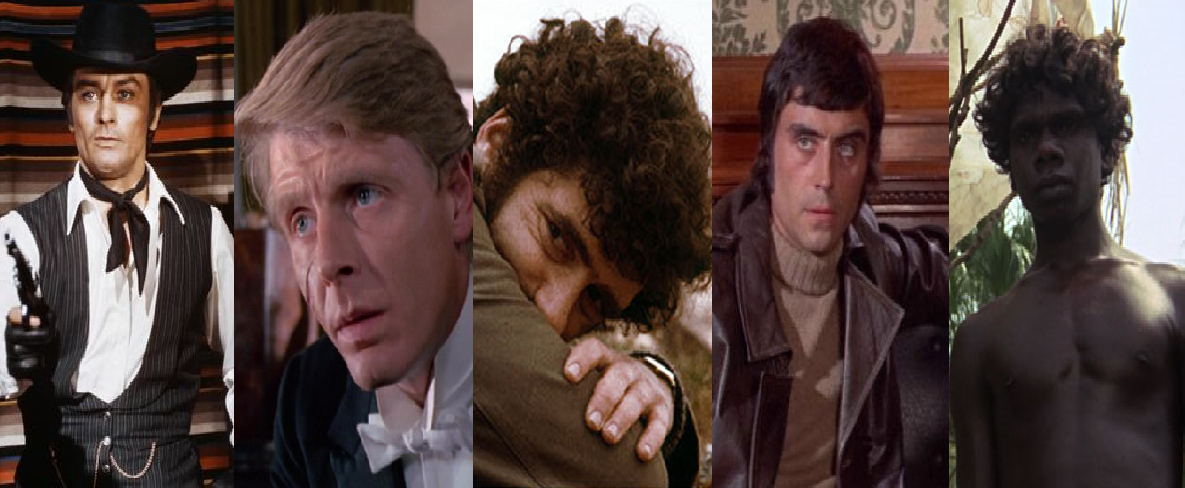
5. Elliot Gould in The Touch - A downright atrocious performance that fails on every level, and is quite bizarre to witness in a Ingmar Bergman film.
Best Scene: When he's off-screen.
4. David Gulpilil in Walkabout - Gulpilil does not have a great deal to work with, but gives an honest portrayal of his character.
Best Scene: The failed mating ritual.
3. Edward Fox in The Go-Between - Fox manages to be more than background largely in a single scene where he brilliantly realizes exactly what his character is going through.
Best Scene: Leo asks Hugh about Ted.
2. Ian McShane in Villain - McShane, despite dealing with a terrible co-star, gives an engaging and complex portrait of a gangster's closest associate.
Best Scene: Vic goes to Wolfe after his mother dies.
1. Alain Delon in Red Sun - Delon creates a memorable and appropriately smooth villain who acts as worthy foe for the all-star pairing at the center of the film, which is quite an achievement.
Best Scene: Catching Kuroda and Link off guard.
Updated Overall Rank
Next Year: 1985 Lead
Best Scene: When he's off-screen.
4. David Gulpilil in Walkabout - Gulpilil does not have a great deal to work with, but gives an honest portrayal of his character.
Best Scene: The failed mating ritual.
3. Edward Fox in The Go-Between - Fox manages to be more than background largely in a single scene where he brilliantly realizes exactly what his character is going through.
Best Scene: Leo asks Hugh about Ted.
2. Ian McShane in Villain - McShane, despite dealing with a terrible co-star, gives an engaging and complex portrait of a gangster's closest associate.
Best Scene: Vic goes to Wolfe after his mother dies.
1. Alain Delon in Red Sun - Delon creates a memorable and appropriately smooth villain who acts as worthy foe for the all-star pairing at the center of the film, which is quite an achievement.
Best Scene: Catching Kuroda and Link off guard.
Updated Overall Rank
Next Year: 1985 Lead
Sunday, 22 May 2016
Alternate Best Supporting Actor 1971: Alain Delon in Red Sun
Alain Delon did not receive an Oscar nomination for portraying Gauche in Red Sun.
Yojimbo, Le Samourai, and Harmonica walk into a film and you get a pretty entertaining western about a Samurai, Kuroda, and a bandit, Link, teaming up to track down the bandit's treacherous partner.
The film is notable already through its pairing of Charles Bronson and Toshiro Mifune. The film ups the ante all the more by throwing in Alain Delon as the main antagonist for the film. Delon plays Gauche who begins as Link's partner in crime, and thankfully it is not long for us to see these three onscreen definitions of cool interact with one another. The three are perfectly in tune in that each take a different approach in portraying their characters so there's no override. Mifune takes an intense stoic determination, Bronson takes a sardonic approach, while Delon goes for being a personification of one word, smooth. Now all three are very physical actors, in that they can say a whole lot without speaking. This was already for Delon when he played a modern gunslinger of sorts in his most famous role. What's fascinating in potentially a similair role, Delon manages a unique approach even in this quality. Where Delon portrayed his movements in that role as very exact, almost ritualistic, Delon here instead does something that seems far more relaxed. Delon finds this innate confidence in the character of Gauche from the first scene we see him, because of how at ease Delon is in the frame. There is never a question that Gauche is in danger in the opening robbery, as Delon shows a man in his element. The most remarkable part of this is that, even as the villain, Delon earn this overconfidence.
In the robbery Gauche sets himself up as the chief villain by taking two actions. The first by killing Kuroda's friend in order to steal a gold encrusted samurai sword the second by trying to literally blow up his partner in crime Link in order to steal the bounty from the robbery for himself. What I love about Delon's approach here is in the moment where he kills Kuroda friend is that he does not play it as pleasurable for Gauche, nor is it an exact psychotic detachment. Delon instead keeps with the calm cool of the character as Delon shows that Gauche kills since they happen to be in his way in some way. Delon though creates the right sense of danger in this by portraying not even a second thought in the character, creating an effective sense of a selfish view that best defines the man. Delon is excellent by being just so despicable, yet doing it in such cool way somehow, that he leaves the right impression. This impression being pivotal to the film since Gauche only infrequently appears after this point, but remains as the objective for our two leads for the rest of the film. Delon is often missing but never forgotten as he does not waste an instance of his screen time in the first act.
The film proceeds with a very enjoyable road trip between Bronson and Mifune to try to find Gauche. Delon occasionally appears though only in brief cutaways in order for the film to remind us of what a badass he is, which Delon delivers with every time, it must be said. Eventually though Kuroda and Link come across him, Delon's entrance in the final act is pretty amazing thanks to again that ridiculous confidence that Delon projects so well, which only is multiplied by Gauche's casual twirling of his pocket watch. Another party though interrupts the three's showdown, leaving the three to team up against a common foe. Delon's performance makes this action particularly convincing since the self-absorption was always at the center of the character, which would of course include self-preservation. Delon's little asides to his two opponents throughout the scene are great since there is such a lack of concern in his expression. Once again this should not work, yet Delon realizes Gauche's personality so well that this in the end should be his only reaction. This is terrific villainous turn from Delon as he earns his place as a worthy opponent for Bronson and Mifune, which is already quite an achievement, and crafts a memorable villain out of a role that in the wrong hands, considering the character is rather thin as written, would have been forgettable.
Yojimbo, Le Samourai, and Harmonica walk into a film and you get a pretty entertaining western about a Samurai, Kuroda, and a bandit, Link, teaming up to track down the bandit's treacherous partner.
The film is notable already through its pairing of Charles Bronson and Toshiro Mifune. The film ups the ante all the more by throwing in Alain Delon as the main antagonist for the film. Delon plays Gauche who begins as Link's partner in crime, and thankfully it is not long for us to see these three onscreen definitions of cool interact with one another. The three are perfectly in tune in that each take a different approach in portraying their characters so there's no override. Mifune takes an intense stoic determination, Bronson takes a sardonic approach, while Delon goes for being a personification of one word, smooth. Now all three are very physical actors, in that they can say a whole lot without speaking. This was already for Delon when he played a modern gunslinger of sorts in his most famous role. What's fascinating in potentially a similair role, Delon manages a unique approach even in this quality. Where Delon portrayed his movements in that role as very exact, almost ritualistic, Delon here instead does something that seems far more relaxed. Delon finds this innate confidence in the character of Gauche from the first scene we see him, because of how at ease Delon is in the frame. There is never a question that Gauche is in danger in the opening robbery, as Delon shows a man in his element. The most remarkable part of this is that, even as the villain, Delon earn this overconfidence.
In the robbery Gauche sets himself up as the chief villain by taking two actions. The first by killing Kuroda's friend in order to steal a gold encrusted samurai sword the second by trying to literally blow up his partner in crime Link in order to steal the bounty from the robbery for himself. What I love about Delon's approach here is in the moment where he kills Kuroda friend is that he does not play it as pleasurable for Gauche, nor is it an exact psychotic detachment. Delon instead keeps with the calm cool of the character as Delon shows that Gauche kills since they happen to be in his way in some way. Delon though creates the right sense of danger in this by portraying not even a second thought in the character, creating an effective sense of a selfish view that best defines the man. Delon is excellent by being just so despicable, yet doing it in such cool way somehow, that he leaves the right impression. This impression being pivotal to the film since Gauche only infrequently appears after this point, but remains as the objective for our two leads for the rest of the film. Delon is often missing but never forgotten as he does not waste an instance of his screen time in the first act.
The film proceeds with a very enjoyable road trip between Bronson and Mifune to try to find Gauche. Delon occasionally appears though only in brief cutaways in order for the film to remind us of what a badass he is, which Delon delivers with every time, it must be said. Eventually though Kuroda and Link come across him, Delon's entrance in the final act is pretty amazing thanks to again that ridiculous confidence that Delon projects so well, which only is multiplied by Gauche's casual twirling of his pocket watch. Another party though interrupts the three's showdown, leaving the three to team up against a common foe. Delon's performance makes this action particularly convincing since the self-absorption was always at the center of the character, which would of course include self-preservation. Delon's little asides to his two opponents throughout the scene are great since there is such a lack of concern in his expression. Once again this should not work, yet Delon realizes Gauche's personality so well that this in the end should be his only reaction. This is terrific villainous turn from Delon as he earns his place as a worthy opponent for Bronson and Mifune, which is already quite an achievement, and crafts a memorable villain out of a role that in the wrong hands, considering the character is rather thin as written, would have been forgettable.
Wednesday, 4 May 2016
Alternate Best Supporting Actor 1971
And the Nominees Were Not:
Alain Delon in Red Sun
Edward Fox in The Go-Between
Elliott Gould in The Touch
Ian McShane in Villain
David Gulpilil in Walkabout
Alain Delon in Red Sun
Edward Fox in The Go-Between
Elliott Gould in The Touch
Ian McShane in Villain
David Gulpilil in Walkabout
Wednesday, 22 October 2014
Alternate Best Actor 1967: Results
Best Scene: Final reprise of Camelot
4. James Garner in Hour of the Gun - Garner is effective in portraying the intensity of this vengeful Wyatt Earp, unfortunately the film doesn't let him explore the role enough.
Best Scene: Earp's final kill
3. Sidney Poitier in In the Heat of the Night - Poitier is a commanding and charismatic portrayal of his determined detective, and especially shines in any scene he shares with Rod Steiger.
Best Scene: At the chief's house.
2. Alain Delon in Le Samourai - Delon gives an excellent minimalistic performance as he does so much in the creation of the physical manner of his character.
Best Scene: The Samourai final assassination attempt.
1. Robert Blake in In Cold Blood - Good prediction Fisti. This came down to Delon doing so much with such a purposefully limited character and Blake making the absolute most out of great as he manages to give such a heartbreaking yet wholly chilling portrayal of Perry Smith.
Best Scene: Perry recounts a part of his life before his execution.
Overall Ranking:
- Robert Blake in In Cold Blood
- Alain Delon in Le Samourai
- Rod Steiger in In The Heat of the Night
- Sidney Poitier in In The Heat of the Night
- Toshiro Mifune in Samurai Rebellion
- Paul Newman in Cool Hand Luke
- Scott Wilson in In Cold Blood
- James Mason in The Deadly Affair
- Sidney Poitier in To Sir With Love
- Gene Wilder in The Producers
- Michel Simon in The Two of Us
- Paul Newman in Hombre
- Charlton Heston in Will Penny
- Toshiro Mifune in Japan's Longest Day
- Dustin Hoffman in The Graduate
- Tatsuya Nakadai in The Age of Assassins
- Joe Shishido in Branded To Kill
- Dirk Bogarde in Our Mother's House
- Warren Beatty in Bonnie & Clyde
- Lee Marvin in Point Blank
- Dudley Moore in Bedazzled
- Yūzō Kayama in Two in the Shadow
- Richard Burton in The Taming of the Shrew
- Ugo Tognazzi in L'immorale
- Ljubiša Samardžić in The Morning
- James Garner in Hour of the Gun
- Lee Van Cleef in The Big Gundown
- Peter O'Toole in The Night of the Generals
- Peter Cook in Bedazzled
- Zero Mostel in The Producers
- Sean Connery in You Only Live Twice
- Albert Finney in Two For the Road
- Richard Harris in Camelot
- Shin Seong-il in Mist
- Sergei Bondarchuk in War and Peace Part IV
- Sergei Bondarchuk in War and Peace Part III
- Uttam Kumar in Chiriyakhana
- Tomas Milian in The Big Gundown
- Robert Morse in How to Succeed in Business Without Really Trying
- Lee Marvin in The Dirty Dozen
- Lee Van Cleef in Death Rides a Horse
- George C. Scott in The Flim-flam Man
- John Wayne in The War Wagon
- Spencer Tracy in Guess Who's Coming to Dinner
- Milo O'Shea in Ulysses
- Tetsurō Tamba in Portrait of Chieko
- Omar Sharif in The Night of the Generals
- Sidney Poitier in Guess Who's Coming to Dinner
- Michael Sarrazin in The Flim-Flam Man
- Kirk Douglas in The War Wagon
- Dirk Bogarde in Accident
- Jacques Tati in Playtime
- Dick Van Dyke in Divorce American Style
- Bekim Fehmiu in I Even Met Happy Gypsies
- Alain Cohen in The Two of Us
- Robert Redford in Barefoot in the Park
- Antonio Gades in El Amor Brujo
- Maurice Roëves in Ulysses
- James Fox in Thoroughly Modern Millie
- John Philip Law in Death Rides a Horse
- Richard Burton in The Comedians
- Rock Hudson in Tobruk
- Leonid Kuravlyov in Viy
- Marlon Brando in A Countess From Hong Kong
- Rex Harrison in Doctor Dolittle
- Tadao Takashima in Son of Godzilla
- Akira Kubo in Son of Godzilla
- Roy Orbison in The Fastest Guitar Alive
And yes apparently the Producers is 67 by my rules.
Tuesday, 21 October 2014
Alternate Best Actor 1967: Alain Delon in Le Samourai
Alain Delon did not receive an Oscar nomination for portraying Jef Costello in Le Samourai.
Le Samourai is a very effective thriller about a hit man being slowly driven into a corner after being spotted leaving the scene of one of his murders.
Alain Delon plays the titular character of Le Samourai who obviously is not an actual samurai, but technically speaking just a gun for hire. Jef Costello, which is incidentally a far less awesome title than his titular moniker, does not act as some sort of crude hired killer though. This is evidenced from his earliest scene where he lays in bed where he smokes waiting before he goes on his assignment. Delon's performance is almost a silent performance actually. Delon does speak in the film from time to time but it is mostly in one word responses or in the simplest of sentences that are only meant to serve the most basic instructional purposes. There really is very little in terms of dialogue between Costello and anyone, and there is even less in terms of Costello verbalizing whatever it might be that he is going through. Delon's work is mostly all based around what he does physically in the role, and is an interesting example of what an actor can do in a purposely limited part.
Well Delon is rather brilliant in the way he carries himself in the film. Even the way he just smokes in the bed Delon makes less an act of inhaling smoke to rather some sort of preparatory ritual that the samurai must do before he kills. After stopping smoking though the samurai prepares himself by getting dressed in his trench coat and putting on his hat. Although kudos to the costuming, but Delon certainly wears it his own way. There is something so remarkable even just about that way that Delon always puts on Costello's hat. There is just something so, for a lack of a better word, cool about the way Delon removes and wears that hat. It isn't just some guy wearing a hat, even though technically that's all that it is, Delon somehow makes it more than that. The way he does it has this certain emphasis of a warrior preparing himself for his task rather than of a thug with a gun which again that really is all that Jef Costello really is.
Delon even in the way he walks there is something special about it. The concise steps he takes at all times show a man absolutely driven for this precision of a master swordsman more than a master with the gun. Everything that Delon does adds to this characterization of Costello as slightly otherworldly in his qualities as a samurai. What is so wonderful about what Delon does though is this never seems something forced in his performance but rather wholly natural to the character. It also makes watching him a compelling experience as he is spellbinding in his creation of the manner of the samurai. Now this is especially important for the success of the film firstly because he doesn't have much to say at all, but secondly Costello is not necessarily a particularly sympathetic figure therefore it could have been easy to make this silent killer uninteresting. Delon though is absolutely fascinating as he makes every movement as the samurai something to witness.
Delon manages to be especially effective in the scenes where Costello does kill as again his movements accentuate the incisive approach he takes to killing. There is no aggression or pleasure from Delon when Costello kills but rather just a very chilling steely gaze as takes their lives away. It's rather interesting though that this is not quite like say Edward Fox in The Day of the Jackal who also played a professional assassin. Fox played the part of the jackal as a hollow shell of figure who would take on any disguise to make his target, and most of all there was a soulless quality at all times. This is not the case for Delon even though he certainly plays the part of the samurai in a rather cold fashion. Delon though does something else in the role instead and this leads to some of the most remarkable moments during the film. Delon goes about revealing more about Costello than we see, but not for a moment does he change from his intensely subtle performance.
One scene that I particularly liked is after Costello has been injured with a meeting with one of the men who hired him. Costello has to tend to his wounds and Delon somewhat drops the manner of the samurai, almost showing that for the moment the injury has almost snapped him out of his peculiar state forcing him to address something directly that does not require any meditation. It's a striking scene as Delon doesn't show the samurai behavior to be fake, but rather that it is indeed a ritual of sorts for the man. Delon creates particularly powerful scenes though by also revealing that there is a heart in the samurai, and although he kills people for money there is a conscious in him somewhere. It might be rather hard to see but there is evidence of it somewhere.
Delon is extremely reserved in this regard though but surprisingly poignant at the same time. Delon earns these revelations and it seems honest to the character in the way that Delon handles it. He has one amazing scene at the end of the film when it seems Costello is sending another person to their fate. Delon mostly does have that steely gaze again but there is this ever so slight sadness he still conveys so beautifully. It turns out not a sadness for his potential victim but for himself as he surrenders to his fate. It is a perfect moment by Delon and especially notable by just how delicately he handles the scene. The whole performance is a completely fantastic example of truly minimalistic portrayal by an actor. I have to admit to merely loving every second of this performance as he creates such a unique and even oddly heartbreaking character out of the samurai.
Le Samourai is a very effective thriller about a hit man being slowly driven into a corner after being spotted leaving the scene of one of his murders.
Alain Delon plays the titular character of Le Samourai who obviously is not an actual samurai, but technically speaking just a gun for hire. Jef Costello, which is incidentally a far less awesome title than his titular moniker, does not act as some sort of crude hired killer though. This is evidenced from his earliest scene where he lays in bed where he smokes waiting before he goes on his assignment. Delon's performance is almost a silent performance actually. Delon does speak in the film from time to time but it is mostly in one word responses or in the simplest of sentences that are only meant to serve the most basic instructional purposes. There really is very little in terms of dialogue between Costello and anyone, and there is even less in terms of Costello verbalizing whatever it might be that he is going through. Delon's work is mostly all based around what he does physically in the role, and is an interesting example of what an actor can do in a purposely limited part.
Well Delon is rather brilliant in the way he carries himself in the film. Even the way he just smokes in the bed Delon makes less an act of inhaling smoke to rather some sort of preparatory ritual that the samurai must do before he kills. After stopping smoking though the samurai prepares himself by getting dressed in his trench coat and putting on his hat. Although kudos to the costuming, but Delon certainly wears it his own way. There is something so remarkable even just about that way that Delon always puts on Costello's hat. There is just something so, for a lack of a better word, cool about the way Delon removes and wears that hat. It isn't just some guy wearing a hat, even though technically that's all that it is, Delon somehow makes it more than that. The way he does it has this certain emphasis of a warrior preparing himself for his task rather than of a thug with a gun which again that really is all that Jef Costello really is.
Delon even in the way he walks there is something special about it. The concise steps he takes at all times show a man absolutely driven for this precision of a master swordsman more than a master with the gun. Everything that Delon does adds to this characterization of Costello as slightly otherworldly in his qualities as a samurai. What is so wonderful about what Delon does though is this never seems something forced in his performance but rather wholly natural to the character. It also makes watching him a compelling experience as he is spellbinding in his creation of the manner of the samurai. Now this is especially important for the success of the film firstly because he doesn't have much to say at all, but secondly Costello is not necessarily a particularly sympathetic figure therefore it could have been easy to make this silent killer uninteresting. Delon though is absolutely fascinating as he makes every movement as the samurai something to witness.
Delon manages to be especially effective in the scenes where Costello does kill as again his movements accentuate the incisive approach he takes to killing. There is no aggression or pleasure from Delon when Costello kills but rather just a very chilling steely gaze as takes their lives away. It's rather interesting though that this is not quite like say Edward Fox in The Day of the Jackal who also played a professional assassin. Fox played the part of the jackal as a hollow shell of figure who would take on any disguise to make his target, and most of all there was a soulless quality at all times. This is not the case for Delon even though he certainly plays the part of the samurai in a rather cold fashion. Delon though does something else in the role instead and this leads to some of the most remarkable moments during the film. Delon goes about revealing more about Costello than we see, but not for a moment does he change from his intensely subtle performance.
One scene that I particularly liked is after Costello has been injured with a meeting with one of the men who hired him. Costello has to tend to his wounds and Delon somewhat drops the manner of the samurai, almost showing that for the moment the injury has almost snapped him out of his peculiar state forcing him to address something directly that does not require any meditation. It's a striking scene as Delon doesn't show the samurai behavior to be fake, but rather that it is indeed a ritual of sorts for the man. Delon creates particularly powerful scenes though by also revealing that there is a heart in the samurai, and although he kills people for money there is a conscious in him somewhere. It might be rather hard to see but there is evidence of it somewhere.
Delon is extremely reserved in this regard though but surprisingly poignant at the same time. Delon earns these revelations and it seems honest to the character in the way that Delon handles it. He has one amazing scene at the end of the film when it seems Costello is sending another person to their fate. Delon mostly does have that steely gaze again but there is this ever so slight sadness he still conveys so beautifully. It turns out not a sadness for his potential victim but for himself as he surrenders to his fate. It is a perfect moment by Delon and especially notable by just how delicately he handles the scene. The whole performance is a completely fantastic example of truly minimalistic portrayal by an actor. I have to admit to merely loving every second of this performance as he creates such a unique and even oddly heartbreaking character out of the samurai.
Thursday, 16 October 2014
Alternate Best Actor 1967
And the Nominees Were Not:
James Garner in Hour of the Gun
Alain Delon in Le Samourai
Sidney Poitier in In The Heat of the Night
Robert Blake in In Cold Blood
Richard Harris in Camelot
James Garner in Hour of the Gun
Alain Delon in Le Samourai
Sidney Poitier in In The Heat of the Night
Robert Blake in In Cold Blood
Richard Harris in Camelot
Subscribe to:
Posts (Atom)