Showing posts with label Liev Schrieber. Show all posts

Sunday, 7 November 2021

Alternate Best Supporting Actor 2000: Kyle MacLachlan, Liev Schreiber & Sam Shepard in Hamlet

Kyle MacLachlan did not receive an Oscar nomination for portraying Claudius in Hamlet.

This version of Hamlet revisions itself as a time capsule of the 2000's, to the point this almost feels like a period piece of the period through sheer intensity of the period in perhaps a most perfunctory way. I mean the ghost of Hamlet's father drifting through a Pepsi Zero vending machine pretty much summed it up.

Compared to the nearly unwatchable Romeo + Juliet, which is as mid 90's as this film is early 2000's, I did prefer this film, though all modernized versions, that retain the original language, are naturally a kind of oddity, as they are unnaturally a merging of the text which was written to denote a particular period, and it has never been blasphemy to change the setting and the language in an adaptation, just ask Akira Kurosawa. Now a major improvement within this film, rather than that previous film, is most of the cast thankfully doesn't treat Shakespeare as a foreign language that they just learned and feel they should deliver it like an infant having a tantrum. There is still a challenge in how exactly to broach the dialogue within the setting which will be naturally out of place to the setting, and actually most seem to have an idea here. One such is Kyle MacLachlan, who honestly is an actor who the weirder the part he is playing typically the better. Claudius isn't necessarily that weird on his own, however refashioned as a corporate executive who took a most aggressive manner to take over his company we do get something rather unlikely. MacLachlan in turn I think finds just the right kind of not quite traditional, but not too direct delivery within his Claudius within the opening scene of the film. MacLachlan carries in his speech the words in their form, yet refashions it appropriately with a different kind of corporate bravado in his words, rather than that of a kingly decree. 

MacLachlan's performance seeks, I'd say successfully, in creating the part of Claudius that mines the strengths of the role, while also reinventing for this particular style of Hamlet. This as his portrayal is specifically as a corporate executive. In turn he ideally plays the moments of Claudius, as the king, with the smiling face of the corporate head. This with really a smile that is a little more than the smile should be. In turn speaking the words as though he is dealing with public relations of a deal more than anything. Now within that though we see Claudius when as the more overt villain within the piece, such as when he is manipulating Laertes to kill Hamlet, or trying to persuade various powers to rid him of his nephew. MacLachlan delivers none of that phony charm in these moments rather fashioning a cutting intensity fitting a man with a specific kind of power seeking. MacLachlan is excellent because the way he portrays these moments and speaks them is as a merciless CEO not as some attempt to be King. In turn his performance manages to create the right merging of the style of the text to the style of the piece, offering a real bridge where this idea comes to life within his performance. He's especially terrific in a moment of brokering a deal right after the play "confession" scene where MacLachlan is portraying the sense of desperation but also viciousness of the character in equal measure as he tries to rid himself of Hamlet, and of his guilt. The language never interferes with the emotion, rather MacLachlan artfully finds the emotion within the language in a new context. 

Of course this is also with MacLachlan delivering on the strengths of Claudius as a role, which is evident in the text, however I always see the strength of a turn if they pull that out. This is because Claudius is in fact a complex role and isn't this one note fiend for Hamlet to kill. MacLachlan in the moment of the play, here fashioned as a short film, the sense of emotional shame is palatable in the moment, and isn't just of some kind of surprise. More so though this is in the finale, where there really is a key moment that I think kind of defines any portrayal of Claudius and separates the good ones from the less than adequate ones. This being his work during the final duel, here rather unimaginatively still shown as just a fencing duel...I mean that was the best guys...I mean laser tag would've been really bad, surely there could've been something. Anyways MacLachlan brings the right sense of vile determination in his eyes as he watches Hamlet and eyes each moment of treachery as he tries to leave nothing to chance in killing his nephew. This though against the moment of poisoning a cup of wine for Hamlet that Hamlet's mother Gertrude drinks instead, here actually rather brilliantly shown as a purposeful suicide. MacLachlan simply makes the right choice here that Claudius does indeed love Gertrude and it was never just some power play. MacLachlan shows this throughout, but in the moment of Gertrude drinking he is outstanding. This is as he makes the villain's reaction genuinely devastating as he depicts just a straight horror and heartbreak in the man as he sees the woman he loves essentially kill herself. As much as the overall film I think is an inconsistent effort, MacLachlan's performance reveals the great potential of it. This as not only does he make the language tangible, he refashions to recreate a well known role in a new way, that delivers on that role as not just an evil fiend, but as something more complex, as he is a villain but also a man.
Liev Schreiber did not receive an Oscar nomination for portraying Laertes in Hamlet.

I feel I must cover this performance as this is the only time I've seen an actor deliver a good performance in the role of Laertes, the brother of Ophelia and son of Polonius, who Hamlet accidentally causes the deaths of both. Every other performance as the grieved brother has either been an over the top performance or just a completely forgettable one. What I find so odd about this, is that Laertes actually is a good role even on paper. The mistake I think is that most portrayals choose to play him as a villain and just an obstacle to Hamlet, where in fact, the character, though guided in the wrong direction by the villainous Claudius, is actually righteous in his indignation towards Hamlet, and is largely a victim of circumstance. Schreiber's performance does, what every performance as Laertes should do frankly, is portray the character as a basically good man brought down by a terrible situation. We see this as in his portrayal he shows a brother who genuinely loves his sister, and he brings a nice warmth in his moments with Ophelia (Julia Stiles). He even in his reactions conveys a quiet sympathy for his goofy father (Bill Murray) accepting the old man's advice, though largely with a bit of humor reacting to a man who is overly loquacious. When Laertes returns from his travels Schreiber doesn't overplay the character's anger at the death of his father and the immediate troubles of his sister. He rather conveys genuine discontent of a wounded son, and real heartbreak of a wronged brother as he looks upon his sister in such a dire state. The pivotal scene of Laertes and Hamlet fighting around Ophelia's grave, is usually time for some overacting by Laertes's actor, however Schreiber is honestly heartbreaking in showing the intensity of the grief in the man, and even showing it as greater than his anger towards Hamlet in the moment. Schreiber's performance depicts a man gripped by his grief that leads him to make the wrong decisions, unlike other Laertes who frankly show the man too culpable in the final treachery, or just too ridiculous in the depiction of the anger. Schreiber finds the additional tragedy of the character that frankly should be in every version of Laertes, as the character is in microcosm taking the same journey as Hamlet himself. 
Sam Shepard did not receive an Oscar nomination for portraying the ghost of Hamlet's Father.

Now let's talk about Sam Shepard, who plays the small role of Hamlet's father's ghost, which is always a small part of any adaptation by nature, however can leave a large impact. This is one of the most impactful depictions of the ghost because of Shepard's performance. Shepard delivers the Ghost monologue with such a ferocity. There is such a sense of anger over the betrayal in his performance that creates both this powerful sense of his own sense of a duty left unfulfilled, and towards Hamlet towards bringing about the exact revenge for the betrayal he suffered. Shepard brings over every word such a viciousness as he shows his ghost is not happy in his state, he's not even exactly out of the world, rather he seems in this kind of purgatory as defined by the betrayal. Shepard's whole presence dominates the screen even as brief as his screentime here, it is hard to forget him within the proceedings through that power of his work. Shepard largely has just one major scene with Ethan Hawke as Hamlet, where he delivers the essential exposition of the accusation of his death with that ferocity. His impact remains so when he appears again as Hamlet speaks to his mother, it is a tremendous moment as Shepard embodies a true specter defined by vengeance. It is overall a brief performance, but a substantial due to just how striking Shepard is in every second he is onscreen. This is a performance that truly doesn't waste a second, and is the most impactful ghost I have seen in any adaptation.

Wednesday, 27 January 2016

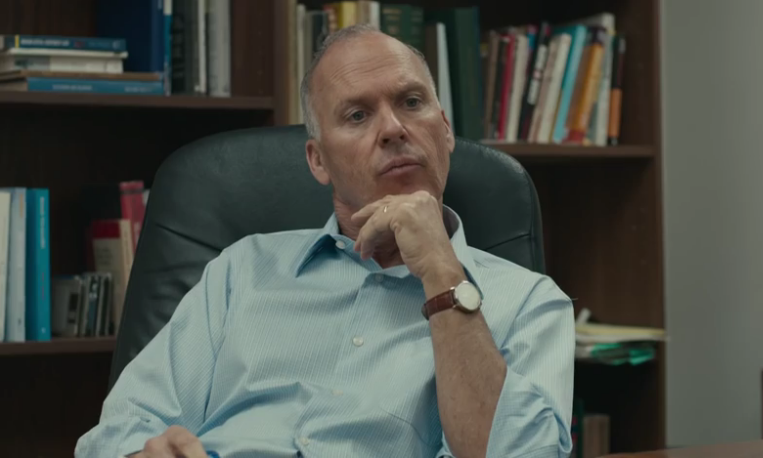
Alternate Best Supporting Actor 2015: Michael Keaton, Liev Schreiber and Stanley Tucci in Spotlight

Michael Keaton, did not receive an Oscar nomination for portraying Walter "Robby" Robinson, nor did Liev Schreiber for portraying Marty Baron, nor did Stanley Tucci for portraying Mitchell Garabedian in Spotlight.

It needs to be said that Spotlight is a film with a great acting ensemble, well except of course one of the actors who was Oscar nominated for it. The smaller roles are essential in receiving insight into its Boston setting and honestly feeling the effects caused by the Catholic Church sex scandals that the journalist of the Boston Globe are trying to uncover. Now within those trying to uncover the scandal there is a nice variations of personalities. The head of the team tasked with uncovering it, the titular spotlight, is headed by Robby Robinson played by Michael Keaton. Keaton's performance is actually very low key right down to his sorta Boston accent that one could argue is consistent, but one could also argue is realistic rendering of someone with a light Boston accent. Either way it's not a big deal. Despite being head of the team Keaton does give this large overly commanding performance, but is very believable as a more likable type of boss. Keaton makes it clear when he's demanding something from one the writers, but he does this in a very authentic way, suggesting just how comfortable the Spotlight team is with one another.

Now what's great about the film though is the ease in which the film depicts the various personalities involved with the story while still spreading the focus all around. Despite being the head of Spotlight the man who actually provokes the investigation is the new Editor-in-chief for the Globe Marty Baron, played by Liev Schreiber. Liev Schreiber often seems to be the right actor in the wrong film so it is good to see him in something a little better for once. Schreiber technically gives a very mannered performance, but unlike he who shall not be named, does it well. One would just assume that this is the way Schreiber really is in, in his calm low pitched voice, his slightly shy demeanor, his slow way of speaking and just his particular way of interacting with others. Schreiber's performance is very interesting in the way he plays it. Marty is probably a guy who was shy in the past, but has gotten over that for the most part. The certain trademarks that go along with that behavior is still evident but he is not being controlled by that in any way. In addition to that. Marty is going to a whole new place, as well as being seen as an outsider, this will make him seem all the more out of the loop which Schreiber portrays in such a natural fashion.

What's intriguing about Schreiber's performance is that despite having that certain awkwardness that would go with a shyness, he is not a meek figure in the film, as again he is basically the only one who sees what everyone else failed to. Schreiber's really effective in the way he actually has this dominating presence in a very unique fashion. Though he never even comes close to raising his voice Schreiber actually carries this incisiveness in his delivery, as he goes about it in his own way, and there is always the sense that it would be impossible to deter Baron from his stance. It's remarkable as Schreiber is able to do this effortlessly, as he makes Baron a truly persuasive man, whose in charge without question, yet never has to force his hand. Schreiber presents the whole personality of Marty Baron just so flawlessly, and it's quite something that he's able to still give an engaging performance by giving one that would appear as low energy. Schreiber though makes it so that Marty certainly does not come off as though the actor portraying him is tired, but rather this is merely a man who we are seeing in his normal behavior.

Baron's own interest is set off though by an article about the lawyer taking on the case of the victims against the church, Mitch Garabedian played by Stanley Tucci. Now in a way Garabedian is a pseudo Hal Holbrook for the story, though he remains secretive rather than secret for a very specific reason. Garabedian wants the story out in the open, but he cannot divulge very much information on the case lest he be disbarred. Tucci plays a character who  is described as a character, but he resists the urge to overact, something Tucci is capable of. Tucci certainly brings a flamboyancy to the role that feels exactly right for his character, who most definitely has many time needed to yell in order to get his day in court. Tucci does not allow this overwhelm his performance though as there is this certain precision of the way he talks, as though he's always getting to the point, given his amount of clients this would be the only way he could be. He carries himself with the right haggard qualities suggesting the burden of his job so well. Tucci's very good in his first scene though especially in the way he uses his eyes as he watches the reporter (some guy) as though he's trying to decipher him a bit, seeing whether or not talking to this man will be beneficial or not for his clients.

Tucci is incredibly good at portraying the way Garabedian is not just in it for the potential money from the settlements of the victims. Tucci does this so quietly yet so eloquently as he reveals an earnest passion in Garabedian as he speaks about the crimes. He also importantly always portrays a strong undercurrent of empathy in Garabedian as he interacts with the few clients we see him with. Tucci carries the right charity in these interactions showing always Garabedian as well aware of what they've suffered, and is trying to do his best only to help them in any way he can. When he mentions to the reporter the fate of many of the victims, Tucci does well to deliver this just as blunt concern for the victims. Though it must be said that much of the cast does a fine job of providing the human  element in their reactions during the scenes of the victim's testimonies, except for two of the performances that I'm covering here. Schreiber does not since Marty never directly works on the case, only providing oversight to the team to make sure they get the story right, and Michael Keaton,  even though he's the head of the investigative team, though he technically does bear witness to as many of the testimonies as the others.

Keaton plays these scenes very close to the chest, but again finds the right nuance within this. It is not as though Robby is detached from any of the stories, but rather Keaton illustrates well the analytical method of the man. Keaton always shows that he is listening very carefully, but takes it all in through his own way which is to stay very reserved. There is never a question though that Robby does not also care about the victims' plight, but rather he's a man who stays professional above all else. Keaton rather skillfully reveals Robby's personal outrage in the scenes where he goes about questioning people involved with the crimes in some way, and demanding an actual answer. Keaton reveals the right intensity in these moments as Robby's distaste is keenly felt at the right moment. There's even more to it than that, as Keaton carefully alludes to something else whenever it is mentioned that the Globe received information about the cases beforehand. There's an underlying unease Keaton suggests in these moments, as though Robby is unsure of whether or not he is remembering something important correctly. He effectively builds on this unease, to the point that you could even miss it on an initial viewing of the film, but Keaton makes it feel very real as Robby has to accept his own failures of the past.

Keaton actually has the one character with a major arc, though its handled in such a subtle fashion by both the film and his performance it sneaks up on you. Keaton delivers so well though that its surprisingly powerful when Robby must admit that he failed to act just as so many did. All three of these performances work even past the notion of having a character arc. They are part of an ensemble in the best possible way. They just add to the film, giving it all the more character, in just how effortlessly they inhabit their roles. Though you barely learn anything about any of their personal lives, you definitely feel that Robby, Marty and Garabedian live outside of the confines of the story. Though to be fair the same can be said about everyone else in the cast, except somebody I'm still not going to mention. The three of them make the right impact. All three have scenes where they stand out but it's always at the right time. Keaton in his confrontation scenes. Tucci's especially great in a memorable scene where Garabedian explains his plan as lawyer, as he reveals the shrewdness of the man, though also still with that layer of concern as it also acts as a bit of a warning about the powers against everyone trying to make the scandal public as well. Schreiber is understated as usual in a pivotal moment where they talk about not taking action earlier. Schreiber makes Marty's reassuring speech to everyone resonate powerfully, as he presents such genuine warmth in his support in his words, while still Marty stays his usual low key self. These are three very strong supporting performances, that never distract from the story, but rather only help to elevate it to even greater heights.

Tuesday, 26 January 2016

Alternate Best Supporting Actor 2015

And the Nominees Were Not:

Stanley Tucci in Spotlight

Liev Schreiber in Spotlight

Michael Keaton in Spotlight


Nicholas Hoult in Mad Max: Fury Road

Idris Elba in Beasts of No Nation

Emory Cohen in Brooklyn

Benicio Del Toro in Sicario

Josh Brolin in Sicario

Walton Goggins in The Hateful Eight

Samuel L. Jackson in The Hateful Eight

Kurt Russell in The Hateful Eight

Oscar Isaac in Ex Machina

Richard Jenkins in Bone Tomahawk

Adam Driver in Star Wars: The Force Awakens

Michael Sheen in Far From The Madding Crowd

Matthias Schoenaerts in Far From The Madding Crowd

For Prediction purposes:

Tucci

Hoult

Elba

Cohen

Del Toro

and/or

Goggins

Isaac

Jenkins

Driver


Sheen