Wednesday, 31 May 2023

Alternate Best Actor 2009: Hal Holbrook in That Evening Sun

Hal Holbrook did not receive an Oscar nomination for portraying Abner Meecham in That Evening Sun. 

That Evening Sun follows an old man who escapes from his retirement home and comes into conflict with the father of a family that took over his old farm. 

The always reliable character actor of Hal Holbrook is given the rare opportunity to take the leading role here within the "old codger" genre, of a man of a bygone era who is our protagonist lashing out at something current. As a film in this genre, this film isn't particularly good, as there are too many things missing in the script to really create a captivating central conflict, which I will get to, or any sort of thematic exploration of who exactly the character of Abner is or what his struggle means even. Holbrook is a great actor and he is the one thing I will readily praise about this film. From the opening scene, he brings a reality to the potential cliches of Abner, as he even goes about looking for his watch and dismissing the local man who becomes quickly exasperated by the quest. Holbrook's work just tears through the scene and you instantly get a sense of the years of this man living his life his way and not taking a moment to suffer fools. Holbrook exudes that far more than the film really sets it up in any meaningful way, and creates a striking figure through his performance. He is worth watching from the first frame because you do believe Abner as a man because Holbrook is so convincing as this man regardless. When he speaks there is the weight of years of seeming wisdom in there, even as the film progresses in a way that isn't exactly the most captivating. 

Holbrook's Abner returns to his home which he finds is now lived in by the Choat family, including Lonzo Choat (Ray McKinnon), whom Abner views as the lowest of the low. Holbrook's performance excels in being the old "coot" who bluntly states his views without exception. And with that, Holbrook does create nuance within the character. We have his moments with the daughter (early Mia Wasikowska), where Holbrook makes no bones about his beliefs and even states directly about her use of language, though there is a seeded bit of warmth in Holbrook's performance. Just enough warmth really as even when correcting bluntly, and making his views about her father clear, Holbrook doesn't hesitate or hide a single sentiment about it. And in that Holbrook grants a bit more depth within the character of Abner, perhaps even as written as it would've been very easy to make these lines just as onery as the rest of him, but Holbrook brings a bit more life to them suggesting a more paternal figure than we will see the rest of the time. With Choat's wife, Holbrook is straightforward, though in a somewhat more amiable way in that he doesn't emphasize anything more than what he sees as the truth and just tells her what he thinks he needs to know. This is in stark contrast to how he interacts with Choat himself, where Holbrook is just exuding venom towards the man, and delivers every word to the man as curtly and without any empathy as possible. 

The progression of the conflict is very weak because it stakes the deck so heavily. As much as Abner is grumpy and set in his ways, he is automatically a saint compared to Lonzo, who despite one action near the end of the film that feels frankly false compared to his portrayal throughout, is a completely wretched human being in every sense of the word. There could've been something more here if say Lonzo was flawed in some ways, but being straight-up horrible really makes the conflict rather dull. Instead, basically, we get the beef we see as Abner is himself, which again is a great man compared to Lonzo, compared to Lonzo who is horrible to everyone (emphasized by Ray McKinnon's nuance-less performance, which is rare for him). We see him set up some ways to "make his moves" but they really are honestly rather uninteresting. The only thing interesting is Hal Holbrook's acting of them, just because he is a compelling performer who always knows how to emphasize a bit more history to every moment, even when the history really is barely there in the script. I think this is most evident with his son (Walton Goggins in a thankless role), who placed him in the home, to begin with, and doesn't want him in this conflict. Holbrook's directness again is different, he is blunt, callous at times, but without the venom like with Choat. Rather he presents a father, but a very tough father, who wants his son to be an honest man and doesn't care for his dishonest ways at times. Of course from the son we get how he was apparently a terrible father, and what does this all add up to? Not much, because the film likes to ask questions, but doesn't really like to answer them, or at least not answer them particularly well. Instead, we get what just the actors are giving us, which thanks to Holbrook is more than something, but he's asked a bit too much of it all. I think this is most evident in the climax of the conflict which is an extremely desperate moment, that really comes along too quickly, without proper buildup with the characters, and has a resolution that just feels dishonest compared to everything else we've seen up until this point. The only thing not dishonest is Holbrook's portrayal of the moment as he mixes this desperation with a somber nostalgia, and manages to be moving in the scene, even while the moment seems more than a little rushed. Speaking of rushed, there is a quick resolution and reconciliation with his son. Again Holbrook gives it his all and does produce something but it is all from him, with the writing helping so little he can only do so much. Still, as just a showcase for the talents of Holbrook, this is still a very good performance, even if still a missed opportunity in some ways due to lackluster material. 

Friday, 26 May 2023

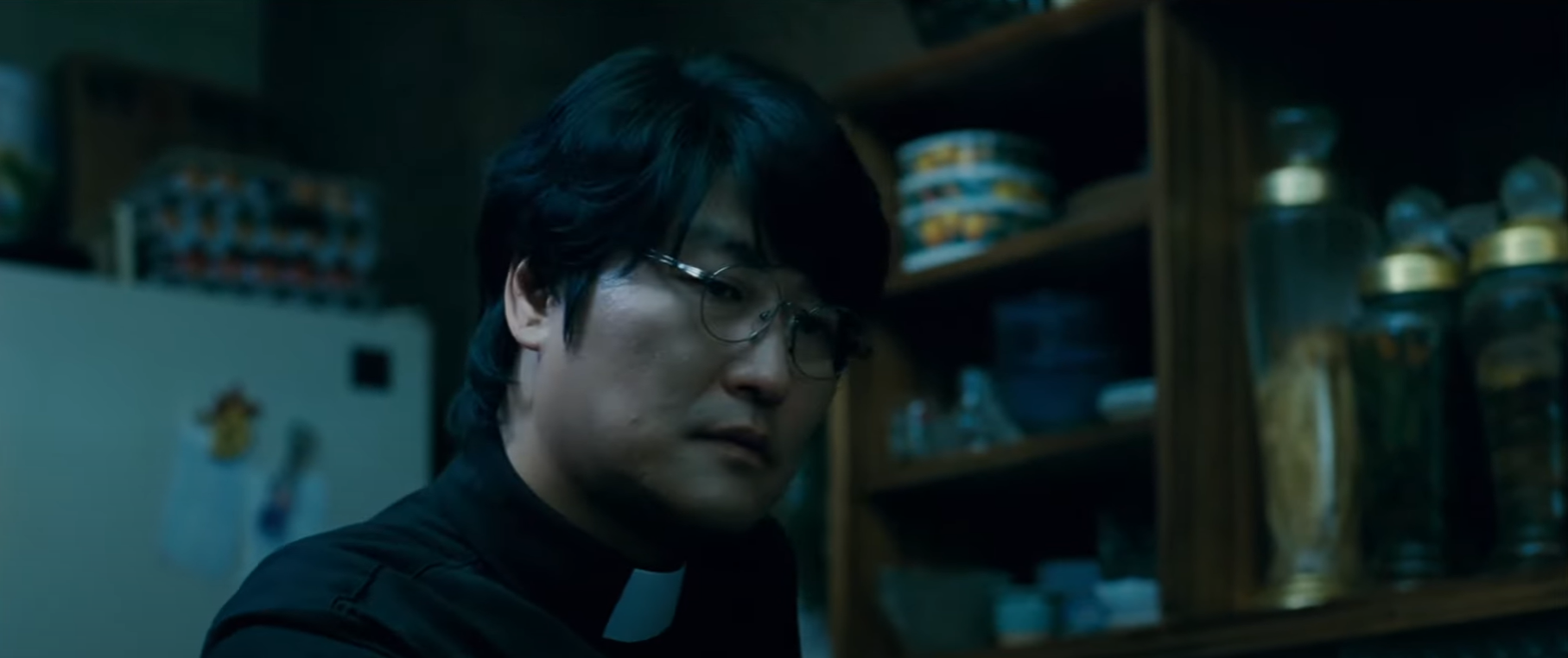
Alternate Best Actor 2009: Song Kang-ho in Thirst

Song Kang-ho did not receive an Oscar nomination for portraying Sang-hyun in Thirst.

Thirst tells the story of a priest who gets infected with a deadly virus that he survives through a blood transfusion that turns him into a vampire. 

If just getting to the vampire part seems complicated, it is, and in this instance, I would say overly complicated. The whole first act of Thirst I would say is a rambling narrative as it touches upon several different ideas but in a way that is just a mess of them rather than any cohesive tapestry. We have our priest played by Song of course, who is going about his duties for dying patients. Song portrays the character very much as any priest you might see often in such scenes, having this calm dignity about him, and careful manner as he goes about administrating prayers and last rites. We essentially have the common priest for many an introspective film, as we see him in private quarters pained over potential doubts and that careful manner seems to show a depressed mood after all. Song certainly portrays this effectively and grants you a sense of the specific malaise of the man behind the apparent dignity. We then jump to his potentially suicidal act by asking to be part of an experimental vaccine for a deadly virus that will most likely kill him. And when asking for this Song certainly conveys just a man staring into the void seemingly without purpose in his life. And through the series of odd circumstances leads up to the other side as a cured man but as a vampire. Leading again for his local congregation to see him as a true healer, and I'll bluntly say this whole aspect of the film could've been cut out. It never really goes anywhere, or at least anywhere interesting, and frankly, Sang-hyun seems just slightly baffled by them. I'd extend that to really his occupation as a priest is nearly set dressing because aspects of faith and morality are barely considered and really only leave this one thread, represented by a one-note group of believers, that amount to absolutely nothing. I think again Song is more than fine in presenting sort of the man going through the motions as the healer, even as his belief is clearly failing him. 

The film remains on shaky ground as we explore Sang-hyun as he begins his feelings of bloodlust but also sexual lust that often seems more dominating than his blood lust more often than not. We discover this through his frequent visit to a family of his parishioners which includes Tae-ju (Kim Ok-bin), the young wife fed up with her husband and family. And here where the film really continues to be sloppy as Sang-hyun and Tae-ju begin an affair, and I would say would be his vampire allure I guess. Because in this stage of the relationship, Song and Kim's chemistry is limited at best. There's more than a little missing in the puzzle particularly if you say compare it to the relationship in Decision to Leave, where you instantly felt here, here it honestly just feels forced...at the start. This is both the writing and acting I think, as writing wise there just isn't enough substance to create any meaningful connection or even just lust between them, and performance wise the urge also specifically between them seems somewhat absent. Song isn't bad in these scenes mind you, he's good in presenting the hidden growing lust within his own performance, but the importance given to the relationship makes it seem like there should be more. Outside of those scenes what we get from Song is essentially the portrayal of the vampire as a junkie. And here Song is quite good in just exuding constant desperate need. Where he successfully switches within the moments of being completely enthralled in his desperate lust for blood and creates the vicious sense of that titular thirst. Against moments where he creates internally the pained conflict of the man literally drinking blood and the shame in it. He successfully creates the constant pull of conflict within the character of Sang-hyun and fashions successfully the idea of creating a very real idea within the mythic concept of vampirism. 

Where the film gets interesting, if not entirely non-sloppy still, is when he begins to take Tae-ju as a partner in his crimes, as she asks him to kill her husband for him. This is when they actually do discover some actual chemistry, what was missing in the just initial relationship, is found once they start realizing the "bond" is a wholly toxic one. This is where things get more interesting and Song's performance, while it has been always good, becomes its most dynamic. His performance particularly comes to life in terms of embodying the conflict of Sang-hyun who doesn't want to be a vampire but has to be one. In these moments about going for the murder, we see him go to his lowest, where Song conveys in his eyes the peak of the desperation that he accentuates as a mix between sexual lust, straight up hunger but also this sort of depressive urge to fall into a kind of despair that goes along with him at his lowest morality. Although I'll still say it doesn't quite have *it* in terms of making this a truly captivating depiction just yet. In fact, you have to go through him murdering the husband, then Tae-ju almost dying due to becoming regretful, which really doesn't feel earned, and leading her to almost die causing Sang-hyung to turn her into a vampire. Song portrays this moment well in instantly evoking such a striking sense of loneliness as he spirals into the act and revives her against his best judgment. And here is where we get slightly closer to something truly captivating, though not really writing wise, as Tae-ju becomes entirely vicious as a vampire and proceeds to kill indiscriminately. Song's performance shifts from the completely messed up drug addict to the one trying to temper his psychotic co-dependent. And there is something in his reaction as we see the sense of honest fear of what has he done and the attempts to be any sort of directing figure for her while she goes off on the deep end. Eventually leading to the ending of the film where he decides they need to both die from the sun, and here is where I most liked Song and the film in general. The quiet calm conviction in Song's performance as he shows perhaps the priest of old trying to hold strongly onto what is the right thing to do while also conveying the severity of what this choice means. He is moving in a subtle manner he takes as he quietly embraces Tae-ju, after fighting with her attempts to survive, and accepts their mutual fate. Having said that, my review probably seems all over the place, because for me the film was all over the place. There are moments I really like, maybe even love, in this film, but they are pieces of a puzzle that don't fit together. Even this ending could've been something truly special if we had a stronger connection to the relationship from start to finish. Instead, it is a messy situation that keeps far from one of Park Chan-wook's best films. Song for his efforts is good, consistently good even, but I'll be honest this is not one of his best performances, for me. There are aspects that suggest he could've brought something special, however, the unwieldy nature of the film, also keeps him from being able to craft a completely cohesive portrait of the reluctant vampire. 

Saturday, 20 May 2023

Alternate Best Actor 2009

And the Nominees Were Not:

Ricardo Darin in Secret in Their Eyes

Ben Whishaw in Bright Star

Michael Stuhlbarg in A Serious Man

Song Kang-ho in Thirst

Stephen McHattie in Pontypool

Predict these five, those five or both:

Tahar Rahim in A Prophet

Aaron Taylor-Johnson in Nowhere Boy

Ben Foster in The Messenger

Hal Holbrook in That Evening Sun

Paul Giamatti in Cold Souls

Friday, 19 May 2023

Alternate Best Supporting Actor 1961: Results

5. Alan Bates in Whistle Down the Wind - Bates certainly makes an impression with a role that, much like the children, he causes you to perhaps put in more than what's there. 

Best Scene: Before giving up.
4. Leo McKern in The Day the Earth Caught Fire - McKern grants a proper sense of character within a role that is often just used for exposition. 

Best Scene: Reporting on what is really happening.
3. Nakamura Ganjirō II in The End of Summer - A delightful mischievous performance as an atypical Ozu patriarch.

Best Scene: "Argument" with daughter.  
2. Murray Melvin in A Taste of Honey - Melvin delivers such humanity and heart to a role that was boundary breaking, but also just a, more importantly now, a memorable portrait of a caring human in a place where he received little care. 

Best Scene: Watching in the dark.
1. Martin Stephens in The Innocents - Stephens gives one of the most confident child performances ever in creating the right ambiguity between a sinister child guilty beyond his years or perhaps just a boy broken by abuse.  

Best Scene: Ending.

Next: 2009 Lead

Alternate Best Supporting Actor 1961: Leo McKern in The Day the Earth Caught Fire

Leo McKern did not receive an Oscar nomination for portraying Bill Maguire in The Day The Earth Caught Fire. 

The Day The Earth Caught Fire follows a reporter Peter Stenning (Edward Judd) covering the world is pushed out of orbit and towards the sun due to nuclear testing. A film that is covering a whole lot, isn't successful in it all, but enough of it works to make it a bit of a fascinating artifact, that still feels more relevant than Don't Look Up....yeah I just can't help myself sometimes. 

Leo McKern is always a reliable character actor who shows up here or there and offers a strong presence in a variety of roles. Whether that be the pitiful titular Ryan of Ryan's Daughter, the domineering Cromwell in A Man For All Seasons, or of course the strange yet comical cult leader from The Beatles' sequel film Help! McKern was one of those character actors that you could depend on to bring something regardless of the role. And here I think you have sort of a plug-in role. Not that the role is poorly written, but his Bill Maguire is very much the classical newspaper boss type. Hard drinking, always had a ruffled collar, and was very much on top of our "hero" for more than just his questionable work ethic. It is however working very much within a certain type, and when working with a type, it can sometimes be needed for a stronger actor to be able to make them seem less rote than than can be. And that is what McKern does here in a role that really is about those expected tropes and a WHOLE lot of exposition. And it has to be said McKern is very good at both. His manner is terrific as he comes into every scene with this instant sense of his character. He has the right exasperation but combined with a dogged conviction that is perfect for a long-time newspaperman. There is sincerity intertwined with cynicism in every one of his deliveries and he just owns them with the ease of the consistent character actor he was. And that really is the trick with the relationship we see with Peter where McKern is effortless in bringing this sort of blunt directness with him but his eyes always denote this earnest care still for the man. He's a boss who wants the best out of his reporter but he also is very straight with him. McKern creates the right supporting energy that really gives just a bit more depth to every moment that could easily be lost if there was any less from him, but McKern is on point in every scene. His best moments though I will say are the exposition because McKern just excels with his delivery of every word. He never lets it sound ropey or obvious but rather expresses each word with such naturalism. What is best though is when McKern denotes the severity of the central situation where he lets some more emotion drift into the man who sticks to the facts, and while brief, are powerful moments from McKern in just letting there be a little more to sensing what Maguire is personally growing through even as he's trying to maintain that certain journalistic distance. And while Maguire's personal arc is limited, particularly towards the end where we jump in time, McKern regardless is striking in his portrayal where he quietly expresses the anxiety the man is going through even as he stays reserved and even eases on the cynical edge in a way that is pretty remarkable. While again a rote part in some ways, McKern really adds a lot to his film, because while Edward Judd isn't bad, he just doesn't quite have *it* to really carry a film, so McKern coming in every few scenes really elevates much of the material and does what the best character actors always do. 

Monday, 15 May 2023

Alternate Best Supporting Actor 1961: Murray Melvin in A Taste of Honey

Murray Melvin did not receive an Oscar nomination, despite winning CANNES, for portraying Geoffrey in A Taste of Honey. 

A Taste of Honey follows a young woman Josephine (Rita Tushingham), living in somewhat dismal circumstances with her alcoholic mother Helen (Dora Bryan), who gets impregnated by a sailor.

Murray Melvin comes into the film about halfway through after Jo is essentially left alone in her mother's ramshackle apartment after both her mother and her lover have gone. Melvin's character is notable here in being one of the very first prominent and openly homosexual characters. More notable I think because the film isn't focused upon his prosecution as such, as was the case with the characters of Victim also from 1961. This is a trait of Melvin's Geof, but it doesn't define his existence. We are introduced when Jo invites him to live with her part due to his circumstances as an outsider, which she sees herself as too. Melvin's performance is particular in his portrayal of Geof's state as kind of not quite assured of his place as Jo quizzes him on his preferences. I think it is important to note the way Melvin depicts this not as shame in his reaction but rather fear and frustration of someone who knows his way of life was literally a criminal offense at the time. Melvin's performance does deliver a certain awkwardness within Geof, however, the awkwardness he presents is specifically in being mixed within a society that in no way accepts him. Melvin's performance has a combination of overt tension within his physical manner as he attempts to ignore Jo's prods initially, but what is remarkable in his performance is his eyes which always denote this greater understanding and intention. Murray just in his eyes conveys far more consideration within his experience than he will fully share really at any time throughout the film. 

An important moment happens early on in the relationship when Jo pesters Geof about his relationships with men and essentially treats him as some sort of exhibition for her to play with. Melvin is great at this moment in the immediate sense of real frustration you see in his eyes and just blunt disregard for the nonsensical line of questioning. Murray is terrific because as much as he shows the real vulnerability in Geof in the frustration, he also does portray a quiet strength within the character by so tangibly presenting this direct refusal to become some kind of object to be ridiculed or gawked at by Jo. Of course, the overriding quality of Jo as a character is her childishness that goes along with her need of being an actual adult given she will be a mother soon, and in turn, she does eventually take a more respectful tone towards Geof turn their relationship grows. Melvin's performance is essential in making this relationship meaningful which is quite contrasting in terms of the performances. Tushingham's performance is very juvenile, intentionally so and effectively so, and while there are elements of that in Melvin's performance there is also this subtle, nearly hidden directness within his work that gives Geof such a tremendous impact within the narrative. 

Melvin's performance isn't one really so much about big moments but a series of little moments throughout his performance where he just manages to deliver so much depth within Geof's particular story that lives in tandem but also in separation from Jo. Much of the time we see Geof attempting to be the responsible one when it comes to raising the baby, and while his delivery again denotes a nearly blithe manner of the man just stating a light need, his manner is much more direct in creating this sense of urgency in terms of getting prepped for the child. Melvin projects this consistency in the concern and shows very much an instinctual sense of trying to prep as a good father would even as Jo is often doing very much the opposite. Melvin creates a particularly potent sense of empathy just quietly in this manner, even again he contrasts this often with his delivery, which doesn't feel inconsistent rather he depicts a certain shyness of Geof trying to be careful how he comes onto the situation even if he cares deeply. The moment of trying to ask Jo to marry him is brilliant work from Melvin because he shows throughout it that it does very much come from love though not a place of sexual interest. Even when he kisses her it is of this kind of act of attempting to live up to the expected standard and Melvin is wonderful in that the kiss is distant, but now in his eyes, the intention of the concern of Geof is wholly true. In his work, as he attempts to basically make things right with Jo, by bringing her mother back, who he isn't aware of her real nature, Melvin is great in just his reactionary moments. The moment of objecting to their instant hostility, and Melvin quietly noting the ever real concern of Geof throughout it all. His best scene actually might be a completely final one in the final where we see Geof considering going to stay with Jo or leave her. And Melvin is able to say so much in this consideration and is truly moving in reflecting the way Geof is considering this connection, while also sensing the imperfectness of it all at the same time. Melvin's performance is a great one because I think there were so many ways this character could've drifted off into stereotype or even just to limit him as there only to be the "best friend". Melvin successfully, even if so subtly, always makes Geof as the man very present within every action, showing where the man seeks connection, while still is his own person even when existing in this relationship. It is a fantastic performance that delivers so much warmth in his supportive state, but as consistently crafts his own powerful portrait of a man in his own kind of personal isolation. 

Thursday, 11 May 2023

Alternate Best Supporting Actor 1961: Alan Bates in Whistle Down the Wind

Alan Bates did not receive an Oscar nomination for portraying Arthur Blakely aka the man in Whistle Down the Wind. 

Whistle Down the Wind, which would make a good double feature with The Secret of the Beehive, is an effective mood piece about a group of children who discover a stranger hiding in their barn who they mistake for Jesus. 

This is a performance as good as any to examine the idea of screen presence and how much it matters to the way an actor can connect with an audience or not. The reason being the role of Arthur Blakely, though really the man is a better descriptor in so many ways, is a fairly limited one. In truth, the character has a scant few lines early on as the children discovered the man a bit disheveled and often rather silent as they presume him to be sent by a divine hand. The story is not about the manipulation of children but rather the perspective of them, because the man doesn't guide this delusion, he rather just doesn't correct it in order to maintain his hiding spot. While the part is limited, the character though does stand out, and not just because of the mistaken interpretations of the man by the children. Rather it is the charismatic Bates who does so, and fascinating as it is, he doesn't appear to be doing a great deal. In terms of the more direct acting, Bates's expression conveys initially the fear and desperation of a probable criminal hiding. That is in simple terms, but there is something about his steely eyes, his intensity that makes him all the more fascinating. It is the quality though that seems innate, but also is without question an essential facet to a performer. As this captivating quality of the work exists via Bates's striking screen presence, just his being on screen carries something with it, and Bates wields that here, not overtly but unquestionably so all the same. Put an actor without such presence, the man is a non-entity, or overtly creepy but with Bates he makes him fascinating even though there is nothing technically that the character does to make him so. 

Bates's presence therefore is particularly key to this film because the children fashion him as Christ without much insistence from anyone, certainly not from the man himself, however, Bates the performer allows it because of the magnetism of his presence as a performer. As the man becomes more verbal, he still just doesn't dissuade but rather just allows, as Bates's expression always carries with it the sense that the man is touched confused, and delivers any lines that might support the theory of the children with a kind of gentle patronizing. Bates doesn't make the man into the Christ, nor does he make him a true villain exploiting the naivety. That exploitation he always depicts as the man still in this sad state of desperation that never completely leaves him. Bates shows a man always filled with a certain somberness that perhaps alludes to his crime or his condition, but the man remains a bit of an enigma throughout. Even when the desperation increases, Bates carries himself still firmly as a man just stuck within his own suffering and his own existence, with the children being largely a distraction with maybe just a hint of solace via Bates's always gentle manner with them. As the film concludes we don't really know much more about the man than when we started, mostly we could've guessed as much, and even as such we learn any truth from a poster, not from the character who leaves his words limited. Regardless he remains a fascinating character largely because Bates himself is a bit innately fascinating, particularly young Bates, and as a performer captures your attention, even though, much like the children's faith, your attention is awarded with any answers, but regardless he still seemed deserving of such attention.