Showing posts with label Tony Curtis. Show all posts

Wednesday, 14 June 2017

Alternate Best Supporting Actor 1968: Results

5. Trevor Howard in The Charge of the Light Brigade - Howard gives a properly strict and slightly ridiculous portrayal fitting to a man who cares more about his stature as an officer than for any of his men. 

Best Scene: Strange seduction.
4. Klaus Kinski in The Great Silence - Kinski gives an effective villainous performance interestingly by taking a rather low key approach showing his Loco as always taking a calm and easy approach to his killings.

Best Scene: Loco wins.
3. Ian Holm in The Bofors Gun - Holm makes an impact through his limited screentime by so effectively presenting the incisiveness of the one man willing to confront both his immediate superior and his out of control fellow soldier.

Best Scene: Flynn confronts O'Rourke.
2. Tom Courtenay in A Dandy in Aspic - Courtenay gives a brilliant performance that creates a complex portrait of a spy who purposefully hates everything and everyone as a means of defense, and rises far above the one note villain the film likely would have settled for.

Best Scene: Gatiss visits Eberline in the hotel. 
1. Tony Curtis in The Boston Strangler - Curtis gives a chilling and effective performance which never relishes in the idea of playing a serial killer, instead offering a haunting and vivid depiction of a psychotic.

Best Scene: DeSalvo's breakdown. 
Updated Overall

Next Year: 2003 Lead

Monday, 12 June 2017

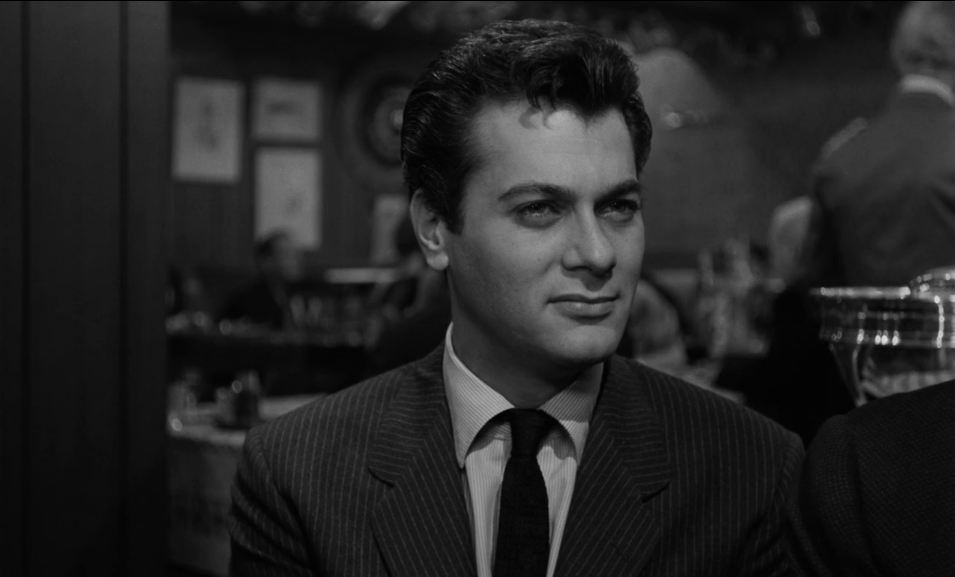
Alternate Best Supporting Actor 1968: Tony Curtis in The Boston Strangler

Tony Curtis did not receive an Oscar nomination, despite being nominated for a Golden Globe, for portraying Albert DeSalvo in The Boston Strangler.

The Boston Strangler is a mostly effective film about the search for the titular killer that feels like a precursor to serial killer procedurals like Zodiac and Memories of Murder, though it isn't as successful as those films. It is yet another example of director Richard Fleischer seeming most adept at realizing darker subject matter though, even if he does unfortunately indulge in some of those forced attempts at an overt style so common in the late 60's.

The Boston Strangler follows the police as they work the case, following them as they struggle to solve it through various false leads while the killer continues to strike. The film over an hour in reveals the killer to the viewer as Albert DeSalvo played by Tony Curtis. Curtis is an actor who apparently wanted to be taken seriously, despite often being cast in pretty boy roles, and like his work in Sweet Smell of Success, that seems rather evident in this performance. Curtis isn't at all distracting, despite being a recognizable face, as he enters as DeSalvo. Although Curtis is playing a serial killer, he's not just playing a random loner psycho, but rather a man who was a killer while living as a seemingly normal family man. Curtis resists any possible urge to telegraph his performance, which would have been wholly ill-fitting given the film's tone, despite even the material setting up, inaccurately apparently, that DeSalvo suffers from a split-personality, more on that later. The initial scenes of Curtis though follow DeSalvo as he makes excuses with his family in order to go continue his murder spree.

The murder scenes, like Fleischer's masterpiece 10 Rillington Place, are handled without exploitation though that is not to say they are not brutal. They do not relish in the violence but they do depict the viciousness of it. Curtis's performance is part of this in his exact depiction of the serial killer who keeps killing as a habit. Curtis is chilling by the ease in which he portrays DeSalvo's manner in these scenes whether it is in asking the potential victims to let him in, like a workman just asking to be able to do his job, or when the assault begins. DeSalvo asks for silence, claiming he will not harm his victim to do so, Curtis delivers this calmly, a calm that is consistent within the scene. Curtis never goes broad with the killer even for a moment though realizing in such eerie detail this man going about his sinister task. This is particularly off-putting as Curtis shows how DeSalvo manages to get away with the crimes in that method of seeming so innocuous until the attack, then during the attack granting that disturbing serenity as he begins, though his eyes always tell of his true intentions for his victims.

Eventually DeSalvo is caught in a failed home invasion but not in a circumstance where it was obvious he was trying to murder someone. Curtis's work is striking by how natural he is in these scenes portraying such a honest fear in the man as he tries to plead to be let go. Curtis does not give away the killer instead showing the man behind all of it. There is a pivotal scene where he meets with his wife and Curtis is excellent because he does not telegraph any evil within this man. If you had not seen him participate in the crime it could seem as just a scared man who made a mistake through Curtis's realistic portrayal. It is rather remarkable to me that I just took Curtis as DeSalvo in the film, and the idea of Tony Curtis playing a killer wasn't even a thought in my mind due to how natural his work is here. Curtis is outstanding in the way he creates almost a sympathy by how genuine every facet of the incarceration and the separation from his family do afflict him. Curtis never dehumanizes the killer actually by showing the real ordeal the man is going through even beyond why he is there.

The film introduces though the idea that DeSalvo suffers from a split personality disorder, which Curtis takes as an idea but doesn't go with an obvious approach to realize it. He does not portray it as a simple switch, or a switch at all for that matter, that would be more akin to a villain in a different kind of film. Curtis instead maintains the tone of the film by creating this as something far less clean within DeSalvo's psychosis. Curtis reveals the broken psyche of the man as a mess, as the moments before his final interrogation, he keeps the indications subtle and incredibly effective in these slips into his urges and his madness. This film leads towards its final scene which is basically the confession of DeSalvo. This is depicted as prompted by the lead investigator (Henry Fonda) but the scene entirely falls upon Curtis's shoulders. The investigator prods the confession by going over with DeSalvo his crimes trying to force him to relive them. Once again Curtis's work is stunning by how subtle he stays for much of the scene. For quite a while he just reveals the intense and raw emotion swirling in the man's mind, just through the gradual unnerving change as he listens. Curtis, worthy of comparison's to Peter Lorre in M, conveys all the damaged thoughts in the man's mind as he suffers through his own remembrance. Eventually he prodded towards his reenactment which Curtis builds towards in a way that is bone chilling by the way he has DeSalvo give himself to the moment, and we see the full insanity of the man. Curtis is absolutely haunting in his depiction of this by giving this unmistakable life to such a monstrous act. It is never a single thing as he reveals with the act this harrowing cluster of lust, hate, and also pain in the act. The film abruptly ends with the end of the "confession". Curtis earns this decision as it feels as though nothing more should be said after that moment. This is an amazing performance by Tony Curtis as he creates such an unsettling and vivid portrait of the man that is the murderer.

Monday, 5 June 2017

Alternate Best Supporting Actor 1968

And the Nominees Were Not:

Ian Holm in Bofors Gun

Trevor Howard in The Charge of the Light Brigade

Tony Curtis in The Boston Strangler

Tom Courtenay in A Dandy In Aspic 

Klaus Kinski in The Great Silence

Tuesday, 25 September 2012

Alternate Best Actor 1957: Results

5. Andy Griffith in A Face in the Crowd- Despite an effective beginning to his performance Griffith never quite matches the ambition of his character, even though he does try.

Best Scene: Lonesome Roads is discovered. 
4. Henry Fonda 12 Angry Men- Fonda gives a good performance consistently portraying the steadfast conviction of his part.

Best Scene: His opening disagreement. 
3. Tony Curtis in Sweet Smell of Success- Tony Curtis gives a strong performance that portrays well the abilities of his amoral press agent, and only shows a glint of conscience in the most powerful moments.

Best Scene: Sidney orchestrates Hunsecker's plan. 
2. Toshiro Mifune in Throne of Blood- Toshiro Mifune gives an effectively brutal turn as his version of Macbeth. He holds no bars physically or mentally in his towering performance.

Best Scene: Death by Archers. 
1. Kirk Douglas in Paths of Glory- Douglas gives the second best performance that I have seen this year, and gives one of the very best performances as an almost entirely moral character. Douglas never gives a hint of sanctimony, or falseness, but instead powerfully and honestly portrays the deep concern of his character believably throughout the film.

Best Scene: Colonel Dax turns down his promotion. 
Overall Rank:
  1. Alec Guinness in The Bridge on The River Kwai
  2. Kirk Douglas in Paths of Glory
  3. Toshiro Mifune in Throne of Blood
  4. Robert Mitchum in Heaven Knows, Mr. Allison
  5. Tony Curtis in Sweet Smell of Success
  6. Charles Laughton in Witness for the Prosecution
  7. William Holden in The Bridge on the River Kwai
  8. Marcello Mastroanni in White Nights
  9. Anthony Perkins in Fear Strikes Out
  10. Victor Sjöström in Wild Strawberries
  11. James Stewart in The Spirit of St. Louis
  12. Henry Fonda in The Tin Star
  13. James Cagney in Man of a Thousand Faces
  14. Henry Fonda in 12 Angry Men
  15. Anthony Quinn in Wild Is the Wind
  16. Rod Steiger in Across the Bridge
  17. Grande Otelo in Rio Zona Norte
  18. Van Heflin in 3:10 to Yuma
  19. Anthony Perkins in The Tin Star 
  20. Tatsuya Nakadai in Black River
  21. Sidney Poitier in Edge of the City 
  22. Charlie Chaplin in A King in New York
  23. John Cassavettes in Edge of the City 
  24. Curd Jürgens in The Enemy Below
  25. Michael Redgrave in Time Without Pity
  26. Cary Grant in An Affair to Remember
  27. Laurence Olivier in The Prince and the Showgirl
  28. Robert Mitchum in The Enemy Below
  29. Max von Sydow in The Seventh Seal
  30. Andy Griffith in A Face in the Crowd
  31. Glenn Ford in 3:10 to Yuma
  32. Guru Dutt in Pyaasa
  33. Gregory Peck in Designing Woman
  34. Fumio Watanabe in Black River
  35. Montgomery Clift in Raintree County
  36. Kirk Douglas in Gunfight at the O.K. Corral
  37. Burt Lancaster in Gunfight at the O.K. Corral
  38. Richard Widmark in Time Limit 
  39. Grant Williams in The Incredible Shrinking Man
  40. Don Murray in The Bachelor Party
  41. Dana Andrews in Night of the Demon
  42. Fred Astaire in Funny Face
  43. Gene Kelly in Les Girls
  44. Gary Cooper in Love in the Afternoon 
  45. Ben Gazzara in The Strange One
  46. Marlon Brando in Sayonara
  47. Rock Hudson in A Farewell to Arms 
  48. Hal Stalmaster in Johnny Tremaine
  49. Lee Philips in Peyton Place 
  50. Jeff Morrow in The Giant Claw
  51. Don Murray in A Hatful of Rain
  52. Anthony Franciosa in A Hatful of Rain
Next Year: 2008 Supporting

Thursday, 20 September 2012

Alternate Best Actor 1957: Tony Curtis in Sweet Smell of Success

Tony Curtis did not receive an Oscar nomination for portraying Sidney Falco in Sweet Smell of Success.

Sweet Smell of Success is an excellent film about a columnist J.J. Hunsecker who gets an ambitious press agent to break up Hunsecker's sister's relationship with a musician. 

Tony Curtis portrays the press agent who will be doing the job for Hunsecker. I considered reviewing Lancaster as well, but watching the film again I would put him in the supporting category. It is an oppressive character so it is easy to see why one could see him as lead as well though. The greater focus of the film though goes onto Tony Curtis's performance as the conniving Sidney Falco. Falco very much is the lackey henchmen of Hunsecker in the film, although it has nothing to do with loyalty, the only reason he follows Hunsecker's demands is to further his own career.

Curtis who usually portrayed good guys before this performance, or at least in some way charming fellow takes on entirely different method here as Sidney Falco. It is a fascinating performance that particularly works well in comparison to Burt Lancaster's superb performance. Both are very much similar men in their amorality, and power waving or seeking, but Lancaster and Curtis take greatly different methods in their performance. Where Lancaster's portrayal of the amorality is very much like forceful brick wall that cannot be surpassed, Curtis though portrays it as something constantly in motion.

Falco is always a man in some sort of motion, and Curtis is excellent in portraying that Falco is constantly playing for some sort of gain. Interestingly enough Curtis always portrays Falco in some sort of motion even when he is standing still or sitting usually blinking at a rapid rate. Curtis puts just the right amount of animation into his role to be able to bring across the idea of how Falco is always a man thinking of the next move during every point of the story, but as well he never does it to the point in which it seems like something flamboyant. It is instead entirely something natural to Falco as a person.

One of the most important lines for Curtis's character is when Hunsecker describes Falco as a man of forty faces not one. This in itself is quite a bit of a challenge to be lived up to, but Curtis is more than capable of doing so. Curtis face is particularly expressive here and quite apt at bringing about the various facades that Falco puts on to move forward in his business. One scene in which Curtis portrays this especially well is when he approaches Hudsecker for the first time in the film. In the scene Hudsecker insults Falco, and Curtis's expression is brilliant. There is a very forced upon slight smirk the entire time, but Curtis so well portrays the incredible hate and venom he does feel Hudsecker in the moment.

Really one of Curtis's greatest assets in this performance are actually his boyish good looks. He plays Falco brilliantly in every scene but especially when he is working his job. There are many who are already put off by him due to previous experience, but there are just as many who do not know the truth about him. Curtis is excellent in every moment of portraying Falco's method as he does not really portray him as the slickest man at all. In fact when some of his angry costumers confront him Curtis is good in showing that quick annoyance and anger Falco comes to right away when confronted being unable to really explain himself.

Curtis though does portray Falco's abilities just as well particularly in showing his abilities to so quickly put wool over people's eyes to meet his demands. Curtis is excellent in bringing across the intelligence in Falco. He never loses a beat and he makes it entirely believable that he could work his way through all of his success. What is so important though is that even when the others doubt him Curtis all brings an incredible degree of determination within Falco that never seems to cease when he is putting one over on someone. There is always a drive in him that keeps him prodding and pushing until he gets his way, or at least gets the person to hate him.

Although Curtis never takes an easy route to be likable in the traditional sense, he does well in adding just the slightest bit of a conscience to his character. Of course Curtis really is terrific here becuase of just how little morality he does give him, making the moments where he does show it quite powerful. Curtis never makes it an overt moment or two as he does the most wretched of things for Hudsecker but there are just the smallest moment of hesitations when doing the worst. Curtis though shows that even the moments of conscience only press for a a slight reaction, but his want for success always shifts to a slight smile of immorality.

Tony Curtis gives a great performance here as Sidney Falco because he never for a moment gives up on that Falco really is only opportunist as Hudsecker calls him. Even in the final showdown between the two Curtis still stays firm that it is not really for goodness sake that he reveals the truth to Hudsecker's sister, he portrays it almost as an accident because it really comes only for his hatred for Hudsecker who betrayed him. He never is overwhelmed by the dialogue or over shadowed by Lancaster, he stands firm in his fascinating depiction of this unscrupulous man.

Wednesday, 19 September 2012

Alternate Best Actor 1957

And the Nominees Were Not:

Henry Fonda in 12 Angry Men

Andy Griffith in A Face in The Crowd

Kirk Douglas in Paths of Glory

Tony Curtis in Sweet Smell of Success

Toshiro Mifune in Throne of Blood

Friday, 28 May 2010

Best Actor 1958: The Results

5. Spencer Tracy in The Old Man and The Sea- Tracy fails to really make an actual character out of the old man, and always is clearly acting. His narration is better than his performance.
 
4. Paul Newman in Cat On A Hot Tin Roof- Paul Newman gives a good performance as Brick, and shows the characters pains and frustrations very well.

 3. David Niven in Separate Tables- The falseness of the character is well done, and then his later admittance of his actually nature is well handled by Niven.

2. Tony Curtis in The Defiant Ones- Curtis is very good at showing the depth of his character, and never overdoes a single part of his performance. His character's transformation is earned and feels natural opposed to artificial.

1. Sidney Poitier in The Defiant Ones- Poitier uses his natural charisma and his abilities to create a powerful character. 

Deserving Performances:
Alec Guinness in A Horse's Mouth
James Stewart in Vertigo

Wednesday, 26 May 2010

Best Actor 1958: Tony Curtis in The Defiant Ones

Tony Curtis received his only Oscar nomination for playing the white escaped convict John "Joker" Jackson in The Defiant Ones.

The Defiant Ones I felt was a fairly effective drama about  a white and a black chain gang runaways who learn more about each other as they try to out run the law. Many seem to think this film is overly heavy handed and overbearing. I never felt that though.

Tony Curtis plays the southern white man who is chained to the black man. This is a good example of two leads working well together. Neither tries to steal scenes from the other and they rather work well together. Curtis plays his part very well actually. His accent is not overdone, although it is not perfect, but it work fine.
 
Curtis could have really overplayed his character the  whole way through. He could have been just an over the top racist character, and then his transition to caring about Poitier's character would have been completely strange and unjustified. Instead Curtis plays it much better, as a man with some racist tendencies but he is not only that. Curtis could have done a lot of overacting but he never does. When he calls Poitier's character various things he never makes it seem too obtuse, instead it shows it as merely the way the man is.

Curtis shows well that the character himself tries to put down the Poitier character because he basically wants to try to see someone lower in society than him. Curtis portrays his frustrations well, and fully realizes Joker as a person and not some symbolic character. Particularly strong scenes for Curtis are when he tries to stop a possibly lynching of himself, or when he talks about his knowledge of lynching. Another strong scene is when he is with the single mother they hold up with briefly. His scene where he describes his dreams is very well handled.

The best part of his performance though is how his character changes. Curtis never just does it but makes it gradual and possibly due to how he played Joker at the beginning. Curtis shows that the man naturally learned to change his view of Poitier's character, and it is not artificial at all as it could have been. Curtis' performance on a whole is very good, and works well for the film. He never has a scene which is unbelievably good, but he is always good, in a part that could have easily been played poorly.

Sunday, 23 May 2010

Best Actor 1958

And The Nominees Were:

Tony Curtis in The Defiant Ones

Sidney Poitier in The Defiant Ones

David Niven in Separate Tables 

Paul Newman in Cat on a Hot Tin Roof

Spencer Tracy in The Old Man and the Sea

Who do you Pick? Who do you Predict?