Showing posts with label 1957 Alternate Best Actor. Show all posts

Tuesday, 8 May 2018

Alternate Best Actor 1957: Results

5. Ben Gazzara in The Strange One - I decided against granting this performance a full review as there is just not much to it. In one part it is a shaky film debut by Gazzara, something he thankfully shook off rather quickly in just a few years, that I would probably ascribe to weak direction. His performance though makes little use of really the cinematic perspective only garnering actions or reactions when absolutely needed for the character. His performance is oddly indifferent for what is as described to be by the other characters this near dictatorial character. There is no sense of charismatic persuasion, nor even a weasel trick in his work. He's mostly just there with the same dour expression until the very end where he gives a fairly standard melodramatic breakdown. This is part the fault of perhaps the adaptation which leaves too much merely stated about the character as the film fails to create a real sense of the cadet's toxic influence within the barracks. Gazzara though doesn't create this in the few instances he has a chance with either, and this is rather underwhelming work from an actor who thankfully quickly improved after this film.

Best Scene: The opening....I guess.
4. Rod Steiger in Across the Bridge - Despite some initial concerns, Steiger gives a rather effective depiction of a cold amorality, that slowly segues to a pained desperation as he naturally discovers the character's morality.

Best Scene: The dog across the bridge.
3. James Cagney - Man of the Thousand Faces - Cagney proves himself once again to be one of the very best actors of his period giving a moving, and more emotionally complex than you might except given the period, portrayal of Lon Chaney's personal struggles, but also a rather remarkable recreations of the man's legendary work that made him an early screen legend.

Best Scene: The handicapped man.
2. Victor Sjöström in Wild Strawberries - Sjöström's performance suggests an understanding of the film's nature giving a moving despite being a largely reactionary turn that grants an even greater power to the imagery and themes presented by the film's notable direction.

Best Scene: The dream of failure.
1. Robert Mitchum in Heaven Knows, Mr. Allison - Good prediction John Smith. Robert Mitchum gives one of his most charming performances that makes for a truly endearing action hero of sorts, but he goes even further in his rather effective realization of the changes of his character through his particularly potent and complex chemistry with his co-star.

Best Scene: Allison's apology.
Updated Overall

Updated Supporting Overall

Next Year: 1991 Lead

Thursday, 3 May 2018

Alternate Best Actor 1957: Robert Mitchum in Heaven Knows, Mr. Allison

Robert Mitchum did not receive an Oscar nomination for portraying Corporal Allison in Heaven Knows, Mr. Allison.

Heaven Knows, Mr. Allison is a rather enjoyable film about a marine and nun stuck on an island in the Pacific in enemy territory during World War II.

It must be said that Robert Mitchum was a great actor, with such an ease onscreen that is perhaps what lead to him being such an underrated commodity. I must say I take a certain joy in finding each and every one of Mitchum's notable turns as they reveal such a remarkable performer who had such a notable idiosyncratic personal style yet had a tremendous and somewhat under exploited range. Of course again even this in some circumstances was almost hard to notice just in terms of how easily Mitchum slipped in a different type of role. The role of Allison here, a marine who finds himself marooned on an island, Mitchum does not use as an excuse just to deliver a performance similair to say his hard boiled P.I. from Out of the Past. Of course that probably almost would have been fine, but Mitchum doesn't go for that approach which is rather impressive to begin with, but also leads to a very special turn from him. Now this isn't just in his New York accent he fashions for his character. That's just part of it, an easy part of it that Mitchum just makes it part of himself. Mitchum with accents is always rather fascinating since he's not an actor who'd strike you as using accents, but you barely notice them when he does use them since he does so in such an effective fashion.

That accent though is only a stepping stone in his portrayal of Allison which I might say is perhaps Mitchum at his most charming. A notable distinction needs to be made in this though in that Mitchum is always a charismatic performer, however this is a time where his considerable charm really comes to the forefront with his approach to Allison as a character. Allison is after all a marine who had a none too pleasant childhood before he reached this rough patch created by his time in the war. Mitchum however does not present this as some sort of horrendous wound by any means. This is not inconsistent though which is so interesting in his work. In that Mitchum delivers the lines on Allison's past rather bluntly with certainly the right hardened attitude in this explanation. There is no sense that these are good memories however they do not truly pain him in Mitchum's presentation. He does this though through a careful, and brilliant, workaround where he reveals this as basically assuaged through his time with the marines. When he speaks of the chapter, even when explaining a harsh drill sergeant, Mitchum infuses this considerable pride in every word. In his eyes he brings this sense of purpose within the marines creating this core within Allison, and this belief essentially towards his duty in the armed forces.

Now the reason Mitchum's choice there is particularly important is because there was a potential possibility for Allison to be this terrible brooder, however his approach to avoid that really opens up the film to frankly a more enjoyable experience in general. Mitchum uses this that allows him to be far more expressive in his charm, of course with such ease as always by portraying Allison very much as a man at ease with himself. Mitchum's approach and turn here actually reminded me a bit of Harrison Ford as Indiana Jones. In that captures that sort of action hero you can approach. This is in part that charm to be sure that makes Allison just this very likable sort, but it goes further than that. In that Mitchum really allows you in on Allison's endeavors to subvert the Japanese efforts to find him, and his companion as well as to later sabotage their defenses against his fellow marines. Mitchum's so good in the action scenes not just by being charming, but also bringing this certain haplessness to moments. In that just his physicality in the moments and his reactions are not of this superman, but just a guy winging it at times. This in turn makes him so very easy to watch in every moment since he never seems too far gone, but is so very endearing in every moment by showing Allison essentially just doing his very best to survive, serve the marines, and help his nun companion.

Speaking of his nun companion who is an essential part of this performance. As in the story the marooned marine Allison comes across a nun who also happened to be marooned there, the nun Sister Angela played by Deborah Kerr. Now I already covered Kerr and Mitchum later showed their considerable chemistry in The Sundowners, but this was their first film together. The chemistry here also is a bit more complicated given the nature of the relationship whereas in that later film the two where they are already a married couple as the film opens. That is not quite the case obviously for Allison and Sister Angela. Kerr and Mitchum evidently developed a real life friendship through this film, and that sort of ease together is quite obvious through their work together here. What is so important about this though is this film is essentially a two person show between the two. What I love is how even though there is the nun/soldier juxtaposition from the start the sense of ease actually comes quite quickly. Now this is with each fulfilling their roles so well, Mitchum naturally being more expressive against Kerr who stays a bit demure. Their interactions from their opening scene though has just something so remarkable in how genuinely they speak with one another. There is just such earned sweetness and warmth in it that makes the two such entertaining duo from the outset.

The two use that as this basis for the two that certainly makes the film all the more compelling in itself. The two go much further than that though, and I love how both performers so eloquently realize their own arcs in tandem yet separately in approach. Kerr giving the more subtle and introverted portrayal, well Mitchum giving the more extroverted, although I wouldn't quite say broad. Mitchum does well though to convey really just the outgoing nature in every scene making some of Allison's blunt statements seem so honest to the character. When Allison just for example states being unaware of pretty nuns, clearly referring to Sister Angela, there is such a earnest sincerity in Mitchum's delivery that so effectively just reveals this as just the way Allison is. He uses this idea though particularly well in creating what Allison's story is within as the non-church going soldier, interacts with the devote nun. Mitchum does this carefully in presenting really an idea of kind of showing Allison's initial attraction essentially slowly falling into love with the Sister. Mitchum brings this purity through how he so well finds that directness of Allison. His rather uncompromising statements early on about her choice to be nun Mitchum refines always through such clear, and rather pure tenderness for her. What helps all the more though is just how good their chemistry is in every interaction, and to the point the two seem right together, even if this must be in a specific way.

Mitchum gradually delivers this to a tipping point which he importantly portrays not as a mental breaking point, but rather Allison's blunt attitude taking him too far, amplified due to drink. When he reveals his feelings for her I love the definite vulnerability in Mitchum's eyes that allude to really only a most sincere reasoning in the man's mind, even if it was perhaps not in the right circumstances or taken with the right considerations. When the Sister rejects this Mitchum doesn't show the love Allison has for her diminish instead he actually presents as growing after she becomes ill. When he treats her there is perhaps the most powerful affection in every moment as Mitchum brings such a striking compassion in every moment. As he treats her, and then later asks for her forgiveness for his previous statements, Mitchum though has one major difference though which is in his face he carries this considerable sense of empathy. When he asks for her forgiveness Mitchum makes Allison as straight forward as ever, but now with such solemness in his voice evoking such a convincing act of contrition and understanding towards her. The relationship between the two is so beautifully realized as we see both change through it, and come together in what is technically not a romantic love in the most traditional sense, however it is not unrequited in the end. Of course this all naturally woven within their interactions throughout that create such a winning duo throughout the film. I love both of their performances here that manage to find the dramatic potential within the central relationship, but at the same time are just a pair I simply liked spending time with.

Sunday, 29 April 2018

Alternate Best Actor 1957: James Cagney in Man of a Thousand Faces

James Cagney did not receive an Oscar nomination for portraying Lon Chaney in Man of a Thousand Faces.

Man of a Thousand Faces, I suppose rather fittingly, is rather like Richard Attenborough's Chaplin, except a bit more era appropriate in terms of delving into the "dirt" so to speak, following a famed silent actor/director through his success on stage/screen, and the struggles in his personal relationships.

James Cagney was obviously no stranger to the biopic having most famously played George M. Cohan in his Oscar winning role in Yankee Doodle Dandy. Although this film is certainly still a biopic of its time, it does differ from that earlier film in delving into some darker material fitting to the famed horror actor. What may seem less fitting is perhaps the casting of Cagney who was about ten years older than when Chaney died when this film was made. Cagney overcomes any such second thoughts though just by being what he is, which is a great actor. Cagney though is particularly tailored made for the role as in some ways Cagney was a silent leading man, even in his great success in sound. Cagney though missed the silent era basically by just a year or so, however the sort of physicality needed for a silent actor was often one of his greatest assets as an actor. Cagney very much has what are the tools to play Chaney even if from the outset he doesn't seem like the first choice for the role, Cagney makes himself the first choice, just as quite honestly what he did with Cohan as a well. In that Cagney's way of specifically performing a "performance" is particularly important for this role as Chaney, as it was for Cohan.

Now part of this performance is just fulfilling the elements of a more typical biopic, although with some unique elements at least for the time. This gives Cagney very much the chance simply to deliver an, as per usual, terrific charismatic leading turn. The personal side of the story mostly involves his relationships with his two wives which also extend towards the relationship with his parents and later his son. His first relationship being problematic with his shallow first wife Cleva (Dorothy Malone) who is troubled by Chaney's parents who are both deaf. Cagney is fantastic in these interactions in portraying effectively an understood infatuation with his wife in the early scenes though that quickly develops to this growing frustration. He properly makes this more overt in the moments where she directly questions his "biology" essentially due to his parents, which Cagney's reaction realizes the sense of harm this does to Chaney. This further realized through the moments between Chaney and his parents alone which are brilliantly played by Cagney. He brings such a direct and pure sense of love for both parents. Obviously these are purely silent moments of sign language, and in each instance Cagney conveys the earnest care Chaney has for both of his parents.

That creates the problematic relationship with his wife, who can't get over Chaney's parents, which Cagney illustrates so well in each successive scene by slowly realizing this underlying distress towards her behavior. He creates the right inherent tension, and this sense of betrayal in every interaction to essentially realize the divorce in Chaney's mind even before it is realized. This is in stark contrast to the relationship between Chaney and his second wife Hazel (Judy Greer). In their scenes Cagney strikes up just a far unassuming yet much more genuine in a way sense of love between the two that both actors establish well as this simple given through their quiet yet potent interactions. This is similarly found in Chaney relationship to his son Creighton. Obviously there are many stages of this however Cagney is terrific in portraying actually more depth towards this than to even be expected from this type of biopic. In that in part he is very good in bringing such a sense of tenderness in the interactions with his son early on, bringing so much warmth in his eyes that he manages to make rather moving when Chaney briefly loses guardianship of him. That is not simplified though as Cagney later just as firmly portrays a real distaste, and anger, that he portrays as a reflection of his old frustrations when Creighton decides to see his biological mother against Chaney's wishes. Cagney doesn't hold back in these moments offering a proper intensity that is fitting towards the earlier troubled relationship, that in turn makes the later unconditional reconciliation with his son all the more moving.

As good as Cagney is in the more traditional narrative elements of the film, what makes this performance standout though is his recreation of what made Lon Chaney the titular man. Obviously Cagney is aided by some proper recreations of Chaney's old makeup but this performance goes far beyond that. Cagney's immense physicality as an actor heavily plays into this as he has that certain energy of his very being that essential to bringing Chaney's creations to life. Although I think the film itself would have benefited with a deeper delving into Chaney's career, nonetheless Cagney is brilliant in recreating the every specific scene depicted within his career. Cagney's physical work is outstanding as he never simplifies any of the creations we see. This includes his moments as this vaudeville clown, which is not a simple thing, but a fully bodied performance. He is both entertaining as seen, but also so good in creating this distinct style of performance so naturally. The same becomes true for Cagney in creating some of Chaney's famous roles including the Phantom of the opera and the Hunchback of Notre Dame. Cagney brings to life, albeit briefly, these characters so effectively to the point one could have imagined Cagney perhaps should have done more of such overly mannered physical turns in his own career. In each he creates the "creature" as a character more than just an image. My favorite single moment of this is Cagney's depiction of Chaney's portrayal of a handicapped man walking again. It is just a brilliantly performed piece of physical acting by Cagney as he creates the whole scene just within his own work, and is compelling just to see him perform this act. Although I obviously would have loved to have seen the film delve deeper into the man's life and career than the film does, Cagney is more than up to the task of the man even in this somewhat limited perspective. He is gives a striking turn that not only is a moving portrayal of the man, but a convincing depiction of what made him famous.

Monday, 23 April 2018

Alternate Best Actor 1957: Rod Steiger in Across the Bridge

Rod Steiger did not receive an Oscar nomination for portraying Carl Schaffner in Across the Bridge.

Across the Bridge is a decent thriller about a European embezzler trying to hide out near the Mexican/American border only by stealing the identity of a lookalike only to find that man is a wanted assassin, a problem I think most of us know all too well.

Rod Steiger I will admit quite worried me as the film opened in a scene where his character is fielding pressing questions about his troubling business history as well as his wife's suicide. In that I've found more recently in my exploration of Rod Steiger's career that there are certain problematic tendencies that are common in his lesser performances. These Steigerisms are on display a bit here early most notably his way of doing this strange loud high pitched yell to signify anger. Thankfully though these are only very briefly used by Steiger, and in context of the entire performance it isn't too egregious as this representation of a man as a pressure cooker just on the edge of letting out his emotions given his situation. That is where his Carl Schaffner is just on the edge of being discovered and about to be liable for a prison sentence. I'll admit though I had a bit further worry, this one a bit more unfounded, in his portrayal of the German Schaffner given his future success in The Pawnbroker. Steiger uses a similair accent here, that actually just becomes a natural part of the character, and successfully further entrenches himself into the role through it.

The strength of this performance quickly became more obvious to me as soon as the plot really kick starts as Schaffner finds himself on a train in his attempt to escape to Mexico in order to escape his prison sentence. Steiger does not portray this initially as a man on the run in a traditional sense. In that he does not portray an overt desperation within the character at first. He subtly exudes just a bit of it enough to be believable, however he introduces well the idea of the cutthroat businessman here on the run as well. This is seen through his portrayal of his initial actions which carry this definite calm in Steiger's performance, and successfully distinguishes the man from the pressure of facing actual consequences. We see the man distinctly running away from them, and the ease that Steiger depicts effectively reveals the man's amorality early on. This personal attitude continuing even as he steals the identity of a fellow passenger who closely resembles him. When Steiger first tricks the man directly, then later directly hectors him for his identity, Steiger carries this intensity with right assurance within this behavior. He delivers this cold efficiency to these two important scenes showing a man ready to avoid taking any responsibility for his actions, in fact rather determined to do so.

Schaffner's choice in identity theft though quickly leads him into trouble as he is sent packing towards Mexico to take the fall as an assassin. Steiger keeps this calm in the moments of the wrongful identification though successfully reveals this certain glint in his eye, a sense of slyness as though this is initially just part of the plan for the man to easily cross over the border. This becomes slightly more complex when the process of correcting his identity takes longer than expected. Steiger still does not depict an obvious breakdown though just a minor frustration in every one of Schaffner's claims of wrongful identification.There is still that cold incisive stare though once the opportunity for bribery and avoiding of responsibility appears. Steiger delivers the needed incisiveness through this bit of smugness in every moment as Schaffner ease away his obstacles and seems to once again avoid his real mistakes. The arrival of Scotland Yard in addition to the local authorities growing exasperation with the man requires further maneuvering from Schaffner. Steiger is consistently compelling in that he captures again that manipulators charisma in that while he is not truly charming, how much command Steiger says with every word is with the authority of a brilliant criminal.

The authorities do not stop trying to catch Schaffner though and Steiger is very good in portraying the growing exasperation in himself which he realizes well in a growing subtle desperation in his performance. This change in the man though goes further though as he sees the results of his actions where the local Mexican populace begin to openly reject any hospitality towards the man due to the fate of the man's identity he stole. The one source of consistent support comes from an unlikely place that being the dog of the same mann. Although Schaffner initially coldly shoos the dog away, which Steiger portrays with the same indifference the same way he treats any human with as well. The dog, being a dog, doesn't reject Schaffner though coming to support him even as all the humans around him having nothing but disdain for him. This relationship oddly enough is the heart of the film, and quite frankly the best part of the film. This is due to Steiger's portrayal of this relationship where he slowly depicts this quietly growing warmth in each subsequent interaction to the dog that insists on taking a liking to the man. This warmth becoming almost a direct need for any tenderness, once all other reject him for his amorality, portraying as this full attention towards the dog. Steiger's quite moving in giving it his all and finally revealing just a bit of a soul in the character. This is often just in his silent performance though in bringing such delicate and earnest physical interaction with the dog that only becomes all the more heartwarming, as the rest of Schaffner's existence becomes all the bleaker. Eventually the dog is used as a last resort by the authorities to catch Schaffner as they tie the dog just across the border where he can be arrested. This idea could have potentially been ridiculous however Steiger makes it honestly heartbreaking by having created such a convincing connection between man and dog. This culminates finally where the dog cries for the man's help, and we only see Steiger's silent reaction where he reveals such a genuine anguish that naturally finally reveals a better man than the one we saw that opened the film. In turn this leaves this performance by Steiger on quite the high note, despite my initial concerns.

Saturday, 21 April 2018

Alternate Best Actor 1957: Victor Sjöström in Wild Strawberries

Victor Sjöström did not receive an Oscar nomination for portraying Professor Isak Borg in Wild Strawberries.

Wild Strawberries is a beautifully told story of an aging professor reliving the memories of his life as it is nearing towards its end.

Victor Sjöström, though had acted in his time, was better known as a director of the silent era before Ingmar Bergman cast him in this film. He was evidently Bergman's only choice for the role to the point he would have not done the film without him. Sjöström's work was an influence on Bergman as a director so he perhaps he was eager to work with one of his idols but perhaps the needing the eye of a director is what helped to encourage this casting as well. Wild Strawberries, to dust off a term, is very much "director's film" in that the overarching vision of the director is what you take most strongly from the film. The acting though is still an essential facet and Sjöström's work suggests a particular awareness in terms of his role within the film. In that this story of the professor Isak Borg is one often of the observer. The observer though need not be distant or unknown at any point. Sjöström's performance seems to understand this idea most keenly. Now there is a bit of more of direct character development, however that is on the lighter side in terms of the purpose of this portrayal. We do however have moments early on where we see the man before his journey both through land and through time. This is rather brief but Sjöström's certainly captures the proper irritability of a man within his ways as he complains to his housekeeper before he goes on his way. This is short yet important in that Sjöström grants us a view of the man Borg is known as to others, and helps to explain the memories others have of him.

The dreams and memories though are pivotal in revealing a different man, a more introspective one. This is through a combination of a few facets though in that we both have the visual of Sjöström in these scenes, but these are also further underlined by his narration throughout the film. A narration that certainly has a touch of distance, as a man recounting a story rather than living it, however infused with the right touches of emotion within key moments that Sjöström still emphasizes even if they are part of a memory. There are the dreams and memories themselves that are quite different, particularly in the film's opening where the professor suffers a rather bleak nightmare where he witnesses an arm-less clock, as well as finds his own coffin which includes his own corpse. Although the images of this nightmare are particularly striking, one of the most pivotal images within this sequence is Sjöström's reaction. He captures not only the more direct fear that is to be expected, but also more important this unpleasant uncertainty from the nightmare. It is not of a man who understands wholly what he sees, but rather is perhaps most troubled by his lack of comprehension. This leaving a sense of this unknown that leaves Borg in this frame of mind that perhaps ensures a different man will begin the journey than the man who complained to his housekeeper.

Sjöström naturally captures this state of an uncertainty, and even a confusion that creates the right understanding to the more pleasant man we see as he begins his road trip, to receive the degree of Doctor Jubilaris from his old university. A journey that he is joined first by his daughter-in-law Marianne (Ingrid Thulin). Their interactions is well realized by both actors in carrying this surface pleasantry yet underlined by a certain distance from Sjöström, but a touch of passive aggressiveness from Thulin. As she quietly airs her grievances towards him Sjöström passively, yet sympathetically listens to her. In this Sjöström effectively captures both the state of the past and the present in this single interaction. In one he is not taken aback by her unpleasant words, and is almost accepting of them. This might seem strange what Sjöström exudes is a man more of finally listening suggesting a man in the past too saturated by his own insecurities to really to listen to his own family's problems, or even their problems with him. The unpleasantness though is combated in a way though from other memories that appear when visiting his childhood home. It is here where Sjöström is a striking part of a sequence, certainly a facet of it only, but also an essential facet to be sure. Sjöström very seems realize this understanding, of the director's viewpoint, as he allows himself to be only part of the scene, yet makes the right impact in being only a part of it.

There is nothing simple about the memory, and again Sjöström's performance is keenly aware of the importance of the complexity of the memory. In that as he watches his old days of his own past, his family, and his old sweetheart it is not a single emotion elicited when he watches. There is certainly a nostalgic joy at times, a certain joy from getting to relive the old times. There is though still an uncertainty as he watches the less perfect moments of the past. Sjöström is downright haunting in a moment portraying this moment of analyzing a solitary moment of insight into a part of the past he did not witness but is now living. A parallel observation appears in the present as they continue their journey picking up a group of youthful hitchhikers, and, briefly, a bickering middle aged married couple. Sjöström's work again is of reaction yet distinct, and frankly less dramatic to those of the memories. This is fitting towards the idea of social circumstances but also his own barrier from them. His reactions though and even interactions still reveal a man living within his own past in these interactions. In that he finds this playfulness with the young couple, again infusing a nostalgic bliss and appreciation towards youth. This is in contrast to the bickering couple where again we have that uncertainty, though less severe in this instance, as Sjöström shows the man's own marriage being represented with their horrid relationship. 

The middle of his life is further explored through two pivotal scenes one of the present one of a manipulated past created through a nightmare. The nightmare is of seemingly his failure as a doctor, and witnessing a horrid time of his past. Again in this scene Sjöström is mainly just watching his past, but again there is such power in this. His eyes evoking not only an awareness of this past wound, but also the pain in processing this over again. Sjöström's work is quite of the moment, but rather finds such a power within the idea of this observation. His reaction seems bone deep as his whole body gripped state of being forced analyze his life and the pain that it entailed. This is against his interaction with a friendly gas station owner (Max von Sydow) who is more than happy to remind the professor of his deeds of the past, and his gratitude towards him. I love how Sjöström shows this almost moment of Borg being taken aback by this idea of his past having worth, leaving his reaction of this slightly pleasant bafflement that he portrays as almost unsure what to do with. The film doesn't end with a single memory or event that fixed everything for the professor by any measure. Sjöström captures instead this sense of man content with rather understanding of what has come, and what he can take with what is still there. We have a slightly reformation, not quite Scrooge level, as Borg is far pleasant towards his housekeeper, his son, and daughter-in-law than he was before. Sjöström finds the right naturalism within this change by just delivering these remarks now spoken as a man with a sense of joy in what was had, and a willingness to connect to those standing in front him. It isn't portrayed as a true revelation, but just this nuanced depiction of sense of appreciation of life in general. Sjöström doesn't leave a man lost in joy, but just able to have those moments as well as still live with his heartbreaks of old. Sjöström's work is not always the center of a scene, it is always the center of the true emotion in terms of the reflection of a scene, and what the scenes means in a greater context of the professor's life. Sjöström's subdued performance captures the emotion of this journey beautifully being an essential facet to every captivating image and sequence by properly establishing the meaning to each one.

Thursday, 19 April 2018

Alternate Best Actor 1957

And the Nominees Were Not:

Ben Gazzara in The Strange One

Rod Steiger in Across the Bridge

Victor Sjöström in Wild Strawberries

Robert Mitchum in Heaven Knows, Mr. Allison 

James Cagney in Man of a Thousand Faces

Tuesday, 25 September 2012

Alternate Best Actor 1957: Results

5. Andy Griffith in A Face in the Crowd- Despite an effective beginning to his performance Griffith never quite matches the ambition of his character, even though he does try.

Best Scene: Lonesome Roads is discovered. 
4. Henry Fonda 12 Angry Men- Fonda gives a good performance consistently portraying the steadfast conviction of his part.

Best Scene: His opening disagreement. 
3. Tony Curtis in Sweet Smell of Success- Tony Curtis gives a strong performance that portrays well the abilities of his amoral press agent, and only shows a glint of conscience in the most powerful moments.

Best Scene: Sidney orchestrates Hunsecker's plan. 
2. Toshiro Mifune in Throne of Blood- Toshiro Mifune gives an effectively brutal turn as his version of Macbeth. He holds no bars physically or mentally in his towering performance.

Best Scene: Death by Archers. 
1. Kirk Douglas in Paths of Glory- Douglas gives the second best performance that I have seen this year, and gives one of the very best performances as an almost entirely moral character. Douglas never gives a hint of sanctimony, or falseness, but instead powerfully and honestly portrays the deep concern of his character believably throughout the film.

Best Scene: Colonel Dax turns down his promotion. 
Overall Rank:
  1. Alec Guinness in The Bridge on The River Kwai
  2. Kirk Douglas in Paths of Glory
  3. Toshiro Mifune in Throne of Blood
  4. Robert Mitchum in Heaven Knows, Mr. Allison
  5. Tony Curtis in Sweet Smell of Success
  6. Charles Laughton in Witness for the Prosecution
  7. William Holden in The Bridge on the River Kwai
  8. Marcello Mastroanni in White Nights
  9. Anthony Perkins in Fear Strikes Out
  10. Victor Sjöström in Wild Strawberries
  11. James Stewart in The Spirit of St. Louis
  12. Henry Fonda in The Tin Star
  13. James Cagney in Man of a Thousand Faces
  14. Henry Fonda in 12 Angry Men
  15. Anthony Quinn in Wild Is the Wind
  16. Rod Steiger in Across the Bridge
  17. Grande Otelo in Rio Zona Norte
  18. Van Heflin in 3:10 to Yuma
  19. Anthony Perkins in The Tin Star 
  20. Tatsuya Nakadai in Black River
  21. Sidney Poitier in Edge of the City 
  22. Charlie Chaplin in A King in New York
  23. John Cassavettes in Edge of the City 
  24. Curd Jürgens in The Enemy Below
  25. Michael Redgrave in Time Without Pity
  26. Cary Grant in An Affair to Remember
  27. Laurence Olivier in The Prince and the Showgirl
  28. Robert Mitchum in The Enemy Below
  29. Max von Sydow in The Seventh Seal
  30. Andy Griffith in A Face in the Crowd
  31. Glenn Ford in 3:10 to Yuma
  32. Guru Dutt in Pyaasa
  33. Gregory Peck in Designing Woman
  34. Fumio Watanabe in Black River
  35. Montgomery Clift in Raintree County
  36. Kirk Douglas in Gunfight at the O.K. Corral
  37. Burt Lancaster in Gunfight at the O.K. Corral
  38. Richard Widmark in Time Limit 
  39. Grant Williams in The Incredible Shrinking Man
  40. Don Murray in The Bachelor Party
  41. Dana Andrews in Night of the Demon
  42. Fred Astaire in Funny Face
  43. Gene Kelly in Les Girls
  44. Gary Cooper in Love in the Afternoon 
  45. Ben Gazzara in The Strange One
  46. Marlon Brando in Sayonara
  47. Rock Hudson in A Farewell to Arms 
  48. Hal Stalmaster in Johnny Tremaine
  49. Lee Philips in Peyton Place 
  50. Jeff Morrow in The Giant Claw
  51. Don Murray in A Hatful of Rain
  52. Anthony Franciosa in A Hatful of Rain
Next Year: 2008 Supporting

Alternate Best Actor 1957: Henry Fonda in 12 Angry Men

Henry Fonda did not receive an Oscar nomination for portraying juror number 8 in 12 Angry Men.

12 Angry Men is an effective drama about how one juror of 12 tries to convince the other 11 than the man charged may not be as guilty as the evidence seems to say. Although it is well directed film by Sideny Lumet, I do have to say some of the writing in regards to treatment of the evidence by the jurors is quite absurd at times. I mean juror 8 takes a few too many assumptions.

Henry Fonda portray the lone juror who says not guilty in the initial roundup of votes. I will keep the fact that in all honesty that the character is somewhat misguided, as he really commits quite the injustice in his approach in the room, and really the obviously best juror in the room is number 4, until that is he falls into the insanity of everyone else. Well really before I get to this performance I can't help but espouse with problems with some of the writing of the film, even though it does form into a compelling piece of cinema in the end anyways.

Firstly the disregard of the eye witnesses basically only on their appearance. As we all know one can only possibly give good testimony if you are young, good looking, and entirely well dressed. Also the fact that 8 and the others continually use testimony they denounce as reason as fact. One should also not forget that the boy's failure in his alibi really is not properly thwarted by the others as 4 could still recount far more of his films four days than the boy could the same night. I especially love it when 4 gets one adjective wrong and they act like it is a big deal.

All in all really they did a pretty bad job especially since at the end of the day if the son did not kill the father than just who did. The son had the motivation, and the murder weapon was obviously his. Fell out of his pocket is an unlikely story, and so there were other knifes like his, that still made it no less likely that it was his knife. I just love though when they say no one would ever use a knife a certain ways, or ever have their glasses on in bed, or near a bed to quickly put them on, or who knows maybe she wore reading glasses and that was completely immaterial, but either way they all put these down as scientific fact.

Anyway I really should get off that and get to Fonda, but I did want to state my problems with the reasoning, because it does actually stop me from really getting entirely behind this performance as well simply because of these flaws. Fonda I should say is quite good in the role that is fairly typical Fonda fare as the steadfast moral man who will not let anger or hatred sway his emotions, even if he will be swayed by over sentimentality, alright I really should stop with that. Anyway though Fonda has a quiet but strong presence here that is always made known in from his first moment in which he decides to vote not guilty in front of all the others.

There is no wonder why Fonda was as popular as he was in these sorts of roles because he is terrific in playing a real down to earth wisdom, that never is over or underwhelming. This is most certainly true here as he is not especially loud in his portrayal but he has a particular passion that cannot be ignored by anyone. He is able to portray the sensibility behind this man who will stand for what he believes no matter what others will say against him clearly. Fonda proceeds through the film with an incredible force of will really that never lets up during the film, and he is honestly allows it to be believable that he would be able to sway the opinion as he does.

I would say what are just as important as his own self assured speeches are his moments where he supports the other men who come up with an idea or two to question the evidence. These moments are pretty short reactions but very effectively used by Fonda. They are usually a small smile or a pat on the arm, but they are quite well handled. Fonda in these moments is able to show both that 8 gains genuine happiness as he pulls each juror over to his more humane way of thinking. Fonda in these moments as well though is able to really show through his gentle positive support how he is able to keep the others on his side.

This is a performance that certainly does not have twists or turns, but nor should it. It is rightfully a consistent performance as a morally righteous man (at least in the film's view) than refuses to falter in the slightest when it comes to his beliefs. In comparison to Kirk Douglas in Paths of Glory I would say that Fonda does not quite match up perfectly though. That is not to say Fonda is not good, he is, but juror number 8 never brings nearly as much power to the role as Douglas does, as well Douglas never for a moment has even a hint of sanctimony, I can't quite say the same about Fonda. Even though this is not the greatest performance of its kind, I must stress this is still strong work from Fonda nevertheless.

Alternate Best Actor 1957: Kirk Douglas in Paths of Glory

Kirk Douglas did not receive an Oscar nomination for portraying Colonel Dax in Paths of Glory.

Paths of Glory is a brilliant film about the French army court marshaling three men after a failed attack during World War I.

Kirk Douglas portrays the Colonel in charge of the regiment used by the ambitious and pompous General Mireau (George Macready) to take an impossible to overcome German position. Douglas here portrays one of the few officers in the film who is not an amoral man who cares far more about his own military career than for the welfare of his soldiers. As he is one of the few officers who seems to treat the war and casualties as something to be truly concerned about. Douglas portrays Dax as a  man who cares deeply for the lives of his men, although still believes that there is a task that needs to be done. 

Douglas takes a fairly simple but effective approach to the part of Dax. He does not really try to portray Dax in any sort of flamboyant fashion which is fairly common in Kubrick's films. Douglas plays it straight and properly so. In the middle of the men who seem almost insane in their manner towards the war, Douglas shows us a man who stands firm in the belief in his men, even if he does need to still follow orders. Douglas says a lot here with very little as even as he agrees to lead the charge on the hill he shows the genuine concern for the lives of his men as well as his own disbelief in his superior officer.

There is an underlying passion and drive always in this performance bringing to life that Dax is a man of action. Douglas importantly though as well even when he is ordering his men to go out on risky scouting maneuvers that there is always a deeply human compassion within Dax. He is never just a man blindly ordering his men about to risk their lives for the war. Douglas importantly in his performance does manage to portray a caring commanding officer even though he still commits to action. It is an important role within the film itself, and Douglas is excellent because he never seems sanctimonious or false. The goodness of his character always comes through as it needs to.

As the film proceeds Douglas stays though as the steadfast moral center of the film who refuses to accept his superior's stance that his men were cowards after the failed attack. Douglas has a quiet and effective intensity as he stands with his men and tries to help the three accused of the cowardice avoid the firing squad. Douglas is terrific representing all of the frustrations felt by the insanity espoused by his superiors who refuse to come to their senses. Douglas is very strong here and even has just the right about of satirical edge to his performance. In just the smallest reactions during the trial scene he can portray the true lunacy behind the charges.

Douglas never portrays the part as sanctimonious and he is able to portray the intelligence and anger behind Dax. After the men are sentenced to death Dax tries his best to make those who caused this to occur suffer as well as he can for their dreadful actions. Douglas's performance always puts forward the extreme hate, and disgust he has for the amoral officers he serves brilliantly. He never makes him seem like just a rebel, or a pointlessly angry man though. He is always firm and proper in his characterization making his moments where he tells his superior just exactly what he thinks extremely powerful. Douglas is absolutely truthful in this as he makes Dax truly the better man.

This may not be Douglas's most complex character, but this is one of his very best performances. Colonel Dax is an essential character in the film as he is the conscience of the entire film who stands against the structured lunacy of the military heads. Douglas keeps the honesty, and goodness of his character to life without ever being boring, dull, or seem in any way false. Douglas is able to genuinely finds the heart of his character, and becomes the heart of the film realistically throughout the film. Technically speaking it might not be the most showy performance in the film, but Douglas succeeds entirely within his performance achieving in finding the incredible power in his character's passion throughout the film. 

Monday, 24 September 2012

Alternate Best Actor 1957: Andy Griffith in A Face in the Crowd

Andy Griffith did not receive an Oscar nomination for portraying Larry "Lonesome" Rhodes in A Face in The Crowd.

A Face in the Crowd in the crowd is an interesting film about a man who goes from a prison to becoming both a popular and powerful television entertainer.

Andy Griffith is most certainly best known as Andy Taylor the kind, honest, and wise sheriff of Mayberry, and if not that the honest attorney known as Matlock. Griffith here to anyone who knows him for his most famous roles would see this performance as Lonesome Rhodes as quite against type. Although technically speaking Griffith did not yet gain his type, nevertheless this is a very different type of role for Griffith who is best known as a nice man. If there is one thing Lonesome Rhodes is not is nice.

In his first scene we open on Lonesome Rhodes in a lock up as a sweaty and reprehensible sort who is convinced to entertain in for a radio show only because he will allowed to leave the prison. Griffith is actually quite good early on at being just a brash, angry drifter. There is nothing at first that suggests that is anything but a pretty lowly type of man who just happens to be able to play a guitar more than anything. When he finally does sing though there is seems to be another side who enjoys an attention as long he is the one forcing others to pay attention to him.

After he gets out of jail Griffith portrays well two quieter scenes. First he has his first scene where has become the radio host, and Griffith has a great deal of charm in this scene showing exactly how Lonesome can so quickly gain in popularity. There is also a very important moment where he talks to the radio producer who discovered him Marsha (Patrica Neal), who he also charms but in a different fashion. In the brief scene Griffith portrays a sympathetic quiet moving portrait of a man who never really had a pleasant place in his life, and this remorseful scene really appropriately gives view to his later actions. 

Once these quiet scenes are done Griffith goes full force into Rhodes driving hard to become one of the most influential and popular men. His performance becomes considerable louder here as really Rhodes becomes as amoral as possible. Griffith spends a great deal of this performance becoming bigger and bigger in his portrayal of Rhodes becoming a louder and louder presence as an entertainer, and a manipulator. In terms of the transformation in terms of going off the deep end Griffith is fine, in that he just gets louder and louder, and he quiets down less and less often.

Griffith really does efficiently portray Rhodes as the almost crazed entertainer that just will not stop no matter what he does, or who he hurts. Griffith is good in his short moments of the apologetic Rhodes, because he manages to show Rhodes as not exactly lying when he says he is sorry, but rather Rhodes does believe at the moment what he is saying even if it is not true. The apologetic moments are short though and Rhodes ego only continues to grow as Griffith's performance becomes only bigger and broader. There no longer is any hesitation in him.

Later in the film Griffith I will say is pretty strong in bringing to life the energy in the performer, but when he is not on he gives basically the same performance but only meaner. There are moments where he is suppose to be the most manipulative, and Griffith frankly would have been better off he downplayed them as he is not nearly as powerful in these scenes as he could possibly have been. He is suppose to be a cold calculated controller in these moments but frankly he stays just a bit to obtuse to be as effective as he would need to be.

I do want to say though that even if Griffith could have been even better later on this is still a very interesting performance by him particularly in his earliest scenes. To be entirely honest if he stayed as good as he is in the first third of the film he would be an easy five. The only problem as his performance becomes even more ambitious and tries to be a larger than life character he just does not quite have the punch he needs to achieve this effect. It most certainly is a good performance though, and certainly quite fascinating when compared to his performances later in his career.

Friday, 21 September 2012

Alternate Best Actor 1957: Toshiro Mifune in Throne of Blood

Toshiro Mifune did not receive an Oscar nomination for portraying Taketoki Washizu in Throne of Blood.

Throne of Blood is an excellent adaptation of Macbeth set in feudal Japan.

Macbeth is certainly a character who has received many different portrayals as Macbeth certainly is very open to interpretation. As with most of Shakespeare's leads there really is not a definitive portrayal even in film. Mifune's performance as Washizu who is Macbeth really is very different from other portrayal of the treacherous lord, one reason I would say is unlike other portrayals his does not have soliloquies. Akira Kurosawa keeps this version of the story very refined, and it always moves forward leaving Mifune to move right forward with his performance of the character.

Although Mifune does not have his inner monologues to himself to describe his internal struggle as that is not really a problem. Mifune takes a striking approach with Washizu as a man who barely has any time to really think about the moral troubles of the situation. Something that really is effective about this version is actually that it is a very short adaptation. It never seems lacking though making it that Washizu's decision to betray the King to seem even more pointless than in other versions of Macbeth due to how little time he seems to be able to enjoy his time at the top.

Mifune portrays the ambition as a necessity though brought on by his wife who basically convinces him that it will be either him or the Emperor whether he likes it or not. There is not a delay in his performance as Mifune portrays the betrayal as his own preservation. It really is not ambition he has at first as it very much is in his concern for his own place and power. Mifune genuinely shows that his original intentions may not be nearly as dreadful as one might think, even though his thoughts are entirely manipulated by his wife who most certainly wants the Emperor dead entirely for her own ends.

Of course the amount of sympathy one can have for Washizu quickly drifts as Mifune only can portray concern for one's self for so long. As he quickly becomes deeper into his dark deeds Mifune brings out his incredible intensity in the part. There are not hesitations in his Washizu once he justifies his actions once.  There is rage and passion here that conveys well the level that Washizu will go to keep and maintain what he has gained. Mifune has a great power in his performance showing Washizu's desires to be an incredible force of nature that propels forward his desire and greed that only causes him to commit worse acts along the way.

As he goes down further into the darkness Mifune brings about a growing insanity within Washizu. Mifune has quite a challenge in that Washizu begins pretty crazy and he only goes crazier and crazier. Mifune though actually manages to bring about the level of insanity required for the part as his actions drive him further and further out of control. The famous ghost scene is particularly well handled by Mifune who in the scene brings a strong visceral effect in his portrayal as Washizu goes on a mad rant of hatred, fear and some regret at the apparition that only he can see.

Mifune creates a portrait that really is unrepentant though, even though he does indicate some regret, when he sees his best friends severed head that he ordered done. Mifune though does not beat about the bush here as there is a great deal of conviction in all of his actions. Even in his short moments of shame, Mifune is terrific in that he has Washizu almost hatefully blame those he wronged for the guilt he feels, rather than honestly feeling any honest or lasting grief for the wrong he has done.

The greatest moment in this performance has to be the final moments of the film as he psychotically postures his presumed power, that is instantly shattered as he sees the truth of what his fate will be. Mifune's final breakdown well being slowly killed by a barrage of arrows is astounding. Mifune becomes a beast in a cage as Washizu flails around trying to avoid the arrows well fully realizing the results of his action. It is a very physical and extremely effective death scene by Mifune that is fitting painful and powerful end for his treacherous character.

He takes a very specific approach with the part that easily commands the screen through the entirety of the film. Macbeth can be portrayed many ways often as a man who reluctantly becomes the same evil he vanquished at the beginning of the story. Mifune takes really no prisoners with his performance as he turns his version of the character that truly is the evil really from the beginning. It is exceedingly memorable that Mifune creates Washizu as a man where the evil simply needed to be let out by a twisted justification. This is terrific portrayal of "Macbeth" that is uncompromising in his depiction of the immorality and brutality.

Thursday, 20 September 2012

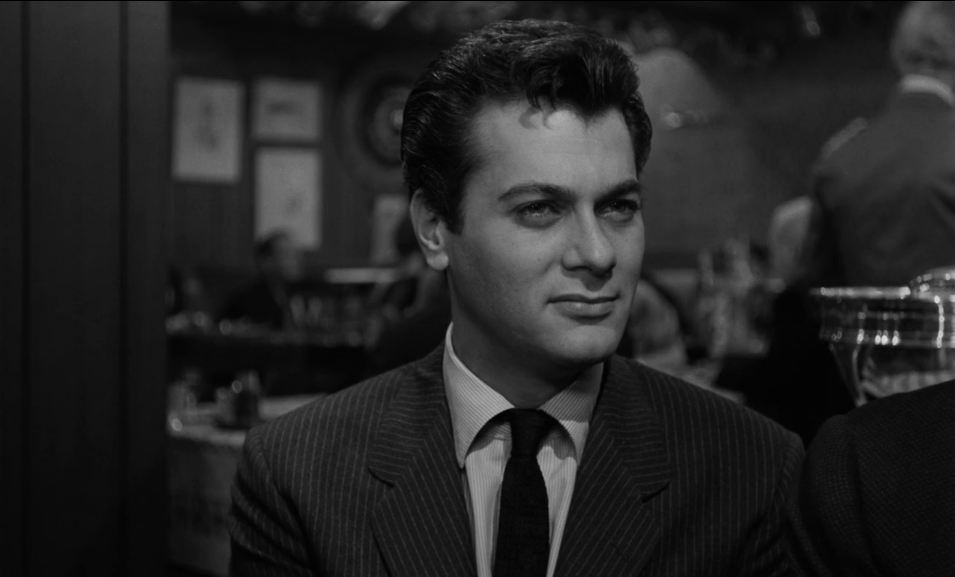
Alternate Best Actor 1957: Tony Curtis in Sweet Smell of Success

Tony Curtis did not receive an Oscar nomination for portraying Sidney Falco in Sweet Smell of Success.

Sweet Smell of Success is an excellent film about a columnist J.J. Hunsecker who gets an ambitious press agent to break up Hunsecker's sister's relationship with a musician. 

Tony Curtis portrays the press agent who will be doing the job for Hunsecker. I considered reviewing Lancaster as well, but watching the film again I would put him in the supporting category. It is an oppressive character so it is easy to see why one could see him as lead as well though. The greater focus of the film though goes onto Tony Curtis's performance as the conniving Sidney Falco. Falco very much is the lackey henchmen of Hunsecker in the film, although it has nothing to do with loyalty, the only reason he follows Hunsecker's demands is to further his own career.

Curtis who usually portrayed good guys before this performance, or at least in some way charming fellow takes on entirely different method here as Sidney Falco. It is a fascinating performance that particularly works well in comparison to Burt Lancaster's superb performance. Both are very much similar men in their amorality, and power waving or seeking, but Lancaster and Curtis take greatly different methods in their performance. Where Lancaster's portrayal of the amorality is very much like forceful brick wall that cannot be surpassed, Curtis though portrays it as something constantly in motion.

Falco is always a man in some sort of motion, and Curtis is excellent in portraying that Falco is constantly playing for some sort of gain. Interestingly enough Curtis always portrays Falco in some sort of motion even when he is standing still or sitting usually blinking at a rapid rate. Curtis puts just the right amount of animation into his role to be able to bring across the idea of how Falco is always a man thinking of the next move during every point of the story, but as well he never does it to the point in which it seems like something flamboyant. It is instead entirely something natural to Falco as a person.

One of the most important lines for Curtis's character is when Hunsecker describes Falco as a man of forty faces not one. This in itself is quite a bit of a challenge to be lived up to, but Curtis is more than capable of doing so. Curtis face is particularly expressive here and quite apt at bringing about the various facades that Falco puts on to move forward in his business. One scene in which Curtis portrays this especially well is when he approaches Hudsecker for the first time in the film. In the scene Hudsecker insults Falco, and Curtis's expression is brilliant. There is a very forced upon slight smirk the entire time, but Curtis so well portrays the incredible hate and venom he does feel Hudsecker in the moment.

Really one of Curtis's greatest assets in this performance are actually his boyish good looks. He plays Falco brilliantly in every scene but especially when he is working his job. There are many who are already put off by him due to previous experience, but there are just as many who do not know the truth about him. Curtis is excellent in every moment of portraying Falco's method as he does not really portray him as the slickest man at all. In fact when some of his angry costumers confront him Curtis is good in showing that quick annoyance and anger Falco comes to right away when confronted being unable to really explain himself.

Curtis though does portray Falco's abilities just as well particularly in showing his abilities to so quickly put wool over people's eyes to meet his demands. Curtis is excellent in bringing across the intelligence in Falco. He never loses a beat and he makes it entirely believable that he could work his way through all of his success. What is so important though is that even when the others doubt him Curtis all brings an incredible degree of determination within Falco that never seems to cease when he is putting one over on someone. There is always a drive in him that keeps him prodding and pushing until he gets his way, or at least gets the person to hate him.

Although Curtis never takes an easy route to be likable in the traditional sense, he does well in adding just the slightest bit of a conscience to his character. Of course Curtis really is terrific here becuase of just how little morality he does give him, making the moments where he does show it quite powerful. Curtis never makes it an overt moment or two as he does the most wretched of things for Hudsecker but there are just the smallest moment of hesitations when doing the worst. Curtis though shows that even the moments of conscience only press for a a slight reaction, but his want for success always shifts to a slight smile of immorality.

Tony Curtis gives a great performance here as Sidney Falco because he never for a moment gives up on that Falco really is only opportunist as Hudsecker calls him. Even in the final showdown between the two Curtis still stays firm that it is not really for goodness sake that he reveals the truth to Hudsecker's sister, he portrays it almost as an accident because it really comes only for his hatred for Hudsecker who betrayed him. He never is overwhelmed by the dialogue or over shadowed by Lancaster, he stands firm in his fascinating depiction of this unscrupulous man.

Wednesday, 19 September 2012

Alternate Best Actor 1957

And the Nominees Were Not:

Henry Fonda in 12 Angry Men

Andy Griffith in A Face in The Crowd

Kirk Douglas in Paths of Glory

Tony Curtis in Sweet Smell of Success

Toshiro Mifune in Throne of Blood