Showing posts with label Joseph Schildkraut. Show all posts

Thursday, 13 August 2015

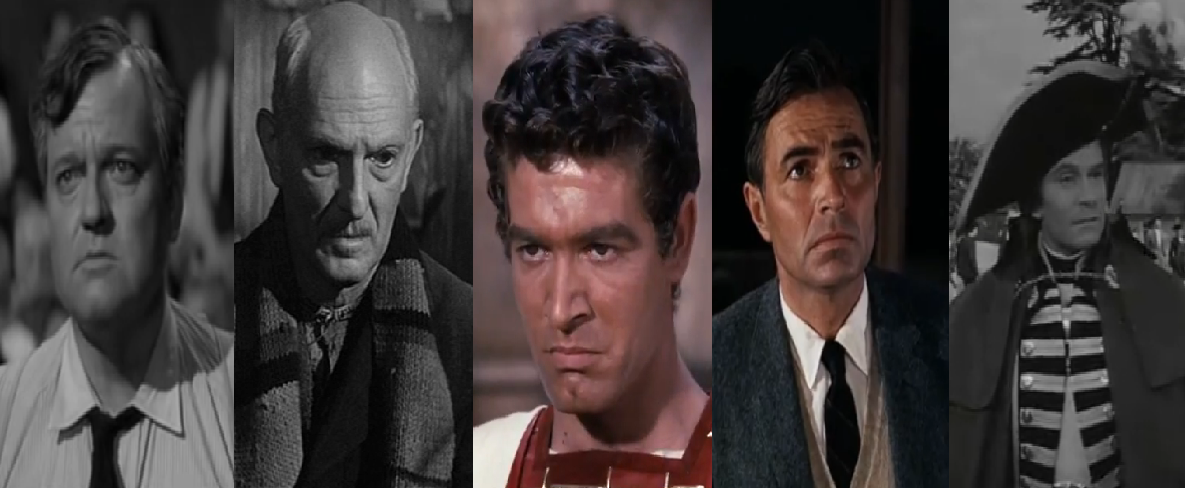
Alternate Best Supporting Actor 1959: Results

5. Orson Welles in Compulsion - Welles gives a rather understated yet very effective portrayal of his passionate lawyer.

Best Scene: Wilk's final words to the killers.
4. James Mason in North By Northwest - Mason gives a wonderfully suave and effortlessly menacing depiction of a villain with class.

Best Scene: The auction.
3. Laurence Olivier in The Devil's Disciple - Olivier gives one of his most entertaining performance as his humorous and incisive portrayal of a soldier who's a true gentleman above all. 

Best Scene: The Trial
2. Stephen Boyd in Ben-Hur -  Although Boyd is great at being a smug and despicable villain, he creates a far more memorable portrayal through giving a greater depth to what motivates this man.

Best Scene: Messala after the race.
1. Joseph Schildkraut in The Diary of Anne Frank - I'll admit this is another year where I could easily switch one way or the other between the top two. At the moment though my win goes to Schildkraut's incredible work which so well realizes the warmth and optimism of his character making his final depiction of a broken man truly heartbreaking.

Best Scene: The Ending.
Overall Rank:
  1. Stephen Boyd in Ben-Hur
  2. Joseph Schildkraut in The Diary of Anne Frank
  3. George C. Scott in Anatomy of a Murder
  4. Laurence Olivier in The Devil's Disciple
  5. James Mason in North By Northwest
  6. Orson Welles in Compulsion
  7. Ben Gazzara in Anatomy of a Murder
  8. Jimmy O'Dea in Darby O'Gill and the Little People
  9. Martin Landau in North By Northwest
  10. Peter Sellers in I'm All Right Jack
  11. Peter Finch in The Nun's Story
  12. Burl Ives in Our Man in Havana
  13. Dean Martin in Rio Bravo
  14. Albert Rémy in The 400 Blows
  15. Hugh Griffith in Ben-Hur
  16. Arthur O'Connell in Anatomy of a Murder
  17. Robert Vaughn in The Young Philadelphians
  18. Richard Attenborough in I'm All Right Jack
  19. Kunie Tanaka in The Human Condition II: Road to Eternity
  20. Lou Jacobi in The Diary of Anne Frank
  21. Finlay Currie in Ben-Hur 
  22. E.G. Marshall in Compulsion
  23. Tony Randall in Pillow Talk
  24. Noel Coward in Our Man in Havana
  25. Donald Wolfit in Room At the Top 
  26. Andre Morrell in The Hound of the Baskervilles
  27. So Yamamura in The Human Condition I: No Greater Love
  28. Ed Wynn in The Diary of Anne Frank
  29. Anthony Quinn in Warlock 
  30. Jack Hawkins in Ben-Hur 
  31. Ernie Kovacs in Our Man in Havana
  32. Joe E. Brown in Some Like It Hot
  33. Christopher Lee in The Hound of the Baskervilles
  34. Terry-Thomas in I'm All Right Jack 
  35. Murray Hamilton in Anatomy of a Murder 
  36. Arthur O'Connell in Operation Petticoat 
  37. Keiji Sada in The Human Condition II: Road to Eternity
  38. Sean Connery in Darby O'Gill and the Little People
  39. Miles Malleson in I'm All Right Jack
  40. Walter Brennan in Rio Bravo
  41. Sam Jaffe in Ben-Hur
  42. John Williams in The Young Philadelphians
  43. Frank Thring in Ben-Hur
  44. Kieron Moore in Darby O'Gill and the Little People
  45. Leo G. Carroll in North By Northwest 
  46. Denis O'Dea in Darby O'Gill and the Little People
  47. Ward Bond in Rio Bravo 
  48. Dean Martin in Career
  49. Billy Dee Williams in The Last Angry Man
  50. Bill Thompson in Sleeping Beauty 
  51. Donald Pleasence in Look Back in Anger 
  52. Ralph Richardson in Our Man in Havana
  53. Donald Houston in Room At the Top
  54. Jack MacGowran in Darby O'Gill and the Little People
  55. Bill Shirley in Sleeping Beauty
  56. Adam West in The Young Philadelphians
  57. Harry Andrews in The Devil's Disciple 
  58. Brian Keith in The Young Philadelphians 
  59. Frank Gorshin in Warlock 
  60. Gary Raymond in Look Back in Anger
  61. Thayer Davis in Journey to the Center of the Earth
  62. Geoffrey Keen in The Scapegoat
  63. Orson Bean in Anatomy of a Murder
  64. Richard Deacon in The Young Philadelphians
  65. Peter Bull in The Scapegoat
  66. Nick Adams in Pillow Talk
  67. Joseph N. Welch in Anatomy of a Murder 
  68. George Raft in Some Like It Hot
  69. Frank McHugh in Career
  70. Pat Boone in Journey to the Center of the Earth
  71. Dick Sargent in Operation Petticoat  
  72. Dan O'Herlihy in Imitation of Life
  73. Luther Adler in The Last Angry Man
  74. Dean Jagger in The Nun's Story
  75. Richard Beymer in The Diary of Anne Frank 
  76. Robert Strauss in 4-D Man
  77. Douglas Spencer in The Diary of Anne Frank
  78. Robert Middleton in Career 
  79. John Gavin in The Imitation of Life
  80. Edgar Stehli in 4-D Man 
  81. Martin Milner in Compulsion 
  82. Ricky Nelson in Rio Bravo
  83. Peter Ronson in Journey to the Center of the Earth
  84. Criswell in Plan 9 From Outer Space
  85. Carl Anthony in Plan 9 From Outer Space
  86. Paul Marco in Plan 9 From Outer Space
  87. Tom Keene in Plan 9 From Outer Space
  88. Tor Johnson in Plan 9 From Outer Space
  89. Lyle Talbot in Plan 9 From Outer Space
  90. John Breckinridge in Plan From Outer Space
Next Year: 1976 Lead

Alternate Best Supporting Actor 1959: Joseph Schildkraut in The Diary of Anne Frank

Joseph Schildkraut did not receive an Oscar nomination, despite being nominated for a Golden Globe, for portraying Otto Frank in The Diary of Anne Frank.

Joseph Schildkraut was not nominated for the film, despite Ed Wynn being nominated in the supporting category for the film, as he was likely positioned in the leading category, the category he was nominated for at the Globes. I would disagree with this placement since the focus, barring the bookends, focuses on Anne (Millie Perkins) with everyone else in the attic supporting her story. Schildkraut though certainly has a pivotal role as Anne's father. Chronologically speaking the earliest scenes we see Otto is when he, his family including his wife and two daughters, and another family enter a hidden attic in a factory where they will be hiding from possible Nazi deportation. Schildkraut exudes a proper dignity fitting for the description of Mr. Frank. Schilkraut carries himself simply with quite the likability in the role of Mr. Frank, and establishes a certain optimism in this first scene. Even though the two families are going into hiding, which involves not moving for several hours of the day, Schildkraut portrays Otto as having a particularly bright outlook as in his view this drastic measure will save his family from the Nazi regime.

Although Anne has a fairly cold relationship with her mother she has a far better relationship with her father. Schildkraut is terrific in helping to establish this so well with his performance. There is such a generous amount of warmth that he brings out, that feels all the more special in the somewhat timid way he expresses himself. Schildkraut portrays Otto as somewhat unassuming but always so very welcoming in his manner. This is particularly well reflected in his relationship with Anne as merely take the early scene where they wait out the work day the first time before they are allowed to move and actual live again. Schildkraut effortlessly depicts just how naturally loving Otto is towards his family and Anne. There is nothing even to be said about it as there is never but this in his eyes in any given moment, and Schildkraut is able to find this in such a wholly genuine way which is essential for his character. Schildkraut is great though because he makes it feel like such a real affection with Mr. Frank, as there is nothing overbearing or too forceful about. It is something that simply exists through Schildkraut's performance and he makes it abundantly easy to understand why Anne is so attached to him, over her mother.

The Diary of Anne Frank is a long film as it focuses on various moments and interactions with Anne and between the other people in the attic, which eventually added one more via Ed Wynn's Mr. Dussel. Although Anne is kept as a focal point the film focuses very much on the ensemble wherein lies a bit of a challenge in which to stay noticed without seeming to try forcibly to become the center of attention. It could be argued that a few of the other performers. Well this is opposed to the character of Otto as well as opposed to Joseph Schildkraut's performance. Schildkraut though he was one of those reprising his stage and had not made a theatrically released film in over ten years before appearing in this one gives a particularly reserved portrayal of Otto Frank. It's quite outstanding then that Schildkraut is never overshadowed in any scene, despite never once trying to actively steal any scene from any other actor in the film. If he's onscreen he manages to hold some attention through his particularly honest depiction of a man leaving through this situation with his family. In simply his silent reactions Schildkraut always adds some power to the proceedings because of how natural he is in every scene.

When a scene focuses closer on Otto Schildkraut makes the most of this as well. There is one particularly great moment where he comforts Anne after a nightmare. Schildkraut brings out the tenderness of Otto comforting his daughter in such a moving fashion, but within that he effective portrays the way Otto is attempting to coax Anne into being showing more love for mother. The love is never in doubt but Schildkraut is terrific in the way he does not let it be only that as in his eyes he manages to convey the disappointment still in his daughter for her problematic behavior. Otto is always the calm center of the attic, who always tries to find the most peaceful solution for everyone. In this point Schildkraut is great simply because he never feels any less than pure in his character's goodness. It always feels the truth. There is another particularly strong scene for him when the attic is breaking apart due to one of the occupants stealing from the rations. While everyone else is falling apart Schildkraut realizes only a true goodness in Otto's disbelief at the anger of the others, and once again that reassuring quality, although slightly weakened over time, that comes from the considerable optimism that never seems to leave the man.

This optimistic man is not he one we first meet in the film as it opens with Otto after the war as he makes his way back to the attic alone. Schildkraut in this scene shows a man without optimism, there have been time of suffering in the meekness, and cold way he approaches the building. He has suffered a great deal, and Schildkraut realizes this in the almost unbearable somberness just before the film jumps back as Otto begins to read his daughter's diary. Even though the time in the diary's timeline ends with one last moment of Schildkraut so well showing that perseverance in Otto as they are about to be arrested, this makes it all the more devastating when it cuts back to Schildkraut depicting Otto as almost a broken man. Schildkraut is so haunting as he lists off learning of the deaths of the people in the attic as the painful memories seem to inflict him with such sadness, until he reaches Anne. Although we are not shown any of the deaths of the others Schildkraut's performance makes every one keenly felt. Schildkraut is absolutely heartbreaking as he so quietly tells the story of how he found out that Anne also had died, because in his breaths the last moments of hope seems to go out of his voice as he seems to accept that he is all that remains from the once life filled place. Although I do think the film has some missteps along the way the power of the story is never lost in a large part due to Schildkraut's work. He creates that sense of loss by so well creating such a warm and loving portrayal of a devoted father, only to strip it away to a man whose seemed to have lost all faith in humanity.

Monday, 3 August 2015

Alternate Best Supporting Actor 1959

And the Nominees Were Not:

Orson Welles in Compulsion

Joseph Schildkraut in The Diary of Anne Frank

Stephen Boyd in Ben-Hur

James Mason in North By Northwest

Laurence Olivier in The Devil's Disciple

Tuesday, 1 May 2012

Best Supporting Actor 1937: Results

5. H.B. Warner in Lost Horizon- Warner is perfectly fine in his role as the knowledgeable mysterious man, but it never makes a memorable impact on the film.
4. Roland Young in Topper- Young is okay throughout the film and except for an occasional moment here or there Young never finds just the right way to be a straight man.
3. Ralph Bellamy in The Awful Truth- Bellamy unlike Young does find the right way to be the straight man in his film, and gives a fairly enjoyable performance.
2. Joseph Schildkraut in The Life of Emile Zola- Schildkraut's role is exceedingly limited but he always does make an impact with his passionate and moving performance.
1. Thomas Mitchell in The Hurricane- Good prediction moviefilm. Mitchell wins this year, and yes my first five wins are shared among only two actors. Mitchell gives a strong performance where he is always an energetic, entertaining and charming presence as well as really brings the tragedy at the center of the film to life.
Deserving Performances:
Jean Hersholt in Heidi

Monday, 30 April 2012

Best Supporting Actor 1937: Joseph Schildkraut in The Life of Emile Zola

Joseph Schildkraut won his Oscar from his only Oscar nomination for portraying Captain Alfred Dreyfus in The Life of Emile Zola.

Joseph Schildkraut probably is fights Jack Palance, and Ben Johnson for the shortest performance to win an Oscar. As Captain Alfred Dreyfus first appears well into the film, and even then there is very little of him seen. He barely is even the main focuses of the scenes he is in, but nevertheless Schildkraut still makes an impact with his short performance as Dreyfus. After all although Dreyfus is a little scene character his character's troubles are the focus of the latter part of the film.

Captain Alfred Dreyfus is falsely accused and convicted of being a traitor in the French army basically because he is Jewish. Due to his limited screen time it is essential that we care for Dreyfus the moment we see him, so Schildkraut has his work cut out for him. Schildkraut meets the demands of the part and from his first scene does have a nice warm presence as Dreyfus that we can easily we sympathize with. Although it is only a glimpse, in the glimpse Schildkraut shows an honest family man who absolutely could not be guilty of anything especially not being a traitor his country.

Schildkraut brings us into Dreyfus's terrible struggle to convince people of his innocence. Schildkraut gives an entirely honest performance showing that pain, and disbelief that Dreyfus is going through. Schildkraut is absolutely heart wrenching when he is being stripped of rank, because his cries of "I am Innocent" are cries of a man desperately pleading to be believed and have his life returned to him. Schildkraut gives a passionate and moving portrait of Dreyfus in just these few moments.

Schildkraut continues to be effective as Dreyfus is being imprisoned and the sadness overwhelms him from what has happened to him. It would be common for many actors of this period to be completely unbelievable or over the top, but Schilkraut always gives a truthful performance. In just a few small reaction shots Schildkraut conveys the utter devastation of Dreyfus that has come from his imprisonment. There is not a false moment in this portrayal.

Dreyfus is finally proven innocent and released. Schildkraut is again given very little time, but still he manages to convey so well the relief, and happiness Dreyfus feels. He doesn't overplay it, but portrays the reality of this man's hope finally being rewarded. This is a good performance throughout only held by the fact he is barely in the film. It is really amazing though that Schildkraut managed to turn Dreyfus into a moving character in such limited screen time, when he could have easily been almost a non entity.

Saturday, 28 April 2012

Best Supporting Actor 1937

And the Nominees Were:

Ralph Bellamy in The Awful Truth

Thomas Mitchell in The Hurricane

Joseph Schildkraut in The Life of Emile Zola

Roland Young in Topper

H.B. Warner in Lost Horizon