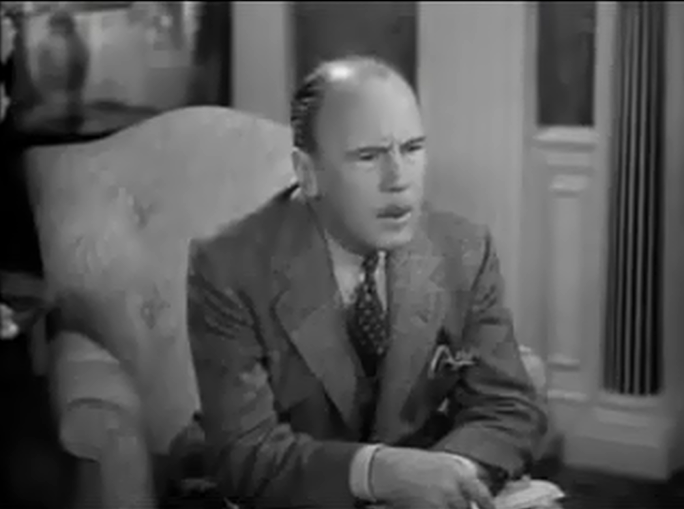
5. H.B. Warner in Lost Horizon- Warner is perfectly fine in his role as the knowledgeable mysterious man, but it never makes a memorable impact on the film.
4. Roland Young in Topper- Young is okay throughout the film and except for an occasional moment here or there Young never finds just the right way to be a straight man.
3. Ralph Bellamy in The Awful Truth- Bellamy unlike Young does find the right way to be the straight man in his film, and gives a fairly enjoyable performance.
2. Joseph Schildkraut in The Life of Emile Zola- Schildkraut's role is exceedingly limited but he always does make an impact with his passionate and moving performance.
1. Thomas Mitchell in The Hurricane- Good prediction moviefilm. Mitchell wins this year, and yes my first five wins are shared among only two actors. Mitchell gives a strong performance where he is always an energetic, entertaining and charming presence as well as really brings the tragedy at the center of the film to life.
Deserving Performances:
Jean Hersholt in Heidi
Showing posts with label 1937 Best Supporting Actor. Show all posts
Tuesday, 1 May 2012
Best Supporting Actor 1937: Ralph Bellamy in The Awful Turth
Ralph Bellamy received his only Oscar nomination for portraying Dan Leeson in The Awful Truth.
The Awful Truth tells about the madcap actions two soon to be divorced spouses Lucy and Jerry (Irene Dunne, Cary Grant) commit during their waiting period before the divorce is finalized.
Ralph Bellamy portrays Dan Leeson a man from Oklahoma visiting New York with his mother attempting to be a suitor to Lucy. Bellamy portrays himself as basically a straw man for Cary Grant to burn down, as Dan is just a man who can't keep up with Jerry's antics. He is a relatively simple man in his attempts to romance Lucy in a rather simple fashion. His simple ways, and simple methods just don't stand a chance in the face of Jerry's mad cap behavior. Bellamy portrays the part as he should as he makes Dan a likable straw man. Bellamy does bring a small simple charm fitting of the simple Dan.
Bellamy's whole point is to be sort of a straight man foil to the wackiness of Dunne and particularly Grant. In this end Bellamy is pretty good at it actually. He does not overplay the simpleness of his part, and the best comparison can be made is with Roland Young in Topper from this same year. Young failed to be that great of a straight man, because he played it a little too straight actually, but Bellamy knows how to balance the act to far greater effect. He is believable in his portrayal of that Dan is never in on the jokes of the film, but Bellamy manages to still get in on the humor of the film at the same time.
There is always just something funny about how out of his element Dan is. He really fits well in the mix of things as the wrong end of jokes between the characters. What makes Bellamy's performance work is because he always is quite earnest as Dan, he desperately does want a romance with Dunne's character, and he genuinely has no idea that everyone is making a bit of a fool of him. His dancing scene pretty much sums it up is all there to funny as he stumbles around the dance floor, yet Bellamy never for a minute shows that Dan thinks this is anything but some great dance moves he knows.
I would say my only problem with the performance is just how short lived is, he only has a few scenes and disappears far before the end of the film. I would say that I preferred Bellamy's performance as a very similar character in His Girl Friday but than again he was given far more to do in that film. Also He most certainly does not override either Dunne or Grant as the best part of the film by any means but he does serve his purpose well. Bellamy though is enjoyable whenever he was on screen though, and gives a performance that adds well to the film.
The Awful Truth tells about the madcap actions two soon to be divorced spouses Lucy and Jerry (Irene Dunne, Cary Grant) commit during their waiting period before the divorce is finalized.
Ralph Bellamy portrays Dan Leeson a man from Oklahoma visiting New York with his mother attempting to be a suitor to Lucy. Bellamy portrays himself as basically a straw man for Cary Grant to burn down, as Dan is just a man who can't keep up with Jerry's antics. He is a relatively simple man in his attempts to romance Lucy in a rather simple fashion. His simple ways, and simple methods just don't stand a chance in the face of Jerry's mad cap behavior. Bellamy portrays the part as he should as he makes Dan a likable straw man. Bellamy does bring a small simple charm fitting of the simple Dan.
Bellamy's whole point is to be sort of a straight man foil to the wackiness of Dunne and particularly Grant. In this end Bellamy is pretty good at it actually. He does not overplay the simpleness of his part, and the best comparison can be made is with Roland Young in Topper from this same year. Young failed to be that great of a straight man, because he played it a little too straight actually, but Bellamy knows how to balance the act to far greater effect. He is believable in his portrayal of that Dan is never in on the jokes of the film, but Bellamy manages to still get in on the humor of the film at the same time.
There is always just something funny about how out of his element Dan is. He really fits well in the mix of things as the wrong end of jokes between the characters. What makes Bellamy's performance work is because he always is quite earnest as Dan, he desperately does want a romance with Dunne's character, and he genuinely has no idea that everyone is making a bit of a fool of him. His dancing scene pretty much sums it up is all there to funny as he stumbles around the dance floor, yet Bellamy never for a minute shows that Dan thinks this is anything but some great dance moves he knows.
I would say my only problem with the performance is just how short lived is, he only has a few scenes and disappears far before the end of the film. I would say that I preferred Bellamy's performance as a very similar character in His Girl Friday but than again he was given far more to do in that film. Also He most certainly does not override either Dunne or Grant as the best part of the film by any means but he does serve his purpose well. Bellamy though is enjoyable whenever he was on screen though, and gives a performance that adds well to the film.
Best Supporting Actor 1937: H.B. Warner in Lost Horizon
H.B. Warner received his only Oscar nomination for portraying Chang in Lost Horizon.
Lost Horizon tells of a group of people whose plan is hijacked and later crashes who were escaping from a revolution in China that find themselves in a strange perfect place known as Shangri-La.
H.B. Wanner portrays Chang a man of some importance in Shangri-La who at first finds the people on the plane, and later tries to make them accustomed to the place. With a name like Chang one can easily say that he probably he is suppose to be Chinese. Thankfully H.B. Warner does not portray the role as so. He does not put a voice or try any mannerisms to try to suggest this in anyway, which is most certainly a good thing. He instead just portrays him straightly as a wise man who knows much of what there is to know about Shangri-La.
H.B. Warner is entirely fine in the part of the wise Chang. There is a nice low key pleasantness in his performance, and Warner also does a good job of conveying the mystery of Chang. There is always an otherworldly quality to Warner here that works well for the part of Chang. Chang is one of the primary representatives of Shangri-La, and Warner's performance does effectively bring to life the pleasantness as well as mysteriousness of the place. Warner properly stays consistent as Change, never changing at all during the film, as Chang is a constant.
Warner really does not have a bad moment in his performance, and plays the part well especially sense it could have easily been portrayed in a very bad fashion considering the time. It also is a bit too limited of a part, and he just does not have that much of an impact on the film. I liked him in the film, but really his character just is never that interesting. It is just too limited for anything to really come from the part and really in the end this is a career nomination for Warner. Thankfully he is at least good in the part, but his performance is just not that memorable.
Lost Horizon tells of a group of people whose plan is hijacked and later crashes who were escaping from a revolution in China that find themselves in a strange perfect place known as Shangri-La.
H.B. Wanner portrays Chang a man of some importance in Shangri-La who at first finds the people on the plane, and later tries to make them accustomed to the place. With a name like Chang one can easily say that he probably he is suppose to be Chinese. Thankfully H.B. Warner does not portray the role as so. He does not put a voice or try any mannerisms to try to suggest this in anyway, which is most certainly a good thing. He instead just portrays him straightly as a wise man who knows much of what there is to know about Shangri-La.
H.B. Warner is entirely fine in the part of the wise Chang. There is a nice low key pleasantness in his performance, and Warner also does a good job of conveying the mystery of Chang. There is always an otherworldly quality to Warner here that works well for the part of Chang. Chang is one of the primary representatives of Shangri-La, and Warner's performance does effectively bring to life the pleasantness as well as mysteriousness of the place. Warner properly stays consistent as Change, never changing at all during the film, as Chang is a constant.
Warner really does not have a bad moment in his performance, and plays the part well especially sense it could have easily been portrayed in a very bad fashion considering the time. It also is a bit too limited of a part, and he just does not have that much of an impact on the film. I liked him in the film, but really his character just is never that interesting. It is just too limited for anything to really come from the part and really in the end this is a career nomination for Warner. Thankfully he is at least good in the part, but his performance is just not that memorable.
Best Supporting Actor 1937: Thomas Mitchell in The Hurricane
Thomas Mitchell received his first Oscar nomination for portraying Dr. Kersaint in The Hurricane.
The Hurricane is a disaster film about a destructive hurricane strikes climatically while a native fugitive Terangi (Jon Hall) tries to escape the authorities to reach his wife (Dorothy Lamour).
I must say it is interesting that Thomas Mitchell was nominated twice, twice as Best Supporting Actor in a John Ford film as a doctor who probably likes his drink just a little too much. I suppose why not have Mitchell is a supportive role as a doctor as it allows him in multiple scenes and Mitchell is an actor who almost always throws a lot of energy into a role. Also why not make him drunk, no one quite plays a drunk like Thomas Mitchell does. Also despite the roles being very very similar Mitchell does not feel like he is just repeating himself in either role.
Mitchell from his very first scene has a serious dedication to the part and brings a much needed weight to the role of the doctor. His opening scene sets the mood as he indicates the loss that will occur later on in the film. Right in Mitchell faces conveys the entire tragedy of the film's finale. His shows a genuine human loss in the doctor's eyes in this moment, as well as his history with the island, a history of a home he once loved, but was all lost in the blink of an eye. It is really a wonderful moment for Mitchell, and it is interesting as Mitchell really shows where the resolution of this man will be in the opening scene of the film.
For the rest of the film Mitchell is almost part of the scenery as the doctor of the strict governor of the region (Raymond Massey). Mitchell basically steals every scene, no that's wrong, Mitchell does not basically, he does steal every scene he is as the doctor. He just a always a perfectly lively and charming presence as the sensible doctor who tries to convince the governor that his strict ways really is not the best way to rule the people of the island. Mitchell as well flawlessly shows the understanding, and intelligence of the doctor. Mitchell manages to make the doctor always the most entertaining, interesting, and intelligent man in any room he is in.
Mitchell does also, despite the limitations on his role, make a character of the doctor who is a drunk for rather different reasons that Josiah Boone. This doctor really is a man, although he knows the people does have some desire for some greater position in life, that makes him drink his days away on the rather limited place of the island. Mitchell shows him not to be an alcoholic like Josiah Boone who was filled with uncertainty, rather Mitchell shows that Doctor Kersaint is really just a drunk since he finds that he just does not have anything better to do. Also it should be said again Mitchell is perfect at playing drunk, somehow he is comical without being over the top and cartoonish.
A great deal of the time Mitchell as the doctor must constantly be the force of wisdom and philosophy in the film. Mitchell does a great job of this actually, especially when these sort of parts can become heavy handed quite easily when in the wrong hands. Mitchell is absolutely the right hands though because there is always just a bit of sly wit behind his jabs at the governor for failing to see the right thing to do. He never makes his passionate pleas or philosophical moments boring, Mitchell always infuses power into these moments because the joy and energy that never ceases in his performance.
Mitchell really shines at the end of the film when The Hurricane finally does strike basically destroying the island. What makes Mitchell so effective here, because like the beginning of the film, he gives a much needed weight to the film but showing a real man in the situation and avoid some of the dodgy acting that can be found in the 30's. He shows the doctor truly go into action in the terrible moment bringing the seriousness of the situation into reality. His best moment comes at the end of the film where most of the actors are showing the aftermath to be bad, but Mitchell manages to really convey just how horrible the event really is. He brings to life this somber man, filled with sadness and pain over the horrendous events that transpired around him. It is in Mitchell's performance that succeeds in bringing to life the tremendous cost of the hurricane. This is very strong work from Mitchell who does far more than support the film, he anchors it.
The Hurricane is a disaster film about a destructive hurricane strikes climatically while a native fugitive Terangi (Jon Hall) tries to escape the authorities to reach his wife (Dorothy Lamour).
I must say it is interesting that Thomas Mitchell was nominated twice, twice as Best Supporting Actor in a John Ford film as a doctor who probably likes his drink just a little too much. I suppose why not have Mitchell is a supportive role as a doctor as it allows him in multiple scenes and Mitchell is an actor who almost always throws a lot of energy into a role. Also why not make him drunk, no one quite plays a drunk like Thomas Mitchell does. Also despite the roles being very very similar Mitchell does not feel like he is just repeating himself in either role.
Mitchell from his very first scene has a serious dedication to the part and brings a much needed weight to the role of the doctor. His opening scene sets the mood as he indicates the loss that will occur later on in the film. Right in Mitchell faces conveys the entire tragedy of the film's finale. His shows a genuine human loss in the doctor's eyes in this moment, as well as his history with the island, a history of a home he once loved, but was all lost in the blink of an eye. It is really a wonderful moment for Mitchell, and it is interesting as Mitchell really shows where the resolution of this man will be in the opening scene of the film.
For the rest of the film Mitchell is almost part of the scenery as the doctor of the strict governor of the region (Raymond Massey). Mitchell basically steals every scene, no that's wrong, Mitchell does not basically, he does steal every scene he is as the doctor. He just a always a perfectly lively and charming presence as the sensible doctor who tries to convince the governor that his strict ways really is not the best way to rule the people of the island. Mitchell as well flawlessly shows the understanding, and intelligence of the doctor. Mitchell manages to make the doctor always the most entertaining, interesting, and intelligent man in any room he is in.
Mitchell does also, despite the limitations on his role, make a character of the doctor who is a drunk for rather different reasons that Josiah Boone. This doctor really is a man, although he knows the people does have some desire for some greater position in life, that makes him drink his days away on the rather limited place of the island. Mitchell shows him not to be an alcoholic like Josiah Boone who was filled with uncertainty, rather Mitchell shows that Doctor Kersaint is really just a drunk since he finds that he just does not have anything better to do. Also it should be said again Mitchell is perfect at playing drunk, somehow he is comical without being over the top and cartoonish.
A great deal of the time Mitchell as the doctor must constantly be the force of wisdom and philosophy in the film. Mitchell does a great job of this actually, especially when these sort of parts can become heavy handed quite easily when in the wrong hands. Mitchell is absolutely the right hands though because there is always just a bit of sly wit behind his jabs at the governor for failing to see the right thing to do. He never makes his passionate pleas or philosophical moments boring, Mitchell always infuses power into these moments because the joy and energy that never ceases in his performance.
Mitchell really shines at the end of the film when The Hurricane finally does strike basically destroying the island. What makes Mitchell so effective here, because like the beginning of the film, he gives a much needed weight to the film but showing a real man in the situation and avoid some of the dodgy acting that can be found in the 30's. He shows the doctor truly go into action in the terrible moment bringing the seriousness of the situation into reality. His best moment comes at the end of the film where most of the actors are showing the aftermath to be bad, but Mitchell manages to really convey just how horrible the event really is. He brings to life this somber man, filled with sadness and pain over the horrendous events that transpired around him. It is in Mitchell's performance that succeeds in bringing to life the tremendous cost of the hurricane. This is very strong work from Mitchell who does far more than support the film, he anchors it.
Monday, 30 April 2012
Best Supporting Actor 1937: Joseph Schildkraut in The Life of Emile Zola
Joseph Schildkraut won his Oscar from his only Oscar nomination for portraying Captain Alfred Dreyfus in The Life of Emile Zola.
Joseph Schildkraut probably is fights Jack Palance, and Ben Johnson for the shortest performance to win an Oscar. As Captain Alfred Dreyfus first appears well into the film, and even then there is very little of him seen. He barely is even the main focuses of the scenes he is in, but nevertheless Schildkraut still makes an impact with his short performance as Dreyfus. After all although Dreyfus is a little scene character his character's troubles are the focus of the latter part of the film.
Captain Alfred Dreyfus is falsely accused and convicted of being a traitor in the French army basically because he is Jewish. Due to his limited screen time it is essential that we care for Dreyfus the moment we see him, so Schildkraut has his work cut out for him. Schildkraut meets the demands of the part and from his first scene does have a nice warm presence as Dreyfus that we can easily we sympathize with. Although it is only a glimpse, in the glimpse Schildkraut shows an honest family man who absolutely could not be guilty of anything especially not being a traitor his country.
Schildkraut brings us into Dreyfus's terrible struggle to convince people of his innocence. Schildkraut gives an entirely honest performance showing that pain, and disbelief that Dreyfus is going through. Schildkraut is absolutely heart wrenching when he is being stripped of rank, because his cries of "I am Innocent" are cries of a man desperately pleading to be believed and have his life returned to him. Schildkraut gives a passionate and moving portrait of Dreyfus in just these few moments.
Schildkraut continues to be effective as Dreyfus is being imprisoned and the sadness overwhelms him from what has happened to him. It would be common for many actors of this period to be completely unbelievable or over the top, but Schilkraut always gives a truthful performance. In just a few small reaction shots Schildkraut conveys the utter devastation of Dreyfus that has come from his imprisonment. There is not a false moment in this portrayal.
Dreyfus is finally proven innocent and released. Schildkraut is again given very little time, but still he manages to convey so well the relief, and happiness Dreyfus feels. He doesn't overplay it, but portrays the reality of this man's hope finally being rewarded. This is a good performance throughout only held by the fact he is barely in the film. It is really amazing though that Schildkraut managed to turn Dreyfus into a moving character in such limited screen time, when he could have easily been almost a non entity.
Joseph Schildkraut probably is fights Jack Palance, and Ben Johnson for the shortest performance to win an Oscar. As Captain Alfred Dreyfus first appears well into the film, and even then there is very little of him seen. He barely is even the main focuses of the scenes he is in, but nevertheless Schildkraut still makes an impact with his short performance as Dreyfus. After all although Dreyfus is a little scene character his character's troubles are the focus of the latter part of the film.
Captain Alfred Dreyfus is falsely accused and convicted of being a traitor in the French army basically because he is Jewish. Due to his limited screen time it is essential that we care for Dreyfus the moment we see him, so Schildkraut has his work cut out for him. Schildkraut meets the demands of the part and from his first scene does have a nice warm presence as Dreyfus that we can easily we sympathize with. Although it is only a glimpse, in the glimpse Schildkraut shows an honest family man who absolutely could not be guilty of anything especially not being a traitor his country.
Schildkraut brings us into Dreyfus's terrible struggle to convince people of his innocence. Schildkraut gives an entirely honest performance showing that pain, and disbelief that Dreyfus is going through. Schildkraut is absolutely heart wrenching when he is being stripped of rank, because his cries of "I am Innocent" are cries of a man desperately pleading to be believed and have his life returned to him. Schildkraut gives a passionate and moving portrait of Dreyfus in just these few moments.
Schildkraut continues to be effective as Dreyfus is being imprisoned and the sadness overwhelms him from what has happened to him. It would be common for many actors of this period to be completely unbelievable or over the top, but Schilkraut always gives a truthful performance. In just a few small reaction shots Schildkraut conveys the utter devastation of Dreyfus that has come from his imprisonment. There is not a false moment in this portrayal.
Dreyfus is finally proven innocent and released. Schildkraut is again given very little time, but still he manages to convey so well the relief, and happiness Dreyfus feels. He doesn't overplay it, but portrays the reality of this man's hope finally being rewarded. This is a good performance throughout only held by the fact he is barely in the film. It is really amazing though that Schildkraut managed to turn Dreyfus into a moving character in such limited screen time, when he could have easily been almost a non entity.
Sunday, 29 April 2012
Best Supporting Actor 1937: Roland Young in Topper
Roland Young received his only Oscar nomination for portraying the titular Cosmo Topper in Topper.
Topper tells about a stuffy rich man Topper, who his haunted by the ghosts of his care free acquaintances the Kerbys (Cary Grant, Constance Bennett).
Roland Young is the very first case of category fraud in Best Supporting Actor as Roland Young is not supporting film. This is rather the indications of the trend that is common which is character actors in lead roles, as well as unassuming characters can commonly find themselves put in the supporting category. The film is titled Topper for a reason as it is about the stuffy Topper being basically forced to be more carefree by his ghostly friends. This is not even a case of secondary male lead, Cary Grant is not even in the film all that much and half the time he is he is only a disembodied voice.
Roland Young whole performance is pretty much made up of him being stuffy and being taken aback by his other worldly friends. The whole point of his performance really is to be funny as the proper man is forced into improper behavior by them. Young certainly is a proper enough man with his demeanor as Topper but Young actually might try to be to realistic as Topper. He is always very to the point, and underplays every situation maybe a little too much. I would rather he wouldn't overact, but maybe in reality Young's Topper is just a bit too stiff.
Not that being is stiff is the incorrect way to portray Topper, that is the point of the character, I just think there probably could have been funnier. It is actually very difficult to do the straight man right, to be comedic without ever seeming to be comedic, but Young does not really accomplish this difficult task. A straight man must somehow have the same comedic energy that matches the comedians, but at the same time never looks like he is having fun, Young certainly does not look like he is having much fun, but the underlying comedic energy never is there.
I don't want to sound too harsh because Young really is not bad as Topper he certainly fits the role, and portrays it without overacting. At the same time though this could have been a truly classic comedic performance with a greater straight man in the role. There is the occasional moment where Young does have a glint of how the performance really should have been but there really are not enough of them. He also is perfectly fine in his portrayal of Topper loosening up.Young is always consistently competent in the role, but he never really makes the part hilarious when it very well could have been.
Topper tells about a stuffy rich man Topper, who his haunted by the ghosts of his care free acquaintances the Kerbys (Cary Grant, Constance Bennett).
Roland Young is the very first case of category fraud in Best Supporting Actor as Roland Young is not supporting film. This is rather the indications of the trend that is common which is character actors in lead roles, as well as unassuming characters can commonly find themselves put in the supporting category. The film is titled Topper for a reason as it is about the stuffy Topper being basically forced to be more carefree by his ghostly friends. This is not even a case of secondary male lead, Cary Grant is not even in the film all that much and half the time he is he is only a disembodied voice.
Roland Young whole performance is pretty much made up of him being stuffy and being taken aback by his other worldly friends. The whole point of his performance really is to be funny as the proper man is forced into improper behavior by them. Young certainly is a proper enough man with his demeanor as Topper but Young actually might try to be to realistic as Topper. He is always very to the point, and underplays every situation maybe a little too much. I would rather he wouldn't overact, but maybe in reality Young's Topper is just a bit too stiff.
Not that being is stiff is the incorrect way to portray Topper, that is the point of the character, I just think there probably could have been funnier. It is actually very difficult to do the straight man right, to be comedic without ever seeming to be comedic, but Young does not really accomplish this difficult task. A straight man must somehow have the same comedic energy that matches the comedians, but at the same time never looks like he is having fun, Young certainly does not look like he is having much fun, but the underlying comedic energy never is there.
I don't want to sound too harsh because Young really is not bad as Topper he certainly fits the role, and portrays it without overacting. At the same time though this could have been a truly classic comedic performance with a greater straight man in the role. There is the occasional moment where Young does have a glint of how the performance really should have been but there really are not enough of them. He also is perfectly fine in his portrayal of Topper loosening up.Young is always consistently competent in the role, but he never really makes the part hilarious when it very well could have been.
Saturday, 28 April 2012
Best Supporting Actor 1937
And the Nominees Were:
Ralph Bellamy in The Awful Truth
Thomas Mitchell in The Hurricane
Joseph Schildkraut in The Life of Emile Zola
Roland Young in Topper
H.B. Warner in Lost Horizon
Ralph Bellamy in The Awful Truth
Thomas Mitchell in The Hurricane
Joseph Schildkraut in The Life of Emile Zola
Roland Young in Topper
H.B. Warner in Lost Horizon
Subscribe to:
Posts (Atom)