Thursday, 3 March 2016

Alternate Best Actor 1939

And the Nominees Were Not:

Charles Laughton in The Hunchback of Notre Dame

Conrad Veidt in The Spy in Black

Henry Fonda in Young Mr. Lincoln

James Cagney in The Roaring Twenties

Basil Rathbone in The Hound of Baskervilles

Wednesday, 2 March 2016

Alternate Best Supporting Actor 1962: Results

5. Robert Duvall in To Kill a Mockingbird - Duvall gives a flawless performance that fully realizes his his pivotal character in a matter of 3 minutes.

Best Scene: His only scene. 
4. Lee Marvin in The Man Who Shot Liberty Valance - Marvin gives a memorable villainous turn by being the absolute lout bully that Liberty Valance should be.

Best Scene: The duel. 
3. Tatsuya Nakadai in Sanjuro - Nakadai once again offers a worthy adversary for Toshiro Mifune's nameless samurai, but this time surprisingly strikes up a certain underlying connection between the foes.

Best Scene: The duel. 
2. Robert Ryan in Billy Budd - Ryan gives one of his best performances, giving a chilling portrayal of a sadist, but also manages to find the depth within what compels the man.

Best Scene: Billy tries to comfort Claggart. 
1. Peter Sellers in Lolita - Sellers gives an amazing performance as he's absolutely hilarious, but also manages to be surprisingly unnerving in the role at the same time.

Best Scene: Just a normal guy with a normal face.
7. Arthur Kennedy - Kennedy offers the needed two sides to his character the slightly shallow broadcaster, but as well the sardonic man who is well aware of what he is doing.

Best Scene: "I'll take your bloody picture"
6. Anthony Quayle - Quayle brings surprising depth to his role as he quietly portrays the affecting arc of his character, which is to fully understand who Lawrence really was.

Best Scene: The funeral. 
5. Anthony Quinn - Quinn gives an appropriately larger than life performance capturing the grandeur needed for the role, but importantly finds the right nuance when it is needed.

Best Scene: Tayi and Brighton.
4. Jack Hawkins - Hawkins naturally fulfills the role of the proper British General but goes further in his exploration of his character's relationship with Lawrence.

Best Scene: Allenby convinces Lawrence to take up the fight again.
3. Alec Guinness - As per usual Guinness gives strong work successfully disappearing into his role as well as giving a rather captivating portrait of a quiet yet powerful leader.

Best Scene: Faisal is interviewed.
2. Jose Ferrer - A brilliant one scene wonder as he completely realizes his character's disposition and finds the needed subtext of his scene through his performance.

Best Scene: His scene.
1. Claude Rains - Good predictions mcofra7, and Jackiboyz. Rains gives such an excellent performance as he does not waste a second in creating a fascinating depiction of a smooth political operator.

Best Scene: The ending.
Overall Rank:
  1. Peter Sellers in Lolita
  2. Robert Ryan in Billy Budd
  3. Omar Sharif in Lawrence of Arabia
  4. Claude Rains in Lawrence of Arabia
  5. Tatsuya Nakadai in Sanjuro 
  6. Lee Marvin in The Man Who Shot Liberty Valance
  7. Jose Ferrer in Lawrence of Arabia
  8. Brock Peters in To Kill a Mockingbird
  9. Alec Guinness in Lawrence of Arabia
  10. Robert Duvall in To Kill a Mockingbird
  11. Jack Hawkins in Lawrence of Arabia
  12. Charles Bickford in Days of Wine and Roses 
  13. Burgess Meredith in Advise & Consent
  14. Ed Begley in Sweet Bird of Youth 
  15. James Gregory in The Manchurian Candidate
  16. Anthony Quinn in Lawrence of Arabia
  17. Melvyn Douglas in Billy Budd
  18. Anthony Quayle in Lawrence of Arabia 
  19. Charles Laughton in Advise & Consent
  20. Karl Malden in Birdman of Alcatraz
  21. Lee Montague in Billy Budd
  22. Arthur Kennedy in Lawrence of Arabia
  23. Lew Ayres in Advise & Consent
  24. Frank Overton in To Kill a Mockingbird
  25. Joseph Wiseman in Dr. No 
  26. David McCallum in Freud
  27. Richard Harris in Mutiny on the Bounty  
  28. Woody Strode in The Man Who Shot Liberty Valance 
  29. Richard Attenborough in All Night Long 
  30. Henry Fonda in Advise & Consent
  31. John McGiver in The Manchurian Candidate
  32. Jack Klugman in Days of Wine and Roses
  33. Rentaro Mikuni in Harakiri
  34. David McCallum in Billy Budd
  35. Edmond O'Brien in The Man Who Shot Liberty Valance
  36. Michael Redgrave in The Loneliness of the Long Distance Runner
  37. Khigh Dheigh in The Manchurian Candidate
  38. Paul Rogers in Billy Budd
  39. Victor Buono in What Ever Happened to Baby Jane? 
  40. Akira Ishihama in Harakiri
  41. Walter Pidgeon in Advise & Consent
  42. Robert Brown in Billy Budd
  43. Gary Cockrell in Lolita
  44. John Carradine in The Man Who Shot Liberty Valance
  45. Yuzo Kayama in Sanjuro
  46. John Neville in Billy Budd
  47. Jack Kruschen in Cape Fear
  48. John Megna in To Kill a Mockingbird 
  49. Buddy Hackett in The Music Man 
  50. Telly Savalas in Cape Fear
  51. Andy Devine in The Man Who Liberty Valance 
  52. Martin Balsam in Cape Fear
  53. Rip Torn in Sweet Bird of Youth 
  54. Takashi Shimura in Sanjuro
  55. Hugh Griffith in Mutiny on the Bounty
  56. James Anderson in To Kill a Mockingbird
  57. Andrew Prine in The Miracle Worker
  58. Paul Fix in To Kill a Mockingbird
  59. Larry Parks in Freud
  60. Wesley Addy in What Ever Happened to Baby Jane? 
  61. Telly Savalas in Birdman of Alcatraz
  62. Don Murray in Advise & Consent
  63. Edmond O'Brien in Birdman of Alcatraz 
  64. Henry Silva in The Manchurian Candidate
  65. Victor Jory in The Miracle Worker
  66. Jack Lord in Dr. No
  67. Ron Howard in The Music Man
  68. Keith Mitchell in All Night Long
Next Year: 1939 Lead

Tuesday, 1 March 2016

Alternate Best Supporting Actor 1962: Alec Guinness, Anthony Quayle, Anthony Quinn, Arthur Kennedy, Claude Rains, Jack Hawkins, and Jose Ferrer in Lawrence of Arabia

Lawrence of Arabia is often touted as one of the greatest films of all time, and deservedly so. However it's one of those films were some elements are often overlooked in its praise. Of course the masterful vision of David Lean's direction, the sheer scope, and Peter O'Toole performance as Lawrence are praised, again deservedly so. What seems more often a little overlooked is how well developed the cast of characters are along with Lawrence, it is not a one character piece. These smaller, yet not underdeveloped roles, are help realized by the film's brilliant screenplay and of course its large ensemble.

Alec Guinness did not receive an Oscar nomination for portraying Prince Faisal in Lawrence of Arabia.

Naturally David Lean's frequent collaborator is in the mix here as the Arab Prince who is most active in his rebellion against the Turkish Empire. Alec Guinness disappears into the role of Faisal, which could be surprising if this were not Alec Guinness. Guinness somehow wears the makeup particularly well, and his adjustment to his accent is especially effective in realizing Faisal's character. Guinness carries himself with the needed quiet dignity of a man who does not use many words, but only seems to make use of important words. Guinness is rather captivating in the way exudes the authority of Faisal with such an ease. He has the grace of a truly great leader. The intelligence of the man just seems a given by Guinness's performance as he very plays Faisal as a leader who is constantly listening to those around him. There's something so special about Guinness's use of his eyes here as they are piercing yet comforting at the same time realizing Faisal as both a man that does not enforce himself upon you, however you cannot ignore his presence.

This is something very interesting about the way Guinness manages to conduct himself as Faisal in that he makes him seem as though he's somewhat aloof, though paints this as merely a facade in order disarm those around him. Guinness presents Faisal as an educated man, but one who purposefully does not try to remove himself from the simple view that a foreigner may take from him. Guinness's approach here is very effective as he shows the way that Faisal does this in order for his more important remarks to be all the more incisive. Guinness utilizes the set up so well as he has this the overriding feature of Faisal yet still suggests so much more about him. There's a great scene for Guinness when the Prince is interviewed about his campaign. Guinness is so good as he keeps Faisal the proper Prince on the surface, however underneath it Guinness finds a striking cutting edge to the man when he states that for him mercy is only good manners. The same holds true in the scenes where he directly interacts with the British high command. There is a definite determination, a far more fervent desire, that Guinness brings within this as Faisal questions the British intentions, and later when he goes into direct negotiations with them. Speaking of the British High Command.

Jack Hawkins did not receive an Oscar nomination for portraying General Allenby in Lawrence of Arabia.

Hawkins, having already collaborated with Lean on The Bridge on the River Kwai, once again returns as a British Officer this one of a somewhat different sort. Hawkins's carries himself as one would expect from a proper British General, that being an assured yet respectful command. Now this is the sort of role that very well could have been just the standard authority figure there to occasionally move along Lawrence's story. That's never the case as Hawkins's performance brings much more nuance to the role than one might even expect. Already important whenever Allenby speaks of military matters Hawkins portrays that proper assurance and passion for his duties. Whenever a political working comes up Hawkins infuses the right sort of exasperation delivering well Allenby's frequent aside of "I'm not a politician, thank God!", though this in itself is not simplified by Hawkins as indifference. Hawkins instead presents an underlying understanding in Allenby that he definitely knows the political issues, but uses this exasperation as basically a defense to make it so he barely has to speak of it.

Hawkins is especially strong in his scenes where he converses with Lawrence directly. Hawkins does well to show the different wavelengths that Allenby is playing at. He keeps the stature of the General correctly when trying support Lawrence's ideas, or attempt to explain away that the English may intend to take Arabia for themselves. Hawkins does not leave it at that though revealing a bit of introspection in Allenby as he puts forth some casual jealousy in the man when he ponders about his own stature when compared to Lawrence's. My favorite moments of Hawkins's though is when Allenby attempts to get Lawrence back on track in terms of defeating the Turkish empire. These moments could have been easy enough to show Allenby attempting to get Lawrence to tow the line so to speak. I love that Hawkins does not play it that way as he calls upon the certain chemistry he has with O'Toole to make it more than that. Hawkins exudes an underlying respect Allenby has as his glances which suggest that Allenby sees the man he wishes he could be. When Allenby encourages Lawrence to take back the fight once again Hawkins is genuinely inspirational as he brings so much vigor in his eyes and words as he tells Lawrence to go on and fulfill his destiny.

Now a favorite scene of mine for both Hawkins and Guinness is near the end of the film where the two argue over who Lawrence belongs to, and the two are forced to decide that he is equally useless for the both of them since either side can lay claim to his actions. Both Hawkins and Guinness are rather cold in this moment by speaking as men of straight duty trying to simply get their demands across without much care for who it might effect. The two do share an equally memorable moment though just as they agree to basically forget Lawrence and get onto more business. Before that though Hawkins and Guinness each have a silent reaction that is quietly moving as Faisal and Allenby each for the moment suggest what Lawrence really does mean to them, before overcoming their emotional connection and moving on. Both Guinness and Hawkins do very commendable work here since either could have been reduced to caricatures of just an Arab Prince or a British General, and could have been just there to occasionally move the plot along. Neither actor allows this to be the case. They both are able to realize not only what are Allenby's and Faisal's motivations, but also who they are as men as well as what their relationship with Lawrence truly is.
(For Hawkins and Guinness)

Anthony Quinn did not receive an Oscar nomination for portraying Auda Ibu Tayi in Lawrence of Arabia.
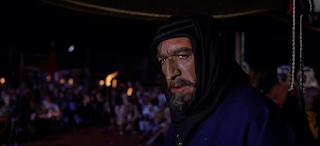
Anthony Quinn plays Auda Ibu Tayi who appears as the leader of a large tribe who Lawrence convinces to join the cause, despite Tayi originally being paid to fight for the Turks. Now this is a role where you get technically what you'd expect, but that's not a problem. This is a very much in Quinn's wheelhouse as a larger than life warrior type which is fitting for a man who will ride into battle because it is "his pleasure" to do so. Quinn brings that boisterous power to his performance, that grand stature of a man who is a true leader of his people, and wholly embraces his life style of war. Quinn's performance excels in just being the spirited aggressive force he should be, as his ability and willingness to ride into war is something that it is obvious he lives for with every breath that he takes. Quinn stands as high as he can in the role as he frankly does not hold back in terms of the exuberance he brings to the part, and nor should he. It fits so well with who Auda Ibu Tayi needs to be for the film, and Quinn stands out by presenting someone in the story who fights exactly for what he says he fights for. He has no hidden motives for his war path.

Quinn is indeed very entertaining in the role as he enlivens the screen with his presence at any given moment he is in. He has some very enjoyable moments as he shows Tayi's personal beliefs that he is very passionate about. He is also effective in showing the certain callousness that comes from such a man, particularly in his brutally straight forward delivery of "It was written then" when he hears that Lawrence had to execute man he previously risked his life to save. Quinn though does well to not make Tayi too simplistic ever. He carefully throughout the film portrays Tayi's growing personal respect for Lawrence. I really like the way he does this still within in his own blunt personal style of course. There's a moment towards the end of the film between Lawrence's right hand man Sherif Ali (Omar Sharif), and Auda Ibu Tayi, where Ali actually threatens Tayi with violence. However it's actually made a rather poignant scene by both actors as they reveal a stronger concern for Lawrence than they are willing to let on. I like how Quinn keeps Tayi rather uncouth as speaks to Ali on the matter, yet he still alludes to Tayi's own honest sympathy for their ally. Quinn's work contributes well to the film offering the right larger than life figure in Tayi, while still finding some depth within him.
Anthony Quayle did not receive an Oscar nomination for portraying Colonel Brighton in Lawrence of Arabia.

Quayle's performance here is actually rather interesting one to examine since just with a cursory glance there may not seem to be much to the character, though there actually is as he has perhaps the third most dynamic character arc after Lawrence and Sherif Ali. The earliest point chronologically speaking that we meet Brighton is when Lawrence first appears to Prince Faisal's camp. Brighton in these scenes very much is the proper British officer who just wants Lawrence to keep quiet, and stick to the plans devised by the British high command. Now apparently Quayle and Lean argued over the portrayal of Brighton as a character with Quayle wishing to play him as a fool while Lean wished for him to be shown as an honorable man. The intriguing part of this is that watching the performance you can take either interpretation to what interpretation took precedence. In that it seems Quayle went about playing it that Brighton's foolishness in fact allows him to be honorable. This is shown even when he's the British officer telling Prince Faisal to do things that mainly benefit the British, but Quayle actually does play Brighton as genuinely believing this to be their best course of action.

Now Brighton's arc is not heavily focused upon but based around his view of Lawrence changing throughout the film. Obviously he begins frankly as an obstacle who wishes to keep Lawrence from making any sort of real impact. However Lawrence proves everyone wrong by taking an important city in a way that no one believed could have been done. When Brighton continues to work along with Lawrence as they proceed to attack the Turkish rail lines. Quayle keeps the skepticism with Brighton, though it is not nearly as strong as it was a before. Quayle though is in one very good scene where he questions some of the Arabs' motivation including Auda Ibu Tayi's. Again both interpretations potentially shine through though it is no less effective as Quayle reveals the intense discontent in Brighton against them. Again Quayle manages both because, he may be foolish to hold such a simple view, yet he is honorable as Quayle once again brings only a genuine passion to Brighton as man who believes one should fight for what one believes in. Now the character's transition in regards to Lawrence continues throughout the film, and Quayle gradually reflects in Brighton as a further understanding of the man. That brings it to his most pivotal moments of the film, that are at completely opposite points in the film. That being his first and last scene, his first scene taking place after Lawrence's death, but each show Brighton's final perspective on the man. The first scene Quayle is rather moving in showing Brighton fully accepting the important, and rather great man that Lawrence was at his funeral, as in the end both men fought for what they believed was right. His last scene is equally strong as Quayle presents Brighton as the one man who can appreciate what Lawrence did without exception through his depiction of Brighton's disdain as he sees that everyone else in the end was merely using him for their own ends. This somewhat brief work once again brings so much unexpected depth to the role, and in turn the film, as Quayle makes Brighton anything but a stock side character.
Arthur Kennedy did not receive an Oscar nomination for portraying Jackson Bentley in Lawrence of Arabia.

Arthur Kennedy plays an American photojournalist based upon the real Lowell Thomas who helped to make Lawrence famous. Kennedy's not an actor who has always been a favorite of mine, though I don't dislike him, but his performance style works quite well for this part. That being Kennedy's usual method of rather accentuated delivery. This feels completely fitting for the role of Bentley as he depicts Bentley very much as a man ready to make a radio broadcast with his words. Kennedy is very good in the scenes where he is in essentially interviewer mode. Kennedy feels like a true broadcaster in these scenes as he kind of has that false refinement of sorts as he speaks so directly, and specifically about topics yet one can't help but feel he's reciting from a script. Kennedy's good in the way he undercuts that when someone basically ask Bentley for a more direct, more honest answer. Such as when Faisal asks really why Bentley's interested in Lawrence after receiving some platitudes previously. Kennedy drops the act for a moment, but importantly does not show Bentley to stumble with this. He still shows him to be an intelligent man, but rather just more naturally responds as he states the exact reason for wishing to cover Lawrence.

Kennedy's good in the scenes where he interacts with Lawrence, and the rest of the party. This is largely because Kennedy embraces the idea that Bentley is able to be the most detached from the situation given that he's really there just to get a good story out of Lawrence. Kennedy reveals the right enthusiasm as he goes about taking Lawrence's picture, and getting the icon he's looking for. Kennedy again brings back the proper broadcaster routine as he interviews Lawrence, as well as Sherif Ali, and he's very effective in the way he drifts from that to a semi-sardonic observer whenever Bentley decides on a bit of an editorial. One of his best moments is in his first scene as he eulogizes Lawrence first in a proper memorial ready for a headline which Kennedy delivers with the utmost passion and respect, then a second later the truth about the man's shortcoming which Kennedy delivers with a definite sarcastic edge. I love that not even the understandably detached Bentley is not only defined by that. Kennedy has a great final scene where he must witness a changed Lawrence as he goes on a massacre of a Turkish brigade. It's a brief moment but rather affecting one as Kennedy bluntly shows that Bentley cannot be detached from what Lawrence has done. Kennedy's excellent in revealing how disturbed Bentley is by what he sees and the outrage as he still must go about his duty to glorify Lawrence. Again this is not a huge role yet Kennedy makes a definite impact with Bentley. He successfully, in just his few scenes, creates a portrait of this journalist as man ready to make stories for more mainstream public consumption yet is well aware of the reality.
Jose Ferrer did not receive an Oscar nomination for portraying the Turkish Bey in Lawrence of Arabia.

Jose Ferrer has the smallest role out of everyone listed here. He only appears in two scenes, one for only a few seconds. His second scene takes place as Lawrence is caught by a few Turkish soldiers and taken to their superior played by Ferrer. Ferrer apparently believed this to be his greatest performance, and I'm a bit inclined to agree despite its brevity. Ferrer is brilliant as he instantly set up his character in the way he simply looks up from his desk as we see a truly exhausted individual. Physically speaking of course but more so mentally. The way he walks even keeps the proper military step yet so labored it is of a man who just is barely keeping to his step. The man then proceeds to look over the potential suspects and Ferrer again is outstanding in the way he slowly reveals more of this man. At first it seems like he might be looking for someone important as he scans the man. As we see a little longer though Ferrer's expression becomes somewhat more peculiar as he decides on Lawrence to be the man who is kept. At first it seems that Lawrence may be found out, which would mean his death, as the Bey notes his eye color. Ferrer though notes this not as though Bey is making a great discovering as an officer in the Turkish army, but rather has found something he finds rather appealing. When the Bey ponders on the fact that he's the only one who notices interesting faces where he is particularly stationed, Ferrer alludes to a consternation. This consternation is not made by Ferrer as that of a man frustrated by the lack intelligent discussion, but rather that of sexual frustration. Ferrer is terrific as he subtly reveals a bit of ache in the Bey as he examines Lawrence, and that ache he's ready to satisfy as he states to his men to "beat him" with a understated glee. After Lawrence is released he's never quite the same man. We know he was beaten but largely due to Ferrer's work we can assume it did not stop there. Ferrer's performance is outstanding as he effortlessly realizes the subtext of the scene. Ferrer like the rest of the cast, though with even less time, makes Bey more than simply a Turkish officer who detains Lawrence, far far more.
Claude Rains did not receive an Oscar nomination for portraying Mr. Dryden in Lawrence of Arabia.
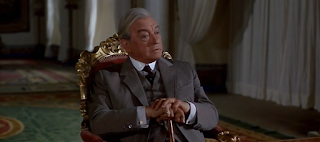
Now as for Claude Rains we have one of the greatest actors of all time in one of his final roles. A quick side note I must admit there is something enjoyable to see as he and the man he shares the record for most supporting actor nominations without a win with, Arthur Kennedy, share a direct interaction with one another. Anyway Rains's performance is sort of a hidden treasure in the film. Say on a initial viewing you pay no mind to Dryden, you're missing something rather special hidden right in front of you. Rains plays Dryden the head of the Arab bureau basically the man who deals with the political matters connected with the Arab campaign. Dryden is in a more than a handful of scenes, and though he does not have an excessive amount of lines he has some pivotal ones. The thing is that the lines themselves, though well written, could often be meaningless if it weren't for Rains's delivery of them. Rains conducts himself so well here as he has Mr. Dryden be someone who takes his time in his movement, yet there is never a question that he's a man who knows exactly where he should be. The level of assurance that Rains conveys with such ease makes the strong willed characters seem meek in way, even though Rains keeps Mr. Dryden so carefully unassuming in his personal style.

Rains is terribly clever here as he makes a man so terribly clever in such a tricky way. When he sends Lawrence on his original mission it seems simple enough, yet the potential involved from the mission seems in Rains's expression the whole time. Rains makes Dryden actually the most powerful man in the film, even though he never states his power in least. In fact he acts as though he's just a modest official who has no great ambitions. There's one magnificent scene where he, Brighton, and Allenby discuss the ability to give the Arabs artillery. It is Dryden who makes decision, even though he specifically states it's Allenby's decision, yet the way Rains conveys the message within a question seems so incisive, more than if even directly told Allenby what to do. There's another great moment when Allenby inquires to Dryden if Britain has any plans for Arabia. Dryden states only that "it's a difficult question" but Rains is so perfect in making it a casual deflection yet in his expression there is no question on the matter in Dryden's mind. Rains is amazing in the way he makes it that Dryden really is always in charge even though he never in fact gives away his position. Rains could not be smoother in how eloquent he is in the depiction of a truly seasoned political operator. Rains is even fantastic when he's not do anything. Even in scenes where he is silent every glance is worth something due to Rains. He suggests Dryden analyzing and dissecting everything he sees. It is fascinating to just watch Rains in any given scene as there's not a wasted second in the entirety of his performance. One favorite moment of mine is when Dryden notices cuts have reopened on Lawrence's back, and Dryden for brief instance tries to inform Lawrence of this. Rains's reaction is so good, even humorous in a way, as he shows as Dryden quickly evaluates the situation and decides it's best not get involved with this issue. Another magnificent moment for Rains is at the end of the film is when he finally responds to Allenby claiming not to be a politician. Rains is hilarious, but also oh so shrewd as Dryden subtly scoffs at hearing the rather false claim once again. I love everything about this performance as Rains adds so much to film with a part that with the wrong actor have easily almost just been part of the background. It's such an astute piece of work by Rains as he does so much with so little.

Sunday, 28 February 2016

Alternate Best Supporting Actor 1962: Robert Ryan in Billy Budd

Robert Ryan did not receive an Oscar nomination, despite being nominated for a BAFTA, for portraying John Claggart, Master d'Arms in Billy Budd.

Robert Ryan is of course known for being the heavy in so many films, and he once again fulfills this role in Billy Budd. Here he plays one the officers on a British warship, the Master d'Arms who in charge of keeping in line and disciplining the crew. We are introduced to John Claggart at the swearing in of the ship's new recruit, a former merchant seaman, Billy Budd (Terence Stamp). It interesting to note that Ryan is top billed, and I can't help wonder if he was campaigned lead since Stamp was place in supporting. Anyway Ryan instantly establishes Claggart as a man with really the stiffness of authority about him. Ryan's whole manner here is particularly tight and restrictive as he reveals Claggart to be a man who seems as though he is always on duty, that's because he is. In the early scenes aboard the ship Claggart orders around the crew and they instantly comply to any orders that Claggart demands of them. Ryan makes this particularly convincing in the way he effortlessly exudes the menace of Claggart as he seems in charge of the men to the point that they stand up straight from his mere presence. Ryan earns this through the cold dominance he is able to project so well.

As the film progresses we are given more insight into Claggart's methods of controlling the crew. Ryan is extremely effective as he reveals Claggart's way of control, which is very specific in that he only infrequently uses direct physical punishment from himself. Ryan instead reflects a disturbing assurance in Claggart whenever he speaks to the men as he incisively alludes to them his ability to have them flogged whenever he would wish. Ryan is excellent in the way he portrays the way Claggart's cruelty comes with this definite ease since he is a man who is well aware of the power his position gives him. Claggart is occasionally "needed" to rise to more aggressive action though whenever one of the men becomes a bit too free-spirited or worse tries to lay a hand on him. When these moments occur Ryan is downright chilling by bringing this twinkle in his eye as though Claggart has found himself a new project. Ryan is terrific in the way he presents Claggart narrowing on whoever this unlikely man might be, as his glare seems to be squarely on the individual as he takes any chance to inflict pain on the man, occasionally sneaking in something physical when he can.

What is most terrible of all of this is that these targets are shown by Ryan to be when Claggart has found a little way to get what he desires the most. The problem with that is Claggart is a pure sadist who only wishes to use his position to fulfill those desires. There is a great scene for Ryan as he tries to explain why a man must be flogged to the ship's Captain, Vere (Peter Ustinov). Claggart explains the reasons, which the Captain accepts, but attempts to argue to the Captain that the man should get more lashes due to it being war time. Ryan's fantastic because he plays the scene with Claggart giving the report as a proper Naval officer, however Ryan shows this as the facade which wains a bit as he so eagerly attempts to get the number of lashes raised. The flogging itself is brilliantly performed scene by Ryan finding the intense joy in Claggart as he calls out every flog as though he is a man living out a fantasy. The best moment of the scene is when he reaches ten as Ryan presents sheer ecstasy as he almost names an eleventh lash, but must stop himself. Ryan's marvelous by showing the effort Claggart puts in stopping himself as he clenches his teeth hard to keep the words from coming out of his mouth.

Now as being the sadistic authoritarian it can already be said that Ryan gives a great performance, but that's not all there is to his Claggart. We find this out through his relationship with Billy, a man who seems out of place within the grit of the ship through his simple grace and eternal optimism. I love one of Ryan's earliest reactions to Billy as he stares for a rather long time as though he is completely unsure of what to make out of this man. The problem is Billy is just such a unassuming yet perpetually charming individual who almost everyone comes to love because of just how honest his goodness is. He's a man who obviously loves life. This is in striking opposition to Ryan's portrayal of Claggart. Of course Claggart is an unpleasant man to begin with, but Ryan goes further than that. Whenever he's not inflicting pain on another there is a subtle pain Ryan suggests in Claggart himself, as a man who seems to hate the very idea of existence. His causing of suffering for others ends up being the only way to relieve his own. Billy though notices this and there is an amazing scene where Billy attempts basically to cheer Claggart up. Ryan actually manages to be rather moving in this scene as for just a moment shows a glint of pure happiness, as Claggart smiles at Billy's suggestion to keep him company during his lonely watches. Ryan depicts so well that mess of man that Claggart is as he forces himself to reject the notion, and decides that Billy's goodness must be proven false. Ryan finds a sick passion in Claggart as he does his best to break Billy down to his level, a passion like that of zealot trying desperately to affirm his failing beliefs. Ryan is outstanding in his final scene as he presents Claggart giving all of his vile beliefs in a moment as he makes up a story to the captain about Billy being the leader of an attempted mutiny against him. This technically breaks down Billy, not to a bad man, but to commit a violent act simply because he cannot come up with any verbal response to Claggart's lies. Ryan's brief reaction to the attack is perfection as his expression brings a final euphoria to Claggart as though he's been assured in his view of the world. This is an outstanding performance by Robert Ryan, his best villainous turn which is really saying something. He fulfills the need of being the film's fiendish sadist, yet goes much further finding the complexity needed for the character in his portrait of the personal desperation which compels the man.

Saturday, 27 February 2016

Alternate Best Supporting Actor 1962: Brock Peters and Robert Duvall in To Kill a Mockingbird

Brock Peters did not receive an Oscar nomination for portraying Tom Robinson in To Kill a Mockingbird.

Brock Peters plays Tom Robinson, an essential character in To Kill a Mockingbird even though he only appears in a single scene, we briefly hear his voice in another scene. Brock Peters plays Tom Robinson a man accused of beating and raping a white woman. The lawyer Atticus Finch (Gregory Peck) does agree to defend the man despite much of the public already having deemed him guilty. This goes to the point that during the night before his trial Tom comes close to being lynched, and we hear Peters's fearful voice as he quietly asks if they've left. We next see Tom at the trial and Peters is very effective even as he sits silently by portraying the state of horror of a man who is well aware of the terrible situation he is in. The highlight of Peters's performance is of course when Atticus asks Tom to testify on his own behalf. Peters is great in the scene as suggests just the modest man Tom was before the trial, and shows him to be almost paralyzed by the considerable unease brought upon by the accusations. Peters is excellent by actually constantly realizing the effort it takes Tom to keep his composure fitting for a man who knows a noose is waiting for his neck for a crime he did not commit.

Peters is great throughout his portrayal of Tom's testimony since he makes the process of it feel so authentic. He finds that difficulty in Tom as he tries to get past each word, and just set up the situation where he had been asked by the woman several times to help her with chores. He attempts to tell this as a friendly story, though Peters properly never allows the nervousness to fully disappear. As the story progresses to reveal the night of when the supposed crime occurred Peters makes the emotional strain all the greater as he tries to tell the truth about what happened. Peters is incredibly moving by depicting Tom's hesitation to get to the important details of what happened showing the sensitive nature of the man, as well as even conveying the certain sympathy Tom has for his rather wretched accuser. Tom states that the woman in fact attempted to come on to him and that all he did was flee the situation. Peters is heartbreaking as he tearfully espouses his innocence. In the moment Peters echoes so well not only the memories of the past but also the terrible pain of knowing where those memories have left him now. After the testimony there is but a guilty verdict left for him. It's only a short moment but Peters reveals a definite despair in Tom before he is taken away, which sets up Tom's unfortunately tragic fate. Peters gives a very strong performance here as he makes the needed impact in his substantial scene. Tom Robinson is not just the name, as Peters creates the real loss of a man caused by a prejudiced society.
Robert Duvall did not receive an Oscar nomination for portraying Arthur "Boo" Radley in To Kill a Mockingbird.

Robert Duvall also plays a pivotal character in the film, but just like Peters he only has a single scene where we see his face. Boo Radley has a quite the build up as Atticus's two children Jem (Phillip Alford) and Scout (Mary Badham) are somewhat obsessed with him due to the various stories told about him. Those being that he is a potentially dangerous man who only comes out at night. Radley has a considerable presence in the story though he does not appear until the very last scene of the film. Luckily though Robert Duvall must have one of the greatest entrances ever for both a character and an actor since this was Duvall's very first film appearance. Boo appears after having saved Atticus's children from an attacker, and he is found hiding behind a door as everyone tries to figure out what happened. I don't mind admitting that the scene never fails to give me chills. Duvall's reaction is indeed perfection as the light first illuminates him. Duvall first jumps back in an instinctual fear as we see the recluse, and in the moment we see the potentially dangerous man that everyone seems to talk about. There's that distance of a man who only finds discomfort from the presence of onlookers. However in just a few seconds as Scout recognizes him Duvall so naturally, yet silently, reveals such warmth in his face showing the good man that Boo is. It's such a beautifully rendered moment by Duvall as he successfully sums up his character matter of seconds. The moment can be used as an example of truly flawless acting as there is such an emotional impact from just that one look. It is true that this performance is probably no longer than three minutes, perhaps shorter. This in itself is a challenge as Duvall manages to simply be Boo Radley here, and everything that his character is and means is found in those three minutes.

Friday, 26 February 2016

Alternate Best Supporting Actor 1962: Tatsuya Nakadai in Sanjuro

Tatsuya Nakadai did not receive an Oscar nomination for portraying Hanbei Muroto in Sanjuro.

Sanjuro follows the further adventures of the nameless samurai (Toshiro Mifune) originally featured in Yojimbo as he goes about helping a group of men weed out the growing corruption in their clan. Tatsuya Nakadai also returns, though obviously not as the same character, but serves a similair purpose. That being again as the most worthy adversary for the samurai, though again not the official leader of the villains, but rather as their most competent enforcer. Hanbei is actually quite a bit different from Unosuke the gunslinger from Yojimbo in large part due to Nakadai's portrayal of each. Hanbei is introduced far sooner in the film as his first appearance is a pseudo confrontation with the samurai, though the samurai avoids a real fight as he's only hiding the group of men. Nakadai though one again proves himself a match for Mifune's considerable presence, as he did in Yojimbo as well though in almost a sneaky way. Nakadai here is much more upfront about going directly face to face against Mifune. Nakadai pulls it off as he carries that same considerable confidence that Mifune exudes so well.

Nakadai finds the same sort of presence as Mifune, and when the samurai later states the danger presented Hanbei, opposed to their other enemies, it is wholly earned by Nakadai's performance. Nakadai as usual excels in the villainous role as he is able to convey such malevolence in those eyes of his that seem to pierce the soul, and simply oozes menace with such ease. There is something rather remarkable in Nakadai's work as he goes beyond making Hanbei simply a worthy foe for the samurai. It's rather interesting in their first meeting, despite the samurai beating a few of his men, Nakadai does not portray an antagonism towards the warrior. Nakadai's reaction instead suggests Hanbei is only rather impressed by the samurai's skill, and is in fact more than happy to offer the samurai a job. This might seem just the set up for the samurai to find a into his enemy's good graces, but Nakadai and Mifune take it bit further than you might expect.When the samurai comes for the job, wanting to infiltrate the enemy from within for more information, Nakadai portrays only an honest warmth in Hanbei as he enthusiastically welcomes the samurai into his ranks.

Their initial conversation scene, as Hanbei fills the samurai in on the situation, is a great moment. Now Hanbei does not mind stating that he is just as corrupt as the men he works for, Nakadai brings such a glee in Hanbei when he makes this statement yet this is not as simple as it might seem. There is an underlying genuine understanding that Nakadai conveys as well as Mifune despite the fact that the samurai is tricking the man. The understanding though is not in regards to their moral codes, that is where they do differ as the samurai is a good man and Hanbei is not, but there is a connection still. Nakadai and Mifune both present men of a similair sort, though again of a different morality, as they not only are aware of each other's skill, but also share a mutual perspective on those around them. This is present through a definite cynicism in that they both know they are in fact much smarter than the men they are helping, the problem is they happen to be helping two different set of fools. It's a real camaraderie that Nakadai and Mifune develop for the moment, I especially like how much fun Nakadai shows Hanbei having when the samurai gives an example to him of how he will impress Hanbei's boss.

I love that Nakadai and Mifune briefly make the two a good team as they share the same sort of grace as the take down four men together. Unfortunately the pseudo friendship of the two cannot continue when the samurai must release the men, since they were those he was trying to help, while Hanbei is away. Nakadai's actually pretty hilarious in his depiction of Hanbei's surprise at his men all being dead, and his disappointment at seeing the the samurai hog tied as the soul survivor. Nakadai rightly suggests Hanbei is much less convinced by the next story the samurai comes to him with, as he keeps an observant stare upon him as though he's trying to see if he can find the truth of the man. Hanbei actually technically outsmarts the samurai catching him in the middle of sending a signal, and technically would win the day if it were not for the incompetence of his bosses. Nakadai though is fascinating as he depicts a very real sense of betrayal in Hanbei as he lashes out at the samurai, before needing to ride off as a messenger. The samurai of course wins the day for his allies, but that still leaves one final duel, a natural occurrence for any Nakadai/Mifune collaboration, with Hanbei due to that earlier betrayal. Again what's so special about this is that's not just a good guy facing down the bad guy. They instead find that same connection before, and Nakadai is actually even rather moving, despite being the main villain, by revealing a genuine despair in Hanbei due to the samurai manipulating him. Nakadai gives a great performance as he not only fulfills the duties of being a menacing foe for the samurai, but also subtly offers more substance by for once given truth to that often said villain cliche of "we're not so different you and I".

Thursday, 25 February 2016

Alternate Best Supporting Actor 1962: Lee Marvin in The Man Who Shot Liberty Valance

Lee Marvin did not receive an Oscar nomination for portraying Liberty Valance in The Man Who Shot Liberty Valance.

Lee Marvin obviously plays the doomed man at the end of the title, but the title itself is a label of fame rather than infamy. The reason being the nature of Liberty Valance who we are introduced to as he robs a stagecoach and brutally beats one of the passengers Ransom Stoddard (James Stewart). Marvin as one should expect dominates the scene with his fierce voice, and imposing demeanor. Marvin exudes a considerable menace from his own personal presence even when his face is hidden by a mask. Stoddard after recovering soon finds out that Liberty is a career outlaw who spends his time robbing and assaulting basically whoever he feels like with the local law enforcement too timid to stand up to him. Liberty really is not this master criminal in the slightest, but  he's still quite the problem since any one may randomly suffer because of him. Marvin is terrific in the role bellowing out his lines with the right bluster and disregard for anything one might even consider to be decent. I particularly love the considerable disdain in his voice whenever he chides the Easterner Stoddard by referring to him as "dude".

Marvin is actually only in about five or six scenes of the film, a few of them even being brief, yet he makes quite the impact as Liberty. The interesting part of it all is that again Liberty is not this hyper intelligent villain, he's just a thug who lives in a place where good punch and quick draw is all that is needed to be a terror. Marvin embraces this so well with his performance as he conquers any given situation not by portraying any sort of exact charisma, but rather just the brunt force that is Valance. Marvin carries almost a relaxed quality at times that is fitting for a man who believes he's pretty much entitled to whatever he wants, but there is only ever an underlying current of viciousness that alludes to the violence Liberty is capable of. A viciousness that only grows whenever a situation forces Liberty to get mad, which is a most unpleasant sight thanks to Marvin. One can see how Liberty himself as Marvin makes him a man who insists upon himself, which is easy since no one can physically stand up to him other than Tom Doniphon (John Wayne). The moments between he and Wayne are fantastic in the way that they match each other's presence and intensity presenting the men distinctly in their element.

Marvin's especially effective in these scenes by quietly conveying a bit of fear in Liberty, as he recognizes Doniphon as a man who is indeed a threat to him, a threat he'd rather avoid. Liberty instead keeps his focus on Stoddard, who only further encourages Liberty by Ransom attempting to take the legal route in dealing with the outlaw. This is until Liberty takes it a step further, and Ransom decides to take on Liberty with a gun in hand. This is a downright amazing scene for Marvin because even though it takes Stoddard all his courage to stare down the man, Marvin shows that Liberty still does not care lick about it. Marvin is excellent as he plays the scene as though Liberty is just trying to get as much enjoyment as he can in his last confrontation with a man he thinks so little of. Marvin portrays this in a terrific fashion as he leans on a pole almost throughout the confrontation displaying not a bit of fear for Stoddard's attempts. Marvin's great as Liberty toys with Stoddard as he so genuinely bursts out laughing every time he messes with Stoddard. Marvin makes Liberty a true bully as he shows so much joy in every second Liberty torments him. When Liberty finally decides on the coup de grace, Marvin's reaction is basically that of a man whose had his fun so might as well get the job done. Marvin tops it all off with his brief, but brilliant death scene as one can't help but see just bit of disbelief in his expression just before he collapses. This is a memorable turn by Marvin not by creating this truly cunning adversary, but rather making him the violent lout he should be.