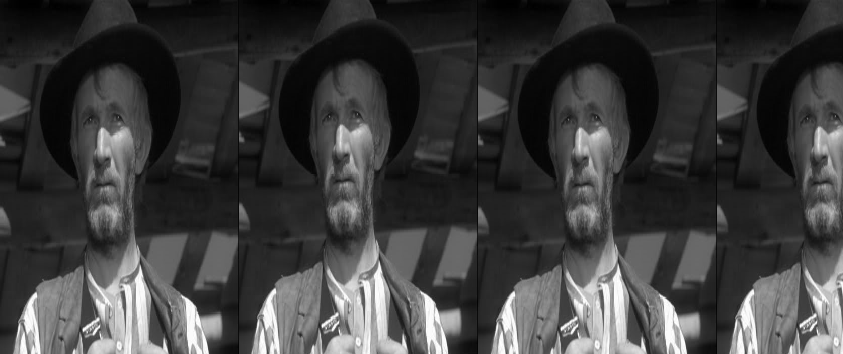
Showing posts with label Laird Cregar. Show all posts

Monday, 15 April 2024

Alternate Best Actor 1945: Results

5. Danny Kaye in Wonder Man - Somewhat disposable Kaye work, not bad, but he's been much better.

Best Scene: Police station.
4. Errol Flynn in Objective, Burma! - Flynn is almost entirely onto something as the more casual approach to playing a military commander, even if the execution isn't quite perfect. 

Best Scene: The death of the correspondent.
3. Roger Livesey in I Know Where I'm Going - Livesey's presence offers a very unique and effectively off-beat take on the romantic stranger type.

Best Scene: Boat ride home.
2. Pierre Brasseur in Children of Paradise - Brasseur brings such potent charisma portraying so effectively one man in the film not weighed down by anything rather elevated by it all.

Best Scene: Ad-libbing.
1. Laird Cregar in Hangover Square - Good predictions Tim, Omar, 8000's, Calvin, Matt & Tahmeed. Cregar delivers one final dynamite portrayal of insanity, this time though with a passionate edge that offers a sense of avenues he may have been able to explore had his career not been tragically cut short.

Best Scene: Final concert.
Updated Overall

Next: Reviews of Redgrave & Karloff.

Friday, 12 April 2024

Alternate Best Actor 1945: Laird Cregar in Hangover Square

Laird Cregar did not receive an Oscar nomination for portraying George Harvey Bone in Hangover Square.

Hangover Square follows a pianist and composer who slowly gets more demented as he moonlights as a serial killer.

The nature of this brief synopsis makes this sound like a very similar role to Cregar's performance as Jack the Ripper in The Lodger, the fact that George Sanders is pursuing him, and it takes place in foggy gaslit London only adds to this approach. BUT, it ends up being quite a bit different, one as the nature of this character's evil action, at least initially, are due to schizophrenic episodes. The schizophrenic episodes in a way gave the audience the Cregar they were expecting, almost as an appetizer with the way the film opens, although to be fair even as heavies Cregar was always finding new ways to play them. Here is such an example as he plays a man killing in the initial scene of a random murder to his episode with this specific intensity, though that is granting a chilling quality because of the sort of hollowness of Cregar's performance. He's just going about it as he would do almost anything as we see him killing a man in a fire and it is nothing more to him than just that, before wandering off where we see his George regain himself, and suddenly we see a very different performance, and really a very different looking Cregar as we see a far more slender man than we had ever seen him any films. In fact he almost nearly looks dashing all things considered, and even more so Cregar is allowed to play even more into the idea of sympathy, though I'd argue he always covertly provided sympathy to his fiends most of the time to begin with, but what we see here is a man with an affliction. Where Cregar plays wonderfully the genuine befuddlement as he walks the street wondering how he got blood on himself and is carrying a knife that he believes might've been used at some point.

When we see George contemplate this Cregar's reactions that of true thoughtfulness and even a dreaded horror at the idea that he might be an unknowing murderer. Cregar creating a potent kind of empathy for the poor soul in this moment, particularly as George's choice is to immediately finding Police Psychologist Dr. Allan Middleton (Sanders) in this instance, to try to get the man to prove he is a murderer. And it is indeed hard not to feel sorry for poor Cregar as he speaks every line with such sincere honesty as he speaks of all his fears for what he has potentially done and is trying to be found guilty. Only when it turns out the knife hasn't been used for a murder and that the blood was his own, is George saved from his guilt and Cregar presents the same sincerity in the character's powerful relief. Cregar brings an innocence even that is particularly wonderfully realized, even as it is turned on its head as poor George discovers yet another knife that would make him culpable for the crime. Cregar's reaction again is not of the monster by the sympathetic man, as you immediately sense the confusion in his eyes and even more so a genuine sadness to what he finds. Cregar this time not portraying the criminal element of Bone as something that compels him, rather something that haunts him deeply as a curse upon him. Cregar creating a change within his often played role of the evil man, this time the evil is something the man is unable to escape, and Cregar creates that penetrating and horrible sense of the madness just beneath the surface that the seemingly decent George would just love to be able to hold at bay if he could.

The film then progresses into something a bit more unexpected within the overall design as it becomes more so the good man, despite what we already know of George, getting pulled into the wrong world by a femme fatale, in this instance Netta (Linda Darnell) a pub singer, that catches his eye. Cregar's performance is terrific in being sincere, though sincere in a way that you wouldn't have seen in his other performances, in that he's not twistedly romantic, here he's trying to be genuinely romantic with Netta. This as he plays a song for her that he's written with her mind, and Cregar brings this great combination between confidence and vulnerability in these moments. The confidence as the man introduces the song with this ease as though music just is second nature to him, and there's that passion as just part of him as he plays for her. Contrasting that however is the interest he has in her where in his eyes it is of sincerity and he speaks only with this reserved shyness of the man trying to make something of this relationship, despite it becomes pretty clear she just intends to exploit him for his musical ability by writing "pop" songs for her, as opposed to the more extensive orchestral works that he's passionate for. Something that is additionally represented by the woman genuinely interested in George, Barbara who also supports his musical passion. Unfortunately George is caught up with Netta, where Cregar articulates so effectively the growing desperation that I think he is quite effective in that he doesn't immediately turn this into obsession. Rather he brings initially the real glint of hope and candour in his voice that is of a man who believes himself to be in love, even as Netta only will cultivate despair for him.

And this is where the film does get a bit unwieldy, however Cregar is great consistently. As first Barbara questions his actions causes him to fall into a triggered state of trying to murder her which fails, and we get a respite as George apologizes, unaware of trying to murder her, with a genuine sympathetic manner in his performance. But then Netta prods him once again for gain, and Cregar is terrific in showing his earlier passion going to this pent up rage and really the sense of disgust for both her and himself as he tries to return to his actual life of the passions he cared about. Unfortunately for him things go one step beyond as he goes into a state again, where he goes about murdering Netta, with the murder musical sting from Sweeney Todd to boot, before returning to himself one more time. Although this time he doesn't quite return to himself, and here's where the film gets sloppy however there is an anchor in Cregar. Cregar finds some actual logic within his own performance that seems to suggest that George himself is being driven crazy by all that's going on with him, even as he still is innocent of his worst crimes. Cregar portrays a difference as George goes off the deep end now, because before it was about that eerie calm in his murders, it is with genuine mania. A specific mania though that still denotes vulnerability in the man as he becomes no longer attached to any of the women but now his music, his original passion. In this Cregar finds something especially potent because when he describes his need to get to his concert over the accusations of murder, Cregar presents not as the man avoiding his guilt but rather this completely sincere desperate belief in his real love, which is for his music. His actions then give it his all to be part of his music, though as this self-destructive act that Cregar finds this sense of a man who might as well die with his music as his only solace in his burdensome life. And as he goes about playing his final concerto, Cregar is outstanding in the intensity he brings within the performance, that again though speaks to man trying to find this singular focus as the madness is all around him, to the point that singular focus too becomes its own madness. A madness filled with only passion and leading to a memorable climax, and unfortunately final act of Cregar's entire career, as he desperately and fearlessly continues to play even as the entire theatre burns around him. An outstanding performance, where Cregar once again proves his measure by finding a new avenue with a villain, but in this instance suggesting new pathways for himself beyond where he had been pigeonholed. Cregar leaving one final reminder of the tragic loss of his talent, with his all too brief career.

Sunday, 10 March 2024

Alternate Best Actor 1945

 And the Nominees Were Not:

Danny Kaye in Wonder Man

Roger Livesey in I Know Where I Am Going

Laird Cregar in Hangover Square

Errol Flynn in Objective, Burma!

Pierre Brasseur in Children of Paradise

Sunday, 18 October 2020

Alternate Best Actor 1944: Results

 
5. Nikolai Cherkasov in Ivan the Terrible Part I - I decided against a full review, as like with Sergei Eisenstein's Alexander Nevsky, his Ivan The Terrible takes the approach, effectively I will say, of almost a documentarian's distance instead focusing on more so the visual spectacle of the historical events than to dive deeply within the nature of the historical figures past a certain point. Nikolia Cherkasov, who previously played the largely symbolic role of Alexander Nevsky, once again takes upon a part that is more so the idea of Ivan The Terrible, than an in-depth careful examination of his personal motivations. His performance largely being used to again symbolize Ivan as this fierce but also potentially troublesome ruler, often with a closer emphasis on how other's react to the man. There are individual moments for Cherkasov within the film, such as his quiet menace he underlines every word as Ivan makes his demands immediately following his coronation, or the made bravado he brings as he throws down a foreign diplomat in order to declare war. In both moments Cherkasov suggests he might've been able to explore more of the character if given the leave. Although then again even when just being the presence of Ivan, which works well enough, he maybe a little to frequently falls upon just the most extreme bug eyes to sell the nature of Ivan's madness. Largely still it is a fine performance, but again one that more so stands as an image of Ivan rather than bearing the actual soul of the man.

Best Scene: Coronation.
4. Dick Powell in Murder, My Sweet - Powell gives a fine turn in the premiere version of Philip Marlowe, finding his own path through a certain sardonic almost carefree quality for the private detective. 

Best Scene: Dealing with everything.
3. Errol Flynn in Uncertain Glory - Flynn gives perhaps his best performance excelling in crafting a far more cynical character than usual and slowly earning the transformation of the role to a more noble sort. 

Best Scene: Fake change of heart.
2. Alexander Knox in None Shall Escape - Knox gives an effectively chilling turn in showing a man go from a pathetic bitter man who slowly finds his terrible path through the Nazi regime. 

Best Scene: Final speech.
1. Laird Cregar in The Lodger - Good prediction Anonymous, Tahmeed, Luke, and Michael McCarthy. Cregar delivers a brilliant sinister turn as he grants a certain almost romantic quality of the man who both lusts after his victims and despises them.

Best Scene: Scene with Kitty in his room.

Next: 1994 Lead

Saturday, 3 October 2020

Alternate Best Actor 1944: Laird Cregar in The Lodger

Laird Cregar did not receive an Oscar nomination for portraying Mr. Slade the titular character in The Lodger.

The Lodger is one of the many adaptations of the Jack the Ripper inspired story of a mysterious man taking residence in the upstairs of a London home.
 
Laird Cregar is one of the great "could've been actors" having only a six year run in films before his untimely death at the age of 31. One must note though then the remarkable thing it is to discover the man, and to see what he was able to accomplish within that tragically brief tenure. Cregar naturally was cast within the classic "heavies" however again notable how Cragar in that time was able to create different types of characters within that role. Whether it was the sniveling weasel henchmen in This Gun For Hire, a particularly affable devil in Heaven Can Wait, or of his creepy yet tragic inspector in I Wake Up Screaming. Cregar found a different approach and even a different tone for each. We find that again here, where honestly one might be able to quickly presume that Cregar is in fact playing Jack the Ripper as the Lodger known as Slade, a nearby street name to his hopeful residence. Cregar's performance then is what must create the intrigue far beyond the "is he?" the defines the story. He's obviously him, so really it comes down to how intriguing he is in revealing the strange state of the man. This from his opening scene where the man investigates the upper floor of the residence. Cregar's higher pitched voice granting both a elegance and an off-beat peculiar quality to the man. His eyes filled with something that isn't so easily described as he looks upon the quarters, and his almost lustful way of speaking that the home will provide the "intense heat" for his "medical experiments". 

Where the part would be later played by Jack Palance with a steely calm, there is something far more dynamic within Cregar's performance that seeks to grant a certain odd sympathy for Slade even as he also reveals the nature of the man. This in his first scene as the man remarks the place shall be a refuge for him after be spoken to of the Jack the ripper murders. Cregar's monetary gaze up into though shows the man's need for some kind of solace within his mind, befitting a man technically being constantly hunted. Cregar's performance creating an intrigue within itself through his manner as he tips towards the stylized yet never goes too far in granting an nearly intangible quality about the man. This again remarkable as Cregar suggests a man almost another plane of thought that alludes towards what is that Slade is doing when he is not "lodging". Cregar's performance, which the cinematographer particularly seems to love in the way his face essentially glows here, is captivating within itself in creating Slade not as a, is he, isn't he, question but rather an examination of what a man who does such would be. We are granted to explore more of this as Slade's introduced to the idea of his landlady's niece Kitty (Merle Oberon) is a showgirl. First explaining his distinct fascination with showgirls. This as Cregar is impeccably creepy in speaking the fear nearly in the man's voice as he explains the way he oddly seems to think he's oppressed by them in some way. This though at the same when distinctly speaking of one Cregar's glare is of a precise transfixing thought. 

His first meeting with her is a brilliant scene for Cregar this is as he's both creepy but in a strange way an almost romantic quality he brings. This when explaining river in the night to her. This as Cregar speaks the words with a poet's grace but just with an intensity that is more than that. There is something pressing with the man, a madness that he so eloquently realizes as a state that makes Slade's psychopathy on that different state of mind. Again though Cregar is chilling with a nearly ethereal quality in creating the deranged state so uniquely. Cregar's performance in a way know that the material has been tried many times before in a way, as though his performance in some way subvert the material, he glides through in a way to grace each note with some marvelous eccentricity. This just in the way he watches others, including an inspector, discuss the case. Cregar's look craft the man suspicious of well...the suspicions, but there's more. His little glares grant a critical quality in the man almost annoyed at the others attempting to pigeonhole himself as some kind of particular maniac. Although I wouldn't quite say Cregar makes the character of Slade fun, there is something quiet entertaining in his portrayal that is playful in a way without being dismissive of the material. This most often in playing the "monster" of the lodger, just in his particular gait, and especially his way of looking upon the others with the manner of a predator minding his prey. That so often with the look of dead eyes of Slade. This though still with the complication in his work of showing Slade is in some way conflicted between disgust and lust in his crimes. This in his interactions with Kitty where Cregar is so many things at once. That looking as both in love with her and with a hate. This speaking though with some critical venom and some hope of seduction. Cregar's always elegant delivery making the most of the hypocrisy of Slade. Cregar apparently attempted to grant the part a "romantic veneer" and successful he is in this. This in making his performance fascinating kind of a mad man. This in even his final scene with Oberon where he reveals his murderous intent that Cregar plays both as a horror scene and a love scene. This in going back and forth between the seduction and the kill as this terrible sort of dance. Although the film is just fine otherwise, if only just fine, Cregar achieves greatness here by both fulfilling and subverting expectations of the part of Slade. A part that was played before and would be played again, but Cregar makes it his own. This as a magnetic hypocrite that exists in his own realm that clashes violently when he attempts to confront reality.

Saturday, 26 September 2020

Alternate Best Actor 1944

And the Nominees Were Not:

Laird Cregar in The Lodger
 
Nikolai Cherkasov in Ivan The Terrible, Part I 
 
Alexander Knox in None Shall Escape
 
Dick Powell in Murder, My Sweet
 
Errol Flynn in Uncertain Glory

Thursday, 16 April 2015

Alternate Best Supporting Actor 1941: Results

5. Joseph Cotten in Citizen Kane - Aside from his scenes as an old man Cotten gives a considerably more assured performance than most of co-stars, and effectively creates a sympathetic character arc to follow along Kane's own. 

Best Scene: After Kane loses the election.
4. Herbert Marshall in The Little Foxes - Marshall gives a very moving portrayal of the physical and mental decay of a decent man among fiends.

Best Scene: Horace rejects Regina's request.
3. Edward Arnold in The Devil and Daniel Webster - Arnold realizes the assumed greatness of his character through his strong presence and genuine passion.

Best Scene: Daniel Webster addresses the jury.
2. Laird Cregar in I Wake Up Screaming - Cregar gives a brilliantly grim portrayal of his shadowy detective, but also manages to be rather heartbreaking when explaining the underlying motivations of the character.

Best Scene: Ed Cornell reveals his connection to the deceased.
1. Peter Lorre in The Maltese Falcon - Peter Lorre is superb managing to be both quite humorous and very sinister in his enigmatic portrayal of Joel Cairo. This an amazing year for supporting actor, especially for the 40's, and I really hate to leave Arnold out of the top five.

Best Scene: Cairo's arrival.
Overall Rank:
  1. Walter Huston in The Devil and Daniel Webster
  2. Van Heflin in Johnny Eager
  3. Peter Lorre in The Maltese Falcon
  4. Laird Cregar in I Wake Up Screaming
  5. Sydney Greenstreet in The Maltese Falcon
  6. Edward Arnold in The Devil and Daniel Webster
  7. Herbert Marshall in The Little Foxes
  8. Joseph Cotten in Citizen Kane
  9. Claude Rains in The Wolf Man
  10. Claude Rains in Here Comes Mr. Jordan
  11. Donald Crisp in How Green Was My Valley
  12. Barry Fitzgerald in The Sea Wolf
  13. William Demarest in The Lady Eve
  14. Elisha Cook, Jr. in The Maltese Falcon
  15. Leslie Howard in 49th Parallel
  16. John Qualen in The Devil and Daniel Webster
  17. Anton Walbrook in 49th Parallel
  18. Walter Brennan in Meet John Doe
  19. Dana Andrews in Ball of Fire
  20. Gene Lockhart in The Sea Wolf
  21. Niall MacGinnis in 49th Parallel 
  22. Richard Haydn in Ball of Fire
  23. Henry Travers in Ball of Fire
  24. S.Z. Sakall in Ball of Fire
  25. Leonard Kinskey in Ball of Fire
  26. Tully Marshall in Ball of Fire
  27. Aubrey Mather in Ball of Fire
  28. Oskar Homolka in Ball of Fire
  29. Edmund Gwenn in The Devil and Miss Jones
  30. H.B. Warner in The Devil and Daniel Webster
  31. Raymond Massey in 49th Parallel
  32. Charles Coburn in The Lady Eve
  33. S.Z. Sakall in The Devil and Miss Jones
  34. Alan Hale in The Strawberry Blonde
  35. Elisha Cook, Jr. in I Wake Up Screaming
  36. Finlay Currie in 49th Parallel
  37. William Demarest in Sullivan's Travels
  38. Edward Everett Horton in Here Comes Mr. Jordan
  39. Robert Cummings in The Devil and Miss Jones
  40. Edward Arnold in Meet John Doe
  41. Jack Carson in Love Crazy
  42. Donald MacBride in High Sierra
  43. Eugene Pallette in The Lady Eve
  44. Ward Bond in The Maltese Falcon
  45. Jack Carson in The Strawberry Blonde
  46. Porter Hall in Sullivan's Travels
  47. Jerome Cowan in The Maltese Falcon
  48. Edward Arnold in Johnny Eager
  49. James Gleason in Meet John Doe
  50. Henry Travers in High Sierra
  51. Walter Brennan in Sergeant York
  52. Laurence Olivier in 49th Parallel
  53. Rhys Williams in How Green Was My Valley
  54. Richard Carlson in The Little Foxes
  55. Dan Duryea in Ball of Fire
  56. Barry Fitzgerald in How Green Was My Valley
  57. Henry Hull in High Sierra
  58. Frances Sullivan in "Pimpernel Smith"
  59. Nigel Bruce in Suspicion
  60. Dan Duryea in The Little Foxes
  61. Bela Lugosi in The Wolf Man
  62. Ray Collins in Citizen Kane
  63. Vladimir Sokoloff in Love Crazy
  64. Barton MacLane in The Maltese Falcon
  65. James Barton in The Shepherd of the Hills 
  66. Gene Lockhart in The Devil and Daniel Webster
  67. Ralph Bellamy in The Wolf Man 
  68. Paul Stewart in Citizen Kane
  69. Cornel Wilde in High Sierra
  70. Charles Dingle in The Little Foxes
  71. Arthur Kennedy in High Sierra 
  72. Ward Bond in The Shepherd of the Hills
  73. Leo G. Carroll in Suspicion 
  74. Walter Pidgeon in How Green Was My Valley
  75. William Alland in Citizen Kane
  76. Ward Bond in Sergeant York
  77. Carl Benton Reed in The Little Foxes
  78. Alan Mowbray in That Hamilton Woman
  79. Sam Levene in Shadow of the Thin Man
  80. Walter Abel in Hold Back the Dawn
  81. George Tobias in Sergeant York 
  82. Allyn Joslyn in I Wake Up Screaming
  83. Cy Kendall in Johnny Eager 
  84. George Coulouris in Citizen Kane
  85. Alan Mowbray in I Wake Up Screaming
  86. Everett Sloane in Citizen Kane
  87. James Gleason in Here Comes Mr. Jordan
  88. Arthur Shields in How Green Was My Valley
  89. Paul Stewart in Johnny Eager
Next Year: 1990 Lead

Monday, 13 April 2015

Alternate Best Supporting Actor 1941: Laird Cregar in I Wake Up Screaming

Laird Cregar did not receive an Oscar nomination for portraying detective Ed Cornell in I Wake Up Screaming.

I Wake Up Screaming is an effective film noir, although I say the love story bogs down the second half more than it should, about the unsolved murder of a glamor model Vicky (Carole Landis). 

Well I'm reviewing a supporting performance in a mystery, that's played by Laird Cregar who usually played rather unsavory figures in his tragically brief career, so I guess you know who did it right? Well just wait a moment. Laird Cregar makes his initial appearance being a voice in darkness as the prime suspect for the murder, a promoter Frankie Christopher (Victor Mature), is being interrogated by several detectives. The outline of Cregar as well as his voice certainly makes for an ominous presence in these early scenes. The build up of his character only continues as the first time we are able to see him more fully is still as a shadowy figure in the flashbacks watching Vicky and her sister Jill Lynn (Betty Grable). He makes his dramatic announced entrance as he is told to be detective Ed Cornell the head of the investigation and Jill fingers him as a stalker that must be the murderer. Cornell though has an airtight alibi, and I'm not talking Agatha Christie airtight. So if Cregar is not there to be the murderer what is he there for? Well to steal the show obviously.

Cregar has such a presence that is truly remarkable. Here he even gets to stretch past the psychopath as he plays the detective who will follow our 'hero' no matter the obstacle. These characters usually are portrayed as particularly foolish but that's not the case with Ed thanks in large part due to Cregar's performance. Cregar has such a powerful innate confidence about himself as he actually bothers to realize the method of Ed who is touted as a great detective. Well Cregar earns this in his performance as there is something so incisive about the way he quietly watches Frankie or any other potential subject. There is one particularly striking scene where he forces a couple of the suspects to watch footage of the dead girl and the way he so calmly glances at the men it only seems inevitable that one of them will break down. Cregar, even though he is indeed not the murderer, does carry such a considerable menace here as he makes Cornell almost an unstoppable force. The often calm manner that Cregar brings in Cornell interrogation manner is surprisingly off-putting as he actually shows how it was that Cornell likely solved his other cases.

Every scene he shares with Victor Mature is brilliant for Cregar. Cornell is assured that Frankie is the murderer, and Cregar presents this as he has him in his grip during every scene they share together. There is one especially fantastic scene where they share a car ride together and Cornell talks with Frankie over the case lining out his objective. Cregar is terribly chilling in the scene as we see him almost envisioning the death of Frankie in his eyes. As he states so gently how he will basically achieve his death by hanging while simply playing with a piece of string. Cregar brings such a quietly grim element that creates a palatable sense of dread as Cornell hands off the finished string to Frankie which has formed a noose. The noir I think easily could have fallen into a mediocrity if left purely to the leads and the story but Cregar never lets that happen. In the scenes where he does appear he makes such a threatening atmosphere needed for the film, and when he is not onscreen he is never forgotten. Honestly I think I definitely would have preferred the film if it simply had been a character study focused on Cregar's Cornell, since Cregar is so fascinating in creating the tenebrous detective.

Well as great as Cregar is as the villain who's not the murderer in a murder mystery the film in its final scene does explain why Cornell is so determined to see Frankie hanged. That being because this was not merely just another case for Cornell but rather Cornell dated Vicky when she was a waitress before Frankie discovered her. Cregar is outstanding in the final scene because brings such a genuine loss in Cornell as he speaks. In his voice Cregar conveys the loneliness of the man as well as those past glimpses of happiness of memory that Frankie did in fact take away from him. Cregar is rather heartbreaking because he portrays Cornell as the man who was the most broken by her death. Cregar's is able to realize this final revelation in such a convincing and sympathetic way, even though he was fine with sending Frankie to death row even though he did not actually kill her, that the film feels rather cruel when it still seems to treat the character with disdain. Cregar's performance earns more than that though as he wholly earns the surprisingly moving end note to his character, when he has been such compelling terror beforehand. This is an excellent performance from an actor who deserves to be remembered.

Friday, 10 April 2015

Alternate Best Supporting Actor 1941

And the Nominees Were Not:

Joseph Cotten in Citizen Kane

Laird Cregar in I Wake Up Screaming

Edward Arnold in The Devil and Daniel Webster

Peter Lorre in The Maltese Falcon

Herbert Marshall in The Little Foxes

Tuesday, 22 July 2014

Alternate Best Supporting Actor 1942: Joseph Cotten in The Magnificent Ambersons and Results

Joseph Cotten did not receive an Oscar nomination for portraying Eugene Morgan in The Magnificent Ambersons.

Joseph Cotten once again collaborates with Orson Welles in the role of Eugene Morgan a wealthy industrial whose life is very much intertwined with the the lives of those Magnificent Ambersons. As I wrote in my review of Holt's performance as the Amberson heir George, Welles, in the early scenes of the film, purposefully creates a false golden age as we first meet the characters. Cotten, unlike Holt, gives a fairly natural portrayal of the golden age for his character though. In his portrayal Cotten gives just enough charm to his role to make his character likable enough as well as with the right warmth to establish that Eugene certainly cares for his daughter Lucy (Anne Baxter), and in general just wants to see everyone happy in the simplest of ways. It's technically relatively simple, but Cotten never makes it seems as there is nothing, and just makes Eugene honestly a kind man.

Problems arise though when it becomes obvious that Eugene and George's mother Isabel have been in love for some time, and Eugene's presence is because of his desire to pursue this relationship once more after the death of George's father. Although George reacts quite harshly to this revelation Eugene's behavior is nothing to get in arms about. Cotten portrays in a wholly humble and fairly sweet fashion creating the needed sympathy for Eugene while showing George to be a word I won't write here. Anyway though George puts an end to it all by throwing a tantrum leaving Eugene alone. Cotten is moving enough showing Eugene basically just accepting this result in a quiet and somber fashion. The film keeps it fairly simple and short though but Cotten certainly makes us understand and care for his character's plight.

Cotten is consistently good here with some standout moments throughout, particularly his monologue about automobiles, but the material never allows Cotten do anything that notable with the role. He definitely is never bad in anyway, and he definitely steals every scene he shares with Tim Holt but that's not too much of challenge. Whenever he is on screen Cotten realizes Eugene properly as character, and he certainly allows you to understand and empathize with his character. The film is a brief one and the story of Eugene's love and loss seems to be one of the aspects of the film that was perhaps cut a little too short leaving Cotten's impact somewhat diminished. Cotten does solid work in every regard there just is not enough here to allow him to truly make something memorable with the role of Eugene Morgan.
Other Performances:

Roddy McDowall in The Pied Piper - Good Child actors are sometimes hard to come by and bad ones can almost ruin a film like say those atrocious ones in Watch on the Rhine. Luckily The Pied Piper has two of the best from the period with McDowall and Peggy Ann Garner. McDowall plays the overly smart type kid character with a few too many comebacks, which could spell disaster for most. McDowall though does it with such a considerable amount of charm and grace. I particularly found his chemistry with Woolley very endearing and they played off each other in such a wonderful and rather funny fashion. My major complaint with the film is later developments in the plot pushes McDowall to the background and there really is something lost there. The only problem with this performance is how little there is of it, the film never seemed to notice the gold they had with McDowall and Woolley.
Laird Cregar in This Gun For Hire - The more I see of him the more I think perhaps Cregar should be mentioned along with the likes of John Cazale when speaking of a great actor whose career was tragically cut short. Cregar has such a tremendous screen presence which he makes of great use as the liaison between Alan Ladd's hit man and a business man. Cregar has such a unique style about himself and he's one of those actors who is just fun to watch acting. This works well for the role of the weasel he plays here who is quite timid about death even though he is the man who hands out the money to cause death. Cregar makes it that, so you can't help but be a little sorry for his overly gentle fool, who is almost positively petrified by how black everything gets around them. Cregar has a very Peter Ustinov like quality about himself as the way he moves and deliveries his lines as the coward just has the perfect comedic tinge to it. Cregar made me enjoy his performance so much I actually was rather sad to see what happens to his character at the end of the film. It's a nice bit of work and shows his range as he manages to proves himself capable of playing a commanding character through his portrayal of Henry Morgan also in 1942.
Claude Rains in Now Voyager - Claude Rains, a noted player of villains, plays quite against that type as the doctor who plans on helping Bette Davis's character who is about to suffer a nervous breakdown because of controlling behavior of her cold mother. Rains does not have a huge role in the film showing up in various key turning points in the film basically to facilitate the best out of Davis's character. Rains, despite being such an expert at playing viscous could men, is quite adept a playing a warm one. Rains is performance is really quite strong here because it is not just the tender way he speaks that makes his character such a comforting factor. No Rains goes further than that with his performance as through his body language he conveys perfectly always a strong sense of empathy. When Davis character first appears the way Rains interacts and moves with the right delicacy and care.  The doctor just wants to help her get better, succeeding in doing so, and that is extremely easy to believe as Rains is so good at making the doctor so genuinely good. I liked every moment he appeared in the film, and like the other performances mentioned thus far I certainly could have gone for more of him.
I'm sure there's someone who's going to like this ranking.

Overall Rank:
  1. Claude Rains in Casablanca
  2. Cecil Kellaway in I Married a Witch
  3. Jules Berry in The Devil's Envoys
  4. Laird Cregar in This Gun For Hire
  5. Claude Rains in Now Voyager
  6. Claude Rains in Kings Row
  7. Claude Rains in Moontide
  8. Laird Cregar in The Black Swan 
  9. Otto Kruger in Saboteur
  10. Pierre Larquey in The Murderer Lives At Number 23
  11. Noel Roquevert in The Murderer Lives At Number 23  
  12. Jean Tissier in The Murderer Lives At Number 23 
  13. Leslie Banks in Went The Day Well
  14. Fernand Ledoux in The Devil's Envoys
  15. Ward Bond in Gentleman Jim 
  16. Shūji Sano in There Was A Father
  17. Edward Rigby in Went the Day Well
  18. Alain Cuny in The Devil's Envoys
  19. Roddy McDowall in The Pied Piper
  20. William Bendix in The Glass Key
  21. James Mason in Thunder Rock
  22. David Farrar in Went the Day Well
  23. Norman Lloyd in Saboteur
  24. George Sanders in The Black Swan
  25. Walter Huston in Yankee Doodle Dandy
  26. Peter Lorre in Casablanca 
  27. Mervyn Johns in Went The Day Well
  28. Stanley Ridges in Eyes in the Night 
  29. Joseph Cotten in The Magnificent Ambersons
  30. William Demarest in The Palm Beach Story 
  31. Alexander Knox in This Above All 
  32. Walter Brennan in The Pride of the Yankees 
  33. Otto Preminger in The Pied Piper
  34. Tully Marshall in This Gun For Hire
  35. Sydney Greenstreet in Casablanca 
  36. Marvel Herrand in The Devil's Envoys
  37. William Bendix in Wake Island
  38. Frank Lawton in Went The Day Well
  39. Paul Henreid in Casablanca
  40. Thomas Mitchell in This Above All 
  41. Wilfred Lawson in The Night Has Eyes
  42. Charles Coburn in Kings Row
  43. Bernard Miles in In Which We Serve
  44. Stanley Ridges in To Be Or Not To Be
  45. Thomas Mitchell in Moontide 
  46. Finlay Currie in Thunder Rock 
  47. David Niven in The First of Few
  48. Henry Travers in Mrs. Miniver
  49. Robert Preston in Wake Island
  50. Paul Henreid in Now Voyager
  51. Rudy Valee in The Palm Beach Story
  52. S.Z. Sakall in Casablanca
  53. Thomas Mitchell in The Black Swan
  54. Frank Morgan in Tortilla Flat
  55. Jimmy Durante in The Man Who Came to Dinner
  56. Robert Stack in To Be Or Not To Be
  57. Ray Collins in The Magnificent Ambersons 
  58. Anthony Quinn in The Black Swan
  59. Philip Dorn in Random Harvest
  60. Brian Donlevy in Wake Island  
  61. S.Z. Sakall in Yankee Doodle Dandy
  62. Anthony Quinn in Road to Morocco 
  63. Brian Donlvey in The Glass Key
  64. Robert Preston in This Gun For Hire
  65. Sheldon Leonard in Tortilla Flat
  66. Reginald Owen in Mrs. Miniver
  67. Donald Meek in Tortilla Flat
  68. Richard Travis in The Man Who Came To Dinner
  69. Richard Ney in Mrs. Miniver
  70. Richard Whorf in Yankee Doodle Dandy
  71. Akim Tamiroff in Tortilla Flat
Next Year: 1997 lead