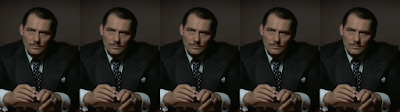
Ghassan Massoud did not receive an Oscar nomination for portraying Saladin in Kingdom of Heaven.
Kingdom of Heaven is a fairly impressive epic about a Knight Balian (Orland Bloom) who travels to Jerusalem during the crusades, eventually becoming the defender of the city.
Now a weaker aspect of the film technically is Orlando Bloom's lead performance, though this in no way means Bloom is at his worst. In fact it is probably his best performance, well outside his guest appearance on Extras of course, but it is easy to see someone probably could have done more with the part, perhaps Niolaj Coster-Waldau who is featured in a bit role already. Luckily Bloom is surrounded by a strong supporting cast, well other than chronic over actor Marton Csokas as the chief villain whose physical appearance in this film kept making me think "come on Angus Macfadyen I know you can do better than this". Csokas is an exception though, and just about everyone else delivers whether it is David Thewlis as an otherworldly mentor, Liam Neeson as Balian's passionate father, Jeremy Irons and Alexander Siddig as two calm advisors on both sides. Then there are the leaders of the respective armies. The Muslims being lead by Saladin played by Ghassan Massoud.
Massoud's performance realizes the stature of a certain type of leader in Saladin. He's not a man known for his grand speeches or dramatic charges into battle, rather he is known for his wisdom. Massoud exudes this sort of unassuming confidence. Massoud plays the part without ego yet still conveys a definite charisma in Saladin. He portrays an assurance in himself as a reasonable man, and creates the sense that his greatest concern is always what is best for his people. Saladin's early appearances in the film are rather brief, as he tries to avoid war with the Christians. In these scenes though Massoud does well to establish the man as a calm leader, yet with an underlying incisiveness about him. The calmness about him never is that of a fool or a fiend, rather Massoud finds the certain sense of contemplation in Saladin that defines the man. Massoud presents him as a man who is always thinking, never acting rashly, properly showing the leader who waits to only ever make the right move.
Eventually Saladin's hand is forced by the villainous forces among the Christians causing him to finally attack. Massoud never portrays a viciousness even as he has his enemies massacred, instead portraying just this certainty of righteousness in his anger as he executes men for their wrongdoing. Saladin though to finish the reign of his enemies goes to conquer Jerusalem from the Christians. Massoud's performance is technically limited during the siege, though when we do see him he is effective in internalizing essentially the loss in the battle. He subtly, yet poignantly reveals the way this weighs on Saladin as he sees so many die in the attempt to take the city. Eventually Saladin instead tries to parlay for a peaceful truce and this is Massoud's strongest scene. Massoud uses the moment essentially to show Saladin at the height of his ability as he reasons a solution rather than forcing one. Massoud adds so much just in his gaze as he gauges Balian while they attempt to reach some sort of solution. He finds the way Saladin reaches his conclusion to spare the Christians, despite being reminded of pass transgressions. Massoud brings such palatable yet understated passion in Saladin response as reaffirms his refusal to be the barbarian. After the surrender I love the almost humorous quality Massoud brings as he portrays Saladin almost laughing at himself for perpetuating the madness by keeping the city intact. Massoud gives a very strong performance as Saladin, though I must admit I don't think he gives the very best performance in the film.

Edward Norton did not receive an Oscar nomination for portraying King Baldwin IV in Kingdom of Heaven.

Edward Norton portrays the initial leader of the Christian factions in the holy land as the king of Jerusalem. Norton is unrecognizable in the film given he wears a mask through almost the entirety of the film, and the one scene we see him without his mask, it hardly matters. That is because Norton is portraying Baldwin who we meet as he is already ravaged from leprosy, though still the King. Edward Norton is not an actor that makes one immediately think of historical epic, however he seems the actor most comfortable with the material out of anyone in the cast. Norton doesn't do an overt accent per se, it is technically more of some akin to what say Harvey Keitel did in the Duellists, yet it still never seems like Norton behind the mask. In the end he seems unrecognizable even in voice, as he merely is Baldwin. Norton's there if you try to find him yet there is no reason for such distractions whenever Norton is onscreen. This is despite the technical limitations against him in this performance as the only part of his face that he is able to make use of are his eyes with the rest of his face being covered up by the lifeless mask, however that is not nearly as debilitating as one might assume.
Norton establishes Baldwin effortlessly from his first scene where Balian is introduced to him. Now Norton does not rely on anything to overt in terms of his body language. He brings the right grace of King, well still conveying the degradation caused by his condition, and effectively gradually showing the worsening of the condition every time we see him throughout the film. That is not what makes this such a remarkable performance though as Norton is absolutely as magnetic when he is standing or when he sitting or laying down here. His first scene where he meets Balian Norton is utterly captivating in realizing the power of the figure. This is essential as Norton must make it convincing that Baldwin is still the respected King despite the ravages of his disease. Norton makes that wholly believable as he conducts himself with such assurance still, and his voice commands attention despite never seeking it precisely. There is simply this wonderful quality about Norton's voice as there is something contemplative about it yet with a profound assurance of a man who firmly understands the world he lives in. There is a humanity Norton brings yet the cunning is all the same, as Norton depicts a benevolent King yet a King who will do what is required to secure his Kingdom.
Norton though also utilizes well the only part of his face that he is allowed to use. Norton's eyes are truly expressive here as he gives them this piercing quality fitting for a leader, yet within them there is the sense of the constant suffering Baldwin must endure. Norton with only seemingly the most minor of resources is utterly fascinating to watch here. Baldwin through the film offers the most sage advice as he attempts to maintain civility with the Muslims, even while dealing with a form of insurrection in the ranks. Norton gives us this struggle, but also makes every success convincing through that eloquent sway in the man he realizes so beautifully. Norton though as keeps the idea of the man alive particularly near the end of his time in the film as he begins to finally die from his disease. There is one especially heartbreaking scene where Baldwin's sister finally goes to see him on his deathbed, after ignoring him in his terrible state for some time. Although we got very little to establish this relationship beforehand, Norton makes us understand it in an instance. The love that Norton expresses in his eyes as he sees her brings such poignancy to the moment suggesting how much she had meant to him. Norton is incredibly moving as he captures the pure joy of the moment as Baldwin has one moment of happiness before his death. Every single scene in which Baldwin appears is a highlight in the film a Norton so effortlessly gives the life to the King and the man, and is never overshadowed by the mere idea behind him. It is an excellent performance which, like John Hurt in the Elephant Man and Conrad Veidt in The Man Who Laughs, never seems limited in emotional impact despite the nature of the role.