Showing posts with label Chishū Ryū. Show all posts

Wednesday, 27 May 2026

Alternate Best Actor 1953: Results

5. Kazou Hasegawa in Gate of Hell - Hasegawa is able to hit the extreme notes called upon him as a character with limited substance but is very much overshadowed by his co-stars who express a bit more nuance in their roles. 
 
Best Scene:  Ending
 
4. Jack Hawkins in The Cruel Sea - Hawkins gives a reliably good performance however his fully lead performance here suggests the possible limitations of his ability as a leading man as a opposed to a character actor. 
 
Best Scene: After the choosing to ignore the men in the sea. 
3. Charles Boyer in The Earrings of Madame de…. - Boyer gives an effective performance in very much playing into his imperious presence in an effective way as essentially presenting his character as above typical human interaction.
 
Best Scene: Requesting the duel. 
2. James Stewart in The Naked Spur - Stewart gives an effectively raw portrayal of a damaged man and successfully downplays his typical charm and heroic presence. 
 
Best Scene: Making the final choice. 
1. Chishū Ryū in Tokyo Story - Good prediction Calvin. Ryū gives a low key but powerful portrayal of the different quiet shades of a father and finding the joy but also painful truths of this man. 
 
Best Scene: Tragedy strikes 
 
Next: 1953 Supporting Reviews (Not a lineup) 

Friday, 15 May 2026

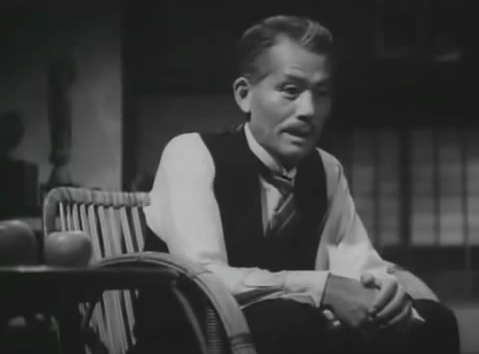
Alternate Best Actor 1953: Chishū Ryū in Tokyo Story

Chishū Ryū did not receive an Oscar nomination for portraying Shūkichi Hirayama in Tokyo Story. 

Tokyo Story is a masterful film about an elderly couple visiting their adult children in Tokyo. 

Longtime Yasujirō Ozu collaborator Chishū Ryū plays the male half of the couple, along with Chieko Higashiyama as Shūkichi’s wife Tomi, who actually wasn’t particularly old when the film was shot. Ryū plays the old man though it works honestly because he doesn’t try to put on any overt “old man” mannerisms like a crusty voice or over the top movement. Rather Ryū is convincing just with the calm deliberate manner of the man. That's a very subtle but believable way to make us believe that his father is the age the film says he’s in. Although anyone familiar with Ryū shouldn’t be too surprised that he takes such a modest approach as that is very much his creed as a performer and always the ideal fit for the equally modest style of Ozu. Much like Ozu, Ryū thrives often in the margins and in this instance Ryū’s performance particularly exists in the moments between moments. As much of Ryū’s screen-time as the father is just going about as a visiting dad. We see him with his wife where he and Higashiyama share a naturalistic and believable chemistry. There’s nothing complicated about it; they just simply are connected as they are. When visiting the adult children, including his daughter Shige (Haruko Sugimura), a hairdresser, and son Kōichi, a doctor, (Sō Yamamura), Ryū’s performance is one of largely quiet modesty. Ryū exudes the sense of the father not wanting to be too much of a bother most of the time keeping largely a smile on his face and a very pleasant demeanor even when both children end up struggling to spend all that much truly devoted time to their parents. The only person in Tokyo who truly goes out of her way is their daughter-in-law, the widow of their deceased son, Noriko (Setsuko Hara), who gladly spends time with them. Where Ryū even within his frequently smiling manner does exude that much of a greater genuine appreciation in this interaction that shows the difference between the smile just to be pleasant and the man reacting to a real appreciation for him. 

The majority of Ryū’s performance is that smile and a pleasant nod, that isn’t a criticism however as the power of his performance is when that smile or nod is broken in anyway and the keen way in which Ryū is able to make such an impact out of so little changes within that, which ends up being rather profound in the nuance. There’s a moment early on where his wife mentions his drinking in older times and just the little annoyed noise that Ryū makes speaks to so much suddenly, as we get some insight into a man whose younger years were a bit more defined by alcohol than maybe he’d like to admit to. When speaking to his wife about his children even within the certain disappointment towards how his daughter is meaner than she used to be and his son is a much smaller scale doctor than he expected, Ryū’s changes to more contemplative and you are gained instantly the insights into how the man truly feels beneath the pleasant smile. When discussing the kids in general not having time for him and his wife, Ryū’s performance keeps the calm yet the sadness is so profoundly there between the smiles. It is truly remarkable because Ryū makes it all feel so natural when you catch just those glimpses of the man’s pain that he mostly keeps down. One of the most profound moments of this is when he goes out drinking with some other older men and Ryū’s moment of talking about his deceased son is tremendous. It isn’t a long moment yet just his degree of losing his composure, the sadness suddenly coming up, before pushing it down to just be there to be joyful with his friends is outstanding work from Ryū. Which the scene probably leads to his most overt scene though less serious, where Ryū is regardless effective in depicting the drunken near blacked out saunter of the dad who takes his friend to his daughter’s home and steadfastly ignores her questions. 

The journey ends as it does with the parents returning home, however spoilers tragedy strikes when the mother takes ill then dies soon afterwards. This being quite frankly executed in one of the least melodramatic deaths in any film while also being one of the most heartbreaking because of just how natural it all feels. Key to the power of this is Ryū’s performance, he is amazing because we just see the steps in the man losing his composure, it is almost entirely physical work, particularly just as his wife dies, yet in the way you suddenly see the anxiety and sadness take over it is so painful to witness within the man who had almost entirely such a calm sunny disposition. Maybe most powerful is that even physically we see that he is absolutely distraught as man, his delivery of words just admiring the dawn, Ryū delivers with almost that same calm yet even within that calm we see how fundamental of a loss this truly was for the man. A man who in no way takes his loss as his own and we see Ryū’s portrayal of him being there for his children. Even more so there being for his daughter-in-law, the person who stays the longest with him and seems to most understand his loss. Their final conversation is so poignant where Ryū brings such earnest empathy as he encourages her to move on from his son, meanwhile still showing the pain of essentially looking forward to a life of loneliness himself. Ryū manages to bring the power in the subtle sense of the man’s acceptance, that isn’t acceptance without pain but rather is acceptance of that pain. His final scene being particularly understated of the man just looking out, now alone, in a new day Ryū has that consistency of the man’s presence yet he is no way the same man. You feel that loss in his quietude, and it is as tremendous as the most intense tragedy. 

Saturday, 25 April 2026

Alternate Best Actor 1953

And the Nominees Were Not:

Chishū Ryū in Tokyo Story

Charles Boyer in The Earrings of Madame de...

Jack Hawkins in The Cruel Sea

James Stewart in The Naked Spur

Kazuo Hasegawa in Gate of Hell

Saturday, 18 December 2021

Alternate Best Actor 1942: Chishū Ryū in There Was a Father

Chishū Ryū did not receive an Oscar nomination for portraying Shuhei Horikawa in There Was a Father.

There Was a Father tells the story of a single father raising his son, however rare is it that he finds time to spend with him regularly. 

Frequent collaborator of director Yasujirō Ozu, Chishū Ryū stars here and it is no surprise that he was so frequently cast as Ozu seeks the simple truths of life, Ryū's a performer who does the same with his wholly sincere and always authentic feeling presence. This is a film on the surface that is very muted, yet in that muted tone is what is so special, and what we also find within the ending of the film. For much of the film we follow Ryū's Shuhei as he raises his son with a simple dignity, however within the simple dignity of Japanese culture of the time where he must uphold certain values of consistent hard-work over the natural needs of familial connection. What then is the film as we follow the ease in which Ryū's creates really the conflict with this without actually ever denoting it towards more expected melodrama or even drama really. Ryū's delivery after all is one of calmness as he explains each time to his less understanding son of why the two must be so frequently separated, as he must pursue work while also having his son be raised. The two's presumed duties leaving them in this state of perpetual separation through the years. This as this film is one through years not days, a week or a month. We rather see the long extension of this practice as the father does what he believes is right by his son, and right by his family, which is two so commonly not be among him. As off-putting as this even seems as though it may be Ryū's performance is what makes it work, and creates this understanding within the logic of the father. 
 
Ryū's delivery is of a calm passion towards the belief and speaks it as an expected truth. It is with a calm duty and an unassuming belief. It isn't something that he has randomly come up with, rather with Ryū he speaks it as though it was just speaking towards any responsbiltiy one would just assume is part of life. I am honestly surprised Ozu was able to get away with this film during World War II in Japan, given what for example Kurosawa's typical individualistic spirit was reduced to in The Most Beautiful. Although it is perhaps because while the text says one thing, and perhaps that is all potential government officials really read into this piece, this being that one should work hard in life, the subtext seems to indicate otherwise. Although Ryū's Shuhei repeatedly speaks one's devotion to work. That though would be ignoring the whole of it, which is every silent moment within Ryū's work. This as even as he doesn't speak his love towards his son, as they interact when he's a boy, to when he's a young adult, to an adult, but it is ever apparent in every moment of interaction in Ryū's performance. The happiness within Ryū's portrayal is of pure warmth when the two go fishing together or just speak towards one another in their home. It is with a gentle love that is simply the truth of their relationship. There is a sense of conflict in Ryū's performance even though it is never something that is emphasized specifically. It is rather within how much appreciation and pride we see in Ryū as he has his moments with his son. There are no moments where there is a more powerful sense of happiness then in these scenes. Again though the beauty of this work is that it is in the briefest of moments, such as his son attending to the shrine of his mother, we in just a look Shuhei's deep affection for his wife, and the love for his son in a singular moment. We see this as a truly loving father who embraces every moment of being a father with his son, while always being trapped within the beliefs of societal expectation. Again this where one could argue quite the subversion, as the true happiness of Shuhei's life and as expressed within Ryū's performance is when the father and son are reunited, not when he is elsewhere. Again though this is never spoken within the film rather in the silence, where there is the truth of it all. In turn we are also granted the classic devastating ending from Ozu that hits you in a way that is most unexpected, yet so palatable when it does. This isn't through theatrics however, it is rather through that calm. Here in really understanding this relationship, and seeing every intimate moment of connection, so wonderfully realized here by Chishū Ryū. We find the loss of the two's time apart not from a big speech to say this, but rather through every gentle reminder that the father and son simply love one another. Ryū's work not defined by every big scene, rather every quiet moment that reveals the moving intimate truth of this reserved man.

Tuesday, 26 September 2017

Alternate Best Actor 1949: Results

5. Anton Walbrook in The  Queen of Spades - Walbrook's role is a touch limited however he is an effective coldly manipulative Lothario then incredibly entertaining in portraying the glee and madness of his greedy soldier who believes he's found the key to his success.

Best Scene: "MY WIN"
4. Howard Vernon in Le Silence de la Mer - Vernon gives a moving performance within the limits of his film through his humane depiction of a Nazi coming to terms with his situation.

Best Scene: Finally a message.
3. Robert Ryan in The Set-Up - Ryan gives a terrific portrayal of a hopeful desperation of a man trying just for one last shot in the ring.

Best Scene: The Fight
2. Chishū Ryū in Late Spring - Ryū gives such a remarkable modest performance that creates such naturalistic and downright heartbreaking depiction of a man quietly letting go of his daughter.

Best Scene: Peeling the apple.
1. David Farrar in The Small Back Room - Good Predictions Luke, Jackiboyz, RatedRStar and Michael McCarthy. Farrar gives an outstanding complex portrait of a brilliant man, yet one suffering from pain, doubt, and self-pity.

Best Scene: Tearing apart the room.
Update Overall

Next: Review of Juano Hernandez in Intruder in the Dust, and updated Supporting.

Sunday, 24 September 2017

Alternate Best Actor 1949: Chishū Ryū in Late Spring

Chishū Ryū did not receive an Oscar nomination for portraying Shukichi Somiya in Late Spring.

Late Spring is a beautifully realized film about a young woman who is pressured to be married, but tries to stay with her father.

Chishū Ryū's performance as the older father, and professor Shukichi Somiya is a particularly understated one. This is notable though as a challenge in its own way though as it is needed for the tone of the film, but also for the nature of the character. What is remarkable about his work though is how effective it is despite how quiet it is. This is even more notable though because this isn't a performance as a character who is quietly in anguish or anything like that, not truly anyways. This is just a normal man living his life, that we get a window into after he has been widowed sometime before, and his adult daughter Noriko (Setsuko Hara) still lives with him in order to take care of him. Shukichi though is not ailing in any way we meet him just as he lives his life and still performs his duties as a professor. As we see him just sort of go about his day in his rather low key way fitting to a man of his position and age there's a certain charm to Ryū's performance. There isn't anything overt about this he just makes Skukichi this likable old man who expresses his personal knowledge without ego, just as modestly as you'd expect from someone who would rather share it, than brandish it in a way.

This performance though seems a challenge in a particular way in that as a performance it does not have the usual tenets of an inherently compelling performance. If I merely described what Ryū's does in the role, considering how unassuming he is, it may even sound boring, but it's not at all the case. This performance is an exceptional display again of what can be done in silence, and really in appealing to just a simply truth of a person. This is not to say Ryū's performance is even simple by any means, but rather what he does is capture the simplicity of life, but not in a simple way. The years of this man's life are within Ryū's performance that does not seem to have an acted moment within it. Ryū's work is genuine in every regard as you do just feel as though you are meeting the man living the life as he does, but how honest every scene is through his performance. It's interesting in the way he is very much engaging in this approach. He never wrongly acts out yet creates interest in this man by just always showing us to be an unmistakable person, with his own history, we are watching, never just some character created for the confines of this story.

The focus of the story is between the daughter and father. Ryū's and Hara's chemistry is essential to the film. Again it is an unassuming yet remarkable connection that the two realize in their scenes together. As in every moment of their interaction the years of tender affection between the two of them is an accepted if technically often unstated truth. The film focuses though as the father, in part due to pressures of friends and relatives, to attempt to apart his advice for his daughter to marry despite her wanting to stay with him. The original prodding by Shukichi to his daughter, might not seem especially important, yet they way Ryū plays these scenes is pivotal to the eventual end result of the film. Ryū's portrays no desire to rid himself of her, or a single bit of absentmindedness rather only the most sincere warmth as he suggests a potential suitor. Ryū importantly never depicts a pressure in Shukichi's suggestions but only the most earnest support for her. Ryū doesn't make these moments a father trying to force his daughter into anything she doesn't want, but trying to connect her with what he believes will allow her to find some happiness in her life.

The matter seems to become more difficult though when Noriko directly reveals her intention not to marry in order to take care of her father. Ryū's work is quite moving in the quiet reactions in this moment as he creates the sense of appreciation in the father, before the father tries to reject the notion by stating that he intends to remarry. Ryū places still only such a sincerity in his appeal to his daughter, as he does not show any intensity or bitterness in the idea of trying to get his daughter to leave. There is such genuine poignancy that Ryū finds in telling her to leave him and attempt to find her own happiness, because he makes this technical rejection of sorts filled with such heart and such a sense of the very real love the two have shared as father and daughter over the years. He eventually convinces her to be married, and this is where Ryū's performance took me off guard. Now I already thought he was incredibly effective in just giving this authentic modest portrayal of this man, but the extent of the power of this performance removed the floor out from under me in the final minutes of the film. In the final minutes Noriko is married leaving Shukichi to reveal to a friend that he was never going to remarry. Now the revelation of this lie is not a drop of the facade but rather merely a part of the truth of what we had seen of the man through Ryū's heartfelt performance. When he returns home alone for the first time living by himself, Ryū's is absolutely heartbreaking in revealing the loss of the man, the sadness that is in part of letting go. This again is no switch or anything like that. It is as authentic as the rest of his work, and that is what makes it so special in the revelation, though we really always knew it, that the father loved his daughter and will miss being with her. Ryū's work is outstanding as he creates such a eloquent and downright devastating portrait with such seemingly profound grace.

Monday, 11 September 2017

Alternate Best Actor 1949

And the Nominees Were Not:

Anton Walbrook in The Queen of Spades

David Farrar in The Small Back Room

Robert Ryan in The Set-Up

Howard Vernon in Le Silence de La Mer

Chishū Ryū in Late Spring

And a Special Review of:
Toshiro Mifune in Stray Dog