Showing posts with label 1972 Alternate Best Actor. Show all posts

Saturday, 14 March 2015

Alternate Best Actor 1972: Results

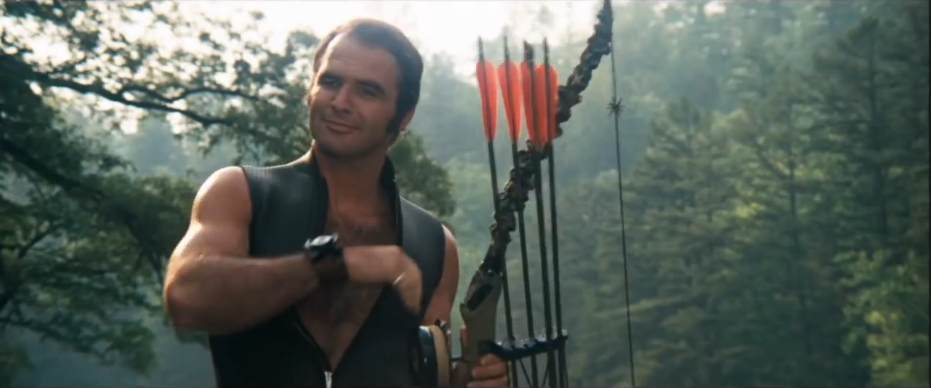
5. Burt Reynolds in Deliverance - Reynolds gives an interesting portrayal that matches yet quietly subverts his character's view of masculinity.

Best Scene: Lewis rescues Bobby and Ed.
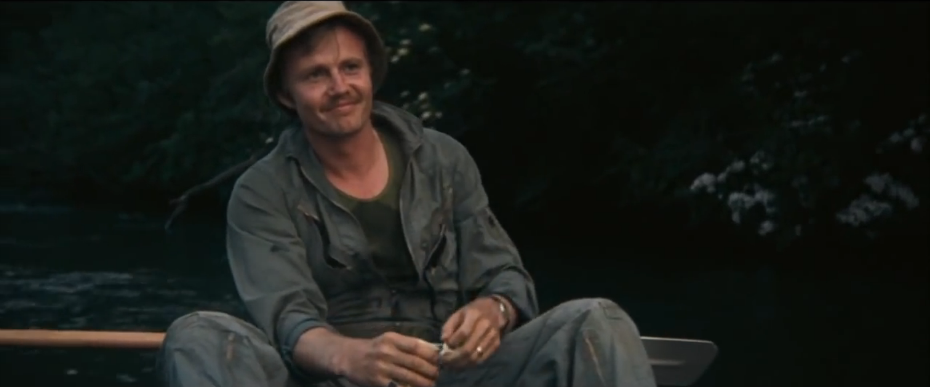
4. Jon Voight in Deliverance - Voight gives a sympathetic and moving portrayal of a man who is both physically and mentally damaged by his journey.

Best Scene: Ed shoots the Hillbilly.
3. Robert Redford in The Candidate - Redford gives a strong performance where he transforms from a somewhat acerbic though passionate man to a charismatic though vapid politician.

Best Scene: McKay's laughing fit.
2. Max von Sydow in The New Land - Max von Sydow gives a great performance of beautiful simplicity through a honest depiction of a man's life in a new land.

Best Scene: Karl-Oskar's final moments with his wife.
1. Klaus Kinski in Aguirre, The Wrath of God - Good Predictions Michael McCarthy, Kevin, Luke, GetDonaldSutherlandAnOscar, RatedRStar, and GM. Kinski gives a mesmerizing portrayal of a man's descent into madness. 1972 was filled with some great performances but I went with the one I simply loved watching the most out of all them.

Best Scene: Alone on the raft. 
Overall Rank:
  1. Al Pacino in The Godfather 
  2. Laurence Olivier in Sleuth
  3. Klaus Kinski in Aguirre, The Wrath of God
  4. Max von Sydow in The New Land
  5. Bruce Dern in Silent Running
  6. Stacy Keach in Fat City
  7. Robert Redford in The Candidate
  8. Jon Voight in Deliverance
  9. Michael Caine in Sleuth
  10. Marlon Brando in The Godfather
  11. Burt Reynolds in Deliverance
  12. Marlon Brando in Last Tango in Paris
  13. John Wayne in The Cowboys
  14. Paul Newman in The Life And Times Of Judge Roy Bean
  15. Gene Hackman in The Poseidon Adventure
  16. Peter O'Toole in The Ruling Class
  17. Michael York in Cabaret 
  18. Charles Grodin in The Heartbreak Kid
  19. Jeff Bridges in Fat City
  20. Clint Eastwood in Joe Kidd
  21. Lee Marvin in Prime Cut
  22. Jack Lemmon in Avanti!
  23. Woody Allen in Play it Again, Sam
  24. Steve McQueen in The Getaway
  25. Cliff Robertson in The Great Northfield Minnesota Raid
  26. William Daniels in 1776
  27. Kevin Hooks in Sounder
  28. Ryan O'Neal in What's Up Doc?
  29. Jon Finch in Frenzy
  30. Simon Ward in Young Winston
Next Year: 1972 Supporting

Friday, 13 March 2015

Alternate Best Actor 1972: Robert Redford in The Candidate

Robert Redford did not receive an Oscar nomination for portraying William 'Bill' McKay in The Candidate.

The Candidate is an effective film detailing a first time politician attempt to win the U.S. Senate in California. A minor problem I do have with the film is the opponent Crocker Jarmon is almost a bit of villainous caricature, which seems odd since Bill McKay is not a hero, although I think this problem might have been non-existent if the original choice for the role, Jimmy Stewart, had taken the part since Don Porter gives a wholly charmless performance.

Robert Redford seems as appropriate of an actor as one could imagine to play the role of Bill McKay since Redford already has the look of politician to begin with. The film does not start with Bill McKay as a politician though as he is at first recruited for the job by a campaign manager Marvin Lucas (Peter Boyle) who sees potential in the young McKay who happens to be the son of the former governor of California. McKay at first is a liberal lawyer actively working causes he believes in. Redford does something interesting in his performance here which is he starts out not exactly all that charismatic. He portrays McKay as clearly a passionate sort of man as he espouses his semi-disinterest with Lucas's offer. Redford does not suggest this in a way that is especially endearing though. He does not espouse his views as a man who is trying gently convince a disbeliever of something, but rather just kinda bluntly telling his belief in a way where he obviously believes he is right. Redford does not give a wiggle room there as he pains McKay's personal drive as something that you can either take or leave, it's not something he will paint any other way.

McKay eventually accepts the offer due to Lucas promising McKay that he can say what he wants since he is going to lose to the incumbent Jarmon who is viewed as unbeatable. At the beginning of the campaign trail Redford is rather effective in depicting McKay's attempts to get his message out there. At first McKay rather bluntly states what his exact beliefs are. Redford is good in showing the lack of panache in the way that McKay does this. When he's trying to talk to random potential voters for the camera Redford brings a certain awkwardness about the whole thing. Redford does not show a lack of conviction in his statements, but rather he expresses the embarrassment of sorts in McKay as though he's not quite sure why he's making his statements in the public forums the way he is. What Redford does though is gradually suggest McKay kinda getting the hang of things as the campaign continues forward. Redford begins to project a stronger charisma in McKay ways as he seems simply more comfortable in the whole interactions with the people and the cameras.

Redford still keeps an inherent anger in McKay's manner though as he states his opinions somewhat as the last angry man, and there is still that quality in which would be rather off putting if one does not completely agree with the man. McKay manages to wins his party's primary though the initial polls show that he will suffer a crushing victory when facing his Republican opponent. McKay being against the embarrassment of such a defeat begins to become even more accepting of all of his managers' advice. This leaves McKay to reign his message in a rather peculiar way in which most of his statements become broad generalizations that most people are willing to support. Redford is equally good in creating the gradual change in this sense. At first he portrays some hesitation in his delivery of these tailored made statements, although for the most part is able to move through them well enough. Redford underlies it with some more obvious distaste for it all as there is something seething beneath McKay as he is forced to hide his real beliefs, making it particularly when McKay potentially compromises his gains from a charged outburst at the end of his otherwise standardized debate with Jarmon. 

The need of the victory out weight the needs of the espousal of views in the end for McKay. There is a great scene for Redford where he seems to indicate McKay's final transformation into the true politician. It's in the form of a speech which Redford delivers at first still with some of that past in the man as he opens in a possibly volatile fashion. Suddenly though when he gets into the meat of the speech Redford is excellent as he becomes the man who's ready to win the race. Redford realizes the command and charisma needed for the politician now as he gives a speech with little meaning other than that America is great and electing him will only aid in that fact. Redford finalizes the transformation brilliantly as he makes McKay far more appealing than he was before, and delivers the speech in a rather rousing way that almost seems to cover up just how shallow it is. He becomes the great American he was meant to be no longer seeming champion his personal cause, but rather champions every cause of any person. Of course it becomes far more difficult to decipher whatever it is that McKay believes in or ever believed in.

McKay continues on his campaign and Redford presents a charged man who seems to master the camera and the public through his unending espousing of platitudes as well as his so promising campaign slogan. This is not to say McKay is completely at ease with himself though Redford is terrific in realizing the acceptance of McKay for the most part. He no longer needs to plug the anger away rather he's done away with it into a certain confusion as well as resignation over his own vapidness. He might still have a problem but can do away with most of it in a quiet sigh when no one is watching. His only major breakdown is a great scene for Redford, because the breakdown is not McKay finally lashing out for his true passions, but rather just not being able to help himself from laughing at his own ridiculousness as he tries to turn out a TV ad. Redford gives a very strong performance here as he drives home the message of the film so well. He does not win us over as an audience here as the passionate young man with a purpose, instead he does it as the politician without a purpose but with the ability to make nothing, something one can vote for.

Thursday, 12 March 2015

Alternate Best Actor 1972: Klaus Kinski in Aguirre, The Wrath of God

Klaus Kinski did not receive an Oscar nomination for portraying Lope De Aguirre in Aguirre, The Wrath of God.

Aguirre, Wrath of God is an intriguing film depicting a Spanish conquistadors attempt to find the non-existent city of gold named El Dorado.

Well I go from one journey down the river to another this time by a group of conquistadors, and their Indian servants as they attempt to make their way through the thick South America Jungle. We are first introduced to Kinski's Aguirre as part of the larger party of men in the jungle as he is essentially just one of the enforcers moving the people along. Kinski is perfect casting for a conqueror as you don't even need to know anything about Aguirre to know he probably has some blood on his hands. Kinski despite certainly not being the tallest man among the group is easily the most menacing as there is something so terribly imposing in the way he carries himself. Kinski is quite something to watch here in his weird way in he walks that seems to suggest a hunch as well as that Aguirre is almost some sort of creature. Not every actor could probably pull this off but with Kinski it feels quite natural only serving to help Aguirre stand out all the more as a very particular sort of man. His peculiarities though begin to rear their heads all the more when the expedition breaks up.

The original leader Gonzalo Pizarro sets off a group of men down the river with Aguirre set as second in command of the group. The film then proceeds to follow the men in their dangerous trek down the river into completely unknown territory. If someone were to watch the film for the first time the person might be a bit surprised to find out about Kinski's role in the film. Although he is indeed lead the film gives considerable focus to the other people on the expedition. Part of the strength of Kinski's work though is how his presence is always felt even when he may not be seen on screen. In the early part of the film, as the rafting party is lead by a more sensible leader named Ursúa, Kinski slinks around the film as almost an agent of destruction. Kinski is quite eloquently sinister in conveying the way Aguirre seems to be watching almost all waiting for their leader to exhibit some weakness in his control. Kinski quietly expresses the ambition in Aguirre which will play a large part in his eventual actions in the story. The way he watches Ursúa Kinski suggests the way Aguirre's intent is slowly simmering in the man, and that when it rears its head fully it might be unstoppable.

One of the first hurdles comes when one of the rafts gets trapped killing the men on board, and Ursúa orders that they receive a burial. Aguirre ensuring that no time is wasted manipulates a few things in order for the raft to be blown out of the water with a cannon ensuring no burial is needed. Kinski creates the deviousness in Aguirre in a rather interesting way. When he destroys the raft there's not pleasure that is shown in his face, or any obvious sadism. Kinski rather plays it as simply a determination in the actions. Aguirre does not destroy the raft for fun, or pleasure, but rather because it will perhaps prevent the expedition from reaching its goal. Eventually Ursúa decides that there is no point to continue the mission and they best backtrack since it seems impossible to go forward. Aguirre's reaction is to obviously have him shot. Kinski utilizes what he built up to before as he suddenly wholly dominates the proceedings as Aguirre lords over all, as he reveals a vicious passion in Aguirre as he conducts everyone in their place which means shooting any supporters. The funny thing is Aguirre does not even take official charge claiming a different man to be King, even though it is obvious who holds the strings.

After this the trek continues down the river despite that no El Dorado is in sight, and the dangers only seem to increase. Kinski is particularly effective in depicting the way Kinski orchestrates the journey forward even though Aguirre still stays only second in command in terms of official standing. Kinski is good in the moments where he quietly prods the puppet ruler to take certain actions, and exudes that power of the personality as it is obvious that all the important decisions are made by Aguirre even if he does not necessarily give the order. Kinski is compelling in the way he makes himself as the almost silent ruler who controls all, and even creates the sense of false benevolence in his manner as he allows Ursúa to live for a little while longer. Kinski balances this well with the more intense moments though of a more obvious leadership. This mostly comes in the form of when they attack the locals who occasionally attack and kill a few of the remaining party. When the men storm Kinski brings the intensity of the attack in his performance as he does lead his men in kinda a routine massacre where he kills whoever is around, and always destroys whatever property he and his men can find.

Every moment Kinski is on screen he brings something to his portrayal of Aguirre. There a few particularly good moments where Aguirre interacts with his daughter who has been brought along the voyage. Kinski nicely brings some tenderness to Aguirre, although even this is a bit problematic as proven later on. Kinski artfully brings this more earthly moments within the framework of the larger than life presentation of Aguirre. Kinski effectively makes him a man though also is absolutely convincing in bringing out someone who would proclaim himself the wrath of God. The size of the man ends up being questioned though as there clearly is no city of gold. One marvelous part of his performance is a seemingly simple reaction of Kinski. The moment is when Aguirre is looking out on the last raft towards the distance. It is not just a simple look checking out what's ahead of him. No instead Kinski realizes the ambition of the man in that look as he seems to be looking off the distance to see El Dorado every time with that great gaze of his, yet it always ends with  disappointment since there never is that golden city in the horizon to be seen.

Due to El Dorado not existing the amount of living passengers and men slowly diminish. With that a madness grows in Aguirre as it is obvious that the whole journey has been futile. The insanity that Kinski portrays does not come from Aguirre realizing that he has failed, but rather it is found in that he cannot or at least refuses to accept his failure. Kinski gradually shows the way Aguirre seems to slowly withdraw into his own mind to become of his own world where his attempt to create a kingdom has been a success. According to Werner Herzog Kinski wanted to depict the final scene, where Aguirre is alone in his "kingdom", as a rambling loud insanity. Herzog though basically used up Kinski's anger though leaving him to handle the scene in a quieter fashion. Well this was a masterstroke for Herzog as Kinski is outstanding in the final scene. He has that intensity of madness though it is in his eyes and the manner in which he seems to be searching for something which is nowhere to be found. In addition though Kinski is surprisingly moving as well as he brings this somberness in the final moments as though a part of Aguirre has understood his failure. It is a powerful ending to this incredible portrait of a descent into a delusion of grandeur.

Wednesday, 11 March 2015

Alternate Best Actor 1972: Jon Voight and Burt Reynolds in Deliverance

Jon Voight did not receive an Oscar nomination, despite being nominated for a Golden Globe, for portraying Ed Gentry, and Burt Reynolds did not receive an Oscar nomination for portraying Lewis Medlock in Deliverance.

Deliverance is a very effective thriller about a group of four men who venture into dangerous backwoods to go on a river-rafting trip.

Jon Voight plays Ed one of the four "city-folk" who go off into the backwoods for the rafting trip on a secluded river. Voight portrays Ed at the beginning of the film as just a fairly easy going sort of guy. Voight is likable enough in portraying Ed as basically just wanting to go and enjoy his vacation with his friends. Voight nicely plays Ed as just a normal guy looking for a good time. The same can't quite be said about Burt Reynolds's Lewis. Reynolds plays the part with a country twang that almost sounds exactly like the sort of accent Paul Newman used in Hud. Burt Reynolds plays Lewis in a somewhat larger than life fashion, although  with a clever twist about it. Reynolds does not plays Lewis as though he is truly some sort action hero, or great adventurer, but rather positions him as a man who believes himself to be. Reynold has a considerable swagger in the way Lewis walks and talks. Everything he does Reynolds plays as possibly a bit much, although this seems to be intentionally so as he shows Lewis to be man who wants to be this adventurer, which works particularly well against Voight who keeps Ed as such a unpretentious sort of man. 

The opening scenes of the film show the four men as they make the preparations for their trip which includes some awkward interactions with the locals. Voight and Reynolds both are good in portraying the different ways in which they interact with the people they don't exactly fit in with in the least. Reynolds conveys a certain disdain in Lewis's whole manner towards the people. There is perhaps something even more than just the disdain that Reynolds suggests. There is a bit of sly grin and just the way he looks at them that alludes to something even more problematic from Lewis. Reynolds shows that Lewis is attempting to egg em on a bit as though he wants trouble merely to perhaps prove himself a bit. Voight on the other hand expresses Ed once again as just a man trying to be as pleasant as the situation deems possible. He effectively portrays some unease in the interactions though in no way intentional, or even offensive just instead suggesting the disconnect between his life and the lives of those people. Voight is especially good in his scenes with Reynolds as he does well to react quite honestly showing both a disbelief and a bit annoyance as fails to understand why his friend seems to be purposefully looking for trouble.

The beginning of the trip goes well enough even though it is obvious that the other two men Bobby (Ned Beatty) and Drew (Ronny Cox) have a bit of a learning curve to go through. A good scene early on is when Ed is shooting the breeze with Lewis at a resting spot while Lewis is showing off his archery skills by shooting fish in the river. While doing this they have a bit of a philosophical discussion in regards to survival. Reynolds is quite good by showing the honestly slightly demented view of Lewis as he speaks about survival in a most peculiar way. Reynolds does well because he presents such a pride in Lewis as he shoots his arrows and boasts about his survival skills while being so very cheerful at the idea of some sort of social collapse. Reynolds believable creates this odd view as he shows that Lewis more than anything relishes the chance to basically prove that he's as awesome as he thinks he is. Voight again does fine work in being the understated counterpoint that provides a balance for Reynolds's work. Voight portrays just the very genuine reactions of one friend to another kinda shaking his head at his friend, who he knows is kinda serious but does not exactly know what he means either. Voight is good in exuding the contentment in Ed as he clearly just enjoys the trip and does not see it as the proving ground Lewis views it to be.

The turn takes a sudden dark turn when the separated Ed and Bobby on a break are approached by two armed mountain men. Although Ed and Bobby try to be pleasant enough things quickly become dangerous as the men begin to threaten them with their weapons before they tie Ed to a tree and force Bobby to strip at gunpoint. Voight's performance here is excellent as he amplifies the horror of the scene through his particularly honest portrayal of Ed's terror as the situation only becomes worse as one of the men begins to rape Bobby. Voight brings the needed fear into Ed as it becomes clear that they very well might not come out of the situation alive. Their savior comes in the form of Lewis who sneaks up on the situation, and Voight's terrified reaction is perfect as he nods for Lewis to take the killing shot against the mountain man who violated Bobby. Voight is terrific in the moment because he expresses no malice but rather just the desire of survival in Ed. Reynolds perhaps has his best scene as the four discuss what they should do next. Reynolds is fantastic in the moment as he shows Lewis looking over the dead man as though it's an achievement of his although with that Reynold artfully brings a glint of sadness as the weight of what he has done seems to slowly dwell him. He never lets the others see exactly, but Reynolds does show that the killing was not just a game for Lewis.

After they leave something happens which causes one of the men to fall into the river to his death and in the ensuing accident Lewis suffers a serious wound. This kinda puts Reynolds out of commission for the rest of the film although he does create the pain of the wound rather effectively and has two good moments, one were he eggs on Ed to take action the other when he later purposefully act oblivious to what exactly happened on the river towards the authorities. This leaves Voight to wholly take over as the lead starting with the point where the men decide one of them has to take down the other mountain man who they believe shot at them from the hills above. Voight is excellent in the scene of climbing the mountain especially in a brief moving moment where Ed glances at a photo of his family on his way up. After resting the night morning comes and Ed is awoken to apparently the man at a distance. Voight is outstanding in this scene as Ed readies his bow. Voight brings the intensity of the moment as he expresses the gravity of the situation as he suggests in his nervousness as Ed is well aware he is about to take a life. When the moment happens Voight is equally excellent in creating the aftermath first the immediate physical pain from falling his own arrow, then the powerful sorrow as Ed examines the dead man. Voight's final scenes are quite striking as he very much earns the transformation in Ed. This is not a transformation to a hard man so to speak, but rather a somewhat broken man haunted by his experience which will never leave him the same. The ease in his manner disappears and Voight is rather affecting in silently conveying what the events of the trip have done to him. Voight and Reynolds, who I do feel is lead due to his importance for the first two thirds, both give strong performances that vividly create the two intriguing personalities of Ed and Lewis and give rather remarkable depictions of how their "adventure" changes each man. 

Tuesday, 10 March 2015

Alternate Best Actor 1972: Max von Sydow in The New Land

Max von Sydow did not receive an Oscar nomination for portraying Karl-Oskar Nilsson in The New Land.

The New Land is a very eloquently straight forward film depicting the lives of Swedish Immigrants settlers in America.

Max von Sydow leaves his roots of the existential angst filled world of Bergman for a much simpler world, although certainly no less grim technically speaking. Max von Sydow's performance is quite unassuming in nature as Karl-Oskar is a very unassuming man. The film opens as he and his family move into the new land that he purchased out in American west. von Sydow's performance early on is that of an uncontrollable enthusiasm. There is such a genuine joy in von Sydow's expression as he sees the place that he will call home. In every one of these moments as he looks over every piece of this life of his von Sydow's creates such a palatable optimism in the man as he boasts what he will make out of the untamed land. von Sydow shows a man who has the thrill of a man who is genuinely beginning the living of his dream, and in these early scenes von Sydow kinda personifies the American dream through his depiction of Karl-Oskar's view of what the New Land means to him. Of course a dream can only be so long before reality must set in.

The reality setting in is not necessarily a bad thing, well at least not at first. von Sydow though does well to just naturally portray the enthusiasm in Karl-Oskar slowly diminishes over time. It is not as though Karl-Oskar even has to suffer serious hardship at first rather von Sydow nicely shows just falling into a basic comfort with the land therefore technically speaking making the experience less special. von Sydow's performance becomes no less special though because of how consistently authentic his performance feels as he begins to just simply show Karl-Oskar relax in his surroundings. The film then proceeds to mostly depict just the day to day lives of Karl-Oskar and his immediate family. von Sydow thrives well within in the relatively simplistic story he lies in for awhile. There is something wonderful in the way von Sydow depicts Karl-Oskar manner in life. He is quietly compelling here as he always keeps Karl-Oskar alive as a man, he's not simply just there to be viewed doing various takes. There is always a personality and a life being lived because of von Sydow's very effective performance of Karl-Oskar as an average man though not a forgettable one.

von Sydow is particularly good in realizing the relationships of Karl-Oskar in a humble though very honest feeling fashion. There are just the well handled slight moments such as the certain awkwardness in Karl-Oskar when he deals with the local shopkeeper and has to deal with the language barrier, or just the moments where he basically just shoots the breeze with the other Swedish settlers, von Sydow just beautifully depicts another facet of Karl-Oskar lives. A more substantial relationship though is found between Karl-Oskar and his younger brother Robert (Eddie Axberg). von Sydow's is quite good as he establishes the difficult dynamic between the two. He shows Karl-Oskar as almost trying to lord over his brother constantly as though he is his father and that Robert should just listen to everything he says. von Sydow does well to not really bring any warmth in this respect needed to be a father figure which he's not because he's his brother not his father. von Sydow finds a certain harshness in his manner towards him finding that Karl-Oskar is almost too quick to judgment since he trying to be a father than really being one.

Then of course there is his most important relationship which is with his wife Kristina (Liv Ullmann). It's an interesting relationship between the two because they really don't have many overtly romantic moments between one another. Technically their relationship is one of few words, but that does not mean it is a cold one. von Sydow and Ullmann have any absolutely flawless chemistry with one another. They manage to create the love between the two so it is always felt even though it is not truly often stated. Their interactions with one another though suggests a certain comfort in one another and the question of whether they love one another never must be asked, it is simply the truth from the performances from both of the actors. There is a sweetness and warmth that is so delicately earned that it is something to behold all on its own. von Sydow is outstanding in creating that underlying sense of tenderness that Karl-Oskar quietly exudes towards in his interactions to her particularly whenever she may be in distress. They find the relationship of two people who have loved each other for so long that it seems as though it will always be that way.

As the film progresses von Sydow is especially effective in depicting the continuing aging in Karl-Oskar and how he changes with his changing life as well as the changing landscape around him. von Sydow's transition is a marvel to behold as such a subtle and so honest feeling portrayal of a man going through life. von Sydow articulates every moment of the life in such a wonderful way whether it be one of considerable happiness, or sadness or all that lies between von Sydow makes it genuine. This makes Karl-Oskar's perhaps worst moment particularly powerful. That being when his wife is slowly dying because of internal problems brought upon by too many pregnancies, and despite warnings that another will be her death she indeed becomes pregnant once more. The final scene between von Sydow and Ullmann is absolutely heartbreaking as the two still keep within the nature of their characters yet find such poignancy in the final moment they share together. von Sydow is incredibly moving as he realizes just how devastating the loss is Karl-Oskar, as even in the few scenes afterwards he portrays Karl-Oskar as a man who will no longer be the same without his devoted wife by his side. I loved every face of Max von Sydow's work as he achieves greatness within what seems like such simplicity.

Saturday, 7 March 2015

Alternate Best Actor 1972

And the Nominees Were Not:

Burt Reynolds in Deliverance

Jon Voight in Deliverance

Robert Redford in The Candidate

Klaus Kinski in Aguirre, The Wrath of God

Max von Sydow in The New Land