Wednesday, 30 September 2015

Alternate Best Supporting Actor 1940: Herbert Marshall in Foreign Correspondent

Herbert Marshall did not receive an Oscar nomination for portraying Stephen Fisher in Foreign Correspondent.

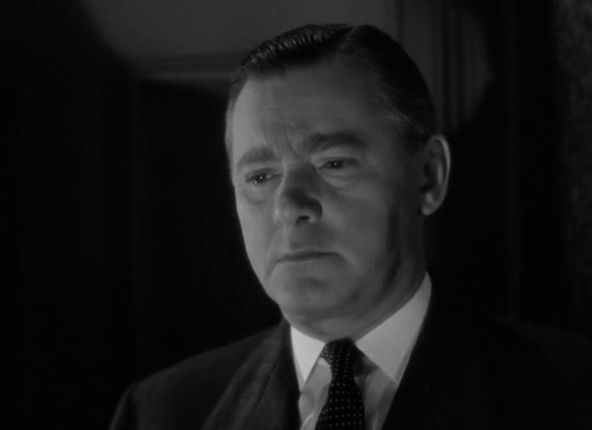
Herbert Marshall plays Stephen Fisher the head of an organization that seeks to find a peaceful solution to world conflicts while war is clearly brewing just before the start of World War II. We first meet Fisher just before our hero Johnny Jones (Joel McCrea) is to embark on his journey as a foreign correspondent in Europe. Marshall presents Stephen Fisher as a very affable man with an unassuming charm. He seems fit to be the man in head of his organization as Marshall simply exudes a respectability, and most definite dignity. He is soon met once again when Jones makes it Europe and attends an important conference for Fisher's organization where Jones meets Fisher's firebrand daughter Carol (Lorraine Day). Marshall is excellent in his scenes with Day as he conveys such a gentle warmth in every interaction with her. There is never a question of Fisher's love towards his daughter as Marshall creates a genuine and loving relationship. Once again Marshall reinforces the idea that Fisher just seems to be a honestly great man that no one could possibly question his motives.

Of course in typical Hitchcock style we soon find out, even before Johnny does, that Fisher is actually the main villain of the film, the man behind the plot to kidnap a Dutch diplomat Van Meer (Albert Bassermann) who apparently knows some very important information that would help the unnamed Nazis. Although this twist is actually told pretty early on it is certainly an effective one since Marshall makes Fisher seem like such a good man. There was perhaps the potential that once the twist takes place that this whole idea behind Fisher could evaporate, and he could have become a more straight forward villain. What's remarkable about Marshall's work is that he never allows it to be that simple, in fact he never begins to start playing Fisher as a villain. Marshall instead portrays Fisher as a man who still is going about a certain duty, rather than some fiend simply trying to bring evil to the world. When he speaks of the plan Marshall reveals some urgency in his voice that of a man who seem actually passionate about what this scheme will do for his cause, opposed to what the plan consists of. Marshall adds a great deal of nuance to the character in momentary reactions as he never loses that kindness about him, it's not an act for him, particularly in regards to his interactions with his daughter where he never loses that true fatherly affection.

As the plot progresses and it takes more extreme measure to both get the information from Van Meer as well as keeping others from finding the man, Marshall is outstanding in again never making Fisher as a straight villain. His reactions are surprisingly moving, when Fisher sees what his men have started doing, as he portrays a definite regret and shame in the man due to the methods he must take. In this though Marshall realizes Fisher's actions though still with understanding and his performance suggests a man who is doing something difficult though something he believes must be the right thing to do. In the final scenes of the film when Fisher explains his actions to his daughter, Marshall again is superb because he does not make this as some sort of evil monologue. Marshall instead delivers it as an attempt to make his daughter grasp what has motivated him, which Marshall never allows a suggestion of selfishness or wickedness to even be taken into account. Marshall creates the sense of how this pains Fisher's in the explanation as though he is forcing himself to realize that his means do not justify his ends, and he has never been doing the right thing. This leads to the his last scene where Fisher finally gets the chance to do some actual good. Marshall is heartbreaking in a completely silent moment as he shows Fisher finally making the choice to do what is truly right. This is a great performance by Herbert Marshall that only improves upon re-watch as wholly earns not only the twist but also successfully makes the villain's demise a poignant loss rather than a satisfying defeat.

Tuesday, 29 September 2015

Alternate Best Supporting Actor 1940: George Sanders in Rebecca and Foreign Correspondent

George Sanders did not receive an Oscar nomination for portraying Jack Favell in Rebecca.

George Sanders plays one of the three villains within the film, the other living one being Judith Anderson as the sinister housekeeper Mrs. Danvers, and the third being the deceased Rebecca whose actions in life still torment her husband Maxim de Winter (Laurence Olivier), and his new wife (Joan Fontaine) as well motivate Danvers, and Sanders's Jack Favell. Sanders only has one appearance in the first half of the film as the second Mrs. de Winter is still lost within the mystery of Maxim's country estate Manderley. Sanders appearance is that of the odd stranger at first who seems to be in some collusion with Danvers about something. Favell catches the new Mrs. de Winter overhearing leading him to introduce himself. Sanders carries himself with quite the charisma as Favell although what makes it so good is just how sleazy Sanders comes off while being this charismatic. There just such an overabundance of confidence that Sanders brings in his manner that it is rather off putting though in a unique manner. Sanders is brilliant because he shows a certain persuasive sort of personality that likely would work in some sort of situation, yet makes it such a curiously obvious routine fitting for a cars salesman, which is just what Favell happens to be.

Sanders does not make another appearance until the last act of the film although we do learn that Favell was one of Rebecca lovers, although honestly Sanders makes that clear in his first scene. We do not meet him again until after new evidence regarding Rebecca's death has risen leaving another inquest that potentially threatens Maxim. Favell naturally turns up at the inquest and although there was plenty of indication to this in that first appearance, his next series of appearances Sanders shows that Favell is well, how should one put this eloquently, well he's a bit of an asshole. Though what a hole that Sanders makes him out him out to be. The way Sanders plays it does not just have Favell simply a man who has no regrets about the affair with Rebecca, although he certainly does that, he also makes it seem so vapid of an affair actually as the way Sanders mentions it you can see only the pleasure that Favell gets from the idea of it. That's not bad enough, not by a slight margin though, as Sanders takes it a step further by making it so whenever Favell makes an indication towards Maxim about the affair, basically gloating about it in his face, Sanders seems to exude the most despicable pleasure from this.

Potentially incriminating evidence against Maxim begins arise against Maxim, which Favell quickly jumps the chance. The scene where Favell just walks right into Maxim's car and starts eating his food, Sanders captures just how obnoxiously Favell behavior he is by the way he insists upon himself. Favell decides to attempt to blackmail Maxim over information he has, which Sanders again is terrific because he does not suggest Favell is trying to avenge his former lover or anything close to that. Sanders keeps Favell quite hollow as he states with such glee about how he'd love to be able to drive the fancy cars he sells, and just is so lacking in even the slightest respectability in his proposition towards Maxim. As Favell continues to attempt his plot, even though Maxim is not having it, Sanders continues to be so perfectly hate inducing that when Max finally does punch him that he perhaps is acting on the audience's wishes as well as his own. Sanders is so entertaining in the role by not holding back for a moment in reveling just how wretched of a man Favell happens to be. I especially love his final scene where the truth about Rebecca is revealed. Sanders makes it incredibly satisfying by his reaction in the scene as all the confidence just instantly leaves his face in a moments notice. What I like most is that Sanders still gets the chance to just make Favell all the more detestable just when there might be a slight chance for sympathy. Favell afterwards quickly puts on a sorrowful act of grief, but Sanders cleverly alludes that Favell is probably just fishing for some gain as he looks around for a supportive face then when seeing none he instantly turns back to his usual wretched self. This is a fantastic performance by Sanders that makes a great villain out of a man who simply is without scruples.
Sanders was not nominated for his performance in Rebecca, leaving supporting actor to be the only acting category where Rebecca was not recognized. To make things only worse though Sanders was also ignored, despite his co-star Albert Bassermann being nominated, for portraying Scott ffolliott in Alfred Hitchcock's other film from 1940 Foreign Correspondent. It is interesting that the two films were paired as Rebecca is an example of one of Hitchcock's more cerebral and internalized film while Foreign Correspondent is of his more direct and extroverted style. Both films though have George Sanders though and in this film George Sanders is allowed to use his talents for good instead of evil, character that is. Sanders makes his appearance into the film well into it as he aids our main hero Johnny Jones (Joel McCrea) is in pursuit of an assassin. Sanders this time utilizes his considerable charisma for the benefits of humankind with ffolliott as he this fits right into the world of international espionage that Foreign Correspondent covers.

It is intriguing how Sanders works in this as he portrays simply a secondary hero for the film since he's certainly not Jones's sidekick, and at the same time ffolliott has the same good intentions as Jones. What Sanders does though is make the film all the better by adding a nice variation in the dynamic seen right for the beginning of his appearance as he so calmly explains the reason for the doubled and lower case f's in his last name while dodging bullets while chasing after the assassin. Sanders is pretty marvelous in realizing a James Bond sort of style for ffolliott, whereas McCrea's Jones is a far more straight forward sort. There's few moments that go by where ffolliott does not have a quip to go with the occasion. Sanders delivers these all quite flawlessly hitting his mark every time. Sanders makes ffolliott's wit as effortless as it should be. He adds so much character to the film through his mere presence, after all perhaps one could get along with simply one hero, but Sanders makes it worthwhile to have two heroes because he's just so much fun in the role.

Sanders is wonderful in finding just the right tone between the quips though and the actual severity of the situation. In the scene where ffolliott reveals to Jones that he's actually been more driven than he perhaps alluded to all along, Sanders is excellent in conveying the quiet passion in ffolliott to do the right thing as well. A funny thing about the film is that the heroic act to find the central figure of the plot is done by ffolliott and note Jones. In fact in the scene Jones really is ffolliott sidekick as ffolliott is the one who takes the needed steps to follow the villain's tracks, and to well save the day. Sanders is great in the scene as he reveals just how much ffolliott does care about the situation, he helps to create the severity of the moment by showing that it is not simply a game for ffolliot making the scene surprisingly powerful. Although this may merely be his second best performance of 1940 its a very good one that proves Sanders not only can be the man you love to hate, but also just the guy you can love without the hate.

Sunday, 27 September 2015

Alternate Best Supporting Actor 1940: Frank Morgan in The Shop Around the Corner

Frank Morgan did not receive an Oscar nomination for portraying Hugo Matuschek in The Shop Around the Corner.

Frank Morgan is perhaps best known for a role that I'll be covering eventually, but one element that is often found in most of his roles is that he plays a fellow who is at least somewhat nervous. This is usually played for laughs. That is the case here for the early scenes of the film, and why not there is something quite enjoyable about the way Morgan's voice fluctuates, and the way his face just seems to be so filled with anxiety in a moments notice. Morgan is a delightful side character in these scenes showing the somewhat problematic state of the shop through Mr. Matuschek behavior. Morgan is consistently entertaining in just his reactions in creating this almost constant mood of unease in Matuschek as he so badly wants everything in the shop to run smoothly though everything that goes wrong makes him become particularly troubled. Morgan while funny does a good job of making this seem like an honest and natural state of his character by just so well realizing the Matuschek's inability to relax that causes him to constantly get worked up even with minor difficulties.

What's notable here is although Morgan's depiction of Matuschek's nervousness does derive some humor for the film, it is not the sole purpose of it in this film. Morgan does not make Matuschek's behavior as simply a joke, because he does not turn him into just a caricature. Morgan actually does something very intelligent in that he creates the sense that as the story progresses Matuschek's behavior slowly becomes not nearly as funny. Technically speaking Morgan allows the humor at Matuschek expense to work because there still seems to be a good spirit in his portrayal, and the nervousness is just his way. As the story progresses though Morgan slowly loses this spirit and there just becomes something far less jovial about his attitude towards everyone. Morgan makes this work especially well because of how naturally and gradually he portrays it. He does not just suddenly change, but rather Morgan realizes the change as though Matuschek is going over something in his mind again and again that is causing him considerable distress. 

Eventually this leads him to unexpectedly his best employee Alfred (James Stewart), and in the scene Morgan is very effective by presenting the terribly dour state of mind that Matuschek is in at this time. Morgan is terrific because he so subtly portrays this descent of the man, as his performance shows a man falling apart though as a meek man. When Matuschek attempts suicide Morgan is rather heartbreaking because it is unexpected through wholly earned in the way Morgan made it always something that was there through the way he quietly creates the depression that he only grows until the final breaking point that comes from finding out that his wife has been having an affair. Morgan is great in his next scene where he is attempting to recover from his nervous breakdown and must apologize to Alfred who he had wrongly been suspicious of. Morgan is incredibly moving in depicting the sad state of regret as Matuschek finally verbalizes what has been troubling him for so long. Morgan in the final scenes of the film again does not cheat the character as he does not show a full recovery. Instead Morgan is quite haunting by portraying Matuschek as attempting to rediscover the joy of life, and while there is some success Morgan still coveys that a sadness still remains in the man. It's a very strong and surprisingly nuanced performance by Morgan, that brings a great deal of poignancy to the film's darker moments.

Saturday, 26 September 2015

Alternate Best Supporting Actor 1940

And the Nominees Were Not:

Frank Morgan in The Shop Around the Corner

John Carradine in The Grapes of Wrath

George Sanders in Rebecca

George Sanders in Foreign Correspondent

Herbert Marshall in Foreign Correspondent

Friday, 25 September 2015

Alternate Best Actor 1940: Results

5. Michael Redgrave in The Stars Look Down - Redgrave, despite being somewhat limited by his film, gives an effective depiction of a shy man finding courage for a cause.

Best Scene: His last speech.
4. Laurence Olivier in Pride and Prejudice - Although apparently in the minority I find Olivier gives a charming and rather funny portrayal of an excessively proper gentleman.

Best Scene: His failed proposition.
3. Edward G. Robinson in Brother Orchid - Robinson calls upon his more serious gangster performances then cleverly subverts them to give a comic, and surprisingly moving portrayal.

Best Scene: Brother Orchid is denounced.
2. Cary Grant in His Girl Friday - Grant gives a very entertaining performance that creates the properly dominating and manipulative presence of the character while still being quite charming.

Best Scene: The final sequence.
1. James Stewart in The Shop Around the Corner - Good Predictions Michael Patison, Jackiboyz, ruthiehenshallfan99, and RatedRStar. Stewart gives an immensely likable and sympathetic performance that is a great example of his appeal as a leading man.

Best Scene: Alfred confronts Vadas.
Overall Ranking:
  1. Laurence Olivier in Rebecca
  2. Charlie Chaplin in The Great Dictator
  3. James Stewart in The Shop Around the Corner
  4. Henry Fonda in The Grapes of Wrath
  5. Conrad Veidt in Contraband
  6. Cary Grant in His Girl Friday 
  7. Edward G. Robinson in Brother Orchid
  8. Laurence Olivier in Pride and Prejudice
  9. James Stewart in The Mortal Storm
  10. Michael Redgrave in The Stars Look Down 
  11. Brian Donlevy in The Great McGinty 
  12. W.C. Fields in The Bank Dick
  13. Joel McCrea in Foreign Correspondent 
  14. Errol Flynn in The Sea Hawk
  15. Henry Fonda in The Return of Frank James
  16. Stanley Ridges in Black Friday
  17. Cary Grant in My Favorite Wife
  18. Raymond Massey in Abe Lincoln in Illinois 
  19. Boris Karloff in Black Friday
  20. Cary Grant in The Philadelphia Story
  21. Tyrone Power in The Mark of Zorro
  22. Dickie Jones Pinocchio
  23. James Stewart in The Philadelphia Story
  24. Charles Laughton in They Knew What They Wanted 
  25. Frank Craven in Our Town
  26. William Holden in Our Town
  27. Mickey Rooney in Strike Up The Band
  28. Gary Cooper in The Westerner 
Next Year: 1940 Supporting

Alternate Best Actor 1940: James Stewart in The Shop Around the Corner

James Stewart did not receive an Oscar nomination for portraying Alfred Kralik in The Shop Around the Corner.

The Shop Around the Corner is an enjoyable romantic comedy about the various things going on in the titular shop.

James Stewart's Oscar win must be noted as a bit of a head scratcher, as his win for The Philadelphia Story is perhaps most notable because it gave Stewart his only competitive Oscar. It always feels a bit of a shame as for me personally it is his only Oscar nominated performance that I don't either really quite like or flat out love. Insult is added to injury is when one realizes that it was not even Stewart's best work from 1940. Stewart here once again plays a romantic lead, although this time this time it more closely focuses on his character unlike The Philadelphia Story where one could possibly argue that both he and Cary Grant were supporting Katherine Hepburn the whole time. Stewart's given a far more substantial role here as a salesman at a leather goods shop. Stewart naturally makes Alfred extremely likable with his easy going charm that is not more fitting for the director, Ernst Lubitsch's fairly, although not quite entirely, breezy tone that he establishes for the lighthearted story. Stewart could not feel more effortless in the role and is an extremely easy lead to follow through this romantic comedy.

Actually one of the things I did not care for in his performance in The Philadelphia Story was that I felt Stewart actually made his character's disgust and boredom at his task of covering socialites a little too realistic to the point that he was a bit too off putting for it to be fun. Stewart actually directly fixes that mistake with this performance as he must conveying a similair sentiment in his earliest scenes with his eventual love interest, Klara Novak, played by Margaret Sullavan. The early set up is that she's the new employee at the shop whose particular method of selling items quickly gets on Alfred's nerves. Stewart now this time strikes exactly the right tone in portraying this. He certainly gets across just how much Klara gets under his skin in his fairly intense reactions, but Stewart accentuates them in the right fashion in which they become appropriately comic without being too ridiculous. Stewart while driving the humor from it properly he also makes the initial conflict between the two characters actually feel wholly honest rather than simply just the superfluous and rather thin barrier to be broken down throughout the story. 

What's worth nothing on Stewart's work though is that he never treats any element of the film just a means to get to the eventual happy end of the film. Stewart does not allow any part of it just to be taken for granted, and succeeds in realizing any aspect of Alfred's life not simply making him feel stuck in the romantic comedy structure. One of the subplots is dealing with the high strung nature of his boss Mr. Matuschek (Frank Morgan) which causes some minor problems earl yon but these problems grow as Matuschek becomes concerned about more pivotal things in his life. This inadvertently effects Alfred early on though eventually it becomes directly problematic for him. Stewart is very good in portraying Alfred's rightful frustrations at the behavior, and is quite moving when portraying the severe disappointment when it appears that Mr. Matuschek's paranoia has gotten the best of him causing him to fire Alfred. Stewart, as per usual, makes this feel so honest that he makes it incredibly easy to sympathize with Alfred's plight during these scenes. Things switch around soon enough though when, through very problematic circumstances, Mr. Matuschek comes back to his senses.

Stewart is great in the scene where Alfred takes on the actual source of Mr. Matuschek's misery, bring that classic Stewart passion into Alfred's disgust which makes the moment rather powerful. The film after all is a romantic comedy though so an essential element of it is the relationship. In this case they are quite dismissive of one another, even though they unknowingly write love letters to one another. What works so well is that Stewart and Sullavan do not depict is that immediate switch from hatred to love. Simply in their scenes together, where they are not necessarily interacting all that much, Stewart and Sullavan slowly depict just a gradual distinguishing of hostilities. There are occasional fall backs to some more aggressive behavior but both actors make this feel particularly natural. The two of them earn the eventual heartwarming sweetness that comes from the ending, since neither of them make it easy by having either the love or the fights seem forced in the least. It's lovely work from the both them. For Stewart this is a great example of just what made him so appealing as a leading man, and if he had to win leading actor for 1940 it should have been for this performance. 

Thursday, 24 September 2015

Alternate Best Actor 1940: Laurence Olivier in Pride and Prejudice

Laurence Olivier did not receive an Oscar nomination for portraying Fitzwilliam Darcy in Pride and Prejudice.

Pride and Prejudice is an enjoyable enough film about the complications that ensue from five sisters without inheritance attempting to find proper suitors.

Having not seen any other versions of the story nor read the book, I'm going into this interpretations with absolutely no idea about the true nature of the story, or perhaps how the tone should be. This as just a film though I felt worked as basically "proper" screwball romantic comedy. A great deal of a reason for this is Laurence Olivier as Mr. Darcy who we meet as one of the targets of the Bennet sisters' mother for a proper suitor for her daughters. Mr. Darcy though is not the sweeping romantic type though, and Olivier actually takes a similair approach to the character that Daniel Day-Lewis would later take with a somewhat similair role in A Room With A View. That being that Olivier goes about portraying Darcy as an excessively proper English Gentleman, particularly in the early scenes where he first meets the Bennets including Elizabeth (Greer Garson). He makes a poor initial impression by making his patrician attitudes known out loud, and Olivier depicts him as a man almost constrained within himself in his tight movements, and the fairly stilted voice he uses as though every words has been rehearsed over and over again beforehand.

Olivier, like Day-Lewis in that later film, does a great service to the film through his work as he makes Darcy quite an amusing presence in the film by making his proper behavior extreme enough that it actually becomes quite comic. The best part about this is that there is nothing that Darcy does that is necessarily funny in itself but Olivier effortlessly brings out through his purposefully overt performance. Although Olivier does technically over do it, so the character is funny rather than just serious and dour as I feel he easily could be, Olivier does not over do it to the point that Darcy is merely a caricature either. Rather Olivier is quite effective in fashioning the barrier necessary for the character, since there must  be some transition for Elizabeth. Olivier interestingly is able to help realize this through his own performance as he depicts the surface of the man as almost impenetrable. Olivier does not do this in order to portray Darcy as cold or unfeeling, but rather fashions the reserve fitting for a man who has spent all his life learning to behave in this distinctly proper fashion even though it may not actually be the true nature of Darcy after all.

Although much of his performance is in the role of being a tad overstuffed, and entertainingly so, Olivier is terrific in alluding to the better nature of Darcy quite early on. The moments where she purposefully embarrasses him Olivier quietly depicts Darcy not reacting like a simple pompous fool being surprised, but rather a more complex man being honestly hurt by this treatment. My favorite scene of Olivier's has to be his initial proposition of marriage of Elizabeth that rejects as in the single scene it shows exactly what's so good about Olivier's performance. In his stumbling proposal Olivier is very funny as well as in his needlessly direct responses to Elizabeth when she announces her objections, as he always stays as the proper gentlemen who never should be too emotional. My favorite moment in the scene is as Darcy exits the room, and its only a brief moment though an extremely important one. When Darcy finally turns his head away from Elizabeth's view Olivier shows just how genuinely torn apart emotionally Darcy is by the rejection, and in the moment Olivier is quite moving by revealing the sensitive man he really is. Olivier is able to make Darcy transition from pompous charmless gentleman to the perfect rather charming gentleman a wholly effortless one, by creating the sense that Elizabeth brings this better side out of him. It's not a change exactly, but rather simply having him shed some of his thick shell he learned over the years. It's strong work from Olivier and I doubt I would have liked the film to the same degree if it were not for his performance, as much of the humor of the film comes from him. It's a splendid performance, that might not be his best work from 1940, but that's hardly a problem.