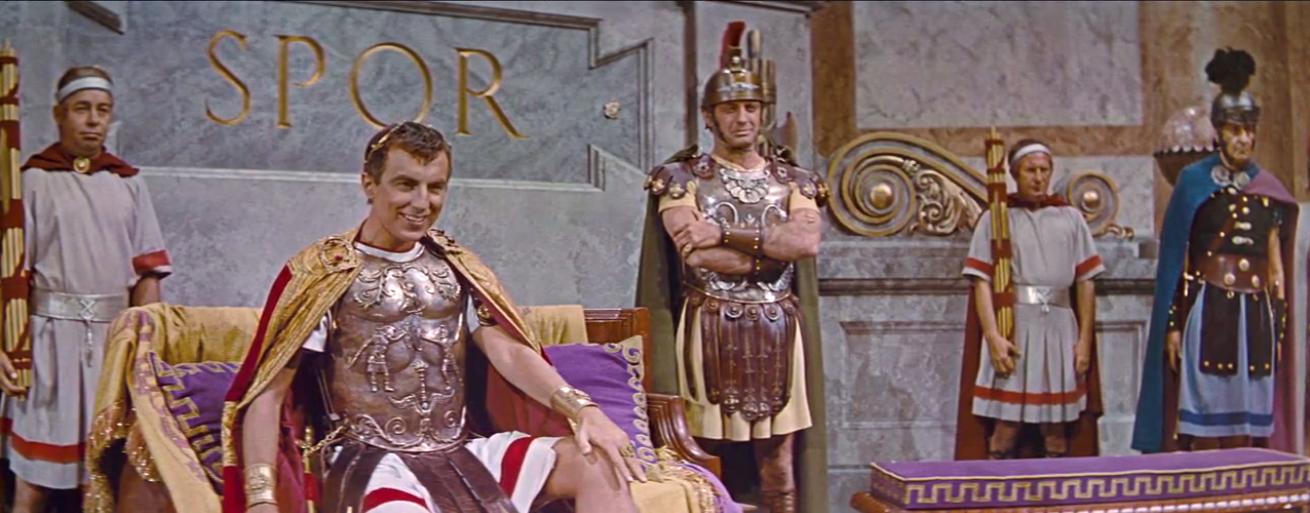
Otto Preminger did not receive an Oscar nomination for portraying Colonel von Scherbach in Stalag 17.
Stalag 17 has a rather robust ensemble which does a great job of making the barracks of Stalag 17 quite the vivid place. Honestly the academy might have pulled a name randomly out of hat when they chose Robert Strauss from the film, since it certainly seems possible that they could have gone for someone else from the film. Otto Preminger certainly would seem right up their alley as a director, primarily known for directing, acting was something the academy seemed to like as seen by their nominations for John Huston, Erich von Stroheim and Vittorio de Sica. Then again Preminger is playing a Nazi so perhaps that prevented some recognition. Being the camp commandant though that leaves Preminger as one of the main villains, technically the spy inside the barracks could be considered more villainous, but Preminger is the one who gets open and about with his villainy.
Preminger, like Borgnine, Marvin, and Robinson, also only has a few scenes most of which are when von Scherbach is addressing the men at roll call. Preminger doesn't play von Scherbach as some obvious Nazi who wears his evil on his sleeve no rather Preminger takes a bit of a lighter approach much more fitting of a man whose duties are watching men rather than killing them. Preminger brings just enough of a flamboyance to his role as he delivers his lines in a fairly lighthearted way. Preminger never goes too far to seem as though out of character, but brings just enough of a jovial quality to von Scherbach. Preminger does it quite well by having a menace within his antics toward the men. Preminger is cleverly warm well being cold as he makes von Scherbach somewhat amusing in his manner but in a way in which only von Scherbach will be allowed to enjoy.
Preminger doesn't get to do a whole lot as Colonel von Scherbach but he's quite enjoyable whenever he is on screen with his smug overly confidant demeanor. He's particularly good in the scene where he's interrogating a prisoner merely by not allowing him to sleep as Preminger walks about as if von Scherbach does not have a single care in the world. My favorite moment of his might actually be a silent one when it appears as though the man the Nazis have been looking for has been killed as Preminger shows Scherbach look over the body with self-satisfaction only to have it abruptly vanquish from his face when realizing it's not the case, that reaction alone makes the ending of the film all the more satisfying to watch. The limits of the part certainly leave Preminger's performance somewhat limited but within those limits he thrives quite well.
Wednesday, 15 October 2014
Tuesday, 14 October 2014
Alternate Best Supporting Actor 1953: Ernest Borgnine in From Here to Eternity
It seems everything was put in place by fate for Frank Sinatra to win his Oscar for his role as Private Maggio in this film. The first being by getting the role because Eli Wallach turned the role down (who surely would have been brilliant), and then the academy taking upon themselves to nominate a rather weak set of nominees to make sure nothing happened like having a performance that was too good to ignore. One wonders if the voters in some way were encouraged to ignore the likes of John Gielgud for example since his film was rather successful otherwise. This allowed a Sinatra victory even though he is not even the best supporting actor in the film. This is made most abundantly obvious by the fact that Sinatra shares more than a few scenes with the man, that man being Ernest Borgnine. There are several negative figures shown in the army, although shown more of to be jerks rather than anything else, Judson, who runs the stockade seems to be another sort of man altogether.
Ernest Borgnine is only in a few scenes, and even in these scenes his screen time is somewhat limited but Borgnine does not allow this to be a problem. His two earliest scenes are directly between Fatso and Maggio as they both purposefully get on each other nerves. Borgnine eats Sinatra alive in these scenes as he brings such menace in his portrayal of Fatso. Borgnine does not show Fatso outwardly aggressive yet he's more chilling by conveying the beast in the man just in that stare he gives Maggio. When Fatso threatens Maggio Borgnine does not show an empty threat but rather a sadistic guarantee that Fatso is certain he will get his satisfaction. Borgnine is fantastic as he makes Fatso such a sinister presence in his few moments on screen that he convinces of what Fatso is doing when not shown. There is not a second wasted in Borgnine's performance making an impact from even a few seconds. Borgnine best scene actually just might be when Maggio is brought to Fatso in the stockade.
Borgnine actually has only a couple of seconds to end that scene as Fatso sees that he has Maggio exactly wants him. Sinatra for some reason chooses to stare blankly at the screen in almost wonderment, not fear or more likely defiance in his face, failing to express what Maggio should be feeling. Borgnine on the other hand brings the most perfect vicious grin to Fatso's face and we know exactly the torture Fatso is planning without having to see it. Borgnine also deserves credit for being one of the actors who completely goes toe to toe with Montgomery Clift without ever being overshadowed. In their one scene together Borgnine proves a match for Clift. Their scene together is sensational as the two meet both having such a reserved intensity as the two suggest that two volcanoes are about to erupt. I especially love though that laugh Borgnine gives before he goes off with Clift portraying one again that above else Fatso loves the idea of the chance for violence.
Now I will note that this is a very short performance and he's not even like a one scene wonder since his role is spread very thinly across his few scenes. His role also technically is quite limited merely that of the evil guard who causes Maggio's downfall. I don't feel though this should be used to complain about Borgnine's performance as he goes above and beyond the duty (no pun intended) with the role of Fatso Judson. Although I certainly would not have minded a little more time given Borgnine here. Nevertheless in his sparse time Borgnine full realizes the sick nature of Judson and it feels as though his performance actually is that of a more substantial character. Not only that though Borgnine absolutely commands the screen for every moment of his performance. This is the definition of a great supporting performance because Borgnine manages to create a memorable and particularly effective character that adds a lot to the film while the character easily could have been just as forgettable as those Sergeants who hassle Prewitt.
Monday, 13 October 2014
Alternate Best Supporting Actor 1953: Jay Robinson in The Robe
The Robe is a pretty bland biblical epic with a bland leading performance by Richard Burton and is many ways like Quo Vadis which was also rather bland. Like Quo Vadis though there is one man who refuses to be bland and once again it is the actor playing the Roman Emperor in the film. In Quo Vadis it was Peter Ustinov playing the infamous Roman Emperor Nero, in the Robe it is Jay Robinson who plays perhaps the even more infamous Caligula. Robinson appears in the opening of the film, before Caligula has been made Emperor, to basically attempt to outbid our hero Marcellus Gallio (Richard Burton) at a slave auction. Robinson is great as he prances on the scene in a way only a man who knew he was about to have absolute power could. Robinson's smile is perfect showing a man loving his place, but as well a man having a such a joy of performance that it's hard not to have fun watching it.
Robinson's performance is quite good at realizing Caligula's character even though the film technically does not get into Caligula's personal lusts, in fact a different actor could have played him as just some jealous power hungry guy. That's not the case for Robinson who seems to suggest Caligula's various perversions merely in that devious grin of his and just the whole odd way he carries himself in every scene. Robinson seems to show a man who loves various pleasures far too much just in the way he slants in his chair. Honestly Robinson does not waste a gesture in making his Caligula one sick man even though we don't see much of it first hand. Technically speaking most of the time is spent with Caligula terrorizing Gallio eventual wife Diana (Jean Simmons) as he basically wants Gallio dead after he has converted to Christianity. Well even within the limits of the role Robinson still makes sure to get the most out of it.
Robinson is incredibly entertaining in the scenes where Caligula is in some way thwarted in his attempts to get Gallio. Robinson plays Caligula in these scenes like a spoiled brat who's not getting the present he wanted. Robinson is glorious in showing the rampant insanity of Caligula that in it's heart is childish in nature fitting for a man who has anything he wants handed to him no matter how crazy the request may be. My only problem with Caligula in this film is he's not in the film as much as Nero was in Quo Vadis. Robinson has about four scenes in the film and two of those scenes are a bit short. There's just not enough Caligula to go around because he's unquestionably the best part of the film. Robinson energizes the proceedings whenever he shows up and actually makes the film entertaining with his antics. Almost alone Robinson prevents the film from being completely forgettable as he gives one reason to watch the film.
Sunday, 12 October 2014
Alternate Best Supporting Actor 1953: John Gielgud in Julius Caesar
John Gielgud did not receive an Oscar nomination for portraying Cassius in Julius Caesar.
John Gielgud plays Cassius who along with James Mason's Brutus is one of the main conspirators who plan to kill Julius Caesar then supposedly reform Rome back to a republic. Gielgud's performance acts as a great counterpoint to Mason's performance. Where Mason upheld Brutus's nobility in every breath he takes Gielgud does not do the same for Cassius. Well maybe he does though as Gielgud shows in the scenes where Cassius is trying to urge Brutus to kill Caesar. Gielgud as usual speaks with such elegance as he tries to convince Brutus to go along with the assassination. There is a determination a righteousness even in Gielgud's voice as he espouses various platitudes to Brutus's ears and Gielgud makes it quite believable that Cassius could sway the good Brutus, who happens to love Caesar, to this rather extreme manner of thinking. When Cassius stares Brutus in the face and speaks to him Gielgud makes himself a mirror of Mason, although as it turns out a false a mirror.
The brilliance of Gielgud's performance though is that he portrays Cassius's urging toward Brutus to be quite false, and merely Cassius manipulating Brutus. This is never spoken of by Cassius himself but rather shown wholly by Gielgud's work. Gielgud is fantastic in the moments where frankly Brutus is simply not looking at Cassius and Gielgud uses these moments to portray the true nature of Cassius's intent. Gielgud silent reactions when Cassius is left to his own thoughts does not portray Cassius as a man who is trying to save Rome from a man who has become a tyrant. No Gielgud instead portrays a searing malice in Cassius as he looks upon Caesar and speaks the words against him. Although in words and even in his delivery Gielgud has Cassius claim a conflict of sorts Gielgud shows nothing but a distinct hate in Cassius's eyes. Gielgud is striking as he creates this sinister duplicity in the character being convincing as he persuades Brutus while still conveying the real motivation in Cassius.
Gielgud is excellent in the way he plays with this act as the film goes on, never fully dropping it, although obviously relinquishing it somewhat when the men do kill Caesar. Where Mason presents Brutus clearly feeling guilt even as he performs the coup de grรขce and tries to uphold the righteousness of the actions Gielgud does not hold to the same pretensions with Cassius. With Brutus dead and the man thinking of their actions Gielgud brings a smile to Cassius face as he ponders about how the future will see this deed. Gielgud presents Cassius as loving having killed a man he hated, there is no guilt whatsoever, only a certain joy as perhaps he sees his own chance for power soon to come. Gielgud keeps the act going though when Caesar's loyal man Mark Antony (Marlon Brando) comes on the scene. Gielgud changes Cassius from the man lusting after power to now a somber sadness fitting of a sensible and honorable man who surely killed Caesar only for the goodness of Rome.
After the overthrow goes much more roughly than expected Gielgud reveals all there is to Cassius when Brutus calls him on his obvious personal corruption. Gielgud is great as he reduces Cassius to almost nothing as he simply sneers angrily at actually being seen for what he is rather than what he pretends to be. This can only be momentary though as they do have a war to fight which Brutus still believes in even if the odds seem against them. Gielgud is quite moving as he seems to make Cassius create a false image again although this time it is not to convince Brutus but rather himself. Brutus still speaks for the good of Rome and Cassius seems to go along with it. Gielgud brings the brave face to Cassius as he tries to stand tall with Brutus yet Gielgud once again brings an undercurrent of something else. This time though it is a dread and a fear as Gielgud shows that in his heart Cassius knows that they are doomed. Gielgud is terrific as through the final moments of Cassius he tears away the false hopes of the man to reveal a man whose seen all his plans go up in flames. John Gielgud on his own gives a great portrait of betrayal and deceit but it works especially well against Mason's portrayal of honesty and devotion.
John Gielgud plays Cassius who along with James Mason's Brutus is one of the main conspirators who plan to kill Julius Caesar then supposedly reform Rome back to a republic. Gielgud's performance acts as a great counterpoint to Mason's performance. Where Mason upheld Brutus's nobility in every breath he takes Gielgud does not do the same for Cassius. Well maybe he does though as Gielgud shows in the scenes where Cassius is trying to urge Brutus to kill Caesar. Gielgud as usual speaks with such elegance as he tries to convince Brutus to go along with the assassination. There is a determination a righteousness even in Gielgud's voice as he espouses various platitudes to Brutus's ears and Gielgud makes it quite believable that Cassius could sway the good Brutus, who happens to love Caesar, to this rather extreme manner of thinking. When Cassius stares Brutus in the face and speaks to him Gielgud makes himself a mirror of Mason, although as it turns out a false a mirror.
The brilliance of Gielgud's performance though is that he portrays Cassius's urging toward Brutus to be quite false, and merely Cassius manipulating Brutus. This is never spoken of by Cassius himself but rather shown wholly by Gielgud's work. Gielgud is fantastic in the moments where frankly Brutus is simply not looking at Cassius and Gielgud uses these moments to portray the true nature of Cassius's intent. Gielgud silent reactions when Cassius is left to his own thoughts does not portray Cassius as a man who is trying to save Rome from a man who has become a tyrant. No Gielgud instead portrays a searing malice in Cassius as he looks upon Caesar and speaks the words against him. Although in words and even in his delivery Gielgud has Cassius claim a conflict of sorts Gielgud shows nothing but a distinct hate in Cassius's eyes. Gielgud is striking as he creates this sinister duplicity in the character being convincing as he persuades Brutus while still conveying the real motivation in Cassius.
Gielgud is excellent in the way he plays with this act as the film goes on, never fully dropping it, although obviously relinquishing it somewhat when the men do kill Caesar. Where Mason presents Brutus clearly feeling guilt even as he performs the coup de grรขce and tries to uphold the righteousness of the actions Gielgud does not hold to the same pretensions with Cassius. With Brutus dead and the man thinking of their actions Gielgud brings a smile to Cassius face as he ponders about how the future will see this deed. Gielgud presents Cassius as loving having killed a man he hated, there is no guilt whatsoever, only a certain joy as perhaps he sees his own chance for power soon to come. Gielgud keeps the act going though when Caesar's loyal man Mark Antony (Marlon Brando) comes on the scene. Gielgud changes Cassius from the man lusting after power to now a somber sadness fitting of a sensible and honorable man who surely killed Caesar only for the goodness of Rome.
After the overthrow goes much more roughly than expected Gielgud reveals all there is to Cassius when Brutus calls him on his obvious personal corruption. Gielgud is great as he reduces Cassius to almost nothing as he simply sneers angrily at actually being seen for what he is rather than what he pretends to be. This can only be momentary though as they do have a war to fight which Brutus still believes in even if the odds seem against them. Gielgud is quite moving as he seems to make Cassius create a false image again although this time it is not to convince Brutus but rather himself. Brutus still speaks for the good of Rome and Cassius seems to go along with it. Gielgud brings the brave face to Cassius as he tries to stand tall with Brutus yet Gielgud once again brings an undercurrent of something else. This time though it is a dread and a fear as Gielgud shows that in his heart Cassius knows that they are doomed. Gielgud is terrific as through the final moments of Cassius he tears away the false hopes of the man to reveal a man whose seen all his plans go up in flames. John Gielgud on his own gives a great portrait of betrayal and deceit but it works especially well against Mason's portrayal of honesty and devotion.
Tuesday, 7 October 2014
Alternate Best Supporting Actor 1953: Lee Marvin in The Wild One
Marvin quite simply is a hoot in the role as he plays the role with such a constant boisterousness. Marvin is extremely flamboyant within his performance and it completely fits his role. He commands the screen despite playing the role in such a frankly wacky fashion but he completely nails this sorta guy who is practically drunk on life despite not necessarily having had anything to drink. Marvin is incredibly entertaining in his constant bravado as Chino plays up every moment as he seems to be trying to get out every bit of fun he can get out of it. When Chino is beaten down by Johnny and technically has his pride taken from him Chino responds by saving he loves Johnny. Marvin absolutely makes you believe this reaction as he realizes Chino so perfectly as the gang member who is ready to go with almost anything because he's just going to love in anyways.
Lee Marvin effectively steals the show as he turns all of his scenes into the most memorable. Where most the other behavior of the bikers is quickly repetitive and quickly obnoxious Marvin always energizes the proceedings whenever he shows up. His performance is just a whole lot of fun in a film that is sorely lacking in it otherwise, and I think this likely where he stole the film far more than what was intended. Marvin just pretty much takes the picture as his own whenever he gets to grace the screen. The only problem I would say is there is not a whole lot of Chino to go around as the film is obviously not about him and he's only a fairly brief side show. That being said he's quite the enjoyable side show for the film and easily the highlight of it all. For a performance that was fulfilling what could have been another throwaway role, and has very limited screen time that's not too bad of an accomplishment.
Alternate Best Supporting Actor 1953
And the Nominees Were Not:
Ernest Borgnine in From Here to Eternity
Otto Preminger in Stalag 17
Jay Robinson in The Robe
John Gielgud in Julius Caesar
Lee Marvin in The Wild One
Ernest Borgnine in From Here to Eternity
Otto Preminger in Stalag 17
Jay Robinson in The Robe
John Gielgud in Julius Caesar
Lee Marvin in The Wild One
Monday, 6 October 2014
Alternate Best Actor 1953: Results
Best Scene: Father Logan confronts the murderer.
Best Scene: Johnny runs from the mob.
3. Glenn Ford in The Big Heat- Ford might not reach the heights that the role seems to offer, but he still gives a fairly striking subversion of his usual decent average man type of character.
Best Scene: Bannion confronts the murderer.
2. Masayuki Mori in Ugetsu- Mori's performance is somewhat limited but good in portraying every moment of his character's rather odd journey.
Best Scene: Genjuro reunites with his "wife".
1. James Mason in Julius Caesar- Good predictions Luke, JackiBoyz, and Kevin. Mason gives a powerful performance bringing such poignancy to his depiction of a man who stands by his convictions no matter how dark of a place they bring him to.
Best Scene: Brutus stabs Caesar.
Overall Rank:- Montgomery Clift in From Here to Eternity
- James Mason in Julius Caesar
- Chishลซ Ryลซ in Tokyo Story
- James Stewart in The Naked Spur
- James Mason in Charade
- Burt Lancaster in From Here to Eternity
- Masayuki Mori in Ugetsu
- Charles Boyer in The Earrings of Madame de….
- Masayuki Mori in Love Letter
- Clifton Webb in Titanic
- Charles Vanel in The Wages of Fear
- Yves Montand in The Wages of Fear
- Hans Conried in Peter Pan
- Trevor Howard in The Heart of the Matter
- Glenn Ford in The Big Heat
- Marlon Brando in The Wild One
- Montgomery Clift in I Confess
- James Mason in The Man Between
- Lars Ekborg in Summer With Monika
- Eitaro Ozawa in Ugetsu
- Charles Winninger in The Sun Shines Bright
- Jack Hawkins in The Cruel Sea
- Alan Ladd in Shane
- Vincent Price in House of Wax
- Gregory Peck in Roman Holiday
- Richard Widmark in Pickup on South Street
- Arturo de Cรณrdova in El
- Louis Jourdan in Rue de l’estrapade
- Fred Astaire in The Band Wagon
- David Niven in The Moon is Blue
- Fredric March in Man on A Tightrope
- Laurence Olivier in The Beggar's Opera
- Charlton Heston in The President's Lady
- Alec Guinness in The Captain's Paradise
- ร ke Grรถnberg in Sawdust and Tinsel
- Kazou Hasegawa in Gate of Hell
- William Tallman in The Hitch-Hiker
- Van Heflin in Shane
- Niall MacGinnis in Martin Luther
- Howard Keel in Kiss Me Kate
- Jack Palance in Man in the Attic
- John Wayne in Hondo
- Raf Vallone in Thรฉrรจse Raquin
- Jacques Tati in Monsieur Hulot's Holiday
- Richard Burton in The Desert Rats
- Edmond O'Brien in The Hitch-Hiker
- William Holden in The Moon is Blue
- Spencer Tracy in The Actress
- Stewart Granger in All The Brothers Were Valiant
- Tyrone Power in The Mississippi Gambler
- Richard Widmark in Take the High Ground
- Michael Wilding in Torch Song
- Frank Lovejoy in The Hitch-Hiker
- Kenneth Moore in Genevieve
- Bobby Driscoll in Peter Pan
- Clark Gable in Mogambo
- Bud Abbott in A & C meet Dr. Jekyll and Mr. Hyde
- Lou Costello in A & C meet Dr. Jekyll and Mr. Hyde
- Dean Martin in The Caddy
- Max Showalter in Niagara
- John Gregson in Genevieve
- Edmond O'Brien in The Bigamist
- Robert Taylor in All The Brothers Were Valiant
- Richard Burton in The Robe
- Cary Grant in Dream Wife
- Mel Ferrer in Lili
- Stewart Granger in Salome
- Tommy Rettig in The 5000 Fingers of Dr. T
- Gene Barry in The War of the Worlds
- Elroy Hirsch in Crazylegs
- Jerry Lewis in The Caddy
- Robert Wagner in Beneath the 12-Mile Reef
- Robert Taylor in Knights of the Round Table
- Ed Wood in Glen or Glenda
- Richie Andrusco in Little Fugitive
- John Brown in Robot Monster
- George Nader in Robot Monster
- John Mylong in Robot Monster
Subscribe to:
Posts (Atom)