Showing posts with label 1953 Alternate Supporting. Show all posts

Monday, 1 June 2026

Alternate Best Supporting Actor 1953: Hans Conried in The 5000 Fingers of Dr. T, Roland Lesaffre in Thérèse Raquin & Isao Yamagata in Gate of Hell & Updated Results

Hans Conried did not receive an Oscar nomination for portraying Dr. Terwilliker aka the titular character of The 5000 Fingers of Dr. T.

The 5000 Fingers of Dr. T follows a young boy imagining his imperious piano teacher as a dictator of a fantasy world. 

Hans Conried who had a long voice actor career, with probably his most notable role in that vein coming the same year as Captain Hook/Mr. Darling in Peter Pan, was given the rare opportunity for a large live action role here as the Dr. Terwilliker aka Dr. T, the piano teacher of the young boy Tommy, because of course his name is Tommy. Conried makes the most out of it and very much is the one actor in the film who is absolutely certain on how to sell the style of Dr. Seuss in the live action form. Although we do get his subtler version of his performance in the reality scene before Tommy’s dream version as we see the actual teacher Dr. Terwilliker. Conried makes good use of the scene bringing a slightly dramatic manner to his teacher who is deeply concerned that Tommy will not be up to snuff when all his students perform together. Conried though finds just enough a reality in his reactions behind his spoken overtures that shows that this Dr. T is just a slightly dramatic guy, but still just a guy. I think it’s unfortunate that we never really get him to do a final scene with this version of the character but it is what it is. So then we shift to the crazy fantasy world of Tommy’s dream version where Dr. T is a dictatorial master of this strange world, where he hypnotizes Tommy’s mother, and wants Tommy forced to be part of his large orchestra of children forced to play piano. Conried’s performance is the one that understands the tone of the material and more importantly how to sell it. He brings the proper bit of wacky bravado as this version of Dr. T in his over the top costumes and wholly over the top villainous demeanor. Conried is having a blast and it is hard not to have it with him as he sneers at everyone, makes every declaration as though they are the most important words in the world and continually torments Tommy. It’s a fun performance where Conried is both aware of how to play into the over the top qualities of the film while also bringing this certain conviction about everything he does that also sells the world. It is a nicely balancing act that Conried makes look easy. Leading to a nice contrasting climax one where he gets his own song, singing basically about his various overly flamboyant duds where Conried beautifully plays into the vast ego of Dr. T just exuding the ideal sinister job of an evil man who loves being evil. Followed by his defeat scene where Tommy gets the best of him, and Conried again does what he can in making his over the top frustrations as cathartic as he can. Conried creating the sense of that ego loss just as he loses it. Conried consistently is the highlight here, one of the few things not overshadowed by the sets rather he amplifies them, and like the sets, exhibits the potential the film had that sadly most of it is left unrealized. 
Roland Lesaffre did not receive an Oscar nomination for portraying Riton in Thérèse Raquin. 

Thérèse Raquin follows the titular woman (Simone Signoret) as she embarks on an affair leading to consequences. 

Roland Lesaffre enters very late in the film, in fact initially seems innocuous enough as just a sailor who is sleeping in the train car that Thérèse pretending to be sleeping in, after her lover Laurent (Raf Vallone) killed her husband Camille (Jacques Duby). Lesaffre’s initial scene is very quiet and not particularly showy however he does bring a certain charisma even as his Riton mostly goes along with Thérèse’s claim initially. Lesaffre’s eye performance though is great because you see this internal calculation of the man as though he’s filing something away even as he gives a pretty innocuous answer that seems to put Thérèse in the clear. Of course his Riton is the wrinkle in the plot and the film in the best way possible. Lesaffre instantly brings such a remarkable presence as we unexpectedly visit him again and he does so much with just a few glances as he looks over the information about the death of the man he gave an alibi to. His performance has a fantastic quiet charm about it, mainly by presenting a man who is very much taking ownership of his own questionable ethics, however is doing it in a way that does have a strange allure. Lesaffre enters into the film in a particularly fascinating way because he becomes the star of his own film and has that charisma to back it up. Where we very much become absorbed into his own conflicting noir plot as he decides to blackmail Laurent and Thérèse. Lesaffre comes into this sequence with such a wonderful mischievous quality as he asks for his share. Lesaffre’s fascinating because he really doesn’t accentuate it as an over the top villain and more so a businessman who merely wants his share given he went along with providing protection of their crime. 

Lesaffre’s wonderful as even as he takes some literal physical abuse from Laurent, while still reacting to the pain, his smile afterwards is someone taking in stride as though he understands he’ll get a few punches yet still brings this pleasant conviction of a man who knows he’ll get what he wants from the couple. He’s fascinating because he honestly is just fun to watch here and weirdly pushes the lovers out of the lead spot, and becomes the lead just through sheer presence, even if in the overall scheme of the film he definitely is a supporting role. Lesaffre brings so much life to every bit she has though that it just makes what could be a character just to do a plot point, like say the similar character in The Postman Always Rings Twice, and has this full life of his own. Lesaffre, even within a scene plot wise to set up the final twist of fate, brings so much charm and character as he speaks to a maid to set up a back up plan. Lesaffre brings a wonderful flirtatious energy of someone who is basically seeing a major financial uptick in his future and taking ownership of that joy in every second of the process. Lesaffre importantly letting us in on his scheme essentially and again just having fun with it. I love then the final transaction where we see the duplicitous man go by his word as he accepts the money and he brings in his delivery a strange honesty in his dishonesty of someone who willingly accepts the funds without any intention of breaking his promise, despite having no reason not to keep blackmailing them. Lesaffre makes it more interesting though by presenting a man with his own moral code he goes by leading perfectly to his final memorable scene where a comical misfortune strikes. I love what Lesaffre’s final reaction is because there’s basically a “oops sorry” and in his expression you see that he feels genuinely sorry that the unexpected situation will leave him unable to fulfill the promise he was paid for. Lesaffre delivers a terrific performance that doesn’t just take over the second half of the film, his chaotic presence in the second half elevates the entirety of the film by offering such an unexpected and wholly fresh style that enlivens the last act beautifully. 
Isao Yamagata did not receive an Oscar nomination for portraying Wataru Watanabe in Gate of Hell.

In Gate of Hell we follow mostly as the violent warrior Endo (Kazuo Hasegawa) becomes obsessed with Lady Kesa (Machiko Kyō), requesting her essentially as a prize from their overlord for his efforts in battle. Of course Lady Kesa is married to Isa Yamagata’s Watanabe. A character and performance I thought I’d highlight because of how antithetical it is to so many samurai performances. Yamagata honestly plays the part as mostly just chill. To the point that even as Endo becomes more aggressive, Yamagata’s performance projects more a bemusement at the insanity of the other guy rather than any sense of jealousy. There’s a degree of concern for his wife but Yamagata always expresses it as concern for her well being and never concern for his “claim” of her in any way shape or form. What Yamagata emphasizes instead is just how healthy of a relationship he and Kesa have. Yamagata is very sincere with her and just has a sense of a loving grace. Even as the outside conflict arises Yamagata’s performance always emphasizes the warmth and love for his wife beyond anything else. No matter what show of it Endo makes, Yamagata presents that Wataru is honestly the ideal husband for Kesa and to break it would be a horrible sin. Yamagata even when reacting to the horrible Endo, presents more of a "this guy needs some mental help" more so than "I hate this guy". This is to the point in the finale when tragedy strikes, I love again that Yamagata’s performance again does not show any hate, to frankly someone who deserves all the hate since the tragedy should’ve been easily avoided, but rather his subdued yet potent reaction is that of just a heartbroken man who has lost his wife. There’s no hate, but again just that sense of love for his wife. It is a subtle and poignant performance by Yamagata because he doesn’t show us your great samurai, jealous husband, or any of that. What he does to define the performance is just a guy who loves his wife, and no matter what the complication might be, that never changes.
 
Next: 1930 Update 

Friday, 8 May 2026

Alternate Best Actor/Best Supporting Actor 1953: James Stewart & Robert Ryan in The Naked Spur

James Stewart did not receive an Oscar nomination for portraying Howard Kemp in The Naked Spur. 

The Naked Spur is a terrific western about three disparate men trying to take in one outlaw with a large bounty on his head. 

Despite my love of Stewart as an actor I have somehow never talked about one of his most important collaborations in his career which was with director Anthony Mann in a series of westerns starting with Winchester ‘73 in 1950. These are not your standard westerns and this is a distinct set of performances within Stewart’s career. Long have I held It’s A Wonderful Life as this essential branching off point between essentially pre-war and post-war Stewart where there was a combination through the easy going “aw shucks” charm of the previous period while also alluding to the darkness that would come later with Mann and also two of his collaborations with Alfred Hitchcock, particularly Vertigo. Although interestingly I would say with the Hitchcock films Stewart is still utilizing some aspects, to tremendous impact, of his old presence very modestly, the Mann westerns are notable in that they feel almost like an outright purge of that spirit. As Stewart in this film won’t be saying “aw” or “shucks”, not once, and despite ostensibly playing our hero of the film, to describe his Howard Kemp simply as a hero would not be strictly accurate. 

That idea is quite evident from the opening scene of the film as even Stewart’s resting face here just feels burdened by life already and there’s no sense that he intends to charm anyone. Rather his eyes are evoking a man just on a mission to the point he comes across everyone with suspicion and Stewart, who really always had the most potent of intensity whenever he needed it, delivers that as an innate factor. As we first follow him as he comes across an old prospector Jesse Tate (Millard Mitchell), with suspicion first, Stewart delivers every word with an exact interrogation and every movement is to control the potential attack of the other man. Only when it is clear the man isn’t a threat to him that we get an offer from Howard to Jesse to help him catch the man he’s looking for. Although even in the offer Stewart is cold in just shaking the coins in front of Jesse with no desire to offer the man friendship, it’s simply a business transaction no more no less. Leading to less of a friendship or partnership as they ride together, Jesse wanting no danger and Stewart presenting only the most annoyed frustrations at the other man’s seemingly cowardly demeanor. 

Stewart reaches his man at the top of a rocky incline who seems to have an ideal position to ward off any attackers, requiring that Howard try some separate way up, however before we can get to that the two men run into a third man, a recently dishonorably discharged cavalry officer and sexual miscreant Roy Anderson (Ralph Meeker), where Stewart can do so much with just a glance and his expression the moment he sees the man’s papers Stewart’s quietly disgusted eyes immediately states just how Howard feels about this guy, despite Roy wanting to immediately help. A physical moment but I think a notable one comes when Howard tries to climb the rocky mound first but stumbles and falls. There’s nothing cool in Stewart’s performance, no humor even in recognizing his stumble, rather there’s fear, embarrassment even, and an unpleasant reaction that would likely reflect most falling in a dangerous situation in front of a random stranger who may or may not be on the level. Leaving instead Roy to climb up it successfully and corner the man who had been dropping rocks from above, leading to the introduction of the man who makes this standout among the Stewart/Mann westerns, Robert Ryan. 

Robert Ryan did not receive an Oscar nomination for portraying Ben Vandergroat in The Naked Spur. 

Robert Ryan made his career out of playing various fiends, including many that I have covered here including his Oscar nominated prejudiced killer in Crossfire and the sadistic master d’arms in Billy Budd. From the moment we see him onscreen however the nature of this villainous turn from Ryan immediately reveals itself, which Ryan is having a blast with this role. When Roy corners Ben, Ryan turns around not with a grimace but the biggest smile on his face as he greets the man. Ryan is disarming, charming, quite frankly as his delivery is pretty casual as though, unlike Stewart, that everyone is his friend and almost seems to commend the man for getting on the drop for him, though this is the first trick as Ben’s companion Lina (Janet Leigh) sneaks up behind Roy giving Ben a brief chance to make a go of it. Almost being successful until Howard and Jesse make it to the top. Ryan begins to set sail with this performance where he bites into every scene so wonderfully as his whole demeanor as the captured man is defined by that confidence of his nearly ever present smile of a man who has more than a few tricks up his sleeve. His next one being the way he addresses his former acquaintance Howard. 

We get the first face off between Ryan and Stewart which in itself is fascinating as the actor known for playing the heel is so wonderfully warm in his manner, even if subterfuge, compared to the often quite charming Stewart only filled with a quiet rage that only gets stronger in Ryan’s perfectly needling yet so falsely genteel way of addressing Howard as “Howie” like they’re former best buds. Instantly challenging the setup as Ryan with glee lets everyone know he has a large bounty on his head and that Howard not only isn't a lawman he’s also in it for the money. Which gets to the crux of this film, and common to Mann westerns which while they are certainly evil, most everyone is a shade of grey, some stronger than others. In this instance not even the often heroic Stewart is a pure hero here. As we see Stewart face down not only Ben but also the two other men who worked with him to arrest him, and Stewart’s eyes are as intense towards them as Ben. There’s a viciousness to him that is wholly distinct within Stewart’s presence within these westerns, particularly this one as Stewart shows that calculation of potentially killing everyone to keep the money for himself, before coming down from that extreme. A process that Stewart for a moment suggests is easy and brings that genuine darkness into the moment for technically our hero. 

Howard is forced to take Ben in with the other two men splitting things three ways, though easier than it sounds as this film shares much with The Treasure of The Sierra Madre as the lure of the financial reward is more than a bit. And that’s where Ryan just runs off with so many moments of this film in presenting the intense deviousness that is Ben in his methods to survive. A performance where frankly he is manipulating everyone constantly. Ryan brilliantly layers his performance though as we have that surface smile where he is trying to disarm everyone. Yet he also essentially constructs a different type for everyone in the party for him to try to get what he wants out of the situation. With Stewart Ryan projects that pestering familiarity that not only denotes a history but also speaks in every delivery the man purposefully tries to push the man’s personal buttons whenever he can. For Jesse Ryan is softer with every expression being with a bit of phony interest in the older man and even a sense of deferment. Ryan’s delivery of his compliments to the old man on his prospecting skills while alluding to potential gold mines somewhere, all as Ryan makes it all look like Ben is genuinely impressed by the guy, though we ought to know better. With Roy, Ben presses his obvious instant obsession with Lina, and Ryan against shifting his expression a little to almost noble in his earnest request that the “good man” watch out for Lina around Howard. Meanwhile Ryan’s so great in his silent reactions where he conveys so effortlessly Ben’s moments of calculation and moments of direction intention just before he makes his various moves throughout the trek to turn him in. 

Stewart I think rightfully lets Ryan just run with the show in his way, presenting effectively and I think quite impressively as the man deferring in the right way. What Stewart does is reflect the sense of that pressure as Howard not only needs to concern himself with Ben and Lina but also the two other men who are supposed to be his allies. In turn having the moments of hard bitten decision where you just sense the powerful exasperation that defines a man almost tired of the moral lows of others. A state that is only broken when Howard gets shot and in a point of feverish dream where he hallucinates Lina as an old lover of his. Stewart’s remarkable in he has so much weight lifted within his work as we see the old Howard where we also in a way get the classic Stewart, although broken in fever, as the man pledges his promises to a memory. A memory that Ben takes no time in revealing the truth of, where we get an early taste for the truest form of Ben as he so caustically and with a real sadism in every word notes however Howard’s intended not only left him, essentially robbed him of his home. Which in turn becomes a point of exploitation as we see the key relationship of Ben with Lina. Ryan’s fascinating in what he does in his scenes with Leigh, which in no way are the true Ben. Rather Ryan presents an ideal believable Ben, as he desperately pleads with her to help the first time, as a man you can believe, maybe even a good man. The next time though you see more of this devil in disguise as it becomes clear he’s playing her just like the rest as he so earnestly reminds her to use herself as a woman to distract the men, particularly Howard whom she’s made a connection with. 

We get the main scene between Stewart and Leigh, where it is fascinating what Stewart is able to pull off in this moment as basically we see him present Howard potentially believing in humanity again as she shows him empathy. Stewart’s remarkable in the way he goes from a quiet suspicion to easing into some of his considerable charm as they keep speaking, a charm that is quite powerful here because it contrasts so strongly from the coldness before. Stewart doesn’t suddenly become “aw shucks” though as Stewart even in bringing some of his charm still shows an intensity where he is grasping at this hope in a moment almost with the same degree we see him in the moments of violent action, and while I would describe the romance as rushed, Stewart does it best to sell it as drowning man gasping for air. Unfortunately as Ben makes an attempted escape leaving Howard to think it is one more trick and return back to his cynical ways. Where the climax comes as Ben manages to fully trick Jesse into helping him escape with the promise of gold to prospect. When Ben gets the gun from Jesse, Ryan’s instant switch to the real Ben is amazing as he still portrays such joy, but now it is sadistic. I have particularly affection for his reaction for being described as literally devil, as Ryan doesn’t just have Ben accept the title, he owns it with aplomb. Ryan emphasizes the truly psychotic nature as he shoots Jesse down still with the same smile of a man who has no moral qualms whatsoever about killing and showing the true colors so brazenly and brilliantly in his performance. Ryan makes the most out of every second of his performance as Ben, as he makes him a master manipulator throughout, a villain that is just a true magnificent bastard and is simply just so much fun to watch. Which in a way I think is essential, despite being the main villain, as he actually lightens the mood to the right degree by having so much fun. Stewart, while in a way the more thankless position, I think smartly plays into that difference by offering a man basically suffering in this world of amorality. Leading to his final scene where basically he has a choice between Ben’s bounty and potentially a happy life with Lina. There’s just something particularly heartbreaking about Stewart when he of all performers breaks down, because it does feel so raw and fundamental and painful perhaps given he can be such a joyful presence. What Stewart delivers in this moment is the messiness of a man essentially nearly completely losing it, not because he's lost faith, but rather that suddenly there’s this chance to regain it. Stewart delivers the fundamental severity of such a realization and finding a hopeful moment to the end film on, though also a truly painful one. Stewart and Ryan make a great pair here where Stewart offers the tragedy of a man struggling with losing himself to a cruel world, against Ryan as thriving and loving the same cruelty. 
 (Stewart)
(Ryan) 

Wednesday, 15 October 2014

Alternate Best Supporting Actor 1953: Results

5. Lee Marvin in The Wild One - Marvin steals the film in just a couple of scenes with his entertaining portrayal of a boisterous biker.

Best Scene: The Beetles arrive into town.
4. Otto Preminger in Stalag 17 - Preminger gives an enjoyable, with just enough menace, performance as the smug camp commandant.

Best Scene: The man trying to "escape" is killed.
3. Jay Robinson in The Robe - Robinson makes himself the highlight of the film by giving a lively energetic performance in an otherwise rather bland film.

Best Scene: Gallio's trail.
2. John Gielgud in Julius Caesar - Gielgud gives a great performance through his devious portrayal of Cassius that acts a particularly effective counterpoint to James Mason's honest portrayal of Brutus.

Best Scene: Cassius before the battle.
1. Ernest Borgnine in From Here to Eternity - This year came down for me between Gielgud who gives a great performance with a great material against Borgnine who gives a gives a great performance with very limited material. Although Borgnine only has a few minutes of screen time he makes a substantial impact with his intimidating portrayal of a vicious soldier.

Best Scene: Fatso warns Maggio
Overall Rank:
  1. William Holden in Stalag 17 
  2. Robert Ryan in The Naked Spur
  3. Ernest Borgnine in From Here to Eternity
  4. John Gielgud in Julius Caesar 
  5. Marlon Brando in Julius Caesar 
  6. Roland Lesaffre in Thérèse Raquin
  7. Jay Robinson in The Robe
  8. Otto Preminger in Stalag 17 
  9. Lee Marvin in The Wild One
  10. Hans Conried in The 5000 Fingers of Dr. T   
  11. Isao Yamagata in Gate of Hell
  12. Charles Laughton in Young Bess 
  13. Jūzō Dosan in Love Letter
  14. Shirō Ōsaka in Tokyo Story
  15. Boris Karloff in A & C meet Dr. Jekyll and Mr. Hyde
  16. Jack Palance in Shane
  17. Richard Erdman in Stalag 17
  18. James Mason in The Desert Rats 
  19. Charles Laughton in Salome 
  20. Joseph Cotten in Niagara 
  21. Jukichi Uno in Love Letter
  22. James Mason in The Story of Three Loves 
  23. Jacques Duby in Thérèse Raquin
  24. Peter Graves in Stalag 17   
  25. Millard Mitchell in The Naked Spur
  26. Lee Marvin in The Big Heat
  27. Peter van Eyck in The Wages of Fear
  28. Folco Lulli in The Wages of Fear
  29. Neville Brand in Stalag 17   
  30. James Whitmore in Kiss Me Kate
  31. Keenan Wynn in Kiss Me Kate 
  32. William Powell in How to Marry a Millionaire  
  33. Ralph Meeker in The Naked Spur
  34. Gill Stratton in Stalag 17 
  35. Robinson Stone in Stalag 17
  36. William Tubbs in The Wages of Fear  
  37. Sig Ruman in Stalag 17  
  38. So Yamamura in Tokyo Story 
  39. Robert Strauss in Stalag 17 
  40. Hasse Ekman in Sawdust and Tinsel 
  41. Robert Beatty in Man on a Tightrope  
  42. Jack Buchanan in The Band Wagon 
  43. Donald O'Connor in Call Me Madam
  44. Alberto Sordi in I Vitelloni
  45. Franco Interlenghi in I Vitelloni
  46. Franco Frabrizi in I Vitelloni 
  47. Leopoldo Trieste in I Vitelloni 
  48. Koreya Senda in Gate of Hell
  49. Vittorio de Sica in The Earrings of Madame de... 
  50. Kirk Douglas in The Story of Three Loves 
  51. Edmond O'Brien in Julius Caesar
  52. Scott Forbes in Charade
  53. Robert Newton in The Desert Rats 
  54. Bill Thompson in Peter Pan 
  55. Farley Granger in The Story of Three Loves 
  56. George Sanders in Call Me Madam 
  57. Brian Aherne in Titanic
  58. Edmund Trizcinski in Stalag 17 
  59. Karl Malden in I Confess
  60. Alexander Scourby in The Big Heat
  61. Louis Calhern in Julius Caesar 
  62. David Wayne in How to Marry a Millionaire 
  63. Hugh Griffith in The Beggar's Opera 
  64. Edmund Gwenn in The Bigamist
  65. Harvey Lembeck in Stalag 17 
  66. Donald Sindon in The Cruel Sea 
  67. Eddie Albert in Roman Holiday
  68. Stanley Holloway in The Titfield Thunderbolt
  69. Hugh Griffith in The Titfield Thunderbolt 
  70. Jack Warden in From Here to Eternity
  71. Richard Boone in Man on a Tightrope  
  72. Adam Williams in The Big Heat  
  73. Charles Coburn in Gentlemen Prefer Blondes 
  74. Denholm Elliott in The Cruel Sea 
  75. Miles Malleson in The Captain's Paradise
  76. Frank Sinatra in From Here to Eternity
  77. Charles Goldner in The Captain's Paradise 
  78. Stanley Baker in The Cruel Sea
  79. John McIntire in The Mississippi Gambler 
  80. Adolph Menjou in Man on a Tightrope 
  81. Oscar Levant in The Band Wagon 
  82. Don Taylor in Stalag 17  
  83. Reginald Denny in A & C meet Dr. Jekyll and Mr. Hyde
  84. Anthony Perkins in The Actress 
  85. Michael Rennie in The Robe 
  86. Tom Tully in The Moon is Blue
  87. Ward Bond in Hondo
  88. Richard Kiley in Pickup on South Street
  89. Paul Cavanagh in House of Wax  
  90. George Reeves in From Here to Eternity 
  91. Paul Cavanagh in The Mississippi Gambler 
  92. Elisha Cook Jr. in Shane 
  93. Frank Lovejoy in House of Wax 
  94. Howard Keel in Calamity Jane 
  95. James Whitmore in All The Brothers Were Valiant
  96. Keenan Wynn in All The Brothers Were Valiant 
  97. Henry Morgan in Torch Song 
  98. Bela Lugosi in Glen or Glenda
  99. Brian Aherne in I Confess  
  100. John Harryson in Summer With Monika 
  101. Emile Meyer in Shane
  102. Ray Teal in The Wild One 
  103. Cameron Mitchell in Man on a Tightrope 
  104. Richard Baseheart in Titanic
  105. Gig Young in Torch Song 
  106. Geoffrey Toone in The Man Between 
  107. Rhys Williams in Man in the Attic
  108. Ryosuke Kagawa in Ugetsu  
  109. Robert Keith in The Wild One 
  110. Philip Ober in From Here to Eternity
  111. Cedric Hardwicke in Salome 
  112. Donald Sinden in Magambo
  113. Harley Power in Roman Holiday
  114. Robert Wagner in Titanic
  115. Jean-Pierre Aumont in Lili 
  116. Peter Lind Hayes in The 5000 Fingers of Dr. T 
  117. Michael Pate in Hondo
  118. Cecil Kellaway in Young Bess  
  119. Lyle Bettger in All I Desire 
  120. Harcourt Williams in Roman Holiday 
  121. Karl Malden in Take the High Ground 
  122. Alan Badel in Salome
  123. Paul Picerni in House of Wax 
  124. Tommy Wall in Kiss Me Kate
  125. Bobby Van in Kiss Me Kate 
  126. Richard Long in All I Desire 
  127. Brandon De Wilde in Shane 
  128. Stewart Granger in Young Bess 
  129. Dean Jagger in The Robe
  130. Craig Stevens in A & C meet Dr. Jekyll and Mr. Hyde
  131. Elliott Reid in Gentlemen Prefer Blondes
  132. Tommy Noonan in Gentlemen Prefer Blondes 
  133. Byron Palmer in Man in the Attic  
  134. Victor Mature in The Robe
  135. J. Carrol Naish in Beneath the 12-Mile Reef 
  136. Guy Rolfe in Young Bess 
  137. Richard Brewster in Little Fugitive 
  138. Lloyd Nolan in Crazylegs 
  139. Gregory Moffett in Robot Monster
Next Year: 1967 Lead

Alternate Best Supporting Actor 1953: Otto Preminger in Stalag 17

Otto Preminger did not receive an Oscar nomination for portraying Colonel von Scherbach in Stalag 17.

Stalag 17 has a rather robust ensemble which does a great job of making the barracks of Stalag 17 quite the vivid place. Honestly the academy might have pulled a name randomly out of hat when they chose Robert Strauss from the film, since it certainly seems possible that they could have gone for someone else from the film. Otto Preminger certainly would seem right up their alley as a director, primarily known for directing, acting was something the academy seemed to like as seen by their nominations for John Huston, Erich von Stroheim and Vittorio de Sica. Then again Preminger is playing a Nazi so perhaps that prevented some recognition. Being the camp commandant though that leaves Preminger as one of the main villains, technically the spy inside the barracks could be considered more villainous, but Preminger is the one who gets open and about with his villainy.

Preminger, like Borgnine, Marvin, and Robinson, also only has a few scenes most of which are when von Scherbach is addressing the men at roll call. Preminger doesn't play von Scherbach as some obvious Nazi who wears his evil on his sleeve no rather Preminger takes a bit of a lighter approach much more fitting of a man whose duties are watching men rather than killing them. Preminger brings just enough of a flamboyance to his role as he delivers his lines in a fairly lighthearted way. Preminger never goes too far to seem as though out of character, but brings just enough of a jovial quality to von Scherbach. Preminger does it quite well by having a menace within his antics toward the men. Preminger is cleverly warm well being cold as he makes von Scherbach somewhat amusing in his manner but in a way in which only von Scherbach will be allowed to enjoy.

Preminger doesn't get to do a whole lot as Colonel von Scherbach but he's quite enjoyable whenever he is on screen with his smug overly confidant demeanor. He's particularly good in the scene where he's interrogating a prisoner merely by not allowing him to sleep as Preminger walks about as if von Scherbach does not have a single care in the world. My favorite moment of his might actually be a silent one when it appears as though the man the Nazis have been looking for has been killed as Preminger shows Scherbach look over the body with self-satisfaction only to have it abruptly vanquish from his face when realizing it's not the case, that reaction alone makes the ending of the film all the more satisfying to watch. The limits of the part certainly leave Preminger's performance somewhat limited but within those limits he thrives quite well.

Tuesday, 14 October 2014

Alternate Best Supporting Actor 1953: Ernest Borgnine in From Here to Eternity

Ernest Borgnine did not receive an Oscar nomination for portraying Staff Sergeant James R. "Fatso" Judson in From Here to Eternity.

It seems everything was put in place by fate for Frank Sinatra to win his Oscar for his role as Private Maggio in this film. The first being by getting the role because Eli Wallach turned the role down (who surely would have been brilliant), and then the academy taking upon themselves to nominate a rather weak set of nominees to make sure nothing happened like having a performance that was too good to ignore. One wonders if the voters in some way were encouraged to ignore the likes of John Gielgud for example since his film was rather successful otherwise. This allowed a Sinatra victory even though he is not even the best supporting actor in the film. This is made most abundantly obvious by the fact that Sinatra shares more than a few scenes with the man, that man being Ernest Borgnine. There are several negative figures shown in the army, although shown more of to be jerks rather than anything else, Judson, who runs the stockade seems to be another sort of man altogether.

Ernest Borgnine is only in a few scenes, and even in these scenes his screen time is somewhat limited but Borgnine does not allow this to be a problem. His two earliest scenes are directly between Fatso and Maggio as they both purposefully get on each other nerves. Borgnine eats Sinatra alive in these scenes as he brings such menace in his portrayal of Fatso. Borgnine does not show Fatso outwardly aggressive yet he's more chilling by conveying the beast in the man just in that stare he gives Maggio. When Fatso threatens Maggio Borgnine does not show an empty threat but rather a sadistic guarantee that Fatso is certain he will get his satisfaction. Borgnine is fantastic as he makes Fatso such a sinister presence in his few moments on screen that he convinces of what Fatso is doing when not shown. There is not a second wasted in Borgnine's performance making an impact from even a few seconds. Borgnine best scene actually just might be when Maggio is brought to Fatso in the stockade.

Borgnine actually has only a couple of seconds to end that scene as Fatso sees that he has Maggio exactly wants him. Sinatra for some reason chooses to stare blankly at the screen in almost wonderment, not fear or more likely defiance in his face, failing to express what Maggio should be feeling. Borgnine on the other hand brings the most perfect vicious grin to Fatso's face and we know exactly the torture Fatso is planning without having to see it. Borgnine also deserves credit for being one of the actors who completely goes toe to toe with Montgomery Clift without ever being overshadowed. In their one scene together Borgnine proves a match for Clift. Their scene together is sensational as the two meet both having such a reserved intensity as the two suggest that two volcanoes are about to erupt. I especially love though that laugh Borgnine gives before he goes off with Clift portraying one again that above else Fatso loves the idea of the chance for violence.

Now I will note that this is a very short performance and he's not even like a one scene wonder since his role is spread very thinly across his few scenes. His role also technically is quite limited merely that of the evil guard who causes Maggio's downfall. I don't feel though this should be used to complain about Borgnine's performance as he goes above and beyond the duty (no pun intended) with the role of Fatso Judson. Although I certainly would not have minded a little more time given Borgnine here. Nevertheless in his sparse time Borgnine full realizes the sick nature of Judson and it feels as though his performance actually is that of a more substantial character. Not only that though Borgnine absolutely commands the screen for every moment of his performance. This is the definition of a great supporting performance because Borgnine manages to create a memorable and particularly effective character that adds a lot to the film while the character easily could have been just as forgettable as those Sergeants who hassle Prewitt.

Monday, 13 October 2014

Alternate Best Supporting Actor 1953: Jay Robinson in The Robe

Jay Robinson did not receive an Oscar nomination for portraying Caligula in The Robe.

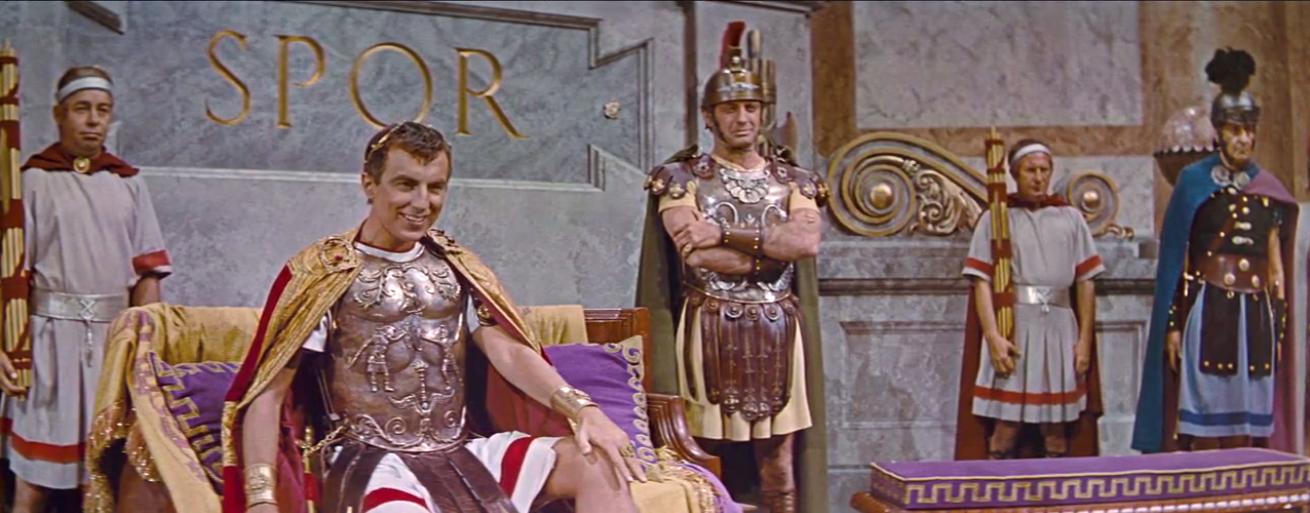
The Robe is a pretty bland biblical epic with a bland leading performance by Richard Burton and is many ways like Quo Vadis which was also rather bland. Like Quo Vadis though there is one man who refuses to be bland and once again it is the actor playing the Roman Emperor in the film. In Quo Vadis it was Peter Ustinov playing the infamous Roman Emperor Nero, in the Robe it is Jay Robinson who plays perhaps the even more infamous Caligula. Robinson appears in the opening of the film, before Caligula has been made Emperor, to basically attempt to outbid our hero Marcellus Gallio (Richard Burton) at a slave auction. Robinson is great as he prances on the scene in a way only a man who knew he was about to have absolute power could. Robinson's smile is perfect showing a man loving his place, but as well a man having a such a joy of performance that it's hard not to have fun watching it.

Robinson's performance is quite good at realizing Caligula's character even though the film technically does not get into Caligula's personal lusts, in fact a different actor could have played him as just some jealous power hungry guy. That's not the case for Robinson who seems to suggest Caligula's various perversions merely in that devious grin of his and just the whole odd way he carries himself in every scene. Robinson seems to show a man who loves various pleasures far too much just in the way he slants in his chair. Honestly Robinson does not waste a gesture in making his Caligula one sick man even though we don't see much of it first hand. Technically speaking most of the time is spent with Caligula terrorizing Gallio eventual wife Diana (Jean Simmons) as he basically wants Gallio dead after he has converted to Christianity. Well even within the limits of the role Robinson still makes sure to get the most out of it.

Robinson is incredibly entertaining in the scenes where Caligula is in some way thwarted in his attempts to get Gallio. Robinson plays Caligula in these scenes like a spoiled brat who's not getting the present he wanted. Robinson is glorious in showing the rampant insanity of Caligula that in it's heart is childish in nature fitting for a man who has anything he wants handed to him no matter how crazy the request may be. My only problem with Caligula in this film is he's not in the film as much as Nero was in Quo Vadis. Robinson has about four scenes in the film and two of those scenes are a bit short. There's just not enough Caligula to go around because he's unquestionably the best part of the film. Robinson energizes the proceedings whenever he shows up and actually makes the film entertaining with his antics. Almost alone Robinson prevents the film from being completely forgettable as he gives one reason to watch the film.

Sunday, 12 October 2014

Alternate Best Supporting Actor 1953: John Gielgud in Julius Caesar

John Gielgud did not receive an Oscar nomination for portraying Cassius in Julius Caesar.

John Gielgud plays Cassius who along with James Mason's Brutus is one of the main conspirators who plan to kill Julius Caesar then supposedly reform Rome back to a republic. Gielgud's performance acts as a great counterpoint to Mason's performance. Where Mason upheld Brutus's nobility in every breath he takes Gielgud does not do the same for Cassius. Well maybe he does though as Gielgud shows in the scenes where Cassius is trying to urge Brutus to kill Caesar. Gielgud as usual speaks with such elegance as he tries to convince Brutus to go along with the assassination. There is a determination a righteousness even in Gielgud's voice as he espouses various platitudes to Brutus's ears and Gielgud makes it quite believable that Cassius could sway the good Brutus, who happens to love Caesar, to this rather extreme manner of thinking. When Cassius stares Brutus in the face and speaks to him Gielgud makes himself a mirror of Mason, although as it turns out a false a mirror.

The brilliance of Gielgud's performance though is that he portrays Cassius's urging toward Brutus to be quite false, and merely Cassius manipulating Brutus. This is never spoken of by Cassius himself but rather shown wholly by Gielgud's work. Gielgud is fantastic in the moments where frankly Brutus is simply not looking at Cassius and Gielgud uses these moments to portray the true nature of Cassius's intent. Gielgud silent reactions when Cassius is left to his own thoughts does not portray Cassius as a man who is trying to save Rome from a man who has become a tyrant. No Gielgud instead portrays a searing malice in Cassius as he looks upon Caesar and speaks the words against him. Although in words and even in his delivery Gielgud has Cassius claim a conflict of sorts Gielgud shows nothing but a distinct hate in Cassius's eyes. Gielgud is striking as he creates this sinister duplicity in the character being convincing as he persuades Brutus while still conveying the real motivation in Cassius.

Gielgud is excellent in the way he plays with this act as the film goes on, never fully dropping it, although obviously relinquishing it somewhat when the men do kill Caesar. Where Mason presents Brutus clearly feeling guilt even as he performs the coup de grâce and tries to uphold the righteousness of the actions Gielgud does not hold to the same pretensions with Cassius. With Brutus dead and the man thinking of their actions Gielgud brings a smile to Cassius face as he ponders about how the future will see this deed. Gielgud presents Cassius as loving having killed a man he hated, there is no guilt whatsoever, only a certain joy as perhaps he sees his own chance for power soon to come. Gielgud keeps the act going though when Caesar's loyal man Mark Antony (Marlon Brando) comes on the scene. Gielgud changes Cassius from the man lusting after power to now a somber sadness fitting of a sensible and honorable man who surely killed Caesar only for the goodness of Rome.

After the overthrow goes much more roughly than expected Gielgud reveals all there is to Cassius when Brutus calls him on his obvious personal corruption. Gielgud is great as he reduces Cassius to almost nothing as he simply sneers angrily at actually being seen for what he is rather than what he pretends to be. This can only be momentary though as they do have a war to fight which Brutus still believes in even if the odds seem against them. Gielgud is quite moving as he seems to make Cassius create a false image again although this time it is not to convince Brutus but rather himself. Brutus still speaks for the good of Rome and Cassius seems to go along with it. Gielgud brings the brave face to Cassius as he tries to stand tall with Brutus yet Gielgud once again brings an undercurrent of something else. This time though it is a dread and a fear as Gielgud shows that in his heart Cassius knows that they are doomed. Gielgud is terrific as through the final moments of Cassius he tears away the false hopes of the man to reveal a man whose seen all his plans go up in flames. John Gielgud on his own gives a great portrait of betrayal and deceit but it works especially well against Mason's portrayal of honesty and devotion.

Tuesday, 7 October 2014

Alternate Best Supporting Actor 1953: Lee Marvin in The Wild One

Lee Marvin did not receive an Oscar nomination for portraying Chino in The Wild One.

Lee Marvin plays Chino the leader of a rival biker gang named The Beetles who decide to match "wits" with Johnny (Marlon Brando) and his gang. Lee Marvin's role here isn't really a substantial one by any means as Chino comes in makes some trouble then proceeds to make more trouble by getting arrested. Marvin technically could be considered the antagonist but that's not the way he plays it. He's the rival gang leader who purposefully starts a fight with Johnny but Marvin does not have an ounce of maliciousness in his portrayal. Marvin in fact plays Chino as a bit more of an approachable sort of guy than Johnny who Brando plays with a bit of a perpetual brood. Marvin instead shows Chino doesn't care like Johnny but in a completely different way. Marvin shows Chino in not caring about much of anything, not even getting beaten up or arrested, but he intends on loving every minute of it.

Marvin quite simply is a hoot in the role as he plays the role with such a constant boisterousness. Marvin is extremely flamboyant within his performance and it completely fits his role. He commands the screen despite playing the role in such a frankly wacky fashion but he completely nails this sorta guy who is practically drunk on life despite not necessarily having had anything to drink. Marvin is incredibly entertaining in his constant bravado as Chino plays up every moment as he seems to be trying to get out every bit of fun he can get out of it. When Chino is beaten down by Johnny and technically has his pride taken from him Chino responds by saving he loves Johnny. Marvin absolutely makes you believe this reaction as he realizes Chino so perfectly as the gang member who is ready to go with almost anything because he's just going to love in anyways.

Lee Marvin effectively steals the show as he turns all of his scenes into the most memorable. Where most the other behavior of the bikers is quickly repetitive and quickly obnoxious Marvin always energizes the proceedings whenever he shows up. His performance is just a whole lot of fun in a film that is sorely lacking in it otherwise, and I think this likely where he stole the film far more than what was intended. Marvin just pretty much takes the picture as his own whenever he gets to grace the screen. The only problem I would say is there is not a whole lot of Chino to go around as the film is obviously not about him and he's only a fairly brief side show. That being said he's quite the enjoyable side show for the film and easily the highlight of it all. For a performance that was fulfilling what could have been another throwaway role, and has very limited screen time that's not too bad of an accomplishment.

Alternate Best Supporting Actor 1953

And the Nominees Were Not:

Ernest Borgnine in From Here to Eternity

Otto Preminger in Stalag 17

Jay Robinson in The Robe

John Gielgud in Julius Caesar 

Lee Marvin in The Wild One