Anton Walbrook did not receive an Oscar nomination for portraying Captain Herman Suvorin in The Queen of Spades.
The Queen of Spades has decent atmosphere and some great moments, though it perhaps has too much time between each of them, following the story of a Russian soldier going about a most unusual plan to win at cards.
The Austrian actor Anton Walbrook who perhaps made his international name through the films of Powell and Pressburger, here stars in perhaps less complex role as a Gothic villain. I must say the plan of Captain Herman Suvorin in this film is not exactly the most sensible even for a greedy louse. He goes about by first slowly seducing a Countess's ward in order to just get access to the Countess to demand to know basically how to supernaturally cheat at cards, because he read that she should know in a book, then use that knowledge against the rich officers he refuses to usually play cards with. Captain Suvorin has a serious not being able to see the forest for the trees problem, but I digress. As little as Suvorin's plan makes a whole lot of sense we get Walbrook here acting in as a highly unsympathetic rouge, there is more than a little entertainment to be found from this. In the first half of the film Walbrook is rather successful at being a slimy creep in his method of seduction, that involves very little passion just some random threats. Walbrook to his credit somehow makes it sort of work in his own style to this as he has this persuasive quality within his essentially pretty pathetic words. Walbrook never hides that the Captain is this terrible man yet he still fashions a convincing Lothario through his unique presence as actor.
After making his way into the ward's mind though he gets to come in and threaten the Countess in order to learn her secrets. It is in this scene where we see Walbrook working up towards something in creating the vicious greed of Suvorin. This is but a warmup though when Suvorin using what he gained from the confrontation finally plays cards. Now this scene is where really is all that matters in regards to Walbrook's performance. Now to be sure Walbrook is pretty over the top here in his darting eyes, and the sheer almost drooling joy in his delivery every time he says "My win" or bets again. He's goes pretty hammy here to be sure, but I would be lying if I did not say I did not find him to be wildly entertaining in his portrayal of the mad greed of the Captain. Walbrook is a hoot throughout the scene in just going all in both literally and metaphorically as they play with Captain seemingly having supernatural help. Eventually though, given that this is a Gothic morality tale, the helps runs out leading to Suvorin losing everything. This thankfully gives us all some more of that very rare rather glorious, delicious, ham from Walbrook in his realization of the Captin's insane ramblings as he loses his mind after he loses the game. Anton Walbrook's performance is not this realization of this complex character it is rather creating essentially a straw man to be burned by the moral of the story basically. In this perhaps somewhat simplistic way Walbrook's work here is a success, it is not a great performance by any margin, however it is rather fun to watch.
Thursday, 14 September 2017
Tuesday, 12 September 2017
Alternate Best Actor 1949: Robert Ryan in The Set-Up
Robert Ryan did not receive an Oscar nomination for portraying Bill "Stoker" Thompson in The Set-Up.
The Set-Up is a terrific film noir/boxing film that follows a boxing match where everyone is on the fix except for the man who's suppose to take the fall.
Robert Ryan is best known for playing heavies in supporting roles so it is interesting to see him here playing not only the lead but also one of the few characters who is not corrupt in the film. Early on we learn of the setup then we are introduced to Ryan's Stoker as he speaks to his wife Julie (Audrey Totter) before he goes off to fight. One only needs to look at Ryan to see that Stoker is an over the hill boxer as Ryan carries this certain underlying despair in his eyes. Stoker though wishes to fight and even speaks about the fight as a chance to potential greatness in the ring. Ryan is very moving as he carries that despair yet is convincing as Stoker makes such statements. Ryan does not depict this as lying to his wife, but rather unintentionally lying to himself. In his delivery Ryan doesn't invoke really a hope but rather this desperate need for a hope in every statement. Ryan reveals this man just trying to put himself in this optimistic mindset despite always reinforcing that underneath Stoker's feelings of doubt are probably as stronger if not stronger than his wife's. Ryan setups so effectively the state of Stoker before he goes to the arena to prepare, portraying just this man dangling on a thread trying so hard not to fall.
Now Robert Ryan is the lead in the film yet in a very specific manner as he acts as the focal point for what is Robert Wise's rather brilliant portrait of the whole atmosphere around the boxing ring. The film takes a great deal of time with Stoker as he awaits his own matches and watches the other boxers prepare to fight. Ryan makes the most out of every second in this largely reactionary performance. Ryan amplifies every other little snippet of a boxer's story through his performance, and in each of these we get a little more insight into Stoker's own life. In the womanizer coming off a victory, Ryan infuses Stoker with an intense distaste not exactly for the behavior rather reflecting his sorrow over his tense relationship with his wife. In the face of the few boxers who are up and comers Ryan finds this incredibly poignant moments as in his eyes you can see a bit of happiness for the men, as well as in the idea of success at all, but also again that sadness still underlines it as he seems to look at himself in the past when he still had an overt hope. This despair only becomes all the stronger though in watching another washed up boxer being beaten within his life. In every single one of these moments there is such a power to them because of how honestly realizes Stoker's investment in their stories since in some way they are like his own.
Eventually it becomes Stoker's turn for the match where we get one of the most powerfully realized boxing matches ever depicted in a fictional film. It is not quite typical though as we focus on almost everyone in the stadium in addition to having the drama right within the ring with Stoker taking on the younger smug boxer who is in on the fix. Ryan is terrific in this sequence, now Ryan a former amateur boxer is believable in terms of fighting, but he goes far further than that with his performance. Ryan portrays physically a certain type of fight as in every moment there is such an intensity in really the heart he brings in every punch, and every moment of facing his opponent straight on. Ryan in every strikes shows a man fighting for his life in a way finding this strength within still an emotional desperation. I love the fierceness in Ryan's his work suggesting Stoker lashing out against everyone and everything doubting him. When Stoker is told of the fix late in the round Ryan only goes further with this idea revealing such a disdain for the idea, and showing a man doing something for himself. When Stoker achieves knockout it is a great moment though as Ryan depicts physically the sheer exasperation of the fight, but also the instance of pride in a man who has had so few of them. Robert Ryan proves his measure in a leading role, technically against type, by delivering this marvelous bittersweet portrait of this boxer. He does not hesitate in revealing the severity of the desperation and vulnerability of the man, which in turn makes his few moments of happiness and hope deeply affecting.
The Set-Up is a terrific film noir/boxing film that follows a boxing match where everyone is on the fix except for the man who's suppose to take the fall.
Robert Ryan is best known for playing heavies in supporting roles so it is interesting to see him here playing not only the lead but also one of the few characters who is not corrupt in the film. Early on we learn of the setup then we are introduced to Ryan's Stoker as he speaks to his wife Julie (Audrey Totter) before he goes off to fight. One only needs to look at Ryan to see that Stoker is an over the hill boxer as Ryan carries this certain underlying despair in his eyes. Stoker though wishes to fight and even speaks about the fight as a chance to potential greatness in the ring. Ryan is very moving as he carries that despair yet is convincing as Stoker makes such statements. Ryan does not depict this as lying to his wife, but rather unintentionally lying to himself. In his delivery Ryan doesn't invoke really a hope but rather this desperate need for a hope in every statement. Ryan reveals this man just trying to put himself in this optimistic mindset despite always reinforcing that underneath Stoker's feelings of doubt are probably as stronger if not stronger than his wife's. Ryan setups so effectively the state of Stoker before he goes to the arena to prepare, portraying just this man dangling on a thread trying so hard not to fall.
Now Robert Ryan is the lead in the film yet in a very specific manner as he acts as the focal point for what is Robert Wise's rather brilliant portrait of the whole atmosphere around the boxing ring. The film takes a great deal of time with Stoker as he awaits his own matches and watches the other boxers prepare to fight. Ryan makes the most out of every second in this largely reactionary performance. Ryan amplifies every other little snippet of a boxer's story through his performance, and in each of these we get a little more insight into Stoker's own life. In the womanizer coming off a victory, Ryan infuses Stoker with an intense distaste not exactly for the behavior rather reflecting his sorrow over his tense relationship with his wife. In the face of the few boxers who are up and comers Ryan finds this incredibly poignant moments as in his eyes you can see a bit of happiness for the men, as well as in the idea of success at all, but also again that sadness still underlines it as he seems to look at himself in the past when he still had an overt hope. This despair only becomes all the stronger though in watching another washed up boxer being beaten within his life. In every single one of these moments there is such a power to them because of how honestly realizes Stoker's investment in their stories since in some way they are like his own.
Eventually it becomes Stoker's turn for the match where we get one of the most powerfully realized boxing matches ever depicted in a fictional film. It is not quite typical though as we focus on almost everyone in the stadium in addition to having the drama right within the ring with Stoker taking on the younger smug boxer who is in on the fix. Ryan is terrific in this sequence, now Ryan a former amateur boxer is believable in terms of fighting, but he goes far further than that with his performance. Ryan portrays physically a certain type of fight as in every moment there is such an intensity in really the heart he brings in every punch, and every moment of facing his opponent straight on. Ryan in every strikes shows a man fighting for his life in a way finding this strength within still an emotional desperation. I love the fierceness in Ryan's his work suggesting Stoker lashing out against everyone and everything doubting him. When Stoker is told of the fix late in the round Ryan only goes further with this idea revealing such a disdain for the idea, and showing a man doing something for himself. When Stoker achieves knockout it is a great moment though as Ryan depicts physically the sheer exasperation of the fight, but also the instance of pride in a man who has had so few of them. Robert Ryan proves his measure in a leading role, technically against type, by delivering this marvelous bittersweet portrait of this boxer. He does not hesitate in revealing the severity of the desperation and vulnerability of the man, which in turn makes his few moments of happiness and hope deeply affecting.
Monday, 11 September 2017
Alternate Best Actor 1949
And the Nominees Were Not:
Anton Walbrook in The Queen of Spades
David Farrar in The Small Back Room
Robert Ryan in The Set-Up
Howard Vernon in Le Silence de La Mer
Chishū Ryū in Late Spring
And a Special Review of:
Toshiro Mifune in Stray Dog
Anton Walbrook in The Queen of Spades
David Farrar in The Small Back Room
Robert Ryan in The Set-Up
Howard Vernon in Le Silence de La Mer
Chishū Ryū in Late Spring
And a Special Review of:
Toshiro Mifune in Stray Dog
Saturday, 9 September 2017
Alternate Best Actor 1935: Edward G. Robinson in The Whole Town's Talking and Results
Edward G. Robinson did not receive an Oscar nomination for portraying Arthur Ferguson Jones and "Killer" Mannion in The Whole Town's Talking.
The Whole Town's Talking is a rather enjoyable screwball comedy about a mild mannered clerk being mistaken for a hard edged gangster.
The Whole Town's Talking offers Edward G. Robinson the chance to go far out of his type, but also play right into it. The out of it type is in the role of the clerk Arthur Ferguson Jones whose main worry at the beginning of the film is just getting to work on time. As usual Robinson proves his measure in yet another type of role here. I've covered him in somewhat meek roles before in his film noirs with Fritz Lang, but this is step away from those roles even. Robinson isn't just meek here he's hilariously meek. Robinson's great though in that he's not playing a guy who is pained in any way due to his modest nature, it's just the way he is. Robinson is delightful in throwing himself fully into playing the role to a tee with every little mannerisms, from his slight smile, to his unassuming physical posture, that just emphasize how much of a harmless man Jones is. There's even a particularly enjoyable scene early on where Jones attempts to fashion a more normalized Edward G. Robinson look, and Robinson is great in portraying Jones awkwardly attempting to contort his face into his normal gangster expression. Robinson though is wonderful though by just how endearing he makes everything about Jones, in just how earnest his depiction of every one of those mannerisms are. There's nothing difficult about them in Robinson's approach, they just are the normal behavior of this sweet clerk.
Unfortunately for Jones he happens to look just like the gangster "Killer" Mannion, which leads him to be arrested early on though eventually released when the mix up discovered. Now after some rather amusing moments from Robinson depicting first an abject terror then an abject joy due to first the mix up then random boons due to the mix up we run into Robinson's second performance. The evil Killer Mannion first appearing deep in shadow there at Jones's apartment to exploit the mix up for himself in order to commit crimes more easily. Now Robinson obviously should be more comfortable as Mannion given this sort of role is how he became a star to begin with, and to be sure he's very comfortable in the role, however this isn't just a copy of Little Caesar here. Robinson actually purposefully overplays the role a tad, in a good way, in that he sort of does a Edward G. Robinson parody type of gangster performance as Mannion. This could be a bit much, but it's just right for the tone of the film. You of course have to still take him seriously as Robinson is always menacing whenever he wishes to be, yet he keeps Mannion from being a downer on the fun by accentuating his typical mannerisms a tad. Robinson finds the right balance as he does make Mannion a genuine threat, yet he's still funny as well by being such an obvious gangster even when he's pretending to be Jones.
Many of the highlight scenes of the film are of Robinson acting against Robinson, this being a fairly early example of the single actor sharing chemistry with himself. He has a real way of acting terrifying while acting terrified at the same time, or acting vicious and gentle at the same time. Robinson has a great deal of fun in every one of these scenes developing a rather amusing dynamic with himself as Mannion misuses the poor clerk. Eventually though the best Robinson scene though does come alone when the meek Jones must pretend to be the tough gangster in order to save himself and his friends. Robinson is sort of outstanding in this sequence as he effectively portrays a struggle just to play his usual part in a most entertaining fashion. The best part being without a doubt when Jones has to brandish a Tommy gun himself and fires at Mannion's henchmen. Robinson is downright hilarious in portraying Jones almost crying as he shoots the gun, and wrenching in fear as he attempts to be menacing even for a moment. This is yet another terrific performance from Edward G. Robinson as he excels at not just one but two types of roles in this screwball comedy.
Updated Lead Overall
Updated Supporting Overall
Next Year: 1949 Lead
The Whole Town's Talking is a rather enjoyable screwball comedy about a mild mannered clerk being mistaken for a hard edged gangster.
The Whole Town's Talking offers Edward G. Robinson the chance to go far out of his type, but also play right into it. The out of it type is in the role of the clerk Arthur Ferguson Jones whose main worry at the beginning of the film is just getting to work on time. As usual Robinson proves his measure in yet another type of role here. I've covered him in somewhat meek roles before in his film noirs with Fritz Lang, but this is step away from those roles even. Robinson isn't just meek here he's hilariously meek. Robinson's great though in that he's not playing a guy who is pained in any way due to his modest nature, it's just the way he is. Robinson is delightful in throwing himself fully into playing the role to a tee with every little mannerisms, from his slight smile, to his unassuming physical posture, that just emphasize how much of a harmless man Jones is. There's even a particularly enjoyable scene early on where Jones attempts to fashion a more normalized Edward G. Robinson look, and Robinson is great in portraying Jones awkwardly attempting to contort his face into his normal gangster expression. Robinson though is wonderful though by just how endearing he makes everything about Jones, in just how earnest his depiction of every one of those mannerisms are. There's nothing difficult about them in Robinson's approach, they just are the normal behavior of this sweet clerk.
Unfortunately for Jones he happens to look just like the gangster "Killer" Mannion, which leads him to be arrested early on though eventually released when the mix up discovered. Now after some rather amusing moments from Robinson depicting first an abject terror then an abject joy due to first the mix up then random boons due to the mix up we run into Robinson's second performance. The evil Killer Mannion first appearing deep in shadow there at Jones's apartment to exploit the mix up for himself in order to commit crimes more easily. Now Robinson obviously should be more comfortable as Mannion given this sort of role is how he became a star to begin with, and to be sure he's very comfortable in the role, however this isn't just a copy of Little Caesar here. Robinson actually purposefully overplays the role a tad, in a good way, in that he sort of does a Edward G. Robinson parody type of gangster performance as Mannion. This could be a bit much, but it's just right for the tone of the film. You of course have to still take him seriously as Robinson is always menacing whenever he wishes to be, yet he keeps Mannion from being a downer on the fun by accentuating his typical mannerisms a tad. Robinson finds the right balance as he does make Mannion a genuine threat, yet he's still funny as well by being such an obvious gangster even when he's pretending to be Jones.
Many of the highlight scenes of the film are of Robinson acting against Robinson, this being a fairly early example of the single actor sharing chemistry with himself. He has a real way of acting terrifying while acting terrified at the same time, or acting vicious and gentle at the same time. Robinson has a great deal of fun in every one of these scenes developing a rather amusing dynamic with himself as Mannion misuses the poor clerk. Eventually though the best Robinson scene though does come alone when the meek Jones must pretend to be the tough gangster in order to save himself and his friends. Robinson is sort of outstanding in this sequence as he effectively portrays a struggle just to play his usual part in a most entertaining fashion. The best part being without a doubt when Jones has to brandish a Tommy gun himself and fires at Mannion's henchmen. Robinson is downright hilarious in portraying Jones almost crying as he shoots the gun, and wrenching in fear as he attempts to be menacing even for a moment. This is yet another terrific performance from Edward G. Robinson as he excels at not just one but two types of roles in this screwball comedy.
Updated Lead Overall
Updated Supporting Overall
Next Year: 1949 Lead
Tuesday, 5 September 2017
Alternate Best Supporting Actor 1992: Results
5. Tony Todd in Candyman - Todd begins his performance in creating a unique approach to a cinematic boogeyman unfortunately the film finds its way into making it a standard one.
Best Scene: The Candyman appears.
4. Graham Greene in Thunderheart - Greene manages to find the right humor while still making an emotional impact as his cop who acts as more than one type of guide.
Best Scene: Finding the murder victims.
3. David Bowie in Twin Peaks: Fire Walk With Me - Bowie in literally a couple of minutes creates a fascinating enigma that leaves quite the impression.
Best Scene: "We're not gonna talk about Judy"
2. Wesley Snipes in The Waterdance - Snipes gives a terrific performance here creating the right charismatic bluster that hides the sad man beneath it all.
Best Scene: Raymond wins the bet.
1. Ray Wise in Twin Peaks: Fire Walk With Me - Wise gives an outstanding reprise of his all-time great television turn, this time effectively realizing the extremes of the man and granting insight into Leland Palmer's mind.
Best Scene: Leland apologizes.
Updated Overall
Next Year: 1935, Won't necessarily do a lineup.
Best Scene: The Candyman appears.
4. Graham Greene in Thunderheart - Greene manages to find the right humor while still making an emotional impact as his cop who acts as more than one type of guide.
Best Scene: Finding the murder victims.
3. David Bowie in Twin Peaks: Fire Walk With Me - Bowie in literally a couple of minutes creates a fascinating enigma that leaves quite the impression.
Best Scene: "We're not gonna talk about Judy"
2. Wesley Snipes in The Waterdance - Snipes gives a terrific performance here creating the right charismatic bluster that hides the sad man beneath it all.
Best Scene: Raymond wins the bet.
1. Ray Wise in Twin Peaks: Fire Walk With Me - Wise gives an outstanding reprise of his all-time great television turn, this time effectively realizing the extremes of the man and granting insight into Leland Palmer's mind.
Best Scene: Leland apologizes.
Updated Overall
Next Year: 1935, Won't necessarily do a lineup.
Monday, 4 September 2017
Alternate Best Supporting Actor 1992: Tony Todd in Candyman
Tony Todd did not receive an Oscar nomination for portraying the titular role in Candyman.
Candyman begins as a rather atmospheric horror film following the investigation of an urban legend, but it loses its way to a more overt slasher film once the titular character fully appears.
This is not a knock against Tony Todd in the role as the ghostly monster who you summon by repeating his name in the mirror so many times. Now I should clarify there can be some entertainment to be had from the second half of this film, it is just the first half suggests the sort of horror film that really gets under your skin rather than the more routine one that follows after. Tony Todd's initial appearance though actually suggests the better path as he appears from a distance in what is a rather chilling scene. Although Todd at 6'5'' is a rather menacing figure to begin with, and that bloody hook does not exactly hurt things in this regard, Todd's performance does take this even further. In this scene he carries an eerie presence that is far more off-putting than if he was just playing it as some overt psychotic. Todd instead plays it as though he this higher being of some sort, though this higher being that desires a death sacrifice. His gaze has a murderous glint in his eyes, yet it seems to look even beyond that as a force beyond the earth. Todd's voice, which needs to be said is an amazing voice to begin with, though takes it even further. Again he does not just go for an overt evil routine instead there is almost a certain allure he brings within his delivery that makes the Candyman a tempter, even while he does not hide the terrible result that would be at the end of that temptation.
After that initial scene though the film becomes far less creative in its use of the titular character. He mostly shows up, says something cryptic, kills someone, then leaves. Now to be fair though Todd's approach in itself is never the problem. His performance remains compelling to at the very least a certain extent as he does so effectively realizes the enigmatic nature of the being. The film though overuses and misuses his performance. It slowly peels away what made him so effective in the first scene till the end where he just has basically lost all his mystery. Unfortunately the trick Todd pulls itself loses its luster and he cannot adjust to something that maintains the sort of horror wonder of the character when he starts flailing around like just any other horror villain. In the end it is the film that is frustrating one not Todd however a part of that frustration comes in how it ends up wasting this performance. From that opening scene one can see the potential for a truly remarkable creation of a different type of terror by Todd, unfortunately the film settles just for a tall guy with a pointy weapon.
Candyman begins as a rather atmospheric horror film following the investigation of an urban legend, but it loses its way to a more overt slasher film once the titular character fully appears.
This is not a knock against Tony Todd in the role as the ghostly monster who you summon by repeating his name in the mirror so many times. Now I should clarify there can be some entertainment to be had from the second half of this film, it is just the first half suggests the sort of horror film that really gets under your skin rather than the more routine one that follows after. Tony Todd's initial appearance though actually suggests the better path as he appears from a distance in what is a rather chilling scene. Although Todd at 6'5'' is a rather menacing figure to begin with, and that bloody hook does not exactly hurt things in this regard, Todd's performance does take this even further. In this scene he carries an eerie presence that is far more off-putting than if he was just playing it as some overt psychotic. Todd instead plays it as though he this higher being of some sort, though this higher being that desires a death sacrifice. His gaze has a murderous glint in his eyes, yet it seems to look even beyond that as a force beyond the earth. Todd's voice, which needs to be said is an amazing voice to begin with, though takes it even further. Again he does not just go for an overt evil routine instead there is almost a certain allure he brings within his delivery that makes the Candyman a tempter, even while he does not hide the terrible result that would be at the end of that temptation.
After that initial scene though the film becomes far less creative in its use of the titular character. He mostly shows up, says something cryptic, kills someone, then leaves. Now to be fair though Todd's approach in itself is never the problem. His performance remains compelling to at the very least a certain extent as he does so effectively realizes the enigmatic nature of the being. The film though overuses and misuses his performance. It slowly peels away what made him so effective in the first scene till the end where he just has basically lost all his mystery. Unfortunately the trick Todd pulls itself loses its luster and he cannot adjust to something that maintains the sort of horror wonder of the character when he starts flailing around like just any other horror villain. In the end it is the film that is frustrating one not Todd however a part of that frustration comes in how it ends up wasting this performance. From that opening scene one can see the potential for a truly remarkable creation of a different type of terror by Todd, unfortunately the film settles just for a tall guy with a pointy weapon.
Friday, 1 September 2017
Alternate Best Supporting Actor 1992: David Bowie, Harry Dean Stanton, Ray Wise and Frank Silva in Twin Peaks: Fire Walk With Me
David Bowie did not receive an Oscar nomination for portraying Phillip Jeffries in Twin Peaks: Fire Walk With Me.
Twin Peaks: Fire Walk With Me acts a prequel to the original Twin Peaks series but also really a bridge, 25 years before, for the third season of the show. In serving that purpose it is extremely effective as an episode in the series, though an outsider may be a bit lost if they are viewing it all on its own.
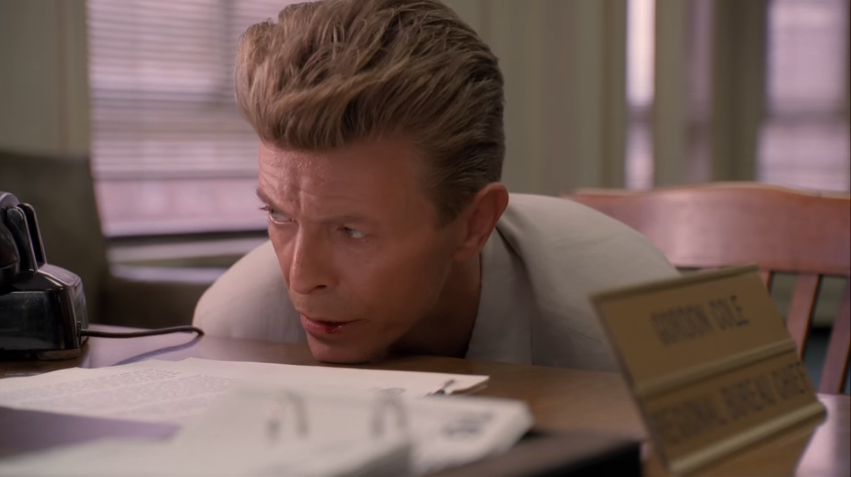
David Bowie is actually only in about two minutes of the film, if even that, in his role as missing F.B.I agent Phillip Jeffries. He appears mysteriously out of an elevator in F.B.I headquarters, rambles seemingly incoherently then disappears without trace, yet leaves an ever lasting memory in this time. Of course credit must go to David Lynch's brilliant set up of the scene, but this scene would not be what it is without David Bowie. Bowie is of course known best as his work as a musician however onscreen he has a singular screen presence, an almost otherworldly quality. This is most useful in this role as one sits up and takes notice the moment Bowie ever enters the frame, Bowie's mere existence amplifies the already enigmatic nature of scene. It is not merely about Bowie being so fascinating in it of itself, but as his performance as agent Jeffries. The beginning of which is Bowie portrayal of the state of Jeffries which seems to be a of a man who sees far beyond one's normal existential crisis. The very particular emotional distress Bowie exudes isn't of just a time traveler, but of a man who has been through hell learned terrible secrets behind his whole universe and is here to tell the story. There is a painful urgency yet confusion that Bowie brings in every bit of that strange anguish he delivers in the role. As he makes Jeffries this man barely in his place with only this minor grip on reality trying to explain his story before disappearing while we witness a blood curdling scream by Bowie. To make everything all the more fascinating though Bowie uses a southern American accent in the role, which is some strange masterstroke. This only makes the already effortlessly intriguing Bowie all the more captivating. Bowie in just a couple of minutes, again if that, leaves an undeniable impression, creating one of the most enthralling figures in the grand Twin Peaks universe.
Harry Dean Stanton did not receive an Oscar nomination for portraying Carl Rodd in Twin Peaks: Fire Walk With Me.
Speaking of effortlessly compelling actors look no further than Harry Dean Stanton, who can do more in a couple seconds than some actors can do in 3 hours. Stanton though is rather different than Bowie in terms of their exact presence, in fact sort of the opposite in that Harry Dean Stanton certainly always feels like a man of our world, which is part of his great appeal. Stanton appears as the trailer park owner that housed a murder victim whose death F.B.I agents Chester Desmond (Chris Isaak) and Sam Stanley (Kiefer Sutherland) are investigating. Stanton initially appears as a seemingly more ill-tempered sort when the agents knock on his trailer door before his normal wake time. Stanton is hilarious in his initial grumpiness though this does aside as he reveals Rodd to be a nice enough guy who just doesn't like being woken up early. Stanton is very entertaining though particularly in contrast to the straight laced F.B.I. agents. Stanton just has a way with any line quite honestly and couldn't be a better fit for David Lynch's unique style of comedy. Stanton finds the appropriate tone for sort of Americana humor found with Lynch, as Stanton makes it quite funny in that particular style, yet he also makes it quite earnest. Stanton finds the humor in just his every little moment, such as commenting on his coffee, or his straight forward confusion at what the F.B.I are doing exactly. Now Stanton just being this friendly trailer park owner, would be enough. There is more though as the seriousness of the situation does arrive, and in an instance Stanton naturally reveals another side to Rodd as the investigate the murder victim's trailer. Stanton in his single line of "See, I've already gone places... I just wanna stay where I am" alludes so haunting to the man's own history in his unknown but there is also something poignant in the second half of a man just wanting the stability in his quiet life. As usual Stanton makes quite an impression in just a few minutes as Carl Rodd giving a great introduction to a character, which he thankfully was allowed to reprise in the show's third season.
Ray Wise did not receive an Oscar nomination for portraying Leland Palmer in Twin Peaks: Fire Walk With Me.
It is also worth noting that Ray Wise was not Emmy nominated for his work in the series leaving one of the all time great television performances unrecognized. Ray Wise's work actually there shows perhaps the wide gap there was between film/television, something that Twin Peaks, very much ahead of its time, was trying to reduce. I mention that as it is likely if someone gave that same performance today they likely would break out across the board, or least for a little while. Of course this is also trying to understand Wise's baffling low key career in general as I've found him to be an incredibly dynamic performer no matter where he turns up. Anyway Wise's reprise begins when he appears after the elongated prologue featuring Bowie, Stanton and the F.B.I. agents, as the film jumps to the titular town to focus on the final days of murder victim Laura Palmer (Sheryl Lee). Wise obviously playing her father Leland, who in the series we eventually discovered, spoilers, that he was her murderer. Of course it's not so simple and where in the series we saw the phases of the man from a certain distance, here we are given the intimate detail of Leland's broken self. The first side we see of him Wise is terrifying as Leland demands Laura wash her fingernails before dinner. Wise in the moment is of this horribly abusive father. Wise persecutes her though in this horribly controlling way as he does it as though he is teaching her lesson, with his "father knows best" delivery that makes the moment all the more chilling.
A moment later though Wise instantly switches to a heartbreaking tone in the purity of the despondence that he shows in Leland as he profusely apologizes to his daughter for his earlier demands. Wise in this moment is completely earnest and sympathetic in his portrayal of such a tender sorrow as Leland attempts to explain himself. This is extremely inconsistent from the previous scene yet this is not a flaw in Wise's performance but rather the truth of it. Wise in that moment shows that being absolutely the purest form of the true Leland Palmer, which is as this loving father. A loving father that Wise does bring such a terrible shattered warmth, as he shows a man attempting to genuinely care for his daughter. Wise though makes every moment of it seem as though he on this horrible edge, as he suggests Leland is always a second from a complete emotional breakdown. Wise is harrowing to watch though as he does not make this in any way false, despite what we have previously seen, as he presents something being deeply wrong in this yet there is an absolute truth in his guilt. Wise in doing this though realizes the grave predicament that Leland Palmer exists in.
The predicament is not that Leland is struggling with his worst impulses but rather that he is literally possessed by an evil spirit that thrives on the suffering of humans. Although the idea of the demon inside can be taken as a metaphor, but in this case it's not. Now the literal in itself is potentially a ridiculous concept but it never feels as such due to the brilliance of how Wise portrays it, as well as another reason which I will get to soon. Wise though creates this state of the man which he does not show as a Jekyll and Hyde but rather something much worse. Wise depicts it as a man essentially being torn from within as his own self is constantly corrupted, which he is occasionally released from yet he can do nothing about it. A genius element in Wise's work in that, even though it's not even required, he actually in many ways allows for both the literal and metaphorical interpretation of Leland's mind. Wise's work is outstanding as he manages to find all that makes of the man without losing control of it. He realizes so effectively this confusion in himself in every moment as in his physical manner there is always this horrid pressure to this as a man who seems never at ease whether he is giving into his shame, to the monster within, or if even he's not directly either. Wise portrays a man who is simply wrong from the inside out yet makes sense of this insane idea. Wise is downright amazing in every scene as he brings the warmth in portraying Leland's love for his daughter, but he is also terrifying as he brings about her own corruption and death. Wise's work in the television series was great, and this performance is an incredible companion of that work as he reveals the internalized horror of the man.
Frank Silva did not receive an Oscar nomination for portraying Bob in Twin Peaks: Fire Walk With Me.
The true source of the evil in the story though is in the spirit Bob played by Frank Silva. Silva's original appearance coming from a sudden bit of inspiration by David Lynch leading Silva, originally a set dresser, becoming one of the most iconic characters from the series. It's a fascinating thing as the image of Silva taken out of context perhaps shouldn't be terrifying, he's just a guy with long hair in denim, yet he's one of the most horrifying figures in any fictional work. Silva's performance is essentially a silent one except for some grunts, which should not be hand waved as his delivery of them as human animal are truly disturbing. Silva embodies this concept of this evil spirit, which is that of seemingly man's worse inclination and desires personified. Silva does not need to speak in order to strike fear. Silva's performance is almost entirely physical and as that it is something unforgettable. Silva's very being is of an urge, a terrible urge, to do whatever creates suffering. There is this lust, yet this hate, there is even a strange sorrow, yet joy all in Silva's performance that is pure unadulterated emotion. A single part of what Silva's doing could be even empathetic in someway yet his combination of all of it, all at once, in this way creates this figure that is one of the most unnerving as Silva is otherworldly yet entirely human all at once. He is a boogeyman that strikes that particular almost existential fear yet with a grounding that carries a most visceral sting. Although of David Lynch's work amplifies all of this, yet there is a reason that the mere sight of Bob behind a dresser is one of the frightening scenes in any film, as Silva gives the boogeyman a face, a most terrifying one.
Twin Peaks: Fire Walk With Me acts a prequel to the original Twin Peaks series but also really a bridge, 25 years before, for the third season of the show. In serving that purpose it is extremely effective as an episode in the series, though an outsider may be a bit lost if they are viewing it all on its own.
David Bowie is actually only in about two minutes of the film, if even that, in his role as missing F.B.I agent Phillip Jeffries. He appears mysteriously out of an elevator in F.B.I headquarters, rambles seemingly incoherently then disappears without trace, yet leaves an ever lasting memory in this time. Of course credit must go to David Lynch's brilliant set up of the scene, but this scene would not be what it is without David Bowie. Bowie is of course known best as his work as a musician however onscreen he has a singular screen presence, an almost otherworldly quality. This is most useful in this role as one sits up and takes notice the moment Bowie ever enters the frame, Bowie's mere existence amplifies the already enigmatic nature of scene. It is not merely about Bowie being so fascinating in it of itself, but as his performance as agent Jeffries. The beginning of which is Bowie portrayal of the state of Jeffries which seems to be a of a man who sees far beyond one's normal existential crisis. The very particular emotional distress Bowie exudes isn't of just a time traveler, but of a man who has been through hell learned terrible secrets behind his whole universe and is here to tell the story. There is a painful urgency yet confusion that Bowie brings in every bit of that strange anguish he delivers in the role. As he makes Jeffries this man barely in his place with only this minor grip on reality trying to explain his story before disappearing while we witness a blood curdling scream by Bowie. To make everything all the more fascinating though Bowie uses a southern American accent in the role, which is some strange masterstroke. This only makes the already effortlessly intriguing Bowie all the more captivating. Bowie in just a couple of minutes, again if that, leaves an undeniable impression, creating one of the most enthralling figures in the grand Twin Peaks universe.
Harry Dean Stanton did not receive an Oscar nomination for portraying Carl Rodd in Twin Peaks: Fire Walk With Me.
Speaking of effortlessly compelling actors look no further than Harry Dean Stanton, who can do more in a couple seconds than some actors can do in 3 hours. Stanton though is rather different than Bowie in terms of their exact presence, in fact sort of the opposite in that Harry Dean Stanton certainly always feels like a man of our world, which is part of his great appeal. Stanton appears as the trailer park owner that housed a murder victim whose death F.B.I agents Chester Desmond (Chris Isaak) and Sam Stanley (Kiefer Sutherland) are investigating. Stanton initially appears as a seemingly more ill-tempered sort when the agents knock on his trailer door before his normal wake time. Stanton is hilarious in his initial grumpiness though this does aside as he reveals Rodd to be a nice enough guy who just doesn't like being woken up early. Stanton is very entertaining though particularly in contrast to the straight laced F.B.I. agents. Stanton just has a way with any line quite honestly and couldn't be a better fit for David Lynch's unique style of comedy. Stanton finds the appropriate tone for sort of Americana humor found with Lynch, as Stanton makes it quite funny in that particular style, yet he also makes it quite earnest. Stanton finds the humor in just his every little moment, such as commenting on his coffee, or his straight forward confusion at what the F.B.I are doing exactly. Now Stanton just being this friendly trailer park owner, would be enough. There is more though as the seriousness of the situation does arrive, and in an instance Stanton naturally reveals another side to Rodd as the investigate the murder victim's trailer. Stanton in his single line of "See, I've already gone places...
Ray Wise did not receive an Oscar nomination for portraying Leland Palmer in Twin Peaks: Fire Walk With Me.
It is also worth noting that Ray Wise was not Emmy nominated for his work in the series leaving one of the all time great television performances unrecognized. Ray Wise's work actually there shows perhaps the wide gap there was between film/television, something that Twin Peaks, very much ahead of its time, was trying to reduce. I mention that as it is likely if someone gave that same performance today they likely would break out across the board, or least for a little while. Of course this is also trying to understand Wise's baffling low key career in general as I've found him to be an incredibly dynamic performer no matter where he turns up. Anyway Wise's reprise begins when he appears after the elongated prologue featuring Bowie, Stanton and the F.B.I. agents, as the film jumps to the titular town to focus on the final days of murder victim Laura Palmer (Sheryl Lee). Wise obviously playing her father Leland, who in the series we eventually discovered, spoilers, that he was her murderer. Of course it's not so simple and where in the series we saw the phases of the man from a certain distance, here we are given the intimate detail of Leland's broken self. The first side we see of him Wise is terrifying as Leland demands Laura wash her fingernails before dinner. Wise in the moment is of this horribly abusive father. Wise persecutes her though in this horribly controlling way as he does it as though he is teaching her lesson, with his "father knows best" delivery that makes the moment all the more chilling.
A moment later though Wise instantly switches to a heartbreaking tone in the purity of the despondence that he shows in Leland as he profusely apologizes to his daughter for his earlier demands. Wise in this moment is completely earnest and sympathetic in his portrayal of such a tender sorrow as Leland attempts to explain himself. This is extremely inconsistent from the previous scene yet this is not a flaw in Wise's performance but rather the truth of it. Wise in that moment shows that being absolutely the purest form of the true Leland Palmer, which is as this loving father. A loving father that Wise does bring such a terrible shattered warmth, as he shows a man attempting to genuinely care for his daughter. Wise though makes every moment of it seem as though he on this horrible edge, as he suggests Leland is always a second from a complete emotional breakdown. Wise is harrowing to watch though as he does not make this in any way false, despite what we have previously seen, as he presents something being deeply wrong in this yet there is an absolute truth in his guilt. Wise in doing this though realizes the grave predicament that Leland Palmer exists in.
The predicament is not that Leland is struggling with his worst impulses but rather that he is literally possessed by an evil spirit that thrives on the suffering of humans. Although the idea of the demon inside can be taken as a metaphor, but in this case it's not. Now the literal in itself is potentially a ridiculous concept but it never feels as such due to the brilliance of how Wise portrays it, as well as another reason which I will get to soon. Wise though creates this state of the man which he does not show as a Jekyll and Hyde but rather something much worse. Wise depicts it as a man essentially being torn from within as his own self is constantly corrupted, which he is occasionally released from yet he can do nothing about it. A genius element in Wise's work in that, even though it's not even required, he actually in many ways allows for both the literal and metaphorical interpretation of Leland's mind. Wise's work is outstanding as he manages to find all that makes of the man without losing control of it. He realizes so effectively this confusion in himself in every moment as in his physical manner there is always this horrid pressure to this as a man who seems never at ease whether he is giving into his shame, to the monster within, or if even he's not directly either. Wise portrays a man who is simply wrong from the inside out yet makes sense of this insane idea. Wise is downright amazing in every scene as he brings the warmth in portraying Leland's love for his daughter, but he is also terrifying as he brings about her own corruption and death. Wise's work in the television series was great, and this performance is an incredible companion of that work as he reveals the internalized horror of the man.
Frank Silva did not receive an Oscar nomination for portraying Bob in Twin Peaks: Fire Walk With Me.
The true source of the evil in the story though is in the spirit Bob played by Frank Silva. Silva's original appearance coming from a sudden bit of inspiration by David Lynch leading Silva, originally a set dresser, becoming one of the most iconic characters from the series. It's a fascinating thing as the image of Silva taken out of context perhaps shouldn't be terrifying, he's just a guy with long hair in denim, yet he's one of the most horrifying figures in any fictional work. Silva's performance is essentially a silent one except for some grunts, which should not be hand waved as his delivery of them as human animal are truly disturbing. Silva embodies this concept of this evil spirit, which is that of seemingly man's worse inclination and desires personified. Silva does not need to speak in order to strike fear. Silva's performance is almost entirely physical and as that it is something unforgettable. Silva's very being is of an urge, a terrible urge, to do whatever creates suffering. There is this lust, yet this hate, there is even a strange sorrow, yet joy all in Silva's performance that is pure unadulterated emotion. A single part of what Silva's doing could be even empathetic in someway yet his combination of all of it, all at once, in this way creates this figure that is one of the most unnerving as Silva is otherworldly yet entirely human all at once. He is a boogeyman that strikes that particular almost existential fear yet with a grounding that carries a most visceral sting. Although of David Lynch's work amplifies all of this, yet there is a reason that the mere sight of Bob behind a dresser is one of the frightening scenes in any film, as Silva gives the boogeyman a face, a most terrifying one.
Subscribe to:
Comments (Atom)