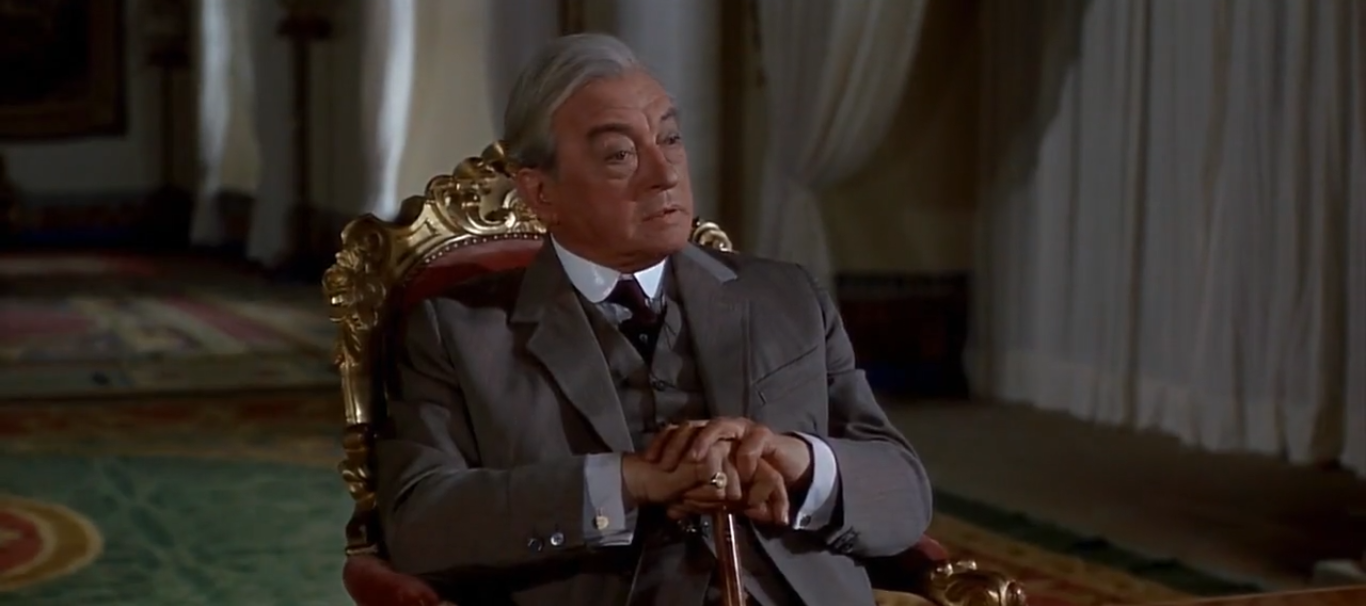
Charles Laughton did not receive an Oscar nomination for portraying Quasimodo in The Hunchback of Notre Dame.
The Hunchback of Notre Dame is a solid enough version of the story bolstered particularly by William Dieterle's direction, and something else.
It is rather interesting to see Charles Laughton to take on this role, perhaps best known previously for proper British gentlemen, though these gentleman certainly varied a great deal in terms of personality. However this is a completely different role for Laughton as Quasimodo the titular Hunchback. Quasimodo in this version of course has his hunchback deformity as well as a skewed eye, bulging half of his face, few teeth in his mouth and to evidently top it all off he is also deaf. The distance given to Quasimodo is far greater since even though he is a leading role, we are often given the perspective of the observer of Quasimodo rather than of the man himself. Now Laughton disappears into the role, which is understandable given the makeup, but that's not all there is to Laughton's work here. Laughton finds the labored movement of Quasimodo due to his hunch, but he goes further revealing the difficult life Quasimodo has had to live in the rest of his face. The wear of such a life can be found imprinted right into the poor soul. Laughton never leaves anything to what is already is there, working with it wholly to make it all singular into his work as Quasimodo. All of it feels completely natural and in way Laughton gives life to the technically artificial elements of the character.
Now Quasimodo's first appearance in this version is during the festival of fools as he makes a surprise appearance to accidentally be the oddest face in order to be crowned the king of fools. Now Laughton is downright brilliant in this first scene as he establishes so well Quasimodo in more than one way. Just about everyone's aversion to him is realized by Laughton because of how effectively he not only gives the sense of his physical state, but also in the way he interacts. Laughton has a disjointed quality about his manner as he realizes how Quasimodo scares those even past his disfigurement. Laughton is terrific in the way he shows Quasimodo's deafness in his awkward method as he is frequently surprised by other people's movement, but Laughton portrays how this surprise may make it appear that he may be dangerous in some way. However even as Laughton establishes this he also alludes to the true nature of Quasimodo in the scene as well. As he looks out at the crowd and those who seem ready to make him the King of the ceremonies, there is a definite enthusiasm that Laughton finds. This enthusiasm is not in terms of the ceremony exactly, but rather Laughton finds the way that Quasimodo is simply incredibly happy to be able to interact with other people.
The film actually keeps Quasimodo at a certain distance for some time as he's merely used by Frollo (Cedric Hardwicke), which gets him into trouble. Quasimodo's trial sorts is another marvelous scene for Laughton as he expresses so well the confusion in Quasimodo as he tries to understand what's going on and tries desperately to communicate in anyway he can. Laughton again finds the inherent awkwardness of Quasimodo in such convincing fashion as he attempts to speak. Laughton's great as he does not reveal Quasimodo to be a unintelligent individual, but rather as someone who can only speak so well given his hearing as well his understandable lack of social skills. The lack of eloquence Laughton finds is not really his choice of words but rather his inability to verbalize them well. Laughton's delivery has the right variation of a man who is actually unable to hear himself speak clearly. There is something so painful about Laughton's work because he is able to show someone reaching out into the world for some sort of connection, but due to everything against him he can't seem to find it. Now fantastic as his ability to create all these traits of Quasimodo that's not all there is to Laughton's performance as we find after he sentenced to a flogging. Everyone seems to ignore his pain except for the gypsy Esmeralda (Maureen O'Hara) who gives him water.
Laughton brings such poignancy in the moment as he presents the relief in Quasimodo physically but also mentally as someone finally seems to care whether he lives or dies. Laughton is outstanding as he brings such sheer jubilation in Quasimodo in the succeeding scenes as in his eyes there is definite hope in him as it seems he's finally found the connection he was seeking. Eventually Quasimodo is able to more than return the favor by saving Esmeralda from hanging and keeps her in sanctuary of the bell tower of Notre Dame. In their initial meeting Laughton is finally able to directly verbalize Quasimodo's own personal hardship, and he does not waste this. As he explains his condition, his name of being half formed, Laughton is extremely moving as he basically laughs and cries at the same time suggesting Quasimodo's pain as well as his attempt to deal with his life by finding humor in it at the same time. Laughton never allows him to be one note in this regard though as he still infuses such eagerness in him as he attempts to connect further with Esmeralda by explaining his life in the bell tower with the few pleasures he does have. There is such a warmth that Laughton is able to bring as he finds without question the humanity behind the "monster". This version of the story is decidedly less tragic than the source material, though that is quite easy to do, the ending of the film still is very powerful largely due to Laughton. Quasimodo acts as the hero, defeating the villain, but in the end Esmeralda as well as the public in general still favor the traditionally handsome hero to fall in love with. This still leaves Quasimodo as an outcast in the end. Laughton is absolutely heartbreaking in his somber delivery of his final lines "why was i not made of stone like thee" as Quasimodo speaks to a Gargoyle, his only companion, as he sees the outside world abandon him once more. This is an astonishing performance by Laughton as he matches all the challenges presented in the role by effortlessly capturing not only the physicality needed for the role, but also even more importantly the emotional core of Quasimodo.
Tuesday, 8 March 2016
Sunday, 6 March 2016
Alternate Best Actor 1939: Conrad Veidt in The Spy in Black
Conrad Veidt did not receive an Oscar nomination for portraying Captain Hardt in The Spy in Black.
The Spy in Black is rather effective spy thriller, though one twist makes the whole plot make no sense, about German spies attempting to destroy the British fleet.
Conrad Veidt plays the German submarine Captain who attempts to carry out the central plot with the help of another German agent posing as a school teacher Frau Tiel played by Valerie Hobson. Veidt and Hobson would team up again the very next year, along with director Michael Powell, this time as two people trying to stop German agents in Contraband. With Contraband and The Spy is Black it is quite interesting to examine Veidt as the leading man to begin with. He's more than a bit atypical given his rather evident German accent. Veidt plays the lead here who technically should be the villain since he's playing the German agent during wartime in a British film. Veidt's a fascinating performer to watch as he actually fits what should be the standard structure of the villain. He's got the mandatory German accent, he's physically imposing to be sure, and Veidt never intentionally subverts his character's position in the way you might expecct. He's obviously believable as the enemy agent, and one should never question his possibility for danger yet even though he is in fact working for an evil regime Veidt prevents Hardt from really being evil.
A great deal of this comes from Veidt calling upon perhaps his greatest asset as a performer his oh so expressive eyes. In the early scenes just as he's being given his marching orders to go about the task Veidt so effectively realizes a hesitation in the man, which he never needs to verbalize this in his performance. Veidt is rather brilliant in that he really somehow is very charming yet never compromises the status of his character. it seems almost intangible in way as Veidt makes Hardt innately likable, though I do think again in those eyes, which made his performance in The Man Who Laughs so special, there is such a genuine humanity. Veidt though importantly is able to remove the result of the act from the motivation of Hardt. Veidt in his performance never makes Hardt seem sadistic in the plan, but rather keeps the drive of the man particularly straight forward. This works in creating the sense that Hardt's not working in any personal malice, but rather simply is doing his duty as a German Captain. The funny thing is Veidt so well reveals these motivations in Hardt that he not only stops him from seeming just as the villain of the film, but also does something that seems more impossible which is to make the German spy rather endearing.
He is helped along by the film to a point as Hardt purposefully dresses as German officer to not be seen as a spy and even questions the less merciful methods of his associates. Veidt makes the most of these moments as he delivers a considerable passion in Hardt as well as a definite disgust as he questions the murder of a civilian. What's pivotal in Veidt's depiction of Hardt comes in with his relationship with apparent fellow spy Tiel. Veidt and Hobson strike up a terrific dynamic with one another, and she helps to make Veidt seem all the more delightful by being so cold herself. The two have rather astonishing chemistry with one another as they manage to develop a romance of sorts between the two despite the certain hostility set between the characters in addition to the fact that little time is devoted to this element. Veidt and Hobson though are able to convey this in just a few pivotal glances and moments that results in something rather special. Now the film's spoiler twist ending comes as it is revealed that everyone besides Captain Hardt is in fact a British agent, and why they don't merely arrest Hardt from the get go is not particularly well established. The film should completely fall apart at this point given how sizable of a plot hole it is, but I still found the film ended up working thanks in large due to Veidt. He stays compelling to watch and so honestly finds the nature of Hardt that he makes it difficult to sympathize with him as he attempts to make his escape. The film even seems to position firmly as the villain at this point yet Veidt never compromises giving a very moving depiction of a Hardt's desperation as his plan falls apart. It's incredibly strong work from Veidt as he really does carry the film past being a spy thriller, where it probably would have failed if that's all it was, through his portrait of a decent man forced to fulfill a terrible duty.
The Spy in Black is rather effective spy thriller, though one twist makes the whole plot make no sense, about German spies attempting to destroy the British fleet.
Conrad Veidt plays the German submarine Captain who attempts to carry out the central plot with the help of another German agent posing as a school teacher Frau Tiel played by Valerie Hobson. Veidt and Hobson would team up again the very next year, along with director Michael Powell, this time as two people trying to stop German agents in Contraband. With Contraband and The Spy is Black it is quite interesting to examine Veidt as the leading man to begin with. He's more than a bit atypical given his rather evident German accent. Veidt plays the lead here who technically should be the villain since he's playing the German agent during wartime in a British film. Veidt's a fascinating performer to watch as he actually fits what should be the standard structure of the villain. He's got the mandatory German accent, he's physically imposing to be sure, and Veidt never intentionally subverts his character's position in the way you might expecct. He's obviously believable as the enemy agent, and one should never question his possibility for danger yet even though he is in fact working for an evil regime Veidt prevents Hardt from really being evil.
A great deal of this comes from Veidt calling upon perhaps his greatest asset as a performer his oh so expressive eyes. In the early scenes just as he's being given his marching orders to go about the task Veidt so effectively realizes a hesitation in the man, which he never needs to verbalize this in his performance. Veidt is rather brilliant in that he really somehow is very charming yet never compromises the status of his character. it seems almost intangible in way as Veidt makes Hardt innately likable, though I do think again in those eyes, which made his performance in The Man Who Laughs so special, there is such a genuine humanity. Veidt though importantly is able to remove the result of the act from the motivation of Hardt. Veidt in his performance never makes Hardt seem sadistic in the plan, but rather keeps the drive of the man particularly straight forward. This works in creating the sense that Hardt's not working in any personal malice, but rather simply is doing his duty as a German Captain. The funny thing is Veidt so well reveals these motivations in Hardt that he not only stops him from seeming just as the villain of the film, but also does something that seems more impossible which is to make the German spy rather endearing.
He is helped along by the film to a point as Hardt purposefully dresses as German officer to not be seen as a spy and even questions the less merciful methods of his associates. Veidt makes the most of these moments as he delivers a considerable passion in Hardt as well as a definite disgust as he questions the murder of a civilian. What's pivotal in Veidt's depiction of Hardt comes in with his relationship with apparent fellow spy Tiel. Veidt and Hobson strike up a terrific dynamic with one another, and she helps to make Veidt seem all the more delightful by being so cold herself. The two have rather astonishing chemistry with one another as they manage to develop a romance of sorts between the two despite the certain hostility set between the characters in addition to the fact that little time is devoted to this element. Veidt and Hobson though are able to convey this in just a few pivotal glances and moments that results in something rather special. Now the film's spoiler twist ending comes as it is revealed that everyone besides Captain Hardt is in fact a British agent, and why they don't merely arrest Hardt from the get go is not particularly well established. The film should completely fall apart at this point given how sizable of a plot hole it is, but I still found the film ended up working thanks in large due to Veidt. He stays compelling to watch and so honestly finds the nature of Hardt that he makes it difficult to sympathize with him as he attempts to make his escape. The film even seems to position firmly as the villain at this point yet Veidt never compromises giving a very moving depiction of a Hardt's desperation as his plan falls apart. It's incredibly strong work from Veidt as he really does carry the film past being a spy thriller, where it probably would have failed if that's all it was, through his portrait of a decent man forced to fulfill a terrible duty.
Saturday, 5 March 2016
Alternate Best Actor 1939: James Cagney in The Roaring Twenties
James Cagney did not receive an Oscar nomination for portraying Eddie Bartlett in The Roaring Twenties.
The Roaring Twenties is a pretty good gangster film about a man trying to make it to top through selling liquor during prohibition.
James Cagney obviously is no stranger to playing gangster roles, but this one's variation comes through the way Eddie Bartlett gets into the rackets to begin with. In The Public Enemy he was already an ambitious hood, in Angels with Dirty Faces he was literally the kid on the wrong side of the rail road track, and later on in White Heat he was already a psychopath. Here Eddie Bartlett starts out as a soldier in World War I, and only comes across crime as a way to make up for the time he lost while in a fox hole. In the early scenes of the film Cagney is good at just playing Eddie a pretty average guy who just is trying to survive in the war, and then later on attempts to find his place back in society which is harder than he expects. Cagney's very good in that he actually makes Eddie's path to crime a rather sympathetic one, by showing the path to be as almost something which he stumbles upon it. There is not an obvious ambition that Cagney portrays as Eddie begins to get involved in the business instead he shows it to be a very honest reaction of a man finding something he can do, no more than that.
Cagney does not compromise the unassuming beginning for Eddie even as he goes about becoming a gangster by setting up his own club, and furthering the illegal operations. Cagney plays Eddie from the start as a charming enough guy who seems conducive to friendship as long as you don't give him a reason to dislike you. There is definite likability that Cagney captures well with Eddie and I particularly like the chemistry he seems to strike up with anyone in his group particularly Eddie's old buddy Danny played by Frank McHugh and Eddie's bootlegging business partner Panama played by Gladys George. Cagney keeps Eddie, even when he is becoming a criminal, still a rather endearing sort as he keeps the central idea behind the cheat of an unpopular law rather than Eddie being a full time villain in the least. As Cagney did in many of his gangster roles, Cagney does not condemn his character for having some moral corruption, despite him being condemned by the codes and standards of the time. Cagney never makes Eddie just a thug and instead presents him as someone one can easily identify with given the situation he is in.
Now this is not to say Cagney keeps Eddie a constant throughout the film by any means. As the film progresses and Eddie becomes more powerful as a gangster Cagney effectively suggests the way Eddie does slowly grow a bit of an ego through a willingness to embrace all elements of the life. Again Cagney does this in a gradual fashion as it never feels as though suddenly Eddie has betrayed himself and instead manages to show the way the lure of the criminal life harms him. Cagney's good as he begins to show that sort of gangster confidence that narrows his personality as a man to the point that he fails to notice a few things the first being that his girlfriend Jean (Priscilla Lane) does not really care for him and perhaps more pressing that his later business partner George (Humphrey Bogart) is a bit of psychopath. Cagney still brings the needed nuance to to Eddie importantly an importantly conveys the revulsion in Eddie as he sees just how cruel George is. However with Eddie's time in the life becomes a capable gangster himself, when dealing with his rivals in the industry. Now these scenes of course are always great for Cagney as he's absolutely in his comfort zone. No one quite threatens and stares down as well as Cagney, but he also earned this transition from the less intense Eddie we knew from the beginning of the film.
There is a bit of a change up for Eddie's story as a gangster as he actually is forced to drop out of the life from the end of prohibition and losing his money due to the stock market crash. To make it all worse Jean leaves him as well. Eddie is left with being a taxi driver as his only means of support. Cagney is terrific in showing just the worn out husk of a man that Eddie has becomes after losing everything that he believed made himself great. Cagney's very moving though by alluding within his sorrow there remains a better man than when he was the king of world. Now here is when the marvel of Cagney's work comes in this film but really all of his best gangster turns, White Heat included despite playing a psychopath. That being he allows Eddie to be more than just a series of gangster mannerisms and a tough exterior. Cagney as per usual reveals really the man within the story. He avoids just being just a two dimensional caricature for the sake of a morality lesson. Cagney finds something more and that's the case here too as he so brilliantly rips your heart right out and you did not even see it coming. By the end of the film Cagney has carried us through Eddie's story and really made him a man to care about despite his shortcomings. When Eddie must meet his fate as a gangster it is made surprisingly poignant because Cagney showed that he was always more than that.
The Roaring Twenties is a pretty good gangster film about a man trying to make it to top through selling liquor during prohibition.
James Cagney obviously is no stranger to playing gangster roles, but this one's variation comes through the way Eddie Bartlett gets into the rackets to begin with. In The Public Enemy he was already an ambitious hood, in Angels with Dirty Faces he was literally the kid on the wrong side of the rail road track, and later on in White Heat he was already a psychopath. Here Eddie Bartlett starts out as a soldier in World War I, and only comes across crime as a way to make up for the time he lost while in a fox hole. In the early scenes of the film Cagney is good at just playing Eddie a pretty average guy who just is trying to survive in the war, and then later on attempts to find his place back in society which is harder than he expects. Cagney's very good in that he actually makes Eddie's path to crime a rather sympathetic one, by showing the path to be as almost something which he stumbles upon it. There is not an obvious ambition that Cagney portrays as Eddie begins to get involved in the business instead he shows it to be a very honest reaction of a man finding something he can do, no more than that.
Cagney does not compromise the unassuming beginning for Eddie even as he goes about becoming a gangster by setting up his own club, and furthering the illegal operations. Cagney plays Eddie from the start as a charming enough guy who seems conducive to friendship as long as you don't give him a reason to dislike you. There is definite likability that Cagney captures well with Eddie and I particularly like the chemistry he seems to strike up with anyone in his group particularly Eddie's old buddy Danny played by Frank McHugh and Eddie's bootlegging business partner Panama played by Gladys George. Cagney keeps Eddie, even when he is becoming a criminal, still a rather endearing sort as he keeps the central idea behind the cheat of an unpopular law rather than Eddie being a full time villain in the least. As Cagney did in many of his gangster roles, Cagney does not condemn his character for having some moral corruption, despite him being condemned by the codes and standards of the time. Cagney never makes Eddie just a thug and instead presents him as someone one can easily identify with given the situation he is in.
Now this is not to say Cagney keeps Eddie a constant throughout the film by any means. As the film progresses and Eddie becomes more powerful as a gangster Cagney effectively suggests the way Eddie does slowly grow a bit of an ego through a willingness to embrace all elements of the life. Again Cagney does this in a gradual fashion as it never feels as though suddenly Eddie has betrayed himself and instead manages to show the way the lure of the criminal life harms him. Cagney's good as he begins to show that sort of gangster confidence that narrows his personality as a man to the point that he fails to notice a few things the first being that his girlfriend Jean (Priscilla Lane) does not really care for him and perhaps more pressing that his later business partner George (Humphrey Bogart) is a bit of psychopath. Cagney still brings the needed nuance to to Eddie importantly an importantly conveys the revulsion in Eddie as he sees just how cruel George is. However with Eddie's time in the life becomes a capable gangster himself, when dealing with his rivals in the industry. Now these scenes of course are always great for Cagney as he's absolutely in his comfort zone. No one quite threatens and stares down as well as Cagney, but he also earned this transition from the less intense Eddie we knew from the beginning of the film.
There is a bit of a change up for Eddie's story as a gangster as he actually is forced to drop out of the life from the end of prohibition and losing his money due to the stock market crash. To make it all worse Jean leaves him as well. Eddie is left with being a taxi driver as his only means of support. Cagney is terrific in showing just the worn out husk of a man that Eddie has becomes after losing everything that he believed made himself great. Cagney's very moving though by alluding within his sorrow there remains a better man than when he was the king of world. Now here is when the marvel of Cagney's work comes in this film but really all of his best gangster turns, White Heat included despite playing a psychopath. That being he allows Eddie to be more than just a series of gangster mannerisms and a tough exterior. Cagney as per usual reveals really the man within the story. He avoids just being just a two dimensional caricature for the sake of a morality lesson. Cagney finds something more and that's the case here too as he so brilliantly rips your heart right out and you did not even see it coming. By the end of the film Cagney has carried us through Eddie's story and really made him a man to care about despite his shortcomings. When Eddie must meet his fate as a gangster it is made surprisingly poignant because Cagney showed that he was always more than that.
Friday, 4 March 2016
Alternate Best Actor 1939: Henry Fonda in Young Mr. Lincoln
Henry Fonda did not receive an Oscar nomination for portraying Abraham Lincoln in Young Mr. Lincoln.
Young Mr. Lincoln is a good film that covers the very early life of Abraham Lincoln, focusing upon his defense of two suspected murderers.
Daniel Day-Lewis's Oscar winning turn as Abraham Lincoln was often noted for his use of a higher pitched, said to be more accurate, voice in his portrayal of Abe Lincoln. That was not the first higher pitch voiced Lincoln to be found, as that's what one will hear in Henry Fonda's performance as Lincoln. Now to be fair it really is basically Fonda's normal voice, which happens to be a great fit, though I don't think the similarities to Day-Lewis's work stop there by any means though. Fonda is made in the film to look more like Lincoln, perhaps slightly overdone in terms of the nose. However Fonda does not just leave the makeup to do the work as he attempts to imitate the man. It's pretty fascinating since unlike imitating someone from modern times Fonda only had paintings and photographs to go off of. Fonda though captures the unique manner of Lincoln found in those sources from his very proper posture, to even the way he sits upon a railing. It never feels like artifice and Fonda manages to make it feel like a natural aspect of the character.
Now this being a biography film of the period means it's not going to be all that hard hitting so to speak. We are given a fairly simple portrait of Abe Lincoln as well an honest guy of course, and his actual biographical portion is pretty short. We only given a glimpse into his relationship with Mary Todd, and his tragic one with Ann Rutledge is shown to be especially short here. To Fonda's credit though he is thoroughly charming in the moments we are given for those possible romances, and manages to make Ann's loss rather moving despite just how swiftly it is handled. The scenes depicting Lincoln out of the public eye are indeed very few though Fonda still succeeds in making a believable depiction of an honest man. Fonda never feels as though he is forcing these qualities and just exudes them as he should. He earns Lincoln's stature, and no not just his height, and makes for a convincing honest Abe. The highlight of his performance though comes in the highlight of the film where he must go about defending two men accused of murder.
In the murder trial, as well as when Lincoln stops a lynch mob the night before, is where the comparisons to Day-Lewis's later work can be freely made. That is again his higher pitched voice is not all there is in terms of his similarities. Fonda goes about carrying himself not as that imposing sort of leader type that say was the way Walter Huston portrayed him in Abraham Lincoln. Fonda gives a nicely relaxed performance, that probably makes his mannerisms also come off as more authentic, as he portrays Lincoln not as man who forces his views or intelligence upon others. Instead Fonda so well conveys the easygoing nature of the man who convinces others to follow his lead almost through a friendly talk, not unlike Day-Lewis's later approach. The attempted lynching scene is absolutely brilliantly played by Fonda as he brings upon a certain self deprecating humor into Lincoln's argument that makes him persuasive in such an unassuming yet wholly effective fashion. Fonda is able to carry a fierce determination in his eyes, but always channels that determination in an understated fashion. The same goes for the trial itself as Fonda rarely even raises his voice so eloquently realizing a true statesman who convinces through a certain goodwill rather than outrage. Fonda suggests a man who allows the person he's trying to persuade choose for himself, he just simply helps the man find the right path. Fonda has that needed magnetism here as one can see the great president he will become even though we never get close to that part of the story here. I would not have minded if the film continued to allow Fonda to depict more of Lincoln's life because his approach here is noteworthy, and I can't help but wonder if he might have influenced Day-Lewis take on the man. It's very strong work from Fonda even within the limitations of the role and the film's story line.
Young Mr. Lincoln is a good film that covers the very early life of Abraham Lincoln, focusing upon his defense of two suspected murderers.
Daniel Day-Lewis's Oscar winning turn as Abraham Lincoln was often noted for his use of a higher pitched, said to be more accurate, voice in his portrayal of Abe Lincoln. That was not the first higher pitch voiced Lincoln to be found, as that's what one will hear in Henry Fonda's performance as Lincoln. Now to be fair it really is basically Fonda's normal voice, which happens to be a great fit, though I don't think the similarities to Day-Lewis's work stop there by any means though. Fonda is made in the film to look more like Lincoln, perhaps slightly overdone in terms of the nose. However Fonda does not just leave the makeup to do the work as he attempts to imitate the man. It's pretty fascinating since unlike imitating someone from modern times Fonda only had paintings and photographs to go off of. Fonda though captures the unique manner of Lincoln found in those sources from his very proper posture, to even the way he sits upon a railing. It never feels like artifice and Fonda manages to make it feel like a natural aspect of the character.
Now this being a biography film of the period means it's not going to be all that hard hitting so to speak. We are given a fairly simple portrait of Abe Lincoln as well an honest guy of course, and his actual biographical portion is pretty short. We only given a glimpse into his relationship with Mary Todd, and his tragic one with Ann Rutledge is shown to be especially short here. To Fonda's credit though he is thoroughly charming in the moments we are given for those possible romances, and manages to make Ann's loss rather moving despite just how swiftly it is handled. The scenes depicting Lincoln out of the public eye are indeed very few though Fonda still succeeds in making a believable depiction of an honest man. Fonda never feels as though he is forcing these qualities and just exudes them as he should. He earns Lincoln's stature, and no not just his height, and makes for a convincing honest Abe. The highlight of his performance though comes in the highlight of the film where he must go about defending two men accused of murder.
In the murder trial, as well as when Lincoln stops a lynch mob the night before, is where the comparisons to Day-Lewis's later work can be freely made. That is again his higher pitched voice is not all there is in terms of his similarities. Fonda goes about carrying himself not as that imposing sort of leader type that say was the way Walter Huston portrayed him in Abraham Lincoln. Fonda gives a nicely relaxed performance, that probably makes his mannerisms also come off as more authentic, as he portrays Lincoln not as man who forces his views or intelligence upon others. Instead Fonda so well conveys the easygoing nature of the man who convinces others to follow his lead almost through a friendly talk, not unlike Day-Lewis's later approach. The attempted lynching scene is absolutely brilliantly played by Fonda as he brings upon a certain self deprecating humor into Lincoln's argument that makes him persuasive in such an unassuming yet wholly effective fashion. Fonda is able to carry a fierce determination in his eyes, but always channels that determination in an understated fashion. The same goes for the trial itself as Fonda rarely even raises his voice so eloquently realizing a true statesman who convinces through a certain goodwill rather than outrage. Fonda suggests a man who allows the person he's trying to persuade choose for himself, he just simply helps the man find the right path. Fonda has that needed magnetism here as one can see the great president he will become even though we never get close to that part of the story here. I would not have minded if the film continued to allow Fonda to depict more of Lincoln's life because his approach here is noteworthy, and I can't help but wonder if he might have influenced Day-Lewis take on the man. It's very strong work from Fonda even within the limitations of the role and the film's story line.
Thursday, 3 March 2016
Alternate Best Actor 1939
And the Nominees Were Not:
Charles Laughton in The Hunchback of Notre Dame
Conrad Veidt in The Spy in Black
Henry Fonda in Young Mr. Lincoln
James Cagney in The Roaring Twenties
Basil Rathbone in The Hound of Baskervilles
Charles Laughton in The Hunchback of Notre Dame
Conrad Veidt in The Spy in Black
Henry Fonda in Young Mr. Lincoln
James Cagney in The Roaring Twenties
Basil Rathbone in The Hound of Baskervilles
Wednesday, 2 March 2016
Alternate Best Supporting Actor 1962: Results
5. Robert Duvall in To Kill a Mockingbird - Duvall gives a flawless performance that fully realizes his his pivotal character in a matter of 3 minutes.
Best Scene: His only scene.
4. Lee Marvin in The Man Who Shot Liberty Valance - Marvin gives a memorable villainous turn by being the absolute lout bully that Liberty Valance should be.
Best Scene: The duel.
3. Tatsuya Nakadai in Sanjuro - Nakadai once again offers a worthy adversary for Toshiro Mifune's nameless samurai, but this time surprisingly strikes up a certain underlying connection between the foes.
Best Scene: The duel.
2. Robert Ryan in Billy Budd - Ryan gives one of his best performances, giving a chilling portrayal of a sadist, but also manages to find the depth within what compels the man.
Best Scene: Billy tries to comfort Claggart.
1. Peter Sellers in Lolita - Sellers gives an amazing performance as he's absolutely hilarious, but also manages to be surprisingly unnerving in the role at the same time.
Best Scene: Just a normal guy with a normal face.
7. Arthur Kennedy - Kennedy offers the needed two sides to his character the slightly shallow broadcaster, but as well the sardonic man who is well aware of what he is doing.
Best Scene: "I'll take your bloody picture"
6. Anthony Quayle - Quayle brings surprising depth to his role as he quietly portrays the affecting arc of his character, which is to fully understand who Lawrence really was.
Best Scene: The funeral.
5. Anthony Quinn - Quinn gives an appropriately larger than life performance capturing the grandeur needed for the role, but importantly finds the right nuance when it is needed.
Best Scene: Tayi and Brighton.
4. Jack Hawkins - Hawkins naturally fulfills the role of the proper British General but goes further in his exploration of his character's relationship with Lawrence.
Best Scene: Allenby convinces Lawrence to take up the fight again.
3. Alec Guinness - As per usual Guinness gives strong work successfully disappearing into his role as well as giving a rather captivating portrait of a quiet yet powerful leader.
Best Scene: Faisal is interviewed.
2. Jose Ferrer - A brilliant one scene wonder as he completely realizes his character's disposition and finds the needed subtext of his scene through his performance.
Best Scene: His scene.
1. Claude Rains - Good predictions mcofra7, and Jackiboyz. Rains gives such an excellent performance as he does not waste a second in creating a fascinating depiction of a smooth political operator.
Best Scene: The ending.
Overall Rank:
Best Scene: His only scene.
4. Lee Marvin in The Man Who Shot Liberty Valance - Marvin gives a memorable villainous turn by being the absolute lout bully that Liberty Valance should be.
Best Scene: The duel.
3. Tatsuya Nakadai in Sanjuro - Nakadai once again offers a worthy adversary for Toshiro Mifune's nameless samurai, but this time surprisingly strikes up a certain underlying connection between the foes.
Best Scene: The duel.
2. Robert Ryan in Billy Budd - Ryan gives one of his best performances, giving a chilling portrayal of a sadist, but also manages to find the depth within what compels the man.
Best Scene: Billy tries to comfort Claggart.
1. Peter Sellers in Lolita - Sellers gives an amazing performance as he's absolutely hilarious, but also manages to be surprisingly unnerving in the role at the same time.
Best Scene: Just a normal guy with a normal face.
7. Arthur Kennedy - Kennedy offers the needed two sides to his character the slightly shallow broadcaster, but as well the sardonic man who is well aware of what he is doing.
Best Scene: "I'll take your bloody picture"
6. Anthony Quayle - Quayle brings surprising depth to his role as he quietly portrays the affecting arc of his character, which is to fully understand who Lawrence really was.
Best Scene: The funeral.
5. Anthony Quinn - Quinn gives an appropriately larger than life performance capturing the grandeur needed for the role, but importantly finds the right nuance when it is needed.
Best Scene: Tayi and Brighton.
4. Jack Hawkins - Hawkins naturally fulfills the role of the proper British General but goes further in his exploration of his character's relationship with Lawrence.
Best Scene: Allenby convinces Lawrence to take up the fight again.
3. Alec Guinness - As per usual Guinness gives strong work successfully disappearing into his role as well as giving a rather captivating portrait of a quiet yet powerful leader.
Best Scene: Faisal is interviewed.
2. Jose Ferrer - A brilliant one scene wonder as he completely realizes his character's disposition and finds the needed subtext of his scene through his performance.
Best Scene: His scene.
1. Claude Rains - Good predictions mcofra7, and Jackiboyz. Rains gives such an excellent performance as he does not waste a second in creating a fascinating depiction of a smooth political operator.
Best Scene: The ending.
Overall Rank:
- Peter Sellers in Lolita
- Robert Ryan in Billy Budd
- Omar Sharif in Lawrence of Arabia
- Claude Rains in Lawrence of Arabia
- Tatsuya Nakadai in Sanjuro
- Lee Marvin in The Man Who Shot Liberty Valance
- Jose Ferrer in Lawrence of Arabia
- Brock Peters in To Kill a Mockingbird
- Alec Guinness in Lawrence of Arabia
- Robert Duvall in To Kill a Mockingbird
- Jack Hawkins in Lawrence of Arabia
- Charles Bickford in Days of Wine and Roses
- Burgess Meredith in Advise & Consent
- Ed Begley in Sweet Bird of Youth
- James Gregory in The Manchurian Candidate
- Anthony Quinn in Lawrence of Arabia
- Melvyn Douglas in Billy Budd
- Anthony Quayle in Lawrence of Arabia
- Charles Laughton in Advise & Consent
- Karl Malden in Birdman of Alcatraz
- Lee Montague in Billy Budd
- Arthur Kennedy in Lawrence of Arabia
- Lew Ayres in Advise & Consent
- Frank Overton in To Kill a Mockingbird
- Joseph Wiseman in Dr. No
- David McCallum in Freud
- Richard Harris in Mutiny on the Bounty
- Woody Strode in The Man Who Shot Liberty Valance
- Richard Attenborough in All Night Long
- Henry Fonda in Advise & Consent
- John McGiver in The Manchurian Candidate
- Jack Klugman in Days of Wine and Roses
- Rentaro Mikuni in Harakiri
- David McCallum in Billy Budd
- Edmond O'Brien in The Man Who Shot Liberty Valance
- Michael Redgrave in The Loneliness of the Long Distance Runner
- Khigh Dheigh in The Manchurian Candidate
- Paul Rogers in Billy Budd
- Victor Buono in What Ever Happened to Baby Jane?
- Akira Ishihama in Harakiri
- Walter Pidgeon in Advise & Consent
- Robert Brown in Billy Budd
- Gary Cockrell in Lolita
- John Carradine in The Man Who Shot Liberty Valance
- Yuzo Kayama in Sanjuro
- John Neville in Billy Budd
- Jack Kruschen in Cape Fear
- John Megna in To Kill a Mockingbird
- Buddy Hackett in The Music Man
- Telly Savalas in Cape Fear
- Andy Devine in The Man Who Liberty Valance
- Martin Balsam in Cape Fear
- Rip Torn in Sweet Bird of Youth
- Takashi Shimura in Sanjuro
- Hugh Griffith in Mutiny on the Bounty
- James Anderson in To Kill a Mockingbird
- Andrew Prine in The Miracle Worker
- Paul Fix in To Kill a Mockingbird
- Larry Parks in Freud
- Wesley Addy in What Ever Happened to Baby Jane?
- Telly Savalas in Birdman of Alcatraz
- Don Murray in Advise & Consent
- Edmond O'Brien in Birdman of Alcatraz
- Henry Silva in The Manchurian Candidate
- Victor Jory in The Miracle Worker
- Jack Lord in Dr. No
- Ron Howard in The Music Man
- Keith Mitchell in All Night Long
Tuesday, 1 March 2016
Alternate Best Supporting Actor 1962: Alec Guinness, Anthony Quayle, Anthony Quinn, Arthur Kennedy, Claude Rains, Jack Hawkins, and Jose Ferrer in Lawrence of Arabia
Lawrence of Arabia is often touted as one of the greatest films of all time, and deservedly so. However it's one of those films were some elements are often overlooked in its praise. Of course the masterful vision of David Lean's direction, the sheer scope, and Peter O'Toole performance as Lawrence are praised, again deservedly so. What seems more often a little overlooked is how well developed the cast of characters are along with Lawrence, it is not a one character piece. These smaller, yet not underdeveloped roles, are help realized by the film's brilliant screenplay and of course its large ensemble.
Alec Guinness did not receive an Oscar nomination for portraying Prince Faisal in Lawrence of Arabia.
Naturally David Lean's frequent collaborator is in the mix here as the Arab Prince who is most active in his rebellion against the Turkish Empire. Alec Guinness disappears into the role of Faisal, which could be surprising if this were not Alec Guinness. Guinness somehow wears the makeup particularly well, and his adjustment to his accent is especially effective in realizing Faisal's character. Guinness carries himself with the needed quiet dignity of a man who does not use many words, but only seems to make use of important words. Guinness is rather captivating in the way exudes the authority of Faisal with such an ease. He has the grace of a truly great leader. The intelligence of the man just seems a given by Guinness's performance as he very plays Faisal as a leader who is constantly listening to those around him. There's something so special about Guinness's use of his eyes here as they are piercing yet comforting at the same time realizing Faisal as both a man that does not enforce himself upon you, however you cannot ignore his presence.
This is something very interesting about the way Guinness manages to conduct himself as Faisal in that he makes him seem as though he's somewhat aloof, though paints this as merely a facade in order disarm those around him. Guinness presents Faisal as an educated man, but one who purposefully does not try to remove himself from the simple view that a foreigner may take from him. Guinness's approach here is very effective as he shows the way that Faisal does this in order for his more important remarks to be all the more incisive. Guinness utilizes the set up so well as he has this the overriding feature of Faisal yet still suggests so much more about him. There's a great scene for Guinness when the Prince is interviewed about his campaign. Guinness is so good as he keeps Faisal the proper Prince on the surface, however underneath it Guinness finds a striking cutting edge to the man when he states that for him mercy is only good manners. The same holds true in the scenes where he directly interacts with the British high command. There is a definite determination, a far more fervent desire, that Guinness brings within this as Faisal questions the British intentions, and later when he goes into direct negotiations with them. Speaking of the British High Command.
Jack Hawkins did not receive an Oscar nomination for portraying General Allenby in Lawrence of Arabia.
Hawkins, having already collaborated with Lean on The Bridge on the River Kwai, once again returns as a British Officer this one of a somewhat different sort. Hawkins's carries himself as one would expect from a proper British General, that being an assured yet respectful command. Now this is the sort of role that very well could have been just the standard authority figure there to occasionally move along Lawrence's story. That's never the case as Hawkins's performance brings much more nuance to the role than one might even expect. Already important whenever Allenby speaks of military matters Hawkins portrays that proper assurance and passion for his duties. Whenever a political working comes up Hawkins infuses the right sort of exasperation delivering well Allenby's frequent aside of "I'm not a politician, thank God!", though this in itself is not simplified by Hawkins as indifference. Hawkins instead presents an underlying understanding in Allenby that he definitely knows the political issues, but uses this exasperation as basically a defense to make it so he barely has to speak of it.
Hawkins is especially strong in his scenes where he converses with Lawrence directly. Hawkins does well to show the different wavelengths that Allenby is playing at. He keeps the stature of the General correctly when trying support Lawrence's ideas, or attempt to explain away that the English may intend to take Arabia for themselves. Hawkins does not leave it at that though revealing a bit of introspection in Allenby as he puts forth some casual jealousy in the man when he ponders about his own stature when compared to Lawrence's. My favorite moments of Hawkins's though is when Allenby attempts to get Lawrence back on track in terms of defeating the Turkish empire. These moments could have been easy enough to show Allenby attempting to get Lawrence to tow the line so to speak. I love that Hawkins does not play it that way as he calls upon the certain chemistry he has with O'Toole to make it more than that. Hawkins exudes an underlying respect Allenby has as his glances which suggest that Allenby sees the man he wishes he could be. When Allenby encourages Lawrence to take back the fight once again Hawkins is genuinely inspirational as he brings so much vigor in his eyes and words as he tells Lawrence to go on and fulfill his destiny.
Now a favorite scene of mine for both Hawkins and Guinness is near the end of the film where the two argue over who Lawrence belongs to, and the two are forced to decide that he is equally useless for the both of them since either side can lay claim to his actions. Both Hawkins and Guinness are rather cold in this moment by speaking as men of straight duty trying to simply get their demands across without much care for who it might effect. The two do share an equally memorable moment though just as they agree to basically forget Lawrence and get onto more business. Before that though Hawkins and Guinness each have a silent reaction that is quietly moving as Faisal and Allenby each for the moment suggest what Lawrence really does mean to them, before overcoming their emotional connection and moving on. Both Guinness and Hawkins do very commendable work here since either could have been reduced to caricatures of just an Arab Prince or a British General, and could have been just there to occasionally move the plot along. Neither actor allows this to be the case. They both are able to realize not only what are Allenby's and Faisal's motivations, but also who they are as men as well as what their relationship with Lawrence truly is.
(For Hawkins and Guinness)
Anthony Quinn did not receive an Oscar nomination for portraying Auda Ibu Tayi in Lawrence of Arabia.
Anthony Quinn plays Auda Ibu Tayi who appears as the leader of a large tribe who Lawrence convinces to join the cause, despite Tayi originally being paid to fight for the Turks. Now this is a role where you get technically what you'd expect, but that's not a problem. This is a very much in Quinn's wheelhouse as a larger than life warrior type which is fitting for a man who will ride into battle because it is "his pleasure" to do so. Quinn brings that boisterous power to his performance, that grand stature of a man who is a true leader of his people, and wholly embraces his life style of war. Quinn's performance excels in just being the spirited aggressive force he should be, as his ability and willingness to ride into war is something that it is obvious he lives for with every breath that he takes. Quinn stands as high as he can in the role as he frankly does not hold back in terms of the exuberance he brings to the part, and nor should he. It fits so well with who Auda Ibu Tayi needs to be for the film, and Quinn stands out by presenting someone in the story who fights exactly for what he says he fights for. He has no hidden motives for his war path.
Quinn is indeed very entertaining in the role as he enlivens the screen with his presence at any given moment he is in. He has some very enjoyable moments as he shows Tayi's personal beliefs that he is very passionate about. He is also effective in showing the certain callousness that comes from such a man, particularly in his brutally straight forward delivery of "It was written then" when he hears that Lawrence had to execute man he previously risked his life to save. Quinn though does well to not make Tayi too simplistic ever. He carefully throughout the film portrays Tayi's growing personal respect for Lawrence. I really like the way he does this still within in his own blunt personal style of course. There's a moment towards the end of the film between Lawrence's right hand man Sherif Ali (Omar Sharif), and Auda Ibu Tayi, where Ali actually threatens Tayi with violence. However it's actually made a rather poignant scene by both actors as they reveal a stronger concern for Lawrence than they are willing to let on. I like how Quinn keeps Tayi rather uncouth as speaks to Ali on the matter, yet he still alludes to Tayi's own honest sympathy for their ally. Quinn's work contributes well to the film offering the right larger than life figure in Tayi, while still finding some depth within him.
Anthony Quayle did not receive an Oscar nomination for portraying Colonel Brighton in Lawrence of Arabia.
Quayle's performance here is actually rather interesting one to examine since just with a cursory glance there may not seem to be much to the character, though there actually is as he has perhaps the third most dynamic character arc after Lawrence and Sherif Ali. The earliest point chronologically speaking that we meet Brighton is when Lawrence first appears to Prince Faisal's camp. Brighton in these scenes very much is the proper British officer who just wants Lawrence to keep quiet, and stick to the plans devised by the British high command. Now apparently Quayle and Lean argued over the portrayal of Brighton as a character with Quayle wishing to play him as a fool while Lean wished for him to be shown as an honorable man. The intriguing part of this is that watching the performance you can take either interpretation to what interpretation took precedence. In that it seems Quayle went about playing it that Brighton's foolishness in fact allows him to be honorable. This is shown even when he's the British officer telling Prince Faisal to do things that mainly benefit the British, but Quayle actually does play Brighton as genuinely believing this to be their best course of action.
Now Brighton's arc is not heavily focused upon but based around his view of Lawrence changing throughout the film. Obviously he begins frankly as an obstacle who wishes to keep Lawrence from making any sort of real impact. However Lawrence proves everyone wrong by taking an important city in a way that no one believed could have been done. When Brighton continues to work along with Lawrence as they proceed to attack the Turkish rail lines. Quayle keeps the skepticism with Brighton, though it is not nearly as strong as it was a before. Quayle though is in one very good scene where he questions some of the Arabs' motivation including Auda Ibu Tayi's. Again both interpretations potentially shine through though it is no less effective as Quayle reveals the intense discontent in Brighton against them. Again Quayle manages both because, he may be foolish to hold such a simple view, yet he is honorable as Quayle once again brings only a genuine passion to Brighton as man who believes one should fight for what one believes in. Now the character's transition in regards to Lawrence continues throughout the film, and Quayle gradually reflects in Brighton as a further understanding of the man. That brings it to his most pivotal moments of the film, that are at completely opposite points in the film. That being his first and last scene, his first scene taking place after Lawrence's death, but each show Brighton's final perspective on the man. The first scene Quayle is rather moving in showing Brighton fully accepting the important, and rather great man that Lawrence was at his funeral, as in the end both men fought for what they believed was right. His last scene is equally strong as Quayle presents Brighton as the one man who can appreciate what Lawrence did without exception through his depiction of Brighton's disdain as he sees that everyone else in the end was merely using him for their own ends. This somewhat brief work once again brings so much unexpected depth to the role, and in turn the film, as Quayle makes Brighton anything but a stock side character.
Arthur Kennedy did not receive an Oscar nomination for portraying Jackson Bentley in Lawrence of Arabia.
Arthur Kennedy plays an American photojournalist based upon the real Lowell Thomas who helped to make Lawrence famous. Kennedy's not an actor who has always been a favorite of mine, though I don't dislike him, but his performance style works quite well for this part. That being Kennedy's usual method of rather accentuated delivery. This feels completely fitting for the role of Bentley as he depicts Bentley very much as a man ready to make a radio broadcast with his words. Kennedy is very good in the scenes where he is in essentially interviewer mode. Kennedy feels like a true broadcaster in these scenes as he kind of has that false refinement of sorts as he speaks so directly, and specifically about topics yet one can't help but feel he's reciting from a script. Kennedy's good in the way he undercuts that when someone basically ask Bentley for a more direct, more honest answer. Such as when Faisal asks really why Bentley's interested in Lawrence after receiving some platitudes previously. Kennedy drops the act for a moment, but importantly does not show Bentley to stumble with this. He still shows him to be an intelligent man, but rather just more naturally responds as he states the exact reason for wishing to cover Lawrence.
Kennedy's good in the scenes where he interacts with Lawrence, and the rest of the party. This is largely because Kennedy embraces the idea that Bentley is able to be the most detached from the situation given that he's really there just to get a good story out of Lawrence. Kennedy reveals the right enthusiasm as he goes about taking Lawrence's picture, and getting the icon he's looking for. Kennedy again brings back the proper broadcaster routine as he interviews Lawrence, as well as Sherif Ali, and he's very effective in the way he drifts from that to a semi-sardonic observer whenever Bentley decides on a bit of an editorial. One of his best moments is in his first scene as he eulogizes Lawrence first in a proper memorial ready for a headline which Kennedy delivers with the utmost passion and respect, then a second later the truth about the man's shortcoming which Kennedy delivers with a definite sarcastic edge. I love that not even the understandably detached Bentley is not only defined by that. Kennedy has a great final scene where he must witness a changed Lawrence as he goes on a massacre of a Turkish brigade. It's a brief moment but rather affecting one as Kennedy bluntly shows that Bentley cannot be detached from what Lawrence has done. Kennedy's excellent in revealing how disturbed Bentley is by what he sees and the outrage as he still must go about his duty to glorify Lawrence. Again this is not a huge role yet Kennedy makes a definite impact with Bentley. He successfully, in just his few scenes, creates a portrait of this journalist as man ready to make stories for more mainstream public consumption yet is well aware of the reality.
Jose Ferrer did not receive an Oscar nomination for portraying the Turkish Bey in Lawrence of Arabia.
Jose Ferrer has the smallest role out of everyone listed here. He only appears in two scenes, one for only a few seconds. His second scene takes place as Lawrence is caught by a few Turkish soldiers and taken to their superior played by Ferrer. Ferrer apparently believed this to be his greatest performance, and I'm a bit inclined to agree despite its brevity. Ferrer is brilliant as he instantly set up his character in the way he simply looks up from his desk as we see a truly exhausted individual. Physically speaking of course but more so mentally. The way he walks even keeps the proper military step yet so labored it is of a man who just is barely keeping to his step. The man then proceeds to look over the potential suspects and Ferrer again is outstanding in the way he slowly reveals more of this man. At first it seems like he might be looking for someone important as he scans the man. As we see a little longer though Ferrer's expression becomes somewhat more peculiar as he decides on Lawrence to be the man who is kept. At first it seems that Lawrence may be found out, which would mean his death, as the Bey notes his eye color. Ferrer though notes this not as though Bey is making a great discovering as an officer in the Turkish army, but rather has found something he finds rather appealing. When the Bey ponders on the fact that he's the only one who notices interesting faces where he is particularly stationed, Ferrer alludes to a consternation. This consternation is not made by Ferrer as that of a man frustrated by the lack intelligent discussion, but rather that of sexual frustration. Ferrer is terrific as he subtly reveals a bit of ache in the Bey as he examines Lawrence, and that ache he's ready to satisfy as he states to his men to "beat him" with a understated glee. After Lawrence is released he's never quite the same man. We know he was beaten but largely due to Ferrer's work we can assume it did not stop there. Ferrer's performance is outstanding as he effortlessly realizes the subtext of the scene. Ferrer like the rest of the cast, though with even less time, makes Bey more than simply a Turkish officer who detains Lawrence, far far more.
Claude Rains did not receive an Oscar nomination for portraying Mr. Dryden in Lawrence of Arabia.
Now as for Claude Rains we have one of the greatest actors of all time in one of his final roles. A quick side note I must admit there is something enjoyable to see as he and the man he shares the record for most supporting actor nominations without a win with, Arthur Kennedy, share a direct interaction with one another. Anyway Rains's performance is sort of a hidden treasure in the film. Say on a initial viewing you pay no mind to Dryden, you're missing something rather special hidden right in front of you. Rains plays Dryden the head of the Arab bureau basically the man who deals with the political matters connected with the Arab campaign. Dryden is in a more than a handful of scenes, and though he does not have an excessive amount of lines he has some pivotal ones. The thing is that the lines themselves, though well written, could often be meaningless if it weren't for Rains's delivery of them. Rains conducts himself so well here as he has Mr. Dryden be someone who takes his time in his movement, yet there is never a question that he's a man who knows exactly where he should be. The level of assurance that Rains conveys with such ease makes the strong willed characters seem meek in way, even though Rains keeps Mr. Dryden so carefully unassuming in his personal style.
Rains is terribly clever here as he makes a man so terribly clever in such a tricky way. When he sends Lawrence on his original mission it seems simple enough, yet the potential involved from the mission seems in Rains's expression the whole time. Rains makes Dryden actually the most powerful man in the film, even though he never states his power in least. In fact he acts as though he's just a modest official who has no great ambitions. There's one magnificent scene where he, Brighton, and Allenby discuss the ability to give the Arabs artillery. It is Dryden who makes decision, even though he specifically states it's Allenby's decision, yet the way Rains conveys the message within a question seems so incisive, more than if even directly told Allenby what to do. There's another great moment when Allenby inquires to Dryden if Britain has any plans for Arabia. Dryden states only that "it's a difficult question" but Rains is so perfect in making it a casual deflection yet in his expression there is no question on the matter in Dryden's mind. Rains is amazing in the way he makes it that Dryden really is always in charge even though he never in fact gives away his position. Rains could not be smoother in how eloquent he is in the depiction of a truly seasoned political operator. Rains is even fantastic when he's not do anything. Even in scenes where he is silent every glance is worth something due to Rains. He suggests Dryden analyzing and dissecting everything he sees. It is fascinating to just watch Rains in any given scene as there's not a wasted second in the entirety of his performance. One favorite moment of mine is when Dryden notices cuts have reopened on Lawrence's back, and Dryden for brief instance tries to inform Lawrence of this. Rains's reaction is so good, even humorous in a way, as he shows as Dryden quickly evaluates the situation and decides it's best not get involved with this issue. Another magnificent moment for Rains is at the end of the film is when he finally responds to Allenby claiming not to be a politician. Rains is hilarious, but also oh so shrewd as Dryden subtly scoffs at hearing the rather false claim once again. I love everything about this performance as Rains adds so much to film with a part that with the wrong actor have easily almost just been part of the background. It's such an astute piece of work by Rains as he does so much with so little.
Alec Guinness did not receive an Oscar nomination for portraying Prince Faisal in Lawrence of Arabia.
Naturally David Lean's frequent collaborator is in the mix here as the Arab Prince who is most active in his rebellion against the Turkish Empire. Alec Guinness disappears into the role of Faisal, which could be surprising if this were not Alec Guinness. Guinness somehow wears the makeup particularly well, and his adjustment to his accent is especially effective in realizing Faisal's character. Guinness carries himself with the needed quiet dignity of a man who does not use many words, but only seems to make use of important words. Guinness is rather captivating in the way exudes the authority of Faisal with such an ease. He has the grace of a truly great leader. The intelligence of the man just seems a given by Guinness's performance as he very plays Faisal as a leader who is constantly listening to those around him. There's something so special about Guinness's use of his eyes here as they are piercing yet comforting at the same time realizing Faisal as both a man that does not enforce himself upon you, however you cannot ignore his presence.
This is something very interesting about the way Guinness manages to conduct himself as Faisal in that he makes him seem as though he's somewhat aloof, though paints this as merely a facade in order disarm those around him. Guinness presents Faisal as an educated man, but one who purposefully does not try to remove himself from the simple view that a foreigner may take from him. Guinness's approach here is very effective as he shows the way that Faisal does this in order for his more important remarks to be all the more incisive. Guinness utilizes the set up so well as he has this the overriding feature of Faisal yet still suggests so much more about him. There's a great scene for Guinness when the Prince is interviewed about his campaign. Guinness is so good as he keeps Faisal the proper Prince on the surface, however underneath it Guinness finds a striking cutting edge to the man when he states that for him mercy is only good manners. The same holds true in the scenes where he directly interacts with the British high command. There is a definite determination, a far more fervent desire, that Guinness brings within this as Faisal questions the British intentions, and later when he goes into direct negotiations with them. Speaking of the British High Command.
Jack Hawkins did not receive an Oscar nomination for portraying General Allenby in Lawrence of Arabia.
Hawkins, having already collaborated with Lean on The Bridge on the River Kwai, once again returns as a British Officer this one of a somewhat different sort. Hawkins's carries himself as one would expect from a proper British General, that being an assured yet respectful command. Now this is the sort of role that very well could have been just the standard authority figure there to occasionally move along Lawrence's story. That's never the case as Hawkins's performance brings much more nuance to the role than one might even expect. Already important whenever Allenby speaks of military matters Hawkins portrays that proper assurance and passion for his duties. Whenever a political working comes up Hawkins infuses the right sort of exasperation delivering well Allenby's frequent aside of "I'm not a politician, thank God!", though this in itself is not simplified by Hawkins as indifference. Hawkins instead presents an underlying understanding in Allenby that he definitely knows the political issues, but uses this exasperation as basically a defense to make it so he barely has to speak of it.
Hawkins is especially strong in his scenes where he converses with Lawrence directly. Hawkins does well to show the different wavelengths that Allenby is playing at. He keeps the stature of the General correctly when trying support Lawrence's ideas, or attempt to explain away that the English may intend to take Arabia for themselves. Hawkins does not leave it at that though revealing a bit of introspection in Allenby as he puts forth some casual jealousy in the man when he ponders about his own stature when compared to Lawrence's. My favorite moments of Hawkins's though is when Allenby attempts to get Lawrence back on track in terms of defeating the Turkish empire. These moments could have been easy enough to show Allenby attempting to get Lawrence to tow the line so to speak. I love that Hawkins does not play it that way as he calls upon the certain chemistry he has with O'Toole to make it more than that. Hawkins exudes an underlying respect Allenby has as his glances which suggest that Allenby sees the man he wishes he could be. When Allenby encourages Lawrence to take back the fight once again Hawkins is genuinely inspirational as he brings so much vigor in his eyes and words as he tells Lawrence to go on and fulfill his destiny.
Now a favorite scene of mine for both Hawkins and Guinness is near the end of the film where the two argue over who Lawrence belongs to, and the two are forced to decide that he is equally useless for the both of them since either side can lay claim to his actions. Both Hawkins and Guinness are rather cold in this moment by speaking as men of straight duty trying to simply get their demands across without much care for who it might effect. The two do share an equally memorable moment though just as they agree to basically forget Lawrence and get onto more business. Before that though Hawkins and Guinness each have a silent reaction that is quietly moving as Faisal and Allenby each for the moment suggest what Lawrence really does mean to them, before overcoming their emotional connection and moving on. Both Guinness and Hawkins do very commendable work here since either could have been reduced to caricatures of just an Arab Prince or a British General, and could have been just there to occasionally move the plot along. Neither actor allows this to be the case. They both are able to realize not only what are Allenby's and Faisal's motivations, but also who they are as men as well as what their relationship with Lawrence truly is.
(For Hawkins and Guinness)
Anthony Quinn did not receive an Oscar nomination for portraying Auda Ibu Tayi in Lawrence of Arabia.
Anthony Quinn plays Auda Ibu Tayi who appears as the leader of a large tribe who Lawrence convinces to join the cause, despite Tayi originally being paid to fight for the Turks. Now this is a role where you get technically what you'd expect, but that's not a problem. This is a very much in Quinn's wheelhouse as a larger than life warrior type which is fitting for a man who will ride into battle because it is "his pleasure" to do so. Quinn brings that boisterous power to his performance, that grand stature of a man who is a true leader of his people, and wholly embraces his life style of war. Quinn's performance excels in just being the spirited aggressive force he should be, as his ability and willingness to ride into war is something that it is obvious he lives for with every breath that he takes. Quinn stands as high as he can in the role as he frankly does not hold back in terms of the exuberance he brings to the part, and nor should he. It fits so well with who Auda Ibu Tayi needs to be for the film, and Quinn stands out by presenting someone in the story who fights exactly for what he says he fights for. He has no hidden motives for his war path.
Quinn is indeed very entertaining in the role as he enlivens the screen with his presence at any given moment he is in. He has some very enjoyable moments as he shows Tayi's personal beliefs that he is very passionate about. He is also effective in showing the certain callousness that comes from such a man, particularly in his brutally straight forward delivery of "It was written then" when he hears that Lawrence had to execute man he previously risked his life to save. Quinn though does well to not make Tayi too simplistic ever. He carefully throughout the film portrays Tayi's growing personal respect for Lawrence. I really like the way he does this still within in his own blunt personal style of course. There's a moment towards the end of the film between Lawrence's right hand man Sherif Ali (Omar Sharif), and Auda Ibu Tayi, where Ali actually threatens Tayi with violence. However it's actually made a rather poignant scene by both actors as they reveal a stronger concern for Lawrence than they are willing to let on. I like how Quinn keeps Tayi rather uncouth as speaks to Ali on the matter, yet he still alludes to Tayi's own honest sympathy for their ally. Quinn's work contributes well to the film offering the right larger than life figure in Tayi, while still finding some depth within him.
Anthony Quayle did not receive an Oscar nomination for portraying Colonel Brighton in Lawrence of Arabia.
Quayle's performance here is actually rather interesting one to examine since just with a cursory glance there may not seem to be much to the character, though there actually is as he has perhaps the third most dynamic character arc after Lawrence and Sherif Ali. The earliest point chronologically speaking that we meet Brighton is when Lawrence first appears to Prince Faisal's camp. Brighton in these scenes very much is the proper British officer who just wants Lawrence to keep quiet, and stick to the plans devised by the British high command. Now apparently Quayle and Lean argued over the portrayal of Brighton as a character with Quayle wishing to play him as a fool while Lean wished for him to be shown as an honorable man. The intriguing part of this is that watching the performance you can take either interpretation to what interpretation took precedence. In that it seems Quayle went about playing it that Brighton's foolishness in fact allows him to be honorable. This is shown even when he's the British officer telling Prince Faisal to do things that mainly benefit the British, but Quayle actually does play Brighton as genuinely believing this to be their best course of action.
Now Brighton's arc is not heavily focused upon but based around his view of Lawrence changing throughout the film. Obviously he begins frankly as an obstacle who wishes to keep Lawrence from making any sort of real impact. However Lawrence proves everyone wrong by taking an important city in a way that no one believed could have been done. When Brighton continues to work along with Lawrence as they proceed to attack the Turkish rail lines. Quayle keeps the skepticism with Brighton, though it is not nearly as strong as it was a before. Quayle though is in one very good scene where he questions some of the Arabs' motivation including Auda Ibu Tayi's. Again both interpretations potentially shine through though it is no less effective as Quayle reveals the intense discontent in Brighton against them. Again Quayle manages both because, he may be foolish to hold such a simple view, yet he is honorable as Quayle once again brings only a genuine passion to Brighton as man who believes one should fight for what one believes in. Now the character's transition in regards to Lawrence continues throughout the film, and Quayle gradually reflects in Brighton as a further understanding of the man. That brings it to his most pivotal moments of the film, that are at completely opposite points in the film. That being his first and last scene, his first scene taking place after Lawrence's death, but each show Brighton's final perspective on the man. The first scene Quayle is rather moving in showing Brighton fully accepting the important, and rather great man that Lawrence was at his funeral, as in the end both men fought for what they believed was right. His last scene is equally strong as Quayle presents Brighton as the one man who can appreciate what Lawrence did without exception through his depiction of Brighton's disdain as he sees that everyone else in the end was merely using him for their own ends. This somewhat brief work once again brings so much unexpected depth to the role, and in turn the film, as Quayle makes Brighton anything but a stock side character.
Arthur Kennedy did not receive an Oscar nomination for portraying Jackson Bentley in Lawrence of Arabia.
Arthur Kennedy plays an American photojournalist based upon the real Lowell Thomas who helped to make Lawrence famous. Kennedy's not an actor who has always been a favorite of mine, though I don't dislike him, but his performance style works quite well for this part. That being Kennedy's usual method of rather accentuated delivery. This feels completely fitting for the role of Bentley as he depicts Bentley very much as a man ready to make a radio broadcast with his words. Kennedy is very good in the scenes where he is in essentially interviewer mode. Kennedy feels like a true broadcaster in these scenes as he kind of has that false refinement of sorts as he speaks so directly, and specifically about topics yet one can't help but feel he's reciting from a script. Kennedy's good in the way he undercuts that when someone basically ask Bentley for a more direct, more honest answer. Such as when Faisal asks really why Bentley's interested in Lawrence after receiving some platitudes previously. Kennedy drops the act for a moment, but importantly does not show Bentley to stumble with this. He still shows him to be an intelligent man, but rather just more naturally responds as he states the exact reason for wishing to cover Lawrence.
Kennedy's good in the scenes where he interacts with Lawrence, and the rest of the party. This is largely because Kennedy embraces the idea that Bentley is able to be the most detached from the situation given that he's really there just to get a good story out of Lawrence. Kennedy reveals the right enthusiasm as he goes about taking Lawrence's picture, and getting the icon he's looking for. Kennedy again brings back the proper broadcaster routine as he interviews Lawrence, as well as Sherif Ali, and he's very effective in the way he drifts from that to a semi-sardonic observer whenever Bentley decides on a bit of an editorial. One of his best moments is in his first scene as he eulogizes Lawrence first in a proper memorial ready for a headline which Kennedy delivers with the utmost passion and respect, then a second later the truth about the man's shortcoming which Kennedy delivers with a definite sarcastic edge. I love that not even the understandably detached Bentley is not only defined by that. Kennedy has a great final scene where he must witness a changed Lawrence as he goes on a massacre of a Turkish brigade. It's a brief moment but rather affecting one as Kennedy bluntly shows that Bentley cannot be detached from what Lawrence has done. Kennedy's excellent in revealing how disturbed Bentley is by what he sees and the outrage as he still must go about his duty to glorify Lawrence. Again this is not a huge role yet Kennedy makes a definite impact with Bentley. He successfully, in just his few scenes, creates a portrait of this journalist as man ready to make stories for more mainstream public consumption yet is well aware of the reality.
Jose Ferrer did not receive an Oscar nomination for portraying the Turkish Bey in Lawrence of Arabia.
Jose Ferrer has the smallest role out of everyone listed here. He only appears in two scenes, one for only a few seconds. His second scene takes place as Lawrence is caught by a few Turkish soldiers and taken to their superior played by Ferrer. Ferrer apparently believed this to be his greatest performance, and I'm a bit inclined to agree despite its brevity. Ferrer is brilliant as he instantly set up his character in the way he simply looks up from his desk as we see a truly exhausted individual. Physically speaking of course but more so mentally. The way he walks even keeps the proper military step yet so labored it is of a man who just is barely keeping to his step. The man then proceeds to look over the potential suspects and Ferrer again is outstanding in the way he slowly reveals more of this man. At first it seems like he might be looking for someone important as he scans the man. As we see a little longer though Ferrer's expression becomes somewhat more peculiar as he decides on Lawrence to be the man who is kept. At first it seems that Lawrence may be found out, which would mean his death, as the Bey notes his eye color. Ferrer though notes this not as though Bey is making a great discovering as an officer in the Turkish army, but rather has found something he finds rather appealing. When the Bey ponders on the fact that he's the only one who notices interesting faces where he is particularly stationed, Ferrer alludes to a consternation. This consternation is not made by Ferrer as that of a man frustrated by the lack intelligent discussion, but rather that of sexual frustration. Ferrer is terrific as he subtly reveals a bit of ache in the Bey as he examines Lawrence, and that ache he's ready to satisfy as he states to his men to "beat him" with a understated glee. After Lawrence is released he's never quite the same man. We know he was beaten but largely due to Ferrer's work we can assume it did not stop there. Ferrer's performance is outstanding as he effortlessly realizes the subtext of the scene. Ferrer like the rest of the cast, though with even less time, makes Bey more than simply a Turkish officer who detains Lawrence, far far more.
Claude Rains did not receive an Oscar nomination for portraying Mr. Dryden in Lawrence of Arabia.
Now as for Claude Rains we have one of the greatest actors of all time in one of his final roles. A quick side note I must admit there is something enjoyable to see as he and the man he shares the record for most supporting actor nominations without a win with, Arthur Kennedy, share a direct interaction with one another. Anyway Rains's performance is sort of a hidden treasure in the film. Say on a initial viewing you pay no mind to Dryden, you're missing something rather special hidden right in front of you. Rains plays Dryden the head of the Arab bureau basically the man who deals with the political matters connected with the Arab campaign. Dryden is in a more than a handful of scenes, and though he does not have an excessive amount of lines he has some pivotal ones. The thing is that the lines themselves, though well written, could often be meaningless if it weren't for Rains's delivery of them. Rains conducts himself so well here as he has Mr. Dryden be someone who takes his time in his movement, yet there is never a question that he's a man who knows exactly where he should be. The level of assurance that Rains conveys with such ease makes the strong willed characters seem meek in way, even though Rains keeps Mr. Dryden so carefully unassuming in his personal style.
Rains is terribly clever here as he makes a man so terribly clever in such a tricky way. When he sends Lawrence on his original mission it seems simple enough, yet the potential involved from the mission seems in Rains's expression the whole time. Rains makes Dryden actually the most powerful man in the film, even though he never states his power in least. In fact he acts as though he's just a modest official who has no great ambitions. There's one magnificent scene where he, Brighton, and Allenby discuss the ability to give the Arabs artillery. It is Dryden who makes decision, even though he specifically states it's Allenby's decision, yet the way Rains conveys the message within a question seems so incisive, more than if even directly told Allenby what to do. There's another great moment when Allenby inquires to Dryden if Britain has any plans for Arabia. Dryden states only that "it's a difficult question" but Rains is so perfect in making it a casual deflection yet in his expression there is no question on the matter in Dryden's mind. Rains is amazing in the way he makes it that Dryden really is always in charge even though he never in fact gives away his position. Rains could not be smoother in how eloquent he is in the depiction of a truly seasoned political operator. Rains is even fantastic when he's not do anything. Even in scenes where he is silent every glance is worth something due to Rains. He suggests Dryden analyzing and dissecting everything he sees. It is fascinating to just watch Rains in any given scene as there's not a wasted second in the entirety of his performance. One favorite moment of mine is when Dryden notices cuts have reopened on Lawrence's back, and Dryden for brief instance tries to inform Lawrence of this. Rains's reaction is so good, even humorous in a way, as he shows as Dryden quickly evaluates the situation and decides it's best not get involved with this issue. Another magnificent moment for Rains is at the end of the film is when he finally responds to Allenby claiming not to be a politician. Rains is hilarious, but also oh so shrewd as Dryden subtly scoffs at hearing the rather false claim once again. I love everything about this performance as Rains adds so much to film with a part that with the wrong actor have easily almost just been part of the background. It's such an astute piece of work by Rains as he does so much with so little.
Subscribe to:
Comments (Atom)