Sunday, 13 September 2015

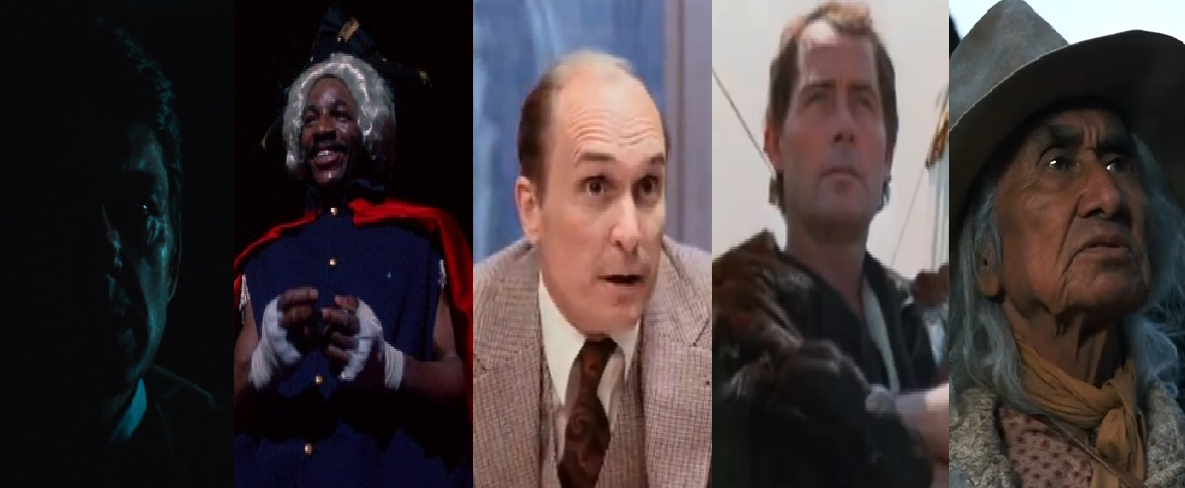
Alternate Best Supporting Actor 1976: Results

5. Robert Duvall in Network - Duvall absolutely fulfills the role of the corporate hatchet men, and smartly differs himself from his other co-stars by showing that only money and power motivate the man.

Best Scene: Firing Max.
4. Carl Weathers in Rocky - Weathers gives a very entertaining yet nuanced depiction of a champion boxer.

Best Scene: Deciding on the Italian Stallion.
3. Chief Dan George in The Outlaw Josey Wales - Dan George gives a moving, funny, and very unique depiction of the "wise Indian".

Best Scene: His first monologue.
2. Hal Holbrook in All The President's Men - Holbrook gives a brilliant performance that creates such an enigmatic and fascinating character. 

Best Scene: Deep Throat's introduction.
1. Robert Shaw in Robin and Marian - Good Prediction RatedRStar. Robert Shaw gives a great performance. He brings his usual menace that you'd expect from him, but also offers a humorous and surprisingly moving depiction of a tired man forced to relive the past.

Best Scene: The duel. 
Overall Rank:
  1. Laurence Olivier in Marathon Man
  2. Robert Shaw in Robin and Marian
  3. Hal Holbrook in All The President's Men
  4. Chief Dan George in The Outlaw Josey Wales
  5. Carl Weathers in Rocky
  6. Burgess Meredith in Rocky
  7. Robert Duvall in Network
  8. Jason Robards in All The President's Men
  9. Nicol Williamson in Robin and Marian
  10. David Warner in The Omen
  11. Roy Scheider in Marathon Man
  12. James Stewart in The Shootist
  13. Harry Dean Stanton in Missouri Breaks
  14. Jeff Goldblum in Next Stop, Greenwich Village
  15. Richard Harris in Robin and Marian
  16. Zero Mostel in The Front
  17. Donald Sutherland in The Eagle Has Landed
  18. Martin Scorsese in Taxi Driver
  19. Robert Duvall in The Eagle Has Landed
  20. Harvey Keitel in Taxi Driver
  21. Joe Spinell in Rocky 
  22. Peter Falk in Murder By Death
  23. John Vernon in The Outlaw Josey Wales 
  24. Ned Beatty in Silver Streak
  25. Peter Sellers in Murder By Death
  26. Christopher Walken in Next Stop, Greenwich Village
  27. William Devane in Marathon Man
  28. Richard Boone in The Shootist
  29. Richard Pryor in Silver Streak
  30. Marty Feldman in Silent Movie
  31. Jackie Earle Haley in The Bad News Bears
  32. James Coco in Murder By Death
  33. Donald Pleasence in The Eagle Has Landed
  34. Patrick McGoohan in Silver Streak
  35. Dom DeLuise in Silent Movie
  36. Erland Josephson in Face to Face
  37. Herbert Lom in The Pink Panther Strikes Again
  38. Vic Morrow in The Bad News Bears
  39. Alec Guinness in Murder By Death
  40. Ron Howard in The Shootist
  41. Melvyn Douglas in The Tenant
  42. Jack Warden in All The President's Men
  43. Burt Reynolds in Silent Movie
  44. Ian Holm in Robin and Marian
  45. Randy Quaid in Missouri Breaks 
  46. Tony Burton in Rocky
  47. Richard Narita in Murder By Death
  48. Ronny Cox in Bound For Glory
  49. Gunnar Bjornstrand in Face to Face
  50. Patrick Troughton in The Omen
  51. Stephen Collins in All The President's Men  
  52. James Caan in Silent Movie
  53. James Cromwell in Murder By Death
  54. William Katt in Carrie
  55. Treat Williams in The Eagle Has Landed
  56. Dick Crockett in The Pink Panthers Strikes Again
  57. Sid Caesar in Silent Movie
  58. Martin Balsam in All The President's Men
  59. Leo McKern in The Omen
  60. Paul Newman in Silent Movie
  61. Albert Brooks in Taxi Driver
  62. Harvey Spencer Stephens in The Omen
  63. Michael Murphy in The Front
  64. Will Sampson in The Outlaw Josey Wales
  65. Scatman Crothers in Silver Streak 
  66. Truman Capote in Murder By Death
  67. John Travolta in Carrie
  68. Robert Walden in All The President's Men
  69. Ned Beatty in Network
  70. Fredric Forrest in Missouri Breaks 
  71. Anthony Quayle in The Eagle Has Landed
  72. Denholm Elliot in Robin and Marian
  73. John Carradine in The Shootist 
  74. Albert Popwell in The Enforcer
  75. Peter Boyle in Taxi Driver
  76. David Niven in Murder By Death
  77. Wesley Addy in Network
  78. Burt Young in Rocky
  79. Harold Gould in Silent Movie
  80. Antonio Fargas in Next Stop Greenwich Village
  81. Clifton James in Silver Streak
  82. Thayer David in Rocky
  83. Charles Grodin in King Kong 
  84. Larry Hagman in The Eagle Has Landed
  85. Kenneth Haigh in Robin and Marian 
  86. Ed Lauter in Family Plot
  87. John Lithgow in Obsession  
  88. Arthur Burghardt in Network
  89. Sydney Lassick in Carrie
  90. Hugh O'Brian in The Shootist
  91. John McLiam in Missouri Breaks
  92. Bill McKinney in The Shootist 
  93. Bill McKinney in The Outlaw Josey Wales
  94. Harry Morgan in The Shootist 
  95. DeVeren Bookwalter in The Enforcer
Next Year: 1940 Lead

Saturday, 12 September 2015

Alternate Best Supporting Actor 1976: Robert Shaw in Robin and Marian

Robert Shaw did not receive an Oscar nomination for portraying the Sheriff of Nottingham in Robin and Marian.

Robin and Marian is an intriguing film about an aged Robin Hood (Sean Connery) attempting one last fight against King John and his men while attempting to win over Lady Marian (Audrey Hepburn) once again.

Robert Shaw once again plays the adversary of Sean Connery. Last time was in From Russia With Love as two spies both at the top of their game. Once again they're adversaries but this time as two men who are well past their primes. Shaw plays the former rival of Robin Hood The Sheriff of Nottingham, but like so many things after Robin's long return home from the crusades things are not quite how they use to be. Shaw seems perfect for the role of the villain for the film at least in how you might expect things if this were a more traditional Robin Hood film. After all Shaw may exude menace more effortlessly than any other actor. It is just an innate part of him, and Shaw utilizes this well. The Sheriff has a general menace about himself though Shaw does not make this an active part of him by any means. Shaw instead suggests the fierce some qualities of the man in part as something very much of the past. There is no question that he was once truly a menacing villain worthy to be the opponent of the Robin Hood of the songs, but the Robin Hood he faces now is not that man of songs, fortunately for Robin is that the Sheriff is not the same man either.

Shaw nicely does differentiates his work from Connery who depicts Robin as a man who is trying to gain back the glory of the past. Shaw portrays the Sheriff as a man who is far more understanding of his own reality. His opening scene is a marvelous moment for Shaw as we see the Sheriff at his castle where some men are training. Shaw depicts such a quiet though malaise as he he just looks upon the sight with the eyes of a man who has seen it again and again. The Sheriff though takes a moment to take on two of the men himself before he defeats them quite easily. In this brief instance there is just a glint off a more vibrant life in the Sheriff. Shaw manages to make all quite a somber moment though because he so naturally returns to his normal state once the brief fight is over, since it is obvious the Sheriff has no real purpose since even that fight had no real purpose. The Sheriff goes out to fulfill his duty which is to round up Marian, now the head of an Abbey, by King John's orders. Shaw shows the Sheriff proceed with this task as simple unremarkable business. Shaw depicts it with not even an hint of evil, or desire for harm, rather he presents a man just being the Sheriff since he will never be anything else.

When the Sheriff and his men come to arrest her he finds Robin there ready to save the day, even though Marian does not even desire to show any resistance in particular. Shaw's nuanced reaction in the moment where the Sheriff sees Robin is just perfect. It's not that of a man seeing an old enemy, but rather there's just a tad of nostalgic joy in the moment as though its an old acquaintance that was associated with some positive moments of the past. Shaw does not even leave this at this though as he quickly shifts it away from that as though in the moment the Sheriff realizes that it is likely Robin is going to make things difficult. Naturally this is what Robin does as he basically launches a war against King John and his men something the Sheriff unfortunately happens to be technically speaking. Shaw's terrific in the later action scenes of Robin attacking as he brings just that slight smile of remembrance to the old days, but Shaw always keeps it that Sheriff has no delusions about the past. Instead he's well aware of the mistakes of the past, and Shaw is rather hilarious in his dead pan reactions to Robin's various success as well as the failures of his own men, since he's seen it all before.

I particularly love his interactions with the unknowing and eager Sir Ranulf, as Shaw conveys such an intelligence of experience as he disregards Ranulf's confidence, as well as his incredible knowing reaction when he hears King John's ultimatum in regards to the Sheriff and Robin. This eventually leads to Robin and Sheriff finally having a showdown. Instead of having their armies go at the two settle on that the battle will be decided by champions, the champions being naturally being Robin and the Sheriff. The duel is not quite what you'd expect from a Robin Hood legend, and that's what makes it so good. It is absolutely brilliantly played by both Shaw and Connery. They wear the age wholly in their physical performances as both men clearly just do not have the grace or the ease in their sword fighting manner any more. Rather than being some sort of beautiful display of swordsmanship it illustrates the desperation in the men at this point of their lives, and you see the effort put into every swing. In addition the pain from every injury is especially vibrant due to the two actors. They each take it further though in that each man approaches it differently. Connery, though his body is fighting against him the whole way, portrays Robin Hood as still looking to the glory, and failing to see what he's fallen into. Shaw though is surprisingly moving by showing that the Sheriff has now just had enough the fantasy. He can't even call back to the past any more as Shaw depicts him as knowing the truth of the matter. Near the end of the fight when Sheriff is telling Robin to yield, it does not feel like that of a man trying to get his foe to surrender, but almost that of a friend asking his friend to finally give up his delusion. When the Sheriff falls in the battle it is rather heartbreaking since Shaw showed that the Sheriff was the one trying to bring some sense to the situation. What's outstanding about this work is that Shaw's screen time is limited yet he makes such an impact with every glimpse of his character. There is not a wasted moment as Shaw realizes such depth in the role through his great performance.

Friday, 11 September 2015

Alternate Best Supporting Actor 1976: Robert Duvall in Network

Robert Duvall did not receive an Oscar nomination for portraying Frank Hackett in Network.

Although Network received five Oscar nominations for acting Robert Duvall was left out of the supporting category with voters instead opting out for Ned Beatty's "one scene wonder" performance, leaving Duvall to be the only actor on the poster not to be nominated for that film. All things considered it does seem a bit of a random snub for Duvall. Any way Duvall plays a character who I suppose shows Network's less than subtle quality, which is that he plays a man named Hackett who's a corporate hatchet man. Not exactly trying to make the audience try to figure that out for themselves, but Network is a film that's definitely obvious in its purpose it just happens to do it so well, for the most part, that it completely works. Robert Duvall is an actor who quite efficient in finding the right tone of a performance for the film and his character as whether it requires a more gentle hand like in Tender Mercies or a more overt approach like in Apocalypse Now. Well when taking on the role of a Hatchet Man named Hackett it was probably wasn't difficult for Duvall to decide on which approach was the right one.

Duvall is terrific in being the Hatchet man in every scene. He walks into every one of the early scenes of the film with so little regard for anyone, and matches the intent of the character who intends to walk over everyone in order to meet his demands. Duvall accentuates the ruthlessness of Hackett incredibly well as he he brings such a particular bluntness to everything that he says, and there is not a delivery of his that does not have at least a tinge of viciousness of it. Duvall conveys as well the particular strategy of Hackett as he goes about attempting to take over the Network's news division from the more noble Max Schumacher (William Holden). Duvall in their initial confrontation Duvall presents Hackett as going forward with an unshakable command in himself as he basically states his intentions without any hesitations, basically sing everything will go as he expects it to while carrying just this general menace about himself that suggests a threat before Hackett has even made any. When Schumacher attempts to stop Hackett's takeover, Duvall is outstanding in unleashing the unholy fury of anger in Hackett as he goes about silencing the man through such smug assurance of his own position. 

As good as he is as being the straight forward unrelenting hatchet man he should, what I really like about Duvall's performance is that he actually shows a different type of character or man from, Howard Beale (Peter Finch), who's lost in his own insanity, Diana Christensen (Faye Dunaway) who's also insane in the way her whole life is ruled by her uncontrollable desire to conquer the world of television, to even the head of the insane head of the corporation Arthur Jensen (Beatty) whose lost in his philosophy of a corporation to rule the whole world. What I like about Duvall's work is he does not present Hackett as insane, at least not in the way the other people are, although one likely would still have to be a bit insane to devise to kill a man just because he has bad ratings. Duvall though does not portray Hackett as any sort of fanatic, which can be seen in the portrayals by Beale, Jensen, and Christensen. Duvall's good in infusing a more realistic bent for Hackett as he's only really motivated by money, and the power of a potential power. He has no actual beliefs, and Duvall portrays Hackett's ambition as far more to the point. This leads to rather effective scenes near the end of the film when threats to his success come in the form of an ever changing Beale. Duvall's very good by giving a humanity to Hackett, by showing just how genuinely worried and troubled he is by seeing his position threatened. Duvall does not present any presumptions in Hackett, his mind is always in the present, and when he decides on the final death Duvall shows Hackett just as swift to the judgment as Diana, but there is just something far more honest in the way he comes to the point. Duvall shows that Hackett feels that he has to, but Dunaway keeps it within Diana's out of reality tunnel vision (this is not a criticism of Dunaway's work in anyway by the way). Duvall gives a very strong performance here. His role actually is a bit thankless. He has a bit less screen time, and in a way his character is kinda inserted around the other who tend to get the "bigger" moment in any given scene. Duvall though still ensures an impact by making the most of what he does have, fulfilling his role as the representation of corporate heartlessness as well as offering an interesting dynamic by effectively realizing the exact nature of this heartlessness.

Wednesday, 9 September 2015

Alternate Best Supporting Actor 1976: Marty Feldman in Silent Movie

Marty Feldman did not receive an Oscar nomination for portraying Marty Eggs in Silent Movie.

Silent Movie is an enjoyable enough Mel Brooks gag fest filtered down even more than usual through that the film is indeed completely silent, well almost completely.

The film itself tells the simple story of a filmmaker Mel Funn (Brooks) and his two cohorts Dom (Dom DeLuise) and Marty Eggs. I suppose it is fitting that they share the same first names as the characters are not developed past the performer personalities of the actors, though I would say this is entirely purposeful. It basically is a chance for the three of them to test out their skills as a silent performer. Feldman perhaps is a bit tailored made for all show no speaking thanks to his well rather unorthodox appearance. I suppose Feldman does not seem like he needs to do anything more to stand out, but to his credit Feldman ensures that he does just a bit more as he is most expressive as a good silent comic performer should be. That grin of his alone of his is worth a few laughs all in itself, as he certainly is a fit for the concept of the film. If he's on screen Feldman does brighten in some way or another, even just the way he's sitting in a car between Dom and Mel comes off as rather funny for some reason.

The majority of the film is made up of various physical hi-jinks involving the boys either trying to get a Hollywood star to appear in the film, or simply avoid the dark corporate forces who want to see their film fail at any cost. Feldman is quit skilled at this and fits right into any given scene with his wild energy of sorts that he makes feel particularly natural, and not overdone in the least. Whether it is dealing with competing dogs who look the same, or tearing up the dance floor with Anne Bancroft Feldman throws himself into a scene rather head first. Now Feldman gets a bit more character, just a bit more, in that throughout the film he attempts to come on to women in the creepiest ways possible, even once announcing himself as a pervert as his line, in a title card though. Feldman is rather hilarious in every one of these quick side shows as he his lusty creep face is consistently entertaining. Now I suppose there's not much more than what he also brings just in the scenes where he's not necessarily the focus. Again Feldman's expressiveness brings a lot to the proceedings as his reactions say more than enough. Now even for a comedy of this sort this is a rather limited role, but Feldman is the best performer in the film. As he really knows how to work without sound. I won't say he's Buster Keaton, Laurel and Hardy, or Charlie Chaplin in this regard, but I will say this is a fun performance.

Tuesday, 8 September 2015

Alternate Best Supporting Actor 1976: Carl Weathers in Rocky

Carl Weathers did not receive an Oscar nomination for portraying Apollo Creed in Rocky.

Carl Weathers as Apollo Creed was actually the only mainstay of the Rocky series, with a large role, that was not nominated for the 1976 Academy Awards. That's unfortunate as this also extends to the character of Apollo is not frequently mentioned in terms of the strength of the original film. Not that he's in any way a criticized element, but rarely is given the credit it should be in terms of the writing and the performance. Since the film is about Rocky (Sylvester Stallone), and his struggle it would have been easy enough to deal with his eventual opponent, The World Heavyweight Champion, as either a non-entity entirely or perhaps an overdone villain. Apollo is neither of those things and through his few scenes throughout the film we get an rather interesting character. His first appearance is for show as we see him on TV handling an interview. Weathers is excellent in his development of Creed's mannerisms in this scene as he takes on Muhammad Ali's style mannerisms of almost dancing when speaking, yet Weathers alters them enough to make them his own in making Apollo not just an imitation.

The next time we see Apollo though it is in a more private setting as he tries to come up with a new fighter for his bi-centennial fight, after his previous opponent must recover from an injury. Weathers is terrific because he does not just present Apollo as he was in the interview, instead he shows frankly a very different man. The mannerisms are still there but only to a far more muted, frankly a far more natural degree. Weathers presents Apollo as much more of a business man in the scene as he discusses the raw facts of what they need to do for the fight. That's not all though and Weathers is brilliant in portraying Apollo as he is basically his own promoter as he comes up with the idea for the fight, which is to get a local nobody a chance at the World Championship belt. There is a special glint in his eyes, and Weathers is marvelous in giving the idea such light as he develops it in his head before pitching it to the rest of the men. In his eyes Weathers conveys so well basically the dollar signs in Apollo's eyes as he states he details of the ideas and even more so when he finds the perfect fighter, none other than the Italian Stallion, Rocky Balboa.

Weathers also technically helps in giving more sense to why Rocky stands a chance, who in this film is not a great fighter. As Weathers shows that there is never the fight on his mind except just a few brief reassurances to his trainer, where Weathers exudes such confidence in his wave away of any potential challenge showing that it is obvious to Apollo that Rocky is not worth a second thought. Most of the time though it is all about the returns of the fight. This eventually leads to the fight itself which Weathers portrays the true showman in Apollo particularly in his over the top entrance. Weathers is extremely entertaining in portraying just the whole pomp of Apollo as his act is clearly trying to get the most of the crowd. The whole put on is absurd and purposefully so as Weathers makes it the true performance it should be with the mannerisms more overt than ever before since the whole crowd needs to see them. His whole physical of portrayal of the fight is worthy of mention as he actually makes a bit of an arc within it. In the opening he continues the act as Weathers continues to be properly over the top as even his punches are done as rather ridiculous and only for the show. Eventually though Rocky shows that he's in for the fight, and Weathers properly adjusts his performance to an actual match. As it continues though Weathers is great in depicting an ever growing intensity, as well his own physical pain, as he finally takes the fight seriously. Weathers gives a strong performance here by finding the depth to Apollo past simply Rocky's opponent. He's far more than that as Weathers develops, in just a few scenes, the whole way this true prizefighter operates, as a businessman, as a promoter, an entertainer, and when he needs to be a fighter.

Saturday, 5 September 2015

Alternate Best Supporting Actor 1976: Hal Holbrook in All The President's Men

Hal Holbrook did not receive an Oscar nomination for portraying "deep throat" in All The President's Men.

A funny thing about Hal Holbrook's casting is that its an actual clue to the real life mystery, at the time of the film's release, of who exactly Deep Throat really was. Deep Throat being Bob Woodward's (played by Robert Redford in the film) secretive source who held some high position within the U.S. government and was privy to much of the top secret information related to Watergate. Hal Holbrook was the only choice for the role as chosen by the real Bob Woodward, and Holbrook happens just to look a bit like the man who eventually was claimed to be the real Deep Throat, Mark Felt. Well his resemblance probably should be put aside though, since though it was meaningful to reality it was meaningless to the film other than it allowed for Holbrook to give the performance that he does give. Holbrook's introduction is originally through voice only, which is a short moment since all he does is avoid commenting on Watergate, instead he sets up a secret meeting with Woodward through a complex and secretive process that eventually leads Woodward to a parking garage.

Although his initial vocal appearance was unceremonious, Holbrook's first physical appearance is one of the most memorable images of the film as a figure drenched in shadow with only a cigarette to grant him light. Even as Woodward grows close the man only known as Deep Throat still stays mostly obscured by the darkness. Deep Throat is such a striking image with the most visible part of the man being Holbrook's piercing eyes looking directly at Woodward. Holbrook does not waste this introduction as his performance seems to fit right into his surroundings. Holbrook's voice is cold as engages Woodward on what information he exactly wants. There is a harshness about his delivery though within that though within it there seems to be the truth. The whole demeanor Holbrook gives Deep Throat is brilliant created by him. There is a considerable intelligence that he exudes as Woodward tells him what he knows, and in his reaction Holbrook suggests so eloquently that he knows so much more than what he is being told yet. In that there is a slight smile in his face as he tells Woodward essentially the White House is not as smart as they are made out to be, and in that certain understated venom as he describes this Holbrook alludes to perhaps a personal vendetta in Deep Throat which may be his motivation for helping Woodward.

What's so fascinating about Holbrook's work is that he never loses any of the character's mystery while still giving a uniquely emotional details within the man. One instance of this is when Deep Throat goes into detail of a disturbing story on Gordon Liddy, one of the men involved with Watergate in someway. Holbrook is outstanding as he conveys almost a fear as he describes his story which involves Liddy purposefully burning his own hand, as for that moment Deep Throat is trying to convey to Woodward as well perhaps himself, the potential danger in the men they are dealing with. Holbrook's second appearance actually does not come until over an hour later, although you certainly have not forgotten his existence. This is one of those performances that is just so captivating to watch as Holbrook takes on this enigmatic style so flawlessly. Honestly the ever so slight form of flamboyancy around the character could have easily faltered quite poorly, but Holbrook executes it so perfectly that it never does. Holbrook is terrific in his second appearance as gives Deep Throat even more of edge as he there is a certain viciousness in his words and in the intensity in Holbrook almost as though he is antagonizing Woodward in order to motivate him to find the exact truth. Holbrook's final appearance comes near the  end of the film after it seems Woodward and Bernstein have made a mistake. Halbrook is once again outstanding, and even though this particular appearance is rather brief, it not way diminishes the considerable impact of the moment. In an instance Halbrook creates such an overwhelming sense of paranoia as he no longer that cold assurance about him, and conveys are more apparent fear as he warns Woodward that their lives may be in danger. Once again Holbrook adds so much to the film within almost not time at all helping to realize three of the best scenes in this great film. All three of his scenes are masterfully portrayed by Holbrook as he, almost serves the role of Deep Throat, by providing us enough to pull us in and make the story all the more compelling while never losing the mystique that makes him such a fascinating figure, and this such a fascinating performance. 

Wednesday, 2 September 2015

Alternate Best Supporting Actor 1976: Chief Dan George in The Outlaw Josey Wales

Chief Dan George did not receive an Oscar nomination for portraying Lone Watie in The Outlaw Josey Wales.

Chief Dan George received his only Oscar nomination for portraying a comically inclined though straightforward Native American chief in Little Big Man. His role in The Outlaw Josey Wales is a bit even less traditional as seen in George's first appearance which comes after the titular Outlaw (Clint Eastwood) is well on the run, and has just lost his young sidekick and runs into Chief Dan George as Cherokee in rather unusual dress considering that he is topped with a stovepipe hat, and wearing a suit both which are purposefully imitating Abraham Lincoln's attire. At first George manages to be so enjoyably pathetic in his portrayal of Lone's attempt to corner Wales himself, particularly his surprise when he sees that Josey has quickly gotten the best of him. George ends up being quite moving though in just a matter of seconds as his face falls into a certain defeat. It's a particularly sad defeat though in that there is such a strong resignation that George suggests that it is not just a man being mad he was caught of guard, or even scared that he might be killed,rather it is the fact that is just is yet another time in which a white man has sneaked up on him.

After Josey indicates that basically he's not going to kill the old man Lone continues to tell his personal story as a Cherokee which has mostly involved one defeat after another over the years. George is incredible in Lone's little monologue as he never leaves it on a single note. George actually begins as though the whole thing is one big joke over the years as he describes being kicked from one place to another. When he refers to the death of his family from the trail of tears though there is a brief though palatable sorrow and hatred in his voice just for that moment. He continues on his life of misfortune and tells Josey of how it was that he found himself clothed in the way he was, which was basically for a show for the government. George brings just a quiet exasperation as he tells the odd story of the patronizing secretary of the interior, though he throws in just a bit of sarcastic show of pride when reciting the words of the man towards Lone, and his fellow natives who had come to Washington. Then there seems just a hint of actual perseverance and determination as he informs Josey that he chose to wage war on the Union due to the meeting, only to artfully end on one more comic note in his reaction as he sees Josey has fallen asleep from his story.

That's simply George's introductory scene, but it sets well what he'll bring to the film with his presence. That monologue could have been just a simple depressing story, but it's fantastic just how much character George gives just through that one monologue. He's great in his very next scene as he shows such an attempt at an honest pride when he's believed he's snuck up on Josey, unfortunately for him someone else sneaks up on him, and George's "aw shucks" reaction is just hilarious. Thankfully for the film Lone decides to go along with Josey on his adventure to escape to Mexico, and becomes his sidekick for the trip. George is great in every scene in which he appears as Wales's sidekick as well as almost his promoter of sorts. George is wonderful the way he enliven every scene just in his appearance as interacts so astutely with Eastwood's performance. In one way being the far more eager fellow than the technically rather somber Wales, and George is terrific the way he shows that old Lone Watie gets such a thrill out of Josey apply his trade so to speak. I particularly love one sequence in which he basically narrates Josey's preparation in front of a group of thugs, and George brings so much humor, astonishment and even some intensity as Lone calls out Josey's moves.

Although George is marvelous at being a secondary hero for the film, George does not leave it there and creates a very interesting character of Lone Waite past simply being a fun fellow adventurer, although he certainly is that. George's is quite fascinating in the way once he goes on the adventure with Wales he seems to find himself as as a proper Cherokee again. What's so splendid is the way George does not do the more typical Indian cliches of mysteriously knowing the way of the land in the way what animals mean or how to properly track someone. George takes the mystery out of it, but in a memorable way. George plays it as a given that a native American should be able to do all these things, but he says it in such a delightful down to earth fashion as though he's aware of any legends treating them simply as a fact that he needs to live up to. George is very endearing as he shows this as the way Lone is once again accepting who he should be, and tries to live up to his causes of old. The way George slowly renews the confidence of the old man is brilliantly done. The film does not specifically stop for him, after all he is not even the central character, and the film is one almost in constant movement, but George manages to naturally as well powerfully transition his character from basically a worn out old husk of a man, to once again a life filled warrior. This is a great performance by Chief Dan George as he makes so much out of the role that in lesser hand could have been maybe just too goofy, or simply too sad. George manages to balance both out flawlessly giving both a very funny and rather moving portrait of this Cherokee who endeavors to persevere.