Showing posts with label Dean Stockwell. Show all posts

Friday, 18 April 2025

Alternate Best Supporting Actor 1986: Results

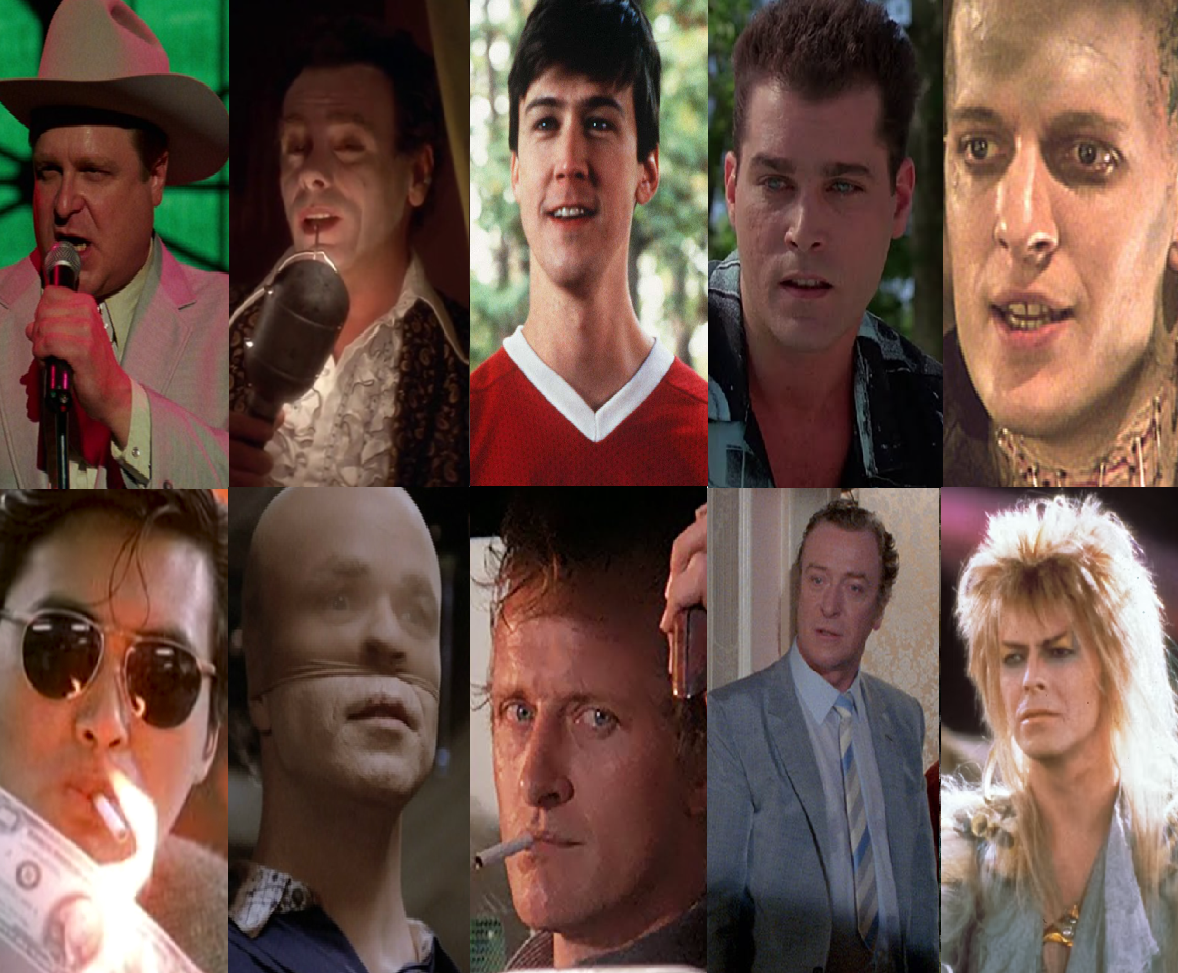
10. David Bowie in Labyrinth - Bowie delivers a perfectly serviceable performance which coasts heavily on his presence, a little too heavily as he's strangely just sort of there much of the time. Playing very much with a lack seriousness without being funny, a lack of menace without being fun and even is musical performances don't really have that much flair to them despite his costuming. 

Best Scene: Dance magic dance.  
9. Rutger Hauer in The Hitcher - Hauer is effective at being menacing in his charismatic way even if it asks far too little of him. 

Best Scene: Opening. 
8. Clancy Brown in Highlander - Brown basically gives two performances, one as a brute, one more so as a crazed villain. He's good at both even if there is a lack of cohesion. 

Best Scene: Church
7. Chow Yun-Fat in A Better Tomorrow - Chow is charismatic and brings the only real emotional impact within the overall scheme of his film. It's only a shame he's not the lead. 

Best Scene: Shoot out. 
6. Michael Caine in Mona Lisa - Caine gives a properly menacing and sleazy performance. 

Best Scene: Final confrontation. 
5. Tom Noonan in Manhunter - Noonan gives a quietly creepy performance that gets under your skin by his calm. 

Best Scene: Do you see?
4. Ray Liotta in Something Wild - Liotta takes over is film with ease giving a charismatic but properly threatening performance of a man going out of control in pursuit of his wife. 

Best Scene: Home invasion. 
3. Dean Stockwell in Blue Velvet - Stockwell gives a brilliantly idiosyncratic work that is so wonderfully one of a kind in its Lynchian goodness. 

Best Scene: His scene. 
2. John Goodman in True Stories - Goodman delivers the most compelling vignettes consistently in is first funny though later moving portrayal of a man searching for love. 

Best Scene: "People like us" first try. 
1. Alan Ruck in Ferris Bueller's Day Off - Good predictions Luke, A, Tahmeed, 8000's Ytrewq, Lucas, Harris & Bryan. Though within overall a light comedy Ruck gives a genuinely emotionally nuanced and in the end quite powerful portrayal of an depressed teenager finding is strength. 

Best Scene: Killing the car. 

Next: 2017 Lead

Sunday, 9 March 2025

Alternate Best Supporting Actor 1986: Dean Stockwell in Blue Velvet

Dean Stockwell did not receive an Oscar nomination for portraying Ben in Blue Velvet. 

Dean Stockwell falls into a specific subset of Lynchian performances where an actor is tasked for brief screen time or a brief scene to make a substantial impact, and Stockwell is game for the part. Stockwell appears during the long night sequence where our hero Jeffrey (Kyle MacLachlan) is brought along for a ride by the psychotic Frank Booth (Dennis Hopper) with his gang and the lounge singer Dorothy (Isabella Rossellini). The latter whom Frank is controlling due to holding her husband and child as hostages. The group arrives at Ben’s, which appears to be a brothel of a strange kid that Ben runs. Stockwell doesn’t have much screen time to work with so he doesn’t waste much time in instantly establishing a unique presence to the film and Stockwell. As we see Ben who perpetually wears a robe, carries his cigarette holder and most bizarrely his face is caked with white powder makeup for reasons unknown. Stockwell amplifies the elements with his completely atypical to his typical presence in almost every facet. Stockwell is extremely affected here, though in the best possible way in his way of almost always casually crossing his arms in an overly relaxed yet oddly specific fashion, along with his casual movement throughout the scene where Stockwell makes Ben a strange lord over his very particular domain. Such a manner perhaps living up to Frank’s description of Ben as “suave”, which Stockwell is suave though suave in a way that Frank would find suave, given Ben seems to be the one person that Frank respects in any way throughout the entire film. The specificity of Stockwell’s performance doesn’t end there with his extremely satisfied expression as he glides about his place, and an expression that seems to indicate a state of normalcy where the world of Ben and Frank seems anything but. Stockwell’s vocal performance amplifies this all the more with his extremely gradual way of speaking all his lines with a considerable calm wrapped into every word. Stockwell’s voice would be more suitable for an affected art dealer in some ways yet here as the brothel running drug dealer there is a particularly fascinating quality to his strangeness. Particularly as the scene develops where he receives praise from Frank, which Stockwell’s reactions are both hilarious and off-putting in the very modest acceptance of such coarse yet adoring descriptions. Keeping that manner in mind even as Frank verbally and physically berates Jeffrey for daring not to toast to Ben, something Ben briefly joins in with by punching him as well, though so perfectly weird as Stockwell keeps Ben as calm as ever even in the act of violence. We even get a particularly bizarre moment where Ben even feeds Frank some drugs, where Stockwell is glowing in the moment and the two look more like a pet and a master. All of this oddity would be wonderful where Stockwell crafts such a idiosyncratic creature in Ben that is fascinating to behold, but what takes the performance the next step towards absolute brilliance is when he chooses to serenade everyone with Roy Orbison’s “In Dreams” using the original track and a work light. Stockwell truly makes lip syncing an art form where he is captivating where he might as well be singing the song with how hard it is not to fix upon every single moment of Stockwell’s performance of Ben’s performance. Stockwell takes this idea further in his motions specifically towards Frank where Stockwell’s performance brings this kind of pestering if not controlling motions seemingly to mess with Frank a bit the lyrics clearly mean more to Frank than even people who love the song. My favorite moment from his performance is actually the moment that suggests all of this might be some kind of facade of Ben’s when Frank’s reactions to the song start to become violent. Stockwell’s “Oh shit” expression is perfect as though Ben suddenly realizes the danger of messing with Frank too much and is genuinely concerned, before the music stops and Stockwell returns to Ben’s old manner however now keeping to himself away from Frank. A great moment because Stockwell through the reaction suddenly opens more about Ben’s relationship with Frank and lets us in a bit behind the curtain albeit for a moment. A moment within a scene, and what a scene it is, with Stockwell being an essential facet through his singular creation of Ben that once you’ve seen his work here, you simply don’t forget it. 

Sunday, 2 March 2025

Alternate Best Supporting Actor 1986

And the Nominees Were Not:

John Goodman in True Stories

Dean Stockwell in Blue Velvet

Alan Ruck in Ferris Bueller's Day Off

Ray Liotta in Something Wild

Clancy Brown in Highlander

Chow Yun-Fat in A Better Tomorrow

Tom Noonan in Manhunter

Rutger Hauer in The Hitcher

Michael Caine in Mona Lisa

David Bowie in Labyrinth

Monday, 3 August 2015

Alternate Best Actor 1959: Results

5. Jean-Pierre Léaud in The 400 Blows - Léaud gives an honest depiction of the manner and behavior of a troubled young boy.

Best Scene: Antoine at the psychologist.
4. Alec Guinness in The Scapegoat - Although the film itself under utilizes its own concept Guinness gives a compelling portrayal of two men.

Best Scene: The two's meeting at the end. 
3. Dean Stockwell in Compulsion - Stockwell gives an effective depiction of the various sides of his "superior" killer from the pompous intellectual to the scared psychopath.

Best Scene: The first interrogation.
2. Tatsuya Nakadai in The Human Condition I: No Greater Love - Nakadai gives a great portrayal of one man horrible journey in discovering what it truly means to be human.

Best Scene: The Executions.
1. Cary Grant in North By Northwest - Good Prediction Maciej, Robert MacFarlane, and GM Grant perhaps  the very best wrong man performance through his exceedingly entertaining work in the film.

Best Scene: Thornhill at the auction.
Overall Rank:
  1. James Stewart in Anatomy of a Murder
  2. Cary Grant in North By Northwest
  3. Tatsuya Nakadai in The Human Condition I: No Greater Love
  4. Laurence Harvey in Room At the Top
  5. Tatsuya Nakadai in The Human Condition II: Road to Eternity
  6. Albert Sharpe in Darby O'Gill and the Little People
  7. Dean Stockwell in Compulsion
  8. Alec Guinness in The Scapegoat
  9. Alec Guinness in Our Man in Havana
  10. James Mason in Journey To the Center of the Earth
  11. Eiji Okada in Hiroshima Mon Amour
  12. Anthony Franciosa in Career
  13. Bradford Dillman in Compulsion
  14. Kirk Douglas in The Devil's Disciple
  15. Jean-Pierre Léaud in The 400 Blows
  16. John Wayne in Rio Bravo
  17. Charlton Heston in Ben-Hur 
  18. Burt Lancaster in The Devil's Disciple
  19. Rock Hudson in Pillow Talk
  20. Cary Grant in Operation Petticoat
  21. Richard Widmark in Warlock
  22. Peter Cushing in The Hound of the Baskervilles
  23. Paul Newman in The Young Philadelphians
  24. Jack Lemmon in Some Like It Hot 
  25. Henry Fonda in Warlock
  26. Tony Curtis in Some Like It Hot
  27. Tony Curtis in Operation Petticoat
  28. Ian Carmichael in I'm Alright Jack
  29. Paul Muni in The Last Angry Man
  30. David Wayne in The Last Angry Man
  31. Richard Burton in Look Back in Anger 
  32. Robert Lansing in 4-D Man
  33. Gregory Walcott in Plan 9 From Outer Space 
  34. James Congdon in 4-D Man
Next Year: 1959 Supporting

Wednesday, 22 July 2015

Alternate Best Actor 1959: Dean Stockwell in Compulsion

Dean Stockwell did not receive an Oscar nomination, despite winning Cannes, for portraying Judd Steiner in Compulsion.

Compulsion is a somewhat compelling film, although certainly brought down by a romantic sub-plot featuring the two worst performances in the film, that tells a fictionalized version of Leopold and Loeb's murder trial.

Leopold and Loeb had previously been fictionalized in film through the 1948 Alfred Hitchcock film Rope. That film took place all in one room and attempted to tell the story of the two men through the setup of a thriller. Compulsion is far more reaching in its version covering the story closer to the actual facts as well as going into the aftermath of the murder, rather than merely depicting the time between the murder and then where they were caught. Both films start in a very similair fashion in that both begin when the murder has just occurred, although in this version instead of killing a classmate they murder a child which was factual to the real case. In both though it focuses in from there onto the relationship of the two young men who decided to commit the murder because they believed themselves superior, and decided that they were basically entitled to a murder since they were supermen who were above the law. This leads them to commit the murder which they believe will be a perfect one which they will get away with since they've worked out every detail it seems.

Dean Stockwell is an actor with a rather odd career to recount as he started as a cutesy child actor in many high profile films, then successfully bridges over the gap into adulthood with a few prominent leading turns. Stockwell's brief stint as a leading man in high profile films seemed strange but likely it was caused by him apparently getting into the hippie counterculture, since after his gap in his filmography his leading turns came in the form of a rather different sort of films although he certainly found success as a character actor. Repulsion stands as one of his most notable leading performances from that brief period as he plays one of the young murderers. Stockwell plays Judd, much like with Farley Granger in Rope, Judd is the submissive of the two men. Farley Granger played this as meekly as possible, but Stockwell is far more interesting in his approach as seen in the opening sequence. Stockwell does not depict it as an overarching quality rather something more specifically attached to their crime. When Judd states his acceptance of this position Stockwell conveys why as he seems to suggest a certain almost sexual thrill in Judd over the prospect.

The other young man is Artie Strauss played by Bradford Dillman takes a similair approach, although I would done in a far more effective manner, as John Dall in Rope as they both present their man is particularly remorseless, but really he'd have to be if he goes about taunting fate by even trying to help in the investigation personally. With Judd is a bit less exact in his behavior. In more official settings such as in the classroom, or in a discussion with other students Stockwell portrays Judd in being very close to Artie in terms of personality. Stockwell is quite good in expressing the sheer pompousness of this pervasive attitude in Judd as he reveals his philosophy about the right of a superior man. Stockwell does not hide just how unlikable the whole idea is, or how unlikable Judd is when he is talking about, but what he does show is the strong conviction in Judd when he speaks these words. There is an affirmative belief and absolute conviction that Stockwell gives every word, the sort of conviction that would be needed to take the philosophy to the next step which would be to actually commit murder to put the philosophy into action.

Judd though does not bring this same conviction though when he is outside an academic setting, and in the real world. Stockwell does well to provide an awkwardness to Judd as he basically has to be a normal person trying to interact with others without his philosophy to hide behind, or with Artie to interact with. There is far less certainty to the man, and Stockwell effectively conveys the weaknesses within him. When a situation causes Judd to reveal some violent and psychotic tendencies Stockwell does not portray it as coming from the super man of his philosophy, but rather just a deranged and pathetic individual. Judd's believability as a "superman" becomes even more into question once it is discovered that they left a pair of glasses at the scene of the crime. Stockwell is terrific as he reveals far less than a master criminal in the scenes where the two men begin to hear about the evidence that suggests they'll likely become suspects sooner rather than later. Stockwell delivers in finding the sort of visceral gut reactions in these scenes fitting for someone whose going back through his mind, and realized they've made a terrible mistake.

Their "perfect" murder comes crashing down in front of their faces as Judd is soon brought in for questioning due to his glasses. Stockwell is great in these scenes because he shows Judd attempting to be the superior being again as he goes face to face with the district attorney. Now outside of just stating his own personal theories Stockwell brings a considerable desperation in the act as it is obvious Judd is not nearly as confident about the matter as he claims to be. This makes it wholly naturally when he quickly breaks down into an emotional mess when it is revealed they know it is his glasses, and later when Artie quickly confesses to the crime after they are both formally brought in. The two fall apart to reveal far less than they every pretended to be and Stockwell is excellent in realizing Judd as the mess he truly is. Stockwell and Dillman take a back seat in the last act of the film once they two men are brought to trial as the film more closely follows on the actions of their defense attorney named Jonathan Wilk clearly based on Clarence Darrow and played by Orson Welles. Stockwell still delivers in the few moments that he has but his impact is diminished. This really does not matter much though as the proceeding scenes allowed him create compelling portrayal of the rather unique derangement of this young man.

Tuesday, 21 July 2015

Alternate Best Actor 1959

And the Nominees Were Not:

Tatsuya Nakadai in The Human Condition I: No Greater Love

Jean-Pierre Léaud in The 400 Blows

Cary Grant in North By Northwest

Alec Guinness in The Scapegoat

Dean Stockwell in Compulsion

And for Some Reason:
Anthony Franciosa in Career

Tuesday, 15 November 2011

Best Supporting Actor 1988: Results

5. Dean Stockwell in Married to The Mob- Stockwell plays his part as he should be but it never amounts to anything that special. I think I was actually more impressed by his single scene performance in Tucker as Howard Hughes.
4. Martin Landau in Tucker: The Man and His Dream- Although he has a rather limited part Landau makes the most out of his performance.
3. River Phoenix in Running on Empty- Phoenix gives an appropriately quiet and effective lead performance.
2. Alec Guinness in Little Dorrit- As usual with Guinness, Guinness naturally gives a layered and effective performance. Guinness easily shows the various facets of his character as well as makes his progression that seems unnatural natural.
1. Kevin Kline in A Fish Called Wanda- Kline gives an extremely enjoyable and entertaining performance. Although broad comedy can easily be done wrong Kline never gets it wrong for a moment in his hilarious performance.
Deserving Performances:
Michael Palin in A Fish Called Wanda
Alan Rickman in Die Hard

Thursday, 10 November 2011

Best Supporting Actor 1988: Dean Stockwell in Married to The Mob

Dean Stockwell received his only Oscar nomination so far for portraying Tony "The Tiger" Russo in Married to The Mob.

Married to The Mob is comedy about a mob wife (Michelle Pfeiffer) who wants out of the life after her hitman husband is killed, but is still followed by the FBI and lusted after by a mob boss.

Dean Stockwell plays the mob boss who is chasing after Pfeiffer's character as well as the person the FBI wants to put away. Stockwell plays his part basically straight as the mob boss. He is basically serious throughout the film, and just goes about through the plot in this way. Although he could have easily overacted a whole lot in his part especially with the name Tony The Tiger, but Stockwell just keeps it toned down in the part.

Although what he does works out just fine there really is nothing too special about his performance either. He just plays the part straight which was the better way to play it, particularly at the end of the film where he could have gone way over the top, but Stockwell stays appropriately realistic without being too realistic to be out of place in the film either. Stockwell keeps Tony just in the right tone throughout.

The only problem is he just mainly required to look like a mob boss walk around talk like a mob boss except at the end of the film where he needs to act rather scared. Stockwell handles all of these very small variations of Tony as well as possible really, but it never amounts to that interesting of a character. Although he is a better aspect if not the best aspect of the film in this film that is not saying that much.

Wednesday, 9 November 2011

Best Supporting Actor 1988

And the Nominees Were:

Alec Guinness in Little Dorrit

River Phoenix in Running on Empty

Kevin Kline in A Fish Called Wanda

Martin Landau in Tucker: The Man and His Dream

Dean Stockwell in Married to the Mob